Introduction
Cough is an extremely common symptom in patients presenting to the out-patient department. When the cough reflex is abnormally sensitised it can present as paroxysms. Common causes of chronic cough are allergy, asthma, viral or bacterial infections of the respiratory tract, gastroesophageal reflux disease, cigarette smoking and patients receiving angiotensin converting enzyme inhibitors.Reference Davis, Kumar and Clark1 Less common causes are endobronchial lesions, interstitial lung diseases, chronic infections like tuberculosis, chronic aspiration, neck masses and psychogenic causes. Cervical lymphadenopathy, the commonest cause for swelling in the neck may also precipitate cough in children. Congenital lesions such as branchial cleft cyst, thyroglossal duct cyst, vascular malformations and, rarely, benign lesions such as thyroid swelling, soft tissue tumour and neck abscess can present as paroxysms of cough due to vagal, laryngeal or tracheal irritation. We report a case of internal jugular vein ectasia causing paroxysmal cough that was successfully treated by surgery.
Case report
A 15-year-old female was referred to the ENT out-patient department of our hospital with complaints of continuous paroxysmal cough of three months duration. The mother also reported that the child had coughed during sleep since last one month, with episodes of spitting blood stained saliva following severe paroxysms of cough. Incidentally the mother had noticed that the child had a neck swelling since birth, which increased during straining.
The intervening periods when she was not coughing were so brief that even examination of the patient was difficult. Examination of her ear, nose and throat was normal. There was a soft compressible swelling on the right side of the neck, anterior to the sternomastoid muscle, which became more prominent on performing a Valsalva's manoeuvre. It was non-pulsatile and silent on auscultation. Systemic examination was unremarkable. A plain radiograph of the neck was taken with the patient performing a Valsalva manoeuvre. Absence of an air-filled sac in the X-ray ruled out the possibility of a laryngocoele. There was also no soft tissue mass in the X-ray of the neck accounting for the swelling on straining. Routine evaluation of blood counts and her chest X-ray were normal. The department of respiratory medicine also evaluated the patient. A pulmonary function test could not be performed due to severe paroxysms of the cough.
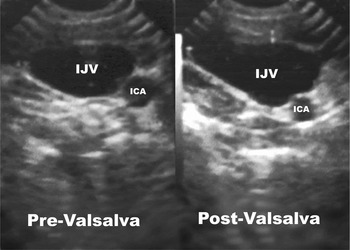
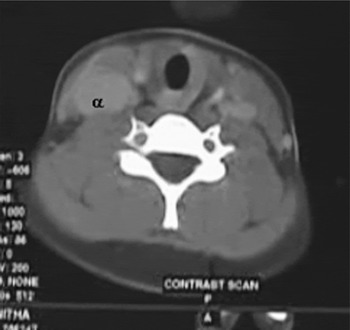
An ultrasound scan of the neck at this stage showed a thin walled, compressible, cystic lesion of 4.86×3.21×2.11 cm in the right anterior triangle, which was more obvious on Valsalva's manoeuvre (Figure 1). A computed tomography (CT) scan of the neck and thorax was done which showed asymmetry of the two internal jugular veins. A CT scan while performing a Valsalva manoeuvre showed the right internal jugular vein to be enlarged to twice its size compared to the left and compared to the resting phase (Figure 2). A Doppler study of the neck vessels showed ectasia of the lower third of the right internal jugular vein, measuring 5.1×1.5×3.4 cm, but without turbulent flow.
Ultrasonographic scan, axial section showing right internal jugular vein before (left) and after (right) the Valsalva manoeuvre.

CT scan, axial section showing prominent ectatic right internal jugular vein (α) while performing the Valsalva manoeuvre.

As an ectatic internal jugular vein had never been implicated in the past as a cause of paroxysmal cough and as no other cause could be found, the patient and her parents were subjected to psychological evaluation and counselling. This also was not contributory and therefore her parents were informed that the ectatic internal jugular vein was the only abnormality detected in their child and there was a probable need for surgical intervention. She was taken up for right internal jugular vein ligation with an informed consent, after giving a guarded prognosis.
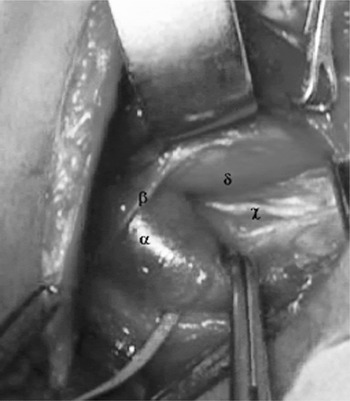
A preliminary laryngobronchoscopy done under anaesthesia showed no lesion in the airway. A pressure probe placed over the left internal jugular vein recorded a jugular pressure of 11 cm of water. Through two transverse neck crease incisions the right internal jugular vein was dissected. It was found to be grossly dilated compared to the left (Figure 3). The ansa cervicalis and its branches were found stretched across the dilated vein. A vascular loop was passed around the vein to occlude the flow. This caused a momentary rise in venous pressure of the left internal jugular vein to 13 cm, which soon returned to the initial level. The right internal jugular vein was ligated and excised from the jugular foramen to the root of the neck.
Intra-operative photograph showing the grossly dilated right internal jugular vein (α), ansa cervicalis (β), vagus (χ) and carotid artery (δ).

Post-operatively there was immediate cessation of her cough. The excised vein was unremarkable on histopathological study. The patient was followed up for two years without any recurrence of symptoms.
Discussion
Internal jugular vein ectasia is a rare venous anomaly that presents as a fusiform lower neck swelling. It increases in size on straining.Reference Indudharan, Quah and Shuaib2 The vein is abnormally dilated without tortuosity. It has also been called phlebectasia, venous aneurysm, venous cyst and aneurysmal varix.Reference Indudharan, Quah and Shuaib2,Reference Paleri and Gopalakrishnan3 It has been commonly described in the internal jugular vein, with sporadic reports in the anterior and external jugular vein, jugular bulb and posterior facial vein.Reference Paleri and Gopalakrishnan3–Reference al-Dousary5 The right internal jugular vein is more commonly affected as in our case.Reference Erdem, Erdem and Camuzcuoglu4,Reference al-Dousary5 Usually it presents as an asymptomatic, soft, compressible neck swelling which increases in size with Valsalva's manoeuvre.Reference Indudharan, Quah and Shuaib2–Reference al-Dousary5 Other described symptoms include change in voice and venous hum due to turbulent flow.Reference al-Dousary5 Cough has never been described as a result of this entity in the literature before. In our patient we believe that the pressure effect of the dilated vein on the underlying vagus nerve was the cause for her cough. The most important differential diagnosis for an ectatic internal jugular vein is laryngocoele, laryngeal diverticulumReference Indudharan, Quah and Shuaib2,Reference Erdem, Erdem and Camuzcuoglu4 and probably a pharyngocoele. Absence of an air-filled sac in the X-ray of the soft tissues of the neck while the patient was performing the Valsalva manoeuvre ruled out the possibility of a laryngocoele. Thoracic CT scan excluded the possibility of a mediastinal cyst or tumour.
Diagnosis is confirmed by non-invasive methods like ultrasound and Doppler, provided the examination is done in the resting and post-Valsalva phase. CT and magnetic resonance imaging are also being increasingly used.Reference Indudharan, Quah and Shuaib2–Reference al-Dousary5 An invasive test like transfemoral venography, the gold standard for diagnosis in the past, has mostly been replaced by non-invasive tests.
The clinical course of the disease is benign. Complications are rare. These include thrombosis in the dilated vein, Horner's syndrome and haemorrhage secondary to trauma.Reference Indudharan, Quah and Shuaib2–Reference Erdem, Erdem and Camuzcuoglu4 The reasons for treatment of internal jugular vein ectasia have ranged from fear of thrombus formation, concern about rupture and cosmetic deformity.Reference al-Dousary5 In most instances, it can be managed conservatively,Reference Indudharan, Quah and Shuaib2–Reference Erdem, Erdem and Camuzcuoglu4 when symptomatic, ligation and excision is required.Reference Sander, Elicevik, Unal and Vural6
• Internal jugular vein ectasia is rare and usually asymptomatic
• Paroxysmal cough due to internal jugular vein ectasia has not been reported before
• Diagnosis can be made with ultrasound and Doppler
• When symptomatic, ligation and excision of the ectatic vein is the treatment of choice