Bosentan is an oral antagonist of the A and B receptors to endothelin, and has been shown to improve haemodynamics, functional status, six-minute walk distance, quality of life, right ventricular reverse remodelling and survival in patients with either idiopathic pulmonary arterial hypertension, or the variant due to connective tissue disease.1–5 Patients with pulmonary arterial hypertension and associated congenital heart disease, such as Eisenmenger's syndrome, have similar pulmonary vascular changes to those with idiopathic pulmonary arterial hypertension, although having better survival.6, 7 Patients with Eisenmenger's syndrome have largely been excluded from large trials of pulmonary arterial hypertension, however, out of concern that the use of vasodilator therapy might increase right-to-left shunting, desaturation, and possibly paradoxical embolism. Treatment with prostacyclin has been shown to improve symptoms, exercise capacity and haemodynamics in selected patients.8–10 Despite these favourable results, the systems for delivery for both continuous intravenous epoprostenol and subcutaneous treprostinil can be associated with severe and serious side effects.8, 10
It is not certain whether bosentan may also improve outcomes for patients with Eisenmenger's syndrome. Four preliminary reports suggest that treatment with bosentan administered over 3 to 10 months was safe, well-tolerated, and possibly beneficial in patients with Eisenmenger's syndrome.11–14 The aim of our study was to document, over a longer period of follow-up, the effect of treatment with bosentan on functional class, transcutaneous saturation of oxygen, haemoglobin levels, and six-minute walk distance in patients with Eisenmenger's syndrome drawn from a National Registry of patients with pulmonary arterial hypertension.
Methods
Study population
We obtained a list of all the patients in Australia known to have Eisenmenger's syndrome who were commenced on bosentan as part of a Special Access Scheme for compassionate use from a National Registry. Eisenmenger's syndrome was defined as intra- or extra-cardiac systemic-to-pulmonary communication with a reversal of the left-to-right shunting due to severe pulmonary hypertension. Patients were seen in the pulmonary hypertension clinics of 3 University teaching hospitals between April 2002 and January 2005. Of the groups, 6 patients had previously received therapy specific for pulmonary arterial hypertension, 5 having treprostinil, and one being on beraprost, while the remaining 17 patients had not previously received such specific treatment.
Clinical evaluation, treatment, and follow-up
At the baseline visit, we obtained a detailed medical history from all patients, including age at diagnosis of congenital heart disease, date and details of any surgical interventions, details of residual shunting in terms of the predominant lesion, and the direction and size of the shunt, extracardiac manifestations (if present), and background medical therapy. We measured functional class in the system of the World Health Organisation, weight, vital signs, haemoglobin levels, saturation of oxygen and Borg dyspnoea indexes before and after the six-minute walk test, and the distances walked over six minutes were measured at baseline, one month, 6 months and at most recent follow-up. All patients were commenced on oral bosentan at a dose of 62.5 milligrams given twice daily. Hepatic transaminases were monitored after 1 month of therapy, and if less than three times the upper limit of normal, the dose of the drug was increased to the target dose of 125 milligrams twice daily.2 Patients were then reviewed after 1 and 6 months, then 6 monthly. The 5 patients on treprostinil were commenced on bosentan at 62.5 milligrams twice daily, and were then weaned from treprostinil completely over a period of 1 month, at which time the dose of bosentan was increased to 125 milligrams twice daily. The patient on oral beraprost stopped the medication the day prior to commencement of treatment with bosentan. The patients were informed about the purpose of the collection of data, and gave their informed consent. The study was approved by the Ethics Committees of all the participating institutions.
Statistical analysis
Data are expressed as mean plus or minus standard deviation, or median and range, where appropriate. The 2-tailed paired Student's t-test was used to compare saturation of oxygen and haemoglobin levels at baseline and at the time points of follow-up. The Chi squared test was used to evaluate the change in classification within the system of the World Health Organisation. The prospectively defined major end-points were functional class, and saturation of oxygen at rest, at the last follow-up compared with baseline. In addition, a subgroup analysis on the effect of bosentan was performed in patients receiving specific therapy prior to the initiation of treatment with bosentan compared with patients whose first treatment was with bosentan. Significance was determined at p value of less than 0.05. Analysis was performed with GraphPad Prism software (version 3.0, GraphPad Software, San Diego, California, United States).
Results
Baseline clinical characteristics
A total of 23 patients were started on bosentan. Their mean age was 37 plus or minus 14 years, and 18 (78%) were female. The syndrome was due to a predominant ventricular septal defect in 13 patients, four of whom had undergone surgical repair, atrial septal defect in 3, and persistent patency of the arterial duct in 3 patients. There were complex lesions in a further four patients, with 2 having a common arterial trunk, and 2 previously having undergone surgical repair of tetralogy of Fallot. Of these, 2 patients had partially corrective surgery, and 1 had a complete repair. Overall, 4 patients had partially corrective, and 2 had fully corrective surgery, at a mean time of 30 plus or minus 7 years prior to commencing treatment with bosentan, and one patient started bosentan 18 months prior to surgical repair of ventricular and atrial septal defects. The remaining 16 patients had not had surgery.
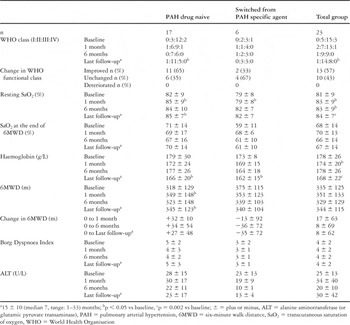
All patients had dyspnoea on exertion, and had functional limitation as assessed by the World Health Organisation functional classification. Of the patients, 5 were in functional class II, 15 in functional class III, and 3 in functional class IV at the time of commencement of bosentan. The baseline saturation of oxygen in room air was 81 plus or minus 9%, and the mean baseline haemoglobin level was 178 plus or minus 26 grams per litre (Table 1).
Table 1. Effect of treatment with bosentan on functional class, saturations of oxygen, six-minute walk distance, haemoglobin and ALT levels.

Supplemental oxygen, at 2 to 4 litres per minute by nasal cannula for 12 to 24 hours per day, was given to 13 patients. In addition, 13 patients were receiving warfarin, 8 patients were on diuretics, 3 were on angiotensin-converting enzyme inhibitors or angiotensin II receptor blockers, 5 were on digoxin, and 1 was also on a calcium channel blocker. Five patients were weaned from subcutaneous treprostinil in the month after starting bosentan, and 1 stopped beraprost at the beginning of the study. Three patients were on stable doses of L-Arginine throughout the study.
Outcomes of clinical and laboratory follow-up
Table 1 illustrates the changes in functional class, saturation of oxygen before and after the six-minute walk distance, haemoglobin levels, six-minute walk distance, Borg dyspnoea index and alanine aminotransferase from baseline to 1 and 6 months of bosentan therapy, and at the last follow-up. The duration of follow-up ranged from 1 to 34 months, with a mean of 15 plus or minus 10 months, and a median of 12 months. After treatment with bosentan, 13 out of 23 (57%) patients showed an improvement of at least one grade (p equal to 0.016 – Fig. 1). The mean resting saturations of oxygen increased from 81 plus or minus 9% to 84 plus or minus 7% (p equal to 0.001 – Fig. 2). Mean haemoglobin level fell with therapy from 178 plus or minus 2.6 to 168 plus or minus 2.2, grams per litre (p equal to 0.002 – Table 1). The baseline six-minute walk distance was 335 plus or minus 125 metres, with no significant change at the last follow-up (p equal to 0.55 – Table 1). There was no significant change in saturation of oxygen after exercise or in Borg dyspnoea indexes (Table 1).

Figure 1. Change in functional class following treatment with bosentan. Line numbers indicate number of patients.

Figure 2. Change in saturation of oxygen at rest following treatment with bosentan.
Overall, there was no significant change in liver function tests (Table 1). One patient discontinued treatment due to abnormal liver function tests, due to retention of fluid, and two others due to no perceived improvement. One patient with tetralogy of Fallot, who had been deteriorating functionally and who was having recurrent pre-syncopal episodes reported at the last follow-up of 13 months, died suddenly after 16 months on treatment. Death was attributed to progression of the disease, and considered unlikely to be related to bosentan.
Subgroup analysis
The six-minute walk distance of 6 patients who were on specific therapy, 5 on treprostinil and 1 on beraprost, at the time of initiation of bosentan therapy decreased, but not significantly so, from 375 plus or minus 115 to 340 plus or minus 104 metres (p equal to 0.14). In contrast, the six-minute walk distance in the patients that were not on specific therapy improved from 318 plus or minus 129 metres to 345 plus or minus 123 metres (p equal to 0.03) (Table 1). Functional class of those not on specific therapy improved from a baseline median of III to a median of II (Fig. 3, p equal to 0.015). Stability in functional class was observed in those patients that were switched from previously specific drug therapy. Similarly, in those not previously receiving specific therapy, the saturations of oxygen increased from a mean of 82 plus or minus 9% to 85 plus or minus 7% (Fig. 4, p equal to 0.013). In those patients that had previous specific therapy at the beginning of the study, we observed a trend to improvement in the saturations, from a mean of 79 plus or minus 8% to 82 plus or minus 7% (p equal to 0.08).

Figure 3. Change in functional class following treatment with bosentan in patients not previously receiving specific drugs for pulmonary arterial hypertension.

Figure 4. Change in saturation of oxygen at rest following treatment with bosentan in patients not previously receiving specific drugs for pulmonary arterial hypertension.
Discussion
Our study demonstrates that bosentan is well tolerated, and appears to be beneficial in the management of adults with Eisenmenger's syndrome. Of those not previously receiving specific drug treatment, two-thirds improved their functional status, whilst those who switched from another specific agent demonstrated stability.
In the past, treatment for those with Eisenmenger's syndrome has concentrated on improving oxygenation. Studies by Bowyer et al.15 reported that long-term treatment with oxygen improved survival in children with congenital heart disease and pulmonary vascular disease, yet long-term nocturnal therapy was found to be ineffective in modifying the natural history of patients with the advanced syndrome.15, 16 We found that treatment with bosentan was associated with mild but significant improvement in oxygenation at rest. This was most likely due to the lowering of pulmonary vascular resistance, with consequent increase in flow of blood to the lungs, although this was not directly measured in our study.
In those patients not previously treated with specific drugs, two-thirds had improved oxygenation at rest, whilst those who switched from another specific agent again demonstrated stability in terms of resting levels of oxygen. The increase in oxygenation was accompanied by an improvement in functional status. In our study, over half of patients had improved their functional class following treatment with bosentan. Importantly, none demonstrated functional deterioration. Although this was an uncontrolled observational study, the improvement was similar to that reported in recent trials of bosentan in patients with idiopathic pulmonary arterial hypertension.1, 2, 17
Systemic hypoxaemia leads to secondary polycythaemia, which may cause symptoms of headache, fatigue, dizziness, visual disturbances, anorexia, or lethargy.18 These symptoms are usually relieved by venesection. We found a significant, albeit modest, fall in levels of haemoglobin during treatment with bosentan, which may decrease the frequency of symptomatic polycythaemia and thus the need for venesection, a question that would require further prospective study. In patients not previously receiving specific treatment, two-thirds displayed decreased levels of haemoglobin, whilst in those who switched from another specific agent, five-sixths had decreased levels.
No patient in our study was receiving intravenous epoprostenol, which has been shown to have a beneficial role in the treatment of patients with pulmonary arterial hypertension related to congenital heart disease.10 The use of epoprostenol, however, is not straightforward, and may be complicated by side effects of flushing, headache, jaw pain, diarrhoea, leg pain, nausea, rash, and complications related to the central line, such as infection and venous thromboses. Interruption to continuous therapy may also be life-threatening.10 The high cost of therapy prohibits its use in our institutions. There is also some evidence to suggest that epoprostenol and bosentan, acting via different mechanisms, could be used safely in combination.19, 20 Subcutaneous treprostinil improved signs and symptoms of pulmonary arterial hypertension and haemodynamics in a large study of patients with pulmonary arterial hypertension, one-fifth of whom had Eisenmenger's syndrome. Its administration, however, was associated with significant pain at the site of infusion in five-sixths of patients.8 In addition, there has been a report suggesting that inhaled iloprost improves six-minute walk distance and symptoms in patients with Eisenmenger's syndrome, without causing oxygen desaturation at rest or during exercise.21 These results appear similar to those obtained in our study with bosentan. Less frequent and more convenient methods of administration and lesser cost may favour the use of bosentan. In our study, 3 patients received L-arginine, the effects of which remain unclear.
Sildenafil, an oral inhibitor of type 5 phosphodiesterase, has been shown to improve functional state and haemodynamics in patients with idiopathic pulmonary arterial hypertension.22–24 Similar to bosentan, there are concerns, however, that in patients with Eisenmenger's syndrome, sildenafil might potentially cause a reduction in pulmonary blood flow and an increase in cyanosis as a result of even mild systemic vasodilation and subsequent increase in right-to-left shunting.25 A preliminary report, nonetheless, suggests that it in practice, it may be safe, with improved symptoms and pulmonary haemodynamics in 30 patients with pulmonary arterial hypertension and atrial septal defect26 and 2 case reports of use of sildenafil in Eisenmenger syndrome patients during pregnancy27 and in the setting of acute pulmonary thromboembolism.28
The pulmonary pathophysiology in patients with Eisenmenger's syndrome supports the use of bosentan. Histological studies demonstrate that endothelin receptors are upregulated.18 Furthermore, levels of endothelin-1 are increased early in animals and patients with congenital heart lesions with left-to-right shunt.29, 30 Bosentan inhibits the A and B receptors for endothelin, and competes with endothelin-1 which usually binds to those receptors.31 By blocking endothelin receptors, bosentan may mitigate endothelin-related vasoconstriction and smooth cell proliferation, and thus modify functional and structural changes in the pulmonary vessels of patients with Eisenmenger's syndrome.
The Bosentan Randomised Trial of Endothelin Antagonist Therapy-3 study evaluated pharmacokinetics, safety and tolerability of bosentan in children, almost half of whom had congenital heart disease, but none had Eisenmenger's syndrome. The study showed good tolerance, improved haemodynamics and a pharmacokinetic profile similar to that in adults.32
There have been previous reports of bosentan use in adults with Eisenmenger's syndrome. Gatzoulis et al.13 treated 10 patients with bosentan, and found mean six-minute walk distance improvement of 99 metres and improvement in resting saturation of oxygen and echocardiographic parameters after 3 months of treatment. Christensen et al.11 showed that 9 patients treated with bosentan for a median period of 9.5 months improved their functional class and saturation of oxygen at rest, with few side effects. Two other preliminary reports suggest similar findings.12, 14 Our current data are consistent with these observations in a large group of patients with longer follow-up, and suggests furthermore that bosentan may be a suitable, more convenient, and thus possibly a favourable alternative to epoprostenol or treprostinil in patients with Eisenmenger's syndrome.
Limitations of this study are its retrospective design and the possibility that a placebo effect may have contributed to the reported improvement in functional status. Stability in the six-minute walk distance, and the significant fall in haemoglobin levels and increase in saturation of oxygen at rest, more objective measures than functional class, nonetheless, lend further support for the efficacy of bosentan in an otherwise progressive condition. In addition, the intercurrent use of treprostinil in 5 patients early during the period of treatment with bosentan, and 1 patient on beraprost just prior to the therapy, are possible confounders. The subgroup analysis (Table 1), however, demonstrated that there was a significant improvement in functional class, saturation of oxygen at rest and six-minute walk distance for patients not previously receiving specific drug treatment, whilst those clinical parameters in patients who were transitioned from treprostinil or beraprost at the beginning of the study, remained stable on bosentan even after withdrawal of their previously specific therapy. The non-significant decrease in six-minute walk distance observed in patients that were switched from a prior treatment with treprostinil or beraprost to bosentan indicate, not unexpectedly, a higher baseline value in patients on specific therapy. The absence of statistical significance, and the similar values at last follow-up compared to the total group, suggests stability after switching to bosentan.
A randomised controlled study of bosentan in patients with Eisenmenger's syndrome, the Bosentan Randomised Trial of Endothelin Antagonist Therapy-5 study, is underway. There are now 54 patients fully enrolled, with results expected in the third quarter of 2005. In conclusion, treatment with the endothelin-1 receptor antagonist, bosentan, is associated with significant improvement in functional class and saturation of oxygen at rest in patients with Eisenmenger's syndrome, similar in magnitude to that seen in idiopathic pulmonary arterial hypertension, as well as stability in the six-minute walk distance. These data suggest potential clinical benefit in such patients.