

Men who have sex with men (MSM) demonstrate an increased incidence of HIV infection, higher than any other group in the United States (Centers for Disease Control and Prevention, 2015; Hall et al., Reference Hall, Song, Tang, An, Prejean, Dietz and Mermin2017). The risk of HIV acquisition has traditionally been viewed in terms of risk stemming from casual sexual encounters. Recent modelling work suggests approximately 33–66% of new HIV infections among MSM occur from primary male partners (Goodreau et al., Reference Goodreau, Carnegie, Vittinghoff, Lama, Sanchez, Grinsztejn and Buchbinder2012; Sullivan, Salazar, Buchbinder, & Sanchez, Reference Sullivan, Salazar, Buchbinder and Sanchez2009). There are several reasons MSM in partnerships may be at greater risk for new HIV diagnosis compared to unpartnered MSM. For example, sexual behaviours in MSM often differ between casual and main partnerships. One model estimated MSM have approximately 10% more sex with main partners than casual partners, resulting in increased sexual contacts and potential exposures to HIV risk if the sex is unprotected (Sullivan et al., Reference Sullivan, Salazar, Buchbinder and Sanchez2009). Additionally, MSM in relationships are more likely to engage in unprotected anal intercourse (Goodreau et al., Reference Goodreau, Carnegie, Vittinghoff, Lama, Sanchez, Grinsztejn and Buchbinder2012) and receptive anal intercourse (Sullivan et al., Reference Sullivan, Salazar, Buchbinder and Sanchez2009) than with casual partners (Centers for Disease Control and Prevention, 2017; Sullivan et al., Reference Sullivan, Salazar, Buchbinder and Sanchez2009).
In addition to these sexual behavioural factors, factors indicative of relationship quality are associated with risk for HIV infection. For example, some couples have a sexual agreement, which is a mutually agreed-upon framework for couples to decide what sexual behaviours, if any, are acceptable to engage in outside of the main partnership (Gomez et al., Reference Gomez, Beougher, Chakravarty, Neilands, Mandic, Darbes and Hoff2012). In one study, couples with more constructive communication styles and higher levels of relationship satisfaction expressed higher levels of investment in their sexual agreements, thereby reducing sexual risk behaviours outside of the relationship and decreasing the potential for HIV infection (Mitchell, Reference Mitchell2014a). Additionally, positive relationship characteristics such as increased constructive communication, commitment, and trust may promote equity within the relationship with regard to both forming sexual agreements and communicating dissatisfaction (Gomez et al., Reference Gomez, Beougher, Chakravarty, Neilands, Mandic, Darbes and Hoff2012). This, in turn, minimises the occurrence of broken agreements, encourages disclosure when agreements are broken, and could ultimately reduce HIV risk (Gomez et al., Reference Gomez, Beougher, Chakravarty, Neilands, Mandic, Darbes and Hoff2012). Additionally, social support from primary partners has been associated with self-reported HIV medication adherence and self-efficacy (Darbes, Chakravarty, Beougher, Neilands, & Hoff, Reference Darbes, Chakravarty, Beougher, Neilands and Hoff2012). This increased HIV-specific support from main partners is hypothesised to decrease risky sexual behaviours by providing a mechanism for stigma management and increased discussion about HIV (Darbes et al., Reference Darbes, Chakravarty, Beougher, Neilands and Hoff2012; Darbes, Chakravarty, Neilands, Beougher, & Hoff, Reference Darbes, Chakravarty, Neilands, Beougher and Hoff2014).
In recognising the importance of dyadic interactions to HIV risk and following recommendations from the World Health Organization, dyadic interventions addressing HIV testing, counselling and prevention have become a new focus of HIV research (World Health Organization, 2012). However, central to the success of dyadic interventions is a couple's ability to engage in these together successfully. Dyadic health interventions differ from individually focused efforts in that they require couples to work together cooperatively toward adopting health-enhancing behaviour changes (Lewis et al., Reference Lewis, McBride, Pollak, Puleo, Butterfield and Emmons2006). These behaviours may be any number of physical, emotional, or supportive tasks partners can engage in to improve their health, and understanding and working with these conditions is critical to the success of the intervention regardless of the particular health behaviour or outcome of interest. Although current literature explores outcomes and effects of interventions, largely absent is exploration of the ability of couples to engage in health-enhancing behaviours together as a precursor to an intervention's success.
Before dyadic interventions can successfully target male couples, research must first ‘identify conditions under which couples interventions might be effective by exploring the optimum mix of individual psychosocial and relationship factors to address for different types of couples’ (Karney et al., Reference Karney, Hops, Redding, Reis, Rothman and Simpson2010, p. S191). This includes how couples approach health-enhancing behaviours together to prevent HIV, as well as which factors might exert positive or negative influences on these approaches. Therefore, the aim of this study was to examine partner and relationship characteristics that contribute to the maintenance of dyadic health behaviours to prevent new HIV infection.
Methods
Procedure and Participants
This analysis utilised baseline survey data from Stronger Together, a large, randomised control trial of a dyadic intervention to improve HIV prevention and care among sero-discordant male couples. Centres in three United States cities were involved in data collection: Emory University in Atlanta, the Fenway Institute in Boston, and Lurie Children's/Northwestern University in Chicago. For baseline data collection, potential study participants were recruited using each site's active website, Facebook, Twitter, and social marketing campaigns. Additionally, flyers and posters were displayed in the clinics and at MSM-targeted venues and publications, and information on the study was displayed prominently at HIV testing sites in each city. Advertising directed potential participants to an online screener for eligibility. Eligibility criteria, which was based on self-report, included: (1) two cisgender men in a relationship for at least 6 months (to reduce relationship dissolution during follow-up); (2) each 18 years or older; (3) current residents of metro Atlanta, Boston, or Chicago for at least three months to improve retention; (4) both individuals not having been tested for HIV in the last six months; and (5) no reported history of intimate partner violence (IPV) or coercion in the last six months of the current relationship. Couples were either sero-concordant negative or sero-discordant at baseline, with the intention of identifying sero-discordant couples to participate in the intervention. A partnership in this study was defined as ‘a relationship with a male partner who you feel committed to above all others’. Study staff at each site contacted eligible couples who had completed online screening. Once couples were contacted, informed consent was provided in person. Consented couples simultaneously completed the self-administered the baseline survey in separate rooms.
Dependent Measures
In the current study of dyadic approaches to health-enhancing behaviours, three outcome variables were considered in the analysis: planning and decision making, communication, and joint effort. These outcomes were measured as sum scores for three subscales of a couple-specific communal coping measure (Salazar, Stephenson, Sullivan, & Tarver, Reference Salazar, Stephenson, Sullivan and Tarver2013). The construct ‘communal coping’ refers to ‘the utilization of strategies, which are characterized as communal in nature such as couple communication about behaviour change, joint decision-making and planning regarding the behaviour or working together to engage in the behaviour’ (Lewis et al., Reference Lewis, McBride, Pollak, Puleo, Butterfield and Emmons2006, p. 1374). The Cronbach alphas for the scales were 0.87, 0.86, and 0.68 respectively. Both face and construct validity have been demonstrated for these measures (Salazar et al., Reference Salazar, Stephenson, Sullivan and Tarver2013). Each outcome was assessed using seven questions specific to what extent couples interacted regarding HIV-related behaviours. Each of the three scales had the same response options, and participants answered on a 5-point Likert scale ranging from not at any extent at all to to a great extent. The base for each of the seven questions was specific to the subscale, and therefore included three options: (1) ‘To what extent do you and [partner] make decisions together about . . .?’, (2) ‘To what extent do you and [partner] communicate about . . .?’, and (3) ‘To what extent do you and [partner] work together to . . . [engage in the outcome]?’. The seven questions attached to each base were identical, and included: (1) ‘using condoms when we have sex with each other’, (2) ‘limiting the number of other sex partners’, (3) ‘deciding about either of us having sex “outside” our relationship’, (4) ‘using condoms when either of us has sex outside our relationship’, (5) ‘getting tested regularly for sexually transmitted infections (STIs) and/or HIV’, (6) ‘being the top or bottom when we have sex with each other’, and (7) ‘being sexually faithful to each other’.
Independent Measures
To understand factors associated with health-enhancing behaviours, the analysis considered predisposing factors of couples hypothesised to influence these behaviours, including demographic data and relationship characteristics. Demographics included race, sexual orientation, HIV status, education, employment status, and yearly income. Alcohol use was also assessed as how often the participant had a drink containing alcohol in the past year (never, monthly or less, 2–4 times a month, 2–3 times a week, 4–5 times a week, 6 or more times a week). Drug use was similarly assessed as use within the past year, with answer options including none, other, and 16 different drug options. Relationship characteristics were assessed multidimensionally, with questions about relationship length, marital status, relationship type (‘What term best describes your relationship with [partner name]: boyfriend, lover, husband, spouse, partner, “fuck buddy”, hook-up, friends with benefits, we don't use labels, other?’), the presence of a sexual agreement (Mitchell, Reference Mitchell2014b), cohabitation status, length of cohabitation, and time spent together (‘Out of the last 30 days, how many nights have you spent with your partner?’). Relationship characteristics also included measures for IPV (Stephenson & Finneran, Reference Stephenson and Finneran2013), conflict style (Levinger & Pietromonaco, Reference Levinger and Pietromonaco1989; Salazar et al., Reference Salazar, Stephenson, Sullivan and Tarver2013), love (Lemieux & Hale, Reference Lemieux and Hale1999, Reference Lemieux and Hale2000), depression (Carpenter et al., Reference Carpenter, Andrykowski, Wilson, Hall, Kay Rayens, Sachs and Cunningham1998), and dyadic trust (Larzelere & Huston, Reference Larzelere and Huston1980). Happiness in the relationship was measured by asking ‘Please indicate your degree of happiness, all things considered, with your relationship with [partner's name]’ (extremely unhappy, fairly unhappy, a little unhappy, happy, very happy, extremely happy, perfect). A Cronbach's alpha greater than 0.78 has been demonstrated for each of these measures. Face and construct validity have been demonstrated for the conflict style inventory, and discriminant and convergent validity have been demonstrated for the trust measure (Larzelere & Huston, Reference Larzelere and Huston1980; Levinger & Pietromonaco, Reference Levinger and Pietromonaco1989; Salazar et al., Reference Salazar, Stephenson, Sullivan and Tarver2013). This analysis also controlled for stigma, operationalised as the internalised homonegativity scale, which has a demonstrated Cronbach's alpha of 0.84 (Meyer, Frost, Narvaez, & Dietrich, Reference Meyer, Frost, Narvaez and Dietrich2006). Although each of these measures produced an actor and a partner variable because both individuals answered all questions separately, some composite variables were derived by combining data from both partners. These variables were HIV concordance between partners based on both individuals’ serostatus, as well as sexual risk concordance based on each individual's self-reported sexual behaviours. These self-reported sexual risk behaviours included condom use both within and outside the partnership, and being the receptive or insertive partner during instances of unprotected anal intercourse.
Analysis
Factor analysis
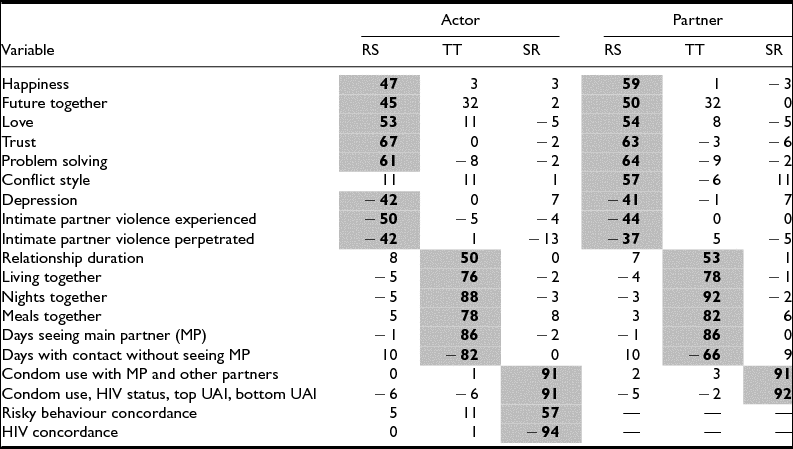
Given the large number of variables that could be included in analysis (N = 59, including scores for actors and partners and composite variables), exploratory factor analysis was performed for the independent variables using squared multiple correlations as prior communality estimates (O'Rourke & Hatcher, Reference O'Rourke and Hatcher2013). Exploratory factor analysis was used because the intent was to ascertain latent factors contributing to covariation in the dataset (O'Rourke & Hatcher, Reference O'Rourke and Hatcher2013). The principal factor method was used to extract factors, followed by a promax rotation to account for correlation between factors (O'Rourke & Hatcher, Reference O'Rourke and Hatcher2013). A scree test followed by a test for the proportion of common variance indicated that three meaningful factors be retained for rotation. In interpreting the rotated factor pattern, an item was said to load on a given factor if the factor loading was 0.35 or greater for that factor and less than 0.35 for the other factor. As seen in Table 1, these factor loadings can also be assessed as standardised regression coefficients. Factors for actor and partner were loaded separately. Applying these criteria, nine items were loaded onto the first factor, which was subsequently labelled ‘relationship satisfaction’, six items were found to load on the second factor, which was subsequently labelled ‘time together’, and four items were loaded on the third factor, labelled ‘sexual risk’. However, only eight items were loaded onto the first factor for actors, as conflict style did not load for actor, but did load for partner. The optimally weighted linear composites for each factor were used as standardised estimates of factor scores for subsequent analysis.
Factor Loadings: Rotated Factor Pattern (Standardised Regression Coefficients)

Note: Risky behaviour concordance and HIV concordance are composite variables utilising data from both partners and were therefore only included in the actor composite to avoid redundancy. RS is relationship satisfaction or factor 1, TT is time together or factor 2, and SR is sexual risk or factor 3.
Actor-partner interdependence modelling
Actor-partner interdependence modelling (APIM) techniques were used to examine associations between relationship characteristics and each of the three outcomes of interest (planning and decision making, communication, and joint effort). Separate models were run for each of these outcomes in the present analysis. APIM accounts for the nesting of individuals within dyads and therefore can examine two effects simultaneously: an individual's data affects both their own dependent variable score (known as the actor effect) and their partner's dependent variable score (known as the partner effect; Kenny, Kashy, & Cook, Reference Kenny, Kashy and Cook2006; Zvara, Mills-Koonce, Heilbron, Clincy, & Cox, Reference Zvara, Mills-Koonce, Heilbron, Clincy and Cox2015). Although multilevel modelling and structural equation modelling are both appropriate for APIM, multilevel regression models were used because it is recommended for indistinguishable partners, which were present in this dataset (i.e., designation between actor and partner in the dataset is arbitrary and the researcher cannot differentiate members from one another; Kenny et al., Reference Kenny, Kashy and Cook2006). The use of multilevel modelling also allowed this analysis to control for mixed independent variables that vary between and within dyads, on average from dyad to dyad, and from person to person within each dyad (Kenny et al., Reference Kenny, Kashy and Cook2006). This use of mixed independent variables allows investigation of mutual influence (Kenny et al., Reference Kenny, Kashy and Cook2006).
Results
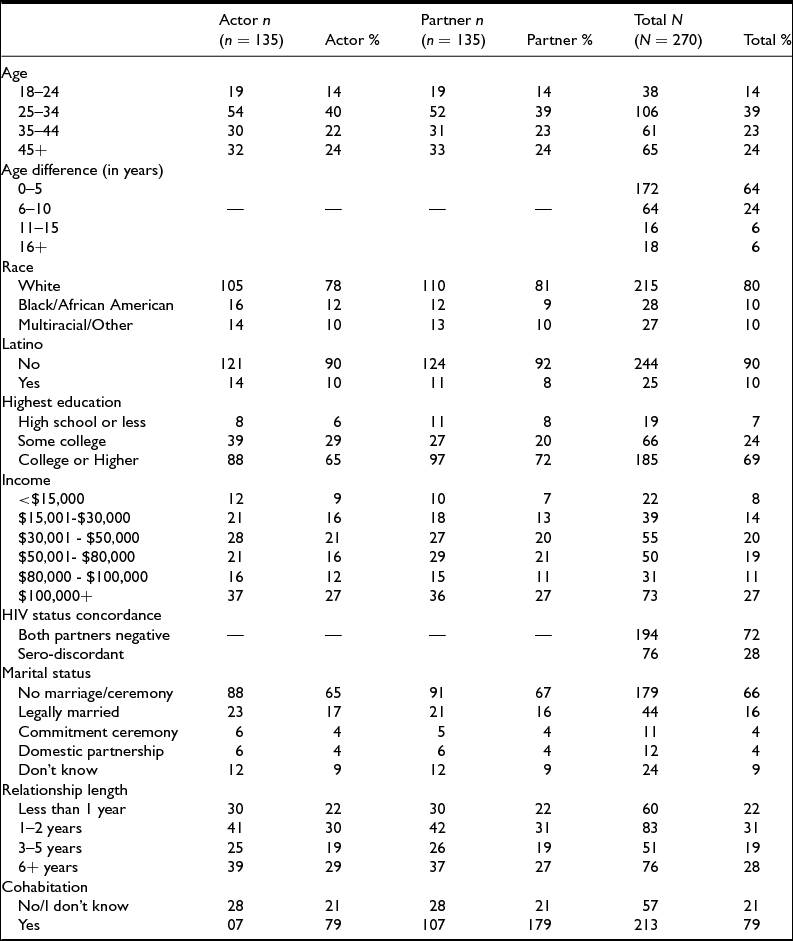
The complete sample included 398 individuals (199 partnerships). After excluding partners with missing data in key covariates and individuals whose partners had been excluded due to missing responses, the final sample was comprised of 270 individuals that constituted 135 partnerships. Ages of participants ranged from 19 to 69 years. Age differences between the couples ranged from zero to 38 years apart, but partners were generally close in age, with a median difference of 5.4 years. The majority of the sample was White (n = 215, 80%), though the sample included participants who identified as Black/African American (n = 28, 10%), multiracial, Asian, Pacific Islander, and Native American or Alaskan Native. A small proportion of the sample also identified as Latino (n = 25, 10%). Most respondents were educated with college completion or higher (n = 185, 69%), and the majority of the sample made at least $50,000 annually (n = 154, 57%). Most partnerships had two sero-negative partners (n = 194, 72%); all other partnerships were sero-discordant. Most couples lived together (n = 213, 79%), but had not pursued a commitment ceremony or legal marriage (n = 179, 66%). Relationship length varied from less than one year (n = 60, 22%) to more than 6 years (n = 76, 28%), with the longest reported relationship being 26 years. See Table 2.
Demographics of Actors and Partners (N = 270 Couples)

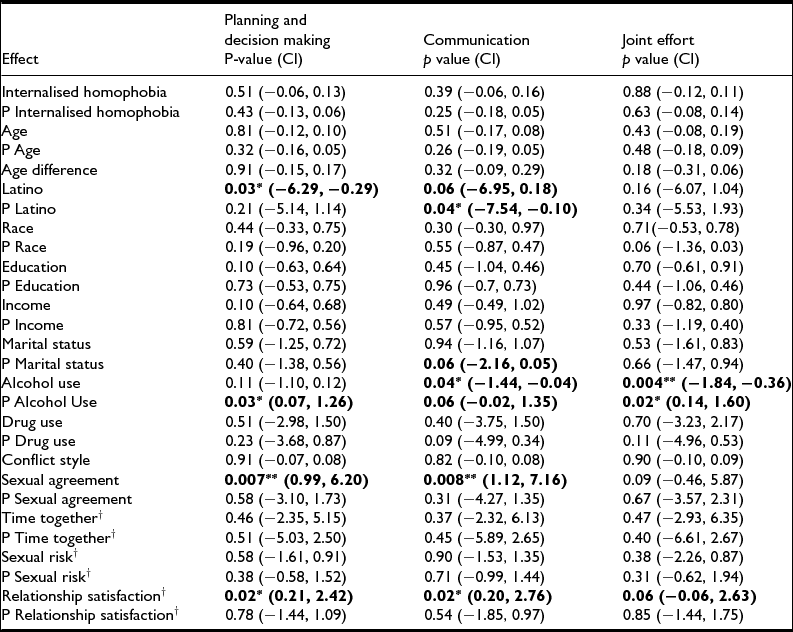
In the APIM modelling (Table 3), the key covariate factor variable relationship satisfaction was significantly and positively associated with all three outcomes (planning and decision making, communication, and joint effort) for actors (p = .02, .02, .06 respectively). Race was negatively associated with some outcomes whereby relative to White males, Latino males in this sample reported lower planning and decision making and communication scores (p = .032 for actors’ planning and decision making, p = .044 for partners’ communication). Alcohol use in the past year was negatively associated with planning and decision making, communication, and joint effort for both actors and partners except for actors’ planning and decision making (actors: p = .11, .038, .004 respectively, partners: p = .03, .056, .02 respectively). The presence of a sexual agreement was also positively associated with planning and decision making, and communication for actors (p = .007 and .008 respectively), but not for joint effort and not for partners. Internalised homophobia was not significantly associated with planning and decision making, communication, or joint effort for actors (p = .51, .38, .88 respectively) or partners (p = .43, .25, .63 88 respectively).
Results of APIM Multilevel Modelling

Note: *p < .05, **p < .01, ***p< .001. Bold type without * approaches significance. ‘P’ before the variable name differentiates partner scores from actor scores. CI = confidence interval. †Indicates factor variables.
Discussion
Based on these results, dyadic interventions can capitalise upon and improve relationship satisfaction to refine interventions for male partnerships, whereby increasing relationship satisfaction holds promise to improve the effects of dyadic interventions. This finding coincides with previous research that suggested other relationship characteristics, such as length, communication, and the presence of sexual agreements, are associated with HIV risk (Darbes, Chakravarty, Beougher, Neilands, & Hoff, Reference Darbes, Chakravarty, Beougher, Neilands and Hoff2012; Darbes et al., Reference Darbes, Chakravarty, Neilands, Beougher and Hoff2014; Gomez et al., Reference Gomez, Beougher, Chakravarty, Neilands, Mandic, Darbes and Hoff2012; Hoff, Chakravarty, Beougher, Neilands, & Darbes, Reference Hoff, Chakravarty, Beougher, Neilands and Darbes2012; Mitchell, Reference Mitchell2014a; Mitchell & Petroll, Reference Mitchell and Petroll2013; Mustanski, Newcomb, & Clerkin, Reference Mustanski, Newcomb and Clerkin2011). It may be that relationship characteristics and satisfaction affect couples’ ability to engage in health-enhancing behaviours most, whereby a lack of positive relationship characteristics and satisfaction negatively affect a couple's ability to jointly engage in health-enhancing behaviours, and vice-versa. For example, the specificity of the outcome measures to specific HIV-related behaviours indicates those with less positive relationship characteristics would not be able to engage in fruitful discussions around condom use and therefore would be less likely to engage in the behaviour itself. Accordingly, positive relationship characteristics and relationship satisfaction are likely appropriate targets for dyadic interventions to promote joint effort as the antecedent to HIV health-enhancing behaviours within partnerships.
An unanticipated result of this analysis was the lack of association between internalised stigma and couples’ outcomes. This lack of association may be a reflection of resilience from this population, whereby constructive relationship characteristics such as love, trust, and lack of IPV are protective and lessen the impact of stigma on relationship effort outcomes. This indicates increased social support found within relationships may also be a positive moderating factor, resulting in increased joint effort outcomes for this population. It is also possible that externalised or structural stigma may be significantly associated with these outcomes, but were not accounted for in analysis. Future analyses should examine multiple types of stigma to explore these possibilities.
In addition to the key finding related to relationship characteristics, there were also findings related to alcohol use, race, and sexual agreements. Alcohol use by the actor was significantly and negatively associated with communication and joint effort, and alcohol use by the partner was negatively associated with all three outcomes. This outcome may be due to the hypothesised causal relationship between minority stressors and risky sexual behaviour wherein substance use acts as a mediating factor (Hatzenbuehler, Nolen-Hoeksema, & Erickson, Reference Hatzenbuehler, Nolen-Hoeksema and Erickson2008; Kaplan et al., Reference Kaplan, Wagner, Nehme, Aunon, Khouri and Mokhbat2015). Increased minority stressors require sexual and gender minorities to utilise coping mechanisms. Minority individuals may turn to maladaptive avoidant coping mechanisms to deal with minority stressors (Baiocco, D'Alessio, & Laghi, Reference Baiocco, D'Alessio and Laghi2010; Fan et al., Reference Fan, Lu, Wu, Yousuf, Feng, Li and Ruan2016; Pachankis, Hatzenbuehler, & Starks, Reference Pachankis, Hatzenbuehler and Starks2014; Peacock, Andrinopoulos, & Hembling, Reference Peacock, Andrinopoulos and Hembling2015). These coping mechanisms may include risky sexual behaviour, or may indirectly promote risky sexual behaviour through alcohol or substance use (Hatzenbuehler et al., Reference Hatzenbuehler, Nolen-Hoeksema and Erickson2008; Kaplan et al., Reference Kaplan, Wagner, Nehme, Aunon, Khouri and Mokhbat2015). Alcohol is also a known barrier to effective communication, one of the joint effort measures (Denes & Afifi, Reference Denes and Afifi2014; Hatcher, Colvin, Ndlovu, & Dworkin, Reference Hatcher, Colvin, Ndlovu and Dworkin2014). Therefore, alcohol use may be a barrier to joint effort itself, or may point to the existence of latent factors such as externalised stigma and the impact of these latent factors on joint effort.
Similarly, the presence of a sexual agreement was significantly associated with communication and planning and decision making for partners only. It may be that couples who naturally exhibit better communication or planning and decision making without intervention have an easier time discussing and creating sexual agreements. Conversely, making an agreement together bolsters these skills among couples. Therefore, it may not be the agreement itself that affects coping, but rather the underlying skills inherent in making these agreements. Future research could also examine whether the presence of the agreement or factors associated with the agreement produce these effects. For example, satisfaction with the agreement of concordance between partners about what the agreement is may have stronger associations with health-enhancing behaviours than simply the presence of an agreement. Further, existing literature has begun to explore and determine associations between outcomes and specific aspects of agreements, such as satisfaction with the current sexual agreement (Mitchell, Reference Mitchell2014a). Specific types and details of agreements should be studied in more detail in relation to couples’ mutual engagement in health behaviours.
Additionally, a small but statistically significant effect was found for each of the outcomes for Latino MSM specifically, but not for overall race/ethnicity. Research regarding individuals with both racial/ethnic and sexual minority identities indicates that stigma or discrimination resulting from intersectional minority identities results in worse health outcomes. These negative outcomes include alcohol use (Gilbert, Perreira, Eng, & Rhodes, Reference Gilbert, Perreira, Eng and Rhodes2014), depression and anxiety (Choi, Paul, Ayala, Boylan, & Gregorich, Reference Choi, Paul, Ayala, Boylan and Gregorich2013), discomfort expressing affection with other men and psychological distress (Bishop, Reference Bishop2014), and HIV acquisition, an association moderated by psychological distress (Lelutiu-Weinberger, Gamarel, Golub, & Parsons, Reference Lelutiu-Weinberger, Gamarel, Golub and Parsons2015). These results demonstrate how ‘multiple forms of oppression contribute additively and interactively to mental health in this population’ (Velez, Moradi, & DeBlaere, Reference Velez, Moradi and DeBlaere2015, p. 1). However, this research has largely focused on individuals rather than dyads. These associations may also exist for dynamics within ethnic/racial minority relationships, negatively affecting these individuals’ ability to cope and participate in HIV preventative behaviours. Although the racial and ethnic minority sample of this study was too small to draw definitive conclusions, future research should examine differences in outcomes between racial and ethnic minority relationships.
Strengths and Limitations
This research should be interpreted in light of several limitations. This study may have limited generalisability due to the largely White and highly educated sample. Additionally, this analysis was unable to examine social support variables due to high rates of missing responses, which would have allowed more robust analysis of theoretical principles. These limitations must be considered relative to two constraints of the data set. First, this data set is cross-sectional, which can determine associations between relationship satisfaction and the outcomes but cannot determine which causes the other or if this relationship is linear. Second, this dataset utilised measures chosen before this analysis was considered. However, steps were taken to ensure the reliability and validity of measures. When reliability and validity measures were not available, survey measures were assessed for specificity to the population of interest (Salazar et al., Reference Salazar, Stephenson, Sullivan and Tarver2013). To further minimise this limitation, the same theoretical foundation was utilised for the data collection project and this analysis, and measures were assessed for their relation to theoretical principles. The interdependence theory described by Lewis et al. (Reference Lewis, McBride, Pollak, Puleo, Butterfield and Emmons2006) is a framework appropriate for gay male dyads, and measurements used are an excellent fit with theoretical concepts.
Conclusion
This analysis fills an important gap in the literature through the use of innovative and complex statistical techniques. The use of APIM allows for simultaneous analysis of both partners within a dyad, providing a more nuanced and robust understanding of how the communal nature of dyadic coping truly impacts outcomes. Specifically, this analysis has identified partner effects for relationship satisfaction that validate the previously assumed interaction with a partner score in affecting couple's outcomes regarding approaches to health-enhancing behaviours. By establishing the importance and utility of dyadic level analysis, this study provides further evidence base to support dyadic level interventions. This analysis identifies specific factors that may inform intervention delivery models targeting male couples.