INTRODUCTION
Carnivorous plants are able to attract, trap and digest various animal species and thus gain an extra nutrient source that enables them to grow on nutrient-poor soils. Depending on size and trap type, the composition of the prey ranges from protozoa up to small vertebrates, but the main part of the prey of carnivorous plants consists of insects (Barthlott et al. Reference BARTHLOTT, POREMBSKI, FISCHER and GEMMEL1998, Reference BARTHLOTT, POREMBSKI, SEINE and THEISEN2007; Juniper et al. Reference JUNIPER, ROBINS and JOEL1989, Lloyd Reference LLOYD1942). All 120 species (McPherson Reference MCPHERSON2009) of the genus Nepenthes (Nepenthaceae) are carnivorous and catch preferentially arthropods with their pitcher-like leaves (Juniper et al. Reference JUNIPER, ROBINS and JOEL1989). The prey animals, usually attracted by nectar, colour, and sometimes by fragrance, slip into the digestive liquid inside the pitchers and drown. Recent studies revealed that it is the intermittently slippery surface of the peristome (rim along the pitcher entrance) that lets the prey slide into the trap (Bauer et al. Reference BAUER, BOHN and FEDERLE2008, Bohn & Federle Reference BOHN and FEDERLE2004). In the case of Nepenthes madagascariensis, Ratsirarson & Silander (Reference RATSIRARSON and SILANDER1996) detected alkaloids and essential oils in leaf tissue, nectar and pitcher fluid. These constituents are supposed to disorient visitors and to make them fall into the trap.
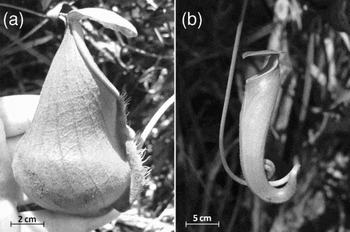
Nepenthes pitchers generally show a conspicuous dimorphism. Young plants produce a rosette of pitchers which rests on the ground (Figure 1a). These compact lower pitchers usually have a pair of wing-like structures running up the vertical front of the pitcher. Older plants form a second type of pitchers, upper pitchers, which generally are suspended above ground level (Figure 1b). The upper pitchers normally have a more cylindrical or, in the case of N. madagascariensis, a trumpet-like shape, and the wing-like structure is often absent. Unlike lower pitchers, the tendrils of upper pitchers are coiled and can entwine the surrounding vegetation for climbing.
Lower pitcher (a) and upper pitcher (b) of Nepenthes madagascariensis.

While the centre of diversity of the genus Nepenthes is located in south-eastern Asia, N. madagascariensis is one of two species that are endemic to Madagascar. Both Malagasy species are considered as evolutionarily basal in the genus (Meimberg et al. Reference MEIMBERG, WISTUBA, DITTRICH and HEUBL2001). The distribution range of N. madagascariensis extends along the eastern coast of Madagascar up to the Masoala Peninsula in the north-east (Jebb & Cheek Reference JEBB and CHEEK2001).
Although it is often mentioned that the prey spectrum of Nepenthes comprises insects, spiders, and sometimes small vertebrates, there are few studies which have analysed the composition of the prey in detail (Adam Reference ADAM1997, Erber Reference ERBER1979, Jebb Reference JEBB, Juniper, Robins and Joel1989, Moran Reference MORAN1996, Moran et al. Reference MORAN, BOOTH and CHARLES1999), and moreover, these studies were all performed on Asian Nepenthes species.
In the present study, we investigate the influence of pitcher type and study site on the prey composition of Nepenthes madagascariensis and test the differences to the prey spectra of Asian Nepenthes species growing in comparable habitats. In particular, we examine the hypothesis that (1) pitcher size does not influence the number of prey captures, (2) lower pitchers catch more flightless prey animals while flying prey is mainly trapped in upper pitchers, (3) the prey composition of N. madagascariensis does not significantly differ between the study sites in Madagascar while (4), due to its isolated distribution, the prey composition of N. madagascariensis shows significant differences in comparison with Asian Nepenthes species.
METHODS
Study sites
Nepenthes madagascariensis usually grows on nutrient-poor, acidic sandy soils, often associated with Sphagnum sp., Ravenala madagascariensis Sonn., Pandanus spp. and Typhonodorum lindleyanum Schott. We chose two different study sites along the south-eastern and eastern coast of Madagascar where this species occurs in large populations. One site was located at Sainte Luce, 50 km north of Tolagnaro (Fort Dauphin), where populations of N. madagascariensis are abundant along the edge of swampland and littoral forest which is today heavily fragmented due to anthropogenic action. The second study site was located in Ankanin'ny Nofy, 60 km south of Toamasina (Tamatave), where the edge of Lake Antsangira (approximately 4 km2) is lined with N. madagascariensis. The natural vegetation in this area likewise consists of littoral forest which is heavily fragmented today and interspersed with invasive plant species, especially of the genera Melaleuca and Grevillea. Both study sites are affected by the south-eastern trade wind that absorbs moisture over the Indian Ocean and transports it to the mountain range along the east coast of Madagascar. In the mountains, the clouds release the moisture as rain and provide well-distributed precipitation through the year, with a rainy season from November to April. The mean annual precipitation is 1583 mm in Tolagnaro and 3465 mm in Toamasina, while mean annual temperature at both sites is about 23 °C (White Reference WHITE1983).
Sample collection and processing
At each site, the contents of 20 lower pitchers and 20 upper pitchers were collected and fixed in ethanol (70% final concentration). Unfortunately, the samples from 20 lower pitchers from Sainte Luce were damaged during transport, so that the contents of the individual pitchers became mixed, and these samples had to be excluded from our study. In addition to prey individuals, height and diameter of the pitchers sampled were measured, and the pitcher volume was calculated assuming that the pitchers approximate a cylindrical body. Prey was collected only from fully developed pitchers that did not show any signs of age; the life span of N. madagascariensis pitchers averages 3-mo (Ratsirarson & Silander Reference RATSIRARSON and SILANDER1996). Only one pitcher per plant was collected in order to avoid pseudoreplication (Hurlbert Reference HURLBERT1984). The collected prey was sorted under a dissection microscope and determined to the lowest taxonomic level possible. For counts of very abundant taxa (ants) a grid was used. Due to an advanced stage of digestion many animals were degraded. To avoid duplicate counts in case of incomplete animals only the heads were enumerated.
Statistical analysis
Possible relationships between pitcher size and number of prey items were estimated using linear regression. In order to test if the two different pitcher types from the two sites caught significant different numbers of flying prey taxa we used the Kruskal–Wallis Rank Sum Test as a global test procedure followed by pairwise comparisons using the Wilcoxon Signed Rank Tests when significant differences were obtained (Hollander & Wolfe Reference HOLLANDER and WOLFE1999). Differences in taxonomic composition of pitcher types at both sample stations were analysed by means of non-metrical multidimensional scaling ordination (NMDS; Kruskal & Wish Reference KRUSKAL and WISH1978). A similarity matrix was calculated using the Jaccard similarity index, with double-square-root-transformed abundance data obtained from the prey collected from the pitchers. Because two- or three-dimensional NMDS plots can be misleading with regard to compactness within- and between classes when similarities are highly dimensional (usually indicated by high stress values), we investigated the strength of each classification by comparing within- and between-class similarities using a mean similarity dendrogram (van Sickle Reference VAN SICKLE1997). Possible significant differences between classes were investigated through analysis of similarities (ANOSIM) pairwise randomisation tests (Clarke Reference CLARKE1993). These tests calculate an R-value based on differences in average-ranked dissimilarity within and between samples. Possible values of R range from –1 to 1, with R = 1 indicating that a group of samples is more similar to each other than to any other group, and R = 0 corresponding to a situation where no differences between groups exist. Analysis of similarity percentages (SIMPER; Clarke & Warwick Reference CLARKE and WARWICK1994) were used to rank the prey-taxa contributing most to the average Jaccard dissimilarities between samples. In order to investigate if the prey assemblages caught in Malagasy and Asian Nepenthes species (data were obtained from the following literature sources: Adam Reference ADAM1997, Erber Reference ERBER1979, Jebb Reference JEBB, Juniper, Robins and Joel1989 and Moran Reference MORAN1996) differ significantly, we performed cluster analysis combining our data and the literature data, and then we compared the relative abundance values of taxa caught in Nepenthes pitchers with the relative abundances of taxa among all Nepenthes species using Pearson's χ2 tests with Monte-Carlo simulated P-values as a global test procedure. When significant differences were present, we applied one sample t-tests with arcsine-square-root-transformed percentage data (Sokal & Rohlf Reference SOKAL and ROHLF1998) to further investigate differences. In order to account for the Type I error associated with multiple t-tests, Bonferroni adjusted critical P-values were calculated (Sokal & Rohlf Reference SOKAL and ROHLF1998). All analysis and figure compilation were made with the R computer software (Version 2.10.1, www.r-project.org, Ihaka & Gentleman Reference IHAKA and GENTLEMAN1996).
RESULTS
In general, the prey of N. madagascariensis consisted of 96.9% insects, while Arachnida, Entognatha and Diplopoda shared the remaining 3.1%. Within the Insecta 80.2% of the prey belonged to the family Formicidae.
Influence of pitcher volume on the number of prey items
Pitcher volumes ranged between 17 to 493 cm3, with the highest mean values found in the lower pitchers at the Ankanin'ny Nofy site (152 cm3) and the lowest mean ones in the upper pitchers at Sainte Luce (72 cm3). In order to test if the pitcher volume of N. madagascariensis influences the number of prey items trapped, we applied linear regression analysis to the lower and the upper pitchers separately. Pitcher volume did not significantly influence the number of prey items (linear regression analysis; F1,19 = 2.32; P < 0.145 in lower pitchers and F1,39 = 0.25; P < 0.623 in upper pitchers).
Influence of pitcher type and position on the capture rate of flying and crawling prey
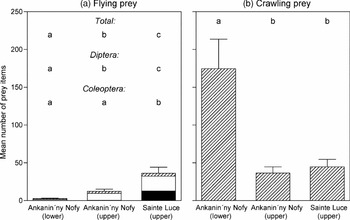
There was an overall significant difference in the total number of captured flying and crawling prey items per study site and pitcher type (Kruskal–Wallis rank sum test, χ2 = 12.9, P = 0.0015), but pairwise comparison revealed only significant differences between upper and lower pitchers of the Ankanin'ny Nofy site (Wilcoxon rank sum test, W = 323, P = 0.0009). Flying prey showed significantly different numbers between different pitcher types at the two sites investigated (Kruskal–Wallis test, χ2 = 36.3, P < 0.0001) and significant differences were present between all three samples (Figure 2): lower pitchers at the Ankanin'ny Nofy site caught significantly less flying prey-taxa, while upper pitchers captured significant more flying prey (Wilcoxon test; W = 57, P < 0.0001). Significantly higher numbers of flying prey were present in the upper pitchers of our Saint Luce site compare to the upper and lower pitchers of the Ankanin'ny Nofy site (Wilcoxon tests; W = 57, P = 0.0001 and W = 10.5, P < 0.0001, respectively). Within the taxa, distinctions concerning the life phases are available: Lepidoptera trapped by upper pitchers were all flying imagines, while four of the individuals trapped by lower pitchers were flightless larvae. Among the ants captured by upper pitchers there were 36 winged individuals. Lower pitchers did not contain any winged ants.
Mean ± SE number of flying (a) and crawling (b) prey taxa in the two different pitcher types in Nepenthes madagascariensis at the two sites investigated (shaded bars). Mean numbers of Diptera (white) and Coleoptera (black) are included as stacks. The results of the pairwise Wilcoxon rank sum tests are indicated by letters above the bars; equal letters refer to no significant differences (P ≥ 0.05) and unequal letters indicate significant differences (P < 0.05) between means.

The numbers of captured Coleoptera and Diptera showed a highly significant difference between the two sites (Wilcoxon tests; W = 23, P < 0.0001, Figure 2). The abundance of crawling prey taxa (Figure 2) showed overall significant differences between sites and pitcher types (Kruskal–Wallis test, χ2 = 18, P = 0.0001) but significant differences were present only between the lower and upper pitchers from Ankanin'ny Nofy and between the lower pitchers of Ankanin'ny Nofy and the upper pitchers Saint Luce (Wilcoxon tests, W = 341, P = 0.0001 and W = 329, P = 0.0005, respectively; Figure 2).
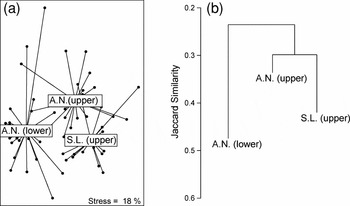
Differences in taxa composition of pitcher types and study sites were analysed using non-metrical multidimensional scaling ordination followed by mean similarity dendrograms. Although, the stress value is relatively high (18%), the NMDS plot (Figure 3a) shows a clear distinction between the three different groups of prey caught by N. madagascariensis pitchers. This observed difference in community composition is significant (ANOSIM, global R = 0.531, P < 0.001). In addition, pairwise comparison showed significant differences between the prey community structure in upper and lower pitchers at Ankanin'ny Nofy and between the upper pitchers at Ankanin'ny Nofy and at Sainte Luce (ANOSIM, R = 0.545, P < 0.001 and R = 0.292, P < 0.001, respectively). The similarity dendrogram (Figure 3b) shows a high within-similarity among the lower pitchers at the Ankanin'ny Nofy site. Obviously, the prey-assemblages in these 20 pitchers were relatively similar to each other, while the prey assemblages found in the upper pitchers at Ankanin'ny Nofy and Sainte Luce were less similar to each other. Similarity between site and pitcher (Figure 3b; represented by the horizontal connections between two pitcher types or sites) was higher between the upper pitchers at Ankanin'ny Nofy than at Sainte Luce. In other words: the prey assemblages found in the upper pitchers were more similar to each other, although they came from two different sample sites. SIMPER analysis revealed that the taxa contributing most to the dissimilarity between Ankanin'ny Nofy lower and upper pitchers were the Formicidae, Diptera, Acari, Lepidoptera, and Aranea with contributions of 22%, 16%, 13%, 12% and 9%, respectively, to the total dissimilarity of 60%. Average dissimilarity between upper pitchers at Ankanin'ny Nofy and at Sainte Luce were lower in comparison with upper and lower pitchers at Ankanin'ny Nofy (45% and 60%, respectively), and the taxa contributing most to these differences were Coleoptera (22% contribution to the overall dissimilarity), Formicidae (19%), Diptera (14%), Lepidoptera (11%) and Hymenoptera (9%).
Jaccard similarities of data obtained from the prey collected from the pitchers of Nepenthes madagascariensis displayed as two-dimensional NMDS plot (a) and mean similarity dendrogram (b). Individual samples of the three different groups are connected with solid lines in the NMDS plot to their class centroids for better discrimination. A.N. = Ankanin'ny Nofy, S.L. = Sainte Luce, upper = upper pitchers, lower = lower pitchers.

Comparison of prey between Nepenthes madagascariensis and Asian species
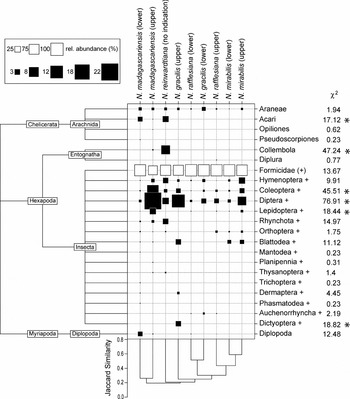
To investigate whether the prey taxa caught by N. madagascariensis differs significantly from the catches of its Asian relatives, we used two techniques: (1) we performed cluster analysis by combining our data and data from the literature, and (2) we compared the relative abundance of the taxa caught by N. madagascariensis pitchers with literature data by using χ2 tests as a global test procedure followed by one sample t-tests with arcsine-transformed percentage data, when the χ2 test had revealed significant differences. Cluster analysis showed a distinct difference between prey caught by N. madagascariensis pitchers compared with that of Asian Nepenthes species (Figure 4); the similarity between the prey assemblages caught by N. madagascariensis pitchers and Asian pitcher plants was only 40%. The relative abundance of prey showed significant differences at P < 0.05 in 6 of the 20 prey taxa tested (Figure 4). The results of the pairwise comparison of relative numbers of individual taxa found in N. madagascariensis pitchers and its Asian relatives indicated that the relative abundance of Acari caught in the upper pitchers of N. madagascariensis was significantly lower than in N. reinwardtiana pitchers (one-sample t-test, t = -93.0, P < 0.0001). Coleoptera, Diptera and Lepidoptera were significantly more abundant in the upper pitchers of N. madagascariensis than in all other Nepenthes species (one-sample t-tests, t = 26.7, P < 0.002, t = 10.0, P < 0.05, and t = 6.26, P < 0.005, respectively), and Dictyoptera were significantly more common in the upper pitchers of N. gracilis compared with the upper pitchers of N. madagascariensis.
Relative abundances (%) of prey taxa collected from the pitchers of Malagasy and Asian Nepenthes species displayed as different square sizes. Results are ordered according to the arthropod taxonomy (rows) and the results of the cluster analysis using mean Jaccard similarities (columns). Results from the χ2 tests are given and asterisks indicate significance (P < 0.05); winged species are marked (+).

DISCUSSION
In the present study we were able to demonstrate that (1) pitcher volume had no significant influence on the trapping success of the Malagasy pitcher plant N. madagascariensis, (2) that upper pitcher caught more winged prey taxa than lower pitcher, (3) that the prey assemblages differ significantly between upper and lower pitcher types and sites, and (4) that the taxa assemblages caught by N. madagascariensis differs in some taxa significantly from the prey assemblages found in Asian pitcher plants; mainly Coleoptera, Diptera and Lepidoptera are present in significantly higher numbers in lower pitchers of N. madagascariensis.
Different capture success between lower and upper pitchers in Nepenthes species is well known (Moran Reference MORAN1996). For many prey taxa (especially Hymenoptera, Diptera, Coleoptera and Lepidoptera) secreted nectar is the main attraction to visit the Nepenthes pitchers as they were numerously observed consuming nectar, especially at the peristome and underneath the lid. Further some carnivorous Coleoptera species were certainly not lured by nectar, but by animals feeding on the nectar or inhabiting Nepenthes pitchers. Flightless animals like Polydesmida (Diplopoda), primarily captured by lower pitchers which were often covered by a cushion of Sphagnum mosses up to the peristome, dropped probably inadvertently into the traps without being attracted.
Seasonal and spatial influence to prey composition
The increased occurrence of the order Coleoptera in upper pitchers from Sainte Luce compared to upper pitchers from Ankanin'ny Nofy (Figure 2) might be ascribed to an emergence peak at the beginning of rainy season during the collecting period in November. During this period a lot of plants start blooming which means plenty of nectar and fresh plant material is available and foraging beetles could have been abundantly attracted and captured by Nepenthes traps. Since in Ankanin'ny Nofy prey was collected only during February it is not clear if the lower number of captured Coleoptera was caused by seasonal differences or differences between study sites. Further studies would be necessary to discover the total influence of seasonality to the prey composition of Nepenthes species.
The water-level fluctuation of Lake Antsangira during rainy season presents another seasonal influence. At high water level the lake overflows numerous Nepenthes pitchers (pers. obs.) and by decreasing water level aquatic animals might be trapped. So lower pitchers from Ankanin'ny Nofy contained four aquatic Trichoptera larvae each in a case built out of plant tissue which is rarely available in N. madagascariensis pitchers. If they would have hatched inside the pitchers, they would most likely have built their cases out of prey remains as observed by Guenther (Reference GUENTHER1913) in case of larvae from Nepenthes distillatoria.
The total absence of the class Diplopoda in Sainte Luce can be attributed to the limited distribution area of some Malagasy Diplopoda species (Wesener & Sierwald Reference WESENER and SIERWALD2005). Probably the species captured in Ankanin'ny Nofy do not occur in Sainte Luce (Wesener pers. comm.).
Comparison with prey composition of Asian Nepenthes species
Numerous studies of Asian Nepenthes species are available, but however, there are comparatively few works that pay attention to prey composition. The comparison of their data with prey composition of N. madagascariensis shows numerous similarities (Figure 4). In most cases the authors agree that ants are the primary prey of Nepenthes. Also the significance of the other important prey orders like Coleoptera and Diptera is very similar. One exception is Nepenthes albomarginata which is specialised on termite prey (Merbach et al. Reference MERBACH, MERBACH, MASCHWITZ, BOOTH, FIALA and ZIZKA2002, Moran et al. Reference MORAN, MERBACH, LIVINGSTON, CLARKE and BOOTH2001) and Nepenthes ampullaria also shows an exceptional feeding behaviour with its tendency to detritivory (Cresswell Reference CRESSWELL1998, Moran et al. Reference MORAN, CLARKE and HAWKINS2003). The unusual upper pitchers of Nepenthes lowii have lost their carnivorous attributes and use tree shrew faeces as an extra nitrogen source (Clarke et al. Reference CLARKE, BAUER, LEE, TUEN, REMBOLD and MORAN2009). Such kinds of specialisations could not be observed for the evolutionarily basal N. madagascariensis and might present younger adaptations.
The allocation of flying and flightless prey between the two pitcher types also accords with Asian species. Flying arthropods are likewise mainly captured in upper pitchers while prey composition of lower pitchers predominantly consists of flightless prey (Moran Reference MORAN1996). Thus, the allocation of the most captured prey groups to the two pitcher types agrees with the habitat and motility of the prey. Even small vertebrates are sometimes mentioned being captured by Asian Nepenthes species (Clarke Reference CLARKE1997, Hua & Li Reference HUA and LI2005, Phillipps & Lamb Reference PHILLIPPS and LAMB1996, Slack Reference SLACK2000), but in spite of the high number of analysed pitcher contents from Madagascar there is no indication of trapped vertebrates.
The significantly different frequency of several prey taxa of Malagasy Nepenthes species compared with Asian species might indicate different arthropod composition at the two areas or might be ascribed to the impact of seasonality on the prey composition. Continuative studies would be necessary to explain those differences. However, no indication could be found which suggest that the differences in prey composition of N. madagascariensis are related to functional differences of the general trap mechanism of Nepenthes pitchers.
ACKNOWLEDGEMENTS
We are indebted to the staff of the Parc Botanique et Zoologique de Tsimbazaza (PBZT) for co-operation, especially to Marie Elisette Rahelivololona and Solo Hery Rapanarivo, and to the Ministère d'Eaux et Forêt for granting permission to work in Madagascar. We acknowledge the funding by the German Academic Exchange Service (DAAD) and the Akademie der Wissenschaften und der Literatur zu Mainz. Sincere thanks for determination of prey are due to Michael Schmitt, Bernhard Huber, Inge Bischoff, Bradley Sinclair, Karl-Heinz Lampe, Klaus Riede, Sigfrid Ingrisch, Dieter Stüning, Francisco Hita Garcia, Thomas Wesener (Zoologisches Forschungsmuseum Alexander Koenig), Christian Fischer (Freie Universität Berlin), Mark Maraun (Technische Universität Darmstadt), Reinhard Ehrmann (Staatliches Museum für Naturkunde Karlsruhe), and Ingo Fritzsche (Max Planck Institut Plön). We would also like to thank our colleagues Ulrich Sinsch, Rebecca Basile and Bernd Uebelmann for valuable discussions.