





Introduction
Healthcare-associated viral respiratory infections (HA-VRIs) cause significant patient morbidity and mortality, increased healthcare costs and prolonged length of stay. Reference Chow and Mermel1–Reference Bonvehí and Temporiti3 Annually, an estimated 19,000 HA-VRI cases occur in United States hospitals. Reference Chow and Mermel1 Transmission within the hospital can lead to outbreaks. Almost 400 HA-VRI outbreaks were identified among the Canadian Nosocomial Infection Surveillance Program (CNISP) in 2024. 4
In the healthcare setting, respiratory viruses can spread by infectious respiratory particles (IRPs) through the air or by direct or indirect contact via visitors, family members, healthcare workers (HCWs), other patients or shared medical equipment. Reference Pak, Chen, Kanjilal, McKenna, Rhee and Klompas5–7
The SARS-CoV-2 pandemic illustrated how IRPs of this virus may play a role in transmission, potentially contributing a heighted role in poorly ventilated settings and underscoring the importance of ventilation systems in healthcare settings. 8,Reference Stabile, Pacitto, Mikszewski, Morawska and Buonanno9
The relationship between HA-VRI rates in hospitals and hospital characteristics, such as the proportion of single-bed rooms, type of hospital, teaching status, structural ventilation parameters, and HCW policies have been explored but studies have focused predominantly on SARS-CoV-2 and influenza at the national or local outbreak level. Reference Leal, O’Grady and Armstrong10–Reference Salachas, Le Hingrat and Haviari12 Identifying these factors can contribute to understanding differences in HA-VRI rates between hospitals and offer potential improvement priorities upon hospital renovations.
The CNISP is a collaboration between the Public Health Agency of Canada (PHAC), the National Microbiology Laboratory (NML), the Association of Medical Microbiology and Infectious Disease (AMMI) Canada and a sentinel network of over 100 acute care hospitals across Canada, representing approximately 39% of acute care beds. 13 In Canada, health service delivery falls under provincial and territorial government jurisdiction. Hospitals adhere to provincial/territorial public health guidelines, including recommendations for routine practice and additional precautions during the respiratory virus season.
The study aimed to determine hospital characteristics and policies associated with adult and pediatric HA-VRIs rates (SARS-CoV-2, influenza A, influenza B, and respiratory syncytial virus (RSV)) in 2024 across a large network of academic and community hospitals.
Methods
Data sources
Among 109 CNISP hospitals, 89 participated in VRI surveillance in 2024 and received the study survey.
Hospital characteristics survey
A 15-item survey consisting of both single and multiple-choice questions, including certain free text responses, was developed to collect information on hospital characteristics, including patient testing and accommodation, infection prevention and control (IPAC) practices, occupational health policies for HCWs and hospital structure. It was reviewed and approved by the CNISP VRI Working Group, a group of subject matter experts including physicians, infection control practitioners (ICPs)/infection preventionists (IPs), nurses, and epidemiologists. The finalized survey was developed and distributed online through the LimeSurvey platform 14 to hospitals participating in CNISP VRI surveillance. Responses were collected from March 4 to March 31, 2025 and participants were required to respond to all survey questions.
The full survey is available in Supplemental Materials (Appendix I).
Patient data
As part of routine, active VRI surveillance, hospitals submit non-identifying case-level data for patients who meet the CNISP HA-VRI case definition (Appendix II) as well as the total number of patient-days observed at the hospital. Data were collected through review of patient medical records by trained ICPs/IPs and submitted to CNISP through the Canadian Network for Public Health Intelligence, a secure data repository. 15
Analysis
The surveillance period was January 1 to December 31, 2024. Hospitals that responded to the survey and had submitted HA-VRI case data for this period were included in the analyses; all others were excluded.
HA-VRI rates
Hospital-level HA-VRI rates were calculated as the number of HA-VRI cases/10,000 patient-days. Rates were calculated for HA-VRIs (SARS-CoV-2, Influenza A, Influenza B and RSV combined), HA-SARS-CoV-2 only, and HA-Influenza A/B and RSV. Hereafter, HA-VRIs refers to the combined rate for the four VRIs (SARS-CoV-2, Influenza A, Influenza B, and RSV). Other respiratory viruses were not included.
Hospital survey responses were linked to HA-VRI rates using a hospital identifier.
Statistical analysis
Hospital characteristics and HA-VRI rates were analyzed descriptively. Single beds were reported as a proportion of overall acute care beds. Continuous variables were reported as medians with interquartile ranges (IQR) and categorical variables as values and percentages.
Analyses were performed for HA-VRIs, HA-SARS-CoV-2 only, HA-Influenza A/B and RSV hospital rates and stratified by adult/mixed and pediatric hospitals, the latter including four maternal health units.
Generalized linear models with a negative binomial distribution were used to fit both univariate and multivariable models due to significant overdispersion observed in the Poisson models. Variables included in the multivariable model were either statistically significant (P < .05) in the univariate analysis or proposed to be relevant in the literature (e.g., universal masking, HCW testing). Variables in the multivariable model were assessed for collinearity using Variance Inflation Factor of <5. Associations between variables of interest and HA-VRI rates were reported as relative risk (RR), 95% confidence intervals (CI) and P-values. More detailed modeling methods can be found in Appendix III. Cohorting variables were excluded from the multivariable model, as they were only applicable to hospitals with multi-bed rooms.
To assess the relationship between HA-SARS-CoV-2 (independent variable) and HA-VRI rates (dependent variable), we conducted a sensitivity analysis comparing multivariable models for HA-VRI and HA-Influenza A/B and RSV.
All analyses were performed using R version 4.3.2. 16
Privacy and ethical considerations
Individual hospital rates and responses were anonymized. The survey was considered exempt from the requirement for ethics approval or approved by the research ethics boards at CNISP hospitals if required by institution specific policies. 17
Results
Survey
Of 89 eligible hospitals, 93% (n = 83) responded to the survey. A descriptive table of all survey responses can be found in Appendix IV.
All but two hospitals routinely tested all patients who presented with VRI symptoms, and all sites used additional precautions with patients at the onset of symptoms. The other two hospitals reported it was up to clinical discretion which symptomatic patients would be tested. Among hospitals with multi-bed rooms (n = 74/83, 89%), the most frequent cohorting practice for patients on additional precautions was when the same virus was identified (69/74, 93%). Most hospitals used a broad multiplex PCR assay to test for respiratory viruses (67/83, 81%) and half (54% (45/83)) used limited multiplex tests (not mutually exclusive).
Universal masking policies were enacted in nearly 75% of hospitals during respiratory season (Fall/Winter periods); most frequently masking only for direct patient care (39% (32/83)), followed by masking throughout the hospital (34% (28/83)); 17% (14/83) of hospitals had masking recommendations only on units with a VRI outbreak, 8% (7/83) did not implement any masking policies in the hospital and 2% (2/83) reported masking only in specific units.
Personal protective equipment (PPE) practice recommendations did not differ between SARS-CoV-2 and VRI (Influenza A/B, RSV) for gown and glove use (100% recommended for both). Masks (medical/procedure or N95 respirators) were used by all hospitals for VRI, with N95 respirators only used in 27% (22/83) of hospitals specifically for SARS-CoV-2.
Approximately half of hospitals (43/83 (52%)) had a policy for HCWs with a VRI to notify occupational health. The majority (81% (67/83)) advised HCWs presenting with VRI symptoms to stay home. Onsite access to testing was only offered to HCWs by 28% (23/83) of hospitals. SARS-CoV-2 was the most commonly available test (23% (19/83)).
Many IPAC programs and/or respondents were unable to provide detailed information about building ventilation: 54% (45/83) reported varying HVAC systems with unknown or variable ages, 35% (28/83) could not answer if they used high efficiency particulate air filters for filtration, and 42% (35/83) did not know the number of air exchanges per standard ward room.
Most, 79/83 (95%) hospitals, had submitted case data for all of 2024 and were included in the analysis.
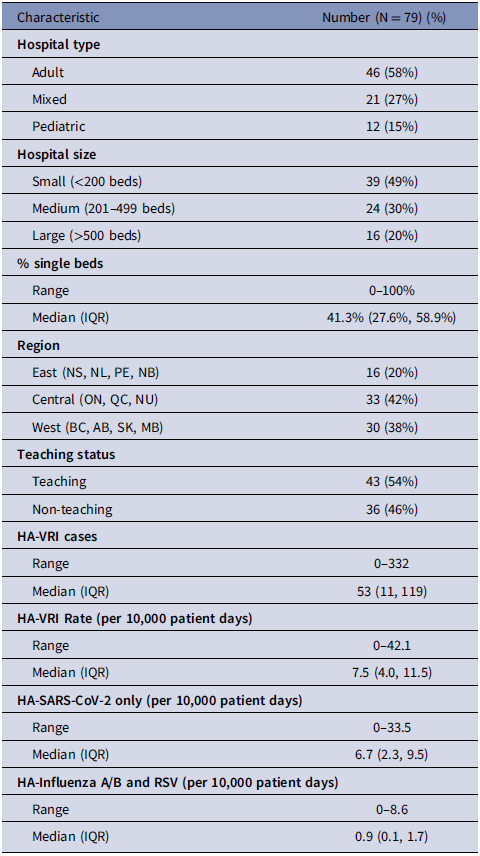
Table 1 presents the characteristics of these 79 hospitals. The majority (67/79, 85%) were adult/mixed hospitals and almost half were small hospitals (<200 beds) (Table 1). Over half were teaching hospitals and there was an even geographic distribution (Table 1).
Characteristics of CNISP hospitals participating in VRI surveillance in 2024 and who provided a survey response

Table 1. Long description
The table presents the characteristics of 79 hospitals participating in VRI surveillance in 2024. It includes data on hospital type, size, percentage of single beds, region, teaching status, and HA-VRI cases and rates. The table has 11 rows and 2 columns. Row 1: Hospital type, Adult, 46 (58 percent). Row 2: Hospital type, Mixed, 21 (27 percent). Row 3: Hospital type, Pediatric, 12 (15 percent). Row 4: Hospital size, Small (<200 beds), 39 (49 percent). Row 5: Hospital size, Medium (201-499 beds), 24 (30 percent). Row 6: Hospital size, Large (>500 beds), 16 (20 percent). Row 7: % single beds, Range, 0-100 percent. Row 8: % single beds, Median (IQR), 41.3 percent (27.6 percent, 58.9 percent). Row 9: Region, East (NS, NL, PE, NB), 16 (20 percent). Row 10: Region, Central (ON, QC, NU), 33 (42 percent). Row 11: Region, West (BC, AB, SK, MB), 30 (38 percent). Row 12: Teaching status, Teaching, 43 (54 percent). Row 13: Teaching status, Non-teaching, 36 (46 percent). Row 14: HA-VRI cases, Range, 0-332. Row 15: HA-VRI cases, Median (IQR), 53 (11, 119). Row 16: HA-VRI Rate (per 10,000 patient days), Range, 0-42.1. Row 17: HA-VRI Rate (per 10,000 patient days), Median (IQR), 7.5 (4.0, 11.5). Row 18: HA-SARS-CoV-2 only (per 10,000 patient days), Range, 0-33.5. Row 19: HA-SARS-CoV-2 only (per 10,000 patient days), Median (IQR), 6.7 (2.3, 9.5). Row 20: HA-Influenza A/B and RSV (per 10,000 patient days), Range, 0-8.6. Row 21: HA-Influenza A/B and RSV (per 10,000 patient days), Median (IQR), 0.9 (0.1, 1.7).
IQR: interquartile range.
HA-VRIs
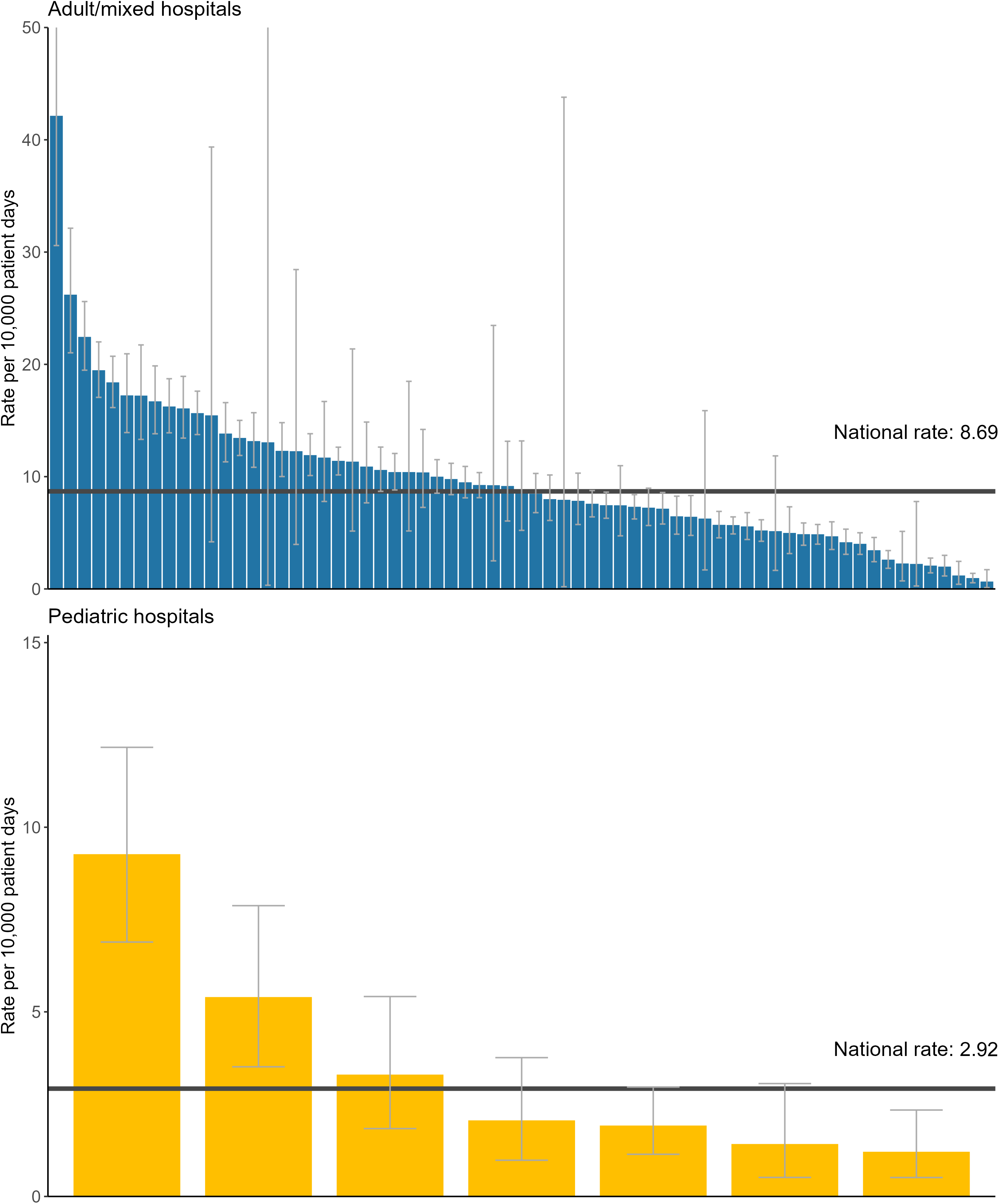
HA-VRI rates across surveyed hospitals ranged from 0 to 42.1/10,000 patient days (Table 1 and Figure 1). Adult/mixed hospitals had higher HA-VRI rates than pediatric hospitals (8.69 vs 2.92/10,000 patient days) (Figure 2).
Rates of healthcare-associated (HA) viral respiratory infection (VRI) for each CNISP hospital shown with 95% confidence interval. The horizontal black lines indicate the national rates. Top: Rate for HA-VRIs (SARS-CoV-2, Influenza A, Influenza B, and RSV) for each hospital; Middle: Rate for HA-SARS-CoV-2 only for each hospital; Bottom: Rate of HA-Influenza A/B for each hospital (y-axis scale different than other panels).

Healthcare-associated rates of infection for each CNISP hospital by hospital type shown with 95% confidence interval. Top: HA-VRI rate for adult/mixed hospitals; Bottom: HA-VRI rate for pediatric hospitals.

Variables associated with HA-VRI incidence
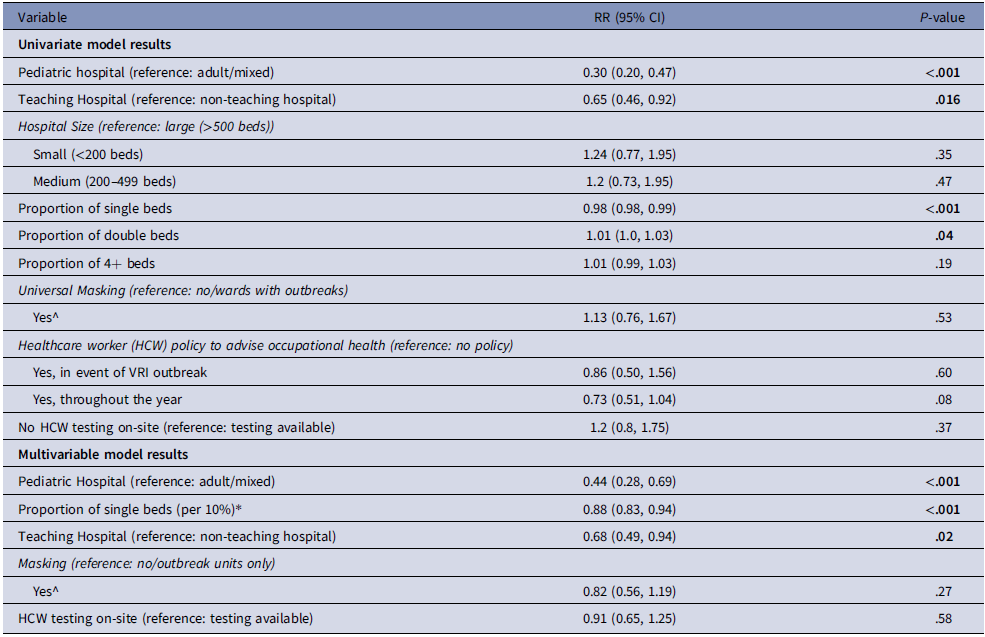
In the univariate negative binomial regression analysis, variables significantly associated with lower HA-VRI rate were pediatric (versus adult) hospitals, teaching (versus non-teaching) hospitals, and having a larger proportion of single beds (Table 2). Variations in universal masking, hospital size and HCW access to testing were not significantly associated with HA-VRI rates. The risk estimate of infection associated with proportion of double beds was borderline significant at 1.01 (P = .04, CI: 1.0–1.03), whereas proportion of 4+ beds was not significantly associated with HA-VRI rates (Table 2).
Univariate and multivariable analysis of healthcare-associated viral respiratory infection rate (SARS-CoV-2, Influenza A, Influenza B, and RSV) and survey responses with relative risk, 95% confidence interval and P-value

Table 2. Long description
A table comparing healthcare-associated viral respiratory infection rates with various hospital characteristics and policies. The table has 18 rows and 3 columns. The columns are labeled Variable, RR (95% CI), and P-value. The rows are grouped into Univariate model results and Multivariable model results. The variables include hospital type, hospital size, proportion of single, double, and 4+ beds, universal masking, healthcare worker policy, and on-site testing. The table lists the relative risk (RR) with 95% confidence intervals (CI) and P-values for each variable. Notable trends include significant associations with pediatric hospitals, teaching hospitals, and the proportion of single beds in both univariate and multivariable models. Variations in universal masking, hospital size, and healthcare worker access to testing were not significantly associated with infection rates.
RR: relative risk; ^includes: at the unit level, throughout hospital and direct patient care; *RR was re-expressed to reflect a 10-percentage point increase for interpretability.
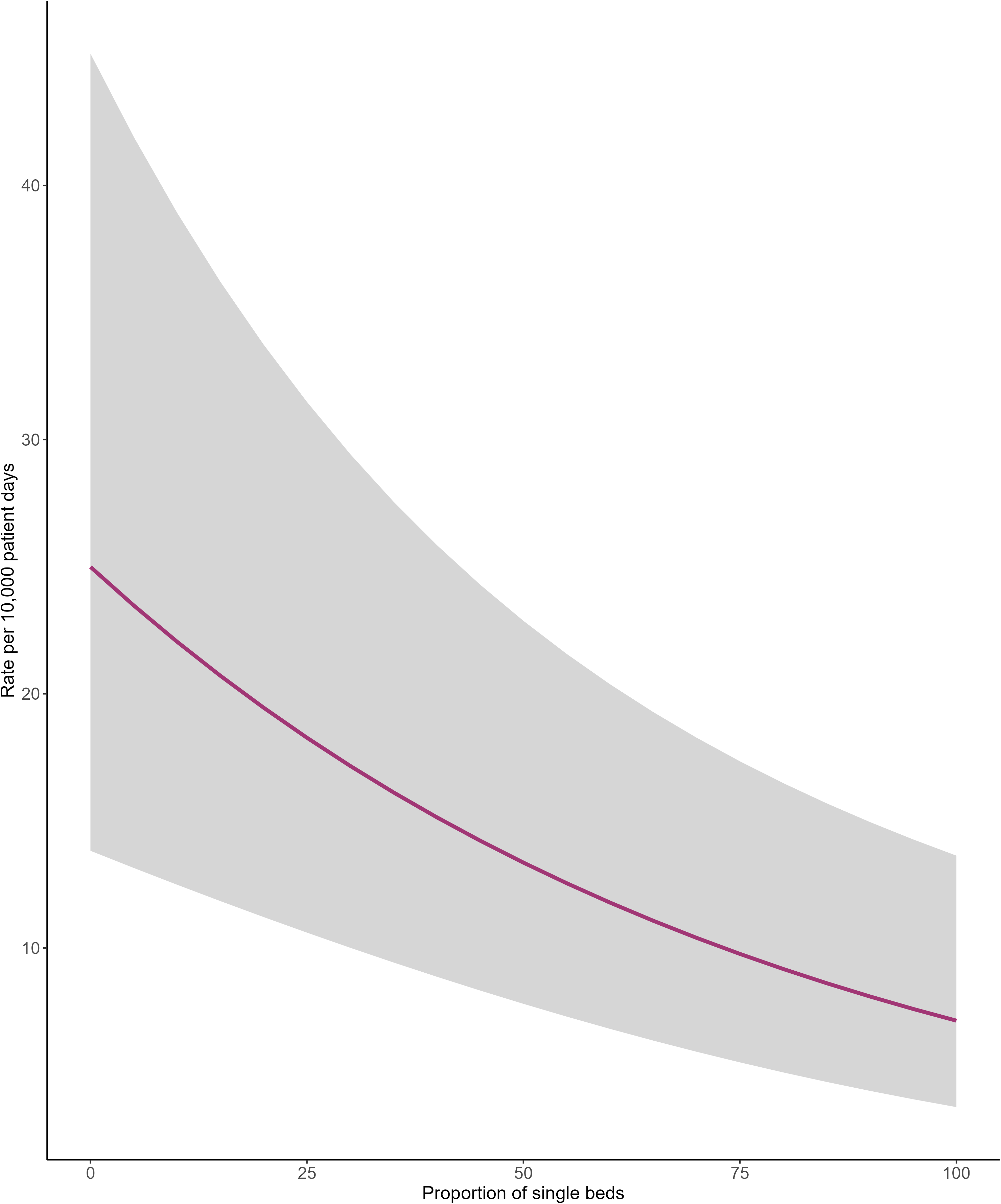
The results of the multivariable binomial regression analysis were similar (Table 2). Pediatric hospitals had a 56% lower HA-VRI rate compared to adult/mixed hospitals (RR = 0.44, P < .001). We also identified a strong inverse relationship between the proportion of beds in private rooms and the incidence of HA-VRI. For every 10% increase in the proportion of single-bed rooms, there was an 12% decrease in HA-VRI rate (RR = 0.88 per 10% increase, P < .001) (Table 2; Figure 3). Teaching hospitals were associated with a 32% lower HA-VRI rate compared to non-teaching hospitals (RR = 0.68, P = .02). In contrast, universal masking was not associated with a statistically significant reduction in HA-VRI rates.
Predicted HA-VRI rates per 10,000 patient days based on the multivariable negative binomial regression model illustrating the adjusted relationship between proportion of single beds and infection rate; 95% confidence interval indicated in gray.

There was also no statistically significant association with availability of HCW testing onsite and HA-VRI rates (Table 2).
HA-SARS-CoV-2 only
The rate of HA-SARS-CoV-2 only (6.94/10,000 patient days) was higher than the rate of HA-Influenza A/B and RSV combined (1.21/10,000 patient days) (Figure 1, P < .001) during the study. Only the proportion of single beds in a hospital was associated with HA-SARS-CoV-2 rate in a univariate analysis (P < .001). There was no statistically significant difference regarding choice of PPE including medical/procedure masks or N95 respirators for all procedures vs aerosol-generating procedures.
The sensitivity analysis showed evidence SARS-CoV-2 was a major contributor to HA-VRI rates and excluding SARS-CoV-2 was associated with an 89% reduction in HA-VRIs (RR = 0.11, 95% CI: 0.04, 0.31, P < .001). Pediatric hospitals were associated with a 56% lower risk of infection when SARS-CoV-2 cases were included in HA-VRI rates. However, a significant interaction was observed when SARS-CoV-2 was excluded: the infection risk in pediatric hospitals increased by multiplicative factor of 4.72 (interaction RR = 4.72, 95% CI: 2.17, 10.3, P < .001). This finding suggests that the apparent protective effect of pediatric hospitals is largely driven by lower rates of SARS-CoV-2 infections, with the risk estimate shifting from a protective effect (RR = 0.44) to an increased risk (RR = 2.06). Of the 216 cases from pediatric hospitals, 124 (57%) were HA-Influenza A/B and RSV cases and only 92 (43%) were HA-SARS-CoV-2. Of The 3,878 cases from adult hospitals, 3,366 (87%) were HA-SARS-CoV-2 and only 512 (13%) were HA-Influenza A/B and RSV. Other associations such as proportion of single beds, teaching hospital status, masking, and HCW access to testing remained consistent across HA-VRI including and excluding SARS-CoV-2.
HA-influenza A/B and RSV
A univariate analysis showed that hospitals that only implemented additional precautions at the bedside instead of single room isolation or infection cohorting strategies had double the infection risk (RR = 2.0, 95% CI 1.27–3.15, P < .01). Implementing a policy for HCW to notify occupational health during a VRI outbreak had a RR of 0.44 (95% CI 0.21–1.0, P = .04) in the univariate analysis. PPE use including N95s for aerosol-generating procedures, and eye protection were not significant in the univariate analysis.
Discussion
This study provides an overview of hospital IPAC practices, testing practices, HCW policies and structural factors associated with HA-VRI rates across a large network of Canadian teaching and community hospitals with most hospitals reporting similar testing policies. All sites used additional precautions for patients at symptom onset, and 93% of hospitals cohorted patients with the same virus (excluding those with only single beds).
We found higher proportions of single-bed rooms had a protective association against HA-VRIs, consistent with other literature. Reference Leal, O’Grady and Armstrong10,Reference Jo, Choe and Kim11,Reference Munier-Marion, Bénet and Régis18,Reference O’Grady, Harrison and Snedeker19 This observation supports findings from other research suggesting that the incidence rate of HA-SARS-CoV-2 increased according to the number of patients per room . Reference Jo, Choe and Kim11 The protective association between single-beds and HA-VRI rates was also observed by Quach et al. (2016), where pediatric HA-VRI rates in hospitals with <50% single-bed rooms were 1.33 times higher than in hospitals with >50% single bed-rooms. The relationship between proportion of single-bed rooms and HA-VRI may reflect transmission through multiple modes. Further, rates may be associated with room design, with newer hospitals having larger single or double-bed rooms with improved ventilation standards and materials for cleaning and disinfection. These findings support prioritizing private rooms in hospital design and redevelopment projects.
Differences in hospital structure may have further contributed to the observed disparities in HA-VRI rates between adult and pediatric populations. The proportion of single-bed rooms is higher among most pediatric hospitals compared to adult/mixed hospitals (median 69.2% vs 38.9%). Among pediatric hospitals, there is a higher proportion of teaching hospitals (10/12 (83%)) compared to adult/mixed (33/67 (49%)).
Pediatric hospitals had 56% lower HA-VRI rates compared to adult/mixed hospitals, suggesting that pediatric hospitals may have intrinsic or operational factors that contribute to reduced viral transmission. However, when HA-SARS-CoV-2 cases were excluded, the protective association observed for pediatric hospitals was reversed and pediatric hospitals had a higher nosocomial infection rate compared to adult/mixed hospitals. This may reflect the differences between adult and pediatric populations with respect to transmission and virulence of SARS-CoV-2 compared to Influenza A/B and RSV. Reference Chen, Huang and Liao21–Reference Lee, McGill and Pelude24 Young children appear to pose a lower risk of SARS-CoV-2 transmission to other children, whereas, they may exhibit more symptoms with other VRIs, leading to more testing and diagnoses. Reference Asner, Petrich and Hamid25,Reference Silva, Ito and Moreira26 Importantly, other respiratory viruses, e.g., enterovirus, rhinovirus, human metapneumovirus, parainfluenza, etc., were not included in analysis. Prior studies of HA-VRIs in pediatric populations have identified enteroviruses and rhinoviruses as the most common pathogens in the pediatric population. Reference Asner, Petrich and Hamid25,Reference Silva, Ito and Moreira26 The exclusion of these viruses may have contributed to an underestimation of HA-VRI rates in pediatric hospitals.
Our findings showed that teaching hospitals were associated with a 32% lower HA-VRI rate compared to non-teaching hospitals, potentially reflecting differences in infection prevention protocols, resource availability, and staff expertise. Teaching hospitals are more likely to have IPAC teams with trained infection control physicians and ICP/IPs who can develop and enforce evidence-based protocols to reduce HAIs. Their university affiliations and emphasis on ongoing HCW education may support higher compliance with infection control practices. Reference Shahian, Nordberg and Meyer27
Universal masking was not found to have a statistically significant association with HA-VRIs in the multivariate analysis in our study. Other small observational single institution studies suggested that universal masking in conjunction with other IPC measures was associated with a lower risk of respiratory virus transmission in healthcare settings. Reference Williams, Mieusement and Tomiczek28,Reference Most, Phillips and Sebert29 Importantly, compliance with masking policies was not assessed. Variability in adherence among HCW due to factors such as mask fit, proper usage, and duration of wear might have influenced the effectiveness of masking policies. The use of universal masking during respiratory season is a major research gap and should be subjected to large, multi-centered randomized clinical trials with embedded adherence measurements in both high- and low-to-middle income countries to provide high quality evidence on which to base future policy decisions.
Strengths
There are several strengths to this study. First, CNISP VRI surveillance is geographically representative and includes cases from hospitals in all provinces and one territory. Adult, mixed and pediatric hospitals were all represented, as were teaching and non-teaching and urban and rural hospitals.
There was an excellent response rate with 93% (83/89) hospitals responding to the survey. As such, the study had a large sample size with 79 hospitals included in the HA-VRI analysis.
Thirdly, subject matter experts were involved in both VRI surveillance and survey development. The VRI surveillance protocol and case definitions were co-developed by the working group members with expertise in infectious disease and IPAC. Patient data collection and review was conducted by trained ICPs/IPs. CNISP VRI data is of high quality using standardized definitions and are not based on an administrative datasets.
Limitations
Hospital practices are determined by provincial/territorial recommendations, which can make it challenging to draw comparisons across jurisdictions.
An important limitation of the survey results was that practices were self-reported and adherence was not measured. Survey responses were not validated to assess their accuracy. The survey only collected information on routine practice and did not capture information on overcapacity situations.
As the survey was conducted in March 2025 and captured practices from the previous respiratory virus season, there is a possibility of recall bias and a temporal mismatch between practices reported and those in place during the 2024 surveillance period. Facility ventilation variables could not be incorporated into the multivariable model, representing additional limitations. Although ventilation and air flow may be factors associated with HA-VRI risk, the responses received were insufficient for inclusion in analysis. Surveys were sent to the hospital point of contact, typically an infection prevention and control professional, who might not have been the best placed to answer the ventilation type questions. Having the HVAC/infrastructure questions completed by hospital staff with this knowledge and/or more specific questions could have improved completeness.
As an ecological observational study, reverse causation and ecological fallacy are potential limitations; for example, hospitals with higher HA-VRI rates may have implemented more stringent IPAC measures in response, which could obscure the true relationship between IPAC practices and HA-VRI rates at the patient level.
It is inherently challenging to tease apart cases who acquired their infection in hospital versus those who had hospital onset but were community-acquired, potentially resulting in misclassification bias and inflated rates.
Conclusion
The CNISP survey and VRI surveillance data showed that higher proportions of single-bed rooms were associated with lower HA-VRI rates, supporting their prioritization in hospital design. Pediatric hospitals and teaching hospitals were associated with lower HA-VRI rates. Universal masking was not significantly associated with HA-VRI rates, possibly confounded by suboptimal compliance, which was not measured.
Future studies should include other HA-VRIs (e.g., enterovirus, rhinovirus, human metapneumovirus, parainfluenza) and assess compliance to hospital policies, such as universal masking and HCW adherence to Occupational Health policies through the use of high-quality randomized trials. The effects of visitation policies, passes, hand hygiene rates and vaccination of HCW and patients should also be studied.
Supplementary material
The supplementary material for this article can be found at https://doi.org/10.1017/ice.2026.10490.
Acknowledgements
We thank members of the Canadian Nosocomial Infection Surveillance Program (CNISP) Viral Respiratory Infection (VRI) Working Groupα for their critical review of the survey and analysis and continued support of CNISP VRI surveillance, as well as the infection control practitioners, epidemiologists, and staff at participating hospitals for their support in national VRI surveillance. α Nicole Anderson, Jeannette Comeau, Chelsey Ellis, Meghan Engbretson, Matthew Garrod, Bonny Granfield, Jennifer Happe, Jennie Johnstone, Kevin Katz, Jamal Khan, Santina Lee, Marie-Astrid Lefebvre, Allison McGeer, Erika Oates, Susan Roman, Jocelyn Srigley, Kathy Suh, Kennard Tan, Jen Tomlinson, Alice Wong.
Author contribution
EM: Data collection, Data analysis and interpretation, Drafting the article, Critical revision of the article, Final approval of the version to be published. DL: Created survey, Data collection, Final approval of the version to be published. CQ: Conception or design of the work, Critical revision of the article, Final approval of the version to be published. JAL: Drafting and critical revision of the article, Final approval of the version to be published . MD: Drafting and critical revision of the article, Final approval of the version to be published. JC: Drafting and critical revision of the article, Final approval of the version to be published. JE: Drafting and critical revision of the article, Final approval of the version to be published. JME: Drafting and critical revision of the article, Final approval of the version to be published. BEL: Drafting and critical revision of the article, Final approval of the version to be published. YL: Drafting and critical revision of the article, Final approval of the version to be published. DM: Drafting and critical revision of the article, Final approval of the version to be published. SS: Drafting and critical revision of the article, Final approval of the version to be published. RT: Drafting and critical revision of the article, Final approval of the version to be published. OV: Critical revision of the article, Final approval of the version to be published. JV: Drafting and critical revision of the article, Final approval of the version to be published. NT: Conception or design of the work, Data interpretation, Drafting and critical revision of the article, Final approval of the version to be published. CF: Conception or design of the work, Data interpretation, Drafting and critical revision of the article, Final approval of the version to be published
Financial support
None to declare.
Competing interests
None to declare.



 Open access

