

Vodka, Trump, and Adjusting the Geopolitical Scope
In June 2008, Russia’s foreign minister, Sergey Lavrov, was on board the Russian nuclear icebreaker Lenin in the Arctic port of Murmansk together with the Norwegian foreign minister, Jonas Gahr Støre. The two ministers had met more than a dozen times in the previous months, and on this occasion, they watched the Euro 2008 football match between Russia and Spain while drinking vodka.Footnote 1 Two years later, in April 2010, the ministers announced a breakthrough in Norway–Russia relations and a ‘new era’ was declared, as the two countries agreed to settle a four-decade-old dispute in the Arctic (V. L. Pettersen Reference Pettersen2010).
Geographic proximity was the foundation for this dispute and subsequent agreement. Norway and Russia share a land border near the northernmost point of the European mainland, initially agreed upon in 1326 and finalised in 1826. A disagreement emerged in 1977 over how to divide the maritime space north of the European mainland, extending into the Arctic Ocean all the way to the North Pole. Geographic proximity between Norway and Russia was also the reason for the breakthrough agreement of 2010: by finally resolving this longstanding dispute, a thorn in Norway–Russia relations was removed, paving the way for joint offshore oil and gas development in the Arctic. As sea ice was receding and prospects of new shipping routes via the ‘shortcut’ to Asia became a reality, the two countries’ shared geographic space became a source of cooperation and new relations.
In the Arctic, geography looms large. The Arctic is one of the places on the planet where climate change is most apparent. Large land and sea areas that were previously covered by ice are changing character. Resources previously inaccessible are not anymore. The millennia-old dream of a shortcut between continents via the North Pole is suddenly a reality.
Geography is also increasingly a cause for concern. In 2022, Russia launched a full-scale invasion of Ukraine in breach of international law, having already engaged in conflict in Ukraine since 2014. All the other Arctic states joined a Western response through sanction regimes scaled-up from those put in place in 2014, while they cut most forms of political and economic ties with Russia. All Arctic states apart from Russia have joined NATO. Both Russia and NATO member states signal their military capabilities in the Arctic, and fears of escalation and conflict abound.
Russia has turned towards some of the BRICS countries in order to fulfil its economic and political ambitions in the Arctic. Russia has even engaged in deeper military cooperation with China in parts of the Arctic to enhance its security vis-à-vis the other seven ‘Western’ Arctic states – something thought unthinkable a decade earlier. Because the Arctic is one of the geographic spaces where Russia borders Western states along two fronts (in both Europe and in the North Pacific), the Arctic is touted by many as the next arena for direct conflict, even war, between Russia and the West.
A clear illustration of this materialised in 2024 on 22 December, as incoming and returning US President Donald Trump stated that ‘the United States of America feels that the ownership and control of Greenland is an absolute necessity’ (Trump Reference Trump2024). Trump’s interest in acquiring control over Greenland, articulated for the first time publicly in 2019, reflected a securitised economic and strategic interest in Arctic geopolitics partly in response to what is perceived as Russia’s northern dominance and China’s increasing Arctic interest. Greenland’s vast natural resources, including rare earths and hydrocarbons, combined with its location between North America and Europe, renders it a site of so-called geopolitical significance. Trump framed a potential purchase as enhancing US control over Arctic access routes and resource security, seeking to pre-empt rival powers’ influence (Vock Reference Vock2025).
The counter-reaction, from Danish authorities, Greenlandic leadership, and international observers, highlighted norms of sovereignty, self-determination, and NATO cohesion. Governments in both Copenhagen and Nuuk rejected the notion as an affront to constitutional order and a misreading of contemporary statecraft, emphasising Greenland’s autonomous governance and aspirations.
The episode also catalysed renewed attention to Arctic security policy, prompting a range of stories in both media and amongst analysts about the Arctic as an arena for geopolitics and conflict between great powers (i.e., states with relatively more recognised capacity than their peers).Footnote 2 The problem, however, is that although the Trump administration’s attention to the Arctic was perhaps overdue due to the USA’s relative lack of interest in the rapidly changing political, economic, and climatic conditions in the North, the emphasis was placed on the wrong part of the Arctic.
If geopolitical concern over China truly was the motivation behind the statements and ensuing visits by top Trump officials to Greenland, then Alaska would have been a better place to focus policy and efforts. If Russia, on the other hand, was the motivation, Alaska, again, but also the European parts of the Arctic are more relevant to managing security threats that emanate from Russia’s Arctic (Østhagen Reference Østhagen2025b, Reference Østhagen2025c).
The way we describe, understand, and analyse the Arctic is a clear example of the pitfalls of conflating security, geography, and state practices. Or, to put it another way, the Arctic is prone to quick ‘geopolitical’ analyses that make bold claims about the region, lacking specificity, nuance, or even a comprehension of what geographical space we are talking about. Examples of this abound. Descriptions such as a ‘Great Game’ (Borgerson Reference Borgerson2009), ‘Great Race’ (E. Buchanan Reference Buchanan2023b), and ‘Great Power Competition’ (Fridtjof Nansen Institute 2024b) are common. Others claim that ‘War will start with Russia in the Arctic’ (Geri Reference Geri2024) or that ‘a battle for the Arctic is underway’ (K. R. Rosen Reference Rosen2022).Footnote 3
Indeed, geography is a key, if not the key, factor in understanding the security concerns of a state. The premise of (traditional) international relations theory concerning how states behave and interact with each other is that power can to a degree help explain outcomes in the international domain. And power, whether based on economic, military, or population attributes, is contingent on the territory in question.
At the same time, the political developments in the Arctic amongst the eight Arctic states (those with territory above the Arctic Circle at 66.34 degrees latitude) – Canada, the Kingdom of Denmark, Finland, Iceland, Russia, Sweden, and the USA – in the period 2005–2014 actually attempted to transcend the constraints of geography and construct a ‘region’ defined by cooperative traits. Russia and the other Arctic states, alongside a range of non-Arctic actors such as China, India, Japan, the UK, and the EU, have more or less avoided a ‘race for resources’ or a ‘scramble’ for northern territory,Footnote 4 instead engaging in what is typically conceived of as region-building (Neumann Reference Neumann1994).
Over the last three decades, instead of racing towards conflict, Arctic states alongside other actors have been setting up governance mechanisms and forums for the Arctic, while creating a whole discourse and practice around Arctic peacefulness, an Arctic ‘exceptionalism’, joint sustainable development, and the region’s inherent cooperative elements. State leaders everywhere from Russia to the USA, China, and India have attempted to politically define the Arctic as a region that they either belong to or have strong connections with. Emphasising everything but state security (or traditional military security) concerns, the ‘Arctic region’ emerged as a constructed object at the turn of the millennium and is now accepted not only as the geographic space above the Arctic Circle but also as a political entity where states engage and interact in both adversarial and cooperative ways.
However, if you – as an analyst of security in international affairs – retain a focus on the state, and its concerns with securing its own survival, the Arctic region becomes fuzzy. It seems doubtful that immediate security concerns and state practices covers the whole Arctic region, that is, across the still-frozen Arctic Ocean and this vast space that occupies 4 per cent of our planet. And yet we continue to talk about political, climatic, and economic developments in ‘the Arctic’. And states highlight their Arctic credentials, while emphasising the role of pan-Arctic bodies such as the Arctic Council in dealing with ‘Arctic issues’ (whatever they might be).
Officials from the various Arctic states seem to recognise this discrepancy when they highlight the importance of immediate geography in explaining investments in military forces in the ‘North’. As Daniel Riviere, the Canadian chief of Joint Task Force North,Footnote 5 put it in 2024: ‘I challenge anyone to have a land invasion of the Canadian North … it would end up being a search and rescue operation’ (Fridtjof Nansen Institute 2024a: pt. 51 min).
Other Arctic states see it differently, depending on geography. For Finland, also an Arctic country, a land invasion by Russia is indeed a plausible scenario – as the USSR did exactly that in 1939. After Russia’s war in Ukraine, fears of Russian aggressive activity along the extensive Finnish and Norwegian border in the Arctic and the maritime boundary stretching towards the North Pole have become much more immediate. Russia simulates attacks on essential infrastructure across the border, while continuously jamming GPS signals in both Finland and Norway, disrupting everything from emergency services to civilian aviation.
The discrepancy between the politically defined Arctic ‘region’ and how Arctic states actually practice their security interests and concerns leads to a fundamental question in international affairs. Is state security ‘trapped’ by the confines of geography? Or can geographical parameters be transcended by political ingenuity and constructs, such as governance mechanisms and cooperation, as the Arctic states attempted to do at the start of the 2000s?
The answer naturally lies somewhere in between these two counterpoints, the former being particularly reductionist and deterministic, and the latter being rather utopian. But how do we understand the linkages between geography and security in a given territorial space? How can examining these linkages help us unpack the increasingly complex security dynamics in a part of the world where geography itself is also changing due to more fundamental planetary changes? In essence, will the changing climate and thus also geography of the Arctic lead to resource wars and interstate conflict in the North?
More fundamentally, are there certain inherent traits in the Arctic regional context that makes it prone to conflict, or cooperation? Or is there perhaps something about regions in general that by virtue of geographic proximity tend to exacerbate underlying security concerns and dynamics, that is, so-called geopolitics?
Here the concept of regions come into play: (1) as a level of analysis (i.e., something less than global but more than national and domestic), (2) as a distinct political process creating the ‘region’ (i.e., regionalism), and (3) as a so-called security complex defined by geographical limits in states’ power or immediate reach. All of this is framed by the re-emergence of geopolitics as a fuzzy, albeit increasingly used, concept to understand international relations. Although there is no doubt that geopolitics is a relevant frame from which to analyse Arctic policies and security developments, that frame requires that we get our level of analysis right and adjust the scope. That holds true not only for the Arctic but also for geopolitical analyses in general – which increasingly seem to be employed by a range of state leaders around the world.
The Re-emergence of Regions and Geopolitics
In 2023, more than a decade after drinking vodka and highlighting the Arctic’s economic potential, Gahr Støre – now prime minister of Norway – reminded an Arctic conference crowd about the perils of forgetting the rules of geography: ‘I would warn against what we see in part of the debate in Europe now, where people are cutting Russia out of the map, as if it is no longer there. It is. We do not choose our geography’ (Gahr Støre Reference Støre2023b). In other words, Norway cannot escape the ‘destiny’ of its geography.Footnote 6 Despite strong objections to the Russian war in Ukraine, Norway had to, and continuously must, find constructive ways to manage issues in the North with its larger north-eastern neighbour because of geography.Footnote 7
The same point about the destiny of geography seems to underline some of the Trump administration’s obsession with control over Greenland (albeit with a different policy approach emphasising control, not cooperation): that the island is geographically part of the North American continent, and that in turn makes it crucial for the USA to have ‘control’ over it. In fact, the same can be said about Russia’s insistence of control over Ukraine, or China’s adamant position regarding Taiwan: the simplified notion that the geography of these large states demands some form of control over adjacent territories.
The emphasis on the role of geography in defining international relations is, however, nothing new. Since the nineteenth century,Footnote 8 scholars, politicians, and pundits have made claims linking how states act and relate to each other in the international system and geographic attributes. The word geopolitics derives from the German term Geopolitik and was first introduced by Rudolf Kjellén in 1899 and later popularised by Halford Mackinder and other scholars (Mackinder Reference Mackinder1904). The roots of the term can be traced to Kjellén’s vision of a framework that integrates geography, political science, and sociology to analyse the spatial dynamics of power (R. Kjellén Reference Kjellén1924).
Traditionally, geopolitics focuses on the connections between power politics and geographic characteristics, such as location, topography, population numbers, and territorial size, all of which are sensitive to expansionist inclinations and interstate rivalries over finite territories and resources (Sloan and Gray Reference Sloan and Gray1999; Stokke Reference Stokke, Conde and Iglesias2017; Dodds Reference Dodds2019). Today, ‘geopolitics’ has become shorthand for rivalry and potential conflict between states. The critique of traditional geopolitical analyses has often been that they are too narrowly focused on resource drives and tend to be deterministic in their analytical capacity.
The prevalence of geopolitical analyses has varied over time, often in sync with fluctuations in the levels of conflict seen amongst leading states (Mead Reference Mead2014). The notion of geopolitics has also been tainted by its use by expansionist states engaging in territorial expansion and – in the case of Nazi Germany – deterministic race-based justification for those actions. In recent decades, however, more critical assessments of geopolitics – linking it to everything from language to popular imageries (M. Müller Reference Müller, Dodds, Kuus and Sharp2013) – have expanded on the concept, attempting to break what is often a somewhat deterministic link between geography and explaining outcomes in world politics.
Despite the overuse or misuse of the term, over the last decade ‘geopolitics’ has seen a revival amongst both media and scholarly work (Topalidis et al. Reference Topalidis, Kartalis, Velentzas and Gr Sidiropoulou2024). What these works have in common is that they often explicitly or implicitly lean on more academic concepts of geography, security, and state behaviour within a geographically bounded space – or, to put it differently, ‘regions’ as both a political and social concept and as a defined material entity observable to the analyst frame our understanding of world affairs.
An increasing interest in the regional as a counterweight to the global (or at times national) derives from several political and economic trends apparent since the start of the 2010s. The financial crisis from 2008 and the decline of the USA as a global hegemon and the subsequent (possible) unravelling of a unipolar international system has prompted renewed interest in regional or anything-less-than-global power relations and security concerns.
Similarly, as the simplistic belief from the 1990s and early 2000s that all states were on a one-way path towards a liberal democratic system has been dispelled with the decline in democratic states and the growth and/or success of non-democratic states, a reappreciation for the complexities of states and their immediate neighbourhood has emerged. The disruption of economic ‘globalism’ – ranging from renationalisation in response to domestic income gaps and populism and an increase in trade barriers (e.g., the trade war between the USA and China) – has led to an emphasis on regional trade blocs and market integration. The COVID pandemic from 2020 also seems to have led to a more insular or protective approach to international politics by states. This comes alongside a policy of tariffs and ‘regionalisation’ by the world’s largest economy – the USA – led by both the first Trump administration and the Biden administration (The Economist 2024), and also the second Trump administration.
In response to these trends, the focus in international affairs has somewhat shifted from the global to the national and the regional. In part, the practical response by states (i.e., their bureaucrats and politicians) has been an emphasis on securing regional cooperation with their near abroad. Simultaneously, in a related albeit somewhat separate intellectual space, ‘regionalism’ – the study of the social-political processes where actors construct and reinterpret regions – has again become trendy in international relations scholarship. Regionalism, however, in contrast to geography or security-oriented approaches, is conceived as more of a constructed or sociological phenomenon dependent on the relations amongst the states (or other actors) involved.
Another approach altogether, in order to ‘objectively’ unpack the geopolitical security concerns of states in the twenty-first century, is to focus solely on geography. Tim Marshall, for example, in the bestseller Prisoners of Geography: Ten Maps That Tell You Everything You Need to Know about Global Politics (Reference Marshall2015), promises to unlock international politics. If one goes beyond the immediate critique of such relatively simple and reductive assertions,Footnote 9 the underlying concept framing such an examination of, say, the South China Sea, Eastern Europe, or the Arctic is that security relations amongst states in a regional space overlap and interplay. What, for example, Vietnam does in terms of military investments or security doctrines will inherently impact security considerations in, for example, Malaysia and China, because these states share the same geographical space. Moreover, the totality of these relations and interactions defines security dynamics within that geographically bounded space, or region.
In other words, several trends are occurring at the same time in the study of international relations. Geopolitics and an emphasis on the linkages between security and geography – especially within a confined geographical space (i.e., region) – is becoming a popular topic for both politicians and pundits. Even some state leaders actively refer to the relevance of Robert Kaplan’s Revenge of Geography (Reference Kaplan2012) when considering the geopolitical and security implications of a changing Arctic (Gahr Støre Reference Støre2019). Everyone is a ‘geopolitician’ these days.
Regions, as a level of analysis or as a social-political-economic process perpetuated by actors, are also again attracting academic attention – after previous ‘waves’ of interest in the 1970s and 1990s. And the fundamental driver of these issues is an increasing concern with state-oriented notions of security, linked to developments in the 2020s from an emerging multipolar system to Russia’s initiating of war in Europe, or fears of conflict erupting over Taiwan.
Security, geopolitics, and regional studies undoubtedly overlap, although these concepts are often not linked or explored in tandem. Moreover, they tend to either ignore elements of geography or have blind spots – at least when it comes to the study of states and their (traditional) security interests. At the same time, the emphasis on geopolitics and geographic attributes tends to – still – produce wide, sweeping conclusions that do not hold up under scrutiny. As put by Klaus Dodds (Reference Dodds2019: 35): ‘Geography is either greatly underappreciated or perversely overexaggerated.’ Similarly, the regionalist focus tends to ignore core aspects of geography, and the barriers posed by distance, at least when it comes to security and military affairs.
The in-between framework often employed to merge the study of security and the regional level – regional security complex theory or variants thereof – proposes a relatively neat solution to the study of regional security interactions. Such approaches merge the fundamental restrictions levied on state interactions by geographic distance and the socially constructed element emerging from ‘securitising’ acts amongst states – acts that tend to have a regional flair.
Yet even this framework does not accurately reflect or explain region- and state-specific actions and security interests, as it arguably does not place enough emphasis on the geographic dimensions inherent in a ‘security region’ – at least from a state perspective. Drawing lines around most of Europe and arguing that Greece and Finland, or around Southeast Asia and arguing that Papua New Guinea and Myanmar, or around the Arctic and arguing that Canada and Norway belong to the same regional security complexes might hold true for theoretical and/or system-level analytical purposes. But for a military planner or foreign minister the scale is arguably too extensive to hold direct relevance to the task of ensuring the security of the state – a task, however, that seems increasingly to occupy the political agenda.
Instead, as argued in this book, it is time to take a closer look at the linkages between state security, the role of geography as perpetuated by geopolitics, and regional security complexes. This is especially true for regions that are undergoing rapid change with the potential to alter and even upend security relations amongst states in that very space.
The Arctic: An Ideal Case of Geopolitics, Regionalism, and Security
Certain regions are experiencing change more rapidly than others. Regional change involving states can, for example, be climatic or environmental (e.g., desertification in the Sahel), economic (e.g., trade agreement concerning market access in North America), or political (e.g., the security concerns derived from Russia’s invasion of Ukraine). These dynamics overlap and can reinforce each other.
In no place is regional change more apparent than in the Arctic. If you find yourself driving, flying, sailing, walking, or even sledding northwards in any of the eight countries that surround the Arctic Ocean, you will at some point cross the invisible line that is the Arctic Circle (66°33′49.0″ north of the Equator). This Circle marks the point where the sun will not rise all day on the shortest day of the year and will not set on the longest day of the year. Apart from that, you can initially find no marked difference as you make your way from the south to the north. Except that after a while, nature changes, the population becomes even sparser, and summer days can feel chilly.Footnote 10 Thus, you have ventured into the Arctic.
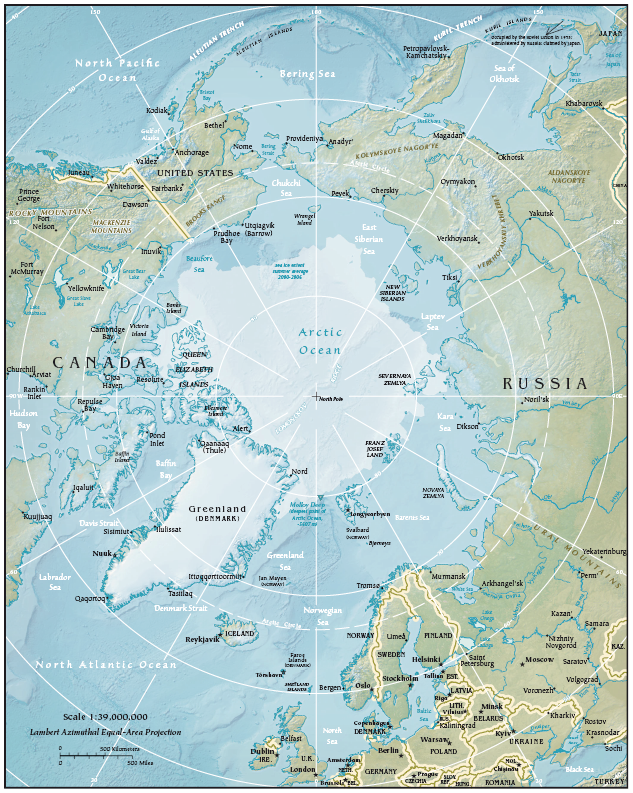
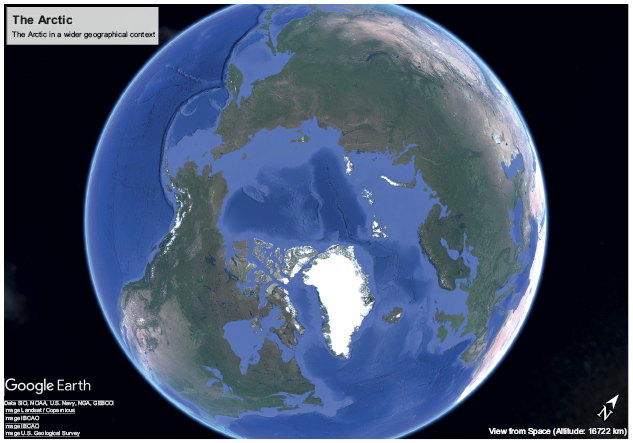
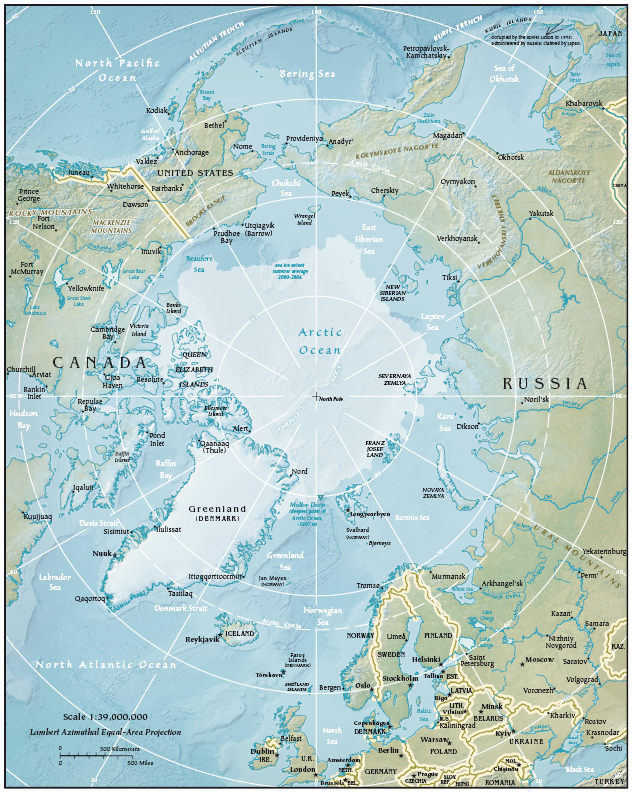
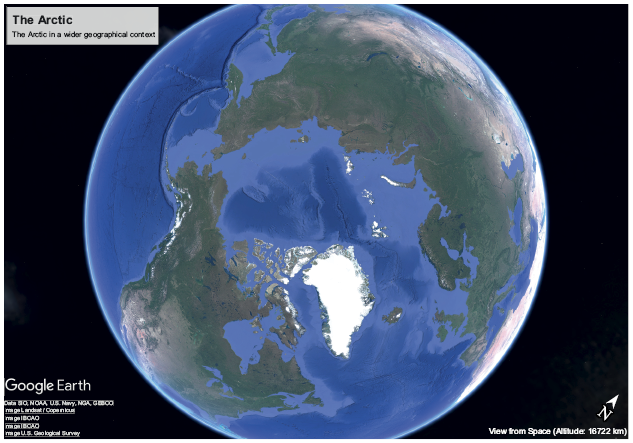
For clarity, Figures 1.1 and 1.2 set the geographical parameters for this book. This book operates under the most common political definition of the Arctic as the region located above, or north of, the Arctic Circle. Another common definition often used by natural scientists is the 10°C isotherm that is defined as the northern area of the globe, where the average temperature in the warmest month, July, is below 10°C/50°F. Whole books have been written about defining the regional boundaries of the Arctic. However, this book is about the political dynamics in the Arctic, not water temperatures or animal habitation. This implies that what matters for our enquiries is not how we define the Arctic but how the dominant actors that we study – states – define the Arctic. The chapters of this book will also explore how a security region is defined and constituted as more than just geography through its social processes involving actors and interests. This has a bearing on security debates and Arctic geopolitics too.
Map of the Arctic.
Map of the Arctic in a wider geographical context.
None of the eight Arctic states are located solely above the Arctic Circle. Iceland comes closest. Greenland, if it were to become independent at some point, would almost qualify, although the southernmost part of the island is actually below the Arctic Circle (not that many would question that all of Greenland is Arctic in terms of climate or identity (Jacobsen Reference Jacobsen2015)). Note the emphasis on the Kingdom of Denmark here. Denmark, in and of itself, is not even close to the Arctic Circle.Footnote 11
In turn, this book makes use of the Arctic spatial domain that has repeatedly been portrayed as an ‘emerging’ security region to question some of the fundamentals that constitute the concept of security regions and – fundamentally – international relations. This builds on developments in, or about, the Arctic for more than two decades now. During 2006–2007, reports of increasingly receding Arctic sea ice began to appear in headlines. Around approximately the same time, under the leadership of Vladimir Putin, Russia set out to reassert itself militarily, both regionally and globally. The symbolic pinnacle of this was on 2 August 2007, when a Russian expedition used a submersible to plant a Russian flag on the Arctic seabed beneath the North Pole.
However, since then, all eight Arctic states have held several high-level gatherings both separately and in the context of the regional cooperative science-oriented forum the Arctic Council where they emphasised the importance of international law, governance, and cooperation amongst Arctic states and peoples. The Arctic was even deemed an ‘exceptional’ region and used by some as the ultimate example of the virtues of region-building and transcending a state security-oriented approach to international affairs (Heininen Reference Heininen, Alfredsson, Koivurova and Stepien2013; Heininen, Exner-Pirot, and Barnes Reference Heininen, Exner-Pirot and Barnes2019; Devyatkin Reference Devyatkin2023; Olesen Reference Olesen2020).
Accordingly, some argued that a regional security complex was emerging, albeit due to environmental and human security concerns, not state or military security issues (Exner-Pirot Reference Exner-Pirot2013; Padrtová Reference Padrtová, Bátor and Ondrejcsák2015; Lanteigne Reference Lanteigne2016; Sadurski Reference Sadurski2024). Others have, however, questioned this – for example, Østhagen Reference Østhagen2021b; Jacobsen, Wæver, and Pram Gad Reference Jacobsen, Wæver, Gad, Jacobsen, Wæver and Gad2024c – albeit without delving into an in-depth study of security dynamics, geography, and notions of security regions. Some even mused on a future security community emerging around the North Pole (Keil Reference Keil2013: 252; Åtland Reference Åtland2014: 162; Schaller Reference Schaller2015).
Russia’s partial invasion of Ukraine in 2014 and its subsequent full-scale invasion in February 2022 marked watersheds in relations between the West and Russia, including in the Arctic, as cooperation was halted and sanctions on Russia were put in place. Some of the ideas about an Arctic exceptionalism and a shared community with Russia were disbanded (Bennett Reference Bennett2023; Koivurova and Shibata Reference Koivurova and Shibata2023). Other analysts emphasise that the Arctic is still a region characterised by cooperation, hoping that despite the invasion of Ukraine, low-level forms of collaboration with Russia can still be possible in the future (Spence et al. Reference Spence, Alexander, Rødven and Harriger2023; Oma Vyvial Reference Oma Vyvial2023).
The Arctic Council – briefly suspended – continues at the time of writing to function with Russian participation, albeit at a low level (Andreeva and Rottem Reference Andreeva and Rottem2024). At the same time, Russian politicians and military leaders actively seek the partnership of non-Arctic actors, China first and foremost (Stensdal and Heggelund Reference Stensdal and Heggelund2024), in order to counter all the other seven Arctic states being NATO members (after Finland and Sweden joined in 2023 and 2024 respectively).
There are, in other words, a range of different political and security dynamics at play in the field of security and geopolitics in the Arctic, both before and after 2014 – some might even seem contradictory. All the while analysts, media, politicians, and academics refer to the Arctic as one ‘region’ – as it has been more than a dozen times already in this chapter. Especially since 2014, as rhetoric and statements concerning Arctic security threats have intensified, there has been a general tendency to describe security challenges as coherent across the region. Scholars interested in this ‘new’ region
often describe the Arctic as one geographical space where states’ various types of security interests are inherently intertwined.Footnote 12
This Book and the ‘Regional’ Level
This book is about the intersection of security dynamics in the Arctic, and about a critical examination of the labels often used to describe those dynamics in the Arctic and in other spatial domains around the globe. On the one hand, this book is about the Arctic. More accurately, it is about the political-legal-security construction of the Arctic region and the respective Arctic states’ security interests, concerns, and entanglements; that is, their security practices. The fundamental questions that this book aims to explore and eventually answer are: What is ‘Arctic security’ as seen from a traditional state or military security perspective? Is the Arctic a ‘security region’? Do the Arctic states’ security interests overlap? And, perhaps most importantly, why does this matter?
These questions are crucial to answer because, increasingly, we are talking about Arctic security and geopolitics, but with a lack of nuance or understanding of the complex causal mechanisms that may lead to interstate conflict. Statements such as ‘Melting ice in the Arctic is unlocking a valuable natural resource base … pushing countries to jostle over territorial claims and control of the region’s shipping routes and navigation rights’ (Rozpedowski Reference Rozpedowski2024) are emblematic of how the Arctic is perceived and described. Others claim that ‘Whoever controls the Arctic has a clear strategic advantage’ (G. Johnsen Reference Johnsen2024). The US Chamber of Commerce (Sapsford Reference Sapsford2024) states that ‘Russia and the northern members of US-led NATO are manoeuvring amid the receding ice packs for strategic advantage. … Among the expected rewards are the region’s abundant resources of fish, minerals and energy, and quick maritime passage from one ocean to another.’
The main trend in these descriptions, and a range of others,Footnote 13 is that everything is mixed with everything else. Chinese interests in the Arctic region are combined with the Russian presence, the mere fact that seven states in the Arctic are NATO members, and that parts of the Arctic hold resource potential that may or may not be commercially relevant. Yet how accurate are such descriptions and narratives when it comes to the Arctic? Which part of the Arctic is China investing in? Where is Russia increasing its presence, and for what purpose and with what goal?
This book questions the assumptions underpinning such descriptions and the concerns over security and geopolitics that derive from them. There is no doubt that there are a range of relevant security issues in the North and that geopolitics defines many Arctic issues. However, one goal here is to provide better accuracy and introduce nuance to debates about ‘Arctic geopolitics’ and the role of the Arctic space in global affairs.
On the other hand, by using the Arctic as a case study, we can better understand the notions of geopolitics, security, and regions more broadly, merging all this into the academic concept of security regions (e.g., Kelly Reference Kelly2007). An interesting concept in and of itself, the idea of ‘security’ issues and interests bounded by a region (either defined by geography, by political constructs, or a combination of both) – security regions or ‘regional security complexes’ – have oscillated in and out of fashion since they were made popular by primarily Buzan and Wæver in the late 1990s. The focus here is not only on evaluating the relevance of theories concerned with security regions but also examining their empirical accuracy.
To do so, it is helpful to lean on separating into ‘levels of analysis’, a basic concept in the studies of international relations as formulated by Kenneth Waltz in 1959. In his book Man, the State, and War, he classified theories of the causes of war into three categories, or levels of analysis. Waltz refers to these levels as ‘images’. The first image is the individual level of analysis, whereas the second is the state itself. A spotlight on the state is about understanding states’ foreign policy decisions and their specific security strategies. The third image is the framework of world politics. Whereas the first and second images are the determining forces that create the policies of a state, it is primarily the third image where the cause of war is found; namely, that the anarchic structure of the international system is the root cause of war.Footnote 14
However, we cannot get very far into unpacking security concerns and practices with only an emphasis on the individual, the state, or the global system of states. How can we explain that the same actor (state) might behave differently across different geographic parts of the world? How do we theorise and explain the intensity of interests and actions within certain spaces close to the state in question, but with effects or practices that dissipate the further removed we are from that very state? Hence, a range of scholars (as explored further in the Chapter 2) have argued for and examined the regional level in studies of security policy. The decisive factor in such studies is geographical proximity, that is, states that are geographically close to each other have more intense interactions (positive and negative) than those located on different continents.
The question driving this book is fundamentally what role and limitations geographic factors – primarily revolving around proximity to other states – pose for states, as they orient themselves in the immediate geographic vicinity. The focus is on unpacking and sorting the different political and security dynamics that take place across the Arctic today and have been taking place over the last two decades since the emergence of the Arctic on the international (geo)political agenda. Leaning on a basic distinction between levels of analysis, separating between the national, regional, and global levels, but also – crucially – the ‘subregional’, allows for a more granular understanding of Arctic security dynamics, but also for a more accurate assessment of what are actually regional dynamics, and how these intertwine with state security concerns, geography, and geopolitics.
The book thus positions itself somewhere between a desire to explain the nuances and empirics of one particular part of the world – the Arctic – in terms of state behaviour and geopolitics (to the extent that is objectively possible), and the theorisation of international relations and security studies – directly answering the challenge put forth in 2003 by Buzan and Wæver when they developed a rather complex and comprehensive theory to attempt to understand all security regions.Footnote 15 This approach builds on international security studies, political geography, and legal studies. However, the scope of this book is the state and its security practices, thus this book is closer to foreign policy analysis approaches than to more broad-ranging international relations theories.
Ultimately, the argument here is that if we want to understand a state’s security actions, interests, and concerns (or at least an approximation of these), the typical way of analysing regional security complexes is too broad and limited in its explanatory leverage. A fundamental premise here is that we must take the role of, and the constraints defined by, geography seriously, and scale down what ‘regions’ states operate in. Most states are not great powers or superpowers and do not operate or have security entanglements in several geographic regions: they are bound to their immediate vicinity. However, that vicinity is arguably smaller than the typical regional level often employed by scholars and analysts alike.
Therefore, to understand states’ security concerns and related policies and actions, we must take the regional level seriously but also scale down to a subregional level – that is, less than regional (at least in the way region is commonly used), but still more than just the national. ‘Western Europe’, ‘North America’, or ‘Southeast Asia’ become too extensive and nondescript (Friis Reference Friis2021).Footnote 16 These geographic domains are undoubtedly relevant, but they are too broad and extensive when trying to distil the linkages between state security practices and the regional aspect whether linked to geography or the construction of political regions. China might be a constant security factor across Southeast Asia for all other related states, but China’s policies and actions differ in their scope and intensity within that very space. The same goes for the USA in North America. Despite still being the most powerful country in world measured according to traditional power characteristics, US security policies and practices are not uniform from the Gulf of Mexico to the Hudson Bay, nor is it possible for them to be due to constraints linked to traditional geographic traits such as sheer distance and topography.
However, this book is not arguing that all that matters for understanding state security practices is the regional, or more limited subregional, domain. The subregional level of analysis must naturally be conceived in conjunction with the systemic and national levels of analysis, as studying only the regional or subregional provides a lopsided picture of the importance of that level of analysis. The key argument, however, is that we utilise this bottom-up approach alongside an understanding of how global dynamics shape specific regions and subregions and how national and domestic politics in states that are located in that geographic space conceive of and act according to their security interests.
In turn, this book argues we need to combine an analysis of four levels in order to understand the geopolitics of a specific part of the world: the global (the system level), the regional (in this instance, the Arctic, level), the national (the state level), and finally the subregional (less-than-regional, more-than-national level). The focus is on mapping the regional, namely, the Arctic. But this book also tries to combine different approaches to regions. Conflating different dynamics and issues at various levels is often the root cause of many erroneous descriptions of the Arctic as an arena for geopolitical issues or security concerns; although these do exist, we must distinguish between different types of issues and concerns.
It is the interconnectedness and co-constitution of these levels that can help us better understand why states act as they do, when it comes to security practices, in a particular geographic domain. In turn, the Arctic as a case study exhibits the importance of geographic factors and a need to scale down the regional into something less than regional but more than national. Security dynamics linked to the Arctic and Arctic states take place in subregional security complexes where the most relevant – from a security point of view – are the Barents subregional security complex (Northern Fennoscandian region) and the Beringia subregional security complex (North Pacific region). Moreover, in contrast to a core tenet of regional security complex theory, which states that complexes do not overlap, this examination of the Arctic with state security as the primary concern shows how the subregions do indeed overlap. This becomes particularly apparent when studying the Arctic-specific security approaches by relevant states – here with case studies of Norway and the USA.
At the same time, the Arctic as a regional construct has been developing for decades, spurring circumpolar cooperation and even actions, including in the realm of state security. This in turn means we cannot ignore a broader regional scope and related region-building as both an arena for state interactions and its possible role in shaping state security agendas. This should in turn inspire additional studies of other scaled-down subregional security complexes and related security dynamics across different levels and geographies. How about further performing the same empirical analysis of security practices in, say, the Caucasus region (Oskanian Reference Oskanian2013), or around the East China Sea (Midford and Østhagen Reference Midford and Østhagen2024)?
The forthcoming chapters of this book explore various dimensions of Arctic geopolitics, security, and regional dynamics. First, Chapter 2 delves into the relationships between security, geography, and geopolitics, outlining the significance of the regional dimension and so-called regionalism in understanding state security practices and dynamics in given spatial domains.
Chapter 3 starts with the level analysis of security dynamics and practices by looking at the regional level – what does ‘the Arctic’ mean in terms of the ideational construction of a region and subsequent state actions? This chapter looks at efforts to construct an Arctic region and notions of Arctic exceptionalism and cooperation by tracing the evolution of regional governance post the Cold War.
Chapter 4 examines global factors impacting Arctic security practices, including climate change, naval developments, and the rising influence of China, alongside historic and contemporary responses from Russia and NATO. What are the international issues (or systemic developments if you will) that impact the Arctic states’ security practices? To what extent are they pan-Arctic in their impact?
Chapters 5 and 6 shift to national perspectives, contrasting the unique security approaches among Arctic states. This means asking: What are the security practices of particular Arctic states and how do they relate to the previous levels explored? These two chapters place particular weight on Norway and the USA and how they manage relations with Russia and China, as examples of two very different, but also – in an Arctic context – somewhat similar states.
Chapter 7 draws some preliminary conclusions based on the three-level analysis performed in Chapters 3–6 and then concludes we must place weight on a fourth level – the subregional. It goes on to analyse the two prominent subregional security complexes in the Arctic, namely the Barents and Bering Seas, to reveal intricate security interactions.
Chapter 8 expands on the findings from the previous chapters and attempts to answer whether the Arctic is a ‘region’, or even a ‘security region’, and why that matters to both academic studies and those interested in the Arctic in general. This chapter also analyses the various ways in which we can understand the Arctic and what this means for our use of the region label in geopolitics more generally.
Finally, Chapter 9 concludes by reflecting on the implications of developments in these subregions on Arctic security dynamics, suggesting that recognising the region’s complexities while also upholding the artificial Arctic construct can yield advantages amidst looming tensions. That in turn holds relevance not only for those who want to move beyond theorising international affairs and impact the very state practices we study, but also for other subregional parts of the world in need of fewer one-liners and more nuanced and lengthy descriptions.

 Open access