


D. R. Viete, G. J. H. Oliver and S. A. Wilde comment: First, we would like to commend Aoki et al. (Reference Aoki, Windley, Maruyama and Omori2013) on a careful study and thought-provoking manuscript. Their interpretation of the Barrovian metamorphism as a fundamentally retrograde feature offers a refreshing alternative to the more conventional ‘peak-metamorphic’ models.
Aoki et al. (Reference Aoki, Windley, Maruyama and Omori2013) suggested that high-grade rocks from the eastern Grampian Terrane, Scotland, signify high-pressure/high-temperature (1.2–1.4 GPa, ≥770–800°C) metamorphism during the early stages of the Grampian Orogeny. These granulite-facies rocks were overprinted during the Grampian Orogeny by the amphibolite-facies Barrovian metamorphism. Here, with consideration of time scales and heat sources available for metamorphism during the Grampian Orogeny, we argue that an early Grampian high-temperature metamorphism is highly implausible. The results of structural and geochronological work from the literature provide support for another interpretation of the origins of the Aoki et al. (Reference Aoki, Windley, Maruyama and Omori2013) gneisses: rather than forming during the Grampian Orogeny, they represent Precambrian basement to the Dalradian Supergroup. We present a new latest Mesoproterozoic (1003±6 Ma) U–Pb age for migmatization of the Cowhythe Gneiss, which corroborates the Precambrian basement model for some high-grade metamorphic rocks of the eastern Grampian Terrane.
1. Results and interpretations of Aoki et al. (Reference Aoki, Windley, Maruyama and Omori2013) and background information
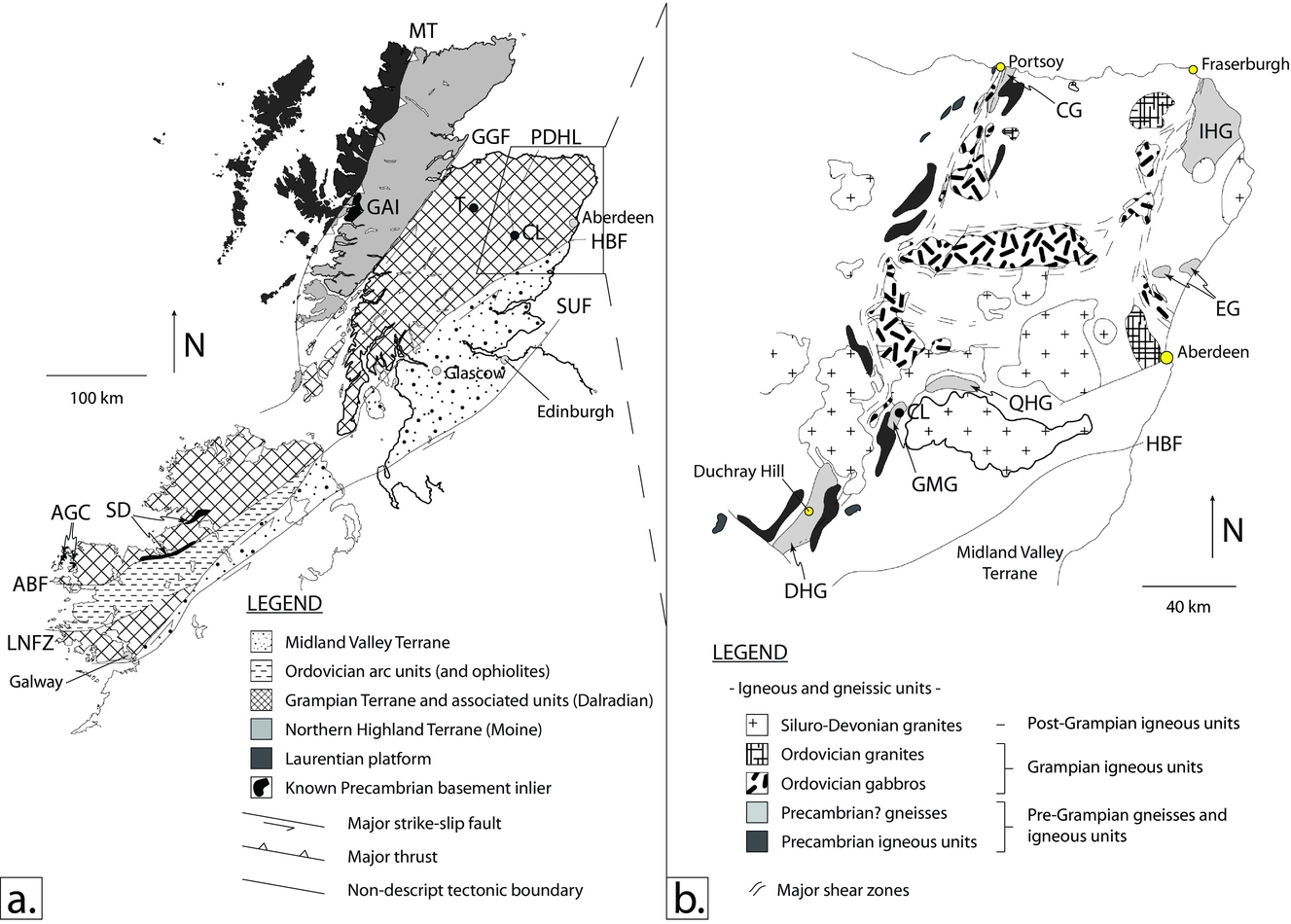
The study of Aoki et al. (Reference Aoki, Windley, Maruyama and Omori2013) focused on garnetite lenses within garnet amphibolites from the region of Cairn Leuchan, above Glen Muick, in the Grampian Highlands of Scotland (location shown on Fig. 1). These rocks experienced a high-pressure granulite-facies (HGR) metamorphism and later amphibolite-facies (AM) metamorphism (Aoki et al. Reference Aoki, Windley, Maruyama and Omori2013).
Map of northern United Kingdom and Ireland showing (a) distribution of major tectonic boundaries and terranes, known Precambrian basement inliers and locations of interest; and (b) distribution of the major shear zones and magmatic and gneissic bodies of the eastern Grampian Terrane, Scotland. Shear zones and faults after Ashcroft et al. (Reference Ashcroft, Kneller, Leslie and Munro1984), Fettes et al. (Reference Fettes, Graham, Harte and Plant1986), Goodman (Reference Goodman1994) and Dewey (Reference Dewey2005). Magmatic and gneissic bodies after Read (Reference Read1955), Goodman (Reference Goodman1994), Brewer et al. (Reference Brewer, Storey, Parrish, Temperley and Windley2003), Flowerdew & Daly (Reference Flowerdew and Daly2005) and MacAteer et al. (Reference MacAteer, Daly, Flowerdew, Whitehouse and Kirkland2010). ABF – Achill Beg Fault; AGC – Annagh Gneiss Complex; CG – Cowhythe Gneiss; CL – Cairn Leuchan; DHG – Duchray Hill Gneiss; EG – Ellon Gneiss; GAI – Glenelg–Attadale Inlier; GGF – Great Glen Fault; GMG – Glen Muick Gneiss; HBF – Highland Boundary Fault; IHG – Inzie Head Gneiss; LNFZ – Lough Nafooey Fault Zone; MT – Moine Thrust; PDHL – Portsoy–Duchray Hill Lineament; QHG – Queen's Hill Gneiss; SD – Slishwood Division; SUF – Southern Uplands Fault; T – Tomatin.
The early HGR metamorphism produced mineral assemblages of grt+amp+qtz+pl+cpx±ep in the Cairn Leuchan garnetites and garnet amphibolites (Aoki et al. Reference Aoki, Windley, Maruyama and Omori2013). Thermodynamic modelling of metamorphic phase equilibria and the composition of garnet (Xalm, Xgr), clinopyroxene (Xaug) and amphibole (XCa-amph) – using PERPLEX v.6.6.6 (Connolly, Reference Connolly2005) and an update of the thermodynamic dataset of Holland & Powell (Reference Holland and Powell1998) – yielded pressure–temperature (P–T) estimates for the HGR metamorphism in the range 1.2–1.4 GPa and 770–800°C (Aoki et al. Reference Aoki, Windley, Maruyama and Omori2013). Additional thermodynamic modelling using THERMOCALC v.3.33 (Powell & Holland, Reference Powell and Holland1988) and the same thermodynamic dataset gave higher estimates of T to c. 900°C (Aoki et al. Reference Aoki, Windley, Maruyama and Omori2013). Thus, the HGR metamorphism of Aoki et al. (Reference Aoki, Windley, Maruyama and Omori2013) involved conditions approaching those for ultrahigh-temperature metamorphism (i.e. >900°C at 0.7–1.3 GPa; Harley, Reference Harley, Treloar and O'Brien1998).
The late AM metamorphism produced mineral assemblages of grt+amp+qtz+pl±ep in the garnetites and garnet amphibolites (Aoki et al. Reference Aoki, Windley, Maruyama and Omori2013). Absence of cpx from the AM metamorphic assemblage is suggestive of P–T conditions for the metamorphic overprint in the range 0.5–0.8 GPa and 580–700°C (Aoki et al. Reference Aoki, Windley, Maruyama and Omori2013).
Aoki et al. (Reference Aoki, Windley, Maruyama and Omori2013) published 206Pb/238U ages obtained from laser ablation inductively coupled plasma mass spectrometry (LA-ICP-MS) analysis of metamorphic zircons from the Tomatin eclogitic amphibolite of the central Grampian Highlands (location shown on Fig. 1a). The Tomatin eclogitic amphibolite has typical mineralogy for a garnet amphibolite (grt+hbl+qtz+pl), but also contains symplectic intergrowths of cpx and pl (Baker, Reference Baker1986). Baker (Reference Baker1986) considered the cpx within the cpx-pl symplectites as a remnant of a previously more widespread grt-cpx-qtz assemblage, which formed during an early (probably Precambrian in Baker's view) high-P metamorphic episode.
The 206Pb/238U analyses of Aoki et al. (Reference Aoki, Windley, Maruyama and Omori2013) produced ages of 446±32 Ma and 485±37 Ma, which overlap with the Grampian Orogeny. They took these ages to date a late AM (Barrovian-type) overprint in the Tomatin rocks. Supposing that the HGR metamorphism at Cairn Leuchan represented early-stage retrogression of eclogite-facies assemblages similar to those preserved at Tomatin – and with reference to the many global examples of Barrovian-type metamorphic overprinting of high-P (eclogite- and blueschist-facies) metamorphism – Aoki et al. (Reference Aoki, Windley, Maruyama and Omori2013) assumed that the HGR and AM metamorphisms at Cairn Leuchan represented two metamorphic episodes along a single Grampian-age retrogression path.
Aoki et al. (Reference Aoki, Windley, Maruyama and Omori2013) related the late AM metamorphism to the Barrovian metamorphism (Barrow, Reference Barrow1893, Reference Barrow1912), a brief thermal event that occurred at c. 475–465 Ma (Oliver et al. Reference Oliver, Chen, Buchwaldt and Hegner2000; Baxter, Ague & DePaolo, Reference Baxter, Ague and DePaolo2002; Viete et al. Reference Viete, Oliver, Fraser, Forster and Lister2013; Vorhies, Ague & Schmitt, Reference Viete, Oliver, Fraser, Forster and Lister2013) during the Grampian Orogeny. If the earlier HGR metamorphism at Cairn Leuchan was also Grampian – as Aoki et al. (Reference Aoki, Windley, Maruyama and Omori2013) assert – it occurred after initial Grampian collision and crustal thickening at c. 488 Ma (Chew, Graham & Whitehouse, Reference Chew, Graham and Whitehouse2007; Viete et al. Reference Viete, Oliver, Fraser, Forster and Lister2013), but before the Barrovian metamorphism.
Thermodynamic modelling of phase equilibria and mineral geochemistry for blueschist rocks from South Achill, western Ireland, has yielded P–T estimates of 0.9–1.2 GPa and 415–505°C for Grampian blueschist-facies (BS) metamorphism (Chew et al. Reference Chew, Daly, Page and Kennedy2003). These P estimates are similar to those for the HGR metamorphism at Cairn Leuchan. However, T for the Irish BS metamorphism was 300–400°C cooler. Temperatures of >650–700°C are sufficient to cause partial melting of metasedimentary rocks, which form the majority of rock outcrop in the Glen Muick region (Baker, Reference Baker1985). Such partial melting processes are strongly endothermic, meaning that T of 770–800°C (and possibly 900°C) for the HGR metamorphism would have required substantially greater heat input when compared to the BS metamorphism of Chew et al. (Reference Chew, Daly, Page and Kennedy2003).
So, how did the HGR gneisses of the Glen Muick region get so hot? Within the context of the Grampian Orogeny, any valid explanation must involve rapid heating following initial Grampian collision, perhaps with some heat inherited from a pre-Grampian thermal history. Below, we discuss the validity of this metamorphic heating scenario in light of time scales and heat sources available during the Grampian Orogeny. Following that, we propose what we believe to be a more plausible explanation for the HGR metamorphism: that it is much older than Aoki et al. (Reference Aoki, Windley, Maruyama and Omori2013) have supposed. We refer to the geological literature on the Grampian Highlands and provide geochronological evidence in support of this alternative hypothesis.
2. Could rapid, early Grampian heating have produced the HGR gneisses?
A summary of all known ages for Grampian magmatism is provided by Viete et al. (Reference Viete, Oliver, Fraser, Forster and Lister2013, section 4.1.2, appendix B supplementary file). Magmatism during the Grampian Orogeny began with the emplacement of both mafic and felsic magmas from c. 475 Ma. Bimodal magmatism continued until c. 470 Ma. Exclusively felsic magmatism persisted from c. 470 Ma until c. 465 Ma. There is no evidence for any igneous activity during the earliest phase of the Grampian Orogeny (c. 488–475 Ma) prior to the Barrovian metamorphism. Grampian-age advection of mantle heat can therefore be rejected as a heat source for the early HGR metamorphism of Aoki et al. (Reference Aoki, Windley, Maruyama and Omori2013).
Fettes et al. (Reference Fettes, Graham, Harte and Plant1986) and Goodman (Reference Goodman1994) mapped a wide zone of highly sheared rocks and thinly sliced tectonostratigraphy through the region of Glen Muick, which they considered a continuation of the Portsoy Shear Zone of Read (Reference Read1955) and more extensive shear zone network of Ashcroft et al. (Reference Ashcroft, Kneller, Leslie and Munro1984). The highly deformed nature of the rock in the region of Glen Muick raises the prospect of mechanical heating. Mechanical heating within rocks undergoing pure or simple shear is calculated as the product of shear stress and strain rate, for which typical maximum values for highly deformed gneisses might approach 50 MPa (Yuen et al. Reference Yuen, Fleitout, Schubert and Froidevaux1978) and 10−13 s−1 (Pfiffner & Ramsay, Reference Pfiffner and Ramsay1982), respectively. This could produce significant heating rates of the order 5 μW m−3. However, mechanical heating rates can only be maintained for temperatures at which the shear strength of rock is significant; mechanical heating to beyond 500–700°C is self-limiting due to the onset of partial melting and/or emergence of ductile deformation processes and associated rock strength decrease (Toksöz & Bird, Reference Toksöz and Bird1977; Yuen et al. Reference Yuen, Fleitout, Schubert and Froidevaux1978). Considering the high values of T (770–800°C and possibly 900°C) for the HGR metamorphism (Aoki et al. Reference Aoki, Windley, Maruyama and Omori2013), mechanical heating cannot have been significant.
Radioactive heating rates for high-grade granulites take a mean value of 1.5 μW m−3, but can be as high as 10 μW m−3 for some examples (Vilà, Fernández & Jiménez-Munt, Reference Vilà, Fernández and Jiménez-Munt2010). Despite the close attention paid to the Highlands of Scotland by the geological community, there is no published evidence for rocks within the Grampian Terrane that are particularly enriched in heat-producing elements. For radiogenic heating rates of 1.5 μW m−3 and instantaneous doubling of crustal thickness, numerical modelling has shown that time scales of 30–40 Ma can only produce a T increase of the order 100°C (Toksöz & Bird, Reference Toksöz and Bird1977; England & Thompson, Reference England and Thompson1984; Clark et al. Reference Clark, Fitzsimmons, Healy and Harley2011). As outlined above, recent geochronological constraints on the timing of the Grampian Orogeny restrict the HGR metamorphism of Aoki et al. (Reference Aoki, Windley, Maruyama and Omori2013) to a 13 Ma window after 488 Ma (see Viete et al. Reference Viete, Oliver, Fraser, Forster and Lister2013 and references therein). This timeframe is too brief to allow significant crustal heating by heat conduction from the mantle with moderate rates of internal radioactive heating.
Johnson & Strachan (Reference Johnson and Strachan2006) suggested that much of the heat for thickening-related metamorphism may be inherited from a high heat flow setting immediately prior to the onset of orogenesis (e.g. a back-arc basin). This seems a reasonable model for deep metamorphism at modest values of T, as for the Grampian BS metamorphism of Chew et al. (Reference Chew, Daly, Page and Kennedy2003). However, for the HGR metamorphism of Aoki et al. (Reference Aoki, Windley, Maruyama and Omori2013), initial T (prior to Grampian Orogeny) would have to have been >700°C and pre-Grampian partial melting and/or igneous activity would be expected. A survey of the literature shows no immediately pre-Grampian metamorphic, migmatitic or igneous ages. The ‘inherited heat’ scenario is therefore also ruled out.
With a lack of a valid source for Grampian metamorphic heating within the 13 Ma window available for the HGR metamorphism, we are not convinced that the HGR metamorphism is in fact Grampian in age.
3. Could the HGR gneisses be Precambrian?
The rich geological literature from Scotland raises the possibility of an alternative explanation for the origin of the HGR metamorphism of Aoki et al. (Reference Aoki, Windley, Maruyama and Omori2013): that it is Precambrian in age.
In the regions of Cromar, Deeside and Glen Muick of the SE Grampian Highlands, Read (Reference Read1927, Reference Read1928) mapped an extensive ‘injection complex’ he named the Queen's Hill Group. Read (Reference Read1928) considered a similar ‘injection complex’ that forms the Duchray Hill Gneiss to be a possible SW extension of the Queen's Hill Group. The location of the Glen Muick and Queen's Hill gneisses (which form the Queen's Hill Group) and the Duchray Hill Gneiss is shown in Figure 1b.
The Queen's Hill Group comprises intermixed micaceous schists, quartzites and feldspathic gneisses, which ‘intrude’ hornblende basic igneous rocks (Read, Reference Read1927, Reference Read1928). The lithologies studied by Aoki et al. (Reference Aoki, Windley, Maruyama and Omori2013) are consistent with those of the Queen's Hill Group of Read (Reference Read1927, Reference Read1928) and their location (at Cairn Leuchan) corresponds precisely with the location of the Queen's Hill Group, as mapped by Read (Reference Read1928, plate II) (see Fig. 1b).
Read's extensive mapping of the Grampian Highlands revealed a tectonic dislocation that separates high-grade gneissic packages (including the Cowhythe, Duchray Hill, Ellon, Glen Muick and Queen's Hill Gneisses of Fig. 1b) from significantly lower-grade rocks (Read, Reference Read1955). Read (Reference Read1955) proposed that this dislocation (mapped first as the Boyne Line on the E–W-trending Banffshire coast and then extended south and east) marked the tectonic removal of the upper limb of a regional structure he called the Banff Nappe. According to the model of Read (Reference Read1955), the Cowhythe, Duchray Hill, Ellon, Glen Muick, Inzie Head and Queen's Hill gneisses (Fig. 1b) are inliers: exposures of the highly metamorphosed core of the Banff Nappe from beneath low-grade upper Dalradian metasediments.
The work of Ashcroft et al. (Reference Ashcroft, Kneller, Leslie and Munro1984), Fettes et al. (Reference Fettes, Graham, Harte and Plant1986, Reference Fettes, Leslie, Stephensons and Kimbell1991) and Goodman (Reference Goodman1994) revealed a geographical association between: (1) a network of long-lived shear zones in the NE of the Grampian Terrane (including the Boyne Line and its along-strike equivalents); (2) the Cowhythe, Duchray Hill, Ellon, Glen Muick, Inzie Head and Queen's Hill gneisses; (3) pre- and syn-Grampian igneous rocks; and (4) thinly sliced lithostratigraphy. The major branch of this network of narrow and extensive geological features (highlighted on Fig. 1b by the location of ‘major shear zones’) has come to be known as the Portsoy–Duchray Hill Lineament (PDHL). The concentration of c. 600 Ma ‘Dalradian’ igneous bodies along the PDHL (and associated shear zones) suggests that the history of the shear zone network pre-dates the Grampian Orogeny (see Viete et al. Reference Viete, Richards, Lister, Oliver, Banks, Law, Butler, Holdsworth, Krabbendam and Strachan2010). Geological mapping in the region of Portsoy (location shown on Fig. 1b) has demonstrated differing geological histories in the various lithostratigraphic units that form the PDHL there, in addition to a complex history of alternating (thrust v. normal) shear movements along the PDHL during the Grampian Orogeny (Viete et al. Reference Viete, Richards, Lister, Oliver, Banks, Law, Butler, Holdsworth, Krabbendam and Strachan2010). Of particular importance for this discussion is the observation that the Cowhythe Gneiss preserves a significantly more complex structural history than the lower-grade Dalradian sediments that surround it, which includes a (granulite-facies) migmatitic history that predates both Dalradian sedimentation and the Grampian Orogeny (see Ramsay & Sturt, Reference Ramsay, Sturt, Harris, Holland and Leake1979; Viete et al. Reference Viete, Richards, Lister, Oliver, Banks, Law, Butler, Holdsworth, Krabbendam and Strachan2010, table 1, p. 139).
Sturt et al. (Reference Sturt, Ramsay, Pingle and Teggin1977) published Rb–Sr whole-rock ages of 724±120 Ma and 691±39 Ma for the Ellon and Inzie Head gneisses, respectively. These ages, partnered with the results of detailed structural mapping, caused Ramsay & Sturt (Reference Ramsay, Sturt, Harris, Holland and Leake1979) to reinterpret the Cowhythe, Ellon, Queen's Hill and Inzie Head gneisses (and related gneissic rocks) as basement to the Dalradian Supergroup. They proposed that a dislocation represented by the Boyne Line on the E–W-trending Banffshire coast was responsible for ‘uncoupling’ of Dalradian cover from its gneissic basement along the full extent of the shear zone network that includes the PDHL.
Various phases of shear activity within the broad zone of shear that forms the PDHL can account for isolation of thin basement gneiss bodies. Viete et al. (Reference Viete, Richards, Lister, Oliver, Banks, Law, Butler, Holdsworth, Krabbendam and Strachan2010) argued that shear movements juxtaposed basement rocks and their Dalradian cover (as Ramsay & Sturt, Reference Ramsay, Sturt, Harris, Holland and Leake1979 envisioned), but that subsequent movements then stranded these thin slices of gneissic basement within the PDHL. According to their model, the PDHL was a ‘shuffle zone’ whose long and complex deformation history was responsible for the creation of a zone of thinly sliced lithostratigraphy containing various rock packages with markedly differing age and provenance. Aoki et al. (Reference Aoki, Windley, Maruyama and Omori2013) state that the contacts between the amphibolitic gneisses they studied at Cairn Leuchan and the metasedimentary gneisses that enclose them are not deformed. However, this does not preclude assembly of the gneissic package during the Proterozoic, and later emplacement of the package within a ‘shuffle zone’ during the Grampian Orogeny.
Interestingly, complex structural histories and anomalously high P–T conditions (when compared to neighbouring Dalradian metasediments) are also preserved in some gneisses of the Irish Grampians (Sutton & Max, Reference Sutton and Max1969; Max & Long, Reference Max and Long1985; Sanders, Daly & Davies, Reference Sanders, Daly and Davies1987; Kennedy & Menuge, Reference Kennedy and Menuge1992; Flowerdew & Daly, Reference Flowerdew and Daly2005; MacAteer et al. Reference MacAteer, Daly, Flowerdew, Whitehouse and Kirkland2010). These gneisses (including those of the Annagh Gneiss Complex and Slishwood Division; Fig. 1a) have been interpreted as Precambrian basement inliers within the Irish equivalent of the Grampian Terrane, Scotland.
Below, we present previously unpublished data in support of a 1003±6 Ma (latest Mesoproterozoic) age for migmitization of the Cowhythe Gneiss. These results lend support to the models of Ramsay & Sturt (Reference Ramsay, Sturt, Harris, Holland and Leake1979) and Viete et al. (Reference Viete, Richards, Lister, Oliver, Banks, Law, Butler, Holdsworth, Krabbendam and Strachan2010), which treat some gneissic units within the PDHL (and associated shear zones) as stranded slivers of Precambrian basement to the Dalradian.
4. U–Pb SHRIMP ages for migmatization of the Cowhythe Gneiss
Sample PO5, a highly strained anatectic migmatite, was sampled from the Cowhythe Gneiss on the east side of Links Bay, Portsoy [GPS NJ 59556630]. The rock comprises significant quartz-feldspar leucosomes that delineate thicker layers of biotite-rich mesosome (which themselves have thin leucosome layers) (Fig. 2a). The rock is interpreted to have formed by partial melting of a pelitic protolith, with significant deformation during and/or following migmatization.
(a) Section of Cowhythe Gneiss sample PO5 [GPS: NJ 59556630] showing examples of leucosome and mesosome layers used for samples PO5a and PO5b, respectively; (b) cathodoluminescence (CL) and secondary electron (SE) images of two euhedral, zoned garnets from sample PO5a (with ages and 1σ uncertainties); and (c) 206Pb/238U v. 207Pb/235U concordia plots for all U–Pb analyses performed on sample PO5a and PO5b (black ellipses on plot on the right represent analyses used in calculation of the Cowhythe Gneiss age).

For geochronological analysis, thick leucosome layers were removed from the bulk sample using a diamond saw to separate the dominantly leucosome material (sample PO5a) from the remaining mesosome (with some leucosome) material (sample PO5b) (Fig. 2a). Samples PO5a and PO5b were crushed separately and zircons were extracted from each using conventional Wilfley table, heavy liquid and magnetic separation techniques. The zircon grains were mounted in epoxy with Curtin University standard CZ3 (Pidgeon et al. Reference Pidgeon, Fufaro, Kennedy, Nemchin, van Bromswjk and Todt1994). The epoxy disks were ground and polished to expose the grains, then cleaned and coated in gold. Cathodoluminescence (CL) and secondary electron (SE) imaging was performed on the zircon grains to reveal internal zoning and the presence of cracks and inclusions, respectively (see example images in Fig. 2b). All isotopic analyses were performed using the SHRIMP II at Curtin University and the approach outlined in Oliver, Wilde & Wang (Reference Oliver, Wilde and Wang2008). Data reduction also followed the methodology of Oliver, Wilde & Wang (Reference Oliver, Wilde and Wang2008).
In total, 55 SHRIMP U–Pb analyses were performed on zircons from samples PO5a and PO5b. Individual concordant ages range from c. 3000 Ma (Archean) to c. 1000 Ma (latest Mesoproterozoic) (Fig. 2c). Zircon grains that yielded 3000–1300 Ma (Archean to middle Mesoproterozoic) ages were invariably well rounded and interpreted to be detrital in origin. The sedimentary protolith for the Cowhythe Gneiss was therefore deposited no earlier than 1300 Ma. The post-1300 Ma zircon population is igneous in character; grains are small and euhedral with prominent oscillatory zoning (Fig. 2b) and are more common in the leucosome material than the mesosome material, accounting for 23 of 33 analyses from PO5a but only 14 of 22 analyses from PO5b. Fifteen analyses of these small igneous grains form a discrete 1025–975 Ma (latest Mesoproterozoic – earliest Neoproterozoic) age population with a mean 206Pb/238U age of 1003±6 Ma (2σ uncertainty, n = 15, MSWD = 0.99, probability of fit = 0.46) (Fig. 2c). The 1300–1025 Ma ages define an age array (see Fig. 2c) that is interpreted to signify inheritance in igneous zircon grains grown dominantly at 1003±6 Ma. The 1003±6 Ma age is interpreted to date partial melting (migmatization) of a metasedimentary protolith during the 1090–980 Ma Grenville Orogenic event (Rivers, Reference Rivers1997). The lack of any Ordovician zircons within the Cowhythe Gneiss precludes Grampian gneissification and the unit is interpreted as latest Mesoproterozoic basement to the Dalradian. A single-grain 206Pb/238U age of 988±23 Ma (2σ), obtained for a zircon from the Inzie Head Gneiss during the same SHRIMP work that yielded the Cowhythe Gneiss ages, provides additional support for interpretation of the some of the Grampian Terrane gneisses as Precambrian basement to the Dalradian.
Latest Mesoproterozoic to earliest Neoproterozoic ages have been published for the eastern Glenelg–Attadale Inlier of the Northern Highland Terrane, NW Scotland (location on Fig. 1a). These ages include the 1082±24 Ma and 1010±13 Ma Sm–Nd whole-rock-garnet-clinopyroxene ages of Sanders, van Calsteren & Hawkesworth (Reference Sanders, van Calsteren and Hawkesworth1984), the 995±8 Ma 206Pb/238U zircon age of Brewer et al. (Reference Brewer, Storey, Parrish, Temperley and Windley2003) and the 971±71 Ma U–Pb and 945±54 Ma Pb/Pb whole-rock-titanite-feldspar ages of Brewer et al. (Reference Brewer, Storey, Parrish, Temperley and Windley2003). Similar ages of 1070±70 Ma (Rb–Sr whole rock: Max & Sonet, Reference Max and Sonet1979), 995±6 Ma (U–Pb zircon: Daly, Reference Daly1996) and 963±8 Ma (207Pb/206Pb titanite: Daly & Flowerdew, Reference Daly and Flowerdew2005) have been obtained for migmatization/metamorphism of the Annagh Gneiss Complex, NW Ireland (location on Fig. 1a). These ages provide robust evidence for Grenville tectonothermal activity in Scotland and Ireland and support for Grenville migmatization of the Cowhythe Gneiss. We suggest that the HGR metamorphism of Aoki et al. (Reference Aoki, Windley, Maruyama and Omori2013) should be reinterpreted as evidence of a Precambrian pre-history for the Glen Muick Gneiss, rather than proof of high-pressure granulite-facies metamorphism during the Grampian Orogeny (for which no evidence of acceptable sources of metamorphic heat are available).
In conclusion, models for high-T metamorphism during the early stages of the Grampian Orogeny (prior to c. 475 Ma) cannot be supported from the available geological evidence. New U–Pb ages for Precambrian migmatization of units within the Grampian Terrane were presented. We believe the rocks studied by Aoki et al. (Reference Aoki, Windley, Maruyama and Omori2013) are not Dalradian but Grenville basement gneisses, and that the HGR metamorphism of Aoki et al. (Reference Aoki, Windley, Maruyama and Omori2013) occurred at 1003±6 Ma. Our arguments, however, do not disqualify a significant and widespread, high-P/low-T early Grampian metamorphism (see Chew et al. Reference Chew, Daly, Page and Kennedy2003). We hope this discussion does not detract from what we see as the major contribution of the Aoki et al. (Reference Aoki, Windley, Maruyama and Omori2013) study: the suggestion that in the case of the classic Barrovian metamorphism of Scotland, like so many other worldwide Barrovian-type metamorphic examples, metamorphism may have overprinted a higher-P (though lower-T) pre-history.



