


1. Introduction
This paper investigates the English language spoken by four educated Japanese speakers from an acoustic phonetic perspective. We look closely at how they pronounce and connect segments in reading a short text. Because English has the status of an international language, it is actively used for various purposes within and across countries. English speakers are therefore not necessarily native speakers but have a different first language (L1); English is a second (L2) or foreign language (FL) for them. There are increasing numbers of studies on Japanese English (JE), particularly from attitudinal and perceptual angles (e.g. Tokumoto & Shibata, Reference Tokumoto and Shibata2011; Matsuura et al., Reference Matsuura, Chiba, Mahoney and Rilling2014), but, as McKenzie (Reference McKenzie, Houghton and Rivers2013: 228) notes, there is a dearth of research that documents, or systematically characterizes, the English produced by Japanese speakers.Footnote 1
This paper begins by outlining the design of the experiment and the profiles of the Japanese speakers who participated. We then describe the acoustic features of English produced by four Japanese speakers in an experimental setting (Section 3), and discuss the implications of our findings with regard to the recent direction of research that gives priority to the non-native variety over the native variety (Section 4). Agreeing with Hino's (Reference Hino, Leitner, Hashim and Wolf2016: 41) definition of Japanese English as ‘a pedagogically designed variety of English,’ we argue that ‘nativeness,’ as defined by Moyer (Reference Moyer2013: 181), is still crucial for the development of this variety of English. This long-term process may ultimately find its way to endonormativity, a state in which a language gains relative stability. The insertion of the vowel [a] (Section 3.2.3) and devoicing of obstruents (Sections 3.1.1 and 3.2.2) may hint at this direction.
2. Recordings and participants
The data for the current study were collected from recordings which were made in a professional studio in Petaling Jaya, Malaysia, in November and December in 2016. Each recording had four components. The speakers read (i) a short text (the beginning of Lewis Carroll's Alice's Adventures in Wonderland (251 words, reproduced in the Appendix below), (ii) words (38 words), (iii) sentences (34 sentences), and finally (iv) talked about three topics.
The first three sets of material were shown to the participants for five minutes shortly before the recording. The participants were informed about the topics for the free talk in advance by the first researcher, and they were allowed to have a list of keywords. They were asked to construct each talk naturally while speaking, and were strictly prohibited from preparing a text and memorizing it. They were advised to maintain their everyday style of speaking as far as possible. In addition to the Japanese participants, we collected data from four native speakers of American English (AE) (23 or 24 years old). At the time of the recording (November 2016), three of them were MA students at a Malaysian university and one was learning Mandarin at school after his BA. The analysis of the recordings of these AE speakers was not the primary purpose of this study but the comparison of JE and AE facilitated the identification of features of JE. The findings of the study are based exclusively on the acoustic analysis of the read text but it was occasionally necessary to draw on some illustrative examples from other components of the recording to supplement our analysis.
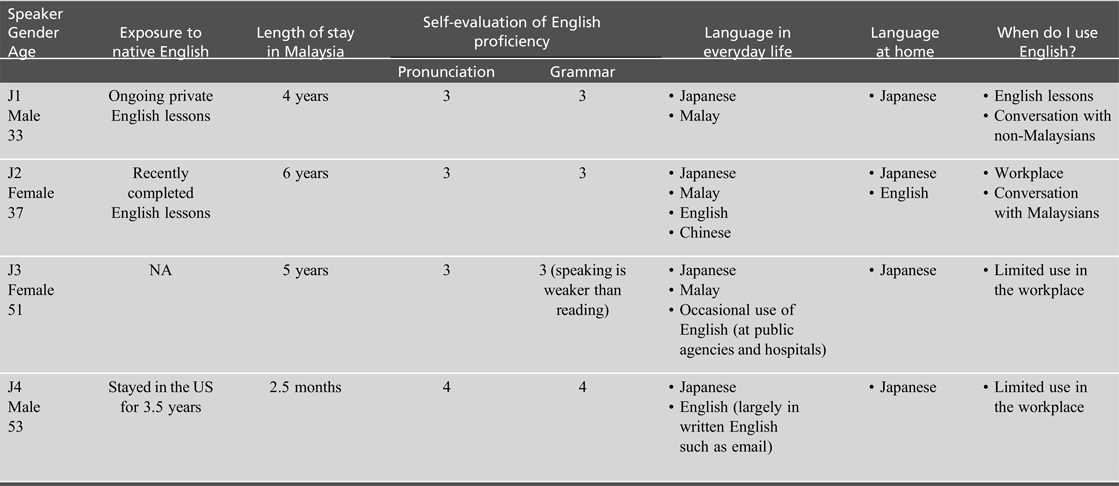
All four Japanese participants were living in Malaysia at the time of the recording.Footnote 2 Three of them had obtained an MA degree from a Japanese university and one had completed a PhD at a university in the US. J2 and J3 were teaching Japanese at a Malaysian university. J1 was a PhD student and J4 was a visiting scholar to a Malaysian university. Like the majority of Japanese nationals, they started to learn English as part of their formal education at junior high school (at the age of 13). Two participants had received English lessons from British native speakers and one was still taking weekly private lessons at the time of the recording. English is not an official language in Malaysia, but one can communicate in English, especially in urban areas, to different degrees. As an Outer Circle variety, the English spoken in Malaysia is a local form which exhibits some significant variations of particular pronunciations. Two participants informed the first researcher that some words are unintelligible when pronounced locally until one is told what they actually are (e.g. [tɔːt] for thought or [ti:m] for theme are homophonous to taught and team, which have completely different meanings). As their descriptions above indicate, these four speakers had already had unique exposure to different varieties of English. While their dominant language was Japanese in Malaysia, as shown in Table 1, they were not stereotypical Japanese citizens who routinely spoke Japanese with little or no exposure to English. Among the four speakers, J3 had the least opportunity to expose herself to English.
Information about the four Japanese speakers of English

Table 1 summarizes the four speakers’ linguistic and social backgrounds as of November/December 2016.Footnote 3 Self-evaluation follows a five-point Likert scale (1 = very poor; 2 = poor; 3 = not poor/not good; 4 = good; 5 = very good).
3. Results
The recordings were analyzed using Praat (Boersma & Weenink, Reference Boersma and Weenink2017).
3.1 Segmental features
Segmental features were produced differently depending on whether they were consonants (Section 3.1.1) or vowels (Section 3.1.2). Our point of departure was that the pronunciation of the four JE speakers may be influenced by their Japanese pronunciation (Suenobu, Reference Suenobu and Honna1990; Jenkins, Reference Jenkins2007; Morizumi, Reference Morizumi, Murata and Jenkins2009; Moyer, Reference Moyer2013), but this assumption was not always justifiable.
3.1.1 Consonants
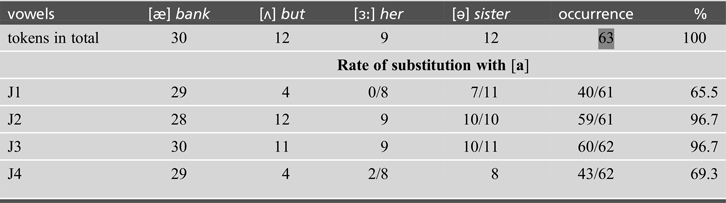
All the speakers apparently knew how to pronounce consonants following the standard norm and produced them relatively well. For example, all participants correctly pronounced all tokens of voiced and voiceless dental fricatives, [θ] and [ð] (n = 6; n = 23, respectively), even though these sounds are absent from the Japanese sound inventory. This fact might contradict the long-standing claim that L2 speakers of a particular L1 tend to substitute (inter)dental fricatives with fricatives, such as [s] and [z] (e.g. Gough, Reference Gough1999; Walker, Reference Walker2010). As shown in Table 2, another similar case is the pronunciation of [l] and [r]: J1 and J2 pronounced [l] and [r] correctly.Footnote 4
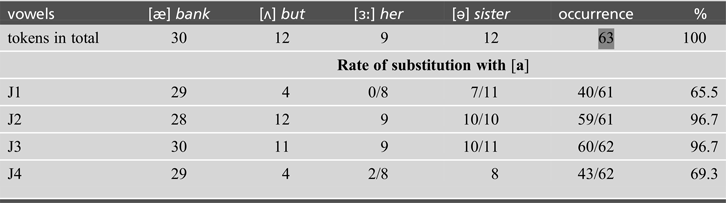
Substitution of [æ], [ʌ], [ɜː] and [ə] with [a] in Alice's Adventures in Wonderland
The observations offered by past studies are not always confirmed by our study. For example, Jenkins (Reference Jenkins2000) observed that Japanese speakers substituted [r] with [l], but this directionality was rare in our dataset. The other directionality, namely, from [l] to [r], was more common, and substitution itself was rare on the whole. To illustrate, J4 produced 67 words with [l] (London) in his three free talks, of which only five cases (e.g. place as [preɪs]) were substituted with [r] (0.074%). He produced 60 words with [r] but only two instances (e.g. reason as [li:zʊn]) were substituted with [l] (0.033%). Takeshita (Reference Takeshita and Kirkpatrick2010: 276) stated that [l] and [r] ‘may be sounded the same,’ but the acoustic difference between the two was distinct in the spectrogram. The two pronunciations also fluctuated within one speaker (e.g. London as [rondon] on one occasion and [london] on another). Another surprising finding was the high rate of devoicing: we attested that obstruents – namely, three plosives ([b], [d], [g]) and one fricative ([z]) – frequently lost their voicing quality and this occurred among the four speakers. For example, all speakers devoiced the word-initial/final plosives in did (nor did Alice think it … ) and the fricative in eyes ( … a White Rabbit with pink eyes ran close by her). We assume that devoicing was not caused by the phonemic environment: [d] and [z] in the above examples are not surrounded by voiceless sounds and, indeed, the Japanese sound inventory has the voiced plosive [d] and fricative [z] at its disposal. There was no logical reason for these sounds to be devoiced.
3.1.2 Vowels
The substitution rate of vowels was much higher than that of consonants. All the speakers substituted [æ], [ʌ], [ɜː], and [ə] with the open vowel [a], although the rate of substitution differed among speakers (Table 2). Sometimes, [o] was used to substitute [ʌ] and [ə] (e.g. London).Footnote 5 These four substituted vowels are absent from the Japanese sound inventory. Table 2 presents the substitution of four vowels with [a] that occurred in the lexical items bank, but, her, and sister. The total number of lexical items is 63 (shaded column). Numbers right of the slash are the actual numbers of the lexical items which we could identify in Praat. The rightmost column indicates the percentage of the substitution with [a] according to each speaker. The table shows that the hardest vowel for all speakers was [æ].
It is worthy of mention that the text contained the definite article the 13 times (e.g. on the bank) and all the speakers pronounced the schwa correctly, meaning that they knew how to pronounce it. It is not clear why the schwa in lexical items such as sister was substituted. The percentages shown in the table suggest that J1's vowels were closest to the standard norm (substitution rate: 65.5%), which may be correlated with his regular exposure to native English (Table 1). Vowels were apparently more difficult to produce than consonants for these Japanese speakers.
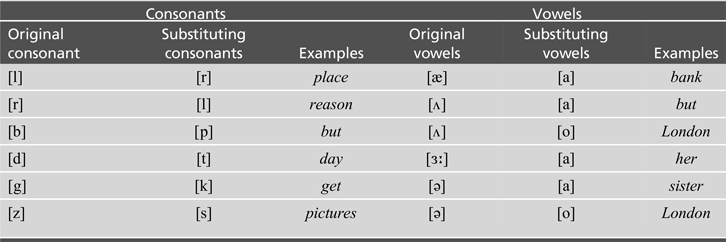
The question arises as to why this contrasting picture was yielded. Katamba (Reference Katamba1986) explains the difference between the two letter types. Consonants are relatively easy to articulate because of the presence of noticeable obstruction through place and manner of articulation. By contrast, vowels are produced by relatively little obstruction but by the position of the tongue. The consequence is that some vowels may sound similar although articulatory gestures are substantially different. This basic characteristic of English vowels may pose problems for JE speakers in identifying exactly where the vowels are produced. Katamba's definition of consonants and vowels makes good sense of the results we obtained from the experiment. Table 3 is a summary of the substitutions discussed above.
Substitutions of consonants and vowels

3.2 Suprasegmental features
We highlight four features at the suprasegmental level. The first is speech rate (Section 3.2.1) and the second is silent gap (Section 3.2.2). The third concerns the insertion of a vowel between words (3.2.3) and the fourth concerns deletion (3.2.4). We are aware that these four features only represent part of what is called speech fluency. Features such as pitch and intonation belonging to speech melody are not considered in this study. Nevertheless, focus on speech fluency is advantageous for this preliminary study for two reasons. First, speech fluency seems more basic than speech melody in that the above four features can help us easily distinguish JE speakers from AE speakers. Pitch or intonation, which can be affected by emotional factors (Wennerstrom, Reference Wennerstrom2001), may not be considered to be ‘basic.’ Second, since the four features are completely absent in the AE speakers, they can be assumed to be characteristic of JE, further suggesting the possibility that they can be extended to Expanding Circle English.
3.2.1 Speech rate
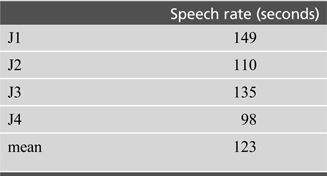
Overall, Japanese speakers were slower than American speakers, whose mean rate was 83 seconds. This result tallies with previous studies in SLA and ELF research that yielded similar findings (Trofimovich & Baker, Reference Trofimovich and Baker2006: 15; Walker, Reference Walker2010: 42).Footnote 6 Table 4 is a summary of the speech rate of the four Japanese speakers.
Speech rate of Japanese speakers

3.2.2. Silent gaps
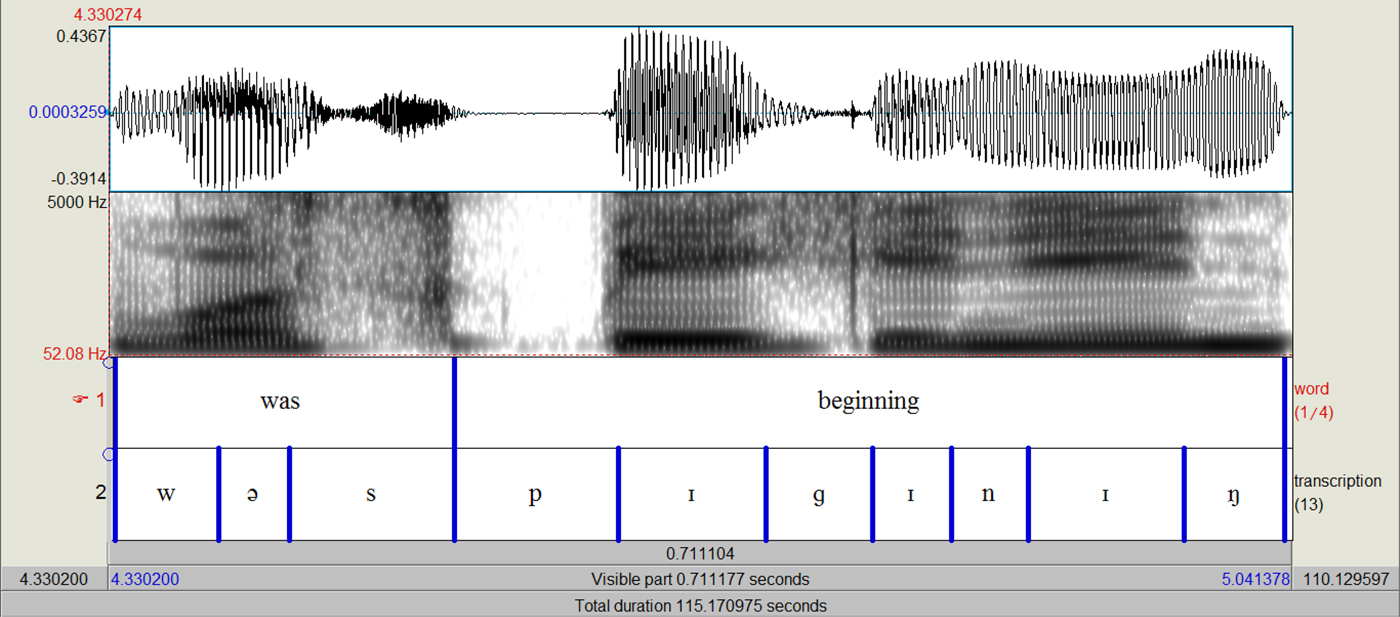
The slowness of Japanese speakers’ speech may be caused by the frequent occurrence of silences. A silence, which is sometimes called a ‘silent gap’ (S), is a period of time in which no sound is produced. We have discovered that some silent gaps were not easily separable from stop closuresFootnote 7 – or, put differently, the production of a gap and a stop closure overlapped. As discussed earlier, the loss of voicing quality in voiced plosives ([b], [d], [g]) and the fricative ([z] in our dataset) may be due to what we call ‘voiceless assimilation.’ That is to say, voiced sounds are assimilated, regressively or progressively, to gaps which the speaker creates. When devoicing occurs prior to the gap (e.g. was [wǝs] S beginning), this might serve as an anticipation of the silence. When devoicing occurs following the gap (e.g. was S beginning [pɪgɪnɪŋ]), the presence of the silence might retard the vocal fold vibration of [b] in beginning.
Figure 1 is an excerpt of the Praat analysis for the verb phrase was beginning produced by J2. The reduced voice bar represents the devoicing of [z] in was and [b] in beginning. Between the two segments, there is a prolonged silent gap. The gap is prolonged as it includes the stop closure. Voiceless assimilation thus contributed to the prolongation of the silent gap, which is probably one of the reasons why the Japanese speakers needed more time to read the text. J4 produced silent gaps less often than the other speakers and J1 produced them most frequently.
An excerpt from Praat: was beginning in Alice's Adventures in Wonderland
3.2.3. Insertion of the open vowel [a] between words
J2 and J4 inserted [a] between two words (e.g. the book [a] her sister was reading by J2; Alice was [a] beginning by J4). This insertion, which might be called ‘final vowel insertion,’ seems to be found frequently in Korean English (Schreier, Reference Schreier2005: 188–9). However, this insertion of the vowel did not appear when the speakers read words (second component of the experiment), which implies that this phenomenon is typically suprasegmental. In other words, this insertion might be a signal that the speaker intended to link two words. This insertion did not always occur. If inserting [a] is a reflex of Japanese syllable structure, as Suenobu (Reference Suenobu and Honna1990) proposed, this should have occurred more often in our dataset.
3.2.4. Deletion of the word-final plosives
This feature was produced most frequently by J2 (e.g. [t] in get very tired of). Deletion of word-final plosives was mentioned by Suenobu (Reference Suenobu and Honna1990), who put it down to Japanese syllable structure. It resembles elision, an aspect of connected speech that occurred regularly in the four American speakers. For J2's speech, however, ‘deletion’ would be most suitable to describe this, as it occurred rather irregularly. Disappearance of the segments in J2's speech was not predictable, whereas the American speakers’ elision was rather regular (Jenkins, Reference Jenkins2000: 142). J2's frequent deletion of word-final plosives might have contributed to her speech rate, which was the second fastest (Table 3). While deletion of segments can be classified as a segmental feature, deletion did not occur in J2's second task (reading of words), and we decided that this feature should be classified as a suprasegmental feature.
4. Implications of the acoustic results
Recognising the dominant role which English plays in today's world, the central question is how non-native speakers should approach English in order to achieve successful communication internationally. In Japan, the ‘paradigm shift’, a shift from the Old to the New (cf. Kachru, Reference Kachru2017: 148), has made slow progress despite the plea for teaching communicative English (Friedman, Reference Friedman2016: 15) and for promoting local varieties of English for Asia (Honna, Reference Honna and Honna1990). One perspective that is shared by scholars, and especially Anglo-European scholars, is that the most effective way to teach and learn English for communicative purposes is to forget native-speakerism and to forge a local variety, or a variety whose ownership speakers and teachers themselves share.
A fundamental criticism of the traditional method of teaching English in Japan is that it has paid so much attention to the native-speaker model that it has not responded to the needs of today's world. An oft-cited example is that university students who have learned the language for years are unable to communicate using English. Kirkpatrick (Reference Kirkpatrick2007: 194) takes the position that learning L1 English is ‘unattainable and inappropriate’ for non-native speakers. Through their own local variety, he goes on (Kirkpatrick, Reference Kirkpatrick2007: 194), learners can more easily acquire ‘linguistic features,’ ‘cultural information,’ and ‘communicative strategies.’
Intelligibility is another related notion, first noted by Jenkins (Reference Jenkins2000; Reference Jenkins2007) and supported by researchers who share the view that the target of English acquisition as an FL is no longer nativeness or near-nativeness (see Moyer, Reference Moyer2013: 180) but degrees of comprehensibility to interlocutors on the basis of phonological features. Jenkins’ Lingua Franca Core consists of a small set of pronunciation features which are said to be applicable universally. These features are taken to be central to mutual intelligibility among participants in cross-cultural communications. It is stated, for example, that the speaker can be deemed intelligible without pronouncing dental fricatives correctly. It is stated that vowel quality does not affect intelligibility, with the exception of [ɜː] in fur (Galloway & Heath, Reference Galloway and Heath2015: 151). Hino (Reference Hino, Leitner, Hashim and Wolf2016) may be one of the first to adopt the notion of intelligibility in the Japanese educational context (see also McKenzie, Reference McKenzie, Houghton and Rivers2013: 228). However, as Moyer (Reference Moyer2013) points out, intelligibility cannot be easily pinned down, since there are many criteria that affect its perception. Similarly, it may be too early to conceive of ‘a local variety’ in contemporary Japan. Despite the complexity of the matter, we agree with Hino's definition of Japanese English as ‘a pedagogically designed variety of English.’ Rationally, English in contemporary Japan can only be obtained, other things being equal, through a formal education whose pedagogical model is based on ‘Standard English.’ As long as Japanese speakers are not owners of Standard English, they are likely to divert from this pedagogical norm. A question that arises here is what the diversion is and how it occurs. In order to answer this, we must first grasp the English which Japanese produce, before we can fully accept ‘a local variety’ and/or ‘intelligibility’ as a learner target.
All four Japanese speakers who participated in the experiment were perceived to be intelligible, but exhibited a ‘foreign’ accent to different degrees.Footnote 8 We faced a reality that does not fit Jenkins’ Core. The most impressive deviation from Jenkins’ Core was the norm-dependent pronunciation of dental fricatives presented by all speakers. In Malaysia, dental fricatives are often, but not always, replaced by alveolar stops, but this feature was not found in the Japanese speakers. Expanding Circle English has often been classified as norm-dependent. When it comes to consonants, the standard norm was maintained very consistently. When it comes to vowels, the speakers replaced English vowels with another, very often [a]. We suggest that vowel insertion and devoicing might be understood as norm-developing, as we presume that they served to facilitate certain strategies and emerged therefore at a word boundary, probably without speakers’ consciousness.
It has been almost 30 years since Suenobu (Reference Suenobu and Honna1990: 259–260) published his list of ‘Japanese pronunciation of English words.’ Suenobu's ‘mother tongue syndrome’ has been inherited more recently by Morizumi (Reference Morizumi, Murata and Jenkins2009: 78), who took the position that ‘we cannot get rid of some particular sound habits which have been acquired through our mother tongue.’ Our data offer a new perspective that Japanese speakers do not necessarily speak in accordance with their mother tongue but adapt themselves to their immediate speech environment to some extent. It is not clear at this point whether the resources for this adaptability derive from the speaker's L1 phonology. During the analysis of the data, we had the impression that the speakers tried to speak well, that is, they tried to coincide with the standard norm. As we have seen, however, this frame of mind did not always guarantee the maintenance of the standard norm.
5. A final word
This paper began by presenting acoustic features of the English spoken by four Japanese speakers in an experimental setting. While the scope of the present study is obviously limited, we hope that it has painted a long-overdue picture of certain linguistic aspects of Japanese English. Our tentative conclusion is that the standard norm was integral to their speech but that they concurrently adopted certain strategies that emerged during discourse. We hypothesize that the main reason for the rise of such strategies was to achieve ease of speaking. We hope that future studies will test this hypothesis on a larger scale, and among Japanese English speakers in a range of different communicative contexts.
Appendix: Reading text used in the study
‘Alice was beginning to get very tired of sitting by her sister on the bank, and of having nothing to do: once or twice she had peeped into the book her sister was reading, but it had no pictures or conversations in it, “and what is the use of a book,” thought Alice, “without pictures or conversations?”
‘So she was considering in her own mind (as well as she could, for the hot day made her feel very sleepy and stupid), whether the pleasure of making a daisy-chain would be worth the trouble of getting up and picking the daisies, when suddenly a White Rabbit with pink eyes ran close by her.
‘There was nothing so very remarkable in that; nor did Alice think it so very much out of the way to hear the Rabbit say to itself “Oh dear! Oh dear! I shall be late!” When she thought it over afterwards, it occurred to her that she ought to have wondered at this, but at the time it all seemed quite natural.
‘But, when the Rabbit actually took a watch out of its waistcoat-pocket, and looked at it, and then hurried on, Alice started to her feet, for it flashed across her mind that she had never before seen a rabbit with either a waistcoat-pocket, or a watch to take out of it. Burning with curiosity, she ran across the field after it, and was just in time to see it pop down a large rabbit-hole under the hedge.’
 TOSHIKO YAMAGUCHI is Associate Professor in the Department of English Language, University of Malaya, Malaysia. Besides her research on functional aspects of Japanese, she also investigates varieties of English, particularly the English spoken by Japanese people. This paper is the first publication of an analysis of recordings conducted in 2016. She has a plan to provide an overview of linguistic aspects of this variety of English. Email: tyamag@um.edu.my
 MAGNÚS PÉTURSSON is Professor Emeritus of general and applied phonetics at the University of Hamburg, Germany. He has published articles on articulatory and acoustic phonetics as well as textbooks on phonetics and Icelandic, his mother tongue. His most recent publication is a chapter on the history of experimental phonetics in Europe. In his free time, he likes to read Japanese. Email: magnus.petursson@uni-hamburg.de