Introduction
Extracranial arterial dissection (EAD), involving disruption of the intimal layer of the extracranial carotid or vertebral arteries, is among the most clinically important non-atherosclerotic causes of ischemic stroke, responsible for up to 25% of strokes in adults younger than 45 years. Reference Wu, Chen and Xing1 The pathophysiology centers on an intramural hematoma arising from an intimal tear, which can progressively narrow the arterial lumen, precipitate occlusion or generate thromboemboli resulting in cerebral ischemia. Reference Montalvan, Ulrich, Wahlster and Galindo2
Although early case-fatality rates are relatively low, EAD carries substantial long-term morbidity. Because it predominantly strikes younger individuals with preserved premorbid function and prolonged life expectancy, optimizing acute treatment carries profound clinical and socioeconomic implications. Reference Redekop3
Intravenous thrombolysis (IVT) with rtPA remains the cornerstone of acute ischemic stroke treatment within the established therapeutic window, underpinned by robust evidence from landmark randomized controlled trials. Reference Liu, Ding, Schoenwaelder and Liu4,Reference Díaz, Mouyal and Zuber5 Despite this, patients with EAD-related stroke have historically been underrepresented or excluded from these pivotal trials. The theoretical concern that thrombolytic agents might lyse protective mural thrombus within the dissected wall, thereby expanding the intramural hematoma, propagating the dissection flap or precipitating rupture, has led many clinicians to favor conservative management with antiplatelet agents or anticoagulation instead. Reference Goldstein, Marrero and Masrur6 This uncertainty has generated marked practice variability across stroke centers worldwide.
To date, three dedicated meta-analyses – Zinkstok et al. (2011), Tsivgoulis et al. (2015) and Lin et al. (2016) – have examined the safety and efficacy of IVT in dissection-related stroke and broadly concluded that it appeared safe, but each was constrained by small overall sample size, heterogeneous study designs and the absence of the large contemporary registries available today. Reference Zinkstok, Vergouwen and Engelter7–Reference Shu, Akpokiere and Mandel9 Two contemporary large-scale registries Reference Shu, Lee and Field10,Reference Debette, Mazighi and Bijlenga11 now provide a substantially larger evidence base with which to reappraise this question. The 2021 European Stroke Organisation (ESO) guidelines classify IVT as a low-evidence recommendation in EAD, Reference Yaghi, Engelter, Del Brutto and .12 and the 2024 American Heart Association scientific statement similarly notes that IVT is not contraindicated in otherwise eligible EAD patients. Reference Kashihara, Nakai and Koga13 The 2026 AHA/ASA guideline for early management of acute ischemic stroke reaffirms this position, explicitly stating that isolated extracranial cervical dissection should not preclude IVT in otherwise eligible patients. Reference Lin, Sun, Zhao, Xu and Zhao14 Both underscore the need for a synthesis that updates the existing evidence base with these contemporary data. The present systematic review and meta-analysis therefore updates the three prior dedicated meta-analyses on this question Reference Zinkstok, Vergouwen and Engelter7–Reference Shu, Akpokiere and Mandel9 by incorporating STOP-CAD and the US National Inpatient Sample (NIS) study alongside the legacy cohort and registry literature, extending the literature search through August 2026 and focusing on standardized 90-day functional and safety endpoints.
Methods
Protocol and reporting
This study was conducted in accordance with the PRISMA 2020 statement and prospectively registered on PROSPERO (CRD420261296521). A predefined protocol governed all aspects of the literature search, study selection, data extraction and statistical analysis.
Search strategy
A comprehensive search was performed across PubMed/MEDLINE, Embase and the Cochrane Library from inception through August 2026, conducted in two stages: an initial search through April 2025 that identified the primary evidence base for this review, followed by a prespecified update search (April 2025–August 2026) using an identical strategy to capture any newly published eligible studies. Both stages used MeSH terms and free-text synonyms across three domains: EAD (including “carotid artery dissection,” “vertebral artery dissection” and “cervical artery dissection”), ischemic stroke (including “cerebral infarction”) and thrombolytic therapy (including “thrombolysis,” “tPA” and “alteplase”). No language restrictions were applied. Reference lists of all eligible articles and pertinent review papers were hand-searched for additional studies.
Eligibility criteria
Studies were eligible if they: (1) enrolled adults with acute ischemic stroke confirmed to be secondary to extracranial carotid or vertebral artery dissection by CTA, MRA or DSA; (2) compared IVT with conservative medical management (antiplatelet therapy and/or anticoagulation) and (3) reported at least one prespecified 90-day outcome.
Eligible study designs included randomized controlled trials, prospective or retrospective cohort studies and prospective or administrative registry-based observational studies that directly compared IVT with conservative medical management. Case reports, case series without a comparator arm, narrative reviews, editorials, conference abstracts without extractable comparative data and studies limited exclusively to intracranial arterial dissection were excluded.
Study selection and data extraction
Two reviewers (S.T. and N.B.) independently screened all retrieved titles and abstracts, followed by full-text review of potentially eligible records, in both the original and update searches; disagreements at the screening stage were resolved by consensus and, where necessary, arbitration by a third reviewer (S.S.).
Data extraction was performed independently and in duplicate by two reviewers (S.T. and S.S.) using a standardized, pre-piloted extraction form. Discrepancies were resolved by consensus, with a third reviewer (N.B.) arbitrating when agreement could not be reached. Extracted data included study design, country, sample size, patient demographics, dissection vessel type, imaging modality, IVT protocol, comparator regimen and all reported outcome data.
Risk of Bias Assessment
Methodological quality was evaluated independently and in duplicate by two reviewers (S.T. and N.B.) using the ROBINS-I tool across seven domains: bias due to confounding, selection of participants, classification of interventions, deviations from intended interventions, missing data, measurement of outcomes and selection of the reported result. Disagreements were resolved by consensus, with arbitration by a third reviewer (S.S.) when needed. Findings of this assessment are reported in the Results (Risk of Bias Assessment) and Supplementary Figures S1a and S1b.
Outcome measures
Co-primary endpoints were (1) excellent functional recovery (modified Rankin Scale (mRS) 0–1 at 90 days) and (2) favorable functional recovery (mRS 0–2 at 90 days). Secondary safety outcomes included symptomatic intracranial hemorrhage (sICH) (as defined per study), all-cause mortality at 90 days and recurrent ischemic stroke during follow-up.
Statistical analysis
Quantitative pooling was undertaken only for outcomes reported by at least two studies using comparable definitions and the same treatment comparison (IVT vs. conservative therapy). Before pooling, we qualitatively assessed clinical and methodological homogeneity across contributing studies – population, intervention, comparator and outcome ascertainment – and subsequently corroborated this judgment using the I 2 statistic to quantify statistical heterogeneity. Outcomes reported by only a single study were not pooled and are instead described narratively.
All analyses were performed in Review Manager (RevMan) 5.4 (Cochrane Collaboration). Pooled odds ratios (ORs) with 95% confidence intervals (CIs) were computed using Mantel–Haenszel fixed-effects models for low-heterogeneity outcomes (I 2 < 25%) and DerSimonian–Laird random-effects models for higher heterogeneity. I 2 values were classified as low (<25%), moderate (25–75%) or high (>75%). Publication bias was assessed where sufficient studies were available using Egger’s and Begg’s tests. A two-tailed p < 0.05 was considered statistically significant. A post hoc sensitivity analysis comparing multivariable-adjusted effect estimates from the two largest included studies was performed after data extraction was complete; this analysis was not specified in the original PROSPERO protocol and is reported separately from the prespecified primary crude pooled analysis.
Results
Study selection and characteristics
The initial database search (inception–April 2025) identified 847 records, of which 214 were duplicates. After title and abstract screening, 58 full-text articles underwent eligibility assessment, and five studies met all inclusion criteria (Figure 1).
PRISMA 2020 flow diagram illustrating the systematic literature search and study selection process (inception–April 2025). Records were identified through PubMed/MEDLINE, Embase and the Cochrane Library. After removal of 214 duplicates, 633 records were screened by title and abstract; 58 full texts were assessed for eligibility; and 5 studies met all inclusion criteria and were included in the final quantitative synthesis (total n = 11,285 patients). A subsequent update search (April 2025–August 2026) using the same strategy identified six additional full-text records for eligibility assessment; none met inclusion criteria (Supplementary Table S2), and no changes to this flow diagram resulted. IVT = intravenous thrombolysis; NIS = National Inpatient Sample.

Figure 1. Long description
Flow diagram in three stages. Identification: PubMed/MEDLINE (n = 412), Embase (n = 293) and Cochrane Library (n = 142) gave 847 records; 214 duplicates were removed. Screening: 633 records were screened by title and abstract and 575 were excluded as not relevant. 58 full-text articles were assessed for eligibility and 53 were excluded (no comparator group 21; intracranial dissection only 14; no 90-day outcome reported 10; duplicate population 5; insufficient outcome data 3). Included: 5 studies in the quantitative synthesis: Dziewas et al., 2003; Fuentes et al., 2011; Engelter et al., 2012 (CADISP); Shu et al., 2024 (STOP-CAD); and Shu et al., 2025 (NIS). Total N = 11,285 patients: IVT n = 1,410 and non-IVT n = 9,875.
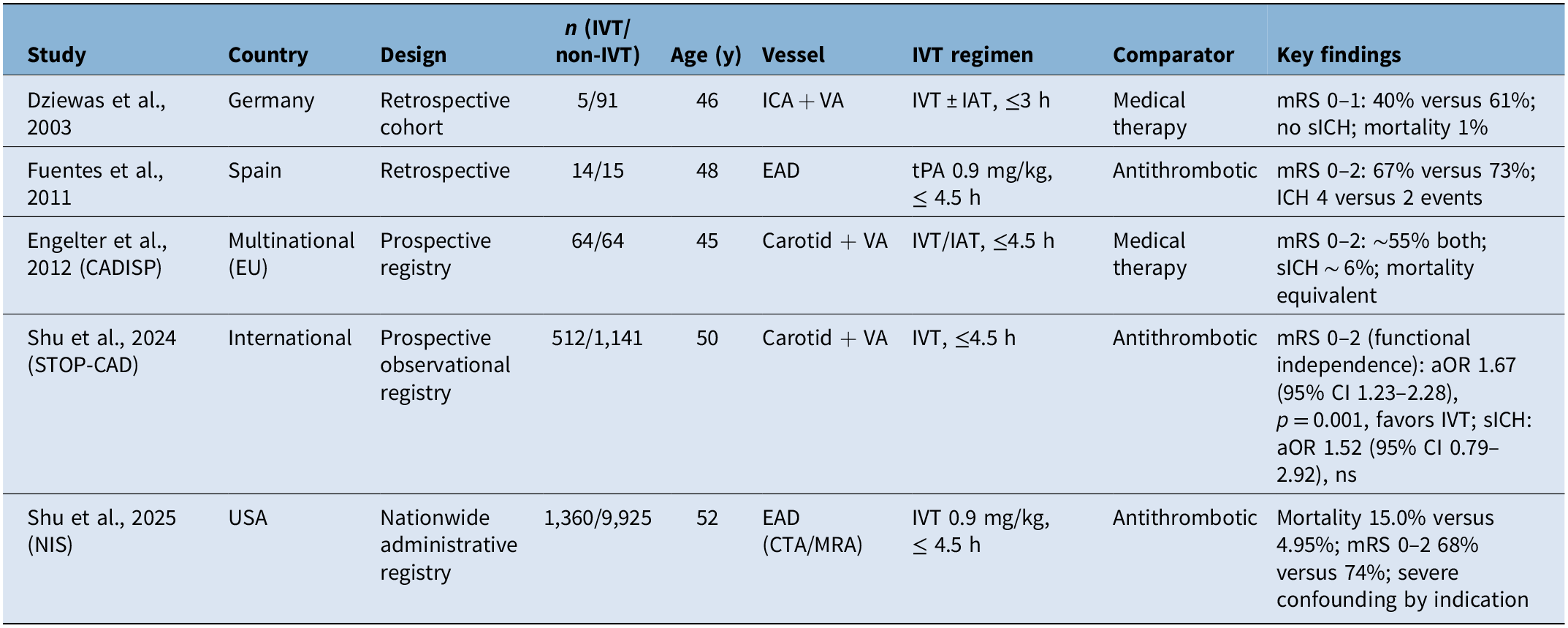
A prespecified update search (April 2025–August 2026), using an identical strategy across the same three domains, identified six additional full-text records for eligibility assessment. None met inclusion criteria for quantitative synthesis: two compared mechanical thrombectomy or IVT-before-thrombectomy bridging strategies with thrombectomy alone or with best medical treatment rather than IVT with conservative medical management (i.e., no conservative-therapy-only arm), one was a sex-stratified analysis not designed or powered to compare treatment strategies, one reported long-term vascular-surgical outcomes without 90-day functional or safety data and two were thrombectomy-focused meta-analyses or multicenter technical/safety studies with no conservative-therapy comparator (Supplementary Table S2). The five studies identified in the original search therefore remain the final evidence base for this review, collectively enrolling 11,285 patients: 1,410 who received IVT and 9,875 who received conservative medical management. Study characteristics are detailed in Table 1.
Characteristics of included studies

Table 1. Long description
Columns: study, country, design, n IVT/non-IVT, age, vessel, IVT regimen, comparator, findings.Dziewas 2003: Germany; retrospective cohort; 5/91; 46 y; ICA and VA; IVT +/- IAT within 3 h; medical therapy; mRS 0-1 40% vs 61%, no sICH, mortality 1%. Fuentes 2011: Spain; retrospective cohort; 14/15; 48 y; EAD; tPA 0.9 mg/kg within 4.5 h; antithrombotic; mRS 0-2 67% vs 73%, ICH 4 vs 2 events. Engelter 2012 (CADISP): multinational, Europe; prospective registry; 64/64; 45 y; carotid and VA; IVT/IAT within 4.5 h; medical therapy; mRS 0-2 ~55% both, sICH ~6%, equal mortality. Shu 2024 (STOP-CAD): international; prospective registry; 512/1,141; 50 y; carotid and VA; IVT within 4.5 h; antithrombotic; mRS 0-2 aOR 1.67 (1.23-2.28), p = 0.001, favors IVT; sICH aOR 1.52 (0.79-2.92), ns. Shu 2025 (NIS): USA; nationwide administrative registry; 1,360/9,925; 52 y; EAD (CTA/MRA); IVT 0.9 mg/kg within 4.5 h; antithrombotic; mortality 15.0% vs 4.95%, mRS 0-2 68% vs 74%, strong confounding by indication.
CI = confidence interval; EAD = extracranial arterial dissection; EU = Europe; IAT = intra-arterial thrombolysis; ICA = internal carotid artery; ICH = intracranial hemorrhage; IVT = intravenous thrombolysis; mRS = modified Rankin Scale; NIS = National Inpatient Sample; sICH = symptomatic intracranial hemorrhage; tPA = tissue plasminogen activator; VA = vertebral artery.
Briefly, Dziewas et al. (2003) was a single-center German retrospective cohort of 96 EAD stroke patients, of whom 5 received IVT within 3 hours, providing early safety signals but limited power. Fuentes et al. (2011) enrolled 29 Spanish patients (14 IVT, 15 medical), demonstrating comparable 3-month recovery. Engelter et al. (2012) reported the multinational CADISP registry of 128 matched patients, finding equivalent mRS 0–2 rates (∼55%) and sICH (∼6%) between arms. Shu et al. (2024), a secondary analysis of the international STOP-CAD dataset (n = 1,653), found that IVT was independently associated with significantly greater 90-day functional independence (mRS 0–2: adjusted OR 1.67, 95% CI 1.23–2.28, p = 0.001) without a significant increase in sICH (adjusted OR 1.52, 95% CI 0.79–2.92, p = 0.22). Shu et al. (2025), the largest study, analyzed 11,285 patients from the US NIS and documented higher crude in-hospital mortality in the IVT group (15.0% vs. 4.95%), attributed by the authors to severe confounding by indication.
Risk of Bias Assessment
All studies carried at least a moderate overall risk of bias, primarily attributable to confounding by indication, as IVT recipients systematically had higher baseline stroke severity. Earlier single-center cohorts were rated as a serious risk; contemporary registry-based studies were rated as moderate. No study was judged to be at critical risk. Full domain-level ratings are presented in Supplementary Figures S1a and S1b.
Primary efficacy outcomes
90-day excellent functional recovery (mRS 0–1)
Four studies contributed data on this endpoint (Figure 2). Pooled analysis showed that IVT was associated with significantly lower odds of achieving mRS 0–1 at 90 days compared with conservative therapy (OR 0.78, 95% CI 0.63–0.97; I 2 = 0%; p = 0.03). Effect direction was consistent across all four studies with negligible heterogeneity.
Forest plot: excellent functional recovery (mRS 0–1) at 90 days. Experimental = IVT; Control = conservative medical therapy. Four studies; fixed-effects model (Mantel–Haenszel); I 2 = 0%; p = 0.03. OR <1 indicates lower odds in the IVT group, likely reflecting confounding by indication (higher baseline stroke severity in IVT recipients). IVT = intravenous thrombolysis; OR = odds ratio; CI = confidence interval.

Figure 2. Long description
Fixed-effect (Mantel-Haenszel) forest plot of odds ratios on a log scale from 0.05 to 20; left of 1 is labelled favours experimental (IVT), right favours control. Events/total, IVT vs control, weight, OR (95% CI): Dziewas 2003, 2/5 vs 56/91, 1.9%, 0.42 (0.07-2.62). Engelter 2012, 19/64 vs 20/64, 7.8%, 0.93 (0.44-1.97). Fuentes 2011, 6/14 vs 9/15, 2.8%, 0.50 (0.11-2.19). Liqi Shu 2024, 212/414 vs 510/890, 87.5%, 0.78 (0.62-0.99). Total: 239/497 vs 595/1,060, pooled OR 0.78 (0.63-0.97), shown as a diamond just left of 1. Heterogeneity: Chi-squared 1.00, df 3, P = 0.80, I-squared 0%. Test for overall effect: Z = 2.24, P = 0.03.
90-day favorable functional recovery (mRS 0–2)
Three studies contributed data on this endpoint (Figure 3). No statistically significant difference was observed between IVT and non-IVT groups (OR 0.86, 95% CI 0.67–1.10; I 2 = 0%; p = 0.24). Heterogeneity was negligible, and the CI spanned unity, indicating functional independence rates were equivalent between treatment strategies. A summary of all pooled outcomes appears in Table 2.
Forest plot: favorable functional recovery (mRS 0–2) at 90 days. Three studies; fixed-effects model; I 2 = 0%; p = 0.24. No statistically significant difference between IVT and non-IVT groups. mRS = modified Rankin Scale; IVT = intravenous thrombolysis. CI = confidence interval.

Figure 3. Long description
Fixed-effect (Mantel-Haenszel) forest plot of odds ratios on a log scale from 0.1 to 10; left of 1 is labelled favours experimental (IVT), right favours control. Events/total, IVT vs control, weight, OR (95% CI): Engelter 2012, 35/64 vs 35/64, 11.8%, 1.00 (0.50-2.01). Fuentes 2011, 7/14 vs 10/15, 3.6%, 0.50 (0.11-2.24). Liqi Shu 2025, 305/414 vs 681/890, 84.6%, 0.86 (0.66-1.12). Total: 347/492 vs 726/969, pooled OR 0.86 (0.67-1.10); the diamond crosses 1. Heterogeneity: Chi-squared 0.68, df 2, P = 0.71, I-squared 0%. Test for overall effect: Z = 1.18, P = 0.24.
Summary of pooled meta-analysis results

Table 2. Long description
Columns: outcome, studies (k), IVT events/N, non-IVT events/N, I-squared, OR (95% CI) and p, interpretation. OR above 1 means higher odds with IVT. Excellent recovery (mRS 0-1): k 4; 239/497 vs 586/1,060; 0%; 0.78 (0.63-0.97), p = 0.03; favors non-IVT, likely confounding by indication. Favorable recovery (mRS 0-2): k 3; 347/492 vs 726/969; 0%; 0.86 (0.67-1.10), p = 0.24; no significant difference. Symptomatic ICH: k 3; 84/1,957 vs 386/11,248; 60%; 2.15 (1.01-4.56), p = 0.05; favors non-IVT, interpret with caution given high I-squared. All-cause mortality: k 2; 205/1,365 vs 496/10,016; 0%; 3.38 (2.85-4.03), p < 0.001; favors non-IVT, mainly driven by the NIS study and likely confounding by severity. Recurrent stroke: k 2; 3/69 vs 8/155; 0%; 2.13 (0.39-11.45), p = 0.38; no significant difference.
CI = confidence interval; ICH = intracranial hemorrhage; IVT = intravenous thrombolysis; k = number of studies; mRS = modified Rankin Scale; N = total patients in arm; NIS = National Inpatient Sample; OR = odds ratio.
OR>1 = higher odds in the IVT group.
*Likely driven by confounding by indication (higher baseline severity in IVT recipients).
†High I2; interpret with caution.
‡Predominantly driven by Shu 2025 NIS; almost certainly reflects confounding by severity rather than causal drug effect.
Secondary safety outcomes
Symptomatic intracranial hemorrhage
Three studies reported sICH (Figure 4). IVT was associated with nominally higher odds of sICH (OR 2.15, 95% CI 1.01–4.56; I 2 = 60%; p = 0.05). Substantial heterogeneity across only three studies limits the reliability of this estimate; observed sICH rates in IVT-treated patients ranged from 3 to 6% across the contributing studies.
Forest plot: symptomatic intracranial hemorrhage (sICH). Three studies; random-effects model (DerSimonian–Laird); I 2 = 60%; p = 0.05. High heterogeneity substantially limits interpretation of the pooled estimate. CI = confidence interval.

Figure 4. Long description
Random-effects (Mantel-Haenszel) forest plot of odds ratios on a log scale from 0.002 to 500; left of 1 is labelled favours experimental (IVT), right favours control. Events/total, IVT vs control, weight, OR (95% CI): Dziewas 2003, 0/5 vs 1/91, 4.6%, 5.48 (0.20-150.86). Engelter 2012, 4/64 vs 0/64, 5.7%, 9.60 (0.51-181.99). Fuentes 2011, 4/16 vs 2/27, 12.3%, 4.17 (0.67-26.02). Liqi Shu 2024, 21/512 vs 18/1,141, 34.4%, 2.67 (1.41-5.05). Liqi Shu 2025, 55/1,360 vs 365/9,925, 42.9%, 1.10 (0.83-1.47). Total: 84/1,957 vs 386/11,248, pooled OR 2.15 (1.01-4.56), diamond right of 1. Heterogeneity: Tau-squared 0.32, Chi-squared 10.09, df 4, P = 0.04, I-squared 60%. Overall effect: Z = 1.99, P = 0.05.
All-cause mortality
Two studies contributed mortality data (Figure 5). IVT was associated with significantly higher odds of 90-day all-cause mortality (OR 3.38, 95% CI 2.85–4.03; I 2 = 0%; p < 0.001), driven predominantly by Shu et al. (2025), in which crude mortality was 15.0% in the IVT group versus 4.95% in the non-IVT group. In the CADISP registry, mortality was equivalent between groups. As detailed in the Sensitivity Analysis below, the NIS registry’s fully adjusted model found no significant increase in mortality with IVT (adjusted OR 1.29, 95% CI 0.76–2.20).
Forest plot: all-cause mortality at 90 days. Forest plot of pooled ORs (odds ratios) for all-cause mortality. Two studies; fixed-effects model; I 2 = 0%; p < 0.001. The large pooled OR is predominantly driven by the Shu et al. (2025) NIS registry and almost certainly reflects severe confounding by indication rather than a causal treatment effect of IVT. NIS = National Inpatient Sample; IVT = intravenous thrombolysis; CI = confidence interval.

Figure 5. Long description
Fixed-effect (Mantel-Haenszel) forest plot of odds ratios on a log scale from 0.1 to 10; left of 1 is labelled favours experimental (IVT), right favours control. Events/total, IVT vs control, weight, OR (95% CI): Dziewas 2003, 0/5 vs 1/91, 0.2%, 5.48 (0.20-150.86), its interval running off the right of the axis. Liqi Shu 2025, 205/1,360 vs 495/9,925, 99.8%, 3.38 (2.84-4.02), a large square. Total: 205/1,365 vs 496/10,016, pooled OR 3.38 (2.85-4.03), narrow diamond well right of 1. Heterogeneity: Chi-squared 0.08, df 1, P = 0.78, I-squared 0%. Test for overall effect: Z = 13.76, P < 0.00001.
Recurrent ischemic stroke
Two studies reported recurrent stroke (Figure 6). No statistically significant difference was identified (OR 2.13, 95% CI 0.39–11.45; I 2 = 0%; p = 0.38). The very wide CI reflects few events and limited contributing studies.
Forest plot: recurrent ischemic stroke. Forest plot of pooled odds ratios for recurrent ischemic stroke. Two studies; fixed-effects model; I 2 = 0%; p = 0.38. No significant between-group difference; wide confidence interval reflects few events. CI = confidence interval.

Figure 6. Long description
Fixed-effect (Mantel-Haenszel) forest plot of odds ratios on a log scale from 0.001 to 1000; left of 1 is labelled favours experimental (IVT), right favours control. Events/total, IVT vs control, weight, OR (95% CI): Dziewas 2003, 0/5 vs 7/91, 46.9%, 1.02 (0.05-20.36). Engelter 2012, 3/64 vs 1/64, 53.1%, 3.10 (0.31-30.61). Total: 3/69 vs 8/155, pooled OR 2.13 (0.39-11.45); the wide diamond crosses 1. Heterogeneity: Chi-squared 0.33, df 1, P = 0.56, I-squared 0%. Test for overall effect: Z = 0.88, P = 0.38.
Sensitivity analysis: adjusted estimates
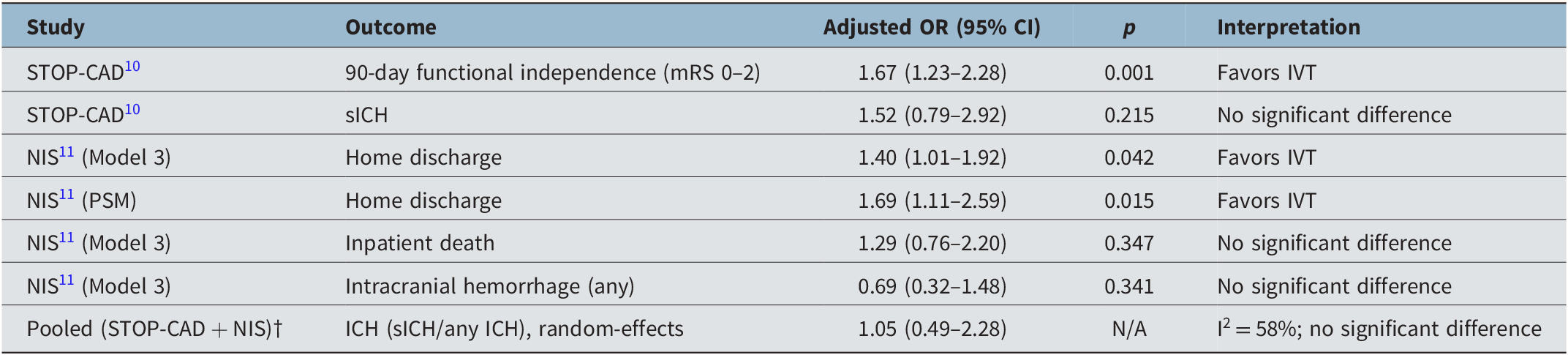
Because two of the five included studies – STOP-CAD Reference Shu, Lee and Field10 and the NIS registry Reference Debette, Mazighi and Bijlenga11 – each reported multivariable-adjusted effect estimates, a post hoc sensitivity analysis was performed comparing these adjusted results with the crude pooled estimates above (Table 3). STOP-CAD’s fully adjusted model found IVT independently associated with significantly greater 90-day functional independence (mRS 0–2: adjusted OR 1.67, 95% CI 1.23–2.28, p = 0.001) – directionally opposite to the crude pooled result for excellent recovery (mRS 0–1) reported above – without a significant increase in sICH (adjusted OR 1.52, 95% CI 0.79–2.92, p = 0.215). In the NIS registry, the most fully adjusted model (age, NIHSS score, insurance status, carotid involvement and endovascular therapy) found IVT associated with significantly higher odds of home discharge (adjusted OR 1.40, 95% CI 1.01–1.92, p = 0.042; propensity-score-matched adjusted OR 1.69, 95% CI 1.11–2.59, p = 0.015), with no significant increase in adjusted odds of inpatient death (adjusted OR 1.29, 95% CI 0.76–2.20, p = 0.347) or intracranial hemorrhage (adjusted OR 0.69, 95% CI 0.32–1.48, p = 0.341) – in marked contrast to the crude pooled mortality OR of 3.38 derived from unadjusted comparison of these same data.
Sensitivity analysis: multivariable-adjusted estimates

Table 3. Long description
Columns: study, outcome, adjusted OR (95% CI), p, interpretation. STOP-CAD, 90-day functional independence (mRS 0-2): 1.67 (1.23-2.28), p = 0.001, favors IVT. STOP-CAD, symptomatic ICH: 1.52 (0.79-2.92), p = 0.215, no significant difference. NIS Model 3, home discharge: 1.40 (1.01-1.92), p = 0.042, favors IVT. NIS propensity-score-matched, home discharge: 1.69 (1.11-2.59), p = 0.015, favors IVT. NIS Model 3, inpatient death: 1.29 (0.76-2.20), p = 0.347, no significant difference. NIS Model 3, any intracranial hemorrhage: 0.69 (0.32-1.48), p = 0.341, no significant difference. Pooled STOP-CAD plus NIS, ICH, random-effects: 1.05 (0.49-2.28), p not applicable, I-squared 58%, no significant difference.
CI = confidence interval; IVT = intravenous thrombolysis; mRS = modified Rankin Scale; NIS = National Inpatient Sample; OR = odds ratio; PSM = propensity-score-matched; sICH = symptomatic intracranial hemorrhage.
Adjusted for each study’s own covariate set (STOP-CAD: prespecified covariates including age and NIHSS score; NIS Model 3: age, NIHSS score, insurance status, carotid involvement and endovascular therapy). †Random-effects (DerSimonian–Laird) pooling of STOP-CAD sICH and NIS any-ICH adjusted estimates; outcome-definition and adjustment-set heterogeneity across studies limit the precision of this pooled estimate (see Limitations).
Pooling the two studies’ adjusted hemorrhage estimates (STOP-CAD’s sICH and the NIS registry’s any-ICH outcome, acknowledging differing outcome definitions) using an inverse-variance random-effects model yielded a pooled adjusted OR of 1.05 (95% CI 0.49–2.28; I 2 = 58%), markedly attenuated from the crude pooled sICH OR of 2.15 reported above. Adjusted mortality could not be pooled across studies, as STOP-CAD did not report mortality as an outcome; only the NIS registry provided an adjusted mortality estimate, which was not statistically significant. Taken together, every adjusted estimate available from the two largest and most contemporary datasets in this review points in a favorable or neutral direction for IVT, reversing the direction of the crude pooled efficacy estimate and substantially attenuating the crude pooled hemorrhage and mortality estimates. A forest plot of this sensitivity analysis appears in Supplementary Figure S2.
Discussion
This systematic review and meta-analysis – updating three prior dedicated reviews of IVT in dissection-related stroke Reference Zinkstok, Vergouwen and Engelter7–Reference Shu, Akpokiere and Mandel9 with the two largest contemporary datasets in this field Reference Shu, Lee and Field10,Reference Debette, Mazighi and Bijlenga11 – synthesizes comparative data from five observational and registry-based studies enrolling 11,285 patients with ischemic stroke due to EAD. The key findings are as follows: (1) IVT was associated with significantly lower odds of excellent functional recovery (mRS 0–1) at 90 days, yet no significant difference in favorable functional recovery (mRS 0–2); (2) IVT was associated with nominally higher sICH rates, though with substantial heterogeneity; (3) a large apparent excess in all-cause mortality was observed in IVT recipients and (4) recurrent stroke rates were comparable. Critically, findings (1), (2) and (3) are substantially, and in the case of mortality, almost entirely, explained by confounding by indication rather than causal harm from IVT.
The distinction between the mRS 0–1 and mRS 0–2 results is clinically important. The finding of no significant difference in mRS 0–2 (OR 0.86, 95% CI 0.67–1.10) is arguably the more relevant efficacy endpoint, as it captures functional independence. The significant difference in mRS 0–1 (OR 0.78, p = 0.03) most likely reflects the fact that IVT-treated patients started with higher NIHSS scores and were therefore less likely to reach the more stringent “excellent” threshold regardless of treatment assigned. The absence of heterogeneity (I 2 = 0%) across both efficacy outcomes indicates this pattern was consistent and not study-specific.
The mortality finding demands particular scrutiny. The pooled OR of 3.38 was overwhelmingly driven by the Shu et al. (2025) NIS registry, in which crude in-hospital mortality was 15.0% in IVT recipients versus 4.95% in conservatively managed patients. This three-fold crude difference cannot plausibly represent a direct drug effect and instead reflects the archetypal confounding-by-indication scenario in observational stroke research: patients receiving IVT were selected precisely because they presented with severe neurological deficits and were hemodynamically more compromised. Even with multivariable adjustment, administrative registry studies cannot fully account for the extent of this baseline imbalance. Critically, in the CADISP registry, a more carefully matched study with mortality equivalent between groups further supports the conclusion that the pooled mortality signal is artifactual.
The sICH findings are more nuanced. While the pooled OR of 2.15 (p = 0.05) is nominally significant, it is based on only three studies with I 2 = 60%, indicating meaningful heterogeneity that undermines the pooled estimate. Importantly, absolute sICH rates in IVT-treated EAD patients (3–6%) are within the range expected for rtPA use in general stroke populations, and the CADISP registry using matched controls found equivalent sICH rates (∼6%) in both arms. Taken together, there is insufficient evidence to conclude that EAD mechanistically increases sICH risk above the baseline associated with IVT in any stroke population. This is corroborated by the sensitivity analysis above, in which the pooled adjusted OR for hemorrhage across STOP-CAD and the NIS registry was 1.05 (95% CI 0.49–2.28), essentially null, compared with the crude pooled OR of 2.15.
These findings contextualize and extend prior meta-analyses. Zinkstok et al. (2011) reported an acceptable sICH profile and functional outcome distribution in 180 IVT-treated dissection patients in an individual patient data meta-analysis. Reference Zinkstok, Vergouwen and Engelter7 Tsivgoulis et al. (2015) similarly concluded from case series data that thrombolysis appeared safe and feasible. Reference Tsivgoulis, Zand and Katsanos8 Lin et al. (2016) pooled a broader set of observational cohorts and case series and reached a similar conclusion, though, like the earlier reviews, it was limited by small overall sample size and heterogeneous outcome reporting. Reference Shu, Akpokiere and Mandel9 The present analysis updates and substantially extends these three prior meta-analyses by incorporating the two largest EAD-specific datasets published to date: STOP-CAD Reference Shu, Lee and Field10 and the US NIS. Reference Debette, Mazighi and Bijlenga11 The 2021 ESO guidelines Reference Yaghi, Engelter, Del Brutto and .12 and 2024 AHA scientific statement Reference Kashihara, Nakai and Koga13 both acknowledge that IVT is not contraindicated in otherwise eligible EAD patients, consistent with the overall conclusion of the present analysis.
An updated search extending through August 2026 did not identify any new studies directly comparing IVT with conservative medical management in EAD-related stroke, indicating that the evidence base synthesized here remains current. Two related studies published during this window nonetheless demonstrate active investigation of thrombolytic and endovascular strategies in EAD, albeit in different populations. Sykora et al. (2025), in a multicenter CONCORDIA collaboration analysis, found that mechanical thrombectomy improved functional outcome relative to standard medical treatment in carotid artery dissection-related large-vessel occlusion among patients with NIHSS ≥ 6, a comparison distinct from the IVT-versus-conservative-therapy question addressed here. Reference Berge, Whiteley, Audebert and .15 Hotz et al. (2026), analyzing a pooled thrombectomy registry collaboration, found that IVT administered before thrombectomy was associated with improved functional outcome and higher reperfusion success compared with thrombectomy alone in carotid dissection-related large-vessel occlusion, without an increase in sICH. Reference Egashira, Kunisawa and Koga16 Neither study met eligibility criteria for the present synthesis, as both compared endovascular strategies rather than IVT with conservative therapy (Supplementary Table S2); nonetheless, they corroborate this review’s central conclusion that IVT-based reperfusion is not inherently hazardous in EAD, and they reinforce the need for a dedicated, adequately powered comparison of IVT with conservative management in patients who are not proceeding to thrombectomy.
Several limitations merit acknowledgment. First, all included studies are observational, and confounding by indication is the dominant methodological threat that cannot be fully mitigated even in large registries. Second, the limited number of eligible studies (five) precluded subgroup analyses by dissection location, stroke severity, concurrent large-vessel occlusion or sex. Third, sICH definitions varied across studies, introducing measurement heterogeneity. Fourth, adjunctive endovascular therapy, post-IVT antithrombotic strategy and follow-up imaging data were inconsistently reported. Fifth, most patients were treated in high-income, high-volume stroke centers, limiting generalizability. Sixth, and most consequentially, the primary analysis in this review pooled crude (unadjusted) event counts, which are known to be substantially confounded by indication in this literature. A post hoc sensitivity analysis pooling the multivariable-adjusted estimates reported by the two largest contributing studies (Table 3) found materially different, generally favorable-to-neutral results for IVT; because the two studies adjusted for different covariate sets and the hemorrhage outcome definitions differed (sICH in STOP-CAD vs. any ICH in the NIS registry), this adjusted synthesis should itself be interpreted as exploratory rather than definitive, and an individual patient-level meta-analysis with harmonized covariate adjustment remains the appropriate next step to resolve this discrepancy conclusively. Seventh, the updated search, while comprehensive and repeated using an identical strategy, relied on the same three databases as the original review and may not capture unpublished, non-English or gray-literature studies; given the pace of related endovascular research in this field, a living systematic review approach may be warranted for future updates. Finally, the small number of studies contributing to mortality and recurrent stroke endpoints constrains the precision of those estimates.
Notably, the NIS registry’s interaction analysis found that IVT’s adjusted benefit for home discharge was concentrated in patients with moderate-to-severe strokes (NIHSS score > 4: adjusted OR 2.14, 95% CI 1.47–3.12) and carotid, rather than vertebral, artery involvement (adjusted OR 1.81, 95% CI 1.23–2.66), with no significant benefit in mild strokes or vertebral-only dissection. Reference Debette, Mazighi and Bijlenga11 This effect-modification signal, unavailable in the other four included studies, suggests that dissection vessel location and baseline severity may be clinically actionable criteria for identifying EAD patients most likely to benefit from IVT and warrants dedicated confirmation in future subgroup analyses.
These findings carry both clinical and methodological implications. Clinically, the totality of adjusted evidence supports the current guideline position that EAD alone should not preclude IVT in patients who otherwise meet standard eligibility criteria (time window, NIHSS and imaging findings); the NIS registry’s interaction signal, while exploratory and drawn from a single study, suggests that clinicians and patients discussing IVT for EAD-related stroke may reasonably weigh dissection vessel (carotid vs. vertebral) and baseline stroke severity when individualizing risk–benefit discussions, though it should not yet be treated as a formal decision rule pending confirmation. Methodologically, confounding by indication in this literature is not a limitation that further observational studies of the same design can resolve on their own; it requires analytic strategies explicitly built to address it. Target trial emulation – specifying the eligibility criteria, treatment strategies and analysis plan of the hypothetical randomized trial this question deserves, then emulating it within existing registries – offers one such framework and has been increasingly applied in neurology and stroke research. Reference Wang, Liu and Lin17,Reference Coutts, Ankolekar, Appireddy and .18 Instrumental variable analysis, using between-hospital or temporal variation in IVT treatment propensity as an instrument, is another approach that can yield materially different, and sometimes more conservative, effect estimates than individual-level regression or propensity-score adjustment alone, as demonstrated in a head-to-head comparison of these methods using observational stroke registry data. Reference Prabhakaran, Gonzalez and Zachrison19 Quantitative bias analysis using the E-value could also usefully complement future EAD-IVT studies by formally quantifying how strong an unmeasured confounder would need to be to negate an observed association, rather than relying on qualitative reassurance that adjustment was sufficient. Reference Sykora, Poli and Giannakakis20 Combining these approaches with prospective, harmonized multicenter registries that prespecify baseline severity matching (as CADISP did) and blinded outcome adjudication, and ultimately with an individual patient-level meta-analysis pooling STOP-CAD, the NIS registry and future cohorts under a single harmonized covariate set, represents the most promising path to resolving whether the adjusted associations reported here reflect a true treatment benefit or residual confounding. Whether newer thrombolytics such as tenecteplase Reference Hotz, Poli and Giannakakis21 confer any advantage in EAD-related stroke also warrants dedicated investigation as the field evolves.
Conclusions
In patients with acute ischemic stroke due to EAD, this updated systematic review and meta-analysis – the first to incorporate STOP-CAD and the NIS study alongside the three prior dedicated meta-analyses on this question – confirms that crude, unadjusted meta-analytic pooling did not show superior functional outcomes with IVT compared with conservative medical therapy and suggested excess hemorrhage and mortality. However, a sensitivity analysis pooling multivariable-adjusted estimates from the two largest, most contemporary included studies (STOP-CAD and the NIS registry) found IVT independently associated with significantly greater 90-day functional independence and significantly higher odds of home discharge, with no significant adjusted increase in mortality or intracranial hemorrhage. This pattern indicates that the unfavorable crude associations most likely reflect confounding by indication rather than a causal treatment effect. Favorable functional recovery (mRS 0–2) was statistically equivalent between groups in crude analysis and significantly favored IVT in adjusted analysis. The updated search identified no new comparative studies of IVT versus conservative therapy in EAD, underscoring both the currency of this synthesis and the persistence of an important evidence gap. These data support the current guideline position, reaffirmed by the 2026 AHA/ASA guideline, that arterial dissection alone, in the absence of other contraindications, should not preclude IVT in eligible patients. Individual patient-level analyses and prospective registries with harmonized confounding control are needed to definitively characterize the benefit–risk profile of thrombolysis across EAD subgroups.
Supplementary material
The supplementary material for this article can be found at https://doi.org/10.1017/cjn.2026.10725.
Data availability statement
All data are derived from previously published studies and are available within this article and the supplementary materials.
Author contributions
S.T. and N.B. designed the study and performed literature screening, including the updated search. S.T. and S.S. performed data extraction and statistical analysis. A.S., R.A. and A.B. contributed to data interpretation and critical manuscript revision. All authors approved the final version.
Funding statement
No external funding was received for this study.
Competing interests
The authors declare no competing interests.