

INTRODUCTION
What factors drive CSR strategies of multinational enterprises (MNEs)? Recent years have seen a lively debate about this question. In this context, a growing number of scholars (e.g., Arthaud-Day, Reference Arthaud-Day2005; Filatotchev & Stahl, Reference Filatotchev and Stahl2015; Hah & Freeman, Reference Hah and Freeman2014; Husted & Allen, Reference Husted and Allen2006; Muller, Reference Muller2006) apply the integration-responsiveness framework (Bartlett & Ghoshal, Reference Bartlett and Ghoshal1989; Prahalad & Doz, Reference Prahalad and Doz1987) to studying CSR. It captures the challenge facing MNEs of adopting globally integrated, versus locally responsive, CSR strategies.
Extant studies on the drivers of this choice tend to vary in their approaches and explanations. For example, Cruz and Boehe (Reference Cruz and Boehe2010) emphasized cost-benefit aspects as well as coordination costs associated with CSR. Similarly, Husted and Allen (Reference Husted and Allen2006) identified correspondence between CSR and MNE organization strategy, in that multi-domestic and transnational MNEs emphasize country-specific CSR more than global MNEs. Yang and Rivers (Reference Yang and Rivers2009) took an MNE subsidiary perspective to underline the importance of local stakeholder demands and considerations of legitimacy associated with local CSR practices. Jamali (Reference Jamali2010) showed how patterns of global CSR diffusion by headquarters were diluted according to specific subsidiary features and host-market characteristics. Overall, these studies establish firm grounds to believe that considerations of consistency and efficiency within the MNE as well as external legitimacy in host countries are important drivers of MNEs’ CSR postures.
Yet there are reasons to suppose that further drivers of CSR strategies exist. Most prior research on the topic tends to focus on Western MNEs. However, recent years have seen growth in emerging-market MNEs (EMNEs) (Cuervo-Cazurra, Reference Cuervo-Cazurra2012; Doh, Husted, Matten, & Santoro, Reference Doh, Husted, Matten and Santoro2010, Gammeltoft, Pradhan, & Goldstein, Reference Gammeltoft, Pradhan and Goldstein2010; Luo & Tung, Reference Luo and Tung2007; Ramamurti, Reference Ramamurti, Ramamurti and Singh2009), which may be subject to different or additional drivers of global CSR integration and local CSR responsiveness. In particular, there is the question whether EMNEs follow predefined patterns of global isomorphic pressures (Liou, Rose, & Ellstrand, Reference Liou, Rose, Ellstrand, Tihanyi, Devinney and Pedersen2012; Matten & Moon, Reference Matten and Moon2008) to gain legitimacy abroad, or if the distinct institutional characteristics of their home countries (Luo & Tung, Reference Luo and Tung2007; Ramamurti, Reference Ramamurti2012) affect the enactment of their CSR. Investigating these questions can help develop a deeper understanding of whether existing theories and approaches can explain EMNEs’ CSR strategies or whether more institutionally-embedded perspectives (Filatotchev & Nakajima, Reference Filatotchev and Nakajima2014) considering the idiosyncratic characteristics of emerging economies are required.
With this study, we aim to help shed light on this issue by examining Chinese MNEs. These firms provide an ideal empirical setting for doing so. Having witnessed sweeping changes in economic structure over the last few decades, China represents an emerging market with a distinctive institutional environment characterized by government intervention and absence of rule of law (Park, Li, & David, Reference Park, Li and David2006; Witt & Redding, Reference Witt and Redding2014). From a CSR perspective, the recent state rubric of “harmonious society” (héxié shèhuì) aims to balance economic objectives against pressing societal and environmental targets (See, Reference See2009), while the strong economic growth over the last few decades has resulted in social and environmental challenges (Xu & Yang, Reference Xu and Yang2010). The development of CSR in China is further relevant as regards growing concern over reputational damage to Chinese companies both domestically and internationally (Fombrun & Pan, Reference Fombrun and Pan2006). Chinese state-owned enterprises (SOEs) operating outside China have endured considerable criticism for their absence of collaborative business models and sustainable business practices (Alden & Davies, Reference Alden and Davies2006). In Africa, for example, the extraction of resources by Chinese companies has been accompanied by concerns over transparency, governance, and protection of the environment. Equally, though, this development has also increased expectations that local living standards would improve, putting Chinese companies in the spotlight in terms of their social and environmental contributions (Tan-Mullins & Mohan, Reference Tan-Mullins and Mohan2013). Overall, Chinese MNEs have been facing increasing tensions between global CSR integration and local CSR responsiveness. Therefore, these firms provide an ideal empirical setting for investigating the drivers of both dimensions.
Drawing on institutional theory and legitimacy considerations (DiMaggio & Powell, Reference DiMaggio and Powell1983; Kostova & Zaheer, Reference Kostova and Zaheer1999; Tan & Wang, Reference Tan and Wang2011; Tost, Reference Tost2011), we identify a number of antecedents that we expect to affect the levels of global CSR integration and local CSR responsiveness of Chinese MNEs. We test our hypotheses based on a sample of 29 of China’s globally most influential MNEs, using fuzzy-set qualitative comparative analysis (fsQCA). Our findings suggest a synergetic perspective, with evidence supporting the impact of both isomorphic patterns of adaptation and the distinct characteristics of the Chinese institutional context. Our study thus expands our theoretical understanding of the drivers of MNEs’ CSR strategies and the contingencies governing them.
Research on Chinese MNEs
Fast economic growth and more liberal market policies in China have facilitated the internationalization of Chinese companies (Deng, Reference Deng2009; Luo & Tung, Reference Luo and Tung2007; Rui & Yip, Reference Rui and Yip2008; Wei, Clegg, & Ma, Reference Wei, Clegg and Ma2014). In particular, international expansion was sparked by China’s “go global” initiative aiming to create 30 to 50 globally competitive champions (Gugler & Shi, Reference Gugler and Shi2009; Luo, Xue, & Han, Reference Luo, Xue and Han2010). This development has received considerable attention in the international business literature, with focus on the antecedents, processes, and outcomes of their internationalization (Deng, Reference Deng2012). In particular, research on the topic has tended to investigate the determinants of Chinese MNEs’ outward direct investment (e.g., Buckley et al., Reference Buckley, Clegg, Cross, Liu, Voss and Zheng2007), location choices (e.g., Duanmu, Reference Duanmu2012) and the impact of internationalization on value creation (e.g., Yang, Yang, & Doyle, Reference Yang, Yang and Doyle2013), as well as Chinese MNEs’ internationalization performance in developed economies (e.g., Zhong, Peng, & Liu, Reference Zhong, Peng and Liu2013).
In contrast, research on CSR in China has been relatively limited (Kolk, Hong, & Dolen, Reference Kolk, Hong and van Dolen2010), and work on Chinese MNEs’ CSR strategies and practices even more so. Extant work tends to focus on activities of both Chinese and foreign MNEs within China (e.g., Tang & Li, Reference Tang and Li2009), Chinese MNEs’ CSR strategies abroad (e.g., Tan-Mullins & Mohan, Reference Tan-Mullins and Mohan2013), and the more general research in the field of CSR in China (e.g., Moon & Shen, Reference Moon and Shen2010). In this regard, differences between indigenous Chinese CSR and Western approaches are often highlighted (e.g., Xu & Yang, Reference Xu and Yang2010). Gugler and Shi (Reference Gugler and Shi2009) remark that in contrast to Western CSR engagement, CSR development in China has yet to yield a systematic approach.
The integration-responsiveness framework in the context of CSR
As Chinese MNEs expand globally, they face increased pressures to balance globally integrated with locally responsive CSR, which requires them to build and leverage ambidexterity (Luo & Rui, Reference Luo and Rui2009) in this regard. This challenge is consistent with the strategic logic of the integration-responsiveness framework (Bartlett & Ghoshal, Reference Bartlett and Ghoshal1989; Prahalad & Doz, Reference Prahalad and Doz1987), which is increasingly applied within the sphere of CSR in various international business and management contexts as a tool to study how companies and their managers respond to the opposing pressures of global integration and local responsiveness with regard to stakeholder expectations. Alongside the two opposing dimensions of global CSR integration and local CSR responsiveness, this framework illustrates the dilemma MNEs face: divergent home- and host-country as well as international pressures that affect how CSR is enacted (Muller, Reference Muller2006). Thus, the integration-responsiveness framework in the context of CSR assumes that MNEs need to deal with the often-contradictory demands of globally integrating and locally adapting their CSR activities.
The dimension of global CSR integration relates to the extent to which MNEs consistently respond to CSR-related demands across all countries in which they operate. It manifests transcultural or universal standards (Frederick, Reference Frederick1991) and presumes certain universal principles or hypernorms (Donaldson & Dunfee, Reference Donaldson and Dunfee1999). MNEs that globally integrate their CSR activities and manage to transfer these practices effectively across their subsidiaries potentially achieve “upward harmonization” of their international CSR standards (Muller, Reference Muller2006). However, they may risk not responding to CSR issues that are relevant to local communities (Reed, Reference Reed2002).
In contrast, the dimension of local CSR responsiveness refers to the extent to which MNEs deal with their CSR-related obligations according to the standards of local communities (Husted & Allen, Reference Husted and Allen2006). It implies lower universal consistency of CSR activities and greater flexibility in response to the various stakeholders and communities in countries where MNEs operate (Filatotchev & Stahl, Reference Filatotchev and Stahl2015). While locally adapting CSR activities can help MNEs gain legitimacy from local stakeholders (Yang & Rivers, Reference Yang and Rivers2009), it also implies increased complexities and attendant risks including strategic fragmentation, tensions within the organization, and minimum fulfillment of host-country standards (Christmann, Reference Christmann2004; Muller, Reference Muller2006). Furthermore, a high degree of local CSR responsiveness may reduce the ability of MNEs to create or enact universally accepted CSR standards (Filatotchev & Stahl, Reference Filatotchev and Stahl2015).
MNEs may, in principle, choose to emphasize either global CSR integration or local CSR responsiveness. However, political pressures or economic considerations may force them to answer both demands (Miska, Stahl, & Mendenhall, Reference Miska, Stahl and Mendenhall2013), which implies a need for multifaceted CSR responses (Husted & Allen, Reference Husted and Allen2006; Logsdon & Wood, Reference Logsdon and Wood2005). The two dimensions are thus not mutually exclusive (Arthaud-Day, Reference Arthaud-Day2005). Instead, companies can create globally standardized guidelines that they enact according to local circumstances, following a transnational hybrid approach (Filatotchev & Stahl, Reference Filatotchev and Stahl2015; Stahl et al., Reference Stahl, Pless, Maak, Mendenhall, Osland, Bird, Oddou, Maznevski, Stevens and Stahl2013). Donaldson and Dunfee (1999: 50) describe such a transnational approach as acknowledgement of “both universal moral limits and the ability of communities to set moral standards of their own.”
Institutional theory
The concern of CSR with legitimacy questions suggests that institutional theory may provide useful insights into firms’ choices of different CSR approaches. Institutional theory assumes that firms need to achieve and maintain legitimacy, defined as “a generalized perception or assumption that the actions of an entity are desirable, proper, or appropriate within some socially constructed system of norms, values, beliefs and definitions” (Suchman, Reference Suchman1995: 574). It suggests that an isolated cultural system can be theorized as an institutional field in which isomorphic pressures prescribe appropriate beliefs and practices for organizations to obtain legitimacy (Tan & Wang, Reference Tan and Wang2011). In the MNE context, institutional isomorphism explains that the isomorphic pressures in host-country societies encourage firms to morph their strategies with the society’s values and belief systems to gain and maintain legitimacy (DiMaggio & Powell, Reference DiMaggio and Powell1983; Kostova & Zaheer, Reference Kostova and Zaheer1999; Tan & Wang, Reference Tan and Wang2011). According to Tost (Reference Tost2011), legitimacy supports organizations in their survival and preserves their influence, which makes it important for MNEs as they operate across countries and societies.
In the context of CSR, some work (e.g., Matten & Moon, Reference Matten and Moon2008) suggests that legitimacy-seeking and the homogenization of institutional environments across national boundaries lead to rationalized, predictable CSR strategies. In contrast, other authors (e.g., Crilly, Reference Crilly2011; Jamali, Reference Jamali2010; Westney & Zaheer, Reference Westney, Zaheer and Rugman2001) remark that the application of institutional theory may not conform to straightforward patterns of isomorphic pressures. These views can be explained by the issue-specific nature of institutional theory, and, as Kostova, Roth, and Dacin (2008: 997) note, the fact that MNEs “have a very different institutional story that better fits the conditions of equivocality, ambiguity, and complexity.” Thus, as institutions “consist of cognitive, normative, and regulative structures and activities that provide stability and meaning to social behavior” (Scott, Reference Scott1995: 33), the isomorphic pressures MNEs face to engage in CSR activities are likely to vary according to the specific institutional context in which they are embedded. Consistent with this logic, Aguilera, Rupp, Williams, and Ganapathi (Reference Aguilera, Rupp, Williams and Ganapathi2007) propose a model that identifies a multitude of actors across multiple levels of analysis pressuring organizations to engage in CSR initiatives, motivated by instrumental, relational or moral reasons. Similarly, Tan and Wang (Reference Tan and Wang2011) draw on the institutional logics approach to explain the complex mechanisms through which MNEs deal with divergent legitimacy pressures in their home- and host-country societies. Their exploration is driven by the observation that MNEs frequently have home-grown CSR standards and practices that directly contradict their practices in host-country societies, where they face distinct ethical pressures.
The above considerations are arguably even more important for EMNEs. On the one hand, these companies are often seen as agents of global isomorphism (Liou et al., Reference Liou, Rose, Ellstrand, Tihanyi, Devinney and Pedersen2012) that seek to gain legitimacy in advanced economies through adaptation to desired and established practices. On the other hand, the distinctive home institutional conditions of EMNEs, such as different ownership advantages compared to MNEs from developed economies (Ramamurti, Reference Ramamurti2012), the critical role home governments play in fostering or hindering their growth (Salehizadeh, Reference Salehizadeh2007), or their unique motivations to internationalize (Luo & Tung, Reference Luo and Tung2007), suggest that more holistic and institutionally embedded perspectives may be necessary to fully understand their CSR approaches.
Antecedents of Chinese MNEs’ global CSR integration and local CSR responsiveness
Based on this discussion, we identify the antecedents of Chinese MNEs’ global CSR integration and local CSR responsiveness, considering both the development of CSR within China and attendant legitimacy pressures for Chinese MNEs, as well as legitimacy forces originating from the internationalization of these companies. Specifically, we discuss the influence of the Chinese state, global CSR associations and initiatives like the UN Global Compact, Chinese MNEs’ presence and experience in the West, their internationalization through mergers and acquisitions (M&As), and multicultural experience in Chinese MNEs’ top management teams. For these antecedents, we hypothesize effects on either global CSR integration or local CSR responsiveness, except for multicultural experience in top management teams, where we expect an impact on both dimensions. This approach aligns with past research (e.g., Fan, Nyland, & Zhu, Reference Fan, Nyland and Zhu2008) in the context of Chinese MNEs and the integration-responsiveness framework, suggesting antecedents that affect either global integration or local responsiveness or both.
State influence. While in the early 2000s the Chinese government adopted a “wait-and-see” approach to evaluate whether foreign supplier codes and the auditing of Chinese factories imposed by international organizations and foreign MNEs implied trade barriers, it became more active after 2004 and started creating home-grown CSR standards to maintain Chinese corporate competitiveness (Gugler & Shi, Reference Gugler and Shi2009). Moon and Shen (Reference Moon and Shen2010) note a conjunction of “external” and “internal” drivers of CSR in China, with the latter in the form of laws, regulations, and institutional expectations and CSR being considerably endorsed and encouraged by the Chinese government. Therefore, considering the role of government in the enactment and development of CSR is essential, despite and also because of greater market liberalization and market opening (Wang, Guthrie, & Xiao, Reference Wang, Guthrie and Xiao2012; Wong, Reference Wong2009).
Policies issued by the Chinese government and respective institutional support, such as streamlined administrative procedures and easing of capital controls, have played a key role during the “go global” initiative (Luo et al., Reference Luo, Xue and Han2010). Correspondingly, Wong (Reference Wong2009) remarks that the new state rubric of “harmonious society” represents a different approach that may affect the evolution of global CSR practices. Notable in this regard is the criticism of Chinese SOEs operating overseas for their lack of collaborative business models and sustainable business practices (Alden & Davies, Reference Alden and Davies2006). In order to improve the reputation of Chinese companies overseas, during the last few years the Chinese government has increased its efforts to oversee these companies (Maurin & Yeophantong, Reference Maurin and Yeophantong2013). Thus, by enacting home-grown CSR standards, the government seeks to respond to such criticism and help safeguard national competitiveness globally (Gugler & Shi, Reference Gugler and Shi2009).
For Chinese MNEs, this implies amplified institutional pressure to conform to home-grown CSR standards to maintain legitimacy within China and help achieve national goals tied to the development of CSR. Due to the attendant “state agent roles” (Cooke, Reference Cooke2014) that such companies assume, they tend to follow the prescribed CSR standards globally. We therefore hypothesize that the influence of the state on Chinese MNEs is positively associated with the global enactment of Chinese CSR standards:
H1: The greater the influence of the Chinese state on Chinese MNEs, the higher their global CSR integration will be.
Global CSR associations. While Chinese companies understand the importance of CSR communication both internally and externally, they have tended to lack comprehensive and coherent CSR strategies (Wang & Chaudhri, Reference Wang and Chaudhri2009). Therefore, global CSR and business associations like the UN Global Compact or World Business Council for Sustainable Development (WBCSD) have become important mechanisms for promoting CSR by Chinese MNEs (See, Reference See2009). Business associations determine guidelines for social and environmental CSR practices and can help improve CSR standards by promoting mimetic isomorphism (See, Reference See2009). In China, the increasing importance of such associations is evident, for example, in the close to 300 SOEs and private companies that have joined the UN Global Compact (UN Global Compact, 2014a), which aims to align businesses’ strategies and operations according to ten universally accepted principles relating to the environment, human rights, and anti-corruption. In addition, common CSR reporting standards as promoted by the Global Reporting Initiative (GRI) allow for comparisons of extra-economic performance within an industry, thus creating competitive pressure while at the same time providing exposure to international best practices (See, Reference See2009).
The growing importance of these global CSR associations and reporting standards reflects the relatively speedy shift in China (Moon & Shen, Reference Moon and Shen2010) from “implicit” toward more “explicit” CSR (Matten & Moon, Reference Matten and Moon2008). This tendency is a function of new institutional isomorphism (DiMaggio & Powell, Reference DiMaggio and Powell1983; Matten & Moon, Reference Matten and Moon2008) and results in companies’ adaptation to established standards and practices. For Chinese MNEs, global CSR associations and reporting standards represent ways of gaining global legitimacy, allowing them to possibly mitigate their liability of foreignness (Devinney, Reference Devinney2011; Oliver, Reference Oliver1991) in host countries. Gaining and preserving global legitimacy is crucial for Chinese MNEs concerning the general vulnerability of multinationals to non-market activities (Kostova & Zaheer, Reference Kostova and Zaheer1999). However, as Palazzo and Scherer (Reference Palazzo and Scherer2006) suggest, the legitimacy-ascribing environment on the global level is not homogenous but consists of a multitude of contradictory legal and moral requirements, resulting in high levels of complexity. Global CSR associations and their universal appeal are therefore likely to help Chinese MNEs gain legitimacy on a global scale regardless of the countries in which they operate. By adopting such standards, we hypothesize, the global integration of Chinese MNEs’ CSR is reinforced, as these guidelines help respond universally to the heterogeneity of the various legitimacy-ascribing environments in which Chinese MNEs operate. Hence, we suggest that global CSR associations and reporting standards affect Chinese MNEs’ global CSR integration:
H2: The greater the activity of Chinese MNEs with respect to global CSR associations, the higher their global CSR integration will be.
Presence in the West. CSR in China tends to differ from that in Western countries (Xu & Yang, Reference Xu and Yang2010). While initially Chinese companies were pressured by foreign CSR requirements brought into China by Western MNEs (Gugler & Shi, Reference Gugler and Shi2009), they are now prompted by their own government to contribute to a “harmonious society” according to the Chinese understanding of CSR. The core principles of CSR in China are not new and can be interpreted in terms of traditional Chinese culture (Wang & Juslin, Reference Wang and Juslin2009). According to Xu and Yang (Reference Xu and Yang2010), these principles include requirements for corporations to operate in good faith, to provide job opportunities to ease China’s employment pressure, and to contribute to social stability and progress; this is in contrast to typically Western motives for engaging in CSR, such as the creation of shareholder value and the safeguarding of equality among races, genders, and underprivileged groups.
At the same time, Chinese MNEs active abroad need to respond to local stakeholders’ CSR expectations to gain legitimacy, like MNEs in general need to adapt to local CSR practices to legitimize themselves if they operate in host countries with diverse institutional environments and demanding stakeholders (Yang & Rivers, Reference Yang and Rivers2009). This requirement has become particularly intense in Western countries as a result of heightened awareness and local stakeholder expectations, to which Western firms have responded by developing proactive CSR approaches (Gugler & Shi, Reference Gugler and Shi2009). Adapting to local CSR practices in Western host countries is thus a likely prerequisite for Chinese MNEs to meet local CSR expectations and to gain legitimacy (Yin & Zhang, Reference Yin and Zhang2012).
However, Western CSR is not a homogenous concept, and variations in the institutional embeddedness of CSR across developed economies require additional adaptation to local needs and contexts. For example, Matten and Moon (Reference Matten and Moon2008) conceptualize the differences in CSR between the United States and Europe. Similarly, Sotorrío and Sánchez (Reference Sotorrío and Sánchez2008) point out differences in levels, components, and motivations in the CSR behavior of companies from North America and Europe. Consequently, if Chinese MNEs operating across a range of Western countries aim to gain legitimacy, they need to adapt to these variations rather than follow universal CSR standards.
The resultant diversity in experience provides Chinese MNEs with greater flexibility in terms of dealing with various local legitimacy pressures, also in non-Western countries. For instance, evidence from in-depth case studies of MNE subsidiaries located in Central and Eastern Europe (Filatotchev & Stahl, Reference Filatotchev and Stahl2015) suggests that companies that have succeeded in adapting to local stakeholders’ CSR expectations and needs in these countries use templates for coordinating their MNEs’ CSR activities to ensure consistency across the organization while allowing local subsidiaries to adapt these templates according to their needs and circumstances. The resultant flexibility ensures responsiveness to local conditions and leads to higher local CSR responsiveness also in countries outside the Central and Eastern European region.
In the case of Chinese MNEs, these findings suggest that the greater local CSR responsiveness developed in Western countries in response to heightened CSR expectations will generalize to non-Western contexts and enable Chinese MNEs to adapt their CSR practices according to local stakeholders’ expectations. We therefore hypothesize that the greater flexibility required in Western countries, which tend to have heightened CSR expectations as discussed earlier, will enable firms to respond with greater local CSR responsiveness in general, not only in Western countries.
H3: The more present Chinese MNEs are in the West, the higher their local CSR responsiveness will be.
Internationalization through M&As. As new players on the global market, Chinese companies tend to engage in cross-border M&As to seek strategic resources and capabilities (Deng, Reference Deng2007), which makes this mode of internationalization important for Chinese MNEs. In addition to sourcing strategic assets and knowledge-enhancing competitive advantages, cross-border M&As can serve as vehicles to engage in “institutional arbitrage”, which refers to the exploitation of differences across various institutional environments and jurisdictions (Boisot & Meyer, Reference Boisot and Meyer2008). Rui and Yip (Reference Rui and Yip2008) suggest that Chinese firms use cross-border M&As to acquire strategic capabilities offsetting their competitive disadvantages, while leveraging their distinct ownership advantages.
However, the internationalization of Chinese firms reflects particular features that include latecomer perspectives, the need for catch-up strategies, and liability of foreignness (Child & Rodrigues, Reference Child and Rodrigues2005). Williamson and Raman (Reference Williamson and Raman2011) describe the development of Chinese M&As. During a first wave of cross-border takeovers, Chinese companies made grave mistakes, including a lack of attention to managing intangibles like systems, people, and processes, and the attendant issues of a need to sell off investments, back-scaling, or even bankruptcy. However, a new approach aimed to strengthen the domestic market positions of Chinese companies. In doing so, they followed a partnering-like approach, leaving operational autonomy to the foreign companies they took over—an approach that not only Chinese but also EMNEs from other countries tend to follow (Kale, Singh, & Raman, Reference Kale, Singh and Raman2009).
From an institutional theory perspective, Deng (Reference Deng2009) suggests that the acquisition of strategic assets through M&As may be advantageous for Chinese companies, as they can achieve legitimacy, social support, and prestige through the acquisition of local companies. Thus, in addition to gaining access to strategic assets, M&As, if properly executed, can generate legitimacy from the external environment and social acceptance. The managerial and operational autonomy of acquired companies, though, is an important legitimacy mechanism of M&As through Chinese MNEs. This underlines the importance of local responsiveness. In the same way, adhering to local CSR practice can safeguard external legitimacy in host countries. We therefore argue that the managerial and operational autonomy that Chinese MNEs tend to grant to the companies they acquire makes these MNEs more likely to allow for similar autonomy in terms of local CSR enactment elsewhere. Thus, we hypothesize:
H4: The greater the number of cross-border M&As as a mode of internationalization of Chinese MNEs, the higher their local CSR responsiveness will be.
Multicultural experience in top management teams. Top managers of Chinese MNEs face opposing institutional pressures of global CSR integration and local CSR responsiveness through the strategic CSR orientations of their MNEs’ subsidiaries. They are thus on the horns of a dilemma—whether to pursue global CSR standardization to build internal legitimacy consistent with their parent companies’ domestic CSR requirements, as well as with the Chinese government’s expectations as regards national CSR goals, or to prioritize local CSR responsiveness to build external legitimacy to suit expectations abroad (Hah & Freeman, Reference Hah and Freeman2014; Yang & Rivers, Reference Yang and Rivers2009). Thus, Chinese top managers play an important role in navigating and balancing these opposing forces.
Stahl, Pless, and Maak (Reference Stahl, Pless, Maak, Mendenhall, Osland, Bird, Oddou, Maznevski, Stevens and Stahl2013) argue that in responding to these pressures and due to the implicit need for a variety of perspectives, values, and expectations, the inclusion of different voices into the corporate dialogue and decision-making process on the part of global managers is required. Multicultural experience gained through overseas education, international assignments or work in foreign countries can be an important means for top management teams to gain capabilities that help them respond to the opposing pressures of global CSR integration and local CSR responsiveness. Lu, Liu, Filatotchev, and Wright (Reference Lu, Liu, Filatotchev and Wright2014) suggest that such experience can support managers in being more open toward foreign contexts and adapting to them, due to the external orientation in managerial mindsets it tends to provide. In the context of emerging markets, multicultural experience in top management teams is particularly important, as it helps augment expertise specific to emerging markets with more international expertise (cf., Meyer, Wright, & Pruthi, Reference Meyer, Wright and Pruthi2009).
In the case of China, “returnees”—i.e., managers who have studied or worked abroad and returned to China—are often described as important contributors to China’s economic growth (Tung, Reference Tung2007). The expertise that they and managers with extensive foreign experience possess can enable top management teams of Chinese MNEs to better understand the various CSR realities that their MNEs’ subsidiaries face abroad. Executives with such experience are less likely to exclusively draw from their domestic mindsets (Nadkarni, Herrmann, & Perez, Reference Nadkarni, Herrmann and Perez2011), which can serve as reference points (Jeannet, Reference Jeannet2000) and cognitive filters (Gupta & Govindarajan, Reference Gupta and Govindarajan2002). Consequently, given the need to enact CSR-related state policies and navigate the “state agent” roles their companies are supposed to assume, while simultaneously responding to their subsidiaries’ local CSR requirements, top management teams with considerable multicultural experience are more likely than entirely Chinese teams to incorporate both global integration and local responsiveness into their MNEs’ CSR strategies. Thus, we hypothesize:
H5: The greater multicultural experience in the top management teams of Chinese MNEs, (a) the higher their global CSR integration, and (b) the higher their local CSR responsiveness, will be.
DATA AND METHODS
To test these hypotheses, we investigated some of China’s largest and globally most influential MNEs.
Sample selection. Our definition of Chinese MNEs aligns with Luo and Tung's (Reference Luo and Tung2007) approach in that we focused on companies that originate from China and exercise effective control abroad, undertaking value-adding activities internationally. In selecting the sample, we followed a comparable procedure to past research (e.g., Barthelemy & Apoteker, Reference Barthelemy and Apoteker2012). We focused on companies with a large global footprint and feature among the leaders in their global industries. Our rationale for doing so was that their size and prominence make global industry leaders more likely to engage in CSR and provide sufficient information on their activities (Torres-Baumgarten & Yucetepe, Reference Torres-Baumgarten and Yucetepe2009).
In selecting specific Chinese MNEs, we followed precedent approaches (e.g., Lee, Kim, Park, & Sanidas, Reference Lee, Kim, Park and Sanidas2013) by using the 2012 Fortune Global 500 ranking and the 2012 Forbes Global 2000 ranking. These rankings list the world’s largest and most influential companies, based on criteria like sales, profits, market value, assets, and number of employees. We verified the information in these rankings through other databases provided by Orbis, Thomson Reuters, Marketline Advantage, and Bloomberg. In addition, and to avoid sampling and selection biases, we reviewed the literature on Chinese MNEs (e.g., Barthelemy & Apoteker, Reference Barthelemy and Apoteker2012; Deng, Reference Deng2009; Goldstein, Reference Goldstein2009) to identify significant Chinese MNEs not included in the Fortune Global 500 and the Forbes Global 2000 rankings. This procedure resulted in an initial list of more than 200 companies.
Further refining the sample, we first focused on companies listed in both the Fortune Global 500 ranking and the Forbes Global 2000 ranking, as this was an indicator that these companies met our sampling criteria of global footprint and industry leadership. This yielded 31 Chinese MNEs. We further examined the stages of their internationalization in terms of countries in which they were active, beyond pure export activities and with visible market presence. Altogether, 18 of the 31 companies clearly met these criteria. In a second step, we analyzed all remaining Chinese companies from our initial list, applying the same criteria. Overall, this led to the additional inclusion of 12 companies. In a final step, we inspected the interconnectedness of the selected companies in terms of equity and ownership structures to avoid double-counting. We identified one company as the majority owner of another company and excluded the subsidiary firm. The final sample thus included 29 Chinese MNEs.
Sample characteristics. The selected sample (see Table 1) represents Chinese companies that have a large international footprint and are among the world’s leading firms in their industries. In terms of headquarters, 69% are based in Beijing, 10% in Shanghai, 7% in Shenzen, and 3% each in Hong Kong, Shijiazhuang, Huizhou, and Wuhan. As for industries, 41% of the MNEs in our sample are predominantly in manufacturing, 21% in mining and quarrying, 17% in financial and insurance activities, 10% in construction, 7% in information and communication, and 3% in transportation and storage. About half of the sample companies are controlled by the State-owned Assets Supervision and Administration Commission (SASAC), and on average 71% of the stock is directly or indirectly owned by the state. About half of the companies in our sample are listed on Chinese stock exchanges and 14% are additionally listed abroad. As for market presence, 83% of the MNEs in our sample are present in North America, 72% in the Middle East, 72% in Oceania and Australia, 66% in Europe, and 62% in Africa and South America respectively.
Selected Sample Companies

Data collection. To avoid common method bias (Podsakoff, MacKenzie, & Podsakoff, Reference Podsakoff, MacKenzie and Podsakoff2012), we collected the data for our CSR-related dependent variables and the data for our independent variable measures from separate sources. The first were obtained from the sample companies’ CSR reports and corporate websites specifically dedicated to CSR, as well as from CSR sections in the companies’ annual reports. The latter were obtained from databases and other sources, including the Orbis company database, Thomson Reuters, Marketline Advantage, and Bloomberg. We contrasted the data from these databases and, in cases of discrepancies, examined the information in more detail until we identified consistent data. This procedure helped to safeguard the reliability of our data. For data not available or not sufficiently consistently obtainable from these sources, we consulted specific sources such as the UN Global Compact website (UN Global Compact, 2014b).
As for the CSR-related data, CSR reports were available for 72% of the companies in our sample, with the earliest reports accessible from 2006 onwards. Of these, 86% incorporated the GRI standards. For 79% of our sample, specific CSR websites with information about the companies’ definitions and understanding of the concept of CSR and respective descriptions of related activities were available. In addition, we collected CSR-related information from sections in annual reports for 38% of the companies in our sample. All data were from 2012 and in English. To safeguard reliability, we contrasted the obtained CSR information with the Thomson Reuters ASSET4 database, which systematically provides environmental, social, and governance data and covered 66% of the companies in our sample.
Measures and properties. The two dependent variables were global CSR integration and local CSR responsiveness. These were obtained through content analysis of the CSR-related materials of each sample company and following the methodological guidelines provided by Krippendorff (Reference Krippendorff2012), Neuendorf (Reference Neuendorf2002), and Weber (Reference Weber1990). Content analysis may be realized using a priori coding or emergent coding. While the first requires establishing coding categories based on theory and prior to analyzing the data, the latter involves establishing coding categories following preliminary examination of the data (Weber, Reference Weber1990). Our approach was predominantly based on a priori coding. However, since CSR activities can be context-dependent and tend to vary according to specific company contexts, industry, and competitive situation, the content-analytical procedure also included elements of emergent coding. Specifically, two coders were familiarized with the logic of the integration-responsiveness framework and received definitions of global CSR integration and local CSR responsiveness in line with extant research (e.g., Arthaud-Day, Reference Arthaud-Day2005; Filatotchev & Stahl, Reference Filatotchev and Stahl2015; Husted & Allen, Reference Husted and Allen2006; Miska et al., Reference Miska, Stahl and Mendenhall2013; Muller, Reference Muller2006; Stahl et al., Reference Stahl, Pless, Maak, Mendenhall, Osland, Bird, Oddou, Maznevski, Stevens and Stahl2013). This reflects the a priori nature of the coding process. In order for the coders to accurately grasp potential context-dependent aspects and particularities, they were given examples of globally integrated and locally adapted CSR activities to demonstrate the potential variety in how global CSR integration and local CSR responsiveness may display. This reflects the emergent element of the content-analytical procedure. In addition, the coders were instructed to focus on the extent of global integration and local responsiveness in the sample companies’ CSR activities rather than evaluating the kind of CSR activities in which the sample companies engaged. This was important to safeguard against biased, subjective evaluations and also to circumvent any associations with particular attributes according to the Western or Chinese understandings of CSR. Appendix A summarizes the coding instructions.
Both coders independently read the CSR-related materials of all companies and provided their codings. Coder agreement according to the intraclass correlation coefficient (ICC; Shrout and Fleiss, Reference Shrout and Fleiss1979) was calculated based on the entire sample. The ICC value for global CSR integration was 0.75, and for local CSR responsiveness, 0.84. Since ICC values above 0.70 can be considered acceptable (Neuendorf, Reference Neuendorf2002), these values suggest sufficient coding reliability. Disagreements were analyzed and discussed in detail. For this purpose, the coders compared and contrasted their codings and excerpts supporting their evaluations from the CSR-related materials in order to reevaluate their codings. This process was repeated until all discrepancies were resolved. In addition, an independent coder replicated the coding process based on a randomly selected sub-sample of 35% of the entire sample. The ICC value for global CSR integration was 0.83, and for local CSR responsiveness it was 0.86 suggesting sufficient coder reliability (Neuendorf, Reference Neuendorf2002).
As for the independent variables, two independent coders analyzed and rated relevant materials and information. We operationalized state influence by using a dichotomous scale, coding companies noticeably influenced by SASAC (SASAC, 2014) as 1 and companies not under SASAC impact as 0. Since SASAC can directly influence the companies it oversees and can thus push state-driven restructuring and reforms, we consider this measure to have better construct validity than percentages of company stocks owned directly or indirectly by the government, which may or may not align with state influence. For global CSR associations, we recorded whether our sample companies were listed in the UN Global Compact participant directory (UN Global Compact, 2014b), and observed related activities as reported there. Companies considerably active with respect to the UN Global Compact were coded 1, others, coded 0. Because of its supranational character and the increasing adoption of the UN Global Compact principles worldwide, we found this global CSR initiative to have construct validity. We operationalized presence in the West by recording whether the sample companies were established in North America and Europe. Companies established in both regions were coded 2; if established in either one, they were coded 1; and otherwise 0. For internationalization through M&As, we obtained the number of majority cross-border acquisitions (more than 50% ownership stake) by our sample firms from the Orbis company database. Finally, for multicultural experience in top management teams, we coded as 0 those top management teams that were composed entirely of Chinese managers without substantial international experience. We coded teams with managers with extensive international experience according to the number of such individuals. Rather than relying on nationality as a proxy for multicultural experience, we carefully analyzed the biographies of the top managers, taking into consideration aspects such as overseas university education and completed international assignments. This procedure allowed for more fine-grained analyses and helped identify factors affecting the overall multicultural experience within the top management teams. For the independent variables coder-agreement values ranged between 0.75 and 0.97, which suggests sufficient reliability (Neuendorf, Reference Neuendorf2002).
To obtain a more nuanced picture, we included two other factors that could potentially affect the CSR-related dependent variables, but for which theory and prior work do not support the formulation of clear hypotheses. Extant research suggests that financial performance can influence CSR orientation and practices, though the relationship tends to be complex and its direction unclear (e.g., Chen & Wang, Reference Chen and Wang2011; Husted & De Jesus Salazar, Reference Husted and De Jesus Salazar2006; Pava & Krausz, Reference Pava and Krausz1996). We thus included in our analyses the average profits of the two years preceding our sampling year (2012). Since this variable displayed high positive skew, we followed standard practice and ln-transformed the variable as follows: lnprofits = ln(profits + min(profits) + 1). We further explored the impact of industry, as different industries may have evolved varying CSR approaches. Given methodological limitations in the maximum number of variables we could accommodate (see below), we operationalized this as a binary variable coded 1 for resource-related industries and 0 otherwise.
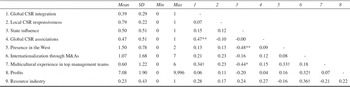
Summary statistics and correlations for all study variables are listed in Table 2.
Summary Statistics and Correlations for all Study Variables

† p < 0.1, * p < 0.05, ** p < 0.01; N = 29
Data analysis. We used fuzzy-set qualitative comparative analysis (fsQCA) as implemented in the eponymous software (Ragin, Drass, & Davey, Reference Ragin, Drass and Davey2009) to test our hypotheses. This method uses Boolean algebra to establish which configurations of causal conditions (independent variables) are related to an observed outcome (Ragin, Reference Ragin2000). It has found growing use in the business and management literature (e.g., Bell, Filatotchev, & Aguilera, Reference Bell, Filatotchev and Aguilera2013; Crilly, Reference Crilly2011; Fiss, Reference Fiss2007; Judge et al., Reference Judge, Hu, Gabrielson, Talaulicar, Witt, Zattoni, Lopez, Chen, Shukla, Quttainah, Adegbite, Rivas and Kibler2015; Schneider, Schulze-Bentrop, & Paunescu, Reference Schneider, Schulze-Bentrop and Paunescu2010). Several characteristics make fsQCA suitable for our research. First, it is explicitly designed for medium-sized samples such as ours, which are generally viewed as too small for standard regression analysis, but too large for deep qualitative analysis (Ragin, Reference Ragin2000). For a sample of 29 such as ours, up to six explanatory variables may be specified (Marx, Reference Marx2006). Second, fsQCA helps determine the precise configurations—that is, combinations—of causal conditions associated with the outcome. Third, the method permits a more fine-grained understanding of causal relationships by allowing for equifinality, that is, the possibility that a number of different configurations of causal conditions may lead to the same outcome (Fiss, Reference Fiss2007). And fourth, since no underlying probability distributions are assumed, fsQCA is robust against outliers (Fiss, Reference Fiss2011; Vis, Reference Vis2012).
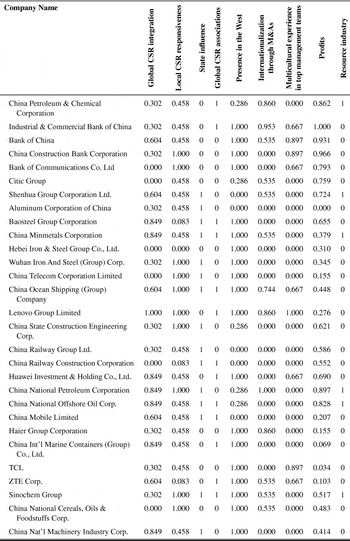
Analysis using fsQCA requires the values of all variables to fall within the range of 0 to 1, where 0 denotes full absence of a given characteristic, 1 full presence, and intermediary values gradations in between. All variables other than binary (dummy) variables thus need to undergo a transformation known as “calibration” (Ragin, Reference Ragin2008). Since there are no strong theoretical reasons for assigning calibration scores manually to our variables, we rank-ordered and then standardized them to range from 0 to 1 (Longest & Vaisey, Reference Longest and Vaisey2008). Table 3 displays the calibration table for each firm and condition.
Calibration Table

Based on these inputs, fsQCA calculates a truth table with 2 k rows, where k is the number of causal conditions. This matrix denotes the entire range of possible combinations of causal conditions. In practice, only some of these are actually observed, and for sample sizes such as ours, only rows with at least 1 or 2 observations would usually enter the final analysis (Ragin, Reference Ragin2008). We chose the more stringent minimum threshold of 2 so as to improve the generalizability and robustness of our results. In addition, the analysis requires specifying a minimum value for consistency, which is a measure indicating the extent to which combinations of causal conditions are reliably associated with the given outcome (higher values being better). In line with precedent studies (e.g., Fiss, Reference Fiss2011; Judge et al., Reference Judge, Hu, Gabrielson, Talaulicar, Witt, Zattoni, Lopez, Chen, Shukla, Quttainah, Adegbite, Rivas and Kibler2015; Ragin, Reference Ragin2008), we set this threshold to 0.80.
Results
Table 4 shows the results of our analyses for global CSR integration, and Table 5 for local CSR responsiveness. Since fsQCA does not necessarily produce symmetrical outcomes—the configurations of causal conditions for the presence and absence of a given outcome can differ (Crilly, Reference Crilly2011; Fiss, Reference Fiss2011)—we performed separate analyses for higher and lower levels of our dependent variables. In line with precedent work (Bell et al., Reference Bell, Filatotchev and Aguilera2013; Crilly, Reference Crilly2011; Fiss, Reference Fiss2011), we denote the presence of a causal condition in a given solution by a filled black circle (●) and the absence of a condition by a circle with an X (⊗). Blank cells indicate that it does not matter whether the given causal condition is present or absent. Large symbols denote so-called “core conditions,” which are more strongly related to the outcome (cf. Fiss, Reference Fiss2011; Ragin, Reference Ragin2008). Small symbols denote “peripheral conditions”, which are more loosely related to the dependent variable. Footnote 1
Solutions for global CSR integration

Key:
-
 core causal condition (present);
peripheral causal condition (present);
-
core causal condition (absent);
peripheral causal condition (absent)


Solutions for local CSR responsiveness

Key:
-
core causal condition (present);
peripheral causal condition (present);
-
core causal condition (absent);
peripheral causal condition (absent)


Table 4 shows that there are two sufficient solutions for attaining high global CSR integration: Being in a resource industry paired with state influence (H1) and higher profits (1); or being active with respect to global CSR associations (H2) and having higher multicultural experience in top management teams (H5a) while having lower profits and not being in a resource industry (2a and 2b). For result 1, resource industry emerged as a core condition. For results 2a and 2b, lower profits are a core condition, paired either with global CSR associations or higher multicultural experience in top management teams as a second core condition. Both solutions exhibit good explanatory power and stability: Coverage, which is roughly equivalent to R2 in a regression, is 0.23 for result 1 and 0.17 for result 2, with a total coverage of both solutions of 0.40. Consistency is 0.89 for solution 1 and 0.97 for solution 2, with a total solution consistency of 0.92. This is well above the threshold of 0.75 suggested by Ragin (Reference Ragin2008).
Turning to solutions producing low global CSR integration, we find one solution (3) requiring non-activity with respect to global CSR associations, low multicultural experience in top management teams, and not being in a resource industry. All three conditions are core conditions. Coverage is high at 0.52, and consistency is acceptable at 0.78.
Overall, these results suggest support for hypotheses 1, 2, and 5a, in that state involvement, global CSR associations, and multicultural experience in top management teams are associated with high global CSR integration. The influence of profits and resource industry emerged as salient.
Table 5 shows the two possible pathways to high local CSR responsiveness; no solution leading to low local CSR responsiveness was identified. Specifically, local CSR responsiveness can be attained through internationalization through M&As (H4) paired with higher profits (core) in a resource industry (peripheral) (solution 4); or in non-resource industries (peripheral), through presence in the West (H3), multicultural experience in top management teams (H5b), and higher profits (solution 5). For solution 5, the analysis suggests two different combinations of core conditions: Multicultural experience in top management teams paired with higher profits, or presence in the West (H3) paired with higher profits. Solution coverages are 0.16 and 0.22 for solutions 4 and 5, respectively. Total coverage stands at 0.40. Solution consistencies are all above the threshold of 0.75, at 0.85 and 0.81, respectively. Overall solution consistency is 0.83.
These results are consistent with hypotheses 3, 4 and 5b, in that high local CSR responsiveness should be associated with presence in the West, internationalization through M&As, and multicultural experience in top management teams. Profits and membership in a resource industry again emerged as important factors. Industry type seems to mediate what pathway to high local CSR responsiveness is taken. The presence of profits as a core condition in all solutions further suggests that in the context of the pathways identified in this paper, it represents a necessary condition for high local CSR responsiveness.
We conducted robustness tests using two different configurations. In one case, we omitted from the sample Chinese MNEs that are state-controlled but listed on the Hong Kong stock exchange. These companies’ behavior may be subject to different institutional logics and pressures, with prior research indicating low levels of CSR consciousness in Hong Kong (Witt & Redding, Reference Witt and Redding2012). Results were identical for local CSR responsiveness and showed minor shifts in the global CSR integration solutions, with solution 2 disappearing and an additional solution for low global CSR integration emerging. In the second case, we included dummy variables for manufacturing and services, a model that we did not adopt as our main specification because the number of variables exceeds the limits recommended for our sample size (Marx, Reference Marx2006). As one would expect, adding variables enables finer differentiation and thus additional solutions. Overall, however, these remain consistent with our main models.
DISCUSSION AND IMPLICATIONS
Since most CSR-related research still focuses on developed economies (e.g., Dobers & Halme, Reference Dobers and Halme2009; Muller & Kolk, Reference Muller and Kolk2009), there is a lack of theoretical understanding about how EMNEs address the tensions of global CSR integration and local CSR responsiveness (Hah & Freeman, Reference Hah and Freeman2014). While some authors (e.g., Matten & Moon, Reference Matten and Moon2008) suggest that legitimacy-seeking and the homogenization of institutional environments across national boundaries lead to rationalized, predictable CSR strategies, others (e.g., Crilly, Reference Crilly2011; Jamali, Reference Jamali2010; Westney & Zaheer, Reference Westney, Zaheer and Rugman2001) propose that applying institutional theory may not delineate straightforward patterns of isomorphic pressures, requiring more institutionally embedded perspectives.
We aim to contribute to this debate as the antecedents we tested in this study, in the emerging-country context of China, suggest a synergetic perspective. We find support for both antecedents that reflect isomorphic patterns of adaptation across and within institutional settings, such as global CSR associations, presence in the West, and internationalization through M&As; and also antecedents that mirror the idiosyncratic characteristics of the Chinese institutional context, such as state influence. Overall, these observations are in line with Cuervo-Cazurra's (Reference Cuervo-Cazurra2012) analysis that investigating EMNEs creates a laboratory for extending existing theories. This suggests that the study of EMNEs has the potential to uncover antecedent factors of global CSR integration and local CSR responsiveness that may not yet have been fully considered.
In our findings, state influence, motivated by the Chinese government’s interest in establishing CSR standards (Gugler & Shi, Reference Gugler and Shi2009) and accompanied by respective CSR policies and guidelines for companies, emerged as an antecedent of Chinese MNEs’ global CSR integration. This finding reflects a key peculiarity of China’s institutional context. At the same time, activity with respect to the UN Global Compact was another important antecedent, underlining the significance of impact from universal plea on Chinese MNEs’ CSR strategies. While extant international business research tends to discuss home- and host-country influences on MNEs’ CSR approaches (e.g., Crilly, Reference Crilly2011; Hah & Freeman, Reference Hah and Freeman2014), an enlarged focus considering such supranational and other factors beyond the headquarters-subsidiary dyad, such as industry membership, may enrich future research. This would be consistent with CSR research suggesting multiple-level influences on business organizations’ CSR (e.g., Aguilera et al., Reference Aguilera, Rupp, Williams and Ganapathi2007). For example, in the case of resource-intensive MNEs, established global industry standards seeking to offset the environmental and social footprint might be of particular relevance with respect to global CSR integration. Such perspectives could thus identify and test a broader range of antecedents, and they are important for two reasons. First, examining the interplay of various drivers of global CSR integration can enrich the understanding of how MNEs globally integrate their CSR strategies. Second, the consideration of various antecedent factors of global CSR integration is potentially promising, as it requires both insights from the international business and the CSR and ethics literatures. Therefore, such research could contribute to a closer integration and assimilation of these areas (cf., Doh et al., Reference Doh, Husted, Matten and Santoro2010).
As for local CSR responsiveness, presence in the West and internationalization through M&As emerged as antecedents. In accordance with institutional theory, both support the logic that Chinese MNEs tend to be responsive to local CSR requirements for reasons of legitimacy. Future studies could examine the CSR-related learning opportunities for Chinese MNEs that may result from local adaptations because of these two drivers. Our findings also showed that profits were a core condition for high local CSR responsiveness in all configurations. While there is a lack of theory and prior work supporting the clear formulation of hypotheses relating profits and local CSR responsiveness, this finding poses the question whether Chinese MNEs consider profitable business a necessary prerequisite for engaging in local CSR. Future research may benefit from investigating this relationship and thus help advance the understanding of local CSR responsiveness. Our main analyses did not reveal configurations of low CSR responsiveness, suggesting that this dimension may be rather complex and multifaceted, most likely due to the large number of diverse local CSR contexts in which Chinese MNEs are present.
Our results further indicated that multicultural experience in top management teams is associated with both global CSR integration and local CSR responsiveness. This suggests that we may see more approaches toward transnational CSR as Chinese top management teams become more multiculturally experienced. Future studies might focus on these dynamics and possible developments over time. In accordance with preceding work (e.g., Fan et al., Reference Fan, Nyland and Zhu2008), it demonstrates that certain antecedents to MNEs’ CSR strategies may influence both dimensions of the integration-responsiveness framework in the context of CSR. Studies that aim to identify these factors are likely to be insightful, as they may help examine the mechanisms that enable MNEs to create multifaceted CSR reactions (Husted & Allen, Reference Husted and Allen2006; Logsdon & Wood, Reference Logsdon and Wood2005) in response to political and economic pressures from global and local stakeholders. Specifically in the context of emerging economies, research that aims to identify and test such antecedents could contrast MNEs from various emerging countries with MNEs from advanced economies, which would allow for identifying antecedents that are distinct for individual emerging economies or present in emerging markets in general.
Limitations
A key limitation of our study is that for reasons of data availability, our perspective on CSR emphasized the group and aggregate levels of the MNEs we analyzed. Thus, we were unable to distinguish clearly between headquarters and subsidiary perspectives, which for our analyses may have added substantial value. In particular, subsidiary perspectives could have provided more in-depth explanations about why companies adapt their CSR approaches locally. Due to the large number of subsidiaries of our sample companies, the complex group structures they exhibit, and a lack of published data, we were unable to incorporate these perspectives. Furthermore, although all possible precautions were taken to ensure the reliability of the data, our analyses rely on secondary sources such as company websites and databases.
As a consequence of the focus of this study on the emerging-market context of China and the institutionally embedded perspective we assumed, as well as the idiosyncratic characteristics of emerging countries more broadly, our findings may not be fully generalizable across institutional contexts. Witt and Redding's (Reference Witt and Redding2012) work, for example, suggests that CSR orientations can differ across institutional settings. Therefore, as indicated previously, future studies may find promising opportunities to investigate whether the synergetic perspective identified in this study equally applies to other emerging economies.
CONCLUSION
This study can help advance our understanding of how Chinese MNEs address the tensions of global CSR integration and local CSR responsiveness. Drawing on institutional theory and considerations of legitimacy as well as the integration-responsiveness framework in the context of CSR, we find relevant both those antecedents reflecting isomorphic patterns of adaptation across and within institutional settings and those mirroring idiosyncratic characteristics of the Chinese institutional context. These findings support Cuervo-Cazurra’s (Reference Cuervo-Cazurra2012) analysis that investigating EMNEs creates a laboratory for extending existing theories. Our study therefore helps inform work at the intersection of international business and CSR, as it stimulates future research into the antecedents of global CSR integration and local CSR responsiveness of EMNEs.
ACKNOWLEDGEMENTS
We would like to thank the special issue editors and the anonymous reviewers for their guidance and valuable input. Thanks are further due to Monika Mikulová, who with her contributions laid invaluable foundations for this study, and to the coders involved in the content analyses.
Appendix A: Summary of coding instructions
Global CSR Integration
The company’s CSR strategy and activities tend to highlight universal principles around clearly defined core themes applicable to all countries of operation. These strategies might feature widespread consensus on the relevance of their CSR activities. Overall, such approaches may appear to be of proactive nature and could emphasize efficiency, expressed through the setting of standards, guidelines, and norms.
Examples of globally integrated CSR activities may relate, but are not limited to:
-
• the establishment of uniform, company-wide employee safety standards
-
• a global warming and climate change initiative enacted in all countries of operations
-
• a company-wide charity program that unanimously endorses the same emphases
Depending on the company’s objectives, industry, and targets, the actual CSR themes and foci may differ considerably. Yet the extent to which the various company-specific CSR activities are globally cohesive, could be high or low.
Please evaluate to which degree the company’s CSR strategy is globally integrated.
Local CSR Responsiveness
The company’s CSR strategy and activities tend to be responsive to local communities in countries of operations and may focus on particular needs and circumstances, which are of importance in specific countries and regions. These strategies might feature select native issues to support the relevance of their CSR strategies. Overall, such strategies may appear to be fragmented and ad hoc.
Examples of locally responsive CSR activities may relate, but are not limited to:
-
• employee training and development in a country with low literacy rates adapted to the particular needs of the employees in this country
-
• HIV/AIDS programs in select regions of Africa
-
• a number of diverse charity activities across countries of operations with various emphases depending on local communities’ needs
Depending on the company’s objectives, industry, and targets, the actual CSR themes and foci may differ considerably. Yet the extent to which the various company-specific CSR activities are locally receptive could be high or low.
Please evaluate to which degree the company’s CSR strategy is locally responsive.