I. INTRODUCTION
Zeolite membranes have attracted significant interest in chemically demanding applications such as gas and liquid separations, biofuel upgrading, ammonia recovery from syngas looping and in pervaporation.Reference Camus, Perera, Crittenden, van Delft, Meyer, Pex, Kumakiri, Miachon, Dalmon, Tennison, Chanaud, Groensmit and Nobel1–Reference McLeary, Jansen and Kapteijn4 Effective zeolite membranes should combine a high flux and good selectivity with a desirable chemical and mechanical durability. Zeolite membranes typically consist of thin microporous zeolite films attached to macroporous substrates of alumina,Reference Piera, Giroir-fendler, Dalmon, Moueddeb, Coronas, Menéndez and Santamaria5 stainless steel,Reference Piera, Téllez, Coronas, Menéndez and Santamaria6 glass,Reference Wong, Au, Ariso and Yeung7 and carbon.Reference Berenguer-Murcia, Garcia-Martinez, Cazorla-Amorós, Linares-Solano and Fuertes8 Important properties of membrane substrates are a low pressure drop, sufficient mechanical strength, and good chemical durability. However, problems with compatibility between the support and the zeolite film and the large difference in the coefficient of thermal expansion between the zeolite film and the ceramic or metallic support may limit performance and lifetime in chemically demanding applications. Recently, we have demonstrated how (macro)porous substrates of silicalite-I can be produced by a pulsed current processing (PCP) route and that these substrates display a negative coefficient of thermal expansion similar to the zeolite film.Reference Akhtar, Ojuva, Wirawan, Hedlund and Bergström9 Zeolite-based substrates are expected to have a better compatibility and minimal thermal expansion mismatch with the zeolite film and are thus promising alternatives to ceramic or metallic porous supports. Zeolite films are typically grown on porous substrates usually under hydrothermal conditions in highly alkaline or acidic solutions.Reference Lai and Gavalas10 During operation, zeolite membranes are commonly subjected to acidic and alkaline solutions or vapors at elevated temperatures and pressures for extended periods of time. Hence, the resistance of the support (and zeolite film) to chemically corrosive environments is an important and sometimes decisive factor in controlling the durability and lifetime of zeolite membranes. Unfortunately, studies providing a better understanding of the chemical degradation of the zeolite film and the porous membrane support are sparse. Previous work suggests that TiO2 macroporous supports show a significantly larger chemical stability than α-Al2O3, ZrO2, and SiO2 supports in highly acidic and alkaline solutions and that the degree of crystallinity strongly influences the degradation in acidic solutions.Reference Jeannette-Mareike11–Reference Van Gestel, Vandecasteele, Buekenhoudt, Dotremont, Luyten, Leysen, Van der Bruggen and Maes13
It is well known that exposure of SiO2 to highly alkaline solutions above pH 10.0 significantly increases its solubility and thus decreases its chemical stability.Reference Iler14 Andersson and HedlundReference Andersson and Hedlund15 reported that additional micro- and mesopores are created within a silicalite-I film with increasing pH of the aqueous solution. Selective dissolution of Al and/or Si in acidic and alkaline media has been utilized to produce dealuminized and desilicated zeolite crystals with an enhanced catalytic activity.Reference Apelian, Fung, Kennedy and Degnan16,Reference Ogura, Shinomiya, Tateno, Nara, Nomura, Kikuchi and Matsukata17 Performing the dissolution at near saturation conditions can result in both the attack of Si–O–Si and Si–O–Al sites in basic and acidic solutions and re-precipitation of a solid phase.Reference Čimek, Subotić, Šmit, Tonejc, Aiello, Crea and Nastro18,Reference Werner19 Dissolved silicate species can reprecipitate and form a layer of amorphous silica on the surface of the zeolite crystals.Reference Čimek, Subotić, Šmit, Tonejc, Aiello, Crea and Nastro18 In comparison, selective removal of aluminum from the zeolite framework usually takes place in acidic solutions.Reference Beyer20
Kaolin and bentonite are aluminosilicate clays and are commonly used as inorganic binders to enhance the strength of zeolite bodies.Reference Li, Perera, Crittenden and Bridgwater21,Reference van Mao, Rutinduka, Detellier, Gougay, Hascoet, Tavakoliyan, V Hoa and Matsuura22 The transition state theory of minerals dissolution and precipitation suggests that the dissolution of aluminosilicate clay minerals starts with the removal of exchangeable cations from the structure followed by hydrolysis of Si–O–Al bonds.Reference Oelkers, Schott and Devidal23 Silicon is released by hydrolysis of the remaining Si–O–Si surface bonds.Reference Casey, Westrich and Arnold24
This study aims to investigate the changes in the durability of three types of silicalite-I substrates after accelerated dissolution at elevated temperature in acidic and alkaline solutions. The changes in the chemical composition, microstructure, pore architecture, crystallinity, and mechanical stability of the treated substrates have been systematically investigated by inductively coupled plasma-atomic emission spectroscopy, scanning electron microscopy, N2 physisorption and mercury intrusion porosimetry, x-ray diffraction, and diametral compression tests, respectively. The properties of binder-free substrates produced by our recently developed PCP route were compared with binder-containing substrates produced by the conventional thermal treatment.
II. EXPERIMENTAL
A. Materials
Silicalite-I powder (Sϋd-Chemie AG, Bruckmuhl, Germany) with a Si/Al ratio of 1200 and a particle size of 5 μm was used to prepare membrane substrates. Kaolin (Acros Organics, Geel, Belgium) and colloidal silica (Sigma-Aldrich Chemie GmbH, Steinheim, Germany, 30 wt% suspension in water) were used as inorganic binders. The pH of water was adjusted by 1 M solutions of sodium hydroxide (Sigma-Aldrich, Chemie GmbH, Steinheim, Germany) and hydrochloric acid (Analar Normapur, France, 37%).
B. Materials preparation
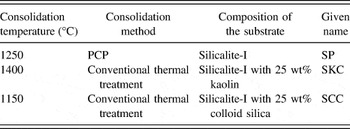
Binder-free silicalite-I cylindrical substrates with a diameter of 25 mm were consolidated by PCP in a spark plasma sintering machine (Dr Sinter 2050, Sumitmo Coal Mining Co., Ltd., Kawasaki, Japan). The powder was loaded in a graphite die where a uniaxial pressure of 20 MPa and heating rate of about 100 °C/min was applied. When the temperature reached to 1250 °C, it was held constant for 3 min and the die was cooled afterward. Silicalite-I and 25 wt% kaolin were mixed with deionized water while stirring, then the mixture was dried in an oven at 60 °C. A suspension of silicalite-I and 25 wt% colloidal silica was mixed on the stirrer and heated under stirring to obtain dried powders. Cylindrical substrates of 13 mm diameter were formed by pressing the dried powders at an applied pressure of 10 MPa. The binder-containing silicalite-I substrates with kaolin and colloidal silica were consolidated, with a heating rate of 20 °C/min without holding time, by conventional thermal treatment at 1400 and 1150 °C, respectively. The consolidated substrates in this work are presented in Table I and the given name to each substrate is used throughout the text.
Silicalite-I substrates consolidated with different compositions and heat treatment methods.

C. Dissolution
Zeolite substrates were immersed in polyethylene tubes containing 25 mL aqueous solutions at three different pH values: pH 2.0, 10.6, and 13.0, at 90 °C for 168 h. The aqueous solutions for dissolution experiments were prepared by adjusting the initial pH of deionized water by using 1 M NaOH and HCl. The pH of the aqueous solution after dissolution of the silicalite-I substrates at pH 2.0 for 168 h at 90 °C remained unchanged. This is due to the very slow formation of silicic acid in the solution at this pH. In contrast, the pH decreased by 1.0 and 1.5 units when silicalite-I substrates were dissolved at pH 10.6 and 13.0, respectively, due to formation of high concentration of silicic acid in the solution at these pH conditions.Reference Iler14 After a time interval, the zeolite substrates were drawn out of the solution. The recovered substrates were rinsed (one time) immediately with an aqueous solution of same pH followed by deionized water at room temperature. The substrates were then dried in the oven at 80 °C. After removing the substrates, the solution was used to analyze the concentration of dissolved silicon and aluminum.
D. Characterization
The pH was measured with a SevenMulti (METTLER-TOLEDO, GmbH, Switzerland) pH meter. An ICP-AES (Vista AX, Varian, Agilent Technology Inc., Santa Clara, CA) with sample preparation system SPS-5 equipped with simultaneous CCD solid-state detector was used to quantify the concentration of silicon and aluminum in the solution. XPERTPRO powder diffractometer (PANalytical, Almelo, Netherlands) with Cu Kα radiation operating at 45 KV and 40 mA settings was used for structural analysis. The surface area was calculated by Brunauer, Emmett, and Teller (BET) model within 0.05–0.15 P/P0 relative pressure from N2 adsorption/desorption isotherms collected on an ASAP 2020 analyzer (Micromeritics, Norcross, GA) and Gemini VII (Micromeritics, Norcross, GA). Diametral compression test was performed on binder-containing silicalite-I substrates at an applied load rate of 0.5 mm/min on an electromechanical Zwick Z050 machine (Zwick GmBH Co & KG, Ulm, Germany), and the measurement was repeated for at least 3 cylinders. The strength of binder-free silicalite-I membrane substrates was tested following ASTM F394 standard repeated for at least 5 substrates.25 Mercury intrusion porosimetry on Autopore III (CiAB Chemical Instruments AB) was used to determine the meso–macropore size distribution and to estimate the porosity of the silicalite-I substrates within the intrusion pressure range of 0.03–412 MPa. Microstructure of the silicalite-I substrates was characterized by a field emission gun scanning electron microscope (FEG-SEM, JSM-700F, JEOL, Tokyo, Japan), without any coating on the surface of the substrates, at a working distance of 6 mm and an accelerating voltage of 1.5 kV.
III. RESULTS AND DISCUSSIONS
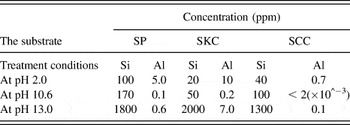
The ICP data in Table II show that silicon and aluminum are dissolved from binder-free silicalite-I substrates. The amounts of dissolved aluminum from all the silicalite-I substrates are only between 0.1 and 10 ppm, and always significantly lower than the amount of dissolved silicon. As expected, the amount of dissolved silicon is much higher after leaching at pH 13.0 than at pH 2.0. Previous work has shown that the conversion of Si(OH)4 to anionic silicate species at pH above 11.0 increases the dissolved amount by keeping the solution unsaturated with respect to Si(OH)4 concentration.Reference Iler14 The ratio between the dissolved silicon over aluminum is higher for the colloidal silica-containing (SCC) substrates compared with the binder-free (SP) or clay-containing (SKC) substrates. This suggests that the colloidal silica dissolves more readily than the silicalite-I material. This is in accordance with studies by IlerReference Iler14 who has shown that the solubility of the colloidal particles of different forms of amorphous silica is higher than that of crystalline siliceous materials. Silicalite-I substrates containing kaolin (SKC) as binder release more aluminum into the solution at pH 2.0 and pH 13.0 compared with the other substrates (Table II), which suggests that the aluminum-containing kaolin binder also dissolves. Indeed, it has been reported that kaolin with low crystallinity is a metastable phase and dissolves both in alkaline and acidic aqueous solutions.Reference Xie and Walther26,Reference May, Klnniburgh, Helmke and Jackson27
The concentration of silicon and aluminum dissolved in the solution (in ppm) from the silicalite-I substrates treated at pH 2.0, 10.6, and 13.0 at 90 °C for 168 h.

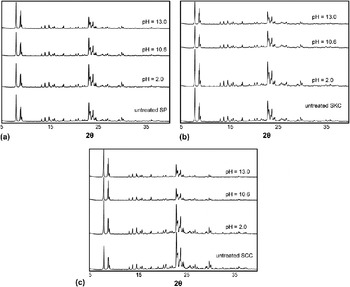
The crystalline nature of zeolites can be readily investigated by x-ray diffraction. The XRD patterns of acid- and alkaline-treated SP substrates [Fig. 1(a)] show that the major reflections at 2θ = 7.9, 8.9, and 23.1° are similar to the untreated materials. Hence, the leaching of silicon and aluminum from the zeolite framework at pH 2.0, 10.6, and 13.0 does not result in a collapse or significant change in the microporous structure.Reference Ogura, Shinomiya, Tateno, Nara, Nomura, Kikuchi and Matsukata17 The preservation of the microporous structure after leaching is also observed for the SKC and SCC substrates [Figs. 1(b)–1(c)].
XRD patterns of silicalite-I substrates before and after exposure to aqueous solutions at pH 2.0, 10.6 and 13.0 for 168 hours at 90 °C; (a) SP; (b) SKC and (c) SCC substrates.

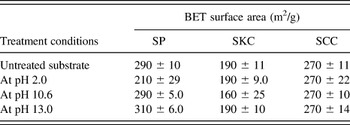
The BET surface area (Table III) of the SP substrates remains unchanged after 168 h exposure at pH 10.6 and 13.0 with respect to the untreated substrates. The insignificant change in the BET surface area at alkaline conditions confirms that the pores do not get blocked by re-precipitation of dissolved species onto the surface of silicalite-I crystals. The loss of surface area of the SP and SKC substrates after treatment at pH 2 and pH 10.6, respectively, may be related to the precipitation of a nonporous amorphous aluminosilicate film.Reference Hartman and Fogler28 Further investigations are required to ascertain the cause of the observed loss in the surface area.
BET surface area (m2/g) of silicalite-I substrates subjected to aqueous solutions at pH 2.0, 10.6, and 13.0 at 90 °C for 168 h.

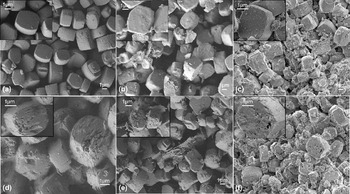
Comparison of the SEM micrographs of the untreated SP substrate [Fig. 2(a)] and the SP substrate treated at pH 13.0 [Fig. 2(d)] shows that the silicalite-I crystals are etched and the distinct particle morphology is partly lost. The untreated binder-containing substrates, SKC [Fig. 2(b)] and SCC [Fig. 2(c)], display a microstructure characterized by the larger silicalite-I crystals fused together by the smaller binder particles. The silicalite-I grains of the binder-containing substrates are also leached after treatment at pH 13.0 [Figs. 2(e) and 2(f)] but appear to be less affected than the binder-free material [Fig. 2(d)]. The micrograph of SCC substrates [Fig. 2(c)] shows that silica particles are dispersed on the surface of the silicalite-I crystals and bind them to each other. The microstructural observation after the dissolution treatment of SCC substrates at pH 13.0 shows that the silicalite-I particles are dissolved, large holes and channels are formed on the surface, and particles are loosely bonded due to dissolution of silica particles. These observations along with the preservation of the silicalite-I particles are in agreement with the pore size distribution (Fig. 3) and XRD (Fig. 1), respectively.
HRSEM micrographs taken from the uncoated surface of the silicalite-I substrates before and after treatment at pH 13.0; (a) untreated SP, (b) untreated SKC, (c) untreated SCC and (d) treated SP, (e) treated SKC, (f) treated SCC substrates.

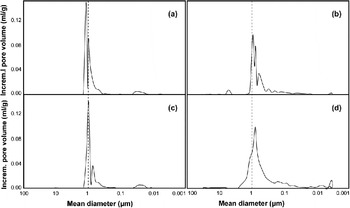
The pore size and pore size distribution of SP substrates; (a) untreated substrate and after treatment for 168 h at 90 °C in an aqueous solution at; (b) pH 2.0; (c) pH 10.6; and (d) pH 13.0.

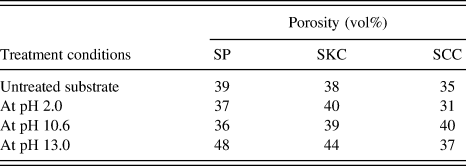
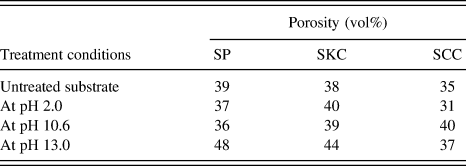
Mercury intrusion porosimetry data (Fig. 3) show significant changes in the macroporous structure of SP substrates. SP substrates treated at pH 13.0 show an increase in the macropore size and broadening of pore size distribution [Fig. 3(d)]. Indeed, this is due to removal of a significant amount of material from the substrate. The removal of material from the SP substrates at pH 13.0 results in formation of intracrystalline mesopores and broadening of interparticle macropores of 1 μm size [Figs. 2(d) and 3(d), respectively] and increases porosity to 48% (Table IV). However, acid leaching at pH 2.0 and base treatment at pH 10.6 do not induce any significant changes in the (macro–meso)porous structure of silicalite-I crystals [Figs. 3(b) and 3(c)]. After dissolution at pH 13.0, the porosity of the SKC and SCC substrates increases to 44% and 37% (Table IV), respectively. Previous studies have shown that both kaolin and silica are less soluble in acidic and mild alkali solutions but they are largely degraded if treated in strong alkaline solutions.Reference Iler14,Reference Xie and Walther26,Reference Jozefaciuk and Bowanko29 ICP data (Table II) and SEM micrographs (Fig. 2) show that silicalite-I crystals degrade to a lower degree when binder is present in the substrates.
Porosity (vol%) acquired by mercury intrusion porosimetry for the silicalite-I substrates treated at pH 2.0, 10.6, and 13.0 at 90 °C for 168 h.
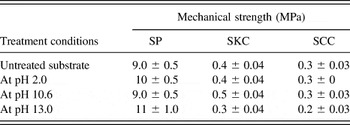
Mechanical strength of SP substrates remains virtually unaffected after exposure to acidic and alkaline conditions (Table V). The stable mechanical strength is due to the presence of stable bonds between silicalite-I particles after treatment that are visible in high-resolution SEM micrographs [Fig. 2(d)]. It has already been reported that the strength of porous ceramics is not only controlled by porosity fraction but also influenced by microstructure, neck growth leading to strong bonds.Reference Shi30 Owing to the presence of strong bonds between silicalite-I crystals [Fig. 2(d)], the mechanical strength of SP substrates may have no dependency on porosity after 168 h of exposure. We suggest that long-term exposure, i.e., more than 168 h, is required to observe mechanical degradation of SP substrate. In contrast, SKC and SCC substrates lose 25% of their strength when exposed for 168 h to pH 13.0. The degradation of mechanical properties can be explained by the selective binder dissolution that results in the weakening of the bonds between the binder and silicalite-I crystals. Our results show that the mechanical strength of SP substrates is twenty times higher than SKC and SCC substrates and does not change in a harsh chemically corrosive environment over an exposure of 168 h. The mechanical stability of SKC and SCC substrates degrade over time when exposed to a chemically corrosive environment. The significantly higher mechanical strength of binder-free SP substrates that remain stable after treatment at different pH conditions shows the advantages of using membrane substrates consolidated by PCP.
Mechanical strength (MPa) of the silicalite-I substrates treated at pH 2.0, 10.6, and 13.0 at 90 °C for 168 h.

IV. CONCLUSIONS
The chemical and mechanical durability study of silicalite-I membrane substrates suggests that binder-free substrates (SP) are durable when exposed to aqueous solutions at pH 2.0, 10.6, and 13.0 at 90 °C for 168 h. The long-term (168 h) exposure of the silicalite-I substrates to the acid and alkali solutions results in a slight removal of silicon (in acid) and aluminum (in alkali) and does not significantly affect the specific surface area, crystalline microporous structural features, and mechanical stability of the substrates. The treatment of SP substrates at pH 13.0 increases the macropore size and broadens the macropore size distribution and porosity. In comparison, the binder-containing substrates (SKC and SCC) exhibit twenty times lower mechanical strength than SP substrates. The mechanical strength of the binder-containing substrates is further reduced by dissolution of the binder at pH 13.0. The high mechanical stability and chemical durability of binder-free SP substrates suggest that the binder-free SP substrates could be suitable substrate materials in chemically demanding applications.
ACKNOWLEDGMENTS
The authors would like to thank Swedish Foundation for Scientific Research (SSF) and Berzelii center EXSELENT on porous material at Stockholm University for financing this work. We like to acknowledge Dr. Kjell Jansson for his help with the electron microscopy.