Introduction
Nasopharyngeal carcinoma (NPC) arises from the epithelium of the nasopharynx.Reference Wenig 1 The worldwide average incidence of NPC is less than 1 per 100 000 population.Reference Black, Bray, Ferlay and Parkin 2 However, in some areas of China, its incidence is 20 per 100 000.Reference Yu and Yuan 3 – Reference Chang and Adami 5
Radiotherapy is considered the ‘gold standard’ treatment for patients affected by NPC because of the anatomical site of the nasopharynx and the radiosensitivity of NPC. The advent of intensity-modulated radiotherapy has decreased the incidence of side effects, whilst maintaining the same efficacy of traditional techniques.Reference Kam, Chau and Suen 6 , Reference Lee, Xia, Quivey, Sultanem, Poon and Akazawa 7 Today, a combined therapeutic approach with the addition of chemotherapy (concurrent, neo-adjuvant or adjuvant) to radiotherapy for patients affected by locally advanced disease is preferred. This has led to a drop in treatment failures and improved prognosis.Reference Geara, Glisson, Sanguineti, Tucker, Garden and Ang 8 – Reference Dimery, Legha, Peters, Goepfert and Oswald 12 The most active and most used chemotherapeutic agents for the treatment of NPC patients are cisplatin, carboplatin, epirubicin, bleomycin, methotrexate and fluorouracil (5-FU).Reference Decker, Drelichman and Al-Sarraf 13
Life expectancy of these patients and, consequently, post-treatment morbidity, has increased: a higher incidence of oral mucositis, dysphagia, xerostomia, and olfactory and gustatory function deterioration has been registered.Reference Maes, Huygh, Weltens, Vandevelde, Delaere and Evers 14 – Reference Temmel, Quint, Schickinger-Fischer, Klimek, Stoller and Hummel 16
Despite the impact on quality of life (QoL), little attention has been given to olfactory impairment. It is known from literature that several chemotherapy drugs used in the treatment of NPC could cause olfactory dysfunction as a side effect.Reference Ravasco 17 At the same time, radiotherapy for head and neck cancers could have a direct effect on receptors and on the nerve fibres of olfactory pathways.Reference Hua, Chen, Tang and Leung 18 – Reference Ho, Kwong, Wei and Sham 20 Furthermore, although the radiation dose to the olfactory region has decreased significantly with the use of intensity-modulated radiotherapy, some patients still complain of post-treatment olfactory dysfunction.
Olfactory function can be assessed using numerous psychophysical tests and some subjective scales, such as visual analogue scales (VAS) and the six-item Hyposmia Rating Scale.Reference Millar, Perez, Rossi, Cerquetti and Merello 21 A more objective assessment of the integrity of olfactory pathways can be obtained via olfactory event-related potentials, an electrophysiological technique that allows the assessment of changes in olfactory function.
Olfactory event-related potentials are the result of sequential activation of different structures. The transmission of olfactory sensory input travels from the olfactory neuroepithelium located in the nasal cavities towards the olfactory bulbs, through the first cranial nerves, where contact is made with second-order neurons (dendrites of mitral and tufted cells within glomeruli). From here, the post-synaptic fibres that form the olfactory tracts project to the primary olfactory areas, which comprise the anterior olfactory nucleus, tenia tecta, olfactory tubercle, piriform cortex, amygdale, anterior cortical amygdaloid nucleus, and peri-amygdaloid and entorhinal cortices. The piriform cortex is connected to the thalamus, hypothalamus and orbitofrontal cortex, and the entorhinal cortex is connected to the hippocampus. The thalamus has connections towards secondary olfactory areas, such as the orbitofrontal and insular cortices.Reference Rombaux, Mouraux, Bertrand, Guerit and Hummel 22 – Reference Caminiti, De Salvo, De Cola, Russo, Bramanti and Marino 25
Few studies have been conducted to assess the impact of chemotherapy and radiotherapy on the olfactory system. We are not aware of any studies that have assessed olfactory function in patients affected by locoregionally advanced NPC, who were treated with neo-adjuvant chemotherapy followed by radiotherapy and concurrent chemotherapy. For this reason, our team opted for the use of self-rating measurements and olfactory event-related potentials in order to evaluate the impact of chemo-radiotherapy on the olfactory system.
Materials and methods
Study population
Thirty-one patients with histopathologically confirmed non-keratinising carcinoma of the nasopharyngeal region were followed up in the Department of Otorhinolaryngology at the University of Messina from February 2010 to June 2013.
According to the 7th edition of the American Joint Committee on Cancer staging system,Reference Greene, Page, Fleming, Fritz, Balch and Haller 26 the disease distribution was as follows: stage I, 2 patients (6.4 per cent); stage II, 4 patients (12.9 per cent); stage III, 11 patients (35.4 per cent); stage IVa, 5 patients (16.1 per cent); stage IVb, 5 patients (16.1 per cent); and stage IVc, 4 patients (12.9 per cent).
The inclusion criteria were: locoregionally advanced disease, in particular tumour–node–metastasis stages III (T3–4,N0–1,M0) and IVa (T4,N0,M0 or T1–4,N2,M0); patients who had received chemo-radiotherapy performed with the same protocol; and regular follow up after initial therapy.
The exclusion criteria were: nasal diseases such as persistent allergic rhinitis, and acute or chronic rhinosinusitis; nasal polyps; severe nasal deformity; upper respiratory tract infections; pregnancy; and patients on steroids or other drugs that may affect sense of smell.
Six radiotherapy treated patients with early stage disease (stages I or II), seven chemotherapy treated patients affected by metastatic disease (stages IVb–c), five dead patients (one with stage III, one with stage IVb and three with stage IVc disease), and one patient (with stage IVa disease) with residual lesions after combined therapy, were excluded from the study.
In line with the inclusion and exclusion criteria, 12 patients with a diagnosis of locoregionally advanced (stages III or IVa) nasopharyngeal carcinoma (NPC) were enrolled in our study. Subsequently, three patients were excluded, as they could not be followed up regularly (two with stage III and one with stage IVa disease).
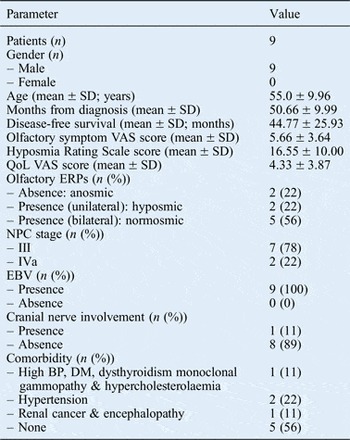
Overall, 9 patients (all males), with a mean age of 55.0 ± 9.96 years, and 9 healthy controls (all males), with a mean age of 52.56 ± 8.56 years, were enrolled in the study. Seven patients (77.77 per cent) had stage III disease and two patients (22.22 per cent) had stage IVa disease.
All patients received neo-adjuvant chemotherapy and concurrent platinum-based chemo-radiotherapy using intensity-modulated radiotherapy. The primary tumour with direct extensions (including metastatic retropharyngeal lymph nodes) was defined as gross tumour volume (gross tumour volume 1), and received a dose of 60–69 Gy, with an average of 225 cGy per day. Metastatic cervical lymph nodes were defined as gross tumour volume 2, and received a dose of 50–54 Gy, with an average of 200 cGy per day. Gross tumour volume 1 included the olfactory region in all patients. All fields were treated once daily, five times a week, with varying treatment plans according to tumour volume and cancer stage.
Three cycles of neo-adjuvant chemotherapy were administered during radiation planning, with the intent to prevent disease progression. All patients underwent the following chemotherapeutical protocol: docetaxel 75 mg/m2 (1st day of cycle), cisplatin 75 mg/m2 (1st day of cycle) and fluorouracil 750 mg/m2 (continuous infusion from 1st to 4th day of cycle) administered for 3 cycles every 21 days. Concurrent chemotherapy with cisplatin 100 mg/m2 (1st day of cycle) was continued during the period of radiotherapy and limited to 3 cycles, repeated every 21 days.
At enrolment, all patients, who presented with a mean disease-free survival time of 44.77 ± 25.93 months, completed a questionnaire that included questions on: sociodemographic characteristics, cigarette and alcohol use, general diseases (diabetes mellitus, hypertension, heart disease, liver disease and cancer), ongoing medical treatments, and occupational hazards. Furthermore, information on positivity for Epstein–Barr virus and cranial nerve involvement was collected.
Self-rating scales on olfactory function were administered. A VAS was used to measure olfactory dysfunction; scores ranged from 0 to 10, where 0 indicated complete olfactory loss and 10 indicated normal function. The impact of olfactory dysfunction on QoL was evaluated using a VAS; scores ranged from 0 to 10, where 0 indicated a significant impact on QoL and 10 indicated no impact on QoL. The six-item Hyposmia Rating Scale was also administered: patients were asked to answer six questions by choosing among five options (with option one giving a score of 1, option two giving a score of 2 and so on) for each question. A final score, ranging from 6 (high sense of smell) to 30 (low sense of smell), was obtained.Reference Millar, Perez, Rossi, Cerquetti and Merello 21 The presence of parosmia or phantosmia was also recorded.
All subjects also underwent olfactory event-related potential testing. All demographic and clinical data are shown in Table I.
Demographic and clinical data of nasopharyngeal carcinoma patients

SD = standard deviation; VAS = visual analogue scale; QoL = quality of life; ERP = event-related potential; NPC = nasopharyngeal carcinoma; EBV = Epstein–Barr virus; BP = blood pressure; DM = diabetes mellitus
The present study was approved by the local ethics committee and written informed consent was obtained from all patients.
Olfactory event-related potentials
All measurements were performed at the Istituto di Ricovero e Cura a Carattere Scientifico (‘IRCCS’) Centro Neurolesi ‘Bonino Pulejo’ of Messina, Italy. A selective, controlled stimulation of the olfactory system, to elicit olfactory event-related potentials, was achieved using a computer-controlled Olfactometer OM2S (Burghart Medical Instruments, Wedel, Germany), linked directly to an electroencephalogram (EEG) recorder (Micromed Brain Quick, 32-channel system; Micromed, Treviso, Italy).
A succession of 40 randomised olfactory stimuli, using phenyl ethyl alcohol (40 per cent v/v; Labochem Science, Sant'Agata li Battiati, Italy) and hydrogen sulfide in nitrogen (4 ppm; Rivoira, Milan, Italy) as odorants, was presented through a Teflon nasal outlet (4 mm lumen tube), which was placed into the nasal vestibule. Subjects were asked to breathe normally through their mouth.Reference Rombaux, Mouraux, Bertrand, Guerit and Hummel 22 – Reference Caminiti, De Salvo, De Cola, Russo, Bramanti and Marino 25 A constant level of vigilance was maintained by asking subjects to avoid eye blinking. The stimuli were presented whilst the patients were lying down, in a well-ventilated room. During the recording session, subjects were isolated from ambient noise, with a 70 dB constant binaural white noise administered through headphones. The duration of each stimulus was 200 ms and the inter-stimulus interval was 40 seconds.
The EEG was recorded from three scalp electrodes placed along the midline (at Fz, Cz and Pz positions of the international 10–20 system). The reference electrode was placed on the earlobe (A2) and the ground electrode on the forehead. Eye movements and blinks were monitored using an electro-oculogram, obtained by positioning an electrode above the right eyebrow. Other muscle artifacts were monitored and discarded. The data were band-pass filtered at 0.01–30 Hz and a notch filter was used. The EEG activity was averaged from 500 ms in the pre-stimulus period to 2000 ms in the post-stimulus period. Olfactory event-related potentials were obtained by averaging artifact-free EEG epochs.Reference Rombaux, Mouraux, Bertrand, Guerit and Hummel 22 – Reference Caminiti, De Salvo, De Cola, Russo, Bramanti and Marino 25
Olfactory event-related potentials consist of a large negative N1 component, followed by a large positive component, P2. The P2 component is often described as a complex consisting of two distinct components, P2 and P3. An initial positive P1 component is not always present. The early olfactory event-related potential components (N1 and P1) reflect the exogenous cortical activity related to sensory input. The later olfactory event-related potential components, such as P2, reflect endogenous cortical activity, related to cognitive processing. Several papers have confirmed that the P2 component occurs between 530 and 800 ms after stimulus onset, with an amplitude of 5–20 μV. Olfactory event-related potential components present maximal amplitudes at the Cz and Pz electrode sites.Reference Rombaux, Mouraux, Bertrand, Guerit and Hummel 22 – Reference Caminiti, De Salvo, De Cola, Russo, Bramanti and Marino 25 The parameters of olfactory event-related potential components (latency and amplitude) are influenced by several experimental and demographic variables (including age and gender).
The analysis of olfactory event-related potentials was conducted separately for the right and left nostrils (depending on stimulation side), and two recordings (one per side) were obtained for each patient. Latencies were measured at the first negative peak (N1) and at the second positive peak (P2). Amplitude was measured from the peak of N1 to the peak of P2. The latencies and amplitudes for NPC patients were compared with those for healthy control subjects, matched in age, sex and smoking habits, recorded in the same conditions.
Olfactory event-related potentials were considered absent when it was not possible to distinguish clear responses from background noise in an artifact-free recording. Patients who showed N1/P2 bilateral responses were considered normosmic. Conversely, the bilateral absence of N1 and P2 waveforms indicated a severe olfactory loss (anosmia). Finally, N1 and P2 waveform presence on one side only was considered a condition of partial olfactory loss (hyposmia).Reference Barresi, Ciurleo, Giacoppo, Foti, Celi and Pramanti 23 – Reference Caminiti, De Salvo, De Cola, Russo, Bramanti and Marino 25
Statistical analysis
Olfactory event-related potential latencies and amplitudes (for each stimulation side), and clinical scale scores, were determined for all patients. Descriptive statistics were used to analyse the patient data and the scores obtained for each clinical scale (VAS for olfactory symptoms and for QoL, and six-item Hyposmia Rating Scale). The Mann–Whitney U test was used to compare patients’ and control subjects’ olfactory event-related potential latencies and amplitudes according to scalp distribution (Fz, Cz, Pz) (inter-group analysis). The Spearman's rank correlation coefficient was used to assess whether there was a relationship between the olfactory symptoms VAS and six-item Hyposmia Rating Scale and: (1) the latencies and amplitudes of the main olfactory event-related potential components; (2) the absence (score of 0), the unilateral presence (score of 1) and the bilateral presence (score of 2) of olfactory event-related potentials; and (3) the QoL VAS. Correlations were generally considered as of low statistical significance if r was 0.4 or lower, of moderate significance if r was 0.4–0.8, and of strong significance if r was over 0.8.
Statistical analyses were performed using the R3.0 statistical software package (Foundation for Statistical Computing, Vienna, Austria). A 95 per cent confidence level was set, with a 5 per cent alpha error. Statistical significance was set at p < 0.05.
Results
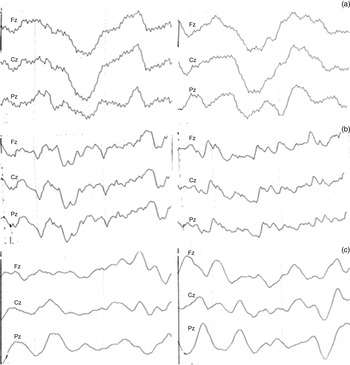
Five of the nine nasopharyngeal carcinoma (NPC) patients showed bilateral presence of olfactory event-related potentials. Two NPC patients showed unilateral presence of olfactory event-related potentials. A complete lack of response to odorants (bilateral absence of olfactory event-related potentials) was recorded in the remaining two NPC patients. All of the healthy control subjects had P2 latency and N1–P2 amplitude values within the normal range.Reference Rombaux, Mouraux, Bertrand, Guerit and Hummel 22 – Reference Caminiti, De Salvo, De Cola, Russo, Bramanti and Marino 25 Examples of patients’ olfactory event-related potential waveforms are shown in Figure 1.
Averaged olfactory event-related potential waveforms, at Fz, Cz and Pz scalp regions (band-pass filtered at 0.01–30 Hz, from 500 ms pre-stimulus to 2000 ms post-stimulus), of: (a) nasopharyngeal carcinoma (NPC) patient with bilateral olfactory responses, showing normal latencies and amplitudes; (b) NPC patient without olfactory responses; and (c) NPC patient with unilateral olfactory responses.

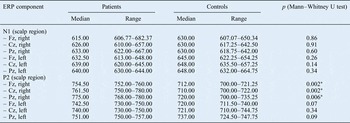
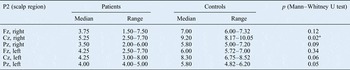
The inter-group analysis revealed significant differences in: P2 latency for the right stimulated side (right nostril) at Fz (p = 0.002), Cz (p = 0.002) and Pz (p = 0.006); and in N1–P2 amplitude for the right nostril at Cz (p = 0.02) (Tables II and III). In patients with bilateral presence of olfactory event-related potentials, there were significant differences in P2 latency at: Fz, right and left nostrils (p = 0.004 and p = 0.026); Cz, right nostril (p = 0.005); and Pz, right and left nostrils (p = 0.013 and p = 0.026). In cases of unilateral presence of olfactory event-related potentials, N1–P2 amplitude was significantly lower in the patient group (compared with the healthy controls) (Fz, right and left nostrils (p = 0.041 and p = 0.043); Cz, right and left nostrils (p = 0.044 and p = 0.043); and Pz, left nostril (p = 0.044)).
Comparison of olfactory event-related potential component latencies between npc patients and controls

Data represent latencies (milliseconds), unless indicated otherwise. *p < 0.05. NPC = nasopharyngeal carcinoma; ERP = event-related potential
Comparison of olfactory event-related potential component amplitudes between npc patients and controls

Data represent amplitudes (μV), unless indicated otherwise. *p < 0.05. NPC = nasopharyngeal carcinoma
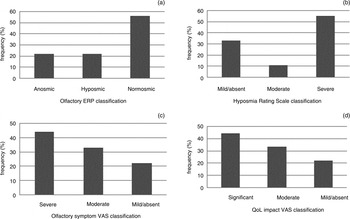
Subjective olfactory loss was indicated in 44 per cent of NPC patients based on six-item Hyposmia Rating Scale scores, and in 75 per cent of NPC patients according to olfactory symptom VAS scores (Figure 2).
Frequencies of anosmic, hyposmic and normosmic patients, according to: (a) olfactory event-related potentials (ERPs) (anosmic = N1 and P2 bilaterally absent, hyposmic = N1 and P2 only in one nostril, and normosmic = N1/P2 bilateral responses); (b) Hyposmia Rating Scale scores (score of 23–30 = severe hyposmia (insufficient olfaction), 14–22 = moderate hyposmia, and 6–13 = mild or absent hyposmia (satisfactory olfaction)); (c) olfactory symptom visual analogue scale (VAS) scores (score of 0–3 = severe olfactory dysfunction (insufficient olfaction), 4–6 = moderate, and 7–10 = mild/absent (satisfactory olfaction)); and (d) quality of life (QoL) VAS scores (score of 0–3 = significant impact on QoL, 4–7 = moderate, and 8–10 = mild or absent (minimal impact on QoL)).

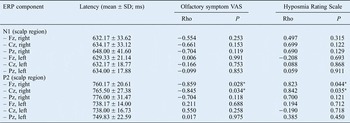
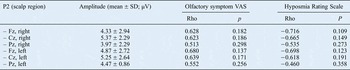
Spearman's rank correlation analyses (Tables IV and V) highlighted significant negative relationships between the olfactory symptoms VAS and P2 latency for the right stimulated side (right nostril) at Fz (rho = −0.86; p = 0.03) and for the right nostril at Cz (rho = −0.85; p = 0.03). In addition, significant positive correlations were found between the six-item Hyposmia Rating Scale and P2 latency for the right nostril at Fz (rho = 0.82; p = 0.04) and for the right nostril at Cz (rho = 0.84; p = 0.03) (Table IV).
Spearman's rank correlation between self-rating scales and olfactory event-related potential component latencies

*p < 0.05. ERP = event-related potentials; SD = standard deviation; VAS = visual analogue scale
Spearman's rank correlation between self-rating scales and olfactory event-related potential component amplitudes

SD = standard deviation; VAS = visual analogue scale
The findings also revealed a significant negative correlation between olfactory event-related potentials and the six-item Hyposmia Rating Scale (rho = −0.731; p = 0.025), and a significant positive correlation between olfactory event-related potentials and the olfactory symptoms VAS (rho = 0.83; p = 0.005). Finally, a highly significant correlation was found between the olfactory symptoms VAS and the QoL VAS (rho = 0.957; p < 0.001), and between the six-item Hyposmia Rating Scale and the QoL VAS (rho = −0.973; p < 0.001).
Discussion
Chemo-radiotherapy for nasopharyngeal carcinoma (NPC) is associated with several acute and chronic side effects. Because of the close anatomical relations between the nasopharynx and olfactory regions, and given the high radiation dose needed to control NPC, olfactory loss is a possible consequence of treatment. Although the use of intensity-modulated radiotherapy has reduced the dose of rays directed to the olfactory region, several cases of olfactory dysfunction associated with radiotherapy have still come to our attention.
Some previous studies demonstrated a deterioration of olfactory threshold in patients who had undergone radiotherapy for NPC.Reference Bramerson, Nyman, Nordin and Bende 19 , Reference Ho, Kwong, Wei and Sham 20 One of these studiesReference Ho, Kwong, Wei and Sham 20 was based on an odour identification and discrimination test, the screening Sniffin' Sticks test. This non-invasive method involved the administration of felt-tip pens impregnated with different odours.Reference Hummel, Konnerth, Rosenheim and Kobal 27 On the basis of this approach, Ho et al. stated that olfactory change in radiotherapy treated NPC patients was most likely due to sensorineural damage.Reference Ho, Kwong, Wei and Sham 20 Bramerson et al. evaluated NPC patients by administering odour-detection sensitivity and olfactory identification tests, and highlighted a reduction of function after radiotherapy.Reference Bramerson, Nyman, Nordin and Bende 19 Conversely, Hölscher et al. reported a non-significant change of olfactory thresholds in patients affected by head and neck cancer, and stated that the olfactory epithelium is relatively resistant against the effects of radiation.Reference Hölscher, Seibt, Appold, Dorr, Herrmann and Huttenbrink 28
Additional effects on the olfactory bulb and/or orbitofrontal cortex have been hypothesised on the basis of recorded changes of suprathreshold olfactory function. In particular, Hua et al. reported that suprathreshold olfactory function defects recorded in their research could not be fully attributed to the absolute olfactory threshold impairment, but had neurological and psychological causes too.Reference Hua, Chen, Tang and Leung 18
Finally, olfactory toxicity induced by chemotherapy has also been reported. Nakamura et al. found decreased olfactory function in patients treated with tegafur, a precursor of fluorouracil.Reference Nakamura, Nonomura, Fujiwara and Nakano 29 Other authors have focused on cisplatin toxicity: subjective olfactory function impairment has been reported by a considerable number of patients.Reference Rhodes, McDaniel, Hanson, Markway and Johnson 30 , Reference de Graeff, de Leeuw, Ros, Blijham, Hordijk and Winnubst 31 However, objective studies have failed to show this cisplatin-induced side effect.Reference Ovesen, Sorensen, Hannibal and Allingstrup 32 , Reference Yakirevitch, Talmi, Baram, Weitzen and Pfeffer 33
Our study evaluated olfactory function using olfactory event-related potentials and self-rating scales in chemo-radiotherapy treated NPC patients. To our knowledge, this is the first study to use olfactory event-related potentials and evaluate interdependence between subjective and electrophysiological methods in these patients. Compared to previous studies, based only on subjective methods, a more objective olfactory dysfunction was found.
It is hypothesised that NPC patients with unilateral or bilateral absence of olfactory responses were affected by damage to the olfactory pathways (peripheral and/or central) of different grades due to varying individual susceptibility to chemo-radiotherapy. In fact, partial or severe olfactory loss was found in four of nine NPC patients who did not demonstrate unilateral or bilateral olfactory event-related potentials. Where olfactory event-related potentials were present in NPC patients, a trend towards increased P2 latency and decreased N1–P2 amplitude compared to control subjects was found. These results highlight the capability of olfactory event-related potentials to identify even slight functionality changes of the olfactory system.Reference Rombaux, Mouraux, Bertrand, Guerit and Hummel 22 – Reference Caminiti, De Salvo, De Cola, Russo, Bramanti and Marino 25
There was a high degree of consistency between subjective and objective assessments of smell, in line with other authors’ experience.Reference Nguyen, Nguyen-Thi and Jankowski 34 However, the correlation between olfactory event-related potentials and the olfactory symptoms VAS and six-item Hyposmia Rating Scale was only significant for the P2 latencies at Fz and at Cz on the right stimulated side. This finding seems to be related mainly to the small sample size, and, therefore, to the specific olfactory dysfunction of certain patients.
Patients with an absence of olfactory responses presented with very low olfactory symptoms VAS scores and very high six-item Hyposmia Rating Scale scores. Conversely, the presence of olfactory responses was associated with higher olfactory symptoms VAS scores and lower six-item Hyposmia Rating Scale scores. Moreover, a highly significant correlation between clinical scales and QoL VAS was found, showing that olfactory dysfunction negatively affected QoL.
The main limitations of this study are the small sample size and the absence of pre-treatment evaluations. Furthermore, psychophysical evaluations were not performed in our patients. Nevertheless, the homogeneity of the clinical and therapeutic features of the sample, and the use of olfactory event-related potentials, make this research original. In particular, the results indicate that olfactory event-related potentials are a reliable tool that may be used in addition to the Sniffin' Sticks test within a diagnostic protocol.
An increased sample size and the recruitment of patients who have received only chemotherapy or radiotherapy could provide more details on the aetiopathogenesis of olfactory dysfunction. Moreover, localisation of the affected site of the olfactory pathway may be possible by analysing the olfactory event-related potential waveforms from each electrode. In addition, comparative analysis with psychophysical measures could further validate the use of olfactory event-related potentials.
-
• Olfactory loss is a possible consequence of chemo-radiotherapy
-
• This is due to the anatomical closeness of nasopharynx and olfactory regions, and the high radiation dose needed to control nasopharyngeal carcinoma (NPC)
-
• Olfactory function can be assessed using numerous psychophysical tests and some subjective scales
-
• Olfactory pathway integrity can also be evaluated using olfactory event-related potentials
-
• Olfactory event-related potentials highlighted an olfactory impairment in NPC patients
-
• Olfactory event-related potentials and subjective scales results were concordant
In our opinion, olfactory event-related potentials could be a useful tool to monitor changes in the olfactory system, supporting the physician in finding solutions to minimise the effects of olfactory dysfunction on patients’ QoL.