Implications
Livestock agriculture is being asked to contribute to reductions in anthropogenic greenhouse gas emissions while simultaneously increasing output. Solutions that are technically, economically and practically viable are limited, particularly for grazing ruminants, and it is likely that absolute emissions of enteric methane from livestock will increase. Research into methods to reduce absolute emissions that can be widely applied is at an early stage and practical solutions are unlikely to be found in the short term. A more feasible approach for livestock agriculture is to adopt an intensity target, that is, emissions per unit of product. This metric is more amenable to reduction as it is influenced by general improvements in the efficiency of production achieved using known approaches.
Introduction
Concentrations of greenhouse gases (GHG) in the atmosphere have been rising consistently since the beginning of the industrial revolution in the mid-18th century. Carbon dioxide (CO2), the gas most people are perhaps familiar with, has increased by 35% over this period, but methane (CH4) concentrations have in fact increased by more than 100%. The increase in CH4 concentration has added a warming effect that is estimated to be about 30% of the warming caused by the increase in CO2 concentrations (Forster et al., Reference Forster, Ramaswamy, Artaxo, Berntsen, Betts, Fahey, Haywood, Lean, Lowe, Myhre, Nganga, Prinn, Raga, Schulz and Van Dorland2007). Although estimates vary, between 25% and 40% of all CH4 emissions associated with human activities (anthropogenic) are estimated to arise from livestock through enteric fermentation (Memon et al., Reference Memon, Denman, Brasseur, Chidthaisong, Ciais, Cox, Dickinson, Hauglustaine, Heinze, Holland, Jacob, Lohmann, Ramachandran, da Silva Dias, Wofsy and Zhang2007; Neef et al., Reference Neef, Van Weele and Van Velthoven2010). This makes livestock emissions the biggest single human-related source of CH4 emissions. Steinfeld et al. (Reference Steinfeld, Gerber, Wassenaar, Castel, Rosales and de Haan2006), using a life cycle analysis approach, intensified the debate around the contribution that livestock farming makes to the increases in atmospheric GHG concentrations, when they estimated that 18% of all carbon dioxide equivalent (CO2-e) anthropogenic GHG emissions arise from livestock farming once ‘emissions’ from the conversion of forests to grazing lands are taken into account. If ‘emissions’ from deforestation are excluded, the same authors estimated that 12% of all carbon dioxide equivalent (CO2-e) anthropogenic arise from livestock farming. Clark (Reference Clark2009) further estimated that ∼75% of these emissions arise from ruminant production systems.
Under the terms of the Kyoto Protocol, most developed countries have agreed to bind targets aimed at reducing GHG emissions by ∼5% over the 2008 to 2012 period compared with 1990. Agreement in principle has also been reached that GHG emissions globally should be constrained such that any global temperature increase is kept below 2°C (United Nations Framework Convention on Climate Change, 2010). This means continued pressure for reductions in GHG emissions, including those emanating from livestock. However, there is a growing realisation that food production will have to increase substantially to meet the needs of a growing population and changing consumer preferences, which are likely to increase the demand for animal derived protein (Steinfeld et al. Reference Steinfeld, Gerber, Wassenaar, Castel, Rosales and de Haan2006; Food and Agriculture Organization, 2009). This places livestock agriculture in the unenviable position of having to increase output substantially while at the same time reducing GHG emissions.
This situation has resulted in a reappraisal of what metric should be used when looking at emissions arising from agriculture; should emission reductions be described in terms of absolute emissions or should they be described in ‘intensity’ terms, that is, emissions per unit of food output? The recently formed Global Research Alliance on Agricultural Greenhouse Gases (http://som2011.globalresearchalliance.org/globalresearchalliance), which comprises 35 countries, has adopted an intensity metric. The practical issue surrounding this change of emphasis is that practices that reduce absolute emissions per animal or unit of land without changing output will in addition reduce emissions intensity but the reverse is not true; reducing emissions intensity places no constraints on changes in total emissions (Leslie et al., Reference Leslie, Aspin and Clark2008; Table 1).
CH4 emissions per unit of product from the New Zealand dairy and beef sectors measured between 1990 and 2005 (from Leslie et al., Reference Leslie, Aspin and Clark2008)

CH4 = methane; CO2-e = carbon dioxide equivalent.
A particularly challenging GHG mitigation area is that of reducing CH4 emissions from grazing ruminants. Emissions from grazing ruminants arise mainly from the fermentation of feed in digestive tract, particularly in the reticulorumen. Some CH4 also arises from animal wastes deposited directly onto pastures by grazing animals but these are minor compared with the emissions from enteric sources. For example, Intergovernmental Panel on Climate Change (IPCC) Tier 1 default values for cattle indicate that CH4 emissions from pasture deposited wastes are ∼1 kg per annum, whereas those from enteric fermentation are >50 kg per annum (IPCC, 2006).
Can diet influence the quantity of CH4 produced?
As CH4 is produced during the fermentation of feed in the digestive tract, manipulating the substrate fermented has long been a high priority in CH4 mitigation studies. However, in grazing ruminants, particularly non-dairy animals, changing and/or supplementing the diet presents practical obstacles that are difficult to overcome.
Supplementing forage-based diets
As CH4 is formed as a by-product of digestion, many studies have looked at the influence of diet on CH4 emissions. In particular, it is well established that diets high in concentrates in general produce less emissions than forage-based diets (e.g. Beauchemin and McGinn, Reference Beauchemin and McGinn2005). However, the amount of concentrate needed to bring about a reduction in emissions is relatively large. For example, a meta-analysis by Sauvant and Giger-Riverdin (Reference Sauvant and Giger-Reverdin2007) found that concentrates need to make up more than 40% of the diet before emissions per unit of intake begin to fall. Current IPCC recommendations are that substantial reductions in emissions should only be assumed where the diet comprises >90% concentrates (IPCC, 2006). In many instances, the practical and financial issues surrounding the feeding of sufficient quantities of concentrates to have an impact on CH4 emissions from grazing ruminants rule out this as a mitigation route.
Another well-studied CH4 mitigation route is that of adding lipid to the diet. Thorough reviews by Martin et al. (Reference Martin, Morgavi and Doreau2010) and Grainger and Beauchemin (Reference Grainger and Beauchemin2011) have established that the feeding of lipids can reduce emissions by 4% to 5% for every 1% change in the lipid content of the diet. The long-term efficacy of high lipid diets is more problematic with Grainger and Beauchemin (Reference Grainger and Beauchemin2011) concluding that the effect persists while conceding that the empirical evidence is inconsistent. However, although technically feasible, supplementing diets with lipids exemplify the general issues faced with diet supplementation as a CH4 mitigation route in grazing ruminants; many grazing animals are not gathered or even seen daily, and supplementing with anything on a daily basis, other than perhaps via the water supply, may well be ruled out on practical grounds. In addition, the financial barriers are substantial unless the carbon price increases substantially. For example, in New Zealand, a milking dairy cow is estimated to produce ∼2 tonnes of CO2-e emissions annually, which based on the current carbon price, have an imputed value of NZ$16 per annum. This means that, in the absence of co-benefits, any dietary supplement that is close to 100% effective and fed simply to reduce CH4 must cost less than 4.4 cents per day if it is not to result in a net cost on the farm business.
Supplementing diets to increase individual animal performance may be financially viable in some situations, for example, if cheap by-products are available, and will bring about reductions in emissions intensity. As individual animal performance increases, maintenance energy requirements become a smaller proportion of total dietary energy requirements resulting in a lowered energy demand for each additional unit of milk, liveweight gain, etc. (O'Hara et al., Reference O'Hara, Freney and Ulyatt2003). This in turn will result in lowered CH4 emissions per unit of product.
Manipulating forage quality
A primary aim of grassland management is to increase the quality of the forage ingested by grazing ruminants. As CH4 production is highly correlated with fibre digestion in the rumen (Kirchgessner et al., Reference Kirchgessner, Windisch and Muller1995), and fibre content and digestibility of forages are negatively correlated, increasing the digestibility of forages could be an effective CH4 mitigation option for grazing livestock. In the 1960s, a series of experiments conducted at the Rowett Research Institute were summarised by Blaxter and Clapperton (Reference Blaxter and Clapperton1965) into a series of equations, which related CH4 emissions to diet digestibility and the level of intake.
Recent work in New Zealand has specifically focused on the relationship between general forage attributes (digestibility and fibre) and CH4 emissions. In contrast to earlier work, these studies have used unsupplemented fresh grass dominated forage diets. These studies suggest that, in C3 grasses at least, the percentage of gross energy lost as CH4 may be relatively insensitive to forage quality over the range of qualities found in temperate grazing systems. Molano and Clark (Reference Molano and Clark2008) working with Lolium perenne L. (perennial ryegrass) at two stages of growth and four levels of feeding, found no relationship between CH4 emissions per unit of dry matter (DM) intake and digestibility when emissions were measured using the SF6 technique. These findings are supported by a recently completed series of trials in New Zealand undertaken with sheep fed fresh pasture diets (Muetzel, unpublished data), which found that ∼85% of the variation in CH4 emissions could be accounted for by herbage intake alone. These direct studies are supported by a detailed analysis of the influence of chemical characteristics on CH4 emissions in New Zealand experiments undertaken between 1997 and 2009 (Hammond et al., Reference Hammond, Muetzel, Waghorn, Pinares-Patiño, Burke and Hoskin2009), and a meta-analysis of studies on grasses and legumes by Archimède et al. (Reference Archimède, Eugène, Marie Magdeleine, Bova, Martin, Morgavi, Lecomte and Doreau2011). Although changing forage quality may not decrease absolute CH4 emissions per unit of feed ingested, increasing digestibility will influence emissions intensity as increased quality should result in greater productivity at equivalent levels of intake and CH4 emissions.
Although changing the general quality attributes of forages may not reduce absolute CH4 emissions, manipulating specific attributes could be a possible mitigation route. Grasses high in fructans (high sugar grasses (HSG)) have been tested for their ability to reduce CH4 emissions in both indoor feeding and outdoor grazing trials (Department for Environment, Food and Rural Affairs (DEFRA), 2010). In the indoor trial, CH4 emissions were not reduced significantly in those animals receiving the HSG grass, although, because of significantly higher growth rates, emissions intensity was reduced. In the grazing trail, which was unreplicated, CH4 emissions over the grazing season were reported to be reduced by 20% and individual animal performance increased by 40%, although the authors state that poor spring growing conditions may have exaggerated the treatment differences. Work by Kim et al. (Reference Kim, Newbold and Scollan2011) using mixtures of HSG with different heading dates also reported significantly lower CH4 emissions per kg DM intake (15%) compared with a standard ryegrass cultivar. Clearly more work is needed before anything conclusive can be said about the ability of HSG varieties to reduce absolute and CH4 emissions intensity but these preliminary studies do show promise.
Changing forage species
There is ample evidence from the literature that forage type influences CH4 production (see reviews by Waghorn et al., Reference Waghorn, Burke and Kolver2007; Beauchemin et al., Reference Beauchemin, Kreuzer, O'Mara and McAllister2008; Martin et al., Reference Martin, Morgavi and Doreau2010).
Legumes in general appear to reduce emissions compared with grasses (Waghorn et al., Reference Waghorn, Tavendale and Woodfield2002), but increasing the proportion of legume in the diet, while at the same time maintaining DM production per hectare is not a simple management issue. In addition, white clover, the dominant legume in many temperate pastures, has been found to have little impact on CH4 emissions from cattle (Beever et al., Reference Beever, Thomson and Ulyatt1985; van Dorland et al., Reference van Dorland, Wettstein, Leuenberger and Kreuzer2007) and sheep (Lee et al., Reference Lee, Woodward, Waghorn and Clark2004; Archimède et al., Reference Archimède, Eugène, Marie Magdeleine, Bova, Martin, Morgavi, Lecomte and Doreau2011; Hammond et al., Reference Hammond, Hoskin, Burke, Waghorn, Koolaard and Muetzel2011).
Studies with forage species containing condensed tannins (CT) indicate that these species can reduce CH4 emissions per unit of feed in cattle (Woodward et al., Reference Woodward, Waghorn and Laboyrie2004) and sheep (Waghorn et al., Reference Waghorn, Tavendale and Woodfield2002; Pinares-Patiño et al., Reference Pinares-Patiño, Ulyatt, Waghorn, Lassey, Barry, Holmes and Johnson2003c). In addition, a meta-analysis by Jayanegara et al. (Reference Jayanegara, Leiber and Kreuzer2011) indicates that tannins in general, not those simply containing CT, have anti-methanogenic properties. In theory, this makes tannin containing forage species an ideal mitigation option since they have also been found to increase liveweight gains and decrease the severity of gastrointestinal worm infestations (Min et al., Reference Min, Barry, Attwood and McNabb2003) and will therefore strongly reduce CH4 emissions intensity. The disadvantage of CT containing plants in temperate pastures is that they do not compete well with other temperate species and therefore have substantial disadvantages when considered within a farm systems context. As pointed out by O'Hara et al. (Reference O'Hara, Freney and Ulyatt2003), the benefits of CT containing plants have been recognised for over 30 years, but to date we still do not have a competitive CT containing temperate pasture plant.
A practical barrier to changing forage species is that in many grazed systems pastures are not routinely reseeded. Reseeding simply to reduce CH4 emissions is unlikely to be attractive unless there are other long-lasting beneficial side effects. An additional issue is that if more pastures are reseeded the effect this has on soil carbon sinks will need to be considered alongside any impacts on CH4 emissions.
Feed additives
There are products in the market or products being tested that, when added to ruminant diets, claim to have CH4 reducing properties. These range from garlic extracts, spices and essential oils through to enzymes, yeasts and antimicrobials, such as ionophores (Beauchemin et al., Reference Beauchemin, Kreuzer, O'Mara and McAllister2008; McAllister and Newbold, Reference McAllister and Newbold2008; DEFRA, 2010). The evidence supporting these claims tends to come from in vitro studies and more research is needed before any of these approaches can be recommended (Benchaar and Greathead, Reference Benchaar and Greathead2011). Even when these approaches have progressed to in vivo trials, the results have been disappointing. For example, trials in the United Kingdom with a garlic extract and an essential oil showed no significant differences in CH4 emissions per animal or consistent differences in animal performance (DEFRA, 2010). Practical considerations make their applicability to grazing ruminants also questionable.
Ionophores, particularly monensin, have been used routinely in animal production systems for many years as growth promoters. On concentrate-based diets they can reduce CH4 through a combination of reduced voluntary intake, reduced acetate production and the inhibition of H2 release from formate (Goodrich et al., Reference Goodrich, Garrett, Gast, Kirick, Larson and Meiske1984; van Nevel and Demeyer, Reference Van Nevel and Demeyer1996; Tedeschi et al., Reference Tedeschi, Fox and Tylutki2003). Slow release delivery devices are available and used widely to control bloat in grazing cattle, making monensin a highly attractive mitigation agent. However, studies in Australia and New Zealand with forage fed dairy cows have been disappointing (Grainger et al., Reference Grainger, Auldist, Clarke, Beauchemin, McGinn, Hannah, Eckard and Lowe2008; Waghorn et al., Reference Waghorn, Clark, Taufa and Cavanagh2008; Grainger et al. Reference Grainger, Williams, Eckard and Hannah2010) and, at present, based on the evidence available, it is not possible to make any firm claims as to the CH4 reducing potential of monensin in grazing cattle. A further issue is that ionophores are classed as antibiotics and there is a strong move to phase out the routine use of antibiotics in livestock production systems. Hence, even if the efficacy of monensin as a long-term CH4 inhibitor in grazing ruminants could be conclusively demonstrated, its routine use may not be readily acceptable to both consumers and regulatory authorities.
Organic acids, such as malic acid and fumarate, are precursors of propionate production in the rumen and can, in theory, act as alternative sinks for hydrogen, thereby reducing the substrate available for CH4 formation. In vitro results have often been strongly positive (e.g. Kolver et al., Reference Kolver, Aspin, Jarvis, Elborough and Roche2004), but the results from animal trials using forage diets have been disappointing (McCourt et al, Reference McCourt, Yan, Mayne and Wallace2008; Molano et al., Reference Molano, Knight and Clark2008). In addition to the practical issues of feeding supplements in many grazed situations, a particular issue for supplements such as these is cost, and based on the evidence we currently have, it is difficult to disagree with the conclusions reached by McAllister and Newbold (Reference McAllister and Newbold2008) that supplementing diets with organic acids at the levels required to suppress CH4 emissions is uneconomical.
Supplementing diets with nitrate and sulphate can also in theory reduce CH4 through their ability to act as alternative hydrogen sinks, and recent results from sheep trials (Nolan et al., Reference Nolan, Hegarty, Hegarty, Godwin and Woodgate2010; van Zijderveld et al., Reference van Zijderveld, Gerrits, Apajalahti, Newbold, Dijkstra, Leng and Perdok2010) suggest that these reductions can be as high as 50% when expressed on a unit of intake basis. However, particularly with regard to nitrate supplementation, concerns around nitrate poisoning will have to be overcome before the general feeding of nitrates for CH4 reduction can be advocated. An additional issue is that the effects on other GHG must be considered, as adding nitrate to an existing forage-based diet may result in greater rumen NH3 production and an increase in the amount of urinary nitrogen excreted. This in turn could influence the emissions of nitrous oxide, a GHG with a global warming potential roughly 12 times greater than that of CH4.
Host animal influences on CH4 emissions
Although CH4 production is a microbiological process, it may be possible for the host animal to influence rumen fermentation processes.
Blaxter and Clapperton (Reference Blaxter and Clapperton1965) were the first researchers to report differences in CH4 emissions (expressed as the % of gross energy lost as CH4) between animals receiving the same diet. These differences were <10%. Stimulus for more recent efforts to explore whether exploiting the differences between animals could be a possible mitigation route came from work in New Zealand (Ulyatt et al., Reference Ulyatt, Clark and Lassey2002), where differences approaching 40% in CH4 emissions per unit of intake were found between individual animals when using the SF6 technique to measure CH4 emissions. In the follow-up work (McNaughton et al., Reference McNaughton, Berry, Clark, Pinares-Patino, Harcourt and Spelman2005), in a trial involving CH4 measurements on 300 lactating dairy cows measured using the SF6 technique, the highest and lowest emitters differed by a factor of three (Table 2). However, in these grazing trials, intake was generally not measured but estimated using back-energy calculations or faecal collections. As there is often a high degree of uncertainty in estimates of intake in grazing animals, these results need to be treated with caution, as the large differences in CH4 emissions per unit of intake could have arisen partly because of inaccurate estimates of intake.
CH4 emissions from a herd of 302 Friesian × Jersey dairy cows measured between January 12 and February 6, 2003 (from McNaughton et al., Reference McNaughton, Berry, Clark, Pinares-Patino, Harcourt and Spelman2005)

CH4 = methane; DMI = dry matter intake.
A particular issue for the New Zealand work is that the method used to estimate CH4 emissions was the SF6 tracer technique (Johnson and Johnson, Reference Johnson and Johnson1995). Although this technique has been found on average to give results similar to those from calorimetry studies (Grainger et al., Reference Grainger, Clarke, McGinn, Auldist, Beauchemin, Hannah, Waghorn, Clark and Eckard2007), detailed studies by Vlaming (Reference Vlaming2008) and Pinares-Patiño et al. (Reference Pinares-Patiño, Lassey, Martin, Molano, Fernandez, MacLean, Sandoval, Luo and Clark2011c) have clearly established that a large component of the difference between animals recorded in trials where the SF6 tracer technique has been used is in fact because of the technique itself. This has been subsequently confirmed in a calorimetry study by Pinares-Patiño et al. (Reference Pinares-Patiño, McEwan, Dodds, Cárdenas, Hegarty, Koolaard and Clark2011b) of 105 sheep receiving a controlled grass silage diet where differences between selected groups of 10 high and low emitters were only of the order of 8%.
Are the differences between animals in CH4 emissions constant?
Work in New Zealand on sheep by Pinares-Patiño et al. (Reference Pinares-Patiño, Ulyatt, Lassey, Barry and Holmes2003a) found that the difference in emissions per unit of intake between individual sheep were maintained for a 5-month period if fed the same diet. However, the same author found this was not the case in dairy cattle selected as high, medium or low emitters from a grazing trial and subsequently measured indoors on a different diet (Pinares-Patiño et al., Reference Pinares-Patiño, Waghorn, Machmuller, Vlaming, Molano, Cavanagh and Clark2007). The SF6 technique was used in both of these studies.
The inherent variability of the SF6 technique used by Pinares-Patiño and his co-workers goes some way to explain any lack of consistency in individual animal emissions. However, subsequent studies by Pinares-Patiño et al. (Reference Pinares-Patiño, McEwan, Dodds, Cárdenas, Hegarty, Koolaard and Clark2011b) using calorimetry have demonstrated that while some animals remain consistent high or low emitters, others do not, and that to identify consistent high and low emitters it is necessary to undertake repeat measurements on the same animal. In this study, two groups of 10 animals were selected as high or low emitters based on four repeat measurements conducted over a 3-month period. Subsequent studies with diets different to those used to select the high and low emitting groups confirmed that at the group level there was no interaction with diet. However, the average difference between the high and low emitting groups increased when tested under both fresh grass (13%) and a pelleted diet (36%). Currently, New Zealand scientists are screening 1080 animals over 3 years in an attempt to obtain two groups of animals that differ in their CH4 emissions per unit of intake by 20% (Pastoral Greenhouse Gas Research Consortium – www.pggrc.co.nz).
Why do individual animals differ in their CH4 emissions when fed the same diet?
The reasons why animals differ in their CH4 emissions per unit of feed intake is at present unresolved, although initial indications are that it is related to passage rate. Pinares-Patiño et al. (Reference Pinares-Patiño, Ulyatt, Lassey, Barry and Holmes2003b) found that consistent low emitting animals identified using the SF6 technique had shorter retention times of rumen particulate matter. The same author, working with two groups of sheep selected for consistent high and low emissions using calorimetry, also reported that low emitters had faster rates of passage of both solutes and particles and lower feed digestibility than high emitters (Pinares-Patiño et al., Reference Pinares-Patiño, Ebrahimi, McEwan, Dodds, Clark and Luo2011a). However, Pinares-Patiño et al. (Reference Pinares-Patiño, Waghorn, Machmuller, Vlaming, Molano, Cavanagh and Clark2007) found no relationship between mean retention time and CH4 emissions in cattle. A possible explanation for these contrasting findings is that, in the cattle study, the animals were incorrectly identified as low or high emitters. They were selected following a single measurement at grazing where intake was estimated from productivity data and the SF6 technique was used to estimate CH4 emissions. Subsequent measurements indoors, where intake was controlled and CH4 estimated using the SF6 technique, found no consistency in emissions ranking.
Is breeding for low emitting animals possible?
It remains an open question as to whether it will be possible to breed for animals that produce less CH4 per unit of intake. Initial published analysis from New Zealand and Australia suggests that emissions have a heritability of 0.13 to 0.16 (Robinson et al., Reference Robinson, Goopy, Hegarty and Vercoe2010; Pinares-Patiño et al., Reference Pinares-Patiño, McEwan, Dodds, Cárdenas, Hegarty, Koolaard and Clark2011b). Subsequent larger studies in New Zealand indicate a heritability of ∼0.2 (J. McEwan, personal communication). In addition, production traits have not been measured in tandem with CH4 measurements, and as yet it has not been established whether the low emission trait is associated with any unwanted side effects; the finding of Pinares-Patiño et al., (Reference Pinares-Patiño, Ebrahimi, McEwan, Dodds, Clark and Luo2011a) that low emitting animals have lower feed digestibility than high emitting animals is an obvious concern in this respect. A crucial issue in any effort to incorporate low CH4 per unit of intake into selection indices are the difficulties surrounding the identification of the desired phenotype. The use of calorimetry to measure CH4 emissions is costly and time consuming and the same applies to measuring intake, especially in grazing animals. Breeding for low emissions per unit of intake will require the identification of the desired phenotype using ‘proxy’ markers of some sort before it becomes feasible.
In one sense, it can be argued that animal breeding has already contributed to reduction in CH4 emissions as, if the chosen metric is emissions intensity, selection for increased milk and meat yield per animal results in reduced emissions intensity via the dilution of maintenance principle (O'Hara et al., Reference O'Hara, Freney and Ulyatt2003). A variant of this is that of selecting animals with a reduced residual feed intake, that is, animals that can achieve a desired level of performance with a reduced feed intake (Hegarty et al., Reference Hegarty, Goopy, Herd and McCorkell2007). Animals with reduced feed intake should have lower individual emissions simply because enteric CH4 emissions are directly correlated with feed intake (Reynolds et al., Reference Reynolds, Crompton and Mills2011). The applicability of this approach for grazing animals is problematic because of the difficulties inherent in measuring intake while grazing. Nonetheless, scientists in Australia and New Zealand are collaborating in an attempt to identify dairy cattle that combine high productivity with lower feed intake (DairyNZ, 2012). Measurements of CH4 emissions from feedlot cattle selected for reduced residual feed intake have been made and they do appear to have lower emissions (Nkrumah et al., Reference Nkrumah, Okine, Mathison, Schmid, Li, Basarab, Price, Wang and Moore2006; Hegarty et al., Reference Hegarty, Goopy, Herd and McCorkell2007; Jones et al., Reference Jones, Phillips, Naylor and Mercer2011). If the effect does operate through a reduced feed intake, at an enterprise level absolute emissions may not be reduced, as more animals may be kept to consume any feed saved, but at both the individual and farm level emissions intensity would be reduced.
Stimulating host animal immunity
A further novel approach, which has been tried in both Australia and New Zealand, is vaccinating animals to produce antibodies against the methanogens present in the rumen and suppress methanogen growth and CH4 production. Wright et al. (Reference Wright, Kennedy, O'Neill, Toovey, Popovski, Rea, Pimm and Klein2004), working in Australia, had mixed results using vaccine based on whole killed cells, and follow-up work in New Zealand using vaccines prepared from New Zealand and Australian methanogen strains proved unsuccessful (Clark et al., Reference Clark, Pinares-Patino and de Klein2005)
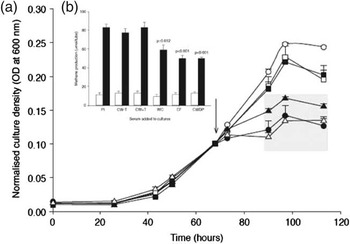
A new approach, based on using cell fractions as opposed to whole cells, is now being tested. Results from in vivo studies have clearly demonstrated that it is possible to stimulate the production of antibodies in sheep via vaccination and that the resulting antisera can suppress both methanogen growth and CH4 production in vitro (Wedlock et al., Reference Wedlock, Pedersen, Denis, Dey, Janssen and Buddle2010; Figure 1). However, this modified approach still needs to be confirmed in vivo.
(a) Mean (±s.e.) optical density (OD) at 600 nm of culture of Methanobrevibacter ruminantium M1 treated with pooled antisera from (n = 4) vaccinated with whole cells of M. Reuminantium M1 (●), cytoplasmic fraction (△), cell-wall fraction (treated with trypsin) (▪), cell-wall fraction (without trypsin treatment) (□) or cell wall-derived proteins (▴); or treated with pooled (n = 20) pre-immune sera (○). Sera were added 68 h after inoculation of the cultures (denoted by the arrow). The densities in the cultures at the points bounded by the grey square were lower than in the cultures that received pooled pre-immunised sera (P > 0.001). (b) Mean (±s.e.) production of methane by in vitro cultures of M. ruminantium M1 just before addition of sera at 68 h (□) and during the growth phase at 90 h (▪). Antisera to whole cells or fractions were pooled from four sheep, whereas pre-immune sera were pooled from 20 animals. (PI = pre-immune; CW − T = cell wall without trypsin treatment; CW + T = cell wall plus trypsin treatment; WC = whole cells; CP = cytoplasmic fraction; CWDP = cell wall-derived proteins). P-values are the significance of the difference compared with cultures treated with pre-immune sera. Bars without P-values were not significantly different (P > 0.05). Source: Wedlock et al. (Reference Wedlock, Pedersen, Denis, Dey, Janssen and Buddle2010).

The vaccination route is highly attractive as it offers the possibility of a solution that is applicable to all ruminant types using a delivery mechanism that is suitable for a wide range of farming systems. Just as importantly, it offers the prospective of a cost-effective solution as it may be possible to maintain immunity by vaccinating at infrequent intervals.
Summary
Ruminant livestock are an important source of anthropogenic CH4 emissions. Although nutrition has been clearly shown to influence CH4 emissions from individual animals, manipulating the diet in grazing ruminants simply to reduce absolute emissions is challenging practically and financially. The host animal does appear to exert an influence on the absolute amount of CH4 emitted but exploiting this via animal breeding is difficult. Stimulating the host to produce antibodies, which suppress the activities of rumen methanogens, is highly attractive, but it is too early to say whether this is a viable mitigation route. Reducing emissions intensity via general improvements in nutrition and animal breeding is more tractable in the short term.