Introduction
Political campaign financing is an integral part of democracy and nation-building. Political parties with strong financial base are more predisposed to actualize their primary objective(s) of capturing and/or retaining political power in any democratic setting. In other words, every successful political party usually boasts of a pool of resources from which it pursues and finances its electoral campaigns and other expenses. This is more so ‘in developing democracies where political parties need more funds because of the avalanche of daunting tasks before them in terms of problems associated with establishing themselves as new political structures . . . and building confidence and popularity in the electorate’ (Aluaigba, Reference Aluaigba2015: 2). Thus, it would be very difficult for parties to articulate their ideas and visions, as well as persuade the members of the public to buy into such ideas without adequate funding.
Party funds are usually expended on erection of campaign offices, hiring of staff, procurement of office equipment, purchase of vehicles and public address systems, carrying out policy research, political education, voter registration, running jingles and adverts, printing of billboards and posters, and other regular functions of parties. However, in Nigeria and indeed several fledgling African democracies, there are instances of illegal expenses, such as bribery of election officials to manipulate election figures; the hiring of political thugs to incite trouble at polling centres; and outright vote buying, all of which are usually pervasive. This was the case in Nigeria during the 2003 and 2007 General Elections, especially in Anambra, Ondo, Edo, Kogi, Cross River, Rivers, Ekiti, Osun, and Bayelsa States. Little wonder most of the governorship and state assembly election results were upturned by either the respective State Election Petition Tribunals or the Appeal Court or both of them. Similar incidents also characterized the 2007 elections in Kenya and the 2010 elections in Cote d'Ivoire. In the Democratic Republic of Congo, its first post-conflict elections in 2006 were adjudged the most expensive in Africa. According to the International Peace Institute (2011: 5), ‘they cost close to 600 million US dollars’. Thus, the quest to satisfy these legal and extra-legal campaign expenses often culminates in the monetization of politics. According to Nwangwu and Ononogbu (Reference Nwangwu and Ononogbu2014), the prevalence of money-bag politics and other primordial identities like ethnicity, regionalism, and religion as instruments of political mobilization is because ideology of development counts for nothing in Nigerian politics since the return to civil rule in 1999.
The 2015 General Elections in Nigeria were in several respects a historical watershed. The elections were not only the most keenly contested in the country but also the most expensive in the annals of electoral politics in Africa. However, the largely unregulated and unbridled deployment of money and other resources by party members, private individuals, corporate organizations, and political entrepreneurs (also known as godfathers in Nigerian political lexicon) has exposed one of the key elements missing in African politics – clear legislation and effective supervision of how political parties raise and utilize funds during electioneering.
The challenges associated with monitoring and supervision of political party financing are typical but not exclusive to Nigeria's political system. Monitoring and supervision of political party financing have been acknowledged as having a complex nature globally (Pinto-Duschinsky, Reference Pinto-Duschinsky and Obiorah2004). It is complex because of the inability of existing mechanisms put in place by different countries to monitor adequately how political parties raise funds and spend them. Several studies have demonstrated some challenges associated with effective supervision of finances of political parties (even in more advanced democracies) by officials of Election Management Bodies (EMBs). For instance, studies have shown that there have been problems in observing the financial dealings of political parties in the United Kingdom (Pinto-Duschinsky, Reference Pinto-Duschinsky and Alexander1989; Fisher, Reference Fisher and Williams2000), the United States (Alexander, Reference Alexander and Alexander1989; McSweeney, Reference McSweeney and Williams2000), Canada (Palthiel, Reference Paltiel and Alexander1989), Germany (Saalfeld, Reference Saalfeld and Williams2000), and Italy (Ciaurro, Reference Ciaurro and Alexander1989). The issue of party/campaign financing is also fraught with a lot of controversies and scandals in Africa. According to Doorenspleet (as cited in Ukase, Reference Ukase2015), in some countries, such as South Africa and Botswana where private and foreign donations to political parties are not subject to any regulations, the ruling parties have continued to attract substantial domestic and foreign donations to the detriment of the opposition parties. Besides their easier and better access to public and private funding, ruling parties often enjoy unrestricted access to the state treasury, thereby swinging the electoral pendulum disproportionately against the opposition parties. However, the foregoing does not suggest that the ability of any country to develop a system that is capable of subduing the negative influence of money on its electoral process is foreclosed.
The legal framework for electoral administration is a composite of laws including constitutional provisions, electoral acts, guidelines, legal precedence, manuals, handbooks, and codes of conduct. Such laws are expected to be unequivocal in policy goals and thematic directions in order to facilitate the functions of EMBs in their engagement with all stakeholders. The prevailing legal regimes on the regulation of party campaign financing in Nigeria are found in the 1999 Constitution (as amended), the Electoral Act 2010 (as amended), Political Party Finance Manual, and Political Party Handbook. However, the relevant provisions of these documents have often been violated by political parties. Some of the provisions that are frequently violated include Sections 221, 225, and 226 of the 1999 Constitution, as well as Sections 88–93 of the Electoral Act 2010. These violations have correspondingly led to the predominance of intra-party rivalry, stifling of internal party democracy, political nomadism, electoral violence, and lack of accountable and participatory governance.
The overall credibility of the 2015 General Elections has been widely acknowledged by different Election Observer Missions and researchers because of the deployment of biometric accreditation technology (Nwangwu, Reference Nwangwu2015; Agbu, Reference Agbu2015). However, there were several constraints on the ability of the Independent National Electoral Commission (INEC) to effectively monitor and control parties’ campaign financing during the general elections. According to Nassmacher (as cited in Pinto-Duschinsky, Reference Pinto-Duschinsky and Obiorah2004: 16), ‘elaborate restrictions designed to control the flow of money into the political process have encouraged the professional politicians to engage in a creative search for potential loopholes in the application of the existing law or when drafting necessary amendments’. The Electoral Act 2010, which empowers the INEC to regulate the sources and nature of funding for political campaigns in Nigeria, is bedevilled with several loopholes and contradictions which tend to undermine the effective oversight functions of the Commission. Arising from the foregoing, this paper examines the interface between the electoral laws and monitoring of campaign financing of the two major political parties during the 2015 Presidential Election in Nigeria. It also investigates how the contradictions inherent in the Electoral Act 2010 have not only undermined the enforcement capacity of the EMB but have correspondingly advanced the interests (in terms of installing their political sons, procurement of contracts, appointment of cronies to public offices, and so on) of the political entrepreneurs.
Methodology
This study relied on the documentary method for the generation of data. The documentary method is concerned with the analysis of documents that contain information about a given phenomenon under investigation. Simply put, a document is a written text. According to Payne and Payne (as cited in Mogalakwe, Reference Mogalakwe2006: 221), ‘documentary method is the technique used to categorize, investigate, interpret and identify the limitations of physical sources, most commonly written documents whether in the private or public domain’. The documentary research method is also often considered a monopoly of professional historians, librarians, and information science specialists. Thus, it has had little attention in social and behavioural sciences compared to other methods such as statistics and quantification which are popular forms of data collection and analysis. The method, therefore, is largely under-utilized and often considered a subsidiary research method in the social sciences. However, it is not less rigorous and scientific because of its adherence to the tenets of scientific protocol.
Sources of documentary research include historical documents such as laws, declarations, statutes, and people's accounts of events and periods. They also include reports based on official statistics, as well as governmental records, mass media, literary texts, drawings, and personal documents such as dairies and biographies. The methodological significance of this tool cannot be over-emphasized. The method is usually applied to obtain in-depth information, concept/variable clarification to facilitate instrument design, and to conduct pilot studies (Biereenu-Nnabugwu, Reference Biereenu-Nnabugwu2006). This data gathering technique enables access into the inner recesses of group life, organizational structure, bureaucratic processes, as well as the motivations for individual behaviour. In relation to the study, data were gathered from official/government documents such as the Electoral Act 2006, Electoral Act 2010, Companies and Allied Matters Act 1990, Political Party Finance Handbook 2005, Political Party Finance Handbook 2010, and Political Party Financial Reporting Manual 2011. The study also included data from journals, newspaper articles, and conference papers, among others.
The mass of data generated were analyzed using the qualitative descriptive method of data analysis. This method moves farther into the domain of interpretation because effort is made to understand not only the manifest but also the latent content of data with a view to discovering patterns or regularities in them. Tables were used for further illumination of the issues in the discourse. The study also utilized the Marxist theory of the post-colonial state through which deeper theoretical insights were elicited as shall be seen below. Consequently, the study was able to establish the nature of the interface between the electoral laws and monitoring of campaign financing of the two major political parties during the 2015 Presidential Election in Nigeria.
Theoretical framework
In analyzing the interface between electoral laws and supervision of political parties’ campaign financing by Nigeria's EMB during the 2015 Presidential Election, this paper employs the Marxist theory of the post-colonial state. This is informed by the fact that analyses of the influence of money on politics have been largely contingent on the pluralist and investment theories with attendant theoretical and methodological problems in emergent post-colonial democracies. The Marxist theory of the post-colonial state arose as a spin-off of the Marxist theory of the state, the latter being a reaction to the Western liberal theory of the state, which holds that the state is an independent force and a neutral observer that caters for the main interest of every member of society. According to the Marxist theory, the state is a product and a manifestation of the irreconcilability of class contradictions. Thus, ‘it arises where, when and to the extent that class contradictions objectively cannot be reconciled’ (Lenin, Reference Lenin1976: 9). According to Engels (as cited in Lenin, Reference Lenin1976: 9):
The state is, therefore, by no means a power forced on society from without . . . it is a product of society at a certain stage of development; it is the admission that this society has become entangled in an insoluble contradiction with itself, that it has split into irreconcilable opposites which it is powerless to conjure away. But in order that these opposites, classes with conflicting economic interests, might not consume themselves and society in fruitless struggle, it became necessary to have a power seemingly standing above society that would moderate the conflict and keep it within the bounds of ‘order’; and this power, arisen out of society but placing itself above it, and alienating itself more and more from it, is the state.
The state does not represent the general interest but the particular interest of the dominant ruling class. Thus, Jakubowski (Reference Jakubowski1973: 41) argues that ‘this state . . . is as a rule, the state of the most powerful, economically dominant class, which by this means also becomes the politically dominant class and thus acquires new means of holding down and exploiting the oppressed’. In this light, Marx and Engels (Reference Marx and Engels1973: 35) aver that ‘the executive of the modern state is but a committee for managing the common affairs of the whole bourgeoisie’. State autonomy in the class society is therefore more apparent than real because the state remains the instrument of the dominant classes for exploiting and suppressing the subordinate classes.
The classical Marxist theory of the state has been further developed to accommodate the peculiarity of the post-colonial states. For instance, Alavi (Reference Alavi and Bourne1973) contends that the classical Marxist view of the state is not fully applicable to the post-colonial states. In order to secure their economic interests during colonialism, the colonial governments discouraged the emergence of a strong indigenous capitalist class. The new indigenous bourgeoisie that inherited control over the post-colonial state apparatuses had a very weak economic base. They had to rely on political power as the means of capital accumulation. Accordingly, Ekekwe (Reference Ekekwe1986: 12) posits that ‘in the periphery of capitalism factors which have to do with the level of development of productive forces make the state, through its several institutions and apparatuses, a direct instrument of accumulation for the dominant class or its elements’. In Nigeria, the state and its institutions like the National Assembly (which enacts and amends the electoral laws) and the INEC (which is saddled with the responsibility of implementing the relevant provisions of the laws) have become the main instruments for the advancement of the interests of the dominant class. These tendencies have persisted because states in peripheral social formations are inchoate and thus thrive on low autonomy. The predominance of politicians with vested interests in the National Assembly and in different political parties, as well as the existence of an EMB that is incapable of enforcing the extant electoral regimes on party campaign financing are by-products of the low level of autonomy of the Nigerian State. This low autonomization makes it possible for the state and its institutions and agencies to express unwillingness, albeit subtly, to enforce the electoral rules in order to advance the electoral interests of the dominant class. As a corollary, electoral laws governing how parties should raise and spend funds are not only ineffective, but there is a lack of knowledge about them.
This development has further led to the entrenchment of political rentierism in Nigeria. The rentier character of the state in Nigeria cannot be divorced from its colonial origin and the manner of its incorporation into the global capitalist network. Thus, the Nigerian State is rentier not just because of its sole dependence on oil rent, but also because of the underdevelopment of its productive forces. These factors combined to produce the type of instrumentalist state that it has become and the unproductive character of the ruling class that it has continued to reproduce. According to Obiorah (Reference Obiorah and Obiorah2004), rentier politics in the country have been characterized by the dominance of ‘electoral machines’ controlled by political entrepreneurs comprised largely of wealthy former military officers and their civilian business cronies.
The political entrepreneurs refer to a crop of politicians who perceive the struggle for, or retention of, state power as investment with disproportionate returns. They hardly engage in any socially acceptable means of livelihood apart from the spoils of public office. They rely heavily on political power as a means of capital accumulation. Many Nigerian politicians are ‘sponsored’ by these local and regional power brokers (otherwise known as godfathers) who finance their campaigns. They install their political sons in public offices as governors, legislators, and local government chairmen. These entail huge resources and circumvention of electoral processes for their candidates who may not actually be the best on grounds of merit or the people's choice by popular demand or vote. Instances of relationship between political entrepreneurs and their estranged godsons in Nigeria include Alhaji Lamidi Adedibu versus Governor Rashidi Ladoja (Oyo State); Chief Emeka Offor versus Governor Chinwoke Mbadinuju, Chief Chris Uba versus Dr Chris Ngige (Anambra State); Senator Jim Nwobodo versus Governor Chimaroke Nnamani (Enugu State); Dr Olusola Saraki versus Governor Mohammed Lawal (Kwara State), and Alhaji Abubakar Rimi versus Governor Rabiu Kwankwaso (Kano State). The ‘sponsorship’ is effectively a business transaction in which the patron recovers the ‘investment’ from the client on assumption of office through procurement of contracts, appointment of cronies to public offices, and other manifestations of prebendalism. This tendency has persisted because:
politics is the way to power, as well as wealth; the premium on the acquisition of political power becomes inevitably very high. The further implication of this is that political competition becomes a grim battle in which winning is all important. Because winning is all important the competitors tend to use every means to win (Ake, Reference Ake1981: 126).
In some cases, where the patron and client failed to define, with sufficient precision, the dimensions of the return on ‘investment’ or the client balks at delivering on the agreed terms, the fallout has led to mass electoral violence, political destabilization, disempowerment of the generality of the Nigerian electors, exclusion of alternative parties seeking to participate in electoral politics, and the absence of an effective system to regulate political finance. In a somewhat corroborative remark, former President Olusegun Obasanjo in an address at the INEC-Civil Society Forum Seminar of 27 November 2003 stated inter alia:
we prepare for elections as if we are going to war, and I can state without hesitation, drawing from my previous life, that the parties and candidates together spent during the last elections, more than would have been needed to fight a successful war. The will of the people cannot find expression and flourish in the face of so much money directed solely at achieving victory. Elective offices become mere commodities to be purchased by the highest bidder, and those who literally invest merely see it as an avenue to recoup and make profits. Politics becomes business, and the business of politics becomes merely to divert public funds from the crying needs of our people for real development in their lives (Cited in Political Party Finance Handbook, 2005: 5).
Consequent upon the premium placed on political power as the most assured means to affluence, Nigerian politicians and their army of petro-dollar financiers have scant regard for the provisions of Section 91 (2–7) of the Electoral Act 2010 (as amended), which place a cap on the amount of money candidates are to spend on their campaigns. In flagrant disregard of the rules, humongous sums of money are often deployed by contestants to outdo each other during party primaries, campaigns, and general elections. This tendency has been recurrent in the Nigerian electoral democracy especially since 1979. Referring to the 1979 and 1983 General Elections, Davies (as cited in Ovwasa, Reference Ovwasa2013: 7) notes that ‘there was so much display of affluence by the wealthy contractors and the mercantile class that those who emerged victorious in the conventions and the primaries of some of the political parties . . . belonged to the business-managerial group’. Chief MKO Abiola, while trying to induce the delegates of the National Party of Nigeria during its 1983 national convention, was told by Alhaji Umaru Dikko – the then Minister of Transport – that the presidency of Nigeria was not for sale to the highest bidder (Rewaju, Reference Rewaju2015). Chief Abiola proved this assertion wrong during the Social Democratic Party (SDP) convention of March 1993 in Jos by beating Babagana Kingibe and Atiku Abubakar to second and third place, respectively. Various stratagems were deployed, including the provision of accommodation to delegates in hotels outside Jos metropolis. In 2007, the Lagos Chapter of the People's Democratic Party (PDP) held its primaries with Senator Musiliu Obanikoro winning the ticket despite heavy manipulation by Chief Bode George. According to Rewaju (Reference Rewaju2015), Chief George parked two jeeps at the entrance of the National Stadium and delegates had to go through the jeeps to gain access to the walkway. As they passed, they received token sums of money to vote for Hilda Williams. More recently, the Global Information System – a privately run think-tank of retired United States military strategists – alleges that major payments are being made to each of the delegates of the political parties, particularly the overwhelmingly large ruling PDP. According to the report published in World Tribune, former President Goodluck Jonathan is bribing PDP delegates using Federal Government funds, making most of the party delegates wealthy enough to buy a new home with the bribery funds (http://www.worldtribune.com/worldtribune/WTARC/2010/af_nigeria1062_10_27.asp). The foregoing lends credence to the assumption that the capture of state power is synonymous with the capture of the state wealth for private ends. It is, therefore, within the context of the specific nature and character of the Nigerian State that one can fully appreciate and analyze the interface between electoral laws and monitoring of campaign financing during the 2015 Presidential Election in Nigeria.
Electoral laws and political parties’ campaign financing in Nigeria
There are several constitutional provisions and legislative enactments on party financing in Nigeria. These enabling laws are found in the 1999 Constitution of the Federal Republic of Nigeria (as amended), the Electoral Act 2010 (as amended), Political Party Finance Manual, Political Party Finance Handbook and the Guidelines and Regulations for Political Parties 2013. As a grundnorm, the Constitution takes pride of place in understanding the provisions of other relevant acts established under it. This is because it provides the basic framework for the enactment and enforcement of other laws in the country. The supremacy of the Constitution is underscored in Section 1(3), which states that ‘if any other law is inconsistent with the provisions of this Constitution, this Constitution shall prevail, and that other law shall to the extent of the inconsistency be void’. The implication of this is that every other law in the country must not only be in line with the provisions of the Constitution but that any inadequacy in the Constitution will automatically taint the provisions of subsequent laws on the same subject matter (Ilo, Reference Ilo and Obiorah2004). Thus, analysis of the interface between the extant electoral laws and party campaign financing here will start with the relevant provisions of the Constitution.
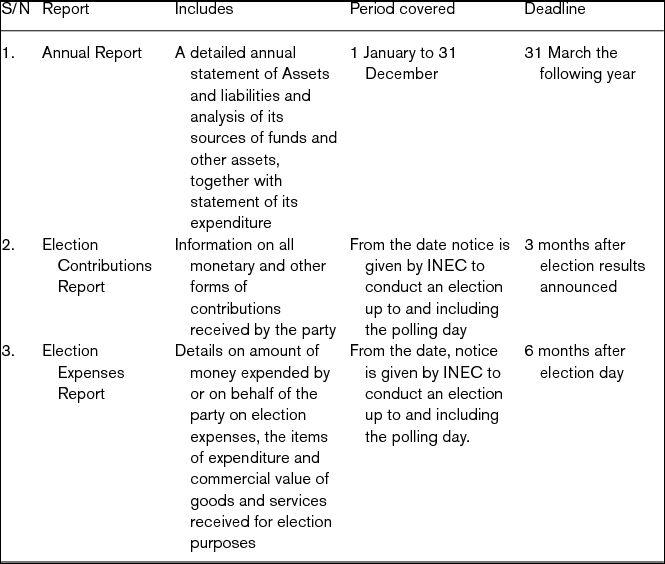
In Section 221, the Constitution prohibits any association other than political parties from making political donations. The provision states that ‘no association, other than a political party, shall . . . contribute to the funds of any political party or to the election expenses of any candidate at an election’. Sections 225 and 226 provide for the finances of political parties and the annual report on finances of political parties, respectively. According to Section 225 (2), every political party shall submit to the INEC a detailed annual statement and analysis of its sources of funds and other assets, together with similar statement of its expenditure in such form as the Commission may require. The Commission is also empowered by Section 226 (1) of the Constitution to prepare and submit an annual report on the financial accounts of every political party to the National Assembly. Section 226 (2) further authorizes the INEC to carry out such investigations as will enable it to form an opinion as to whether proper books of account and records have been kept by the political parties. Thus, political parties are required to submit to the INEC three types of financial report, namely: Annual Report, Election Contributions Report, and Election Expenses Report (see Table 1).
Types of financial reports to be submitted to INEC by political parties

Source: Political Party Financial Reporting Manual 2011, INEC.
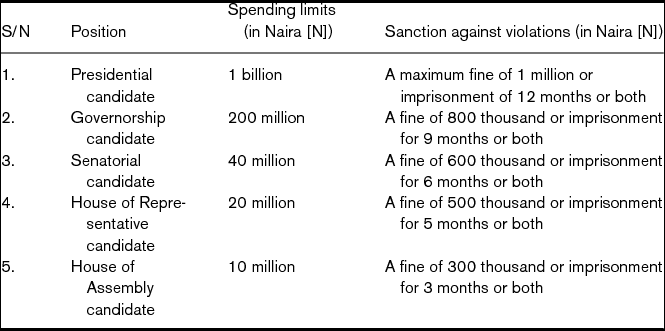
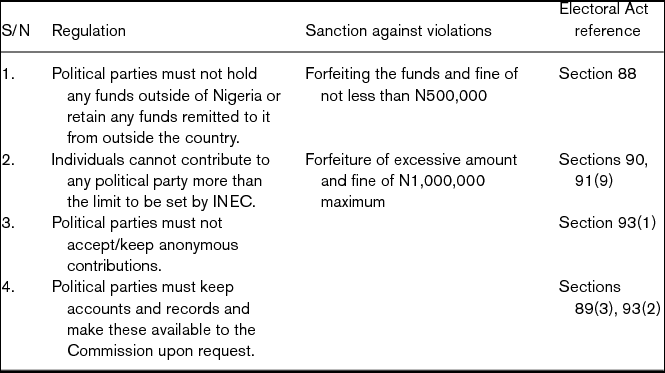
The above constitutional provisions have been extrapolated and complemented by the Electoral Act 2010, Companies and Allied Matters Act (CAMA) 1990, among others. The Electoral Act is enacted by the National Assembly based on the recommendations of the INEC. Section 86 (1) of the Act empowers the Commission to monitor and keep records of the activities of all the registered political parties. It is important to note that unlike previous General Elections of 2003, 2007, and 2011, there was no Electoral Act for the 2015 General Elections as the Commission relied on the Electoral Act 2010 to guide and regulate the conduct of the elections. The Act contains more detailed procedures for the regulation and supervision of political parties’ campaign financing. Such details include specific amounts parties can receive as donations and how much is to be expended for campaigns. Section 90 provides penalties for offences relating to finances of political parties, including any party that contravenes Section 225 (3) of the Constitution, with regard to money transferred from abroad. Sections 88–93 of the Act deal with campaign contributions. Each party is required to keep a record of all contributions and the amount contributed. Section 91 (2–7) puts a ceiling on maximum expenditure to be incurred by candidates according to the offices they are vying for. The maximum election expenses to be incurred by a candidate in a presidential election should not exceed N1billion. Similar ceilings are set for the governorship election at N200 million, while elections to the Senate and the House of Representatives should not exceed N40 million and N20 million, respectively. Section 91 (10) stipulates the various penalties as shown in Table 2. Moreover, Section 92 of the Act makes it mandatory for parties to provide a statement of election expenses to the INEC. For more details on the restraints imposed on political campaign financing and expenditure by the Act, see Table 3.
Ceiling on campaign expenditure by candidates and penalties for violation in Nigeria

Source: Adopted from the Electoral Act 2010 as Gazetted, http://www.placng.org/Electoral%20Act%202010-%20as%20Gazetted.pdf (accessed 8 October 2015).
Regulations relating to finances of political parties in Nigeria

Source: Adopted from the Electoral Acts 2010 as Gazetted.
Furthermore, Section 38 (2) of CAMA re-echoes Section 221 of the Constitution, which forbids any association other than a political party from contributing to the funding of any party or the election expenses of any candidate at an election. This provision of the Act precludes companies from making a donation or gift of any of its property or funds to a political party or association for political purposes. The law provides that officers in default shall be liable to refund to the company the sum or gift so donated. The company/officers shall also be guilty of an offence and liable to fine. The foregoing provisions are supposed to guide political parties in their financial drive during any electioneering, as well as help the INEC in monitoring the parties to ensure compliance with these standards. However, the enforcement gap of the provisions of these statutes during the 2015 Presidential Election accounted for the predominance of money in the body-politic as shall be seen later.
Loopholes/ambiguities in the electoral laws and weak enforcement capacity of the INEC
There is no gainsaying the fact that the weaknesses of the relevant legal and institutional frameworks have abetted extra-legal deployment of money in Nigerian politics. Despite the fact that the donations to the presidential candidates of the All Progressives Congress (APC) and PDP breached the relevant provisions of the Constitution and other electoral laws established under it (as shall be seen in the next section), no action was instituted by the INEC to prosecute the erring candidates and political parties, as well as individual and corporate donors. These legal and institutional weaknesses of the EMB are often blamed on the ambiguities of the electoral laws. Thus, the INEC's attempts at monitoring campaign funding have very limited value under the existing frameworks. For instance, Section 91 of the Electoral Act 2010 establishes the maximum election expenses to be incurred by candidates at different elections. Nonetheless, the section is overridden by subsection (8) (c) which states that in determining the total expenditure incurred in relation to the candidature of any person at any election no account shall be taken of ‘political party expenses in respect of the candidate standing for a particular election’.
Moreover, Section 91 (9) of the Act merely states that ‘no individual or other entity shall donate more than one million naira (N1, 000,000) to any candidate’. Here, the law is silent on the maximum amount any individual or other entity shall donate to any political party. By the same token, it is an offence for political parties to receive funds from foreign countries in line with Section 88 (b) of the Act, but there is no similar provision to check candidates. This makes the spending limits meaningless as unrestricted but illicit funds might be channelled through political parties or individual candidates as the case may be.
Although the Act establishes a sanction for exceeding the party spending limit, it does not actually set such a limit. Section 92 (6) of the Act holds that any political party that incurs election expenses beyond the limit stipulated in the Act is guilty of an offence and shall be liable on conviction to a maximum fine of N1,000,000.00 and forfeiture to the Commission of the amount by which the expenses exceeded the limit set by the Commission. Instead of stipulating a limit, Section 92 (2) of the Act merely states that election expenses incurred by a political party for the management or the conduct of an election shall be determined by the Commission in consultation with the political parties.
Furthermore, it is pertinent to note that Section 38 (2) of CAMA outlaws funding of political parties’ and candidates’ campaign expenditure by business corporations. According to the section:
A company shall not have or exercise power either directly or indirectly to make a donation or gift of any of its property or funds to a political party or political association, or for any political purpose; and if any company, in breach of this subsection makes any donation or gift of its property to a political party, or political association, or for any political purpose, the officers in default and any member who voted for the breach shall be jointly and severally liable to refund to the company the sum or value of the donation or gift and in addition, the company and every such officer or member shall be guilty of an offence and liable to a fine equal to the amount or value of the donation or gift.
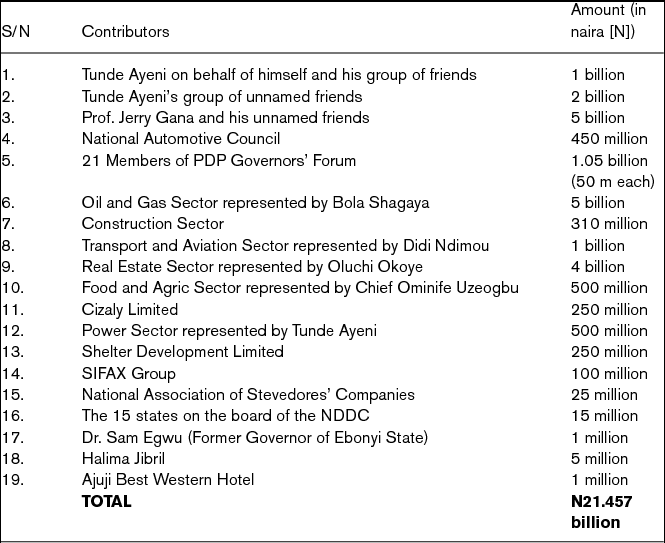
However, the above section is effectively counterpoised by INEC's Political Party Finance Handbook 2010, which stipulates that political parties may obtain funds for their operations from membership fees, income generated by property owned by the political party, profit from the income of the enterprises owned by the political party, and public funding, that is grants from the state and contributions from legal entities and natural persons. From the point of view of CAMA, business corporations are prohibited from funding party campaign expenditure, but their contributions as legal entities are permissible when viewed from the perspective of the Commission's Handbook. Thus, the donations by Cizaly Limited and Shelter Development Limited, among others, during the PDP fundraising dinner (see Table 4), violated Section 38 (2) of CAMA and Section 91 (9) of the Electoral Act 2010 but conformed to the requirements of the Handbook.
Donors at Dr Goodluck Jonathan's 2015 campaign fundraising dinner

Source: Compiled from Olaleye et al. (Reference Olaleye, Chuks, Andrews and Onyebuchi2014), Agande (Reference Agande2014), Onyekpere (Reference Onyekpere2015).
In the 2015 Presidential Election, political parties, politicians, and donors took advantage of these loopholes, and also found ways around other laws in monetizing the electoral process. Several millions, nay, billions of naira were raised with opacity by some groups using such contraptions like ‘committee of friends’ or ‘group of friends’. This is more so because politicians (parliamentarians) whose conducts are supposed to be regulated by laws are the ones who design the electoral regimes. Similarly, lack of institutional, administrative, and financial autonomy of the INEC has further reduced the Commission into a tool for the advancement of the political interests of politicians and political entrepreneurs. Hence, even where the laws are couched unambiguously, they have not enjoyed effective implementation. The issue of ambiguity, therefore, is more or less raised as a smokescreen by the Commission.
Apparently, the lacunae created by the weak enforcement capacity of INEC are being filled by different Civil Society Organizations (CSOs) in Nigeria. For instance, the Socio-Economic Rights and Accountability Project (SERAP) dragged the APC and PDP to court over failure to disclose their sources of spending on their respective electoral campaigns and other operations linked to the 2015 General Elections. The argument of SERAP was that under the Freedom of Information Act, Nigerians have the right to know about spending by their political parties, especially the major parties with a strong possibility to assume government in the future. Citizens should be able to examine financial transactions of parties and be certain that politicians are working for their voters and not their benefactors. The plaintiff further argued that releasing the information will address the perception among Nigerians that the major political parties in the country are less transparent and accountable.
Electoral laws and supervision of PDP and APC presidential campaign funding in the 2015 General Elections
Prior to the 2011 General Elections in Nigeria, political parties drew their funds from two sources namely public and private sources. The public funding of political parties was made possible through Section 228 (c) of the 1999 Constitution, as well as Section 91 of the Electoral Act 2006. Section 91 (1) of the Act stated that ‘the National Assembly may make an annual grant to the Commission for distribution to the registered political parties to assist them in their operation’. Section 91 (2) further stated that:
The Commission shall distribute such grants as follows: (a) 10% of the grant shall be shared equally among all the registered political parties; (b) the remaining 90% of the grant shall be shared among the registered political parties in proportion to the number of seats won by each party in the National Assembly.
It is noteworthy that the main aim of this provision was to give equal opportunities and a level-playing field to all the registered political parties to participate in elections and for the parties to run their affairs. However, this ideal intent of the Act generated some unintended consequences, especially the surge in fringe and amorphous political parties. According to Bisalla and Jimoh (as cited in Aluaigba, Reference Aluaigba2009), in 2008 the then 50 parties received as much as N300 million from the electoral body to finance their activities. Corroboratively, the financial records of INEC indicated that ‘about N4.2 billion was disbursed by the Commission to the various political parties between 1999 and 2009’ (Agina as cited in Nwangwu and Ononogbu, Reference Nwangwu and Ononogbu2014: 72).
Sequel to the expunction of Section 91 of the Act, parties are left with the option of generating funds through private sources. According to the Political Party Finance Handbook 2010, political parties may obtain funds for their operations from the following only: membership fee, income generated by property owned by political party, profit from the income of the enterprises owned by political party, and public funding, that is grants from the state and contributions from legal entities and natural persons. In actuality, however, the sources of party campaign funding in Nigeria are ad infinitum and usually include donations from friends, corporate bodies, Nigerians in Diaspora, anonymous sources, loans, investment, foreign sources, membership dues, and so on.
The supervision of political parties’ campaign financing has remained a very arduous task for the INEC since the return to electoral democracy in 1999. Even under the defunct Third Republic, presidential aspirants spent over N1 billion during the March 1993 primaries, while other not-so-rich contenders had about N120 million as a budget for the primaries (Saffu as cited in Adetula, Reference Adetula2015). Similarly, General Ibrahim Babangida in a broadcast to the nation on 26 June 1993 noted that there were proofs, as well as documented evidence of widespread use of money during the party primaries, and the presidential election. According to him, ‘evidence available to government put the total amount of money spent by the presidential candidates as over N2.1 billion’ (cited in Adetula, Reference Adetula2015: 5). Also, Chief Obasanjo noted that ‘the parties and candidates together spent during the 2003 elections more than what would have been needed to fight a successful war’ (cited in Political Party Finance Handbook, 2005: 5). This disposition towards unlawful deployment of money and other resources characterized the 1999, 2003, 2007, 2011, and 2015 General Elections. Thus, Oji et al. (Reference Oji, Eme and Nwoba2014) hold that there were complaints and allegations by civic groups about large donations by influential political figures and businessmen to some parties during the 1999 elections. Similarly, the Transition Monitoring Group (as cited in Oji et al., Reference Oji, Eme and Nwoba2014) reported that the conduct of primaries by the PDP, All Nigerian Peoples Party (ANPP), All Progressives Grand Alliance (APGA), National Democratic Party (NDP), and the United Nigeria People's Party (UNPP) in January 2003 was characterized by widespread bribery of delegates with sacks stuffed with money to influence their votes. Other studies have shown that this trend has remained an unfortunate characterization of every election cycle in Nigeria since 1999 (Emelonye, Reference Emelonye and Obiorah2004; Ukase, Reference Ukase2015).
The 2015 General Elections were the most expensive in the annals of electoral democracy in Africa. This was made possible through the ineffectiveness of the existing legal and institutional frameworks to curb extra-legal deployment of money and other resources for political campaign financing by party members, private individuals, corporate organizations, and political entrepreneurs. It is noteworthy that INEC made some efforts before the 2015 General Elections to effectively monitor the campaign financing of political parties. This is evident especially through the establishment of the Independent Political Party Finance Monitoring Unit also known as Political Finance Desk Office in the Commission, which hitherto was non-existent. Among other things, seven forms known as Political Party Finance Tracking Forms were drafted by the Office. They were meant to monitor billboard advertisements, electronic media advertisements, print media expenses, expenditure at campaigns and political rallies, campaign coverage by electronic media, political party disclosure, and candidate disclosure. However, the impact of this measure on the supervision of the campaign finances of political parties during the elections was very inconsequential.
Although there are no clear up-to-date statistics on how much was actually expended by different parties and candidates, several media reportages indicate that the two dominant political parties – PDP and APC – conspicuously and barefacedly violated the provisions of the relevant electoral laws of the country. The focus on the PDP and APC presidential campaign financing during the elections does not imply that there were no other parties that participated in the 2015 Presidential Election. Whereas other political parties were largely amorphous, regional, and financially hamstrung, it was either the PDP or APC that had a strong possibility (by virtue of their national spread, command of enormous financial resources, and relatively institutionalized leadership structures, among others) of assuming control of state power after the election. Hence, the two dominant parties were singled out in order to provide an ample opportunity for in-depth analysis of their infractions of the relevant electoral regimes, as well as to provide a basis for generalization.
The Nigerian media, therefore, were awash with reports of how several corporate bodies and individuals directly supported the campaign organizations of candidates for the presidential elections without any reference to their parties. Several millions of naira had been raised through fundraising activities for candidates but no records were kept or even made available to the INEC as the regulatory body to check the political parties and the candidates (Adetula, Reference Adetula2015). By the same token, there is no incontrovertible data on how the various candidates and parties expended their funds. It is difficult to quantify the amount of money spent on defamatory media advertorials, renting of crowds to fill campaign arenas, bribery of voters, as well as inducement of election officials, security personnel, and election observers among others, which consumed a chunk of the finances.
The violation of relevant provisions of, for example, the Electoral Act 2010, CAMA, the Guidelines and Regulations for Political Parties 2013, the 1999 Constitution at a special fundraising dinner held at the Old Banquet Hall of the Presidential Villa, Abuja in favour of the re-election bid of Dr Goodluck Jonathan in the 2015 Presidential Election is self-evident. At the event, over N21 billion was raised mainly by representatives of corporate bodies from different sectors of the Nigerian economy. The chairman of the occasion made a donation of N3 billion; the sum of N1 billion on behalf of himself and his partners and another N2 billion contributed on behalf of his unnamed friends. Other donors included the PDP Governors’ Forum; different sectors of the Nigerian economy, such as oil and gas, transport and aviation, food and agriculture, power, construction, real estate and building; the Niger Delta Development Commission (NDDC); National Automotive Council (NAC); National Association of Stevedores’ Companies; Shelter Development Limited; SIFAX Group (Olaleye et al., Reference Olaleye, Chuks, Andrews and Onyebuchi2014; Agande, Reference Agande2014; Onyekpere, Reference Onyekpere2015). The amounts donated at the occasion are represented in Table 4.
Section 11 (b) of the Guidelines for Political Parties requires all candidates to notify the INEC of all events that pertain to raising funds towards their campaign at least seven days before the event. However, the INEC was neither informed nor invited to the PDP fundraising dinner. This is evident from the fact that there was no INEC representative at the event. Secondly, Section 100 (2) of the Electoral Act which stipulates that ‘state apparatus . . . shall not be employed to the advantage or disadvantage of any political party or candidate at any election’ was violated by the members of PDP Governors’ Forum, the 15 states on the Board of the NDDC, NAC among others. The donations discriminated against other candidates, political parties, as well as their supporters – there were many citizens in these PDP-controlled states who supported different candidates and political parties. The rights of these citizens were violated by their governors through these funds that were ostensibly drawn from their states’ treasuries. Similarly, the N15 million reportedly donated by the 15 states on the Board of the NDDC also typify the use of state apparatus to the disadvantage of other political parties and candidates. It is important to note that not all the 15 states on the Board are PDP-controlled. States like Edo, Imo, and Rivers were under the control of APC governments. Thus, the money could not have come from the state governments, but was invariably drawn from the coffers of the NDDC. In these cases, the non-discrimination clause was violated.
Moreover, there were anonymous donations from different sectors of the economy. These donations were made in complete violation of the Disclosure by Political Parties as contained in Section 93 (1–4) of the Electoral Act 2010. Section 93 (1) of the Act, as well as Section 14 of the Guidelines for Political Parties 2013 clearly stipulates that ‘no political party shall accept or keep in its possession any anonymous monetary or other contributions, gifts, properties etc. from any source whatsoever’. In the same vein, apart from Dr Sam Egwu and Ajuji Best Western Hotel, other donors at the event violated Section 91 (9) of the Electoral Act 2010 which states that ‘no individual or other entity shall donate more than one million naira (N1 million) to any candidate’. In all, over N21 billion raised at the dinner runs counter to the spirit and letter of Section 91 (2) of the Act which stipulates that ‘the maximum election expenses to be incurred by a candidate at a presidential election shall be one billion naira (N1 billion)’. Similarly, the donations by Cizaly Limited and Shelter Development Limited among others violated Section 91 (9) of the Electoral Act. More fundamentally, they breached Section 38 (2) of CAMA which prohibits corporate bodies from making contributions to parties’/candidates’ campaign expenditures.
It is noteworthy that the scandalous abuse of electoral laws at the fundraising dinner generated public outcry in the country. Consequently, Professor Jerry Gana – the Chairman of the Organizing Committee – belatedly came up with a skewed defence. He noted that the money realized from the dinner was not meant for Jonathan's campaign alone but also for building the party's secretariat. However, the invitation to the campaign fundraising dinner, which was publicized by the media, did not indicate that it was meant for Jonathan's presidential campaign and building of PDP's Secretariat as Gana would have everyone believe.
On the other hand, information on the campaign finances of the APC presidential candidate – General Muhammadu Buhari – is very sketchy. According to Buhari Support Organization (BSO), as at January 2015 the presidential candidate of the APC received N54 million from Nigerians in support of his campaign for the 2015 elections (Ejiofor, Reference Ejiofor2015). Providing further insight into the campaign support fund, the spokesperson of BSO – Osita Okechukwu – notes that the Igbos topped the list of donors to the BSO Campaign Fund. He holds that, ‘when the managers of the First Bank of Nigeria warehoused fund unveiled N54 million so far realized, Ndigbo topped the list of the highest donors’ (http://www.premiumtimesng.com/news/top-news/173761-igbos-top-list-donors-buhari-apc.html). However, the statement did not disclose the names of the donors. Thus, such donations contravened the Disclosure by Political Parties as contained in Section 93 (1–4) of the Electoral Act, as well as Section 14 of the Guidelines and Regulations for Political Parties 2013. The Commission's Political Party Financial Reporting Manual of 2011 stipulates that information on all monetary and other forms of contributions received by any party shall be submitted to the INEC by political parties three months after election results are announced (see Table 1 above). After three months, however, none of the political parties has submitted their Election Contributions Report to the Commission. In its characteristic manner, the Commission has not initiated any action against the defaulting parties. Similarly, Adetula (Reference Adetula2015) argues that the former Vice-President – Atiku Abubakar – donated N50 million, an Aircraft, and 12 Land Cruisers to facilitate the electioneering campaigns of the APC presidential candidate. This was done in utter violation of relevant provisions of the electoral laws.
Conclusion
This paper investigated the interface between electoral laws and monitoring of campaign financing during the 2015 Presidential Election in Nigeria. It noted that the complexity associated with party financing the world over has necessitated growing commitment of many democracies to control unregulated use of money in electoral politics. In response to this global trend, Nigeria has enacted several laws that are meant to guide and regulate the funding of political/campaign financing in the country. Nonetheless, the relevant provisions of these laws have not only been flagrantly violated by megalomaniac politicians, but INEC lacks the requisite willpower to enforce compliance. This is evident in the inability of the Commission to prosecute individuals and corporate donors, as well as candidates and political parties who disregarded the relevant provisions of the electoral laws during the 2015 Presidential Election. Using the Marxist theory of the post-colonial state, the paper also established that the electoral laws are deliberately couched ambiguously by politicians with vested interests in order to weaken the enforcement capacity of the INEC and to advance the electoral interests of the political entrepreneurs.
Arising from the foregoing, the Nigerian government should strengthen the ability of the INEC to monitor campaign financing. A better way of achieving this is to unbundle the Commission into Constituency Delimitation Commission, Political Parties Registration Commission, and Electoral Offences Commission as recommended by Mohammed Uwais Electoral Review Committee. The Electoral Offences Commission will be saddled with the responsibility of ensuring compliance of all stakeholders with the provisions of the electoral laws. Lastly, the Electoral Act 2010 and, indeed, other relevant acts of the National Assembly should be reviewed in order to block the loopholes that desperate Nigerian politicians have continued to exploit.
About the authors
Chikodiri Nwangwu is a political scientist in the University of Nigeria, Nsukka (UNN). His research interests include political economy, governance, national security, electoral studies, and party politics. He is a member of Nigerian Political Science Association, Society for Research and Academic Excellence and European Centre for Research Training and Development UK. Currently, he is a doctoral student in UNN where he teaches political science in the Department of Political Science. He has published well-researched articles in reputable journals. He has also participated in several national and international conferences.
Olihe Adaeze Ononogbu is a lecturer and doctoral student in the University of Nigeria, Nsukka (UNN). Her research interests are Nigerian foreign policy, gender studies, national security, and electoral politics. She is a member of several professional associations, including Nigerian Political Science Association. She has published in reputable local and international journals. She has also attended several conferences.