I. INTRODUCTION
The Ni–Fe–Zr-based alloys are widely reported as amorphous alloys. Reference Inoue, Zhang, Itoi and Takeuchi1–Reference Kojima, Makina, Kawamura, Inoue and Masumoto11 Several properties of Ni–Fe–Zr-based amorphous alloys, such as magnetic, Reference Inoue, Zhang, Itoi and Takeuchi1,Reference Inoue, Zhang and Koshiba2,Reference Violet, Borg, May, Rao, Nogues, Taylor and Batra6,Reference Liu, Sun, Zhang and Hu10,Reference Kojima, Makina, Kawamura, Inoue and Masumoto11 mechanical, Reference Liu and Chang3,Reference Inoue, Tomioka and Masumoto7 electrical, Reference Shirakawa, Fukamichi, Kaneko and Masumoto4,Reference Hamed9 invar characteristics, Reference Shirakawa, Ohnuma, Nose and Masumoto5 and thermal stability Reference Liu, Sun, Zhang and Hu10 have been investigated in their reports. In addition, the Ni–Co–Zr ternary system is also an important subsystem for the multicomponent system of the Ni-based brazing fillers. Reference Heikinheimo and Miglietti12,Reference Heikinheimo, Miglietti, Kipnis, Leone and Rabinkin13 To date, the method to develop high-performance Ni–Fe–Zr-based alloys is mainly “tried and errors”, lacking the designation of alloy composition, and the optimization of annealing technology based on phase equilibrium information. Unluckily, only a tentative isothermal section of the Ni–Fe–Zr system at 925 °C reported by Zhou et al. Reference Zhou, Jin, Liu, Liu and Jin14 and the partial isothermal section at 1000 °C for the Fe–Fe2Zr–Ni7Zr2–Ni region reported by Vjunitsky et al. Reference Vjunitsky, Abramycheva, Kalmykov and Dunayev15 are available so far. Therefore, it is necessary to comprehensively investigate the phase equilibria of the Ni–Fe–Zr ternary system. The objective of the present work is to experimentally investigate the phase equilibria of the Ni–Fe–Zr system at 1000, 1100, and 1200 °C by using back-scattered electron (BSE), electron probe microanalyzer (EPMA), and x-ray diffraction (XRD) on equilibrated ternary alloys. The obtained results are expected to provide a better microstructural understanding and composition designation of the Ni–Fe–Zr alloys for practical applications.
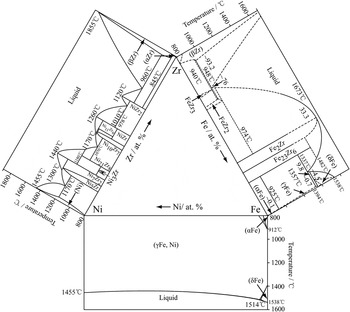
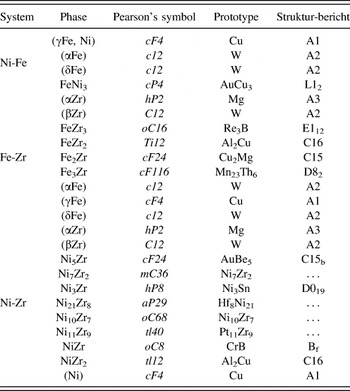
In the Ni–Fe–Zr ternary system, the Ni–Fe, Reference Swartzendruber, Itkin and Alcock16 Fe–Zr Reference Okamoto17 and Ni–Zr Reference Nash and Jayanth18 three sub-binary systems have been experimentally investigated. In the Ni–Fe phase diagram, Fe and Ni form complete solid solubility (γFe, Ni) phase with a wide temperature range. Reference Swartzendruber, Itkin and Alcock16 The stable phases in the Fe–Zr system reviewed by Okamoto Reference Okamoto17 have liquid phase, terminal solid solutions (δFe, αFe, γFe, βZr, and αZr), and four intermetallic compounds (Fe23Zr6, Fe2Zr, FeZr2, and FeZr3). Nine invariant reactions exist in this system involving all the phases mentioned above. The Ni–Zr phase diagram reviewed by Nash et al. Reference Nash and Jayanth18 shows the presence of eight intermediate phases, namely Ni5Zr, Ni7Zr2, Ni3Zr, Ni21Zr8, Ni10Zr7, Ni11Zr9, NiZr, and NiZr2 phases. Except the Ni3Zr phase, all other phases form from the liquid state. The Ni7Zr2, Ni21Zr8, Ni10Zr7, Ni11Zr9, and NiZr2 phases melt congruently above 1200 °C, resulting in their absence at the isothermal section of 1200 °C in this study. The three sub-binary systems Ni–Fe, Fe–Zr and Ni–Zr, constituting the Ni–Fe–Zr ternary system, are shown in Fig. 1. The stable solid phases and their crystal structures in the three binary systems are summarized in Table I.
Binary phase diagrams constituting the Ni–Fe–Zr ternary system. Reference Swartzendruber, Itkin and Alcock16–Reference Nash and Jayanth18

The stable solid phases in the three binary systems. Reference Swartzendruber, Itkin and Alcock16–Reference Nash and Jayanth18

II. EXPERIMENTAL PROCEDURE
Iron (99.9 wt%), nickel (99.9 wt%), and zirconium (99.7 wt%) were used as starting materials. Bulk alloy buttons were prepared from pure elements by arc melting under a high purity argon atmosphere using a nonconsumable tungsten electrode. The ingots were melted at least five times to achieve their compositional homogeneity. The sample weight was around 20 g and the overall weight loss during melting was generally less than 0.30 wt%. Afterward, the ingots were cut into small pieces by wire-cutting machine for heat treatment and further observations.
All samples were sealed in quartz capsules evacuated and backfilled with argon gas. The specimens annealed at 1000, 1100, and 1200 °C, respectively. The time of heat treatment varied from several hours to several days depending on the annealing temperature and the composition of the specimen. After the heat treatment, the specimens were quenched into ice water.
The microstructure was observed by BSE using EPMA (JXA-8100, JEOL Ltd., Tokyo, Japan). The equilibrium compositions of each phase were measured by EPMA with an average value of seven measurements. Pure elements were used as standards and the measurements were carried out at 20.0 kV. The XRD was used to identify the crystal structure of the constituent phases. The XRD measurement was carried out on a Phillips PANalytical X-pert diffractometer (FEI Company, Almelo, The Netherlands) using Cu Kα radiation at 40.0 kV and 30 mA. The data were collected in the range of 2θ from 20° to 90° at a step of 0.0167°.
III. RESULTS AND DISCUSSION
A. Microstructure and phase equilibria
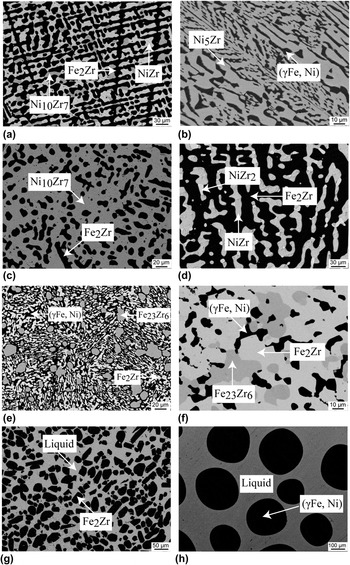
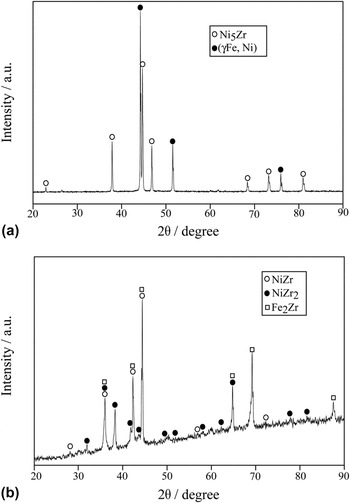
BSE images of typical Ni–Fe–Zr alloys are shown in Figs. 2(a)–2(h). Phase identification was based on the equilibrium composition measured by EPMA and the analysis of XRD patterns. Figure 2(a) shows the three-phase microstructure (NiZr + Fe2Zr + Ni10Zr7) of the Ni45Fe15Zr40 (at.%) alloy annealed at 1000 °C for 60 days. In the Ni85Fe5Zr10 (at.%) alloy quenched from 1000 °C, the two-phase microstructure [Ni5Zr + (γFe, Ni)] is observed [Fig. 2(b)]. Figure 3(a) shows the corresponding XRD pattern, in which the characteristic peaks of the Ni5Zr and (γFe, Ni) phases are confirmed by different symbols. A two-phase equilibrium (Ni10Zr7 + Fe2Zr) is identified in the Ni52Fe10Zr38 (at.%) alloy annealed at 1000 °C indicated in Fig. 2(c). Figure 2(d) presents the three-phase microstructure (NiZr + NiZr2 + Fe2Zr) of the Ni20Fe40Zr40 (at.%) alloy equilibrated at 1100 °C for 30 days, and its XRD result is shown in Fig. 3(b). The Ni10Fe80Zr10 (at.%) alloy annealed at 1100 °C for 30 days and Ni20Fe60Zr20 (at.%) alloy annealed at 1200 °C for 15 days, both are located the same three-phase equilibrium region Fe23Zr6 + Fe2Zr + (γFe, Ni) as characterized in Figs. 2(e) and 2(f), respectively. In addition, the two-phase equilibria of liquid + Fe2Zr [Fig. 2(g)] and liquid + (γFe, Ni) [Fig. 2(h)] are identified in the Ni10Fe50Zr40 (at.%) and Ni87Fe5Zr8 (at.%) alloys annealed at 1200 °C for 1 h, respectively.
BSE images of typical ternary alloys: (a) the Ni45Fe15Zr40 (at.%) alloy annealed at 1000 °C for 60 days; (b) the Ni85Fe5Zr10 (at.%) alloy annealed at 1000 °C for 60 days; (c) the Ni52Fe10Zr38 (at.%) alloy annealed at 1000 °C for 60 days; (d) the Ni20Fe40Zr40 (at.%) alloy annealed at 1100 °C for 30 days; (e) the Ni10Fe80Zr10 (at.%) alloy annealed at 1100 °C for 30 days; (f) the Ni20Fe60Zr20 (at.%) alloy annealed at 1200 °C for 15 days; (g) the Ni10Fe50Zr40 (at.%) alloy annealed at 1200 °C for 1 h; (h) the Ni87Fe5Zr8 (at.%) alloy annealed at 1200 °C for 1 h.

XRD patterns obtained from: (a) the Ni85Fe5Zr10 (at.%) alloy annealed at 1000 °C for 60 days and (b) the Ni20Fe40Zr40 (at.%) alloy annealed at 1100 °C for 30 days.

B. Isothermal section
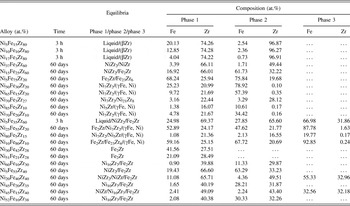
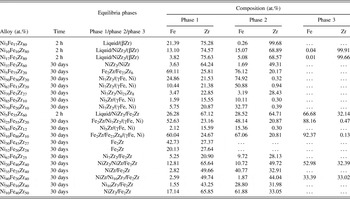
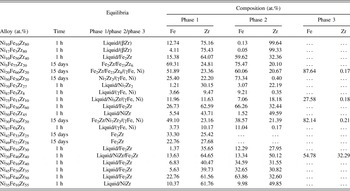
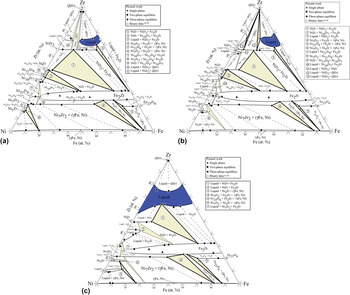
All the equilibrium compositions of the Ni–Fe–Zr ternary system at 1000 °C (Table II), 1100 °C (Table III), and 1200 °C (Table IV) determined by EPMA are listed in Tables II–IV, respectively. Based on the experimental data mentioned above, three isothermal sections of 1000, 1100, and 1200 °C were constructed in Figs. 4(a)–4(c), in which the undetermined phase relationships are shown in the dashed lines.
Equilibrium compositions of the Ni–Fe–Zr ternary alloys at 1000 °C.

Equilibrium compositions of the Ni–Fe–Zr ternary alloys at 1100 °C.

Equilibrium compositions of the Ni–Fe–Zr ternary alloys at 1200 °C.

Experimentally determined isothermal sections of the Ni–Fe–Zr system at: (a) 1000 °C, (b) 1100 °C, and (c) 1200 °C.

In the isothermal section of 1000 °C shown in Fig. 4(a), six three-phase regions [NiZr + NiZr2 + Fe2Zr, NiZr + Ni10Zr7 + Fe2Zr, liquid + NiZr2 + Fe2Zr, Ni7Zr2 + Fe2Zr + (γFe, Ni), Fe23Zr6 + Fe2Zr + (γFe, Ni), and Ni7Zr2 + Ni5Zr + (γFe, Ni)] were experimentally determined; and no ternary compound is found in this work. On the one hand, comparing with a preliminary isothermal section at 925 °C determined by triple diffusion method, Reference Zhou, Jin, Liu, Liu and Jin14 there are some big differences in the present work: (i) The (γFe, Ni) phase region extends from the Ni-rich corner to the Fe-rich corner, and the solubility of Zr in the (γFe, Ni) phase is small; (ii) The Ni5Zr, Ni10Zr7, and Fe2Zr phases have solid solution composition ranges, but Ni7Zr2, Ni21Zr8, NiZr, NiZr2, and Fe23Zr6 phases almost exhibit nearly linear compounds; (iii) The solubilities of Fe in the NiZr, Ni10Zr7, and Ni5Zr phases are measured to be about 4.36, 2.24, and 2.13 at.%, respectively. The solubilities of Ni in the Fe2Zr and Fe23Zr6 phases and the solubilities of Fe in the Ni7Zr2 and NiZr2 phases are very large, especially for Fe2Zr and Ni7Zr2 phases; (iv) The continuous nearly linear compound (Fe, Ni)Zr2 phase disappears due to the absence of FeZr2 phase at 1000 °C. (v) Two liquid phases are present near to Zr-rich corner at 1000 °C. By the present study, the phase equilibria data of almost whole isothermal section have been determined basically, some blurry regions have also been ascertained. On the other hand, comparing with the partial isothermal section at 1000 °C for the Fe–Fe2Zr–Ni7Zr2–Ni region reported by Vjunitsky, Reference Vjunitsky, Abramycheva, Kalmykov and Dunayev15 a little bit of differences can be found: (i) The composition region of Ni5Zr phase is identified in this work; (ii) The compound Fe23Zr6 is neglected in their results, leading to some differences on the phase relationship near Fe-rich corner. In this study, the three-phase region of Fe23Zr6 + Fe2Zr + (γFe, Ni), and the corresponding two-phase regions of Fe23Zr6 + Fe2Zr, Fe23Zr6 + (γFe, Ni), and Fe2Zr + (γFe,Ni) are determined; the composition region of three-phase region of Fe23Zr6 + Fe2Zr + (γFe, Ni) is relatively small. (iii) The composition region of Fe2Zr phase is determined in the present work.
The phase relationship in the isothermal section of 1100 °C [Fig. 4(b)] is similar to that of 1000 °C. Compared with the isothermal section of 1000 °C, the solubility of Fe in the NiZr phase increases to 10.72 at.%, and the solubilities of Ni in the Fe2Zr phase are also very large. Seven three-phase equilibria, NiZr + NiZr2 + Fe2Zr, NiZr + Ni10Zr7 + Fe2Zr, liquid + NiZr2 + (βZr), liquid + NiZr2 + Fe2Zr, Ni7Zr2 + Fe2Zr + (γFe, Ni), Fe23Zr6 + Fe2Zr + (γFe, Ni), and liquid + NiZr2 + (βZr) were determined. Figure 4(c) shows the isothermal section at 1200 °C, where the liquid phase near to the Zr-rich corner forms the continuous region from the Ni–Zr side to the Fe–Zr side. The solubilities of Fe in the Ni7Zr2 and NiZr phases are determined as 38.57 and 13.34 at.%. The solubility of Ni in the Fe23Zr6 phase is larger than that of 1100 °C.
In Fe–Zr binary system, there are two eutectic reactions near to Zr-rich and Fe-rich sides, respectively. Reference Okamoto17 Thus two types of amorphous alloys exist in Fe–Zr-based alloys, namely Zr-rich and Fe-rich amorphous alloys. Reference Inoue, Zhang, Itoi and Takeuchi1–Reference Kojima, Makina, Kawamura, Inoue and Masumoto11 For example, in Ni–Fe–Zr ternary system, Fe70Ni20Zr10 and Fe89.7Ni0.03Zr10 Fe-rich amorphous alloy, Reference Shirakawa, Ohnuma, Nose and Masumoto5,Reference Violet, Borg, May, Rao, Nogues, Taylor and Batra6 as well as Zr70Fe20Ni10 and Zr0.62Fe0.27Ni0.11 Zr-rich amorphous alloys were reported. Reference Inoue, Tomioka and Masumoto7,Reference Saida, Li, Matsushita and Inoue8 From the present phase equilibira at 1000, 1100, and 1200 °C, it is found that the liquid region near Zr-rich side exists all the time, whereas the liquid region close to Fe-rich side disappears at all three isothermal sections. These results may provide some useful information for the alloy designation. For example, Zr70Fe20Ni10 amorphous alloy Reference Saida, Li, Matsushita and Inoue8 located in the liquid phase area near Zr-rich side in the present determined three isothermal sections. Therefore, during the designation of Zr-rich amorphous alloys, it should be better to choose the compositions locating the liquid phase area near Zr-rich side indicated by the blue area in Fig. 4.
IV. CONCLUSIONS
The phase equilibria of the Ni–Fe–Zr ternary system at 1000 °C, 1100 °C, and 1200 °C have been experimentally investigated by BSE, EPMA, and XRD on the equilibrated ternary alloys. The obtained experimental results lead to the following conclusions:
-
(1) For three isothermal sections, no ternary compound is found in this system; the (γFe, Ni) phase region extends from the Ni-rich corner to the Fe-rich corner with small solubility of Zr.
-
(2) The phase equilibria of 1000 and 1100 °C are similar. The Ni5Zr, Ni10Zr7 and Fe2Zr phases have solid solution composition ranges, but Ni7Zr2, Ni21Zr8, NiZr, NiZr2, and Fe23Zr6 phases almost exhibit nearly linear compounds. At 1000 °C, the solubilities of Fe in the NiZr, Ni10Zr7, and Ni5Zr phases are measured to be about 4.36, 2.24, and 2.13 at.% at 1000 °C. For both the sections of 1000 and 1100 °C, the solubilities of Ni in the Fe2Zr phase and the solubilities of Fe in the Ni7Zr2 and NiZr2 phases are extremely large.
-
(3) At 1200 °C, the liquid phase near to the Zr-rich corner forms the continuous region from the Ni–Zr side to the Fe–Zr side. The solubilities of Fe in Ni5Zr, NiZr phases and Ni in Fe23Zr6 phase clearly increase with increasing temperature to 1200 °C. The solubilities of Ni in the Fe2Zr phase and Fe in the Ni7Zr2 phase are also extremely large.
ACKNOWLEDGMENTS
This work was supported by the National Natural Science Foundation of China (Grant Nos. 51571168 and 51471138), the Ministry of Science and Technology of China (Grant No. 2014DFA53040), and the Ministry of Education of China, grant number 2012012113004. The support from the Aviation Industry Corporation of China is also acknowledged.