Introduction
Caused by small interstitial deletions on one copy of chromosome 22q11, velocardiofacial syndrome (VCFS; also known as 22q11.2 deletion syndrome) has an estimated prevalence of 1 in 2000 to 1 in 6000 live births (Botto et al. Reference Botto, May, Fernhoff, Correa, Coleman, Rasmussen, Merritt, O'Leary, Wong, Elixson, Mahle and Campbell2003; Shprintzen, Reference Shprintzen2008). Congenital heart disease, distinctive dysmorphology, learning disabilities and palate anomalies are the most common physical features (Gothelf et al. Reference Gothelf, Frisch, Munitz, Rockah, Laufer, Mozes, Hermesh, Weizman and Frydman1999; Shprintzen, Reference Shprintzen2008). The cognitive profile of VCFS includes reduced intelligence, mathematics learning disabilities, and visuospatial, attentional and executive function deficits (Swillen et al. Reference Swillen, Vandeputte, Cracco, Maes, Ghesquiere, Devriendt and Fryns1999; Woodin et al. Reference Woodin, Wang, Aleman, McDonald-McGinn, Zackai and Moss2001; Feinstein et al. Reference Feinstein, Eliez, Blasey and Reiss2002; Lajiness-O'Neill et al. Reference Lajiness-O'Neill, Beaulieu, Titus, Asamoah, Bigler, Bawle and Pollack2005; Oskarsdottir et al. Reference Oskarsdottir, Belfrage, Sandstedt, Viggedal and Uvebrant2005; Antshel et al. Reference Antshel, Faraone, Fremont, Monuteaux, Kates, Doyle, Mick and Biederman2007b ). The VCFS behavioral phenotype includes shyness, anxiety, social withdrawal and disinhibition (Golding-Kushner et al. Reference Golding-Kushner, Weller and Shprintzen1985; Swillen et al. Reference Swillen, Vandeputte, Cracco, Maes, Ghesquiere, Devriendt and Fryns1999). Common co-morbid psychiatric conditions include attention-deficit/hyperactivity disorder (ADHD) (Gothelf et al. Reference Gothelf, Gruber, Presburger, Dotan, Brand-Gothelf, Burg, Inbar, Steinberg, Frisch, Apter and Weizman2003; Antshel et al. Reference Antshel, Fremont, Roizen, Shprintzen, Higgins, Dhamoon and Kates2006), anxiety disorders (Antshel et al. Reference Antshel, Fremont, Roizen, Shprintzen, Higgins, Dhamoon and Kates2006), autism spectrum disorders (Vorstman et al. Reference Vorstman, Morcus, Duijff, Klaassen, Heineman-de Boer, Beemer, Swaab, Kahn and van Engeland2006; Antshel et al. Reference Antshel, Aneja, Strunge, Peebles, Fremont, Stallone, Abdulsabur, Higgins, Shprintzen and Kates2007a ), mood disorders and, most significantly, psychosis, which develops in up to 25% of youth with the syndrome (Murphy & Owen, Reference Murphy and Owen2001; Murphy, Reference Murphy2002). Accordingly, youth with VCFS are at substantially greater risk for developing schizophrenia than the general population (Gothelf & Lombrosso, Reference Gothelf and Lombrosso2001; Bassett et al. Reference Bassett, Chow, AbdelMalik, Gheorghiu, Husted and Weksberg2003).
Over the past 30 years, numerous studies have examined youth at ‘high risk’ for idiopathic schizophrenia to understand precursors of prodromal symptoms for schizophrenia. Identified cognitive predictors of psychosis include deficits in sustained attention (Cornblatt et al. Reference Cornblatt, Obuchowski, Roberts, Pollack and Erlenmeyer-Kimling1999), short-term and working memory deficits (Cornblatt et al. Reference Cornblatt, Obuchowski, Roberts, Pollack and Erlenmeyer-Kimling1999; Lencz et al. Reference Lencz, Smith, McLaughlin, Auther, Nakayama, Hovey and Cornblatt2006), and verbal memory impairment (Lencz et al. Reference Lencz, Smith, McLaughlin, Auther, Nakayama, Hovey and Cornblatt2006; Whyte et al. Reference Whyte, Brett, Harrison, Byrne, Miller, Lawrie and Johnstone2006). Behavioral predictors include the presence of social anxiety, withdrawal and depression (Yung et al. Reference Yung, Phillips, Yuen, Francey, McFarlane, Hallgren and McGorry2003; Johnstone et al. Reference Johnstone, Ebmeier, Miller, Owens and Lawrie2005). Environmental predictors include high levels of expressed emotion such as criticism and hostility within the family (Levene et al. Reference Levene, Lancee, Seeman, Skinner and Freeman2009; Schlosser et al. Reference Schlosser, Zinberg, Lowey, Casey-Gannon, O'Brien, Bearden, Vinogradov and Cannon2010), social isolation (Reininghaus et al. Reference Reininghaus, Morgan, Simpson, Dazzan, Morgan, Doody, Bhugra, Leff, Jones, Murray, Fearon and Craig2008), cannabis use (Miettunen et al. Reference Miettunen, Tormanen, Murray, Jones, Maki, Ebeling, Moilanen, Taanila, Heinimaa, Joukamaa and Veijola2008; Dragt et al. Reference Dragt, Nieman, Scultze-Lutter, van der Meer, Becker, de Haan, Dingemans, Birchwood, Patterson, Salokangas, Heinimaa, Heinz, Juckel, Graf von Reventlow, French, Stevens, Ruhrmann, Klosterkötter and Linszen2012) and living in an urban environment (Dragt et al. Reference Dragt, Nieman, Veltman, Becker, van de Fliert, de Haan and Linszen2011). Family warmth and parental emotional over-involvement together have been found to decrease negative prodromal symptoms and increase social functioning for high-risk adolescents (O'Brien et al. Reference O'Brien, Gordon, Bearden, Lopez, Kopelowicz and Cannon2006; Schlosser et al. Reference Schlosser, Zinberg, Lowey, Casey-Gannon, O'Brien, Bearden, Vinogradov and Cannon2010).
Few longitudinal studies of predictors of prodromal symptoms or overt psychosis in VCFS have been conducted. Antshel et al. (Reference Antshel, Shprintzen, Fremont, Higgins, Faraone and Kates2010) identified parent ratings of childhood odd/eccentric symptoms and child performance on the Wisconsin Card Sorting Test (WCST) (Heaton et al. Reference Heaton, Chelune, Talley, Kay and Curtiss1993) as the best predictors of adolescent prodromal psychotic symptoms. Gothelf et al. (Reference Gothelf, Feinstein, Thomson, Gu, Penniman, Van Stone, Kwon, Eliez and Reiss2007) identified that the presence of baseline subthreshold psychotic symptoms, baseline symptoms of anxiety or depression, and lower baseline verbal intelligence quotient (IQ) all were associated with more severe psychotic symptoms later in life. In addition, Allen et al. (Reference Allen, Hersch, Schoch, Curtiss, Hooper and Shashi2014) reported a cross-sectional positive association between parental organization and overall adaptive functioning in youth with VCFS. Together, these findings suggest that individual behavioral and cognitive factors affect outcomes in this disorder.
Here, we extend these findings to investigate cognitive and familial moderators of risk for prodromal/overt psychosis in a large, longitudinal sample of youth with VCFS. Youth were assessed at three time points, at 3-year intervals. Based on the literatures on both VCFS and youth at clinical or genetic high risk for schizophrenia, we hypothesized that: (1) severity of anxiety and atypicality at time 1 (T1) in youth with VCFS would be associated with presence of prodromal/overt psychosis at time 3 (T3); (2) the association between anxiety/atypicality during childhood and prodromal/overt psychosis at T1 would be moderated by cognitive factors including relative strengths in verbal learning and sustained attention at time 2 (T2); and (3) the association between anxiety/atypicality at T1 and prodromal/overt psychosis at T3 would be moderated by high levels of family organization and cohesion at T2.
Method
Participants
The sample consisted of youth diagnosed with VCFS, all enrolled in a longitudinal study of biomarkers for psychosis in VCFS. (Community controls and unaffected siblings were also enrolled in the study, but are not included in the present analyses.) Participants were recruited from the State University of New York (SUNY) Upstate International Center for the Evaluation, Treatment and Study of Velo-Cardio-Facial Syndrome, which evaluated children for a variety of developmental and medical issues.
At T1, 86 youth with VCFS between the ages of 9 and 15 years were recruited to participate in the study. The deletion was inherited in two of the 86 participants; accordingly, they were dropped from the current set of analyses. The remaining 84 participants had a mean age of 11.92 (s.d. = 2.26, range 8.92–15.92) years. In all, 13 youth did not return for T2 (Of these 13 youth, three returned for the third time point, and thus were not lost to follow-up.) In order to compensate for our 10% attrition rate, we recruited 12 additional individuals at T2, who were within the same age range of the youth who did return for T2. Accordingly, at T2, our sample consisted of 83 participants (mean age 14.95, s.d. = 2.17, range 12.08–19.91 years). Of those participants, 13 did not return for T3, resulting in a final sample at T3 of 73 participants (mean age 18.08, s.d. = 2.16, range 14.9–24.08 years). T1 demographic variables of age (p = 0.86), gender (p = 0.11) and socio-economic status (p = 0.21) did not differ between participants who were lost to follow-up at either T2 or T3 and those who continued to participate. Moreover, participants who were lost to follow-up did not differ from those who continued to participate on the presence of internalizing (p = 0.91) or externalizing (p = 0.74) disorders, or symptoms of psychosis (p = 0.72).
Procedures
Cognitive, family and psychiatric assessment tools
All measures used for this study are described in detail elsewhere (Antshel et al. Reference Antshel, Shprintzen, Fremont, Higgins, Faraone and Kates2010). Therefore, the measures are described briefly below.
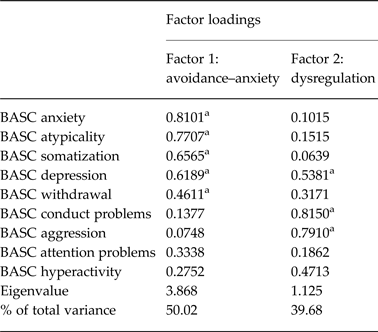
T1 scores on the Behavior Assessment System for Children (BASC) (Reynolds & Kamphaus, Reference Reynolds and Kamphaus1992) – Parent Report version were used to predict psychiatric function at T3. Since little research has been done on the extent to which the composite scores of the BASC apply to children with intellectual impairments, we conducted a factor analysis (using a principal components method) of the BASC subscales to determine the structure of the relationships between BASC subscales in youth with VCFS. Initial factor analysis resulted in two factors with eigenvalues equal to or greater than 1.0. Following orthogonal varimax rotation, the first factor consisted of symptoms with anxiety, depression, atypicality, somatization and withdrawal. We have labeled this the avoidance–anxiety factor. The second factor consisted of symptoms of aggression, conduct problems and, to a lesser extent, depression. We have labeled this the dysregulation factor. Factor loadings are provided in Table 1. These two factors cumulatively accounted for 90% of the variance in the model. Individual factor scores (Thomson, Reference Thomson1951) were derived for both factors, and used in all further analyses.
Factor loadings for time 1 BASC variables in youth with VCFS using varimax rotation

BASC, Behavior Assessment System for Children; VCFS, velocardiofacial (22q11.2 deletion) syndrome.
a Factors accounting for 50.02% and 39.68% of total variance for factors 1 and 2, respectively.
T2 neuropsychological and family environment variables were modeled as moderator variables. Attention was assessed with the Gordon Diagnostic System – Continuous Performance Test (CPT) (Gordon et al. Reference Gordon, McClure and Aylward1989), and executive functioning was assessed with the WCST (Heaton et al. Reference Heaton, Chelune, Talley, Kay and Curtiss1993) and the Stroop test (Golden, Reference Golden1978). Learning and memory were assessed with the California Verbal Learning Test-Children's Edition (CVLT-C) (Delis et al. Reference Delis, Kramer, Kaplan and Ober1994), the Visual Span Test (a computerized adaptation of the visual memory span subtest of the Wechsler Memory Scale, third edition (Wechsler, Reference Wechsler1997), and Digit Span Backward and Forward z-scores from the Wechsler scales. Emotion facial recognition was assessed with the Pennsylvania Emotion Recognition Test (PERT) (Kohler et al. Reference Kohler, Turner, Gur and Gur2004).
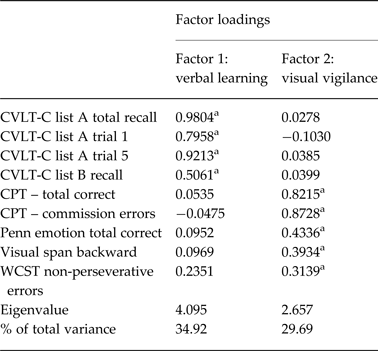
To statistically reduce the neuropsychological data, we conducted a second factor analysis (Table 2). Initial factor analysis resulted in two factors with eigenvalues equal to or greater than 1.0. Following orthogonal varimax rotation, the first factor consisted of scores from the CVLT-C, here labeled verbal learning. The second factor consisted of scores from the CPT, the backwards span score from the Visual Span Test, the PERT correct emotion recognition score, and, to a lesser extent, WCST non-perseverative error scores. We labeled this the visual vigilance factor. These two factors cumulatively accounted for 65% of the variance in the model. Individual factor scores were derived from each factor.
Factor loadings for time 2 neuropsychological test data using varimax rotation

CVLT-C, California Verbal Learning Test-Children's Edition; CPT, Continuous Performance Test; WCST, Wisconsin Card Sorting Test.
a Factors accounting for 34.92% and 29.69% of total variance for factors 1 and 2, respectively.
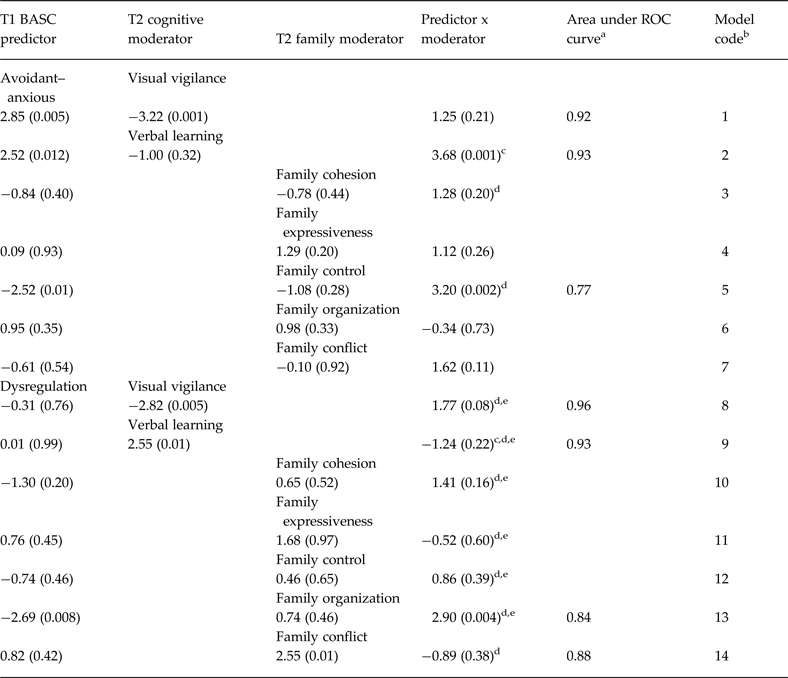
Poisson regression analyses of effects of T1 BASC predictors and T2 moderators on T3 SOPS positive symptoms scores

Data are given as T-score (p).
T1, Time 1; BASC, Behavior Assessment System for Children; T2, time 2; T3, time 3; SOPS, Scale of Prodromal Symptoms; ROC, receiver operating characteristic.
a Values for area under the ROC curve are provided for models in which main or interaction effects were significant after Bonferroni correction.
b Statistical models are numerically coded so that the reader can easily reference them from the text.
c T2 full-scale IQ was a significant (after Bonferroni correction) covariate in this model.
d T1/T2 presence of prodromal symptoms was a significant (after Bonferroni correction) covariate in this model.
e T3 age was a significant (after Bonferroni correction) covariate in this model.
General intellectual functioning was entered as a covariate in predictive models and was assessed with the Wechsler Intelligence Scale for Children, third edition (Wechsler, Reference Wechsler1991) or the Wechsler Adult Intelligence Scale, third edition (Wechsler, Reference Wechsler1994), depending on the age of the participant. Characteristics of the family environment were assessed with a shortened version of the Family Environment Scale, Form R (FES) (Moos & Moos, Reference Moos and Moos2009). The FES consists of 90 true/false items measuring three broad dimensions: relationship, personal growth and system maintenance. Here we focus on the relationship (consisting of scales measuring cohesion, expressiveness and conflict) and system maintenance (consisting of scales measuring organization and control) dimensions.
The Schedule for Affective Disorders and Schizophrenia for School-Age Children, Present and Lifetime Version (K-SADS-PL; Kaufman et al. Reference Kaufman, Birmaher, Brent, Rao, Flynn, Moreci, Williamson and Ryan1997) was administered to all participants at all time points in order to obtain Diagnostic and Statistical Manual of Mental Disorders, 4th edition (DSM-IV) psychiatric diagnoses. Since relatively few children at T3 met criteria for psychosis (n = 5), or displayed psychotic symptoms but not overt psychosis (n = 7) on the basis of the K-SADS-PL, we treated prodromal/overt psychosis as a dimensional variable, measured with the Scale of Prodromal Symptoms (SOPS) (Miller et al. Reference Miller, McGlashan, Woods, Stein, Driesen, Cocoran, Hoffman and Davidson1999, Reference Miller, McGlashan, Rosen, Cadenhead, Cannon, Ventura, McFarlane, Perkins, Pearlson and Woods2003). As described elsewhere, the SOPS consists of four domains, in which the clinician rates each participant and derives summary scores for positive prodromal, negative prodromal, disorganization and general symptoms. The SOPS was administered to all participants at T3 by a doctoral-level clinician. Inter-rater reliability, based on five SOPS interviews and assessed with the intra-class correlation coefficient, was 0.90. Since many of the children in our study had difficulty responding to this instrument, we reworded several questions to allow us to co-administer the SOPS to the child's parent, and reduced the scale from a seven-point to a five-point Likert-type scale. Summary scores for positive symptoms were used for the present analyses. As noted above, these scores included participants whose symptoms were severe enough to warrant a diagnosis of psychosis on the K-SADS-PL. The SOPS positive symptom (SOPS-PS) scale included five subscales: delusional ideas; suspicious/persecutory ideas; grandiose ideas; perceptual abnormalities/hallucinations; disorganized communication. Participants received ratings between zero and 6 on each subscale, and the subscale scores were summed to produce a SOPS-PS score.
Data analyses
As noted above, we increased our sample size at T2 by recruiting 10 additional participants with VCFS. Accordingly, we had data on those participants for T2 and T3, but not for T1. In addition, six participants (8% of total sample) were assessed at T1 and T3, but were unable to come to our center for the T2 assessment. We managed missing data for both time points by building multiple chained imputation models in Stata (v.12; USA) for several variables (Rubin & Schenker, Reference Rubin and Schenker1991). Imputation methods are described in the online Supplementary material S1.
We assessed the degree to which T1 BASC factors predicted T3 SOPS-PS scores with Poisson regression models. We chose the Poisson model due to the distribution of the SOPS, which provides a count of the number (weighted by severity) of symptoms that are present. T1 BASC factor scores and T2 neuropsychological factor scores or family scores were analysed as independent variables and in interaction with each other to determine the extent to which the T2 neuropsychological factors or family scores moderated the effect of T1 BASC factors on T3 SOPS-PS subscale scores. Separate models were built for each set of T1 and T2 variables (see Table 3). We tested for moderating effects by including in each model an interaction term between the T1 BASC factor score and the T2 neuropsychological factor score or family environment score. Covariates in each model included T2 full-scale IQ scores (cognitive models only), T3 age, and T1/T2 presence of psychotic symptoms (using responses to the K-SADS-PL, as described in the online Supplementary material S2).
The Bonferroni-corrected threshold for determining the significance of each overall model was 0.004. Bonferroni-corrected thresholds were also set for the terms within each model that passed the threshold for overall significance. For models including cognitive variables as main effects, the threshold was 0.008; for models including family variables as main effects, the threshold (less stringent because IQ was not included) was 0.01.
In order to determine effect sizes, participants were categorized by the presence of prodromal symptoms or overt psychosis at T3 [based on a score of 3 or higher on the SOPS-PS scale (Miller et al. Reference Miller, McGlashan, Rosen, Cadenhead, Cannon, Ventura, McFarlane, Perkins, Pearlson and Woods2003) or a diagnosis of psychosis on the K-SADS-PL]. Using the resulting prodromal symptoms/overt psychosis status at T3 as the dependent variable, logistic regression analyses were conducted for all models in which Bonferroni-corrected-significant main or interaction effects had been initially identified by the Poisson regression analyses. Logistic regression analyses were followed by receiver operating characteristic (ROC) analyses, to determine the potential for making accurate predictions to prodromal symptoms/overt psychosis status at T3. ROC analysis assesses the diagnostic efficiency of tests to establish diagnostic cut-points for clinical or research purposes (McNeil & Hanley, Reference McNeil and Hanley1984) and has been widely applied to assessing the accuracy of diagnostic tests (Swets, Reference Swets1982, Reference Swets1986a , Reference Swets b ; Swets & Pickett, Reference Swets1982). Values for the area under the ROC curve are provided in Table 3.
Ethical standards
All procedures contributing to this work comply with the ethical standards of the relevant national and institutional committees on human experimentation and with the Helsinki Declaration of 1975, as revised in 2008.
Results
Presence of prodromal/overt psychosis at T3
At T3, five (7%) participants met criteria for psychosis, based on the K-SADS-PL. Of the five, two were diagnosed with schizophrenia, and the remaining three were diagnosed with psychosis-not otherwise specified. An additional seven (10%) participants displayed symptoms of psychosis based on the K-SADS-PL (i.e. they displayed either subthreshold- or threshold-level hallucinations or delusions, but did not meet the full criteria for a diagnosis of psychotic disorder). The mean SOPS-PS score for adolescents with a K-SADS-PL-based diagnosis of psychosis was 10; for adolescents with psychotic symptoms but not overt psychosis, 5.42; and for adolescents without prodromal symptoms or psychosis, 0.06. As noted above, the SOPS-PS score is comprised of five subscale scores, which can range from 0 to 6. When adolescents with either a diagnosis of psychosis or the presence of psychotic symptoms (based on the K-SADS-PL) were analysed together, item means for SOPS-PS were: delusional ideas, 1.75; persecutory ideas, 1.66; grandiose ideas, 1.16; perceptual abnormalities/hallucinations, 1.33; and disorganized communication, 1.41.
Association between T1 BASC factors and T3 SOPS-PS scores
Poisson regression analyses were initially conducted without moderating variables in order to examine the independent strength of each independent variable on T3 SOPS-PS scores. For analyses of the two BASC factors, we covaried by T3 age and the presence of T1/T2 prodromal symptoms. The T1 BASC avoidant–anxious factor, which consists of scores on the subscales of anxiety, depression, somatization, atypicality and withdrawal, was independently predictive of T3 positive prodromal symptoms/overt psychosis, as measured by the SOPS-PS score (t = 4.75, p < 0.001). T1/T2 prodromal symptom score was a significant covariate in the model (t = 2.98, p = 0.003). However, a direct, linear association was not found between scores on the T1 BASC dysregulation factor (which consists of aggression, conduct problems and depression) and T3 SOPS-PS scores (t = −0.17, p = 0.87).
Cognitive effects at T2
To determine the independent strength of T2 cognitive variables on T3 SOPS-PS, we conducted (zero-inflated) Poisson regressions in which we covaried for T1/T2 prodromal symptoms, T2 full-scale IQ and T3 age. Neither scores on visual vigilance (z = −1.73, p = 0.084) nor verbal learning (z = 1.97, p = 0.049) factors at T2 predicted T3 SOPS-PS scores, independently of the effect of T1/T2 prodromal symptoms, T3 age or T2 full-scale IQ scores.
Cognitive moderators at T2 (Table 3; models 1, 2, 8 and 9)
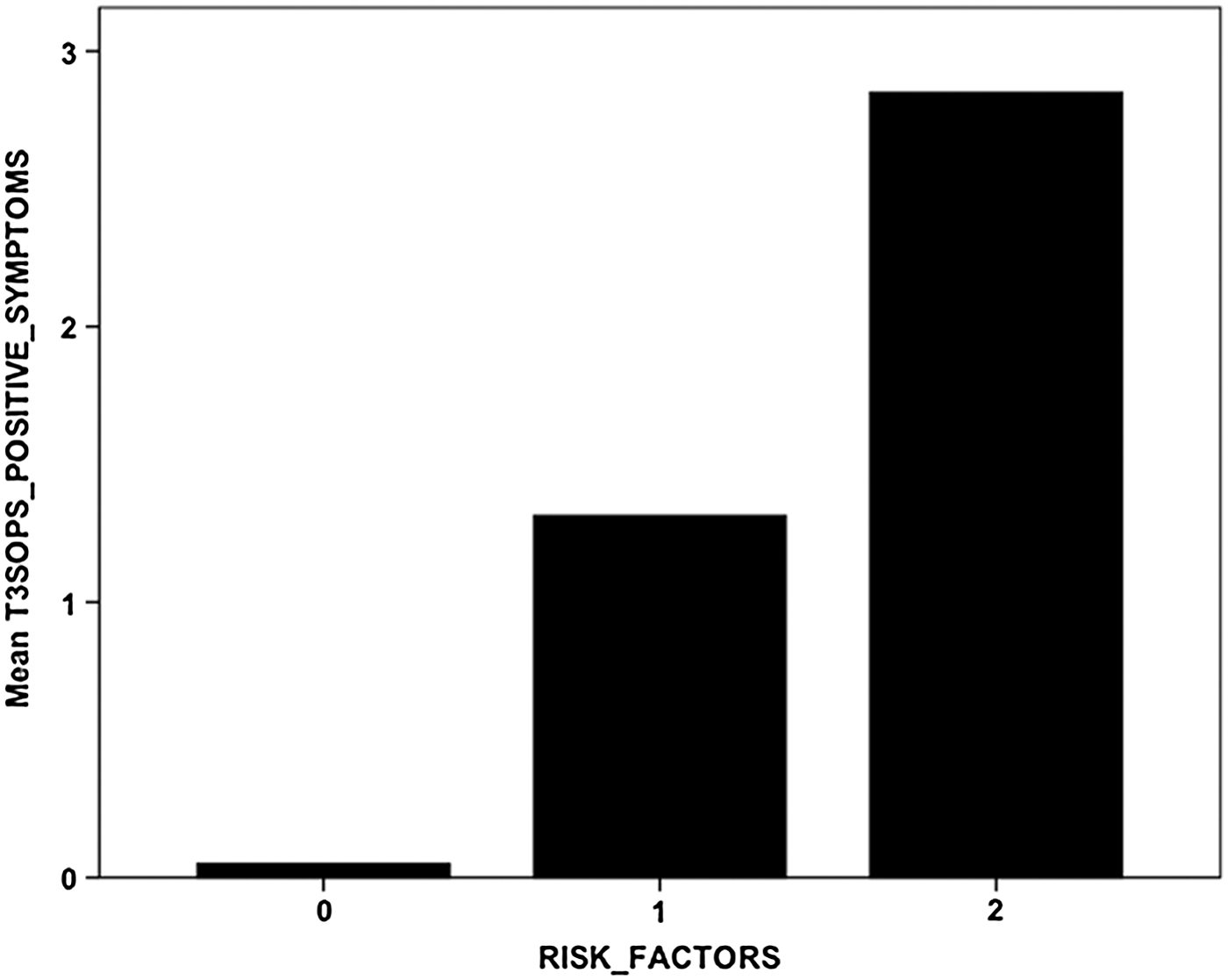
After controlling for T1/T2 prodromal symptoms, T2 full-scale IQ and T3 age, we observed (Table 3, model 2) a significant interaction (t = 3.68, p < 0.001) between avoidant – anxious scores at T1 and verbal learning scores at T2, suggesting that T2 verbal learning is moderating the association between T1 avoidant–anxious scores and T3 SOPS-PS scores. That is, individuals with low scores on the avoidant–anxious factor at T1 and higher scores on verbal learning at T2 were less likely to demonstrate prodromal/overt psychosis at T3 than individuals with high avoidant–anxious scores at T1 and low verbal learning scores at T2 (Fig. 1). The area under the curve value for this model was 0.93, suggesting a fairly large effect. The only covariate that reached significance in this model was T2 full-scale IQ scores, which also predicted to T3 positive prodromal symptoms (t = −3.32, p < 0.001).
Interaction between scores on the time 1 avoidant–anxious factor and the time 2 verbal learning factor, as they predict time 3 (T3) positive prodromal symptoms. Individuals with low avoidant–anxious scores and high verbal learning scores were characterized as having zero risk factors; individuals with high avoidant–anxious scores and low verbal learning scores were categorized as having two risk factors; the remainder of the sample (with either high avoidant–anxious and low verbal learning scores, or vice versa) were characterized as having one risk factor. As the figure indicates, an increase in the number of risk factors was associated with an increase in positive prodromal symptoms. SOPS, Scale of Prodromal Symptoms.

Familial effects at T2
To determine the independent strength of the effect of T2 family environment variables on T3 SOPS-PS scores, we conducted (zero-inflated) Poisson regressions in which we covaried for T1/T2 prodromal symptoms and T3 age. Only high scores on T2 family expression of emotion independently predicted T3 prodromal/overt psychosis (z = 3.46, p < 0.001). The presence of T1/T2 prodromal symptoms was a significant covariate (z = 3.70, p < 0.001) in this model.
Familial moderators at T2 (Table 3; models 3–7, 10–14)
The only characteristic of the child's family environment at T2 that was found to be a significant moderator of the association between T1 avoidant–anxious scores (Table 3; models 3–7) and T3 positive prodromal symptoms was family control (Table 3, model 5; interaction effect: t = 3.20, p = 0.002). T1/T2 prodromal symptoms were a significant covariate (t = 3.32; p = 0.001) in this model. However, visual inspection of the data suggested that this association may be spurious.
The only family characteristic that was found to moderate the association between T1 dysregulation scores (Table 3; models 10–14) was family organization. Interestingly, the association between T1 dysregulation scores and T3 positive prodromal symptoms was amplified by levels of family organization at T2 (Table 3, model 13; interaction effect: t = 2.90, p < 0.004), such that individuals with low dysregulation scores and low family organization scores were more likely to exhibit prodromal/overt psychosis at T3 than individuals with low dysregulation scores and high family organization scores. Both T1/T2 prodromal symptoms (t = 3.59, p < 0.001) and T3 age (t = 2.62, p = 0.009) were significant covariates in this model.
Discussion
The goal of this study was to assess whether the occurrence of positive symptoms of, or overt, psychosis could be predicted prospectively among individuals with VCFS, a genetic disorder that confers increased risk of developing psychotic disorders. Prodromal/overt psychosis was predicted from longitudinal data that considered parental reports of child behavior, as well as familial and neurocognitive factors during early adolescence. The findings suggest several pathways that may increase the risk of prodromal/overt psychosis. These pathways largely overlap with predictors of psychotic symptoms/schizophrenia among high-risk individuals without VCFS, suggesting perhaps that interventions that help mitigate prodromal symptoms in idiopathic schizophrenia might be beneficial to individuals with VCFS and their families.
Pathways via avoidance–anxiety in preadolescence
Two dimensions of childhood behavior problems were assessed via parent report. These included both avoidant–anxious symptoms (anxiety, withdrawal, atypicality and, to a lesser extent, depression) and dysregulation symptoms (oppositionality, conduct problems and, to a lesser extent, depression). Overall, children with VCFS who demonstrated higher symptoms of avoidance–anxiety were at higher risk for developing positive prodromal symptoms of schizophrenia or overt psychosis in late adolescence and early adulthood. The finding that parental reports of high levels of avoidance–anxiety in their children with VCFS predicted prodromal/overt psychosis has been previously noted both among individuals with VCFS (Gothelf et al. Reference Gothelf, Feinstein, Thomson, Gu, Penniman, Van Stone, Kwon, Eliez and Reiss2007) as well as for individuals with or at risk for idiopathic schizophrenia (Baum & Walker, Reference Baum and Walker1995). Importantly however, we found that this pathway was moderated by verbal learning/memory abilities, as measured by the CVLT-C in early adolescence. That is, stronger verbal working memory abilities at T2 (controlling for IQ) protected individuals with VCFS from developing positive symptoms of, or overt, psychosis even if the individual demonstrated significant childhood internalizing symptoms. These findings are consistent with several, although not all (DeHerdt et al. Reference DeHerdt, Wampers, Vancampfort, De Hert, Vanhees, Demunter, Van Bouwel, Brunner and Probst2013), prospective studies of youth at high risk for idiopathic schizophrenia (Lencz et al. Reference Lencz, Smith, McLaughlin, Auther, Nakayama, Hovey and Cornblatt2006; Pukrop et al. Reference Pukrop, Ruhrmann, Schultze-Lutter, Bechdolf, Brockhaus-Dumke and Klosterkötter2007; Seidman et al. Reference Seidman, Giuliano, Meyer, Addington, Cadenhead, Cannon, McGlashan, Perkins, Tsuang, Walker, Woods, Bearden, Christensen, Hawkins, Heaton, Keefe, Heinssen and Cornblatt2010; Kim et al. Reference Kim, Shin, Kim, Park, Hong and Kwon2011).
Pathways via neurocognitive and family factors in preadolescence
Both neurocognitive and familial factors significantly predicted prodromal/overt psychosis among individuals with VCFS. As noted above, stronger verbal working memory performance was considered a protective factor for those children who had high avoidant–anxious scores, independently of IQ. In contrast, lower visual attention scores at T2 were not predictive of the presence of positive prodromal symptoms or overt psychosis at T3, either independently or in interaction with behavioral status at T1. This is not consistent with studies of youth at high clinical risk for schizophrenia in whom deficits in visual sustained attention have been observed (Michie et al. Reference Michie, Kent, Stienstra, Castine, Johnston, Dedman, Wichmann, Box, Rock, Rutherford and Jablensky2000), and may be due to the fact that deficits in sustained attention may be a feature of the overall cognitive phenotype in VCFS and therefore may not differentiate those at high versus low psychiatric risk. In contrast, IQ made independent predictions to the model. Specifically, a lower full-scale IQ predicted prodromal/overt psychosis, suggesting that lower IQ is a significant risk factor for the development of psychotic symptoms, a finding supported by the extant schizophrenia literature (Khandaker et al. Reference Khandaker, Barnett, White and Jones2011) and by a large, multi-site study of the association between IQ and psychosis in VCFS/22q11.2 deletion syndrome (Vorstman et al. in press). Interestingly, the degree of emotion expressed in the family also was an independent predictor of prodromal/overt psychosis. This finding is supported by a robust literature linking expressed emotion to schizophrenia in non-syndromal individuals (see Bebbington & Kuipers, Reference Bebbington and Kuipers1994).
Although a direct linear model did not explain the association between parental reports of behavioral dysregulation and prodromal/overt psychosis, we found that the effect of behavioral dysregulation was amplified in the context of familial dysfunction. Accordingly, low levels of T1 dysregulation combined with high levels of T2 family disorganization predicted T3 positive prodromal symptoms or overt psychosis. That is, children whose parents reported them as being low in oppositionality, conduct problems and, to a lesser extent, depression at T1 were not at higher risk for prodromal/overt psychosis unless their families were disorganized. These findings may be explained, in part, by the fact that several of the children with T3 prodromal/overt psychosis were already demonstrating emotional and behavioral constriction at T1, possibly leading parents to endorse low ratings on oppositionality and conduct problems. It is not clear whether the potential severity of the child's incipient psychiatric impairment led to family disorganization at T2, or whether families with relatively low levels of organization had difficulty meeting the challenges that their child's developing psychiatric impairment produced. Regardless, low levels of T2 familial organization appeared to confer increased risk for the onset or continuation of T3 prodromal symptoms/overt psychosis in individuals with low levels of dysregulation at T1.
The findings from this prospective longitudinal study suggest that multiple pathways confer significant risk for the development of psychotic symptoms/overt psychosis among individuals with VCFS. These factors overlap considerably with what is already known in the schizophrenia literature. Both child and family factors that conferred increased risk for positive symptoms/overt psychosis among individuals with VCFS coincide to a certain extent with risk factors for the development of schizophrenia in non-VCFS at-risk populations, suggesting shared pathways to risk, resilience and, hopefully, effective treatments. Further, these data suggest that there are many points of entry at which remediation and intervention might be useful in mitigating risk factors and enhancing protective factors.
Clinical implications
The findings from the current study suggest that behavioral problems in childhood, specifically avoidant–anxious behaviors, are indicative of risk. From the standpoint of primary prevention, behavioral screening could and should be implemented among school-aged children with VCFS. Evidence for elevated anxiety, atypicality or social withdrawal scores should be seen as indicative of risk, monitored by parents and teachers, and interventions aimed at reducing anxiety and increasing social engagement should be implemented at home and at school. For example, parents can foster or learn skills to deal with their child's anxiety through behavioral parent training (BPT) or work with a psychologist, or, alternatively, perhaps signs of anxious avoidant behavior can be discussed with pediatricians and medication management can be implemented as a preventative measure in order to help decreased future risk. Second, the deleterious effects of family disorganization and conflict could be mitigated by reducing stress, potentially through BPT or parental respite services. Family therapy could also be useful in increasing family cohesion and reducing conflict by helping parents to balance managing their own needs and those of their children. Third, cognitive abilities such as attention and auditory/verbal memory should be assessed and monitored. Low scores in these areas could be used as markers to suggest that supportive interventions (both psychiatric and cognitive remediational) might be warranted.
Limitations and future directions
This longitudinal study makes two contributions to the literature on VCFS and schizophrenia. First, despite the genetic contribution of risk of psychosis among individuals with VCFS, environmental factors played a role in conferring additional risk or providing protection. These protective factors included both child cognitive and behavioral factors, as well as familial factors. Thus, both genetic and environmental interactions should be considered together in future studies of VCFS. Although beyond the scope of this paper, genetic data, as well as neuroanatomical data, were collected as part of this longitudinal design. It is thus an aim of future work to integrate genes, behavior and brain to bear upon our understanding of VCFS and the relationship between this disorder and psychosis. Moreover, as follow-up with participants continues into adulthood, a more categorical approach (psychosis, no-psychosis) will be applied to our data in order to delineate more precise pathways to psychosis. Second, risks and protective factors that mitigate the onset of psychosis of patients with VCFS largely overlap with the literature on individuals without VCFS who are at increased risk for the development of psychotic disorders. Although this may seem intuitive, it suggests that inroads to intervention that have been successfully implemented to reduce the onset of schizophrenia in non-VCFS, high-risk populations might be effective among individuals with VCFS. This overlap can help clinicians provide evidence-based treatments for children and families with VCFS without having to reinvent the wheel.
Supplementary material
For supplementary material accompanying this paper visit http://dx.doi.org/10.1017/S0033291714002724
Acknowledgements
This work was supported by a National Institutes of Health (NIH) grant (R01 MH064824) to W.R.K. The authors gratefully acknowledge the assistance of Amy Olszewski, Jo-Anna Botti and Anne Marie Higgins, and the contribution of Dr Robert J. Shprintzen.
Declaration of Interest
W.R.K., N.R., K.M.A., W.P.F. and W.M.W. have no conflicts of interest to declare. In the past year, S.V.F. received consulting income, travel expenses and/or research support from Akili Interactive Labs, Alcobra, VAYA Pharma and SynapDx, and research support from the NIH. His institution is seeking a patent for the use of sodium–hydrogen exchange inhibitors in the treatment of ADHD. In previous years, he received consulting fees or was on advisory boards or participated in continuing medical education programs sponsored by Shire, Alcobra, Otsuka, McNeil, Janssen, Novartis, Pfizer and Eli Lilly. S.V.F. receives royalties from books published by Guilford Press (Straight Talk about Your Child's Mental Health) and Oxford University Press (Schizophrenia: The Facts).