Introduction
Research into the developmental origins of health and disease has focused much attention on cardio-metabolic outcomes and the physiological processes through which disease risk is influenced by early life nutritional environments.Reference Wadhwa, Buss, Entringer and Swanson 1 – Reference Smith and Ryckman 3 Comparatively little attention has been given to immune function, even though immune processes play important roles in resistance to infectious disease and the etiology of neoplastic, atopic, and cardiovascular and metabolic diseases.Reference Hansson and Hermansson 4 , Reference de Visser, Eichten and Coussens 5 Aspects of immunity are therefore potential mechanisms underlying the developmental origins of disease, and the objective of this paper is to consider the effects of environments in infancy on the distribution of leukocyte subsets in adulthood.
The impact of nutrition on immunity in infancy and childhood is well established, with prenatal and postnatal undernutrition having particularly adverse effects on multiple aspects of cell-mediated immune tissues and processes, including reduced thymic volume, fewer T lymphocytes in circulation, reduced proliferative responsiveness and impaired response to vaccination.Reference Chandra 6 – Reference Ferguson 9 Less established are the immunological consequences of undernutrition beyond infancy/childhood, and the potential long-term effects of more subtle variation in the quality of prenatal environments, as indicated by, for example, birth weight. A handful of studies have addressed this issue, and indicate that lower birth weight – within the range of normal values – predicts multiple aspects of immunity in adolescence and adulthood, including reduced antibody response to vaccination, lower thymic hormone production, higher total IgE and higher levels of inflammation.Reference Sattar, McConnachie and O’Reilly 10 – Reference Godfrey, Barker and Osmond 15 These results suggest that immune processes may play an important role in mediating – at least in part – the well-established association between lower birth weight and increased risk for a wide range of diseases in adulthood.Reference Barker, Eriksson, Forsen and Osmond 16
In addition to nutrition, a larger literature on the ‘hygiene’ or ‘old friends’ hypotheses has underscored the importance of microbial exposures in infancy and childhood to multiple aspects of immune development and regulation, with an emphasis on immune processes that contribute to the etiology of allergy, asthma and autoimmune diseases.Reference Rook, Lowry and Raison 17 – Reference Yazdanbakhsh, Dremsner and van Ree 19 More broadly, microbial exposures in infancy have also been positively associated with vaccine responsiveness in adolescence, as well as reduced inflammation in young adulthood,Reference McDade, Rutherford, Adair and Kuzawa 11 , Reference McDade, Beck, Kuzawa and Adair 20 pointing toward long-term effects that may have implications for immune function and disease risk that extend beyond allergy and autoimmunity. These studies, as well as those on early nutrition, highlight infancy as a critical period of immune development when environmental exposures can have a disproportionate and lasting impact on function in adulthood.Reference McDade 21
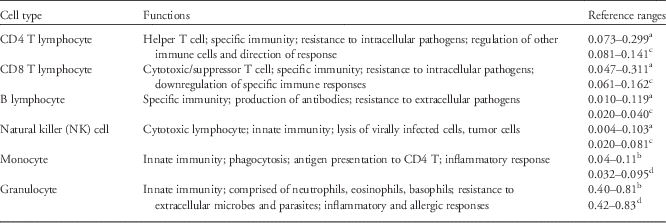
The primary objective of this study is to evaluate the association between birth weight and the proportion of leukocyte subsets in young adulthood. Leukocytes, or white blood cells, are cells of the immune system that serve as the primary mediators of immune activity, including responses to infection and injury, surveillance and repair and interactions with other physiological systemsReference Male 22 (Table 1). We investigated this association in a longitudinal birth cohort study in the Philippines, with detailed, prospective measurement of early life environments.Reference Adair, Popkin and Akin 23 Specifically, we hypothesized that lower birth weight would predict lower proportions of T and B lymphocytes, consistent with prior research documenting the adverse effects of undernutrition on parameters of cell-mediated immunity and antibody responsiveness to vaccination.Reference McDade, Beck, Kuzawa and Adair 20 , Reference McDade, Beck, Kuzawa and Adair 24 In addition, we hypothesized that lower birth weight would predict a higher proportion of monocytes, based on the prior observation that lower birth weight is associated with chronic inflammation in adulthood,Reference McDade, Rutherford, Adair and Kuzawa 11 and the established role of monocytes in upregulating inflammatory processes.Reference Ziegler-Heitbrock 25
Functional significance of leukocyte subsets and established reference ranges

a Based on values from the United States reported for adults.Reference Valiathan, Deeb and Diamante 40 Values are calculated as proportion of total leukocytes.
b Based on values from the United States.Reference Kratz, Ferraro, Sluss and Lewandrowski 39
c Based on values from Singapore for adults, combining results for males and females.Reference Lee, Yap and Chew 42 Values are calculated as proportion of total leukocytes.
d Based on values from China.Reference Wu, Zhao, Pan, Zhang, Peng and Wang 41
A secondary objective was to investigate the association between postnatal microbial exposures and the distribution of adult leukocyte subsets. Based on a prior review and conceptual model,Reference McDade, Georgiev and Kuzawa 26 we hypothesized that microbial exposures would be positively associated with cell subsets that drive specific immune processes, and negatively associated with cells of innate immunity.
Method
Participants and study design
Analyses were implemented with a subset of participants in the Cebu Longitudinal Health and Nutrition Survey (CLHNS), an ongoing birth cohort study in the Philippines. A community-based sample of n=3327 pregnant women was initially recruited in 1983 from neighborhoods in and around Cebu City, and home visits were made before birth, immediately following birth, and every 2 months for 2 years.Reference Adair, Popkin and Akin 23 A comprehensive follow-up survey, including venous blood collection, was implemented in 2005 when participants were 20–22 years of age. Attrition in the CLHNS is due primarily to factors related to out-migration, and rates of refusal during initial recruitment were low (<4%).Reference Adair, Popkin and Akin 23 , Reference Perez 27
Of the n=1885 participants in the 2005 survey, n=1759 provided a venipuncture blood sample. Between 2009 and 2014, a pregnancy tracking study was initiated that included a subsample of n=395 female participants who became pregnant in this interval.Reference McDade, Borja, Largado, Adair and Kuzawa 28 Samples collected in 2005 from these women, as well as samples from n=99 randomly chosen male participants, were used for a study of DNA methylation,Reference McDade, Ryan and Jones 29 which provided information on leukocyte subsets when participants were 20–22 years old (details below). Males were included in order to uncover potential sex differences, although budgetary constraints limited the sample size relative to females. All data were collected and analyzed under conditions of informed consent with institutional review board approvals from the University of North Carolina at Chapel Hill, Northwestern University and the University of British Columbia.
The leukocyte subsample sample did not differ from the rest of the original cohort in household income (260.2 v. 287.5 pesos, t=1.05, P=0.30) as assessed when the study started in 1983. However, household assets were marginally lower (2.36 v. 2.54 items, t=1.85, P=0.06), and the likelihood of home ownership was higher (74.7 v. 64.1%, Pearson’s χ2=20.6, P<0.001) in the subsample. Participants did not differ in birth weight (3107 v. 2984 g, t=1.55, P=0.12), season of birth (21.1 v. 18.1% born in dry season, Pearson’s χ2=2.40, P=0.12), or episodes of infectious diarrhea in the first year (1.04 v. 1.09, t=0.93, P=0.35).
Measurement of leukocyte subsets
The distribution of leukocytes in each participant was bioinformatically determined based on signatures of DNA methylation (DNAm) in DNA extracted from venous whole blood. Epigenetic mechanisms such as DNAm – the covalent linkage of methyl groups to cytosine residues in the context of CpG dinucleotides – underlie the process through which progenitor cells differentiate into functionally distinct cell lineages. Patterns of DNAm are tightly associated with chromatin structure and gene expression, and during differentiation, pluripotent progenitors undergo de novo methylation followed by maintenance methylation, resulting in distinct mitotically heritable epigenetic profiles that shape transcriptional programming of gene expression within each cell line.Reference Ji, Ehrlich and Seita 30 Patterns of DNAm can therefore serve as proxy measures of cell type, and the methylation signatures associated with leukocyte subsets are well established.Reference Houseman, Accomando and Koestler 31 An advantage of this approach is that it does not require large volumes of blood with intact cells, and prior validation studies indicate that DNAm-based results are comparable with results from flow cytometry.Reference Koestler, Christensen and Karagas 32
Overnight fasting blood samples were collected into ethylenediaminetetraacetic acid-coated vacutainer tubes in 2005, and centrifuged to isolate leukocytes before freezing at −70°C. Following DNA extraction (Puregene, Gentra), 750 ng of genomic DNA was treated with sodium bisulfite using Zymo EZDNA methylation kit (Zymo Research, Irvine, CA, USA) and 160 ng of converted DNA was transferred to the Illumina HumanMethylation450 Bead Chip under standard conditions (Illumina Inc., San Diego, CA, USA). Background subtraction and color correction were performed using Illumina Genome Studio with default parameters, and data were exported to R for further analysis.
Cell type composition was calculated from normalized DNAm data with published methods implemented in the minfi R package and using the ‘Blood’ reference data set.Reference Houseman, Accomando and Koestler 31 , Reference Aryee, Jaffe and Corrada-Bravo 33 Reference DNAm data from purified individual cell types are used to predict the most likely proportions underlying the DNAm profile of a cell mixture. Within individuals, the sum of all cell types approaches but does not always equal 1.0, as the prediction algorithm independently predicts the most likely proportion of each cell type, with associated additive variation. Values are provided for the relative proportions of the following cell types: CD4 T lymphocytes, CD8 T lymphocytes, B lymphocytes, natural killer (NK) lymphocytes, monocytes and granulocytes.
Measurement of birth weight and microbial exposure
Birth weight was used as an indicator of the prenatal nutritional environment,Reference Barker, Eriksson, Forsen and Osmond 16 and was measured in the home immediately after birth using standard procedures.Reference Lohman, Roche and Martorell 34 Gestational age was recorded based on maternal report of time since last menstrual period.
Three measures of postnatal microbial exposure were collected during in-home interviews following prior research with this cohort and elsewhere.Reference McDade, Rutherford, Adair and Kuzawa 11 , Reference Nurgalieva, Malaty and Graham 35 , Reference VanDerslice, Popkin and Briscoe 36 Frequency of infectious diarrhea in the first 2 years was assessed by recording symptoms of diarrhea during the week preceding the interview, and a variable was created summing the number of bimonthly intervals when symptoms were present. Complete observations were available for 92.1% of participants. In cases with missing intervals, frequency of diarrhea was calculated as a percentage across observed intervals, and then adjusted to 12 intervals.
A proxy measure for the intensity of exposure to animal feces in infancy was created by summing the number of bimonthly intervals that the interviewer observed that the infant was crawling, and that animals (e.g., dogs, chickens) were present in the home. Lastly, season of birth predicts the intensity of microbial exposure in Cebu as water supply contamination from heavy rainfall is associated with the spread of pathogens and infectious morbidity.Reference VanDerslice, Popkin and Briscoe 36 , Reference Moe, Sobsey, Samsa and Mesolo 37 Birth in the dry season – which is associated with higher levels of microbial exposure postnatally, in early infancyReference McDade, Rutherford, Adair and Kuzawa 11 – was defined as birth in the months of February through April, inclusive.
Additional covariates
While the primary focus was on birth weight, we considered additional, and potentially confounding, measures of the postnatal nutritional environment. Information on infant feeding was collected at bimonthly interviews, conducted in the home, during the first 2 years following birth. The duration of exclusive breastfeeding was defined as the number of days of breastmilk consumption before the introduction of any supplementary foods or liquids. Anthropometric measures were also collected using standard procedures,Reference Lohman, Roche and Martorell 34 and weight gain between birth and 6 months was used as a proxy for the postnatal nutritional environment. We focused on this time interval based on prior research demonstrating that postnatal weight gain predicted vaccine responsiveness in this sample.Reference McDade, Beck, Kuzawa and Adair 20
Household assets were summed as a measure of socioeconomic status (SES), as durable assets provide a more stable measure of socioeconomic resources in low-income settings due to volatility or inaccuracy in reports of household income.Reference Vyas and Kumaranayake 38 Assets included: home ownership, electricity in the home, type of housing material and ownership of items such as air conditioner, television, refrigerator or car. Assets were assessed in 1985–1986 to provide a measure of socioeconomic adversity in infancy. Assets were also measured in 2005, at the time of blood collection, to control for the current SES environment. Lastly, body mass index (BMI, kg/m2) was measured in 2005 using standard proceduresReference Lohman, Roche and Martorell 34 to provide a measure of overall nutritional status in adulthood.
Data analysis
Complete data for all independent variables and leukocyte subsets were available for n=486 participants, except for 26 observations missing data on gestational age. Analyses focused on the proportion of each cell type as the dependent variable. In addition, due to the clinical significance of the ratio of CD4 T to CD8 T lymphocytes,Reference Male 22 we considered the CD4/CD8 ratio as an additional outcome.
Descriptive statistics were used to characterize the independent variables and the distribution of cell subsets, and to make comparisons with established reference values. Comparisons were made with reference values from the United States,Reference Kratz, Ferraro, Sluss and Lewandrowski 39 , Reference Valiathan, Deeb and Diamante 40 as well as two more geographically proximate populations.Reference Wu, Zhao, Pan, Zhang, Peng and Wang 41 , Reference Lee, Yap and Chew 42
Beta regression models for proportional dependent variables were used to evaluate the associations between birth weight (modeled as a continuous variable) and leukocyte proportion in young adulthood adjusting for covariates, and to estimate the magnitude of associations.Reference Ferrari and Cribari-Neto 43 Beta regression coefficients represent the change in the log-odds of the dependent variable in response to a one unit change in the independent variable. Parallel models were implemented for postnatal microbial exposures. Least squares regression was used when CD4/CD8 ratio was the outcome variable. We evaluated the following series of models: First, we implemented a model including birth weight as a predictor of each cell type, adjusting for participant sex; second, we added measures of the postnatal nutritional environment, and SES in infancy, to evaluate whether birth weight was an independent predictor of cell type, or whether correlated aspects of the postnatal environment were stronger predictors of cell type. Third, we added variables representing SES and BMI in young adulthood as potentially confounding measures of the current socioeconomic and nutritional environment. Lastly, we evaluated full models that included birth weight, microbial exposures and all covariates. As coefficients for birth weight and microbial exposures did not change substantially across models, we report coefficients for the full models only.
Preliminary analyses revealed the possibility of nonlinear associations with birth weight, and we therefore considered a squared term for birth weight in all models. Preliminary analyses also revealed no evidence of statistical interactions with sex, and all results were similar when models were run separately for females and males. Therefore, all models adjust for participant sex and results are presented for all participants. We used α<0.05 as the criterion for statistical significance, and we indicate associations with P<0.10. All statistical analyses were implemented with Stata (Stata Corporation version 15.0; College Station, TX, USA). Final models were re-run with robust standard errors to evaluate the potential impact of clustering in the study design (i.e. neighborhood of residence during study recruitment). Robust standard errors did not differ meaningfully from unadjusted standard errors, and no variables crossed the threshold for statistical significance. Therefore, we present results with unadjusted standard errors.
Results
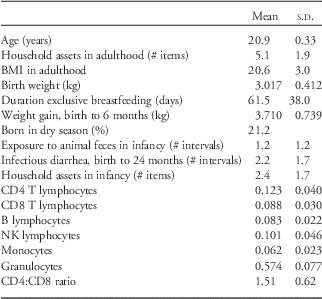
Descriptive statistics are presented in Table 2. Mean proportions of leukocyte subsets are within established reference ranges for healthy adults in the United States (Table 1).Reference Kratz, Ferraro, Sluss and Lewandrowski 39 – Reference Lee, Yap and Chew 42 However, values for B lymphocytes and NK cells are higher than recent reference values from Singapore.Reference Lee, Yap and Chew 42
Descriptive statistics and distribution of leukocyte subsets for study participants (n=486)Footnote a

a Leukocyte subsets are presented as the proportion of all leukocytes.
Mean gestational age for the sample was 39.2 weeks (s.d.=2.6), and 12.6% of participants with data on gestational age (n=460) were born pre-term (<37 weeks). Preliminary analyses indicated that gestational age was not associated with cell type (all P>0.2), and that the inclusion of gestational age in regression models did not modify associations with birth weight. Therefore, gestational age was not considered further in order to preserve observations with missing data on gestational age.
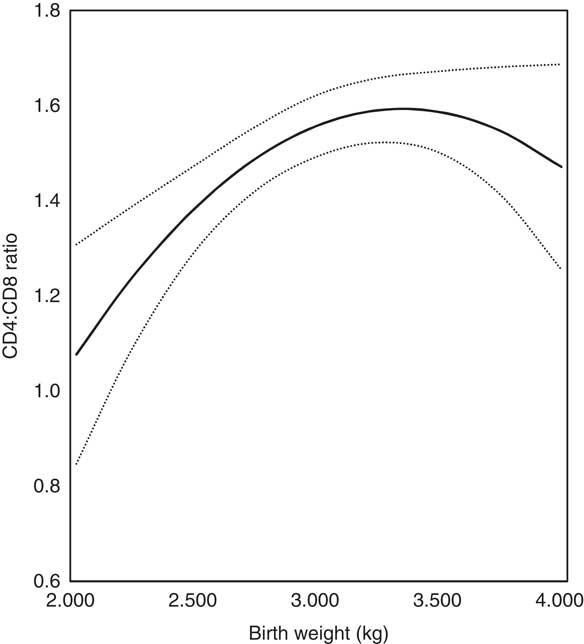
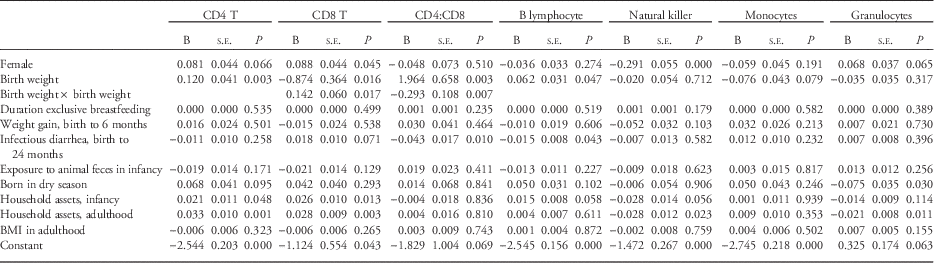
A similar pattern of results was found in bivariate and covariate adjusted regression models evaluating the association between birth weight and leukocyte subsets in adulthood, and coefficients for fully adjusted models for each cell type are presented in Table 3. Higher birth weight was a strong predictor of higher proportion of CD4 T lymphocytes, lower proportion of CD8 T lymphocytes, higher CD4:CD8 ratio, and higher B lymphocytes. Birth weight was also a marginally significant predictor of reduced monocyte proportion. Associations between birth weight and CD8 T, and CD4:CD8 ratio were nonlinear. In the case of CD8 T, birth weight was negatively associated with CD8 T at the lower end of the birth weight distribution, with an inflection point at 3.1 kg where birth weight became positively, but less strongly, associated with CD8 T. The opposite pattern was found for CD4:CD8 ratio: the association with birth weight was positive up to the inflection point at 3.4 kg, with a weak negative association at the highest end of the birth weight distribution (Fig. 1).
Association between birth weight and CD4:CD8 T lymphocyte ratio, as predicted by coefficients in the fully adjusted regression model (Table 3). The 95% confidence interval is represented by dashed lines.

Results of regression models predicting each leukocyte subset in relation to independent variablesFootnote a

a Beta regression models were implemented for all leukocyte subsets, and least squares regression was used for CD4:CD8 ratio.
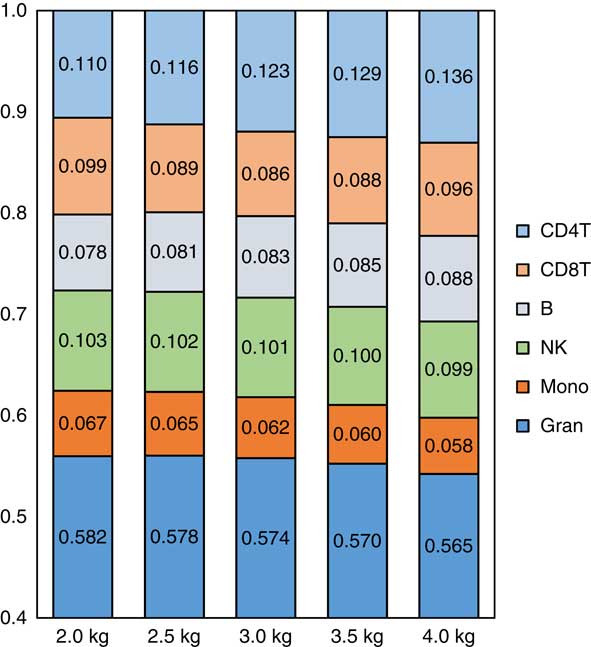
Figure 2 presents the predicted distribution of all leukocyte subsets in relation to birth weight. The overall impact of birth weight is substantial. For example, a 1-kg difference in birth weight (from 2.5 to 3.5 kg) is associated with 11.2% higher proportion of CD4 T lymphocytes, 4.9% higher B lymphocytes and 7.7% lower monocytes in young adulthood. The same increase in birth weight is associated with a 15.0% increase in CD4:CD8 ratio, from 1.38 to 1.59 (Fig. 1). This association is even stronger at the lower end of the birth weight distribution, where increasing birth weight from 2.0 to 3.0 kg predicts a 41.0% increase in CD4:CD8 ratio in young adulthood.
Association between birth weight and distribution of leukocyte subsets, as predicted by coefficients in fully adjusted regression models (Table 3).

These associations were independent of other measures of postnatal nutritional and microbial exposures, as well as current nutritional status and socioeconomic resources. No non-linear associations with birth weight were found for any other cell subsets, and the squared term was therefore not included in the final models for other cell subsets.
Microbial exposures in infancy predicted cell composition, with individuals born in the dry season – a proxy for increased microbial exposure early in infancy – having significantly lower proportion of granulocytes, and marginally higher proportion of CD4 T lymphocyte in young adulthood (Table 3). Higher frequency of infectious diarrhea in infancy predicted a lower CD4:CD8 ratio, lower fraction of B lymphocytes and marginally higher fraction of CD8 T.
While the emphasis of our analyses was on birth weight and postnatal microbial exposures, it is interesting to note that household assets in adulthood predicted higher CD4 T and CD8 T lymphocyte fractions, and lower NK and granulocyte fractions (Table 3). These associations are independent of BMI in adulthood, which is not a significant predictor of any cell subset in the adjusted models. Households assets in infancy, independent of current assets, also predicted higher proportions of CD4 T and CD8 T lymphocytes, with a trend toward higher proportions of B lymphocytes and lower NK fraction.
Discussion
Leukocytes are the key regulators and effectors of immunity, and reference ranges have been established for each cell type to identify situations where abnormally high, or abnormally low, cell levels may be associated with disease. However, there is considerable variability in the distribution of leukocyte subsets across healthy individuals, and across populations, the origins and functional significance of which are not known.Reference McDade 21 , Reference Brodin and Davis 44 In this analysis, we document consistent associations between birth weight and leukocyte subset distribution in young adulthood, as well as significant associations with microbial exposures in infancy. We find general support for our hypothesis that lower birth weight predicts lower proportions of leukocyte subsets associated with specific immunity, and higher proportions of leukocytes associated with innate immunity. Results point toward nutritional and microbial exposures in infancy as potentially important determinants of immuno-phenotypes in adulthood, and they suggest that leukocyte distribution may be a mechanism through which developmental environments shape disease risk in adulthood.
The prenatal environment has enduring effects on a wide range of physiological processes and systems,Reference Wadhwa, Buss, Entringer and Swanson 1 , Reference Barker, Eriksson, Forsen and Osmond 16 and our findings add to the growing list of immune parameters that are associated with birth weight. Previously, in this cohort we have documented that lower birth weight predicts reduced antibody response to typhoid vaccination, reduced concentrations of thymopoetin and increased total IgE in adolescence,Reference McDade, Beck, Kuzawa and Adair 20 , Reference McDade, Beck, Kuzawa and Adair 24 , Reference McDade, Kuzawa, Adair and Beck 45 as well as increased C-reactive protein in young adulthood.Reference McDade, Rutherford, Adair and Kuzawa 11 Similarly, a large study in the United States has documented a negative association between birth weight and total white blood cell count in adulthood.Reference Chen, Srinivasan and Berenson 13 These findings build on prior studies of infants, and one with young children, that report lower proportions of overall T lymphocytes and the CD4 T lymphocyte subset, as well as lower CD4:CD8 ratio, in association with lower birth weight.Reference Chandra 7 , Reference Raqib, Alam and Sarker 46 – Reference Pelkonen, Suomalainen, Hallman and Turpeinen 48 Our results are consistent with this pattern, and suggest that the impact of prenatal nutrition on the distribution of leukocyte subsets extends beyond infancy and into young adulthood. It should be noted, however, that birth weight is a relatively crude and non-specific proxy for fetal nutrition, and missing data on gestational age for 26 participants is a limitation of our study.
Associations between postnatal microbial exposures and leukocyte subsets are consistent with a large literature on the ‘hygiene’ or ‘old friends’ hypothesis, which underscores the effects of microbial exposures during sensitive periods of immune development on the regulation of immunity in adulthood.Reference Rook, Lowry and Raison 17 , Reference Yazdanbakhsh, Dremsner and van Ree 19 Due to the seasonal pattern of rainfall and infectious disease transmission in the Philippines, participants who were born in the dry season experienced a higher level of microbial exposure in early infancy. As young adults, these participants had marginally higher proportions of CD4 T cells – key regulators of immunity – and significantly lower proportions of granulocytes, which include basophil and eosinophil fractions that are centrally involved in allergic responses.Reference Male 22 Findings for infectious diarrhea are more equivocal, with negative associations between symptom frequency in infancy and CD4:CD8 ratio and B lymphocyte proportion. While this pattern of results should be regarded as preliminary, it suggests that leukocyte distribution may be a potential mediator of long-term immunological effects of microbial exposures in infancy. Additional studies with more precise measures of the microbial environment, and more fine-grained measures of cell type and functional capacity, are needed to evaluate this possibility.
Although our hypotheses did not focus on the immunological impact of socioeconomic status, it is interesting to note that higher levels of household assets predicted higher proportions of cell types associated with specific immunity, and lower proportions of innate immune cells. Household assets in infancy and in adulthood were both significantly associated with cell subsets. These findings merit more detailed investigation, in this and other cohorts, given well-established links between socioeconomic adversity, poorer health and earlier mortality.Reference Montez and Hayward 49 In particular, several studies have documented negative associations between socioeconomic status in childhood and inflammation in adulthood,Reference Miller, Chen and Fok 50 , Reference Taylor, Lehman, Kiefe and Seeman 51 and a recent study of adoptees from Eastern European orphanages, using the same DNAm-based measures of cell type employed in our study, suggests that adversity in infancy predicts a lower proportion of CD4 T and B lymphocytes, and a higher proportion of CD8 T, in adolescence.Reference Esposito, Jones and Doom 52 The apportionment of leukocyte subsets may therefore play a role in linking social adversity in infancy with inflammation in adulthood and with social disparities in adult health outcomes.
The clinical and functional implications of our findings are not clear, particularly as the range of ‘normal’ values for leukocyte subsets is large and the magnitude of associations with early environmental variables is relatively small. Furthermore, parallel studies across ecological and epidemiological settings are needed to determine whether these results are generalizable. However, in a prospective study of coronary artery disease, participants with high levels of monocytes at baseline (top quartile v. bottom quartile) were 1.4 times more likely to die or suffer a myocardial infarction during follow-up.Reference Horne, Anderson and John 53 The hazard ratio was 0.51 for participants with high levels of lymphocytes at baseline. In the context of aging, reduced CD4 T and increased CD8 T fractions predict increased mortality risk,Reference Ferguson, Wikby, Maxson, Olsson and Johansson 54 and low CD4 T counts increase risk for a range of opportunistic infections among HIV positive individuals.Reference Crowe, Carlin, Stewart, Lucas and Hoy 55 These findings demonstrate the potential clinical significance of leukocyte distributions for morbidity and mortality in adulthood, and they underscore the importance of additional research into the developmental origins of variation in cell subsets across individuals.
Recently, we proposed a conceptual model for explaining why early environments shape patterns of immune development to complement the more proximate and mechanistic emphasis of most research in immunology and DOHaD.Reference McDade, Georgiev and Kuzawa 26 Drawing on insights from evolutionary biology and ecological immunology, the model acknowledges that immune defenses are costly to grow, maintain and activate, and that the cost profiles of specific and innate immune defenses are distinct. Ecological conditions during sensitive periods of immune development provide signals that optimize the balance of investment in specific v. innate immunity. Innate immune defenses are more costly to operate, but can be mobilized quickly to provide effective responses to novel pathogens. Specific defenses are less effective against novel exposures, but become more effective and efficient over time due to immunological memory.
This framework leads to the prediction that limited nutritional resources early in life will tend to increase investments in innate immunity and reduce investments in specific immunity. In addition, higher levels of microbial exposure will encourage greater investments in specific immune defenses despite the high developmental costs, due to the long-term benefits associated with immunology memory. The model has received preliminary empirical support,Reference Georgiev, Kuzawa and McDade 56 and findings reported above are largely consistent with these predictions. With the exception of CD8 T lymphocytes, lower birth weight – a likely indicator of reduced prenatal nutrition in this sample – predicts lower proportions of cell types that regulate specific immune responses, and higher proportions of innate immune cells. While associations with postnatal microbial exposure are less consistent, birth in the dry season is associated with significantly lower granulocyte fraction, and higher proportions of all specific immune cell types (although these associations are not statistically significant). A consideration of developmental plasticity and tradeoffs in response to the contingencies of the local ecology may provide a useful framework for future research into the developmental origins of adult immune function and disease.
A limitation of our study is the use of DNAm to infer leukocyte proportions, as opposed to the immunological gold standard of flow cytometry. However, prior validations indicate that DNAm-based methods provide accurate results,Reference Houseman, Accomando and Koestler 31 , Reference Koestler, Christensen and Karagas 32 and the distribution of leukocyte subsets in our sample is in line with prior studies using flow cytometry. Nevertheless, using DNAm-based values does not provide absolute cell counts, and it limits comparisons with other studies using cytometric methods. In addition, we do not have more specific information on cell phenotypes (e.g. Th1, Th2, eosinophil, basophil) within our relatively broad categories of cell types, or any indices of how well each cell type performs its functions. Lastly, we rely on immune cell measures at one time point, and cannot evaluate stability over time. These limitations make it difficult to infer the functional consequences of our findings. While the range and time-depth of prospectively collected data is a unique advantage of our study, caution is warranted given the observational study design and the possibility of residual confounding from unmeasured variables.
Our results contribute to a growing body of literature documenting the importance of developmental environments to the regulation of immunity in adulthood, and they suggest that leukocyte distribution may be a mediator of associations between birth weight and disease risk later in life. As such, attention to the causes and consequences of variation in immune cell subsets, across the life course, may be a particularly promising focus for future research in the developmental origins of health and disease.
Acknowledgments
None.
Financial Support
Research reported in this manuscript was supported by the National Institutes of Health (RO1 HL085144; RO1 TW05596) and the Biological Anthropology Program at the National Science Foundation (BCS-0746320; BCS-1440564).
Conflicts of Interest
None.
Ethical Standards
The authors assert that all procedures contributing to this work comply with the ethical standards of the Belmont Report and with the Helsinki Declaration of 1975, as revised in 2008, and has been approved by the institutional committees at University of North Carolina at Chapel Hill, Northwestern University and the University of British Columbia.