Popular opinion holds that “It gets better,” suggesting that peer victimization and bullying decline after high school, but the course of peer victimization in the transition to young adulthood has rarely been empirically investigated. A meta-analysis of 29 studies (Ttofi, Farrington, Lösel, & Loeber, Reference Ttofi, Farrington, Lösel and Loeber2011) supports the long-term influence of peer victimization in childhood and adolescence (ages 8 to 16) on depression later in life (ages 10 to 64), but it did not distinguish young adults from adolescents or older adults and was unable to control for concurrent levels of victimization. Adults' retrospective accounts of chronic peer victimization in early childhood or adolescence were also associated with severe depressive symptoms in clinical samples (Gladstone, Parker, & Malhi, Reference Gladstone, Parker and Malhi2006; Lund et al., Reference Lund, Nielsen, Hansen, Kriegbaum, Molbo and Due2009). A recent prospective study also suggests that the effects of being victimized on mental health may persist into young adulthood. Gibb, Ferguson, and Horwood (Reference Gibb, Fergusson and Horwood2011) followed New Zealand youth from adolescence to age 30, using parent reports on a single-item to assess victimization (teased or bullied by other children) only in adolescence. The effects of victimization on internalizing disorders were not significant after accounting for other correlates of depression. Given the lack of longitudinal data that controls for concurrent reports of victimization, limited conclusions can be drawn from past studies about the changes in peer victimization or its effects on mental health across the transition to young adulthood.
Longitudinal research on changes in peer victimization across this transition is also hampered by the lack of a psychometrically sound measure that can be used to assess physical and relational victimization in both adolescents and young adults. It is not known whether manifestations of victimization are similar across this transition. Physical victimization (being hit, pushed, or shoved, and pulled hair) is likely rare in young adults because social norms and assault laws limit these behaviors and increase their negative consequence. However, relational victimization, which can be fueled by jealousy, power differentials, perceived slights, and interpersonal competition, may continue or even increase across this transition. In the current cohort sequential, longitudinal study of youth, which spans ages 12 to 27 years, we first test the psychometric properties and invariance across time and sex of measures of physical and relational peer victimization based on the Social Experiences Questionnaire (SEQ; Crick & Grotpeter, Reference Crick and Grotpeter1996). We then compare patterns of changes in peer victimization during and after high school. Finally, we examined the concurrent and prospective intraindividual associations between internalizing symptoms (anxiety and depression) and both physical and relational peer victimization from adolescence to young adulthood.
To first situate this research in the existing literature, we briefly review past research on changes in peer victimization across adolescence as well as trajectories of internalizing problems from adolescence to young adulthood. We then go on to explicate how the trajectories of victimization and internalizing may be related across the transition to young adulthood.
Trajectories of Peer Victimization in Adolescence
Longitudinal studies show significant individual differences in changes in peer victimization experiences; however, average levels of relational and physical victimization typically decline for boys and girls across the elementary and early middle school years (e.g., Giesbrecht, Leadbeater, & MacDonald, Reference Giesbrecht, Leadbeater and MacDonald2011; Rudolph, Troop-Gordon, Hessel, & Schmidt, Reference Rudolph, Troop-Gordon, Hessel and Schmidt2011; Troop-Gordon & Ladd, Reference Troop-Gordon and Ladd2005). Trajectory analyses have identified subgroups of high-risk children and adolescents who follow a high and stable or increasing trajectory of peer victimization (Bettencourt, Farrell, Liu, & Sullivan, Reference Bettencourt, Farrell, Liu and Sullivan2013; Boivin, Petitclerc, Feng, & Barker, Reference Boivin, Petitclerc, Feng and Barker2010; Rudolph et al., Reference Rudolph, Troop-Gordon, Hessel and Schmidt2011). Children and adolescents categorized in these high-risk groups also show higher levels of social and emotional difficulties (e.g., social withdrawal, emotional dysregulation, anxiety, and depression) or aggression over time (Giesbrecht et al., Reference Giesbrecht, Leadbeater and MacDonald2011; Rudolph et al., Reference Rudolph, Troop-Gordon, Hessel and Schmidt2011; Troop-Gordon & Ladd, Reference Troop-Gordon and Ladd2005; Vaillancourt, Brittain, McDougall, & Duku, Reference Vaillancourt, Brittain, McDougall and Duku2013). However, most of these studies are conducted with elementary and middle school children, and no studies were found that followed the course of victimization into late adolescence or young adulthood.
Trajectories of Symptoms of Depression and Anxiety From Adolescence to Young Adulthood
Depression and anxiety are among the most common mental health problems in adolescence and young adulthood (Costello, Copeland, & Angold, Reference Costello, Copeland and Angold2011; Costello, Egger, Copeland, Erkanli, & Angold, Reference Costello, Egger, Copeland, Erkanli, Angold, Silverman and Field2011). Subclinical levels of these problems in adolescence also predict more serious disorders in adulthood (Klein et al., Reference Klein, Glenn, Kosty, Seeley, Rohde and Lewinsohn2013; Shankman et al., Reference Shankman, Lewinsohn, Klein, Small, Seeley and Altman2009). However, findings in average patterns of change in internalizing problems are inconsistent and individual differences are significant. Depression trajectories vary across studies, increasing in some, decreasing in others, or showing curvilinear patterns of change (e.g., Galambos, Barker, & Krahn, Reference Galambos, Barker and Krahn2006; Garber, Keiley, & Martin, Reference Garber, Keiley and Martin2002; Leadbeater, Thompson, & Gruppuso, Reference Leadbeater, Thompson and Gruppuso2012). Females report higher levels of internalizing symptoms than do boys (see Essau, Lewinsohn, Seeley, & Sasagawa, Reference Essau, Lewinsohn, Seeley and Sasagawa2010; McLean & Anderson, Reference McLean and Anderson2009, for reviews). Little research has focused on patterns of change in symptoms of anxiety, but symptoms of anxiety increased across the transition to young adulthood in earlier research with the current sample (Leadbeater et al., Reference Leadbeater, Thompson and Gruppuso2012). The significant individual differences in patterns of change in internalizing suggest that other factors influence these average patterns of change. In this research, we investigate the effects of physical and relational peer victimization on levels and trajectories of symptoms of depression and anxiety.
Peer Victimization and Mental Health Consequences in Young Adulthood
Ample, longitudinal research shows that childhood experiences of peer victimization are associated with mental health problems in adolescence (Bettencourt et al., Reference Bettencourt, Farrell, Liu and Sullivan2013; Kumpulainen & Räsänen, Reference Kumpulainen and Räsänen2000; Siegel, La Greca, & Harrison, Reference Siegel, La Greca and Harrison2009; Tran, Cole, & Weis, Reference Tran, Cole and Weiss2012; Ttofi et al., Reference Ttofi, Farrington, Lösel and Loeber2011; Vaillencourt et al., Reference Vaillancourt, Brittain, McDougall and Duku2013; Zwierzynska, Wolke, & Lereya, Reference Zwierzynska, Wolke and Lereya2013). However, the trajectories of peer victimization in young adulthood have not been assessed, and the concurrent and prospective effects of peer victimization on mental health in young adulthood are not known.
The transition to young adulthood offers opportunities to overcome peer victimization. For example, peer victimization could diminish as young adults leave high school, disengage with their high school peer networks and cliques, and establish new peer networks when they enter postsecondary education or take up more formal occupations. However, enduring characteristics and behaviors of victimized adolescents, including negative self-schemas, aggression, poor social skills, and social withdrawal (Cole et al., Reference Cole, Dukewich, Roeder, Sinclair, McMillan and Will2013; Graber & Sontag, Reference Graber, Sontag, Lerner and Steinberg2009), may reduce the potentially positive effects of leaving high school networks. The demands of this phase of life also bring about personal and interpersonal challenges that are related to increasing expectations for independence, workforce participation, and postsecondary education. These challenges may be exacerbated by mental health problems, particularly for youth with histories of peer victimization (Burt & Masten, Reference Burt, Masten, Grant and Potenza2010), sustaining the relations between victimization and internalizing over time.
Adolescents' peer victimization experiences may also influence their ability to establish trust and maintain friendships (Prinstein, Borelli, Cheah, Simon, & Aikins, Reference Prinstein, Borelli, Cheah, Simon and Aikins2005). Recent qualitative research suggests that these friendship problems may be particularly problematic for boys in late adolescence when intimacy in male friendships gives way to romantic relationships and socially sanctioned homophobia (Way, Reference Way2013). It is also possible that continuities in the composition of social networks of aggressive adolescents who also affiliate with deviant peers may increase exposure to aggressive and victimizing peer cultures (Vaillancourt et al., Reference Vaillancourt, Brittain, McDougall and Duku2013). Peer victimization experiences are also related to negative self-perceptions (e.g., low self-worth) and impaired social competence (e.g., social withdrawal, aggression, or perceiving others as threatening) in early childhood and adolescence, and these problems, in turn, increase vulnerability to internalizing problems over time (Cole et al., Reference Cole, Dukewich, Roeder, Sinclair, McMillan and Will2013; Troop-Gordon & Ladd, Reference Troop-Gordon and Ladd2005; Vaillancourt et al., Reference Vaillancourt, Brittain, McDougall and Duku2013). While the possible mechanisms linking victimization and internalizing symptoms are not directly studied here, we take a first step by investigating the relations between physical and relational peer victimization and symptoms of depression and anxiety across the transition to young adulthood. We expect that victimization and internalizing symptoms will continue to be concurrently associated across this transition, and we expect that adolescent experiences of victimization will affect later levels of these internalizing problems.
Sex differences in these relationships are expected but difficult to predict based on differential patterns found in past research. In previous studies, boys report more physical peer victimization, whereas both boys and girls report similar levels of relational peer victimization (see Hong & Espelage, Reference Hong and Espelage2012). Sex differences in the mental health consequences of peer victimization are inconsistent. In some studies, peer victimization predicted depressive symptoms (Rudolph et al., Reference Rudolph, Troop-Gordon, Hessel and Schmidt2011) and social anxiety (La Greca & Harrison, Reference La Greca and Harrison2005; Siegel et al., Reference Siegel, La Greca and Harrison2009) in both boys and girls. However, other research has found that social anxiety and peer victimization (Erath, Flanagan, & Bierman, Reference Erath, Flanagan and Bierman2007) and peer victimization and depressive symptoms (Paul & Cillessen, Reference Paul and Cillessen2003) were more strongly associated for boys than for girls. Similarly, Tran et al. (Reference Tran, Cole and Weiss2012) found that depressive symptoms were more predictive of physical peer victimization for boys than for girls. In a study that used the first three waves of research with the current sample, Yeung Thompson and Leadbeater (Reference Yeung Thompson and Leadbeater2012) found that increases in physical peer victimization over 4 years were associated with increases in internalizing for girls only.
The Current Study
Data were collected biennially from participants in the Victoria Healthy Youth Survey (V-HYS), a five-wave multicohort study that began in 2003. First, we examined the psychometric properties of a measure of relational and physical peer victimization that is commonly used in childhood and adolescence. Second, we examined patterns of changes in peer victimization during and after high school for males and females using piecewise linear growth models. Specifically, changes in peer victimization were estimated during and after high school. We expected that peer victimization would be related to internalizing symptoms not only on occasions when peer victimization experiences occur (concurrently) but also across the transition to young adulthood. To assess concurrent and prospective associations between internalizing symptoms and peer victimization, latent growth curves were estimated for depression and anxiety, and measures of peer victimization were included as time-varying covariates (Curran & Hussong, Reference Curran, Hussong, Moskowitz and Hershberger2002; Preacher, Wichman, MacCallum, & Briggs, Reference Preacher, Wichman, MacCallum and Briggs2008). Baseline age and socioeconomic status (SES) were included as covariates.
Method
Participants
The V-HYS was administered in 2003 (T1), 2005 (T2), 2007 (T3), 2009 (T4), and 2011 (T5) in a medium-sized urban community (for details, see Leadbeater et al., Reference Leadbeater, Thompson and Gruppuso2012). Participants were recruited from a random sample of 9,500 telephone listings; 1,036 households with an eligible youth (aged 12–18 years) were identified. Agreeing to participate were 662 parents and youth (342 females) at T1, 578 (87%; 306 females) at T2, 539 (81%; 294 females and 1 transgendered) at T3, 459 (69%; 254 females and 1 transgendered) at T4, and 465 (70%; 250 females) at T5. Youth were 15.52 (SD = 1.93) years old at T1 and ranged from 20 to 27 (M = 24.18, SD = 1.96) years old at T5. Most were European Canadian (85%), 4% were Asian, and 11% were from other ethnic backgrounds. The sample was economically diverse: 19% of both fathers and mothers had no education beyond high school, whereas 43% of fathers and 49% of mothers had college or university training. The majority of youth (59%; n = 392) lived with both of their biological or adoptive parents, 18% (n = 119) lived with a single parent, and the remaining 23% (n = 151) lived with a blended family (i.e., a combination of biological and stepparents). In addition, 2% of youth (n = 13) had a parent who died. The youth moved an average of three times (SD = 3.21) from Wave 1 to Wave 5.
Selective attrition was assessed by testing for differences at T1 on demographics and all study variables between youth who remained in the longitudinal study (n = 459) and those who did not participate at T5 (n = 203). No significant differences were found on these variables.
Procedure
Youth and one parent or guardian (for youth under 18 years of age) gave written consent for participation at each wave. Youth received a gift certificate for their participation at each interview. A trained interviewer administered the V-HYS interviews in the youth's home or another private place. To enhance privacy and increase responding, a portion of the repeated measures V-HYS questions were strictly self-report. These items dealt with private topics and emotional issues where youth are the best sources of data (e.g., sexual experiences, depression, substance use). This portion of the interview was self-administered and placed in a sealed envelope not accessible to the interviewer. In addition, Skype or phone interviews were used in later waves to follow youth across moves and absences owing to traveling and helped to reduce selective attrition at each wave.
Measures
Physical and relational peer victimization
Using the SEQ (Crick & Grotpeter, Reference Crick and Grotpeter1996; Desjardins, Yeung Thompson, Sukhawathanakul, Leadbeater, & MacDonald, Reference Desjardins, Yeung Thompson, Sukhawathanakul, Leadbeater and MacDonald2013), youth responded to five items tapping how often they experienced physical peer victimization (e.g., “get hit by your peers?”) and five items tapping relational peer victimization (e.g., “do your peers tell lies about you to make others not like you anymore?”) on a 3-point scale ranging from 0 (never) to 2 (almost all the time). Prosocial items of the SEQ were not assessed to reduce participant burden. Cronbach αs at T1 to T5 were low (range α = 0.47–0.68) for physical victimization but were adequate (range α = 0.65–0.72) for relational victimization. The lower internal consistency for physical victimization at T4 and T5 reflect the decline in physical aggression with age as well as a reduction in the number of items from five to three at T4. Scores of physical victimization at T4 were rescaled to maintain the same metric over time (Little, Reference Little2013). Victimization scores for each item were summed at each time point (range = 0–10).
Symptoms of internalizing problems
Participant's symptoms of internalizing behavior were assessed with the Brief Child and Family Phone Interview (BCFPI; Cunningham, Boyle, Hong, Pettingill, & Bohaychuk, Reference Cunningham, Boyle, Hong, Pettingill and Bohaychuk2009). The BCFPI was developed for standardized intake screening and outcome evaluation for children aged 6 to 18 years, and items specifically tap current levels of symptoms delineated in the DSM-IV for different psychiatric disorders. Measurement invariance for each symptom domain for young adult males and females is reported for this sample in Leadbeater et al. (Reference Leadbeater, Thompson and Gruppuso2012).
Participants rated six items for each symptom type on a 3-point scale from 0 (never) to 2 (often) reflecting current experiences of symptoms (range = 0–12). Youth were asked: “Do you notice that you [… item].” Sample items for anxiety are “worry about doing the wrong thing” and “are overly anxious to please people”; for the depression subscale they are “feel hopeless” and “get no pleasure from your usual activities.” The Cronbachs αs for each symptom type ranged from 0.81 to 0.88 across the five waves. Total scores were used for each symptom domain, and higher scores reflected more severe symptomatology.
Plan for analyses
Invariance across time and sex for SEQ measures of physical and relational peer victimization was evaluated using confirmatory factor analyses. A series of three cumulative models with increasingly restrictive parameter constraints were evaluated. A configural model with no equality constraints was estimated first. Equality constraints were imposed on all corresponding factor loadings across time and sex to test for metric invariance. Then, equality constraints were imposed on all corresponding indicator intercepts to rest for scalar invariance across time and sex. Invariance was determined by comparing changes in fit indices for the comparative fit index (CFI) and in root mean square error of approximation (RMSEA) between each successive model. Following Zimprich, Allemand, and Lachman (Reference Zimprich, Allemand and Lachman2012), a change of less than or equal to 0.01 is considered evidence of invariance.
Next, we examined trajectories of physical and relational victimization during and after high school for males and for females. For this analysis, the five waves of data were restructured so that the time metric was centered on the date of high school graduation. In piecewise linear growth models, estimated separately for physical and relational peer victimization, Slope 1 corresponded with changes in victimization during high school (pregraduation) and Slope 2 corresponded with changes in victimization after high school (postgraduation). The 662 participants provided a total of 2,410 observations to estimate a trajectory of peer victimization spanning 16 years (coded from 6 years before graduating high school [–6] to 9 years post high school [+9]). However, for these analyses, 210 observations at the earliest (–6 and –5) and the latest (8 and 9) time points were dropped from the analysis owing to low covariance coverage, yielding a total of 2,132 observations (for 525 participants).
To investigate the relations among depression, anxiety, and peer relational and physical victimization for males and for females, we used a series of multiple-group latent growth curve models with average time in study as the time metric (n = 662). Latent growth curve models were used to estimate the average intercept and linear and quadratic slopes of depression and anxiety symptoms over time (displayed as ovals in the figures), as well as the intraindividual variability (displayed in rectangles). Next, we used time-varying covariate latent growth curve models to test the following hypotheses: (a) victimization types are concurrently related to intraindividual differences in internalizing symptoms, and (b) peer relational and physical victimization are associated with increases in depression and anxiety symptoms across time (time-lagged relations). This allowed us to evaluate whether higher levels of peer victimization uniquely predicted time-lagged increase in depression and anxiety symptoms beyond what would be expected based on the typical trajectories of internalizing symptoms (Curran & Hussong, Reference Curran, Hussong, Moskowitz and Hershberger2002; Preacher et al., Reference Preacher, Wichman, MacCallum and Briggs2008). In other words, by controlling for the underlying growth of depression and anxiety symptoms, we were able to estimate within-person differences among these associations within and across time.
Sex differences in the associations between peer victimization and anxiety and depression were assessed by comparing changes in model fit resulting from imposing and releasing cross-sex equality constraints on the concurrent and lagged paths between victimization and internalizing. Models were estimated with the loadings of the growth factors at each time point constrained to be equal, leaving all other parameters free to vary across sex (unconstrained model). Then constraints were placed on model parameters in the following order: (a) concurrent effects of relational victimization, (b) concurrent effects of physical victimization, (c) lagged effects of relational victimization, and (d) lagged effects of physical victimization. Each model is a more restrictive version than the one preceding it. A scaled chi-square test (e.g., Satorra–Bentler) was used for comparing nested models because analyses used multiple linear regression (Muthén & Muthén, Reference Muthén and Muthén1998–2012). Sex differences are indicated by Δχ2 < 0.05. In all models, age heterogeneity at baseline and SES (mother's level of education) were included as invariant covariates by allowing them to covary with both peer victimization scores and the internalizing symptoms intercepts and slopes. All models were fitted using Mplus version 7.0 (Muthén & Muthén, Reference Muthén and Muthén1998–2012) and used full-information maximum likelihood estimation with robust standard errors (multiple linear regression) to reduce bias caused by missing data and correct for nonnormality (Enders, Reference Enders2010).
Results
Descriptive analyses
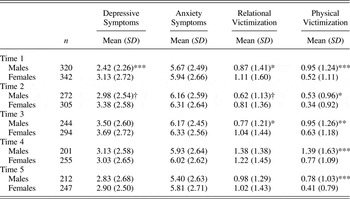
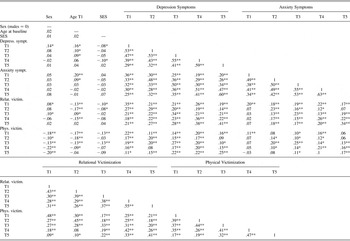
Means and standard deviations for depression and anxiety symptoms and peer victimization at each assessment are presented in Table 1. Females reported significantly higher levels of depressive symptoms at T1 and higher levels of relational victimization at T1, T2, and T3. Male consistently reported higher levels of physical victimization at all time points. There were no significant sex differences in mean levels of depressive symptoms. Approximately 33% to 51% of males and 20% to 39% of females reported experiencing physical victimization at least “sometimes” across at each wave and approximately 28% to 67% of males and 37% to 54% of females reported experiencing relational victimization at least “sometimes.” Approximately 1% to 2% experienced physical or relational victimization “all of the time.” The remaining participants reported “never” having experienced relational or physical victimization. Correlations among depression symptoms, anxiety symptoms, and physical and relational victimization at each time point are presented in Table 2.
Descriptive statistics of internalizing symptoms and peer victimization by sex and time in study

Note: Entries marked with asterisks indicate significant mean differences between males and females at that time point. †p < .10. *p < .05. **p < .01. ***p < .001.
Correlations between depression, anxiety, and relational and physical victimization

Note: SES, socioeconomic status; T1–T5, Times 1–5. *p < .05. **p < 0.001.
Longitudinal measurement invariance of peer victimization
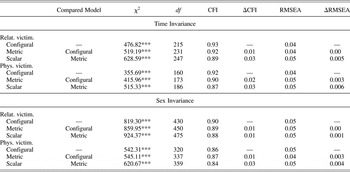
Tests of measurement invariance across time and sex are shown in Table 3. Examination of changes in RMSEA for relational victimization and physical victimization show that the constraints imposed by metric and scalar invariance do not result in a degradation of model fit. The change in CFI was greater than 0.01 for metric and scalar invariance for physical victimization and scalar invariance for relational variance across time, and physical victimization across sex; however, RMSEA “compensates for model complexity” and may be a better indicator than CFI (Hu & Bentler, Reference Hu and Bentler1999, p. 3; Desjardins et al., Reference Desjardins, Yeung Thompson, Sukhawathanakul, Leadbeater and MacDonald2013). The consistent support for metric invariance across time and sex for both relational and physical victimization (and scalar invariance across sex only for relational victimization) suggests that the indicators are stably related to a construct of physical or relational victimization over time for both males and females. Total scores are used for all analyses to facilitate interpretation of the findings.
Longitudinal measurement invariance of relational and physical victimization

Note: CFI, comparative fit index; RMSEA, root mean square error of approximation.
***p < .001.
Relational and physical victimization before and after high school
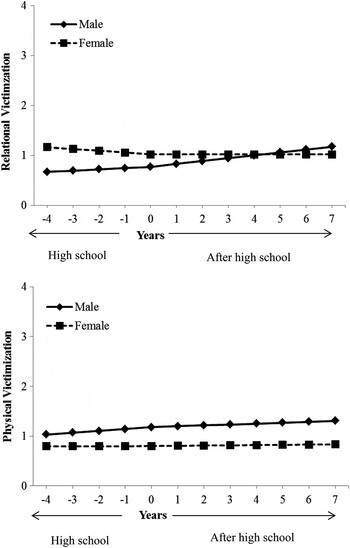
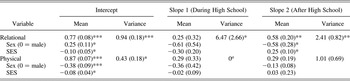
Piecewise linear growth models provided a good fit for both physical, χ2 (63) = 87.70, p < .05, RMSEA = 0.03, CFI = 0.92, and relational victimization, χ2 (60) = 79.11, p < .05, RMSEA = 0.03, CFI = 0.94. Table 4 contains the growth estimates, and Figure 1 displays the average growth trajectories of peer victimization during and after high school. On average, levels of relational victimization were stable during high school, but they increased after high school. Levels of physical victimization were stable over time. Females had significantly higher levels of relational victimization at the end of high school, and males showed significantly greater increases than did females in relational victimization after high school, essentially “catching up” to their female peers. Further, participants from higher SES families experienced lower average levels of relational victimization at the end of high school, but increased more after high school, than those from lower SES families. Females and participants with higher SES also experienced significantly lower levels of physical victimization at the end of high school compared to their male and lower SES peers.
Trajectories of relational and physical victimization before and after high school for males and females.

Univariate parameter estimates of physical and relational peer victimization during and after high school

Note: SES, socioeconamic status. a The slope variance of physical victimization was constrained to zero because it was small and nonsignificant. *p < .05. **p < .01. ***p < .001.
Associations between peer victimization and depression and anxiety over time
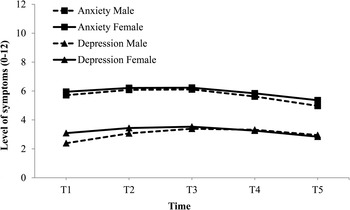
Correlations between symptoms of depression and anxiety were typically low within and across time, suggesting considerable independence in these problems, and mean levels of anxiety were almost twice as high as symptoms of depression. Hence, analyses were performed separately for anxiety and depression. Mean levels of symptoms of depression and anxiety were similar for males and for females. Parameter estimates from univariate trajectories of depression and anxiety are plotted in Figure 2. Quadratic growth curve models for both depression and anxiety from T1 to T5 fit the data well, depression: χ2 (20) = 31.51, p < .05, RMSEA = 0.04, CFI = 0.98; anxiety: χ2 (23) = 24.96, RMSEA = 0.02, CFI = 1.00. Anxiety and depressive symptoms increased for both males and females during the transition to adulthood and then began to decrease. There was significant within-individual variability around the intercepts of anxiety and depression for males and females, and around the slopes (males only).
Trajectories of anxiety and depression symptoms from adolescence into emerging adulthood.

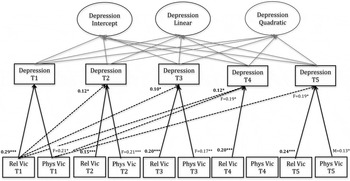
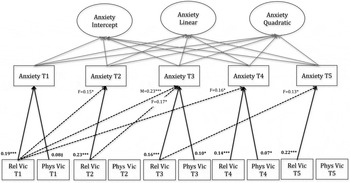
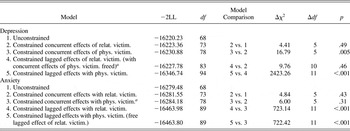
A series of time-varying covariate models were used to examine associations between relational and physical victimization and symptoms of depression and anxiety, as well as test for sex differences in these associations. The comparisons of nested time-varying latent growth curve models are presented in Table 5. The best fitting and most parsimonious model for depressive symptoms constrained both the concurrent and the lagged effects of relational victimization across sex, but it allowed the concurrent and lagged effects of physical victimization to vary across males and females (see Table 5, Model 4), χ2 (83) = 133.07, p = .0004, CFI = 0.95, RMSEA = 0.04. The best fitting model for anxiety symptoms constrained the concurrent effects of both relational and physical victimization across sex, but allowed the lagged effects of relational and physical victimization to be freed across sex (see Table 5, Model 3), χ2 (78) = 93.82, p = .10, CFI = 0.98, RMSEA = 0.03. Standardized regression coefficients for significant paths for these best fitting models are presented in Figures 3 and 4.
Time-varying covariate latent growth curve model for peer victimization and depression controlling for age at Time 1 and socioeconomic status. All paths between victimization and repeated measures of depression were estimated, but only significant paths are displayed. Solid lines indicate within-time effects and dotted lines denote across-time effects. Path values are standardized regression coefficients. Bold estimates are for both males and females. *p < .05, **p < .01, ***p < .001.

Time-varying covariate latent growth curve model for peer victimization and anxiety controlling for age at Time 1 and socioeconomic status. All paths between victimization and repeated measures of anxiety were estimated, but only significant paths are displayed. Solid lines indicate within-time effects and dotted lines denote across-time effects. Path values are standardized regression coefficients. Bold estimates are for both males and females. ‡p < .10, *p < .05, **p < .01, ***p < .001.

Sex differences in the associations between relational and physical victimization and depression and anxiety symptoms

Note: Models were nested and each model was a more restrictive version than the one preceding it −2LL, −2 log likelihood. A p value of .05 indicates that the constraints imposed across sex resulted in a significant degradation of model fit and suggest the presence of sex difference in the constrained specific pathways. When p < .05, constraints on the pathways were released before proceeding to the next step.
a Best fitting model. For depression the best fitting model (4) constrained the concurrent and lagged effects of relational victimization across sex but allowed the concurrent and lagged effects of physical victimization to vary. For anxiety, the best fitting model (3) constrained the concurrent effects of relational and physical victimization but allowed the lagged effects to vary across sex.
Peer victimization and depression
Results show positive concurrent associations between relational victimization and depressive symptoms at each time point for both males and females (Figure 3). Thus, at times when youth experienced more relational victimization, they also reported more depressive symptoms. Sex differences in the associations between physical victimization and depression were significant. Physical victimization was concurrently associated with more depressive symptoms for females at T1, T2, and T3, but only at T5 for males.
Prospective associations were found between T1 relational victimization and later depressive symptoms for both males and females. Youth who experienced higher levels of relational victimization during adolescence (T1) showed increases in depressive symptoms at T2, T3, and T4. However, there were significant sex differences in the lagged effects of physical victimization. Females with higher levels of physical victimization during adolescence (T1) showed increases in depressive symptoms at T4 and T5, but there was no effect of physical victimization on later symptoms of depression for males. These findings support the expectation that victimization during adolescence (relational for males and females; physical for females only) is associated with increases in depressive symptoms across the transition to young adulthood, after controlling for age, SES, and concurrent levels of victimization.
Peer victimization and anxiety
Sex differences in the concurrent associations between relational and physical victimization and anxiety symptoms were not significant (Table 5). Relational victimization was significantly associated with anxiety symptoms at each time point, and physical victimization was concurrently associated with anxiety symptoms at T1, T3, and T4 for males and females (Figure 4). Thus, at times when youth experienced relational and physical victimization, they were also more likely to report higher levels of anxiety symptoms. Relational (but not physical) victimization was prospectively related to anxiety symptoms, and sex differences were significant. For males, relational victimization at T1 was associated with increased anxiety symptoms at T3 (β = 0.23, p < .001). For females, relational victimization at T1 predicted increased anxiety symptoms at T2 (β = 0.15, p = .03) and T4 (β = 0.16, p = .02); relational victimization at T2 predicted more symptoms at T3 (β = 0.17, p = .01); and relational victimization at T3 predicted more symptoms at T5 (β = 0.13, p = .01). These findings offer support for the hypothesized prospective influences of relational victimization during adolescence on changes in anxiety during young adulthood after controlling for age, SES, and concurrent levels of relational victimization.
Discussion
Extending the use of the SEQ (Crick & Grotpeter, Reference Crick and Grotpeter1996) as a measure of peer victimization in adolescence and young adulthood, this study is among the first to examine patterns of peer victimization both before and after high school. We also assessed the concurrent and prospective associations between peer victimization and internalizing symptoms of anxiety and depression, as well as sex differences in these associations. Experiences of victimization were commonly reported: 33% to 51% of males and 20% to 39% of females experienced physical victimization at least sometimes, and 28% to 67% of males and 37% to 54% of females experienced relational victimization at least sometimes. Males consistently reported more physical victimization than did females at each time point, whereas females reported more relational victimization at the three earliest waves only. As expected, trajectories of physical victimization were consistently low and stable. The average trajectory of relational victimization was also low and stable; however, after high school, trajectories of relational victimization increased for males, but not for females. Individual differences in the levels (intercepts) of both types of victimization and in the trajectories (slopes) of relational, but not physical, victimization were also significant before and after high school graduation. Our findings also point to the continued association between victimization and internalizing problems at several time points in the transition to young adulthood and given some support for noting the particular significance of experiences of victimization in high school for mental health across this transition.
The lack of a measure of peer physical and relational victimization has been a challenge for advancing research across the transition from late adolescence to young adulthood. The current study overcomes this challenge by examining the use of the SEQ (Crick & Grotpeter, Reference Crick and Grotpeter1996), which has been widely used with children and young adolescents, in our sample ranging in age from 12 to 27. The internal consistency of the measure of physical victimization was low, possibly reflecting its infrequent occurrence; however, the internal consistency for relational victimization was adequate. Invariance testing gave support for the equivalence in factor loadings (metric invariance) across data waves, suggesting that the item factor loadings were equivalent across time points and supporting the use of the measure from late adolescence to young adulthood. However, it is clear that more work is needed to improve these measures. A more detailed assessment that looks at peer relational and physical victimization or harassment in several contexts, including the workplace, residences, sports teams, or by roommates or even romantic partners, may be needed to improve these assessments. The reliance of this age group on cell phones may also make them vulnerable to cyber bullying, and further research is clearly needed to assess this type of bullying.
Examining the within- and across-time associations of victimization with internalizing symptoms in time-varying covariate latent growth curve models takes account of average trajectories and allows us to understand more about the intraindividual variability in these trajectories. Relational victimization was concurrently related at each wave to higher levels of depression and anxiety symptoms for both males and females. Physical victimization was also concurrently related to anxiety symptoms for both males and females at most time points (T1, T3, and T4). Physical victimization is also concurrently related to depression for females at most time points (at T1, T2, and T3), but finding were less consistent for males (at T5 only). Findings for cross-lagged associations show that relational victimization in high school (T1) was associated with increases in symptoms of depression across late adolescence and early adulthood for both males and females. Cross-time associations of relational victimization with anxiety were less consistent (at T2 only for males and at T2 and T4 for females). Further, high school (T1) levels of physical victimization were associated with increases in depressive symptoms in early adulthood for females only (at both T4 and T5).
Taken together, these results show that peer victimization continues to be associated with internalizing problems across the transition from adolescence to young adulthood and also validates previous calls for the prevention of bullying in high school and for mental health interventions for adolescents experiencing internalizing problems that may be fueled by these experiences. Close friendships may provide young adults with the necessary companionship and emotional support to navigate stresses in the transitions to adulthood (Yeung Thompson & Leadbeater, Reference Yeung Thompson and Leadbeater2012), and friendships continue to play a role in identity development and in the maintenance of self-esteem in this phase of life (Arnett, Reference Arnett2004). However, there may be many reasons for the continuation of peer victimization across the transition to young adulthood. For example, this time of life introduces youth to new peer contexts that can fuel relational victimization, including communal living in residences, having roommates who may be strangers, and experiencing new peer networks in workplaces. As in high school, these peer relationships are often not chosen or easily set aside. These changes can require adaptation to new living arrangements that create a loss of privacy and require sharing space and resources, as well as new areas of competition and power differentials (e.g., in work places where similar age but more experienced workers become supervisors). Individual differences in competencies for resolving disputes and conflicts can fuel teasing, put downs, and exclusions from activities. College and university students often indicate that intrapersonal and interpersonal factors are their greatest stressors during the past academic term (Dusselier, Dunn, Wang, Shelley, & Whalen, Reference Dusselier, Dunn, Wang, Shelley and Whalen2005). Prior victimization by peers in adolescence may enhance avoidance and limit young adults' ability to develop meaningful relationships despite changes in peer networks over the transition to young adulthood.
Sex differences in patterns of peer victimization in young adulthood
Contrary to the popular belief that “It gets better,” a substantial number of young adults in this study report being victimized by their peers sometimes, and 1% to 2% report that they often experience peer victimization even after high school. On average, levels of physical and relational victimization were low and stable for both males and females. However, relational victimization increased for males (but not females) after graduation, and it was associated with increasing internalizing problems. Emotionally supportive peer relationships were also associated with less internalizing in victimized males, but not in females, in previous research with participants in three waves of the V-HYS sample (Yeung-Thompson & Leadbeater, Reference Yeung Thompson and Leadbeater2012); however, the previous research assessed short-term predictors of covarying internalizing and victimization, and did not assess patterns of change or predictions from victimization to internalizing in young adulthood.
In recent qualitative research by Way (Reference Way2011, Reference Way2013), midadolescence boys describe considerable closeness with male friends, but by late adolescence many of them struggled with loss of intimacy, trust, and closeness in these relationships. Fears of teasing related to sexual orientation and homophobia, jealousy from girlfriends, and reduced time for hanging out interfered with maintaining earlier friendships. At the same time, the young men also believed that intimate and trusting same-sex relationships and having friends to talk to was essential for their mental health. Increases in relational victimization in young adulthood may reflect a teasing and bantering that serves to deflect both the closeness and the homophobia in adolescent and young adult same-sex relationships in males. However, the source of peer victimization is not known in this study, and because cross-sex relationships become more important in this age group, it is possible that interactions with women account for some of the increase in men's reports of relational victimization.
More research is needed to assess how peer victimization affects the long-term relationships of young women. It is possible that closeness in adolescent girls’ same-sex attachments can be recreated, without social censoring, in new and continuing young adult relationships despite victimization in high school. Women with the capacity to establish new sources of support and to leave victimizing relationships of high school may be able to protect themselves from internalizing problems. In contrast, physical victimization was associated with increases in depression in young adulthood for girls, but not for boys. Physical victimization occurs infrequently for girls, and it may be associated with other concerns such as co-occurring externalizing, deviant peer networks, or dating violence that also fuel concurrent levels of internalizing. Screening for physical victimization in young adult females with internalizing symptoms may help to reveal and reduce the cycling of internalizing and physical victimization.
Limitations and future directions
As suggested by Ttofi et al. (Reference Ttofi, Farrington, Lösel and Loeber2011), it is likely that internalizing problems contribute to victimization; however, the direction of the effects between victimization and depression is not established in this research. Correlations of symptoms of depression and anxiety with subsequent levels of relational (range r = .18–.38) and physical victimization (range r = .11–.22) are small but significant, suggesting that bidirectional influences are likely. Links between problematic interpersonal relationships and depression and anxiety are well established (Hames, Hagen, & Joiner, Reference Hames, Hagan and Joiner2013): symptomatic individuals may alienate peers with excessive demands for support and reassurance; they may withdraw from relationships and activities with peers owing to depressive symptoms like fatigue, anhedonia, or hopelessness; or they may alienate or provoke friends though irritable angry patterns of behavior. However, it was not possible to test the cross-time direction of effects from depression to victimization in this research because of nonlinear changes in trajectories of relational and physical victimization over time, significant intraindividual variations, and the low variance in physical victimization. Larger samples, more measurement assessment points, and a more refined measure of relational victimization may be needed to allow for a test of these reciprocal effects.
Limiting the generalizability of the findings, participants in this community-based sample are predominately Caucasian in ethnicity and from a medium-size city in Canada. However, they were randomly recruited and represent a broad range of socioeconomic backgrounds. Attrition was also comparable to other studies of this age group and did not create sample bias. In addition, although each participant was individually interviewed, data used in this study were collected in a self-administered portion of the interview to enhance privacy for responding. While the validity of self-report data has been debated, self-report data are generally found to be valid (Beggs, Langley, & Williams, Reference Beggs, Langley and Williams1999), and self-report is frequently the method of choice, particularly in costly longitudinal studies. Recent research by Bradford and Rickwood (Reference Bradford and Rickwood2012) demonstrates that self-administered assessments are the most accepted form of psychosocial screening instruments in young adults and that these enhance engagement and improve rates of disclosure. Although multi-informant data (e.g., with parents and peers) may strengthen the scope of the measures, parents and peers may be poorly informed about experiences of peer victimization and internalizing symptoms as youth move away from home and enter new educational and work settings. The participants’ own experiences and self-identification of these problems may also be particularly important to their coping, help seeking, and recovery.
Implications
Given the salience of the transition to young adulthood for establishing the educational, occupational, and social capital that influence well-being across the life span, preventing or addressing peer victimization in adolescence may be particularly important. The potential influences of peer victimization in young adulthood also need to be recognized, in treating symptoms of anxiety and depression in young adulthood. Mental health vulnerabilities may be exacerbated for youth who lack supportive family and peer relationships to help cope with the harmful consequences of peer victimization (Holt & Espelage, Reference Holt and Espelage2007; Monks et al., Reference Monks, Smith, Naylor, Barter, Ireland and Coyne2009; Desjardins & Leadbeater, Reference Desjardins and Leadbeater2011; Yeung Thompson & Leadbeater, Reference Yeung Thompson and Leadbeater2012). Families, educational institutions, and workplaces may need to do more to encourage victimized youth to seek help and provide counseling and safe havens from relational and physical bullying that occurs.