


Voellmy equations from the PCM model
The differential equation governing the speed V of the centre-of-mass of a dry-flowing avalanche as given by the model of Reference PerlaPerla and others (1980), and here called the PCM Model, is

where θ(S) is the slope angle at position S along the incline, g is acceleration due to gravity, μ is a constant coefficient of sliding friction, and D /M is a constant turbulent drag coefficient written as a ratio of drag D to mass M, and t is time.
In order to derive equations similar to those of Reference VoellmyVoellmy (1955), Equation (1) is re-stated in a simple way. The centre-of-mass concept is retained but the bulk of flowing snow is distributed over a flow height H and an area of extent A over which the avalanche is in contact with the snow or earth surface. Equation (1) re-stated, becomes

where the turbulent drag term is assumed to be 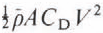 and
ρ
is the average density of the flowing part of the avalanche, called the core. This drag term is written in the form of an inverse drag coefficient, following Voellmy, with the conversion g/ξH =
D
/M = C
D/2H.
It is of interest that H, the average core flow height, is generally only a fraction of the powder or dust-cloud height for dry avalanches. Measurements with load cells through the cross-section of dry-flowing avalanches at the Tupper I avalanche path, Rogers Pass, British Columbia, show that H is on the order of 1 to 2 m for that particular path and may be much less than the powder-cloud height, which is characterized by suspended material.
In order to derive Voellmy’s equations from Equation (2), consider the simple geometry he assumed. Figure 1 depicts this in terms of two segments of constant angle: (i) the upper segment of length S 0 and slope angle θ 0, defining the region where the avalanche accelerates; and (ii) a lower segment of length S r and slope angle θ r representing the run-out or deceleration region of the avalanche. In order to use Voellmy’s method the path must be broken into two such segments by assuming the point at which deceleration begins.
Geometry for two-segment approximation of avalanche path used by Reference VoellmyVoellmy (1955). The two segments have lengths S0 and Sr and slope angles θ0 and θr.

The solution of Equation (2) with θ(S) = θ 0 is given by

where C 0 is a constant determined by initial conditions. With V(0) = 0. C 0 = –ξH(sin θ 0 – μ cos θ 0), and Equation (3) becomes

Now with the assumption (2gS
0/ξH)  1, at the end of the first segment Equation (4) becomes

This equation is commonly used to calculate maximum speed for flowing avalanches by the Voellmy method.
With θ = θ r, the solution for the second or run-out segment becomes

Using the initial condition V(0) = V 0, when S = 0, Equation (6) yields

In addition,
μ
is greater than zero, as required for flowing avalanches, and the condition dV/dS ⩽ 0 must be applied at the beginning of the run-out zone so that the avalanche decelerates on the lower slope. Application of these conditions to Equation (7) implies that
μ
is in the range  .
Application of the condition V(S
r) = 0 to Equation (7) defines the stop position of the centre of mass, and the exponential is written as exp(−2gS
r/ξH)≈ 1−2gS
r/ξH. The latter condition amounts to the assumption that  .
With these assumptions the solution for the run-out distance or the length of the deceleration region of the avalanche becomes

Equation (8) may be compared to the approximate run-out equation given by Reference VoellmyVoellmy (1955) with the modification suggested by Reference SalmSalm (1979)

Salm’s modification as expressed by Equation (9) amounts to the replacement of tan θ r by sin θ r in the denominator and the use of H instead of H D, which is defined in the original equations given by Voellmy as the average height of debris piled up. Inspection of Equations (8) and (9) shows that they are identical except for a factor of two in the third term of the denominator. Using the original Voellmy equations and ignoring the replacement sin θ r → tan θ r, it is necessary to assume that H D = 0.5H to get equivalence between Equation (8) and the original equations. Field observations at Rogers Pass, British Columbia, show that there is no justification for assuming H D = 0.5H if H is taken as the flow height of the core material.
The two assumptions needed to obtain Equations (5) and (8),  , with
 , imply that the deceleration region S
r is much shorter than the acceleration region S
0. Velocity profile data by Reference BryukhanovBryukhanov (1968) and Reference Van WijkVan Wijk (1967) show that this is not generally a safe assumption.
It is of further interest that for the two-segment problem there is no need to make the restrictive assumptions  and
 which were necessary to obtain equations analogous to Voellmy’s. Equation (4) may be used to give the maximum speed, V(S
0) = V
0; whereas the condition V(S
r) = 0 applied to Equation (7) gives

as the version of Equation (8) without the restrictive approximations. This equation is identical to one derived by Reference SalmSalm (1979) except that he has given H a slightly different interpretation.
Discussion
Equations analogous to those of Voellmy have been derived for maximum speed and avalanche run-out from the PCM Model. Attention has been focused on the approximations necessary for development of such similar equations and it is emphasized that these are not, in general, good assumptions based on field experience and measurements. Voellmy’s actual derivation began from essentially the same differential equation and the two-segment geometry assumed here. Voellmy’s derivation, however, is based on energy considerations and the approximations used have been, to the present, unclear in terms of the PCM Model. The purpose of this short note is to clarify the relation between Voellmy’s equations and the PCM Model.
Acknowledgement
This paper is a contribution from the Division of Building Research. National Research Council of Canada, and is published with the approval of the Director of the Division.
MS. received 7 June 1982 and in revised form 11 October 1982



