Introduction
Goosegrass is a pervasive weed of warm-season turfgrass. Many herbicides used for POST goosegrass control cause unacceptable injury to warm-season turfgrasses such as bermudagrass (Busey Reference Busey2004; Cox et al. Reference Cox, Rana, Brewer and Askew2017; Johnson Reference Johnson1980; Kerr et al. Reference Kerr, McCarty, Brown, Harris and McElroy2019a, 2019b; McCarty Reference McCarty1991; Nishimoto and Murdoch Reference Nishimoto and Murdoch1999). In turfgrass systems, loss of herbicides such as diclofop-methyl and monosodium methanearsonate has further limited options available for POST goosegrass control (Cox et al. Reference Cox, Rana, Brewer and Askew2017; Kerr et al. Reference Kerr, McCarty, Brown, Harris and McElroy2019a, 2019b; Leibhart et al. Reference Leibhart, Sousek, Custis and Reicher2014). Concomitantly, goosegrass resistance to PRE herbicides including oxadiazon (McElroy et al. Reference McElroy, Head, Wehtje and Spak2017) and prodiamine (McCullough et al. Reference McCullough, Yu and Gómez de Barreda2013) in turfgrass is well documented (Heap Reference Heap2020) and further challenges effective control.
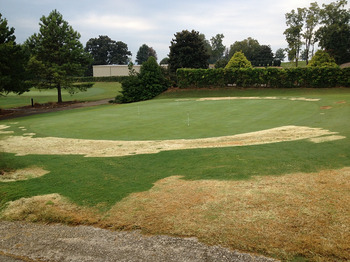
Topramezone is an herbicidal inhibitor of 4-hydroxyphenylpyruvate dioxygenase (HPPD) (Grossmann and Ehrhardt Reference Grossmann and Ehrhardt2007) labeled for POST goosegrass control in bermudagrass when applied as a spot treatment at 12.2 to 18.1 g ha–1 (Anonymous 2018). HPPD-inhibiting herbicides such as topramezone block biosynthesis of plastoquinone, which leads to a reduction in carotenoids expressed as foliar bleaching of leaf tissue (Lee et al. Reference Lee, Prisbylla, Cromartie, Dagarin, Howard, McLean Provan, Ellis, Fraser and Linda1997). However, such bleaching following topramezone application may occur to desirable turfgrass species in addition to weeds and is caused via reductions in chlorophyll a, chlorophyll b, ß-carotene, lutein, and xanthophyll cycle pigment concentrations (Brosnan et al. Reference Brosnan, Kopsell, Elmore, Breeden and Armel2011). These pigment reductions often result in unacceptable (albeit transient) injury (Figure 1).
Severe bermudagrass (Cynodon spp.) bleaching ˜21 d after a label rate application of topramezone at 24.5 g ha–1 on a public golf course in Alcoa, TN.

Several researchers have documented topramezone efficacy for POST goosegrass control and subsequent turfgrass injury (Breeden et al. Reference Breeden, Brosnan, Breeden, Vargas, Eichberger, Tresch and Laforest2017; Cox et al. Reference Cox, Rana, Brewer and Askew2017; Kerr et al. Reference Kerr, McCarty, Cutulle, Bridges and Saski2019b). Cox et al. (Reference Cox, Rana, Brewer and Askew2017) observed an 83% reduction in goosegrass cover 56 d after treatment (DAT) with topramezone at 6.13 g ha–1. Similarly, Breeden et al. (Reference Breeden, Brosnan, Breeden, Vargas, Eichberger, Tresch and Laforest2017) reported that topramezone (12.3, 24.5, or 36.8 g ha–1) controlled goosegrass 67% to 74% 14 DAT but injured bermudagrass 43% to 60%. Bermudagrass recovery following topramezone applications was swift, with <6% injury reported 28 DAT (Breeden et al. Reference Breeden, Brosnan, Breeden, Vargas, Eichberger, Tresch and Laforest2017); this response aligned with previous research investigating the effects of topramezone applied to both common and hybrid bermudagrass cultivars used in managed turfgrass systems (Brosnan et al. Reference Brosnan, Kopsell, Elmore, Breeden and Armel2011; Cox et al. Reference Cox, Rana, Brewer and Askew2017; Elmore et al. Reference Elmore, Brosnan, Kopsell, Breeden and Mueller2011a, Reference Elmore, Brosnan, Kopsell and Breeden2011b; Kerr et al. Reference Kerr, McCarty, Cutulle, Bridges and Saski2019b). Cox et al. (Reference Cox, Rana, Brewer and Askew2017) found that 31 bermudagrass cultivars were injured >30% for 10 and 14 d when treated with topramezone at 6.1 and 12.3 g ha–1, respectively. Similarly, Elmore et al. (Reference Elmore, Brosnan, Kopsell, Breeden and Mueller2011a) observed approximately 40% bleaching of ‘Tifway’ hybrid bermudagrass 21 DAT with topramezone at 18, 25, and 38 g ha–1.
Bermudagrass bleaching has led turfgrass managers to implement injury reduction strategies when controlling goosegrass with HPPD-inhibiting herbicides. One method of mitigating bermudagrass injury from HPPD-inhibiting herbicides is to reduce application rate. For example, Cox et al. (Reference Cox, Rana, Brewer and Askew2017) observed that a decrease in topramezone rate from 12.3 to 6.1 g ha–1 significantly reduced the number of days 31 bermudagrass varieties were injured >30% and resulted in goosegrass control similar to treatment at 12.3 g ha–1. Kerr et al. (Reference Kerr, McCarty, Cutulle, Bridges and Saski2019b) found that 0.6 cm of irrigation applied immediately following topramezone application at 12.3 g ha–1 resulted in 42% less injury to ‘Tifway’ hybrid bermudagrass than applications made without irrigation. However, irrigating following application compromised topramezone efficacy on goosegrass, resulting in 30% less control compared to nonirrigated plots. Kerr et al. (Reference Kerr, McCarty, Brown, Harris and McElroy2019a) observed a similar reduction in turfgrass injury when irrigating following application of topramezone (12.3 g ha–1), carfentrazone + 2,4-D + dicamba + MCPP (500 g ha–1), and topramezone (12.3 g ha–1) + carfentrazone +2,4-D + dicamba + MCPP (500 g ha–1), although herbicide efficacy was not assessed.
Combining topramezone in mixture with triclopyr has been shown to mitigate turfgrass injury without negatively affecting efficacy (Brosnan et al. Reference Brosnan, Breeden, Patton and Weisenberger2013; Cox et al. Reference Cox, Rana, Brewer and Askew2017; Gonçalves et al. Reference Gonçalves, Brown, Basak and McElroy2020). Cox et al. (Reference Cox, Rana, Brewer and Askew2017) found that combining triclopyr (140 g ha–1) with topramezone (6.1 or 12.3 g ha–1) reduced the number of days bermudagrass foliar tissue was bleached >10%; across 31 different bermudagrass varieties, foliar bleaching was >10% for 17 fewer days when topramezone was combined with triclopyr compared to topramezone alone. The addition of triclopyr in mixture with topramezone did not reduce goosegrass control efficacy compared to topramezone alone. Similarly, Gonçalves et al. (Reference Gonçalves, Brown, Basak and McElroy2020) found that applications of topramezone at 20.8 g ha–1 mixed with triclopyr at 259 or 518 g ha–1 resulted in only 1% bleaching to ‘Tifway’ hybrid bermudagrass 21 DAT compared to 53% with application of topramezone alone at 20.8 g ha–1. Applications of topramezone mixed with metribuzin (Brewer and Askew Reference Brewer and Askew2019; Brewer et al. Reference Brewer, Craft and Askew2020) and iron sources including FeDTPA and FeSO4 (Boyd et al. Reference Boyd, McElroy, Han and Guertal2020) have also been shown to significantly reduce hybrid bermudagrass injury.
SpeedZone® (0.62% carfentrazone + 28.57% 2,4-D + 5.88% mecoprop-p (MCPP) + 1.71% dicamba) is used predominantly for broadleaf weed control in turfgrass but also has labeling for POST goosegrass control (Anonymous 2020). Leibhart et al. (Reference Leibhart, Sousek, Custis and Reicher2014) investigated the efficacy of SpeedZone® on goosegrass and found that applications decreased goosegrass cover up to 80% within 2 wk of application. We hypothesized that use of SpeedZone® in mixture with topramezone would result in effective goosegrass control while reducing hybrid bermudagrass injury compared to applications of topramezone alone. The objectives of this research were to (1) assess the efficacy of topramezone, SpeedZone®, and SpeedZone® + topramezone mixtures for goosegrass control and (2) evaluate the tolerance of several hybrid bermudagrasses cultivars to applications of topramezone, SpeedZone®, and SpeedZone® + topramezone mixtures.
Materials and Methods
Goosegrass Control
A field study was conducted at Three Ridges Golf Course (Knoxville, TN) to evaluate efficacy of topramezone, SpeedZone®, and SpeedZone® + topramezone mixtures for POST goosegrass control. Plots (1.8 × 1.5 m) were located in a golf course rough with a history of goosegrass infestation. Turfgrass at the test location was common bermudagrass (Cynodon spp.) atop a 47% Dewey (fine, kaolinitic, thermic Typic Paleudults) silt loam and 53% Urban land-Udorthents complex soil (USDA 2020). The experiment was arranged as a randomized complete block design with four replications.
The experiment was initiated on June 26, 2019 and repeated on June 30, 2020. Six herbicide treatments were assessed, comprising topramezone (12.2 g ha–1; Pylex®, BASF Corp., Research Triangle Park, NC) + methylated seed oil (0.5% v/v); SpeedZone® ([carfentrazone (33.6 g ha–1) + 2,4-D (1,029 g ha–1) + MCPP (322 g ha–1) + dicamba (91 g ha–1)]; PBI Gordon Corp., Shawnee, KS); and SpeedZone® + topramezone (12.2, 6.1, 3.6, or 2.4 g ha–1). Nontreated check plots were included in all replications for comparison. Treatments were applied using a CO2-pressurized backpack sprayer calibrated to deliver 374 L ha–1 via 8002 nozzles (TeeJet Technologies, Wheaton, IL). Goosegrass control was visually rated every 3 wk for 9 wk after treatment (WAT) on a 0 (i.e., no control) to 100% (i.e., complete kill) scale relative to a nontreated check plot in each replication. On the final rating date (9 WAT), goosegrass control was also assessed by counting the number of plants in two adjacent 0.09-m2 areas in the center of each plot. Data were subjected to ANOVA using the SAS (University Edition, SAS, Cary, NC) mixed procedure.
Hybrid Bermudagrass Tolerance
Field studies were initiated on August 12, 2019 and repeated on August 14, 2020 at the East Tennessee AgResearch and Education Center (Knoxville, TN) to evaluate the tolerance of four hybrid bermudagrass cultivars to applications of topramezone, SpeedZone®, and SpeedZone® + topramezone mixtures for POST goosegrass control. Separate experiments were conducted on the following cultivars: ‘Northbridge’, ‘Tahoma 31’, ‘TifTuf’, and ‘Tifway’. These cultivars were mown three times per week at 1.6 cm with a reel-mower, except for ‘Northbridge’, which was maintained at 2.2 cm. For all cultivars except ‘Northbridge’, soil was a Sequatchie silt loam (fine-loamy, siliceous, semiactive, thermic humic Hapludult). Soil at the ‘Tahoma 31’ site was pH 5.6 and contained 1.9% organic matter; at the ‘TifTuf’ site soil was pH 6.7 and 1.5% organic matter, whereas the ‘Tifway’ site contained soil measuring pH 5.8 and 2.6% organic matter. The ‘Northbridge’ trial site was established on sand conforming to United States Golf Association particle size distribution standards (0.7% very coarse, 14.3% coarse, 61.4% medium, 18.1% fine, 5.1% very fine, and 0.4% silt and clay by weight) mixed with 20% reed sedge peat moss (by volume); this medium had a pH of 6.2 and contained 1.3% organic matter. Plots (1.5 m2) were arranged as a randomized complete block design with four replications on each cultivar. Treatments and application equipment were identical to those previously described in our control experiment.
Turfgrass injury was visually rated 3, 7, 14, 21, and 28 DAT relative to a nontreated check plot in each replication. Injury was assessed on a 0 to 100% scale, where 0 = no turfgrass injury and 100 = complete kill. Normalized difference vegetation index (NDVI) data were collected on each date plots were assessed visually. Three NDVI measurements were taken in each plot using a turf color meter (FieldScout TCM 500; Spectrum Technologies Inc., Aurora, IL) to provide a quantitative assessment of cultivar responses to herbicide treatment.
All data were subjected to ANOVA using the SAS (University Edition, SAS, Cary, NC) mixed procedure. Data were tested for experimental year, cultivar, rating date, and treatment interactions. Treatment means were separated using Fisher’s protected LSD test (α = 0.05). Pearson’s correlation coefficients were calculated for NDVI and visual assessment of injury data using the correlation function in Prism (Prism 8 for Mac; Graph-Pad software, La Jolla, CA).
Results and Discussion
Goosegrass Control
ANOVA of visually collected control data revealed a significant year-by-treatment-by-rating date interaction; therefore, data were analyzed separately by year and rating date. In 2019, all treatments including topramezone (regardless of rate) provided greater goosegrass control (74% to 88%) than SpeedZone® alone (38%) at 3 WAT (Table 1). By 6 WAT, SpeedZone® + topramezone mixtures controlled goosegrass 74% to 94%, similar to topramezone alone. However, by the end of the experiment, topramezone applied alone only controlled goosegrass 18%, whereas mixtures of SpeedZone® + topramezone controlled goosegrass 54% to 84% (Table 1). Similar responses were observed in 2020, albeit less pronounced given that no significant differences (at P ≤ 0.05) in control were detected among treatments at the end of the experiment. Treatment differences at this time were significant at P = 0.0727; however, trends were numerically aligned with those observed in 2019. The lack of significant differences at P ≤ 0.05 on this rating date in 2020 is probably due to compounding effects of drought and a heavy infestation of dallisgrass (Paspalum dilatatum Poir.) in the study area, making rating difficult.
Goosegrass control in bermudagrass golf course rough following application of topramezone (Pylex®) and carfentrazone + 2,4-D + mecoprop-p +dicamba (SpeedZone®) alone and in mixture.

a Goosegrass control was visually rated 3, 6, and 9 wk after application (WAT) on a 0 (i.e., no control) to 100% (i.e., complete-kill) scale relative to a nontreated check plot in each replication.
b Treatments were applied as follows: A = June 26, 2019 or June 30, 2020, and B = July 25, 2019 or July 28, 2020.
c Active ingredient rates: carfentrazone (33.6 g ha–1) + 2,4-D (1,029 g ha–1) + mecoprop-p (322 g ha–1) + dicamba (91 g ha–1).
d Methylated seed oil was applied at 0.5% v/v.
e Means in a column followed by the same letter are not significantly different at P ≤ 0.05 according to the Fisher’s protected LSD test.
f The effect of herbicide treatment was not statistically significant 9 WAT in 2020 at P ≤ 0.05; therefore, Fisher’s protected LSD test was not used to separate treatment means. Means were significantly different at P = 0.07.
By 9 WAT each year, goosegrass control with topramezone applied alone was poor at ≤18% (Table 1); a response that may be related to the limited residual activity of topramezone in soil (14-d half-life; Shaner Reference Shaner2014). Rahman et al. (Reference Rahman, Dowsett, Trolove and James2014) reported residual topramezone applied at 202 g ha–1 did not inhibit germination or damage seedlings of wheat (Triticum aestivum L.), ryegrass (Lolium perenne L.), carrot (Daucus carota L.), squash (Cucurbita moschata Duchesne), onion (Allium cepa L.), or tomatoes (Solanum lycopersicum L.). Similarly, Begitschke et al. (Reference Begitschke, McCurdy, Philley, Baldwin, Stewart, Richard and Kalmowitz2017) reported that application of topramezone (49 g ha–1) immediately prior to sprigging hybrid bermudagrass did not affect turfgrass establishment. Goosegrass is reported to germinate throughout the summer across a wide range of temperatures, and therefore may not be controlled season-long with a single application of topramezone (Kerr et al. Reference Kerr, McCarty, Bridges and Cutulle2018).
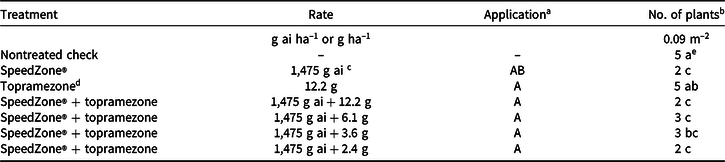
Overall, these results demonstrate that mixtures of SpeedZone® + topramezone are reasonably effective options for goosegrass control. Applications of SpeedZone® + topramezone (at any of the studied rates) controlled goosegrass better than or equal to topramezone alone in this research and reduced goosegrass plant counts compared to the nontreated check (Table 2).
Goosegrass plants in bermudagrass golf course rough 9 wk after application of topramezone (Pylex®) and carfentrazone + 2,4-D + mecoprop-p + and dicamba (SpeedZone®) alone and in mixture.

a Treatments were applied as follows: A= June 26, 2019 or June 30, 2020 and B = July 25, 2019 or July 28, 2020.
b Individual goosegrass plants were counted in two adjacent 0.09-m2 areas in the center of each plot.
c Active ingredient rates: carfentrazone (33.6 g ha–1) + 2,4-D (1,029 g ha–1) + mecoprop-p (322 g ha–1) + dicamba (91 g ha–1).
d Methylated seed oil was applied at 0.5% v/v.
e Means in a column followed by the same letter are not significantly different at P ≤ 0.05 according to the Fisher’s protected LSD test.
Hybrid Bermudagrass Injury
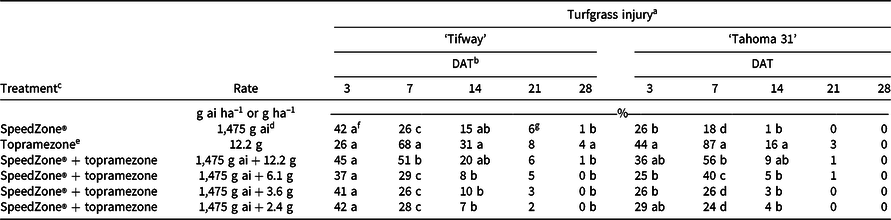
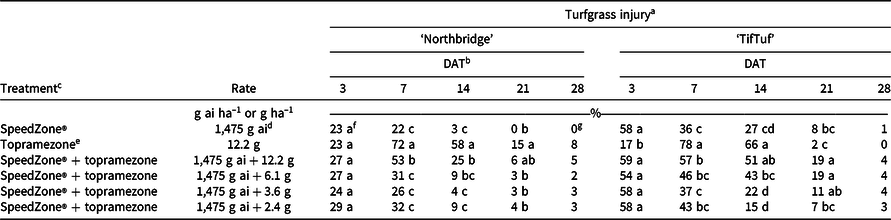
ANOVA revealed a cultivar-by-treatment-by-rating date interaction and that the effect of year was not significant. Therefore, visual assessment of injury data were pooled across year and analyzed separately by cultivar followed by rating date (Table 3, Table 4). NDVI data were significantly correlated to visual assessment of injury data (r = –0.6077, P ≤ 0.05), similar to previous reports outlining the relationship between qualitative and quantitative measures of herbicide performance (Hoyle et al. Reference Hoyle, Yelverton and Gannon2013). NDVI data are not presented to improve clarity.
‘Tifway’ and ‘Tahoma 31’ hybrid bermudagrass injury following application of topramezone (Pylex®) and carfentrazone + 2,4-D + mecoprop-p + dicamba (SpeedZone®) alone and in mixture.

a Turfgrass injury was visually assessed on a 0 (i.e., no injury) to 100% (i.e., complete kill) scale relative to nontreated check plots in each replication.
b Abbreviation: DAT, days after treatment.
c Treatments were applied on August 12, 2019 and August 14, 2020.
d Active ingredient rates: carfentrazone (33.6 g ha–1) + 2,4-D (1,029 g ha–1) + mecoprop-p (322 g ha–1) + dicamba (91 g ha–1).
e Methylated seed oil was applied at 0.5% v/v.
f Means in a column followed by the same letter are not significantly different at P ≤ 0.05 according to the Fisher’s protected LSD test.
g On rating dates without letters of significance listed, the effect of herbicide treatment was not statistically significant; therefore, Fisher’s protected LSD test was not used to separate treatment means.
‘Northbridge’ and ‘TifTuf’ hybrid bermudagrass injury following application of topramezone (Pylex®) and carfentrazone + 2,4-D + mecoprop-p + dicamba (SpeedZone®) alone and in mixture.

a Turfgrass injury was visually assessed on a 0 (i.e., no injury) to 100% (i.e., complete kill) scale relative to nontreated check plots in each replication.
b Abbreviation: DAT, days after treatment.
c Treatments were applied on August 12, 2019 and August 14, 2020.
d Active ingredient rates included: carfentrazone (33.6 g ha–1) + 2,4-D (1,029 g ha–1) + mecoprop-p (322 g ha–1) + dicamba (91 g ha–1).
e Methylated seed oil was applied at 0.5% v/v.
f Means in a column followed by the same letter are not significantly different at P ≤ 0.05 according to the Fisher’s protected LSD test.
g On rating dates without letters of significance listed, the effect of herbicide treatment was not statistically significant; therefore, Fisher’s protected LSD test was not used to separate treatment means.
Injury manifested similarly among the cultivars included in our experiment (Table 3, Table 4). For example, peak hybrid bermudagrass injury (expressed as foliar bleaching) was observed following treatment with topramezone alone by 7 DAT, on all cultivars, and dissipated by 28 DAT, similar to previous reports (Cox et al. Reference Cox, Rana, Brewer and Askew2017; Elmore et al. Reference Elmore, Brosnan, Kopsell, Breeden and Mueller2011a). For SpeedZone®, peak hybrid bermudagrass injury (expressed as phytotoxicity) was observed on all cultivars 3 DAT and dissipated to ≤8% by 21 DAT. The degree of injury (23% to 58%) 3 DAT with SpeedZone® may have been related to the fact that air temperature at application measured 29.4 and 26.7 C in 2019 and 2020, respectively. The herbicide label suggests reducing application rates when air temperatures are ≥26.7 C; however, the 1,475 g ha–1 rate used in this study is required for goosegrass control with SpeedZone® (Anonymous 2020).
On all cultivars, mixtures of SpeedZone® + topramezone reduced hybrid bermudagrass injury compared to topramezone alone by 7 DAT (Table 3, Table 4). For example, 7 DAT on ‘Tahoma 31’, topramezone resulted in 87% injury when applied alone compared to 40% for SpeedZone® + topramezone at ≤6.1 g ha–1 (Table 3). At the higher mixture rate (SpeedZone® + topramezone at 12.2 g ha–1), bermudagrass injury was reduced to a lesser degree 7 DAT. Similarly, on ‘Tifway’, topramezone alone resulted in 68% injury 7 DAT compared to 51% for SpeedZone® + topramezone at 12.1 g ha–1 (Table 3). Injury to ‘Tifway’, ‘Tahoma 31’, and ‘Northbridge’ with SpeedZone® + topramezone (≤6.1 g ha–1) measured ≤10% by 14 DAT and ≤3% by 28 DAT (Table 3, Table 4). Reducing topramezone rate in mixture below 6.1 g ha–1 did not offer greater reductions in hybrid bermudagrass injury on ‘Tifway’ or ‘Northbridge’ (Table 3, Table 4). By 21 DAT, no differences in hybrid bermudagrass injury were detected among SpeedZone® + topramezone mixtures applied to ‘Tifway’, ‘Tahoma 31’, or ‘Northbridge’ regardless of application rate (Table 3, Table 4).
Although direct cultivar comparisons could not be made, ‘TifTuf’ was highly sensitive to both SpeedZone® and topramezone in this study (Table 4). On dates where peak injury manifested for all cultivars studied (3 DAT for SpeedZone® and 7 DAT for topramezone), ‘TifTuf’ yielded the highest injury score following treatment with SpeedZone® (58%) and the second highest injury score following treatment with topramezone (78%). Mixtures of SpeedZone® + topramezone did reduce ‘TifTuf’ injury (compared to topramezone alone) 7 DAT; however, lower rates of topramezone were required to produce a response similar to that observed on the other cultivars tested. Although injury reductions were most pronounced with SpeedZone® + topramezone at 6.1 g ha–1 on ‘Tifway’, ‘Tahoma 31’, and ‘Northbridge’, optimal mixtures on ‘TifTuf’ contained ≤3.6 g ha–1 of topramezone (Table 4). At 7 DAT, for example, SpeedZone® + topramezone (3.6 g ha–1) injured ‘TifTuf’ 37% compared to 78% for topramezone alone. Interestingly, these mixtures resulted in greater injury than topramezone alone by 21 DAT, a response that was not observed on the other cultivars tested (Table 3, Table 4).
Results of this study indicate that SpeedZone® reduces hybrid bermudagrass injury from topramezone when applied in mixture. Similar reductions in bermudagrass injury have been observed from topramezone in mixture with the synthetic auxin herbicide triclopyr. Cox et al. (Reference Cox, Rana, Brewer and Askew2017) found that the number of days 31 bermudagrass varieties displayed bleaching was reduced by 17 with the addition of triclopyr in mixture with topramezone. In this study, the most pronounced reductions in hybrid bermudagrass injury were observed with SpeedZone® mixtures including topramezone at ≤6.1 g ha–1. Future work should explore efficacy and turfgrass tolerance to applications of SpeedZone® + topramezone mixtures that include SpeedZone® rates lower than the 1,475 g ha–1 rate included in this experiment. Additionally, to optimize herbicide timing, research is warranted assessing turfgrass injury following applications made earlier or later in the season compared to the application timing of this study, when air temperatures are cooler. Based on this experiment, turfgrass managers should consider including SpeedZone® when applying topramezone for POST goosegrass control in hybrid bermudagrass to reduce turfgrass injury without compromising efficacy. Moreover, combining multiple modes of action will aid in herbicide resistance management.
Acknowledgments
The authors would like to thank the superintendent at Three Ridges Golf Course, Curtis Pique, for his assistance with this project, as well as staff at the East Tennessee AgResearch and Education Center–Plant Sciences Unit. Authors would like to thank PBI Gordon Corp. for their financial support of this research. Mention of trade names or commercial products in this publication is solely for the purpose of providing specific information and does not imply recommendation or endorsement by the University of Tennessee Institute of Agriculture.
No conflicts of interest have been declared.