In recent years, recurrent norovirus outbreaks have emerged as challenging infections that cause closing of wards. Noroviruses are highly infectious and shed in high concentrations in feces and vomitus. They are spreading by the fecal-oral route, from hand to hand contact, by aerosol, Reference Evans, Meldrum and Lane 1 – Reference Nenonen, Hannoun and Svensson 4 and by contaminated food and water.Reference Nenonen, Hannoun, Larsson and Bergström 5 – Reference Hall, Eisenbart, Etingüe, Gould, Lopman and Parashar 7 These stable viruses can persist on contaminated surfaces for long periods.Reference Nenonen, Hannoun and Svensson 4 , Reference Boone and Gerba 8
Noroviruses include 5 genogroups; 3 of them (I, II, and IV) infect humans, whereas norovirus genogroup III infects cattle and genogroup V, the murine norovirus (MNV), infects mice. The human and murine noroviruses infect and are shed via the gastrointestinal tract, whereas another calicivirus, feline calicivirus (FCV), infects the respiratory tract. Human noroviruses do not grow in cell culture while MNV and FCV grow in murine and feline cells, respectively. This makes MNV and FCV models suitable for virus growth and viability studies. FCV has been used in several inactivation studies of disinfectants.Reference Poschetto, Ike, Papp, Mohn, Böhm and Marschang 9 , Reference Duizer, Bijkerk, Rockx, De Groot, Twisk and Koopmans 10 More recently the focus has moved toward MNV since its route of transmission resembles more transmission of human norovirus.Reference Wobus, Thackray and Virgin 11 , Reference Tuladhar, Terpstra, Koopmans and Duizer 12
Methods to inactivate noroviruses need to take into account that they are nonenveloped and hence resistant to alcohol and lipid-destroying disinfectants.Reference Barker, Vipond and Bloomfield 13 Epidemiologic data suggest that viable norovirus can persist after manual environmental cleaning and disinfection even with bleach, which is the disinfectant recommended for surfaces.Reference Barker, Vipond and Bloomfield 13
Hydrogen peroxide vapor (HPV) distribution systems are independent of employees distributing fluid disinfectants and therefore more repeatable than conventional cleaning.
HPV has been shown to achieve a 6-log reduction on bacterial endospores,Reference Holmdahl, Lanbeck, Wullt and Walder 14 including Clostridium difficile, common hospital bacteria such as methicillin-resistant Staphylococcus aureus,Reference Bartels, Kristoffersen, Slotsbjerg, Rohde, Lundgren and Westh 15 vancomycin-resistant Enterococcus, and Acinetobacter baumannii.Reference Passaretti, Otter and Reich 16 There are strong indications from clinical practice that HPV disinfection can reduce the frequency of outbreaks with bacterial infections and terminate them.Reference Falagas, Thomaidis, Kotsantis, Sgouros, Samonis and Karageorgopoulos 17 – Reference Ray, Perez and Beltramini 22
HPV also has a documented virucidal activity shown against several enteric and respiratory viruses, including adenovirus, poliovirus, rotavirus, MNV, and FCV.Reference Tuladhar, Terpstra, Koopmans and Duizer 12 , Reference Li, Baert and Uyttendaele 23 – Reference Goyal, Chander, Yezli and Otter 25 However, most of these virucidal data have been acquired in test boxes and not in full-scale ward rooms.
The purpose of our study was to determine whether HPV can be used to decontaminate surfaces in a patient room from caliciviruses. We therefore dried both FCV and MNV on plastic surfaces, which were then exposed to HPV, and we determined the fraction of viable virus that could be recovered.
METHODS
Virus, Cells, and Media
FCV (strain 2280 [ATCC VR-2057]) and a feline permissive fetal cell line (FCWF) were gifts from Anna Lindhe from the Veterinary Faculty of Uppsala University, Uppsala, Sweden. FCWF cells were grown in Dulbecco minimum essential medium with high glucose and pyruvate (catalog no. 41966029, Life Technologies). Cells were grown in 10% fetal calf serum (FCS; Life Technologies), supplemented with 5% penicillin/streptomycin.
MNV (strain Berlin/06/06/DE S99) and a permissive murine cell line (RAW 264.7) were gifts from Maren Eggers and Gisela Enders, MVZ GbR Virologie, Stuttgart, Germany. The RAW cells were grown in Dulbecco minimum essential medium (no pyruvate; catalog no. FG 0435, Biochrom), with 10% low endotoxin FCS (catalog no. A15-102, PAA Laboratories; or Hyclone FBS, Nordic Biolabs), supplemented with 1% nonessential amino acids and 5% penicillin/streptomycin.
All cell growth plastic material (6- and 96-well plates and flasks) was from Corning Life Sciences.
Virus Stocks
For FCV, 3 bottles of the FCWF cells (each bottle with a 25-cm2 growth area) were grown to 80%–90% confluence. The medium was removed and 200 µL of virus inoculum was added to 1 mL of the cell medium and incubated for 2 hours at 37°C in 5% CO2. The inoculum was then removed and fresh medium was added. All supernatant material harvested by 48 hours was clarified by centrifugation at 2,000 g for 5 minutes and treated by ultracentrifugation at 39,000 g for 1 hour to concentrate the viral stock. Stock solution was aliquoted and stored at −70°C.
For MNV, 3 bottles of the RAW 264.7 cells (each bottle with a 25-cmReference Marks, Vipond, Regan, Wedgwood, Fey and Caul 2 growth area) were grown to 80%–90% confluence. The medium was removed and 500 µL of virus inoculum was placed on the naked cells and incubated for 1 hour at 37°C in 5% CO2. The inoculum was then removed and fresh medium was added. After 5 days a complete cytopathic effect was observed and the medium was harvested. The cells were removed by centrifugation at 2,000 g for 5 minutes and the clarified supernatant aliquoted and stored at −70°C.
Determination of 50% Tissue Culture Infective Dose (TCID50)
Test material was serially diluted in medium in 10-fold steps and transferred to 96-well microtiter plates where cells had reached approximately 90% confluence. The cytopathic effect was observed with an inverse light microscope and used for calculation of which 50% of wells were infected (TCID50) as described by Reed and Muench.Reference Reed and Muench 26 Viral titers were expressed in 10logs of TCID50 units/100 μL of inoculum.
Plaque Assay
Target cells (1.5 million cells/mL) were seeded into 6-well plates with well diameters of 35 mm and grown to 80%–90% confluence. After removing the medium and washing the cells with fresh medium, 100-μL 10log dilutions of virus, containing test material diluted with 100 μL of medium to cover all cells, were added to wells in duplicate. Following incubation for 1 hour at 37°C, medium was removed and replaced with 2 mL/well of fresh medium with 1.5% low melting point Seaplaque agarose (FMC Bioproducts) at 37°C and left to solidify. The plates were kept in a humidified incubator with 5% CO2 at 37°C.
After 2 days the plates were fixed with 10% formaldehyde added on top of the gel for 30 minutes. The gels were then gently removed and the cell layer stained with crystal blue to facilitate the viral plaque counting. Virus titers were calculated as the mean of plaque-forming units/100 μL of inoculum of duplicate wells and were expressed in 10log units.
Preparation of Contaminated Plastic Surfaces for Exposure to HPV
Next, 100 μL of virus stock was spread out thinly in triplicate around the centers of three 35-mm wells in 6-well plates and allowed to dry at room temperature in a hood. When completely dried after 2 hours the plates were stored at −70°C until used.
On the day of experiment the plates were placed in the test rooms as described below.
Reference Biological Indicators (BIs)
For control of the HPV efficacy, 6-log Tyvek-pouched Geobacillus stearothermophilus BIs (Apex Laboratories) were placed in duplicate adjacent to each virus test plate. After each HPV test run, the BIs were transferred into tryptone soya broth, incubated, and read according to the manufacturer´s instructions as earlier described.Reference Holmdahl, Lanbeck, Wullt and Walder 14
Test Facility
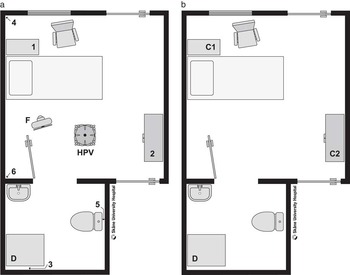
The HPV exposure test was performed in a nonoccupied patient room consisting of a main single bedroom and its attached bathroom (Figure 1a). The bedroom contained a bed with mattress, a bed table, and a chair with fabric. (Equipment, including fabric, can remain in a room during HPV treatment.) A similar unit was used as an HPV-unexposed control room (Figure 1b). The ward had a dedicated air-handling system to the outside of the building, and it was used to enhance removal of HPV.
a. Test room. Single bed patient room (3.4 m×3.3 m×3.9 m) with en suite bathroom (1.9 m×2.0 m×2.2 m). D, flusher disinfector; F, pedestal fan; HPV, hydrogen peroxide vapor (Bioquel Q10) with attached aeration unit. Sample locations are indicated by numbers: 1. Main room, on a table by the bed. 2. Main room, high up on linen cupboard. 3. Bathroom, behind flusher. 4. Main room, floor in a corner. 5. Bathroom, behind toilet. 6. Main room, floor behind door in a corner. b. Control room. Sample locations: C1, Main room, on table by the bed, C2. Main room, high up on linen cupboard.

Design of Experiments
Dried FCV and MNV were tested in separate experiments. At each test run three 35-mm diameter wells were used at each position and each HPV exposure experiment was repeated on 3 occasions. Virus plate/BI combinations were placed at mid-height, high up, and close to the floor at 6 positions, including challenging positions such as on top of a linen cupboard and behind the decontamination apparatus (Figure 1a).
At each exposure experiment, the HPV-untreated patient room was used to determine virus recovery without HPV and as the basis for calculating the reduction of infectivity by HPV. Two control plate/BI sets, prepared as above, were used and positioned as shown (Figure 1b).
The lowest measurable titer was defined as detection limit multiplied by the dilution factor.
The HPV was generated by a Bioquell Q10 Suite system (Bioquell) following the recommendations of the manufacturer. Both the HPV generator and its attached HPV aeration unit were placed in the center of the room. Owing to pretest results with BIs, where we had indications that the high ceiling (3.9 m) in the ward room was giving complicated aerodynamics, we included an oscillating pedestal fan in front of the doorway of the bathroom to enhance a homogenous distribution of HPV. The Bioquell control/monitoring unit was placed in the corridor, outside the unit. During HPV exposure, the doors to the test unit were sealed using adhesive tape. A hand-held sensor was used to monitor for leakage periodically since HPV at peak treatment concentrations is highly toxic.
The concentration of hydrogen peroxide in the test room was recorded every 5 minutes during the injection phase. The test room was considered safe for entry when the concentration was less than or equal to 1 ppm.
RESULTS
HPV Profiles
In the experiments presented here we had a gassing time of 40–50 minutes and a dwell time of 15 minutes before the degradation started. We reached a peak between 474 and 505 ppm. The total cycle time was approximately 3 hours. This is similar to typical profiles reported previously.Reference Holmdahl, Lanbeck, Wullt and Walder 14
Inactivation of FCV
No viable FCV was recovered from any of the triplicate wells at any position in the treated room in any of the 3 test runs. As expected, FCV grew from all triplicate wells at each position in the untreated room in all 3 test runs.
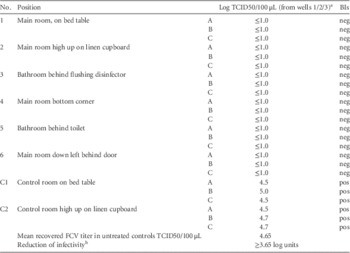
As shown in Table 1 we could document a reduction of infectivity of at least 3.65 logs by TCID50, calculated by subtracting lowest measurable titer (here ≤1.0) from 4.65, the mean titer of untreated controls.
Feline Calicivirus Inactivation by Hydrogen Peroxide Vapor (HPV) in 3 Separate Experiments (A, B, C)

NOTE. BI, biological indicator; FCV, feline calicivirus; TCID50, 50% tissue culture infective dose.
a In each experiment, the mean of triplicate wells (1/2/3) is shown.
b Calculated by subtracting lowest measurable titer (here ≤1.0) from mean titer of untreated controls.
Inactivation of MNV
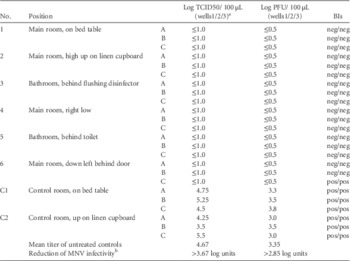
The MNV was measured with both TCID50 and plaque test. No viable MNV was recovered from any position in the treated room in any of the 3 test runs. Virus grew in all triplicate wells in the untreated room in all 3 test runs.
The MNV grew at 4.67 log as measured by TCID50 in the untreated room. Thus we could document a reduction of infectivity of at least 3.67 logs as measured with TCID50 since the lowest measurable titer was less than or equal to 1.0. In parallel, by plaque assay we could document at least 2.85 log reduction, calculated by subtracting the lowest measurable titer (≤0.5) from the mean titer of untreated controls (Table 2).
Murine Norovirus Inactivation by Hydrogen Peroxide Vapor (HPV) in 3 Separate Experiments (A, B, C)

NOTE. BI, biological indicator; MNV, murine norovirus; PFU, plaque-forming units; TCID50, 50% tissue culture infective dose.
a In each experiment, the mean of triplicate wells (1/2/3) is shown.
b Calculated by subtracting lowest measurable titer (here ≤1.0 for TCID50 and ≤0.5 for plaque test) from mean titer of untreated controls.
Inactivation of BIs
Duplicate BIs were tested at each of the 6 positions during the 3 test runs with FCV and 3 test runs with MNV; altogether, 72 BIs were used. In the HPV-treated room, BIs were negative with few exceptions. In 1 test run (with MNV), both spore BIs at the same challenging position (down low and behind an opened door) became positive. In the HPV-untreated room all the BIs were positive, as expected.
DISCUSSION
Several agents used to decontaminate surfaces from nonenveloped viruses, such as chlorine and aldehydes, both are toxic and leave toxic deposits after treatment. Hydrogen peroxide degrades into water and oxygen and has thereby the advantage of leaving no toxic traces.
Since HPV efficacy can be reduced by an excess of organic substances, manual cleaning to eliminate visible dirt always has to be performed before applying hydrogen peroxide.
Our findings confirm the data obtained by Tuladhar et al,Reference Tuladhar, Terpstra, Koopmans and Duizer 12 who used an isolator for MNV and a nonhospital test room for poliovirus. They tested several viruses dried on stainless steel, framing panel carriers, and gauze carriers, whereas we used 2 caliciviruses (FCV and MNV) and dried both on plastic labware.
We used a patient room that included fabric material as a test room to make the trial as realistic as possible (Figure 1a). The viruses and the BIs were placed together in challenging positions.
All 72 BIs except 2 at the same position in a single run became negative, indicating a generally good and even distribution of the HPV. The 2 positive BIs were positioned behind a door and in that run the pedestal fan was accidentally directed in a suboptimal direction. In spite of this the corresponding virus tests showed inactivation. Endospores are considered to be more difficult to inactivate than viruses. If a room is not rectangular (eg, en suite in configuration as in our test), we recommend to do a pretest with BIs and if they indicate problems with HPV distribution, a fan directed towards the area with suboptimal distribution of HPV can be used.
We did not in any case recover virus at any HPV-treated position.
The experiments were designed to study virus that had dried completely in 35-mm wells and hence our input inoculum volume was restricted to 100 μL/well; greater volumes can cause a thicker rim deposit around the well bottom edge. This volume is a limitation since our multistep procedure (drying, storage of plates at −70°C, exposure with/without HPV at room temperature for hours, recovery, renewed storage at −70°C, and finally infectivity titrations) did not allow for measuring a reduction of more than 3–4 logs.
In conclusion, our inactivation data from both our viruses, in particular MNV, the closest related to human noroviruses, indicate that HPV could be used to avoid nosocomial spread of human norovirus in clinical settings where the environment has been contaminated.
ACKNOWLEGDMENTS
We thank Elzbieta Vincic, for excellent laboratory work; Freddie Lund, for providing equipment; Anna Lindhe, for providing FCV and a feline permissive cell line; Maren Eggers and Gisela Enders, for providing MNV and a permissive RAW cell line; and Klas Ramnerö, for preparing the test facility.
Financial support. None reported.
Potential conflicts of interest. All authors report no conflicts of interest relevant to this article.