For more than 2 years, the coronavirus disease (COVID-19) pandemic impacted an already overwhelmed health care system. The local epidemic quickly became a global pandemic that caused worldwide governments to adapt. Reference Gebru, Birhanu and Wendimu1 During the first pandemic wave (from April 10 to May 10, 2020), no vaccine was available, with some areas being more overwhelmed than others. Reference Bouillon-Minois, Schmidt and Dutheil2,Reference Bouillon-Minois, Raconnat and Clinchamps3 Health care workers (HCWs), especially emergency and intensive care HCWs, were on the front lines managing patients affected by this novel disease. Reference Nguyen, Drew and Graham4 Occupational stress leads to burnout and impacts individual morbidity and mortality. Reference Kivimaki, Leino-Arjas and Luukkonen5 Emergency HCWs are particularly at risk for stress and burnout because of the complex interaction between life-threatening emergencies, emergency department (ED) overcrowding, vicarious trauma, Reference Roden-Foreman, Bennett and Rainey6–Reference Stehman, Testo, Gershaw and Burnout8 lack of sleep, unhealthy diet, Reference Bouillon-Minois, Thivel and Croizier9 and accumulated fatigue. Reference Moukarzel, Michelet and Durand10,Reference Durand, Bompard and Sportiello11 Frontline workers were more likely to experience burnout, posttraumatic stress disorders, and poor sleep quality. Reference Shanafelt, Ripp and Trockel12–Reference Yin, Sun and Liu16 Furthermore, HCWs, especially those on the front lines, reported high rates of depression, anxiety, and insomnia compared to the general public. Reference Zhang, Zhao and Zhang17
The Karasek Job-demand scale or the Perceived Stress Scale is a validated tool that assesses subjective stress at work. Reference Karasek, Brisson and Kawakami18 However, because of its length and complexity, the time commitment for completion makes this test impractical in the clinical setting. The Visual Analog Scale (VAS) was initially developed to assess pain. Reference Heller, Manuguerra and Chow19 It has also been used and validated to evaluate stress. Reference Lesage, Berjot and Deschamps20 VAS is attractive because it is simple to implement, easy to understand, and time efficient. Currently, VAS is the most common tool used by occupational physicians to assess stress among workers. Reference Lesage, Berjot and Deschamps20,Reference Dutheil, Pereira and Moustafa21 In addition, stress can be objectively evaluated using biomarkers Reference Wong22,Reference Dutheil, Trousselard and Perrier23(p8),Reference Bouillon-Minois, Trousselard and Thivel24–Reference Dutheil, de Saint Vincent and Pereira26 such as heart-rate variability (HRV). Reference Dutheil, Boudet and Perrier27 Measuring HRV is noninvasive, easy to use, reproducible, and measurable over more extended periods (over 24 hours). Reference Malik, Bigger and Camm28 Linked to the autonomous nervous system, HRV reflects the cardiovascular response to regulatory impulses affecting heart rhythm. Reference Kim, Cheon and Bai29 Stress among HCWs has been widely studied with the overwhelming observation that this pandemic induced stress, burnout, and posttraumatic stress disorder. Reference Couarraze, Delamarre and Marhar30–Reference Guillen-Burgos, Gomez-Ureche and Renowitzky32 Given the dearth of information on stress response during the first wave of the pandemic, we conducted a study among emergency and intensive care unit HCWs. The main objective was to assess the impact of COVID-19 on the subjective and objective stress levels at work. Secondary objectives were to assess the correlation between subjective stress, using VAS, and objective stress, using HRV among HCWs.
Methods
Study Design
We performed a prospective, observational study between April 10 and July 15, 2020, in 3 departments of the University Hospital of Clermont-Ferrand, France: ED, mobile intensive care unit, and intensive care unit (ICU). The study was divided into 2 sessions: the first one during the first wave of the COVID-19 pandemic (April 10 to May 10, 2020) and the second one during the interval between the first wave and the second wave (June 10 to July 15, 2022). We defined this second time point as “control,” considering operationally, clinical practice tended to return to pre-COVID practices. The inclusion criteria were all HCWs (physicians, nurses, and nurse’s aides) who volunteered to participate in the study. Exclusion criteria included pregnancy, refusal to participate, and being a trainee. At the beginning of each shift, 1 investigator installed a portable monitor belt that measures heart rate (HR) and HRV. Study volunteers were asked to wear the belt for the duration of the shift. Furthermore, a survey was created by 3 investigators (MC, FD, and J-BB-M) regarding stress assessment and the necessity to study the impact of COVID-19 on stress among emergency and ICU HCWs. Completion of the survey took approximately 3 minutes and was divided into 3 parts: (1) sociodemographics—age, sex, height, weight, body mass index (BMI), profession, seniority, physical activity, and tobacco; (2) the 13 VAS questions—stress of caring for a COVID-19 patient, stress at work, stress at home, fatigue, sleep quality, anxiety, mood, burnout, job control, job demand, leadership support, support from colleagues, and job satisfaction (this part was answered at the beginning and end of the shift); and (3) patient acuity and demographics—number of patients personally cared for by the study participants, including life-threatening emergencies and the number of procedures deemed high-risk for COVID-19 exposure Reference Mick and Murphy33 (endotracheal intubation, thoracostomy, nasogastric aspiration, and nasopharyngeal swabbing of patients under investigation for COVID-19), number of admissions in the ED, and number of COVID-19-related admissions by shift.
Data Collection
All data from questionnaires were manually extracted in an Excel® sheet. HRV data were downloaded daily using Bioharness Zephyr® software. Analysis from Zephyr was performed with the Kubios® software. All HR records available were analyzed. We deleted incorrect data due to artifacts using the very-low filter on the Kubios® software. Reference Królak, Wiktorski, Bjørkavoll-Bergseth and Ørn34–Reference Plaza-Florido, Alcantara and Amaro-Gahete37 When available, the questionnaires were linked to the biometric data monitoring with an anonymized number.
The following biometric parameters were collected: time-domain measurement—RR interval (interval between every heartbeat), the standard deviation of the regular sinus beats (SDNN), HR mean, root mean square of successive differences between normal (RMSSD), percentage of adjacent NN intervals that differ from each other by more than 50 milliseconds (pNN50), HRV triangular index (HTI), Triangular Interpolation of the NN interval histogram (TINN), the standard deviation of heart rate (STDHR) and frequency-domain measurements to separate HRV into its component, very low frequency (VLF), low frequency (LF), and high frequency (HF) rhythms that operate within different frequency ranges. Reference Shaffer and Ginsberg38
Data Analysis
Categorical data were expressed as a number of subjects and associated percentages, and continuous data as mean ± standard deviation or median [25th; 75th percentile] according to the statistical distribution. Characteristics of the participants were compared according to the 2 sessions, using the chi-squared test or Fisher’s exact test for categorical variables and the Student’s t-test or Mann-Whitney test (if the assumptions of the t-test were not met) for quantitative ones. Normality was verified by the Shapiro-Wilk test and/or histogram, and homoscedasticity by the Fisher-Snedecor test. Factors associated with subjective stress were studied using linear mixed models, considering the participant as a random effect, to account for the repeated measurements per participant. Objective stress was compared according to the 2 sessions using linear mixed models, considering the session a fixed effect and the participant a random effect. If necessary, a logarithmic transformation of the dependent variable was made to achieve normality. Correlations between subjective and objective stress at work (VAS and HRV, respectively) were assessed with Spearman’s correlation coefficients (noted ρ). These coefficients were interpreted as follows (absolute value): ≥ 0.70 (strong correlation), 0.50-0.69 (moderate correlation), 0.30-0.49 (low correlation), 0.00-0.29 (no or negligible correlation). Reference Hinkle, Wiersma and Jurs39 Statistical analysis was performed using the Stata software (version 15; StataCorp, College Station, TX, USA). All tests were 2-sided, with an alpha level set at 0.05. No correction for multiple testing was applied in the analysis of secondary outcomes or subgroup analysis. Reference Feise40 Findings from these analyses were interpreted as exploratory.
Ethics
A French Ethics committee (Comité de Protection des Personnes Sud-Est VI, University hospital of Clermont-Ferrand) approved this study protocol in April 2020 (reference 2020/CE15), and the protocol was registered in ClinicalTrials (NCT04954105).
Results
Characteristics of the Population
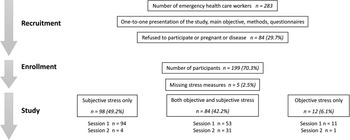
From April 10 to July 15, 2020, we included 199/283 volunteer participants for 192 records, 182 (94.8%) of whom responded to the survey questions regarding stress at work (subjective stress), and 96 (50.0%) participants provided HR data entries (objective stress). The flowchart is shown in Figure 1. We had a total of 98 (51.0%) subjective stress responders: 94 (95.9%) during the first session and 4 (4.1%) during the second session. We also had 12 (6.3%) responders provide objective biometric data entry without their subjective stress data: 11 (91.7%) during the first session and 1 (8.3%) during the second session. We had 84 (43.8%) responders provide both subjective and objective stress data: 53 (63.1%) during the first session and 31 (36.9%) during the second time session.
Flowchart of the study.

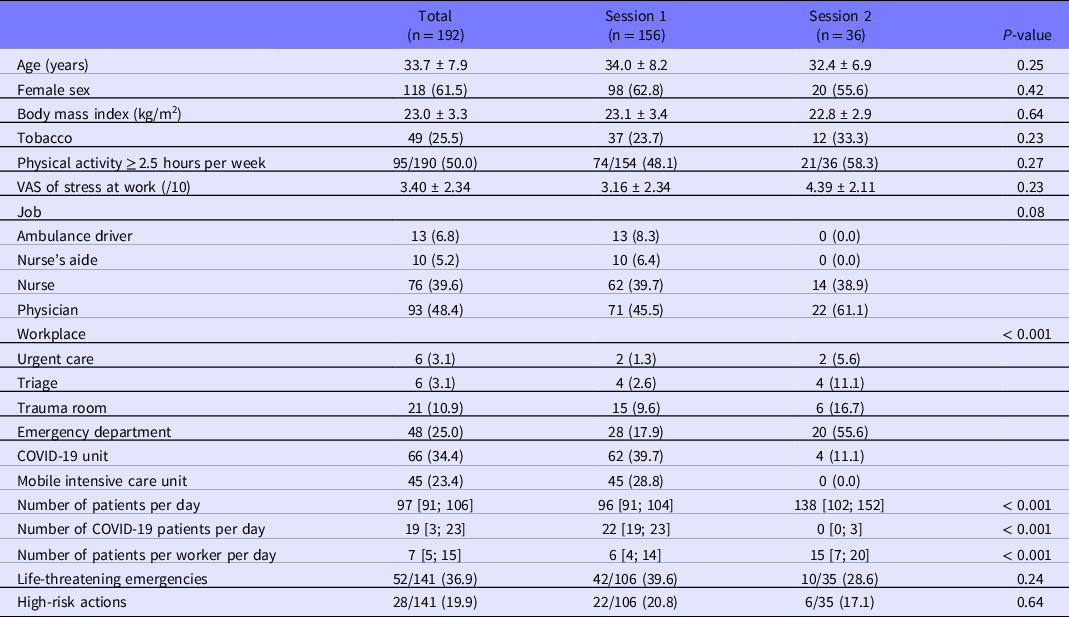
The participants’ demographics were mostly female (61.5%), with a mean age of 33.7 ± 7.9 years old and a mean BMI of 23.0 ± 3.3 kg/m Reference Bouillon-Minois, Schmidt and Dutheil2 ; 49 (25.5%) were smokers, and 95/190 (50.0%) had a physical activity superior to the World Health Organization recommendations (≥ 2.5 hours per week). Of the study respondents, 93 (48.4%) were physicians, 76 (39.6%) were nurses, 13 (6.8%) were ambulance drivers, and 10 (5.2%) were nurse’s aides. Of the patient demographics/acuity survey respondents, 52/141 (36.9%) faced life-threatening emergencies, and 28/141 (19.9%) high-risk COVID-19 transmission procedures. The characteristics of participants were similar between the 2 sessions (Table 1). However, there was a significant difference in the median number of patient volumes per day, the median number of COVID-19 patients, the work location, and the number of patients per worker (see Table 1).
Characteristics of the population

Data are presented as a number of subjects (percentages), mean ± standard deviation, or median [25th; 75th percentile]. VAS, visual analog scale. Session 1: during the first wave of the pandemic (April 10 to May 10, 2020); session 2: the time interval after the first wave of the pandemic (June 10 to July 15, 2020).
Main Objective: Impact of COVID-19 on Stress
Subjective stress
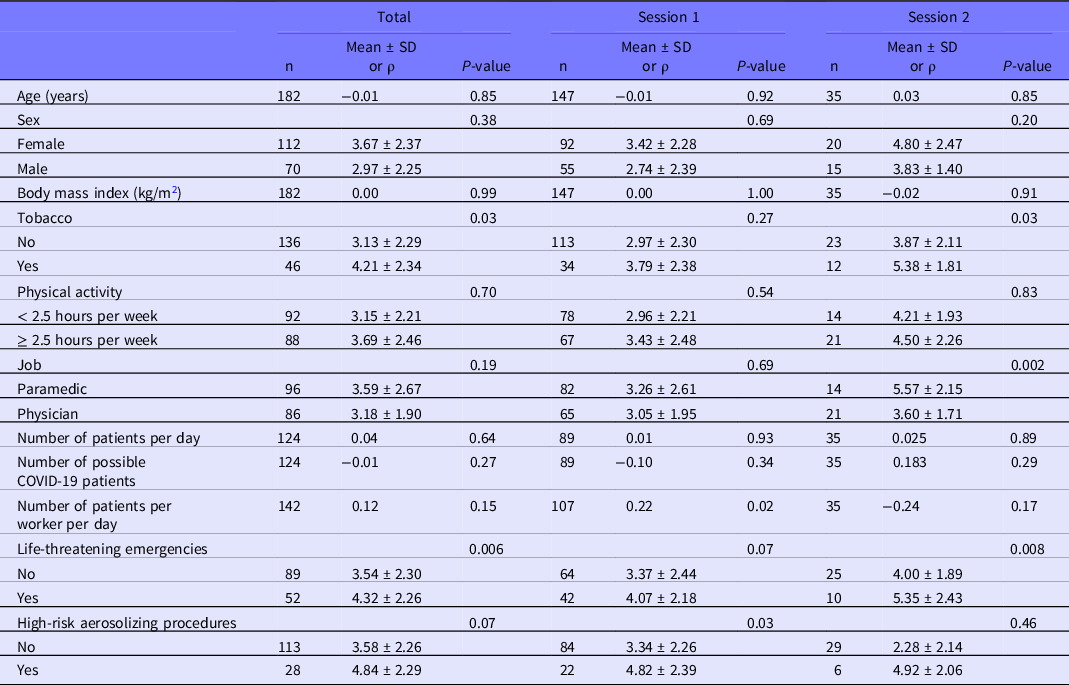
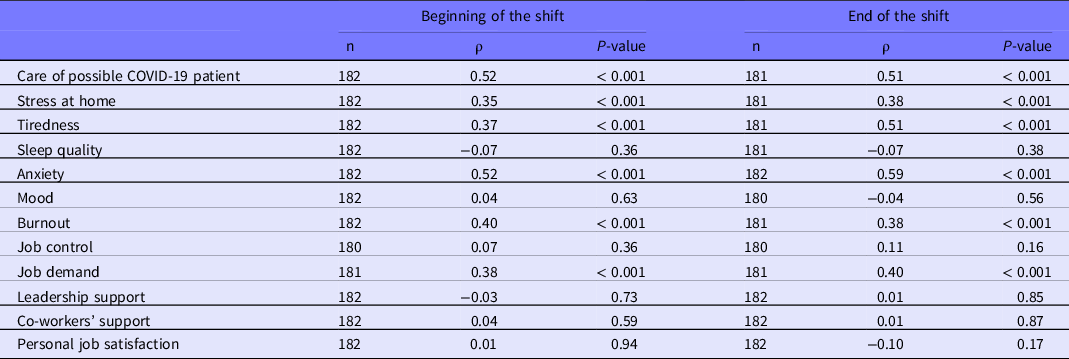
The mean stress level at work was 3.40 ± 2.34, without any difference between the 2 sessions (3.16 ± 2.34 vs 4.39 ± 2.11, P = 0.23). No difference was found according to sex, job, and physical activity. However, a higher stress level was found among smokers (P = 0.03) and participants who had a life-threatening emergency during their shift (P = 0.006) (Table 2). Furthermore, at the beginning of the shift, a moderate correlation (0.52) was observed between the stress of taking care of a COVID-19 patient and anxiety, and a low correlation between stress at home (0.35), tiredness (0.37), burnout (0.40), and job demand (0.38) (Table 3).
Factors associated with subjective stress at work measured by a visual analog scale

n, Number of observations; rho (ρ), Spearman’s correlation coefficient; SD, standard deviation. Spearman’s correlation coefficients were interpreted as follows (absolute value): ≥ 0.70 (strong correlation), 0.50-0.69 (moderate correlation), 0.30-0.49 (low correlation), 0.00-0.29 (no or negligible correlation). Session 1: during the first wave of the pandemic (April 10 to May 10, 2020); session 2: after the first wave of the pandemic (June 10 to July 15, 2020).
Correlation between work and personal environment (at the beginning and end of the shift) and subjective stress at work (measured by a visual analog scale)

n, Number of observations; rho (ρ), Spearman’s correlation coefficient. Spearman’s correlation coefficients were interpreted as follows (absolute value): ≥ 0.70 (strong correlation), 0.50-0.69 (moderate correlation), 0.30-0.49 (low correlation), 0.00-0.29 (no or negligible correlation). All data were assessed using a visual analog scale.
Objective stress
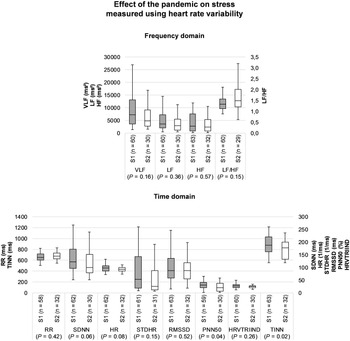
We found no significant difference between the 2 sessions in all frequency-domain measurements (Figure 2). However, during the second session, time-domain measurements, TINN and PNN50, were significantly lower compared to the first session signaling higher stress levels, respectively, 760 ms versus 630 ms for TINN and 31.5% versus 20.6% for PNN50. In addition, SDNN and HR were lower during the second session but not statistically significant (122.9 ms vs 99.5 ms, P = 0.06 for SDNN, and 98.0/min vs 93.3/min, P = 0.08 for HR, respectively) (see Figure 2).
Comparison of heart rate variability.

Secondary Objective: Correlation Between Objective and Subjective Stress
We did not find any correlation between objective and subjective stress except for time-domain measurements, RR (-0.23, P = 0.04) and HTI (-0.28, P = 0.01), considering as low Spearman’s correlation coefficients. However, no other domain was significant: −0.14 for SDNN, 0.17 for HR, −0.15 for STDHR, −0.12 for RMSSD, −0.06 for PNN50, and −0.06 for TINN. Regarding frequency domain measurements, no correlation was significant: −0.17 for VLF, −0.10 for LF and HT, and 0.13 for LF/HF. No linear measurement was significant: −0.13 for SD1 and −0.16 for SD2 (Supplementary Table).
Discussion
We found moderate stress levels among emergency HCWs during the first wave and the control period of the novel pandemic in a low-incidence place. Interestingly, our data show that the novel pandemic did not increase the stress levels of emergency HCWs beyond the expected daily stress. Furthermore, we did not find a strong relationship between subjective (VAS) and objective (HRV) data. Prior literature supports this observation. Reference Petrowski, Herhaus and Schöniger41
Period of Measurement
We performed the first session during the first wave of the pandemic in France from April 10 to May 7, 2020. At that time, scientists did not know much about the virus, its contagiousness, and its transmissibility. Reference Bhagavathula, Aldhaleei and Rahmani42 Since a diagnosis using polymerase chain reaction was not readily available compared to today, we used chest tomography as a surrogate for diagnosing COVID-19. Reference Lv, Wang and Yang43
Furthermore, no vaccine was available during the time of the study. Emergency and ICU HCWs treated and cared for possible or known COVID-19 patients with only personal protective equipment (PPE), adding to moral distress. The French Auvergne region was relatively protected from high volumes of COVID-19 admissions during the first pandemic wave following the French Government declaring lockdown on March 17, 2020. For example, the average daily entries at the Clermont-Ferrand ED are 160 patients per day. On March 18, 2020, the patient volume was 60 patients only. Reference Bouillon-Minois, Schmidt and Dutheil2,Reference Bouillon-Minois, Raconnat and Clinchamps3 Additionally, all non-urgent surgery and medical hospitalization were canceled. These new constraints decreased overcrowding during the first lockdown, Reference Bouillon-Minois, Schmidt and Dutheil2,Reference Bouillon-Minois, Raconnat and Clinchamps3 and the French Auvergne region took care of patients transferred from other locations. Reference Hinkle, Wiersma and Jurs39 This situation was not anticipated at the time we began the study. We anticipated the ED to be overwhelmed, similar to other EDs, Reference Azoulay, Beloucif and Guidet44 and expected a higher stress level in the first session than in the second session. However, our study showed that the control period was more stressful than the pandemic’s first wave, based on objective stress data using HRV. The main explanation we found is overcrowding, with the number of patients in the ED being significantly higher in the second period, aggravated by the lack of beds available to admit patients. Similar to pre-pandemic observations, overcrowding significantly impacts increasing stress among nurses and physicians. Reference Bond, Ospina and Blitz45
Subjective Stress
During more than 24 months, COVID-19 and its impact on emergency HCWs have been studied. We hypothesize that the pandemic increased the stress levels of HCWs. The best performing concept to assess stress is the job-demand-control model created and validated by Karasek in 1981. Reference Karasek, Brisson and Kawakami18 The Job Content Questionnaire is derived from Karasek’s model and has been developed and validated in several languages. Reference Karasek, Brisson and Kawakami18 Studies have highlighted its psychometrics properties, especially in a French population of 24 486 workers. Reference Niedhammer, Chastang and Levy46 However, this tool is difficult to use daily in the population of HCWs because of its length (18 items) and complexity. Similarly, studies show that the participation rate decreases with the length of the questionnaires and decreases in attention and concentration. Reference Aceves-Martins, Whitehead and Inchley47 The VAS was developed to assess occupational stress. Reference Lesage, Berjot and Deschamps20,Reference Dutheil, Pereira and Moustafa21 It is a suitable tool for clinical activity and has good psychometric characteristics. Reference Sung and Wu48,Reference Abend, Dan and Maoz49
Heart Rate Variability
However, when people are less able to cope with stressors or if the duration of stress is too long or often repeated, the autonomic nervous system activity is reduced or unbalanced, inducing anxiety and depression. Reference Yoo, Yune and Im50 Baseline HR and HRV are measures of stress highlighting a sympathetic shift in sympathovagal balance and reduced complexity of the cardiac signal. Reference Orsila, Virtanen and Luukkaala51 Although we did not find any statistically significant baseline HRV between the 2 sessions, we were able to find a tendency. Second session HRV seems to be lower than firsts. We hypothesize that our sample size is not strong enough. However, we will not be able to perform such study before decades. Indeed, the first wave of the COVID-19 pandemic was the first worldwide pandemic since the Spanish flu in the early 20th century. No HCWs have already lived this type of pandemic. To perform the exact same study with a stronger sample, we need a long-term wash-out period to study new HCWs free of the COVID-19 virus. We can only hypothesize on our results and therefore on tendencies. One of the main differences between the 2 periods was the number of daily consults, which is known to be stressful. Reference Eriksson, Gellerstedt, Hillerås and Craftman52 However, we had a lot of cofounding factors that could decrease its impact.
SDNN explores short-term stress, that is, less than 2 hours, whereas PNN50 and TINN explore both acute and long-term stress. SDNN and stress index positively correlate when the stress level is correctly adapted. SDNN increases when stress increases. Our data showed that SDNN levels were lower in the second period, assuming lower stress levels; in the context of long-term stress, it is important to remember that SDNN is the best marker for long-term stress. On the contrary, PNN50 is low during stress exposure, explores short-time variability, and is influenced by both acute and long-term stress. Reference Hernando, Roca and Sancho53,Reference Hernando, Garatachea and Almeida54 We found that PNN50 was lower during the second period highlighting higher stress levels. Lastly, TINN, a well-known HRV parameter to be higher when the stress is lower, is also higher during the first period, signaling lower stress levels during the first period. Reference Orsila, Virtanen and Luukkaala51
Limitations
Our study has some limitations. Our study period covered the first wave of the pandemic, which had comparably less impact in the French Auvergne region, mainly due to early lockdown and public adherence. It may be interesting to perform new measurements during different periods of the COVID-19 pandemic (eg, first wave, second wave, when the vaccine became available, after the third wave), and during “non-COVID-19” and pandemic recovery periods.
Additionally, we used Bioharness Zephyr®, and participants were asked to place the belt themselves after a demonstration, which introduced a lot of artifacts and uninterpretable data. To counter this issue, we used the very-low artifact correction option of Kubios® software. It may be relevant to train participants to use the belt before the beginning of the measurement. Data collection was only obtained during regular business hours and missed those working overnights. Nocturnist schedules may pose unique stressors.
Furthermore, there were some missing data for each variable (not all participants provided both HRV data and the VAS survey). The VAS survey is based on the Karasek model for measuring stress, although it has not been validated. Biometric data obtained were limited to HRV and did not include respiration rates, depth, or amplitude of respiration. Although less studied, evidence for HRV biomarkers is mostly focused on acute stress. Also, we did not study the impact of COVID-19 on neuroendocrine indexes such as plasmatic cortisol or catecholamine levels. Finally, we recruited a sample of young, healthy participants, which impairs the generalization of our results, although it represents the population of our departments.
Conclusion
COVID-19 alone did not increase stress levels during the first wave of the pandemic. This is likely because the French Auvergne region faced fewer COVID-19 patients during the first wave. We found that a higher volume of patients who daily consult in the ED, active smoking, and exposure to life-threatening emergencies was associated with higher stress levels at work during the COVID-19 pandemic. We also found no significant correlation between subjective and objective stress at work.
Competing interests
The authors have declared that no competing interests exist.