For the 2017 Fall MRS meeting, I arrived on Saturday 11/25 so I could be at the grave unveiling ceremony of Professor Mildred Dresselhaus. There I gave tribute to Professor Dresselhaus’ life which is one to celebrate and be proud of because of the wide reach of her legacy and impact on many lives in science.
After the morning at Mount Auburn Cemetery, there was a workshop at MIT held to honor her. The workshop covered Millie's life's work in research (Carbon Nano Tubes, Graphene, and Graphite); her contributions to women issues in science and her many contributions to the science community such as working at Basic Energy Science of the Department of Energy for the last year of President Clinton in office. She had also helped other women came into the position, including Dr. Harriet Kung who has been the director at DOE–BES for over 10 years. A number of her former students, collaborators and other luminaries also paid tributes to Millie. There was also a poster session after the five or six talks. There was a private lunch for families and friends as well as an open dinner reception at the poster session which was for everyone attending. MIT was generous and so was Millie. Millie had donated her Kvali prize to MIT for the fostering of women in science and engineering study at MIT. There was also a workshop at MRS on Monday, Nov 27 devoted to thermoelectric materials for the remembrance of Millie. The program is listed on millie.mit.edu.
For details in a technical program at MRS fall 2017 meeting, please check www.mrs.org/fall2017 or the mobile app and its companion website mrsfall.zeista.com. The meeting was very well organized and had a number of special workshops adopted for young professionals and students, including such topics of how to get the green card, how to start a business: turning Stuff to Money, etc. It is certainly good to be young these days.
The meeting had 54 symposia: two on Broader impact; 11 on biomedical related materials issues; ten on electronics, magnetics, and photonics; 11 on energy and sustainability; eight on nanomaterials; four on processing and manufacturing; seven on theory and characterization, modeling, and of the lunch-time X symposium on materials’ frontiers. Besides the Professor Dresselhaus's workshop, there was a student-organized 2-day workshop on energy and sustainability featuring very young presenters.
The poster sessions on Monday, Tuesday, and Wednesday were all very well attended and full of new projects and ideas. I left on Thursday and cannot comment on the rest. Notable was that many of the poster-winners are from foreign countries. Both China and South Korea are winning many poster prizes, one or two went to Europe.
In the hub area, a lot went on, with workshops on innovation, ABET accreditation and many more. Please check the program websites. These workshops are very helpful especially for students and young professionals.
There were so many good talks and so little time. Some of the notable talks I went to were from the Millie workshop on thermoelectric materials and science. The speakers in the workshop are all excellent. The Awardees’ talks were very capturing, informative and inspiring. The invited talk TC07.03.04 by Professor Chris Wolverton from Northwestern on Oxygen Off-Stoichiometry and Defect Entropies in Solar Thermomechanical Water Splitting was particularly good because of my own interests. The talk was mostly on a large number of perovskites but at the end, ceria is looking pretty good for having the right entropy. This has to do with the seven f-electron orbitals, which create the on-site electronic entropy that much higher ideal for water splitting. The same is true with oxides of the Lanthanide series. Another notable talk was by Talia Gershon of IBM Waston Lab on CuZnTSnSe Kesterites about its Cu/Zn ordering/disordering for photovoltaic (PV) performance. Silver was replacing copper in Cu sites to discourage disordering as (Ag x Cu1−x )2 ZnSnSe y . AZTSe is a weak n-type PV material. A typical PV cell structure is glass/FTO/AZTSe/MoO3/ITO. The Schottkey contact between MoO3 and AZTSe is supposed to be appropriate for the PV device. There was also a talk by Xi Chen of CUNY on novel ways to harvest energy. Among the many ideas, one has to do with a car driven by water evaporation. It is supposed to work well in low humidity area.
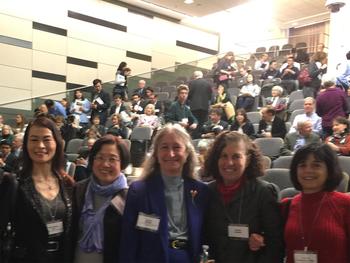
(Colour online) Five women professors at Millie Dressellhaus's Memorial Workshop at 2018 Boston MRS Fall meeting. From L to R: Nai-Chang Yeh of California Institute of Technology, Siu-Wai Chan of Columbia University, Laurie McNeil of the University of North Carolina, Estelle Epstein of Fairleigh Dickenson University, and Lourdes Salamanca-Riba of the University of Maryland.

There were over 300 vendors participating in the exhibition with a number of attracting shows: such as art or science competition-show of metallography. Cartoon drawing, plus hot cider and hot chocolates are also available. There were lots of book vendors, a lot of new equipment with new ideas: such as an infra-red video camera selling for 5 K. Uncooled Infra-red detector was just an army research project 20 years ago which I still remember. Now we have a commercial product that one can buy off the shelf, fantastic! An optical microscope that beats diffraction limit was also on sale. The principle was using an optical probe that goes to 50 nm using a high refractive index bead as an optical antenna. There was an AFM using a diamond cantilever probe with one NV center that is sensitive to electric and magnetic fields. I have to try this one.
There was a student chapter T-shirt contest and Columbia University's minimal design was a real conversation starter and got a runner-up position.