Introduction
Presidential scholars have long emphasised the role of the executive branch in federal policymaking. Presidents develop policies formally through unilateral action, but they also pursue their objectives in the legislative arena. Governors fill an analogous role within their states. They manage the bureaucracy and help set the policy agenda through speeches, calling special sessions or taking unilateral action. I analyse factors that explain gubernatorial use of executive orders, and I consider how these same executive orders influence statute adoption, using lesbian, gay, bisexual and transgender (LGBT) employment protections as an illustrative case.
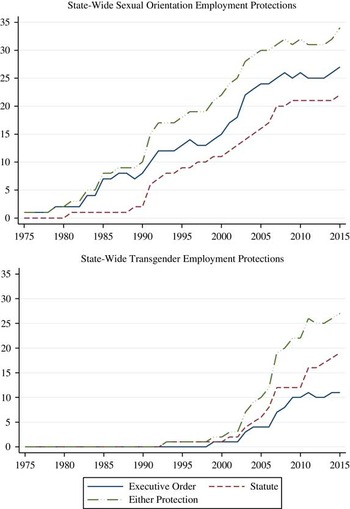
This case is particularly well suited to test the determinants of unilateral action in contrast to statute adoption. Since the 1970s, dozens of governors issued executive orders to establish protections for the LGBT community by prohibiting discrimination on the basis of sexual orientation and/or gender identity. As Figure 1 shows, executive orders created many of the first LGBT protections across the states. Only one governor (Massachusetts Governor Mitt Romney in 2003) issued an executive order after legislation was already in place. Executive orders created new policies in all other cases, but these early protections only protected sexual orientation in public employment. Only one United States governor has been openly out as bisexual or gay while in office,Footnote 1 and no governor has been out as transgender, and therefore this is not a story of descriptive representation. Years, or even decades, lapse between when a governor issues an executive order and the adoption of legislation, if it is adopted at all. This variation in policy creation allows for an analysis of gubernatorial motivation to issue executive orders, while also providing an opportunity to simultaneously consider legislative behaviour.
Adoption of lesbian, gay, bisexual and transgender employment protections from 1975 to 2015.

Policy diffusion literature most often focusses on the legislative branch of government. Commonly, states are the unit of analysis (Berry and Berry Reference Berry and Berry1990; Mooney and Lee Reference Mooney and Lee1995), but numerous studies analyse determinants of policy adoption at the local level (Sharp Reference Sharp2005; Shipan and Volden Reference Shipan and Volden2008). Many recent scholars try to explain diffusion beyond defining policy adoption as a single-stage process. They attempt to understand the content complexity of the adopted policies (Karch Reference Karch2007) and the mechanism that leads to their adoption (Shipan and Volden Reference Shipan and Volden2008; Hicks et al. Reference Hicks, McKee, Sellers and Smith2015). There is a key limitation to the majority of these studies – they rely almost entirely on policy adoption by the legislative branch of government. However, this is not the only manner in which governments create policies.Footnote 2 Indeed, studies show that other political actors can greatly influence the policy landscape whether through interest groups challenging the legality of policies in the courts or acting as policy advocates to provide information to politicians (Godwin and Schroedel Reference Godwin and Schroedel2000), or even as executives acting as policy entrepreneurs to pursue their political agendas (Spill et al. Reference Spill, Licari and Ray2001). I look solely at employment protections for LGBT individuals to demonstrate that executive orders can play a role in the adoption of legislation.
I highlight the limitations of viewing policy creation as being driven solely by the legislature. I argue that executive action, or inaction, and the adoption of LGBT-inclusive legislation influence one another. Legislatures are more likely to adopt legislation in states where governors previously established public employment protections for LGBT individuals, but concern for a legislative stalemate may spur governors to act in the first place. Results show that governors tend to issue executive orders at the start and end of their tenure. I also find support for the strategic model at the state level, which posits that governors use executive orders to sidestep legislatures averse to their political agendas. Findings indicate that governors turn to executive orders more under divided government or when there are fewer members of their political party in the legislature. In the case of LGBT protections, partisanship is strongly linked to both gubernatorial use of executive orders and adoption of legislation. Democratic governors issued approximately 80% of the LGBT-inclusive executive orders. Most importantly, I find that states are more likely to adopt pro-LGBT statutes when similar executive orders are already in place, as the citizens are more liberal, and when institutionally weaker governors serve in office. These results show that policy adoption cannot be understood by simply considering legislative action.
Gubernatorial and presidential use of executive orders
Despite their frequent use across the United States, little research and theory exists on governors’ use of executive orders. Ferguson and Bowling (Reference Ferguson and Bowling2008) show that there is huge variation among states in terms of how frequently governors utilise executive orders and for what purposes. Their analysis reveals that governors across the country issued thousands of executive orders from 2004 through 2005 that established governmental policies, clarified organisational goals or reorganised agencies. Yet, states differ in how they use executive orders. For instance, in recent years, Oklahoma governors used executive orders primarily to order flags to half-staff to honour various individuals or events (Oklahoma Secretary of State 2014). Governors in Arizona were more proactive, issuing executive orders to establish commissions for regulation or to support their initiatives (Arizona Memory Project 2014). Yet, governors in both states can issue executive orders for a number of other purposes; both can make administrative changes.
Governors themselves vary on many dimensions and approaches to running the government. Part of this is due to a state’s traditions or the powers given to the executive branch vis-à-vis the ability of governors to pursue their policy agenda with executive orders. Governors’ powers vary along several lines, such as the ability to veto legislation, set the budget and tenure potential, which puts governors across the states on a different footing, particularly when pursuing their agendas in the legislature (Kousser and Phillips Reference Kousser and Phillips2012). Executive orders are unilateral tools that all governors can use to promote their agendas or to direct agencies regarding how to carry out executive functions (Mayer Reference Mayer1999). As voters hold executives responsible for policy outcomes (Partin Reference Partin2001), governors have motivation to institute policy unilaterally to circumvent opposition in the legislative arena when the legislature is unlikely to mobilise against their policy (Krause and Cohen Reference Krause and Cohen1997). Governors can quickly win support by making administrative changes that align the implementation of state programmes with governors’ platforms, as well as signal overall policy stances. Although the media focusses attention on LGBT-inclusive executive orders issued by presidents, governors and mayors have issued similar executive orders to offer protections to the LGBT community in recent decades (Sellers Reference Sellers2014a, Reference Sellers2014b).
The use of executive orders can also serve as a symbol of new administrative goals. Mayer (Reference Mayer1999, 446) notes that presidents use executive orders “as a symbol of their intention to act decisively” on an issue devoid of Congressional approval or action. In fact, the strategic model provides a broader explanation of executive orders, which asserts that presidents turn to executive orders when they face more and more barriers to pursuing their political agendas in the legislative arena. Presidential literature also suggests that executives are more prone to issuing executive orders to quickly alter policy when Congress is controlled by the oppositional party. Mayer and Price (Reference Mayer and Price2002, 379) argue that presidents use executive orders on significant issues in order to direct agencies, particularly in disparaging political environments and early on in their tenure if they are “recapturing the White House for their party”. My evidence suggests that this is true for governors as well, as the majority of governors under analysis issued protections for LGBT members within the first month of entering office.
Early presidential studies suggest that the use of executive orders can be explained primarily by the rise of the institutional presidency (Burke Reference Burke1992) or divided government (Deering and Maltzman Reference Deering and Maltzman1999), but later research suggests that motivations to issue executive orders are more complex. Fine and Warber (Reference Fine and Warber2012, 272) argue that the intent of executive orders differs based on whether the president is facing a unified or divided government, and that presidents “attempt to bypass a hostile Congress to transform their major policy ideas” into reality. This suggests a refined approach to the strategic model because, although presidents issue fewer executive orders under divided government, these orders make significant changes to policy. I expect governors to issue more policy-oriented executive orders when they view their objectives as unlikely to pass in the legislature.
Executive orders are not equivalent to legislation and should not be conceptualised as such, but they emulate many of the qualities of statutes and are often seen by activists as one possible step in the incremental progression to the adoption of legislation. Mayer (Reference Mayer2009) argues that presidents prefer legislation, but may act unilaterally when the odds are stacked against their policy objectives. Executive orders can indicate the administration’s policy preferences, as well as define a protected class. At best, executive orders are equivalent to the law in some states. However, executive orders are much less stable than legislation because executive orders are not necessarily permanent. Seven states had sexual orientation- and/or gender identity-inclusive protections created by executive orders that were subsequently removed or invalidated. For instance, the Iowa Supreme Court nullified sexual orientation and gender identity public employment protections when it ruled that Governor Vilsack went beyond his constitutional power to issue the executive order (HRC 2014). Oregon citizens also successfully passed a ballot initiative in 1988 that temporarily invalidated sexual orientation protections.Footnote 3 The remaining five states had sexual orientation and/or gender identity protections taken away once a new governor took office, and in all cases this occurred when party control of the executive switched from Democrat to Republican. Several state courts ruled that transgender discrimination is a form of sex discrimination under state statutes (Transgender Law Center 2010), but often these cases remain tied up in court for years and can still be challenged in appeals or state supreme courts.
Statute adoption and executive orders
Policy diffusion literature in recent years is critical of assessing the adoption of multiple variations of policy in the same analysis because the determinants of some components of policy may differ from others, which can cause misleading conclusions (Boehmke Reference Boehmke2009). The same is found when assessing the factors that lead to adopting different kinds of protections for the LGBT community (Taylor et al. Reference Taylor, Lewis, Jacobsmeier and DiSarro2012). For this reason, my analysis is broken down into two parts: (1) factors that lead to executive order use; and (2) determinants of the adoption of legislation establishing LGBT employment protections. I argue that executive action and the adoption of legislation influence one another. Although incremental gains can eventually lead to legislation that protects all LGBT individuals, the adoption of legislation generally occurs years later, if subsequent innovations occur at all. Howell (Reference Howell2005) posits that executives have two broad choices to pursue policy objectives: they can either pursue unilateral action or submit proposals to the legislature. He asserts that the role of the executive in policymaking, and his or her ability to influence political outcomes, varies depending on whether the chief executive creates policies unilaterally or the legislature crafts legislation.
State politics and policy diffusion literature assert that there are internal and external factors that lead to the adoption of legislation (Berry and Berry Reference Berry and Berry1999). External factors include innovations from other states and diffusion. Findings indicate that regional pressures and innovations made by neighbouring states influence the adoption of similar policies; however, scholars in recent years question the power of diffusion to influence policy adoption due to greater media coverage of state action and coordination of national advocacy groups (Haider-Markel Reference Haider-Markel2001). Mooney and Lee (Reference Mooney and Lee1995) find that significant value conflicts occur for morality politics, which LGBT policies fall within, that make intrastate factors pivotal to explaining the adoption of policies. Among these intrastate factors, social and political conditions within a state are particularly important when analysing the adoption of morality politics (Sharp Reference Sharp2005). Social conditions such as cultural values or citizen ideology influence the adoption of legislation by altering the overall support in government for addressing LGBT concerns. Lax and Phillips (Reference Lax and Phillips2009) found that, overall, liberal states are more likely to adopt pro-LGBT legislation; further, scholars find that states with larger proportions of Evangelicals are less likely to adopt pro-LGBT policies (Haider-Markel Reference Haider-Markel2000; Barclay and Fisher Reference Barclay and Fisher2003; Taylor et al. Reference Taylor, Lewis, Jacobsmeier and DiSarro2012). Previous studies also find that greater Democratic control of the legislature increases the probability that states will adopt pro-LGBT legislation (Haider-Markel Reference Haider-Markel2001; Taylor et al. Reference Taylor, Lewis, Jacobsmeier and DiSarro2012). These studies did not control for governors, but based on shifting alliances of political parties in the 1990s I expect Democratic governors to issue pro-LGBT executive orders more often. Therefore, the first two hypotheses are as follows:
H1: Democratic governors are more likely to issue executive orders adding LGBT protections.
H2: Legislatures are more likely to adopt legislation adding LGBT protections as the percentage of Democratic legislators increases.
The strategic model argues that governors issue executive orders to advance their preferred policies. Howell (Reference Howell2003) shows that presidents use executive orders to further their policy objectives. In a similar regard, I argue that stronger governors establish LGBT protections upon entering office through executive orders because they are given greater leverage to act unilaterally and there is strategic incentive for governors to do so; however, this action may run counter to the incentives of the legislature and overall long-term goals of the executives (Bolton and Thrower Reference Bolton and Thrower2015). It also makes legislatures potentially less likely to adopt similar pro-LGBT legislation by reducing the governors’ ability to negotiate once they sidestep the legislature (Wigton Reference Wigton1996). As Howell (Reference Howell2003) asserts, even when a majority is opposed to new policy, Congress is often unable to respond with legislation to overturn a president’s policy once an executive order is in place because of the challenges involved with building a successful coalition. Consequently, governors may elect to pursue legislation to adopt more expansive and enduring policies by negotiating with the legislators first. Governors that see legislation as likely to pass in the legislature, or governors with weaker institutional powers to dictate administration policies, are especially likely to take this approach. Executive orders become appealing once more if efforts in the legislature fail because of a stalemate or changing partisan dynamics later in the executive’s tenure. This leads to the following hypotheses:
H3: Governors are more likely to issue executive orders adding LGBT protections at the start and end of their tenure.
H4: Institutionally stronger governors are more likely to issue executive orders adding LGBT protections.
The final hypotheses test the strategic model applied to the state level, which asserts that governors are more likely to issue executive orders when confronting unfavourable political conditions in the legislature. Governors may utilise executive orders when they view the legislature as unlikely to pass LGBT-inclusive legislation. Among the governors that issued executive orders to protect sexual orientation, 14 of 24 faced divided government and an additional five confronted legislatures with smaller Democratic majorities (55% or less). A similar story is seen with gender identity. Of the 11 governors that added transgender protections, seven faced divided government and one additional Democratic governor had a relatively small partisan advantage in the legislature. Unilateral action is preferable to no policy, and thus governors that want to advance LGBT protections will issue executive orders when they perceive the legislature as unlikely to adopt legislation. As a result, I expect governors to issue LGBT-inclusive executive orders when the legislature is composed of fewer members from their political party. This leads to the final hypotheses:
H5: Governors are less likely to issue executive orders adding LGBT protections when the state legislature has fewer legislators from their political party.
H6: Governors are more likely to issue executive orders adding LGBT protections under divided government.
Data and expectations
To assess factors that explain policy adoption, I conceptualise policy adoption in two ways: (1) as created by executive orders and (2) as created by legislation. I created a comprehensive data set of governors’ use of executive orders and legislatures’ adoption of statutes that establish sexual orientation- and trans-inclusive employment protections. I identified executive orders by first searching the National Gay and Lesbian Task Force (2013) and Human Rights Campaign’s (2014) websites for “executive order”, “sexual orientation”, “gay”, “transgender”, “gender identity” and “governor”. I conducted similar searches within each state’s governmental website and general searches online. The Human Rights Campaign (2014) provided employment nondiscrimination statute adoptions. The resulting data set spans from 1975 – the first year that any form of protection was in place – to 2013 for all 50 states.
I argue that factors specific to individual governors lead to their issuance of executive orders. Klarner (Reference Klarner2012) provided the executive political features. The term Democratic Governor is a dichotomous variable coded 1 for Democratic governors and 0 otherwise. I expect Democratic governors to be more likely to issue executive orders, as on average they appeal to a more liberal voting base and have a greater motivation to do so than their Republican counterparts (Brewer Reference Brewer2007). Although not all Democrats are proponents of LGBT rights, they have more electoral incentives to push for nondiscrimination policies. As the Christian Right Movement (and social conservatives more generally) comprises an influential and highly active component of the Republican Party, creating LGBT-inclusive policies could harm a Republican governor’s chance of reelection (Wilcox and Robinson Reference Wilcox and Robinson2010). Therefore, Republican governors have little incentive to issue an executive order to protect LGBT employees. A similar concern confronts Democrats in more conservative states. These governors have less incentive to issue an executive order than governors from more liberal states because of potential backlash in later elections.
The next explanatory variables consider a governor’s tenure. I argue that governors that are more liberal, or governors that confront more liberal constituencies, want to gain political points by issuing protections. Issuing executive orders can quickly establish new policy without losing much political capital in liberal states that are amenable to these protections. Applying the strategic model suggests that issuing LGBT executive orders allows governors to establish policy and avoid confrontation with a legislature that is either controlled by the opposition party or resistant to the policy. As this does not require negotiations with other political actors, governors can achieve their objectives upon first entering office without losing much political capital. However, governors may pursue their policies through legislative or administrative means first if it appears that there are receptive members in the legislature. If the efforts are unsuccessful, executive orders may be appealing once again later in a governor’s tenure. Two terms capture this nonlinear relationship: (1) Years Served as Governor and (2) Years Served as Governor2. The former variable allows the model to estimate the initial downward trajectory of Years Served, but the squared term allows for a breakpoint where governors turn to executive orders once again. Both variables utilise Klarner’s (Reference Klarner2012) estimates of the number of years governors have served in office. Unlike presidents, not all governors can be term limited. Many governors do not know that a term is their last until their last year in office. Executive orders can serve as a last-ditch effort to establish LGBT protections once governors realise that the legislature is unlikely to act before the end of their term. Therefore, I expect lame duck governors to be more likely to issue an executive order. I include Lame Duck to account for governors serving their last year in office.
I argue that stronger governors are more likely to issue executive orders before pursuing legislation in the legislative arena. Weaker governors may not have the ability to issue these protections, and therefore they take a more conciliatory approach to policymaking. Using the most current coding scheme created by Thad Beyle for 2007, I created annual estimates of institutional power for each state from 1975 to 2013.Footnote 4 This is a six-point composite scale that measures how many separately elected state-wide officials there are, the tenure potential of governors, appointment powers, budgetary power, veto power and the level of control that a governor’s party holds in the state legislature. This cannot get directly at capturing managerial style, but it creates a proxy for the potential ability of governors to manage their administrations. The resulting measure, Gubernatorial Power, ranges from 0 to 5 with values increasing for relatively stronger governors. I expect stronger governors to issue executive orders, whereas I expect weaker governors to be more involved in the legislative arena because they have less authority to act unilaterally. I also expect legislatures in states that have executive orders in place to be more likely to adopt similar legislation. I include the term Executive Order to account for whether a similar sexual orientation and/or gender identity-inclusive executive order is in place. This variable is coded 1 when a state has an executive order in place in the given year, and 0 otherwise.
Partisan control of the legislature helps explain both models, but analysis controls for partisanship differently on the basis of the guiding theory. I construct both measures on the basis of the partisanship of legislators serving across both chambers of the legislature in a given state/year.Footnote 5 The analysis accounts for a diminishing effect in changes to the partisan composition as one party gains more control of the legislature.Footnote 6 Presidential literature suggests that the proportion of the legislature that is controlled by the same party as the governor should explain executive behaviour. Therefore, in the model analysing the issuance of executive orders, I use the % of Legislators from the Governor’s Party (sqrt) to control for legislative partisanship. The policy diffusion and LGBT literature, in contrast, finds that the adoption of pro-LGBT legislation is highly dependent on the partisan makeup of the legislature, with higher proportions of Democrats linked to the adoption of LGBT protections.Footnote 7 I model partisan composition of the legislature with the term % Democratic Legislators (sqrt). I also include Divided Government to account for partisan tension. It is coded 1 if a political party other than the governor’s controls at least one chamber of the legislature and 0 otherwise. I expect governors to be more likely to issue executive orders when legislation appears unlikely. In keeping with previous literature (Deering and Maltzman Reference Deering and Maltzman1999; Howell Reference Howell2003; Fine and Warber Reference Fine and Warber2012), I expect governors to be more likely to issue executive orders under divided government, or when fewer members of their party hold seats in the legislature. In contrast, I expect legislatures to be less likely to adopt legislation under divided government.
I construct two measures of policy diffusion to control for neighbouring states’ policy adoption. Consistent with policy diffusion literature, I model these variables as a function of the proportion of neighbouring states that adopted similar policies (see Mooney and Lee Reference Mooney and Lee1995; Haider-Markel Reference Haider-Markel2001). I include these variables to account for regional influences and practices. Executive Order Diffusion and Statute Diffusion measure the proportion of bordering states that have an executive order in place or passed legislation, respectively. The models require two distinct measures for both forms of LGBT protections because the analysis looks at the spread of protections through two separate mechanisms: (1) unilateral executive action and (2) legislative action.Footnote 8 I create these measures for sexual orientation and gender identity, and therefore the models use a total of four terms to estimate the results in Tables 1 and 2. In keeping with previous literature, I expect policies to diffuse regionally, but I do not expect the diffusion variable to be as influential as when it was first conceived, owing to advancements in technology and coordination of national organisations that previous scholars raised as limitations on the diffusion variable.
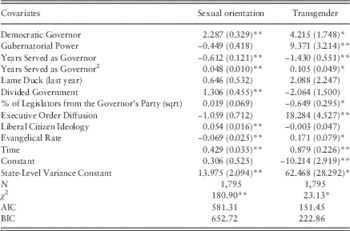
The issuance of lesbian, gay, bisexual and transgender-inclusive executive orders

Note: The dependent variable is coded 1 if in a given state an executive order is issued in year t, 0 otherwise (1975–2013). Executive Order Diffusion, Liberal Citizen Ideology and Evangelical Rate are grand-mean centred. Analysis excludes independent governors. Time is centred at 2013.
AIC=Akaike information criterion; BIC=Bayesian information criterion.
*p<0.05. **p<0.01.
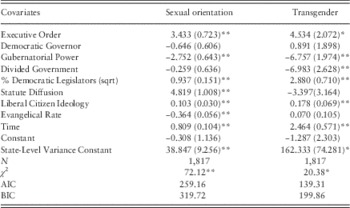
The adoption of lesbian, gay, bisexual and transgender-inclusive statutes

Note: The dependent variable is coded 1 if in a given state an inclusive statute is adopted in year t, 0 otherwise (1975–2013). Power, Statute Diffusion, Evangelical Rate and Liberal Citizen Ideology are grand-mean centred.
AIC=Akaike information criterion; BIC=Bayesian information criterion.
*p<0.05, **p<0.01.
I account for several additional controls. I expect governors and state legislatures to be more likely to add protections when their constituents are more liberal, but less likely to adopt these policies when constituents are less socially conservative. If governors work to appease their base at the expense of swing voters, they endanger holding together a plurality coalition to win reelection; thus, social factors within states, such as citizen ideology and the proportion of the population that Evangelicals make up, must be considered as well to explain gubernatorial behaviour. Liberal Citizen Ideology models the annual constituency’s ideology within each state using a revised citizen ideology series from Berry et al. (Reference Berry, Ringquist, Fording and Hanson1998).Footnote 9 Evangelical Rate is the percentage of Evangelical Protestants within the states as measured by the 1980, 1990, 2000 and 2010 Religious Congregations and Membership surveys, and is expected to be associated with more socially conservative constituents and less receptive to both forms of policy adoption. Finally, the control Time is a simple time counter.Footnote 10
Estimation
Using Multilevel Event History Analysis, with the state/year as the unit of analysis, I evaluate the following:
-
1. The probability that a governor i will issue an executive order protecting LGBT employees in time t, given that no executive order is in place.
-
2. The probability that the state legislature i will adopt an LGBT-inclusive employment nondiscrimination statute in time t, given that it has not already done so.
The analysis runs from 1975 to 2013 for all the models.Footnote 11 As discussed previously, states vary in their tradition and use of executive orders. Multilevel modelling accounts for these differences and within-state patterns of adoption seen throughout the years. Taylor et al. (Reference Taylor, Lewis, Jacobsmeier and DiSarro2012) found that the effect of determinants that lead to successful statute adoption of LGBT protections share common elements, but differ based on the type of protections added – sexual orientation versus gender identity. Therefore, I estimate the likelihood of policy adoption separately for sexual orientation and gender identity. The models estimate state-level heterogeneity with a level-2 variance component; additionally, year-level heterogeneity is accounted for with a level-1 variance component (see Rabe-Hesketh and Skrondal Reference Rabe-Hesketh and Skrondal2008).Footnote 12
The dependent variables are all binary variables coded 1 for policy adoption and 0 if the policy is absent. An advantage of using Multilevel Event History Analysis is that it models “unobserved heterogeneity as a random effect, [therefore,] coefficients for measured variables are less biased” (Mills Reference Mills2011, 13). The state-level variance component partly accounts for the different traditions, and frailties, across the states. States are dropped from the analysis once an “event” occurs, i.e. the state adds protections. The analysis defines an event differently based on the type of policy under analysis. For executive orders, an event occurs when either a governor issues an executive order or the legislature adopts a statute.Footnote 13 For statutes, an event only occurs when the legislature adopts a statute.
Results
Determinants of executive orders
First, I examine the factors that lead to governors issuing executive orders. The first model presented in Table 1 considers factors that lead to protections for sexual orientation, and the second model analyses determinants that influence governors to issue executive orders protecting gender identity. The dependent variable is whether a governor issues an executive order in a given state/year, given that no executive order is in place and the legislature has not already adopted similar legislation. Both models present the results of a Multilevel Event History Analysis. Time is centred at 2013. The covariates Gubernatorial Power, Executive Order Diffusion, Liberal Citizen Ideology and Evangelical Rate are all grand-mean centred, which does not alter the estimates, but aids in interpretation, as the intercept is now meaningful.
The findings are similar for gubernatorial factors across both models. As expected, Democratic governors are much more likely to issue executive orders.Footnote 14 Stronger governors are more likely to issue executive orders to protect transgender individuals, but this finding does not hold for the sexual orientation model. This may indicate a change in strategy in later years with stronger governors issuing executive orders as partisan divisions grow more pronounced or because the public is less aware or supportive of specifically transgender issues. Both the linear and the squared terms are statistically significant across the models, which suggests that governors turn to executive orders most at the start of their tenures, but turn once more to executive orders late in their administrations. The findings indicate that the relationship is nonlinear, with a turning point, or local minimum, approximately six to seven years into their administrations for sexual orientation (6.4 years) and gender identity (6.8 years). Although some governors can serve more than eight years in office, most do not. In fact, the average of Years Served as Governor from 1975 to 2013 is 3.46 with a maximum of 15. Yet, interestingly, the results show that lame duck governors are not statistically more likely to issue LGBT-inclusive employment protections during their last year in office. The term is positive for both models, but does not reach conventional statistical significance.
Political conditions also play a role in explaining gubernatorial use of executive orders. Taken together, both the models support the strategic model, but in different ways. For sexual orientation protections, governors are more likely to issue executive orders under divided government by a factor of 1.9. For gender identity protections, % of Legislators from the Governor’s Party shows a similar narrative. Governors are less likely to issue executive orders when their party controls more of the legislature. To demonstrate the effect, I predict the probability that a new Democratic governor will issue a transgender-inclusive executive order in 2013 under divided government, when similar executive orders exist for a quarter of the state’s bordering states, and all remaining covariates are held at their grand-mean. The predicted probability that a governor will issue an executive order is 0.02 when the legislature is evenly split. The predicted probability increases to 0.10 when the legislature is composed of 45% of legislators from the same party as the governor. This predicted probability increases further to 0.16 when the legislature is composed of only 40% of legislators from the same party as the governor. Both models give some credence to the idea that governors issue executive orders when they do not expect legislation to pass either due to divided government or due to fewer legislators from the same party as the governor in office.
The final covariates analyse social factors that influence gubernatorial use of executive orders. These results differ across the models. Diffusion is not statistically significant for the sexual orientation model, but reaches conventional statistical significance for the analysis of gender identity protections. This tentatively suggests that governors are more likely to issue executive orders as more neighbouring states add similar protections. Governors are more likely to issue executive orders to protect sexual orientation when the states are more liberal, and composed of fewer Evangelicals. Both terms reach conventional statistical significance. However, this does not hold when the analysis turns to the determinants of executive orders that protect gender identity. Citizen ideology is not statistically significant and, counter to sexual orientation protections, governors are more likely to issue executive orders when the Evangelical rate increases. These discrepancies may be related to the changing strategies of governors and LGBT advocates in later years, or it may be a reflection of the late adopters that added protections through executive orders, i.e. the remaining governors in states that were still “at risk” of adopting transgender protections were in more socially conservative states. Both models show that governors are more likely to issue protections later into the time frame, and the variance across the states is statistically significant.
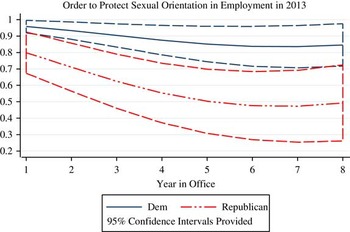
Next, I generate a graph for the “typical” state in the last year of analysis by looking only at the states still “at risk” for issuing executive orders to protect sexual orientation in 2013. I set all continuous covariates to the mean of 2013 using the remaining states “at risk”. I estimate the predicted probability that a governor will issue an executive order to protect sexual orientation in their first eight years in office, assuming that they experienced unified government throughout their tenure and that the governor is not in his or her last year in office, with all continuous variables at their mean. Figure 2 plots the results separated by the partisanship of the governor. Clearly, partisanship matters. Democrats are much more likely to issue executive orders to establish LGBT protections. The confidence intervals of Democrats and Republicans do not overlap for almost the entirety of a governor’s first two terms in office. The figure shows the relationship of time served in office with the declining likelihood of issuing an executive order. As previously stated, governors overall are less likely to issue executive orders as their tenures progress. However, there is a turning point in their administrations, where they become increasingly more likely to issue executive orders for sexual orientation protections (approximately 6.4 years into office), but this incline is modest and most governors leave office before then or shortly after. Governors from both parties are most likely to issue protections upon first entering office. Figure 2 predominantly expects Democratic governors to add protections upon entering office (predicted probability is 0.83), whereas the predicted probability for incoming Republican governors is roughly 0.35.
Predicted probability of a governor issuing an executive order to protect sexual orientation in employment in 2013.

Determinants of statute adoption
The analysis so far shows that gubernatorial characteristics and the political conditions that administrations confront help explain when governors issue executive orders to protect the LGBT community. The analysis now turns from considering what causes governors to act to focussing on the adoption of legislation that establishes sexual orientation and gender identity employment protections. Once more, Time is centred at 2013, whereas the covariates Gubernatorial Power, Statute Diffusion, Liberal Citizen Ideology and Evangelical Rate are all grand-mean centred. The model provided in Table 2 estimates the likelihood that a state legislature will adopt legislation that provides LGBT protections, given that it has not already done so. The results show that, as with determinants of executive orders, statute adoption is an artefact of political and social conditions within a state. In both models, states are more likely to adopt protections if a similar executive order is already in place. However, not all states whose governors issue LGBT-inclusive executive orders go on to adopt similar legislation.
Partisan features of the legislature are influential to the adoption of sexual orientation and gender identity protections. Although Democratic governors are more likely to issue executive orders to add protections, states with Democratic governors are no more likely to adopt LGBT statutes than other states. However, the partisan makeup of the legislature is key to understanding whether states adopt legislation that establishes LGBT employment protections. Divided government is only statistically significant for the adoption of transgender employment protections. The results show no statistically significant difference for legislatures facing divided government versus unified government in the adoption of legislation protecting sexual orientation, which may speak to the overwhelming importance of the partisan composition of the legislature. States with more Democratic legislators in office are more likely to adopt protections. Consistent with previous policy diffusion research, more Democrats in office leads to a higher probability of states adopting pro-LGBT legislation. To illustrate this effect, I predict the probability that a legislature will adopt transgender protections in 2013 for a state with a Democratic governor in his or her first year in office, with no executive order in place, under divided government, when similar executive orders exist for a quarter of the state’s bordering states and with all remaining covariates held at their grand-mean. The likelihood of statute adoption increases dramatically as Democrats gain more seats in the legislature. The predicted probability that a legislature will adopt transgender protections is virtually 0 when the legislature is evenly split. The predicted probability increases to 0.17 when the legislature is composed of 55% Democratic legislators. This predicted probability jumps to 0.68 when the legislature is composed of 60% Democratic legislators.
The remainder of the findings is largely consistent with expectations and previous literature. Diffusion plays a positive role on states adopting sexual orientation protections; yet, it is not statistically significant in explaining the adoption of transgender-inclusive statutes. As anticipated, legislatures are more likely to adopt both forms of legislation in states where the citizens are more liberal. The probability of a state adopting legislation protecting sexual orientation increases by a factor of 1.11 for a one-unit increase in Liberal Citizen Ideology, and the probability increases by a factor of 2.24 for a five-unit increase in citizen ideology. This effect is even more pronounced for transgender protections. A one-unit increase in Liberal Citizen Ideology increases the likelihood of adoption by a factor of 1.20, and the probability increases by a factor of 2.44 for a five-unit increase in citizen ideology. The findings regarding the Evangelical population hint at a similar conclusion. The probability of a legislature adopting legislation protecting sexual orientation decreases by a factor of 1.43 as the Evangelical Rate increases by one unit. However, caution should be taken when extrapolating results based on the Evangelical population, because this finding does not hold for transgender protections, and Table 1 shows the differences in the role of Evangelicals in executive order use. States are less likely to adopt legislation protecting sexual orientation when the Evangelical population is higher, but this does not hold true for transgender protections. As with executive orders, states are more likely to adopt statutes throughout the time period.
Discussion and conclusion
Scholars have largely neglected asking why governors issue executive orders and exploring the role that executive action plays in the adoption of legislation. Analysing executive orders and statute adoption reveals a very different picture of the extent of LGBT protections than when looking solely at legislation. Sexual orientation and gender identity protections followed considerably different adoption patterns. States added sexual orientation protections mostly through executive orders in the 1970s through 1990s. Gender identity protections were not common until the 2000s, and many of the states that added protections did so through statutes. Despite the differences in policy development and the time period during which states created these policies, the governor-specific factors that lead to gubernatorial use of executive orders are similar across the sexual orientation and gender identity models. Governors were more likely to issue protections at the start of their administrations in both cases. Table 1 and Figure 2 show that governors are more likely to issue executive orders upon entering office, but governors turn back to executive orders in later years. Moreover, Table 2 shows that states are more likely to adopt legislation if a similar executive order is already in place. Although the term lame duck governor was positive in both models, neither term was statistically significant, which suggests that time in office explains behaviour better than the end of an administration.
Gubernatorial power has a thought-provoking relationship with policy adoption. Findings suggest that stronger governors are more likely to issue executive orders. Yet, it is the legislatures confronting relatively weaker governors that consistently end up adopting more enduring legislation. There are several possible reasons that unilateral action and statute adoption might be interrelated. First, this may be a result of governors acting strategically. The strategic model suggests that governors will turn to executive orders to avoid a legislature that is not receptive to their political agenda, and that stronger governors have more options to issue these executive orders. Table 1 supports this. In both instances, governors are more likely to issue executive orders when the legislature is less favourable. The model analysing governors’ use of executive orders to extend protections for sexual orientation shows that governors are more likely to act under divided government. Further, the model looking at gender identity protections shows that governors are more likely to issue executive orders when the legislature has fewer members of their party. Second, this phenomenon may partially reflect gubernatorial power. The legislature is a more viable place for weak governors to pursue their policy agenda because they have less discretion to act unilaterally. Then again, even if weak governors oppose legislation, legislation is more likely to pass in states with weak gubernatorial power because these governors are typically poorly equipped to stop statute adoption. In reality, executive and legislative actions likely influence one another, in part due to a combination of these explanations.
Partisan control also plays a strong role in the adoption of LGBT policy. Consistent with previous research, states are more likely to adopt pro-LGBT policies when Democrats have greater control over government, i.e. there is clear evidence of Democrats protecting the LGBT community.Footnote 15 This is found when analysing both the executive and legislative branches. Partisan dynamics provide further insight regarding the strategic model’s ability to explain executive behaviour. This study reveals that governors are more likely to issue executive orders when facing an unfavourable legislative arena. Governors are more likely to issue executive orders to create sexual orientation protections under divided government. In addition, governors are more likely to establish gender identity protections through unilateral policymaking when the legislature holds fewer legislators from the same political party as the governor. Both findings support the strategic model’s argument that executives turn to unilateral action when facing a legislature resistant to advancing their agenda.
Diffusion plays an inconsistent role in policy adoption, but overall it seems that the diffusion of pro-LGBT policies encourages the issuance of executive orders and adoption of similar legislation. However, diffusion does not come up as statistically significant and positive across the board, and thus caution should be taken when examining its role in policy adoption. Governors used executive orders more commonly to establish protections for sexual orientation, whereas legislation was more prevalent for gender identity; therefore, this might explain why diffusion is only statistically significant in those respective models. One possible explanation for why diffusion of LGBT protections does not function as previous diffusion studies suggest is because states consider several competing policies at once. Throughout the time periods, states do not simply consider adopting one form of the protections. Rather, neighbouring states adopt different variants of these policies (sexual orientation or gender identity) through their executive and legislative branches. This process cannot be captured in a single diffusion variable.
Governors and legislatures respond to social factors. Overall, states with more liberal citizens were more likely to adopt LGBT protections. Governors and legislatures are more likely to adopt pro-LGBT policies when their states are relatively more liberal. Yet, the findings from Evangelical Rate differ for sexual orientation and gender identity. Governors and legislatures are less likely to add sexual orientation protections as the Evangelical population increases, but governors are more likely to issue executive orders to protect transgender individuals as the Evangelical rate increases. This unexpected discrepancy should be examined in more depth, but it could be a reflection of the fact that, unlike sexual orientation protections, executive orders were never the preferred method of adding gender identity protections. As a result, more liberal states, which tended to have fewer Evangelicals, opted to add legislation to protect trans-people and forgo executive orders altogether. Consequently, the states that were more liberal and had smaller Evangelical populations were dropped from the analysis without the model recording a policy adoption, which may have led to this anomaly in the findings. More studies should be carried out to determine whether this is a result of gubernatorial behaviour or a result of the time in which states consider these policies.
Many of the states that start off with executive orders go on to adjust or reinvent their policies. However, the average wait time from when a governor issues an executive order for sexual orientation to when the legislature adopts a transgender-inclusive statute is 14.3 years. Many states have yet to expand their policies. In fact, the first state to add sexual orientation protections (Pennsylvania in 1975) has not adopted legislation to expand protections to private employment, and it did not add gender identity until 2003. It should be noted that there may be endogeneity at play between legislation adoption and governors’ use of executive orders. Governors may issue executive orders because they perceive legislation as unlikely to pass. Particularly with LGBT policy, it may be that executive orders and statute adoption are a reflection of an evolving game between the legislature and the executive branch wherein proponents of LGBT-inclusive employment protections advance their preferred policy through the branch of government that is most receptive and offers the most permanent protections.
It should be noted, however, that executive orders cannot influence every policy field equally. Future research should consider the overall managerial style of the governors that issued executive orders, as well as their successes with other policies in the legislative arena. In some cases, governors may have nominal claims to influence policy outcomes because they do not have constitutional or statutory rights to dictate policy, and thus unilateral attempts to influence policy outcomes in these fields will be unsuccessful. Governors are more likely to influence the policy area in this analysis – employment nondiscrimination protections – than in other areas such as modifying the penal code. Future research should consider assessing multiple policy areas, or perhaps conducting a pooled event history analysis of several orders within a specific policy area to help circumvent this generalisability concern.
Despite this limitation, my analysis reveals that governors establish their own form of LGBT protections, and that the adoption of legislation correlates with gubernatorial use of executive orders. Gubernatorial factors and political context largely explain governors’ use of executive orders. Many of the factors that pressure governors influence legislatures as well. In addition, states whose governors issue sexual orientation- or gender identity-inclusive executive orders are more likely to adopt legislation in later years. Findings suggest that stronger governors are more likely to issue executive orders, but it is clearly the states with weaker governors that are more likely to adopt legislation. Ignoring executive orders that influence statute adoption presents a limited picture regarding the current state of LGBT protections. Protections for LGBT employees have progressed further than is usually asserted, but this was carried out through executive orders, which are neither as stable nor as comprehensive as their statutory counterparts. Nevertheless, scholars should expand their conception of policy development to consider the importance of executive action.
Acknowledgements
The author thanks Daniel Smith, along with several University of Florida colleagues, for their comments on early iterations of this article. The author also appreciates the anonymous reviewers for providing valuable feedback.