INTRODUCTION
The healthcare needs of culturally and linguistically diverse (CALD) individuals must be prioritised when evaluating current healthcare practices in increasingly multicultural societies. Throughout the literature a range of terms are used to describe ethnic, linguistic, and culturally diverse populations in different regions, such as ‘BAME’ (Black and Minority Ethnic) in the UK, ‘NESB’ (Non-English-Speaking Background), or ‘ethnic/racial minorities’. In this study, ‘CALD’ refers to people from non-English speaking backgrounds; the term is widely used in Australia (NHMRC National Institute for Dementia Research, 2020), where the primary language is English. In accessing dementia services, CALD individuals often face difficulties in attaining a timely diagnosis given cultural factors that influence the diagnostic process, (Chin, Negash, & Hamilton, Reference Chin, Negash and Hamilton2011; Mukadam, Cooper, & Livingston, Reference Mukadam, Cooper and Livingston2013). Specifically, performance differences on cognitive screening in CALD relative to English-speaking background (ESB) individuals are associated with greater delay (Cooper, Tandy, Balamurali, & Livingston, Reference Cooper, Tandy, Balamurali and Livingston2010; Lee et al., Reference Lee, Lin, Haralambous, Dow, Vrantsidis, Tinney and Giudice2011) and errors in diagnosis (Daugherty, Puente, Fasfous, Hidalgo-Ruzzante, & Pérez-Garcia, Reference Daugherty, Puente, Fasfous, Hidalgo-Ruzzante and Pérez-Garcia2017; Nielsen, Vogel, Phung, Gade, & Waldemar, Reference Nielsen, Vogel, Phung, Gade and Waldemar2010). In Australia, the government has initiated a CALD Dementia Research Action Plan identifying the development and uptake of evidence-based, culturally fair tools for dementia screening and diagnosis as research priorities (NHMRC National Institute for Dementia Research, 2020).
Neuropsychological assessments are integral to the diagnosis and early monitoring of dementia. Pencil-and-paper neuropsychological assessments (PnPAs) are considered the “gold standard” and are widely-used in clinical practice to measure a range of cognitive domains (Low et al., Reference Low, Harrison, Kochan, Draper, Slavin, Reppermund and Brodaty2012).
Computerised neuropsychological assessments (CNAs) are an evolving alternative to PnPAs for the diagnosis and monitoring of cognitive decline as they are designed to be brief, game-like tests that are potentially more cost-effective and time-efficient while assessing a range of comparable cognitive domains to PnPAs (Lim et al., Reference Lim, Ellis, Harrington, Ames, Martins, Masters and Maruff2012); some have showed comparable diagnostic performance for Mild Cognitive Impairment (MCI) and dementia in a meta-analysis (Chan, Kwong, Wong, Kwok, & Tsoi, Reference Chan, Kwong, Wong, Kwok and Tsoi2018). Further, CNAs are proposed to be more culturally and language appropriate as they predominantly include so-called “nonverbal” measures relying on visuo-spatial skills, perceptual reasoning and/or pictorial stimuli, and test instructions are available in multiple languages (Gamaldo et al., Reference Gamaldo, Tan, Sardina, Henzi, Guest, Ross and Andel2020). However, to date, there is limited research establishing the suitability of these tests for use in older CALD populations, including those with cognitive impairment and dementia.
A growing body of research has found that CALD individuals demonstrate consistently poorer performance than their ESB counterparts on PnPA neuropsychological measures (Heller et al., Reference Heller, Briones, Schiffer, Guerrero, Royall, Wilcox and Ledger2006; Kochan et al., Reference Kochan, Slavin, Brodaty, Crawford, Trollor, Draper and Sachdev2010; Lautenschlager, Dunn, Bonney, Flicker, & Almeida, Reference Lautenschlager, Dunn, Bonney, Flicker and Almeida2006). Whilst “verbal” tests (using spoken or written stimuli) have faced criticism due to suspected cultural bias and the impact of assessment in a second language (Carstairs, Myors, Shores, & Fogarty, Reference Carstairs, Myors, Shores and Fogarty2006; Kochan et al., Reference Kochan, Slavin, Brodaty, Crawford, Trollor, Draper and Sachdev2010), the influence of CALD status is not restricted to specific tests nor cognitive domains (Boone, Victor, Wen, Razani, & Ponton, Reference Boone, Victor, Wen, Razani and Ponton2007). For example, in the USA, Boone et al. (Reference Boone, Victor, Wen, Razani and Ponton2007) found differences between Non-Hispanic Whites and African American, Hispanic, and Asian groups in language, attention, nonverbal processing, and executive function domains. Specifically, they observed poorer performance in CALD individuals on “verbal” tests including picture naming and verbal fluency, and digit span, but also on figure copying which arguably makes minimal demands on verbal abilities, but may be impacted by cultural factors, such as lack of formal education and task familiarity (Brijnath, Reference Brijnath2011) and linguistic factors such as language of instructions. Current “gold-standard” neuropsychological measures widely used in clinical practice are largely developed for well-educated, English-speaking populations. This is critical to consider when interpreting differences and disadvantage in performance, resulting in biased assessment. Conversely, a specifically designed measure such as the Spanish and English Neuropsychological Assessment Scales (SENAS), which has demonstrated psychometric equivalence in both language groups (Mungas, Reed, Farias, & Decarli, Reference Mungas, Reed, Farias and Decarli2005; Mungas, Widaman, Reed, & Tomaszewski Farias, Reference Mungas, Widaman, Reed and Tomaszewski Farias2011), is considered free from this bias.
It is important to identify variables that may explain CALD performance on neuropsychological assessments. Important predictors of cognitive performance for all individuals include age (Anderson, Sachdev, Brodaty, Trollor, & Andrews, Reference Anderson, Sachdev, Brodaty, Trollor and Andrews2007), sex (Gale, Baxter, Connor, Herring, & Comer, Reference Gale, Baxter, Connor, Herring and Comer2007), and education (Hsieh & Tori, Reference Hsieh and Tori2007). Computer experience and attitudes toward technology may further influence performance on CNAs (Fazeli, Ross, Vance, & Ball, Reference Fazeli, Ross, Vance and Ball2013). While higher rates of MCI prevalence in CALD populations are associated with a higher co-occurrence of risk factors for MCI and dementia (González et al., Reference González, Tarraf, Schneiderman, Fornage, Vásquez, Zeng and Decarli2019), other contributing factors must be considered. For example, for CALD individuals, Low et al. (Reference Low, Harrison, Kochan, Draper, Slavin, Reppermund and Brodaty2012) found that age, sex, and education were insufficient to account for higher MCI rates in CALD compared to ESB individuals. Rather, inflated prevalence of MCI was better accounted for by linguistic and acculturation variables, such as proportion of time the participant spoke English and the proportion of life lived in Australia. Moreover, Krch et al. (Reference Krch, Lequerica, Arango-Lasprilla, Rogers, DeLuca and Chiaravalloti2015) demonstrated that linguistic variables, such as second language use, and non-linguistic acculturation variables, such as years of residence and education in ESB countries, cultural identification, and age of arrival impacted on neuropsychological assessment performance of Hispanic participants in the USA.
Most research investigating the influence of CALD status on neuropsychological assessment performance originates from countries with one or a small number of broadly homogenous CALD groups. Very few studies have been conducted in heterogenous CALD populations. In Australia, 28% of people aged 65 and over were born in a non-English speaking country, and 20% speak languages other than English at home, including Italian (3.2%), Greek (2.2%), and Mandarin (1%), reflecting the heterogeneity of Australia’s CALD population (Australian Bureau of Statistics, 2017).
The current study investigated the influence of CALD status on PnPA and CNAs, and the influences on performance within the CALD group. The first aim of the study was to compare the level and patterns of performance between ESB and CALD participants on PnPA and CNA measures. We hypothesised that ESB participants would have higher scores than CALD participants on global cognition measures and individual tests. Additionally, we predicted that the difference between ESB and CALD participants’ global cognition scores would be smaller when assessed on the CNA than PnPA. The second aim was to extend previous literature predominantly reporting on PnPA assessments (Krch et al., Reference Krch, Lequerica, Arango-Lasprilla, Rogers, DeLuca and Chiaravalloti2015) by examining the relative importance of a range of linguistic and acculturation variables in explaining CALD performance on both PnPAs and CNAs. We hypothesised that linguistic and acculturation variables would explain CALD performance above demographics and self-reported computer technology use.
METHODS
Participants
Participants for the present study were CALD and ESB individuals from the Sydney Memory and Ageing Study (henceforth MAS), an ongoing longitudinal study that commenced in 2005. MAS participants completed comprehensive face-to-face neuropsychological and medical assessments by trained research assistants at 2-year intervals (called Waves). A detailed description of the MAS procedure and baseline demographics have been previously reported (Sachdev et al., Reference Sachdev, Brodaty, Reppermund, Kochan, Trollor, Draper and Lux2010).
This study utilised data collected at Wave 1 baseline (2005). Participants were 1037 community-dwelling older adults (aged 70–90 years) without a dementia diagnosis and with functional English proficiency. Participants were recruited randomly through the electoral roll from two local government areas in Sydney’s Eastern Suburbs. Exclusion criteria were: history of dementia or dementia at baseline; MMSE (Folstein, Folstein, & McHugh, Reference Folstein, Folstein and McHugh1975) score of <24 (after adjustment for CALD status, age greater than 80 years, and education less than 9 years); neurological or psychiatric diagnoses; developmental disability; progressive malignancy; or a medical or psychological condition that prevented assessment completion.
Participants were categorised as CALD if basic conversational English fluency was attained at ≥ 10 years of age (n = 164, 15.8%); remaining participants were classified as ESB (n = 873).
All participants provided informed written consent and the study was approved by the Human Research Ethics Committees of the University of New South Wales (HC: 05037, 09382, 14327).
Demographics, Linguistic and Acculturation Variables
Demographic information (i.e., age, sex, education, occupation, country of birth, and race) were collected during telephone screening. CALD participants were screened for functional English during the telephone interview. Participants were considered to have functional English if they affirmed they could read a newspaper article in English and explain it to someone, or if answered no to the former, reported that they were able to competently communicate in English in three scenarios (shopping, banking, and attending an English-speaking doctor); adapted from Klimidis, Reddy, Minas, and Lewis (Reference Klimidis, Reddy, Minas and Lewis2004). During an in-person interview, CALD participants were asked questions to elicit linguistic and acculturation information, such as preferred language, percent of the day they spoke English, main languages spoken at home, years of residency in Australia, and years of education in English. Additional questions about English acquisition and community association (5-point Likert scale) were asked at Wave 4 (6-year follow-up) for the 102 CALD participants remaining in the study (see Appendix A).
Trained research psychologists conducted the medical history interview and examination, PnPA, and CNA in full for each participant at baseline under the same conditions as follows.
Medical History and Examination
Medical history was obtained via a structured interview which included questions about vascular risk factors, current medications, smoking, and alcohol use. From the medical examination, height and weight (to calculate body mass index; BMI) and blood pressure were used in this study. Participants completed two mood scales – The Goldberg Anxiety Scale (GAS; Goldberg, Bridges, Duncan-Jones, & Grayson, Reference Goldberg, Bridges, Duncan-Jones and Grayson1988) and the 15-item Geriatric Depression Scale (GDS; Yesavage et al., Reference Yesavage, Brink, Rose, Lum, Huang, Adey and Leirer1982).
Pencil-and-Paper Neuropsychological Assessment (PnPA)
The PnPA examined five major cognitive domains: Attention/Processing speed measured using WAIS-III Digit Symbol-Coding (DSC; Wechsler, Reference Wechsler1997a) and Trail Making Test (TMT) A (Reitan & Wolfson, Reference Reitan and Wolfson1985); Memory measured using WAIS-III Logical Memory Story A (LM; Immediate and Delayed Recall; Wechsler, Reference Wechsler1997b), Rey Auditory Verbal Learning Test (RAVLT; Trial 1, Trial 5, Learning over Trials, Total Learning, Delayed Recall, and Recognition; Rey, Reference Rey1964), and Benton Visual Retention Test Recognition (BVRT; Benton, Sivan, & Spreen, Reference Benton, Sivan and Spreen1996); Language measured using 30-item Boston Naming Test (BNT; Kaplan, Reference Kaplan2001) and Semantic Fluency (Animals; Spreen & Benton, Reference Spreen and Benton1969); Visuospatial reasoning measured using WAIS-R Block Design (Wechsler, Reference Wechsler1981); Executive function measured using FAS (Benton, Reference Benton1967), TMT B (Reitan & Wolfson, Reference Reitan and Wolfson1985). All instructions were presented verbally in English. The battery took 70–80 min to complete. Alphabet literacy was used as a screening measure for the administration of TMT B for all participants. Participants had two attempts to recite the alphabet and were scored for errors up to and including L, as TMT B relies on knowledge of the alphabet to the letter L. TMT B was only administered for participants with no errors. Consequently, TMT B was excluded from analyses in the present study due to missing data (2.4% ESB; 37.8% CALD) as a result of low numbers of CALD compared to ESB completions.
Computerised Neuropsychological Assessment (CNA)
SENSUS is a CNA developed in-house (Kochan, Pont, Woolf, Crawford, & Sachdev, Reference Kochan, Pont, Woolf, Crawford and Sachdev2015) to provide a brief measure of cognitive function in older adults; it has comparable predictive accuracy of 6-year incident dementia as a PnPA in the MAS ESB cohort (Kochan et al., Reference Kochan, Pont, Woolf, Crawford and Sachdev2015). SENSUS was administered after the PnPA following a short break. The testing was conducted in the same room with the same research assistant as PnPA and medical history and examination. It was administered to all participants via tablet computer and examined four major cognitive domains: Attention/Processing speed measured using Simple and Complex reaction time (RT); Visuospatial and associative memory measured using Picture Location memory (PL); Language measured using Stroop Colour Naming (naming patches of colour) and Word Reading (reading word in black ink); Executive function measured using Stroop Colour-Word (naming incongruous ink colour while ignoring the word) and Switching (switching between Word Reading and Colour naming; Bohnen, Jolles, & Twijnstra, Reference Bohnen, Jolles and Twijnstra1992). Additional derived scores were calculated: Stroop Interference (calculated as Stroop Colour-Word minus Colour Naming); and Stroop Switching minus Colour-Word. All instructions were presented in English verbally and visually on the screen. Responses were made with a stylus to tap the screen. All participants completed practice trials to ensure familiarity with touch screen technology and one-to-one support from a research assistant was provided. The battery took 30–40 min to complete. See Supplemental Materials for detailed task descriptions.
Statistical Analysis
All statistical analyses were performed using SPSS version 26.0 (IBM, 2019). Significance levels were set at α = .05 for individual comparisons.
Where necessary, raw PnPA and CNA test scores were reverse-scored for consistency (i.e., higher value indicates better performance), and transformed to approximate the normal distribution (skewness within ±1) using log 10 transformation. Data were inspected for outliers and Winsorized to within ±3 standard deviations (SDs) of mean values accordingly. Subsequently, scores were transformed to z-scores using the whole sample mean and SD.
For tests with multiple scores, test composites were calculated by averaging the z-scores of each component measure and subsequently transforming the composite test score to a z-score using sample mean and SD. Global composite scores were calculated by averaging the z-scores of each individual test and composite scores as follows: Global PnPA Composite: RAVLT composite (RAVLT Trial 1, 5, 7), LM composite (LM Immediate, Delayed), BNT, FAS, Animals, DSC, TMT A, BVRT, Block Design; Global CNA Composite: Stroop naming composite (Colour Naming, Word Reading), Stroop executive function composite (Colour-Word, Switching), RT composite (Simple RT, Complex RT), PL composite (PL 2, PL 3). The global composites were again transformed to z-scores using the sample mean and SD.
Group differences between ESB and CALD participants’ demographic and clinical characteristics were calculated using independent sample t-tests or Mann-Whitney U tests when assumptions for parametric analyses were not met. For categorical measures, the Pearson Chi-square test was used.
Analyses of Covariance (ANCOVAs) were conducted to assess differences in level and pattern of performance between ESB and CALD participants. Covariates were selected if differences in demographics and clinical characteristics were observed between groups at p < .10. Age, sex, and years of education were also included as covariates, as these are typically associated with cognitive performance. For global score comparisons, a 2 × 2 repeated measures ANCOVA was conducted to investigate the interaction between groups (ESB/CALD; between-subject factor) and assessment type (PnPA/CNA; within-subject factor). For individual test comparisons, one-way ANCOVAs adjusted for covariates were conducted. Bonferroni-corrected alpha was α < .003 for the PnPA and α < .005 for CNA.
Two sets of hierarchical multiple regression analyses were performed to identify the extent to which CALD-related variables collected in MAS explained the variance of CALD performance above covariates in each assessment type (PnPA Models 1–3 and CNA Models 4–6). A subset of these reflected age of English language acquisition, use, and preference, henceforth referred to as linguistic variables (age-of-acquisition, preferred language, percentage of day English spoken, frequency of non-English languages spoken), whereas others captured acculturation to the English-speaking environment versus participants’ non-English language community, henceforth described as acculturation variables (years of residency in Australia, years of education in English, community association). A smaller set of covariates were selected for analyses restricted to the CALD sample – age, sex, and education as the most typical predictors of cognition and computer technology use to control for differential effects on PnPA and CNA performance (Gates & Kochan, Reference Gates and Kochan2015). Computer technology use was derived from stratified responses (“Not at all/Rarely” or “Regularly”) to the question “How often do you use the internet for emails, web browsing, chats, etc?”. In Models 1 and 4, variables were entered in two steps (covariates, then linguistic and acculturation variables together) to investigate whether CALD variables explained variance. In Models 2 and 5, variables were entered in three steps (covariates, then linguistic variables, then acculturation variables) to investigate how much additional variance acculturation variables accounted for after controlling for covariates and linguistic variables. In Models 3 and 6, variables were entered in three steps (covariates, then acculturation variables, then linguistic variables) to investigate how much additional variance linguistic variables accounted for after controlling for covariates and acculturation variables.
RESULTS
Sample Characteristics
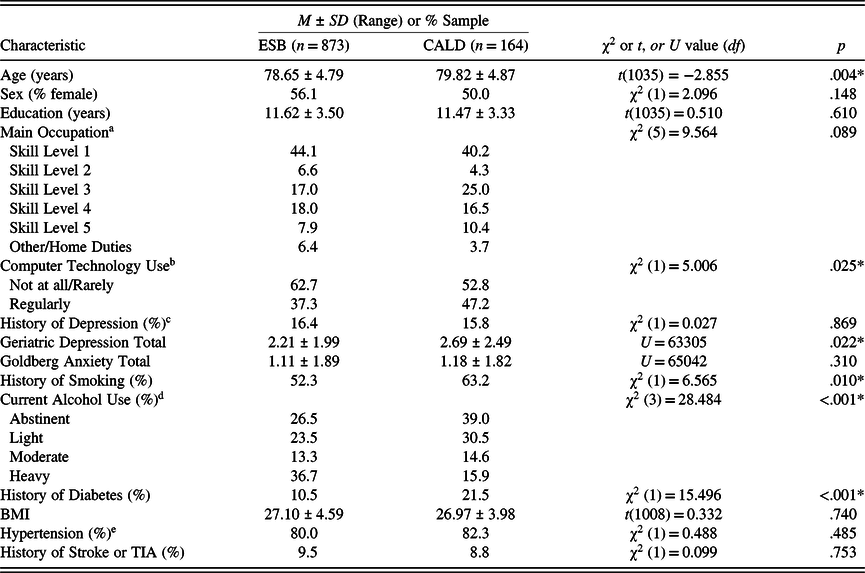
Sample demographics and clinical characteristics are presented in Table 1 for CALD and ESB participants. CALD participants were significantly older, had higher GDS scores, reported less alcohol consumption, had higher rate of history of smoking, and reported higher incidence of diabetes than ESB participants. Additionally, CALD participants reported more regular computer technology use than ESB participants. No significant differences were observed between groups for sex, education, main occupation skill level, history of self-reported depression or anxiety, BMI, hypertension, or history of stroke/TIA.
Comparison of ESB and CALD participant demographics and clinical characteristics

Note. ESB = English-speaking background; CALD = Culturally and Linguistically Diverse.
a Occupations are grouped according to the ABS Skill Level as outlined by McLennan (Reference McLennan1997).
b For Computer Technology Use, responses “not at all”, “once a year”, or “several times a year” were stratified as “Not at all/Rarely” and responses “several times a month” and “regularly” were stratified as “Regularly”.
c History of depression n ESB = 844 and n CALD = 158.
d Current Alcohol Use was categorised as per Topiwala et al. (Reference Topiwala, Allan, Valkanova, Zsoldos, Filippini, Sexton and Ebmeier2017).
e Hypertension was classified based on previous diagnosis and/or systolic blood pressure >140 or diastolic blood pressure of >90 at assessment.
* p < .05.
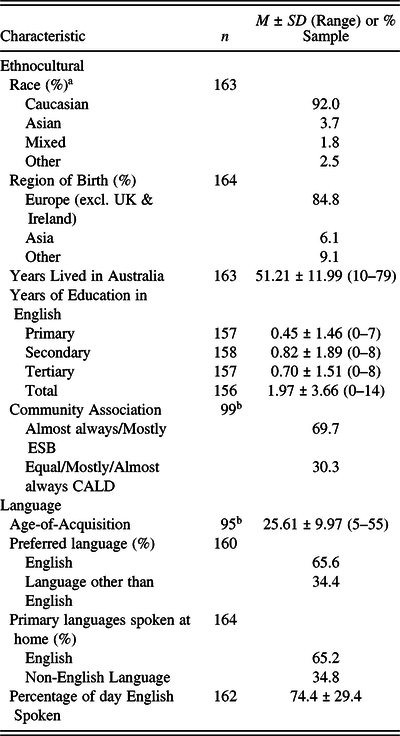
ANCOVA covariates selected based on p < .10 criteria were: occupation level, computer technology use, GDS, history of smoking, current alcohol use, and history of diabetes. Age, sex, and education were also included as covariates. The CALD sample linguistic and acculturation characteristics are outlined in Table 2. The majority of CALD participants were born in Europe (84.8%), identified as “Caucasian” (92.0%), and associated primarily with the ESB community. On average, they had lived in Australia for more than 50 years, representing most of their adult life. On average, CALD participants had comparable years of education to ESB participants (11.47 years) but limited years of education in English (1.97 years). The majority of CALD participants reported English as their preferred language (65.6%), main language spoken at home (65.2%), and language spoken for the majority (74.4%) of their day.
CALD sample linguistic and acculturation characteristics

Note. CALD: Culturally and Linguistically Diverse.
a No participant responses to “Indigenous Australian/Torres Strait Islander”, “African”, or “Pacific Islander” for racial identification.
b Community Association and age-of-acquisition were collected at MAS Wave 4 with a reduced sample size due to attrition.
PnPA and CNA global cognitive performance
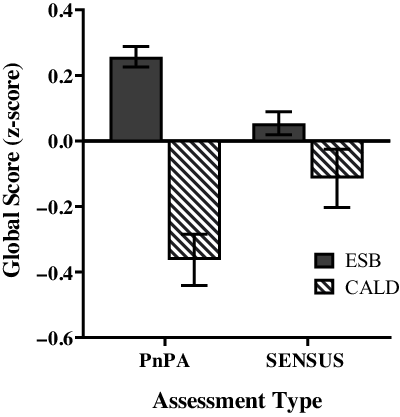
A 2 × 2 repeated measures ANCOVA was conducted on global cognition scores to examine differences between group and assessment type after controlling for covariates (age, sex, education, occupation level, computer technology use, GDS, history of smoking, current alcohol use, and history of diabetes). A significant interaction between group and assessment type was observed [F(1,732) = 32.61, p < .001, ηp 2 = .043] (Figure 1), as well as a significant main effect of group ([F(1,732) = 23.47, p < .001, ηp 2 = .031]). ESB participants had higher global cognition scores than CALD participants on PnPA [F(1,732) = 54.14, p < .001, ηp 2 = .069; M ESB = 0.257, SEM ESB = 0.031, M CALD = −0.363, SEM CALD = 0.078], while the difference was not significant on CNA [F(1,732) = 3.03, p = .082, ηp 2 = .004; M ESB = 0.054, SEM ESB = 0.035, M CALD = −0.114, SEM CALD = 0.089].
Estimated means of global z-scores from 2 × 2 repeated measures ANCOVA (CALD status × Assessment type). Estimated means are presented for English-speaking background (ESB; n = 610) and Culturally and Linguistically Diverse (CALD; n = 110) participants.
Note: Error bars represent SEM.

PnPA and CNA individual cognitive test performance
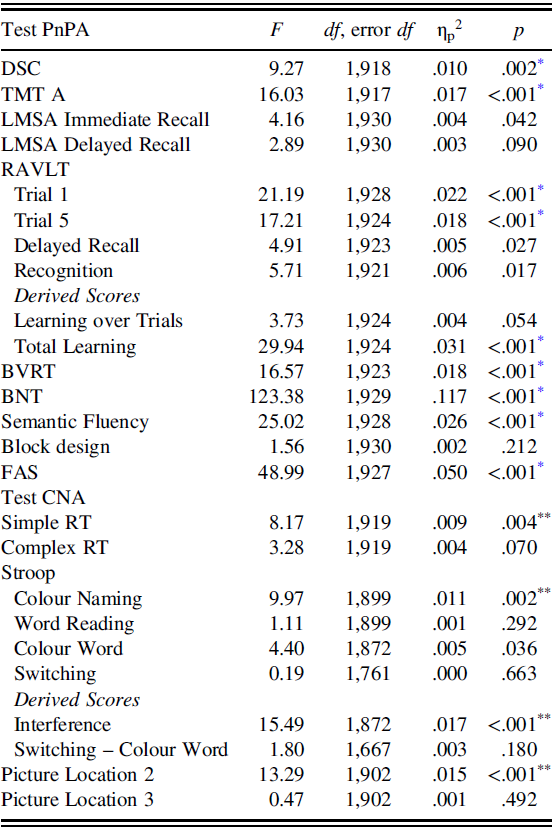
A series of adjusted one-way ANCOVAs were performed to determine the effect of CALD status on each of the PnPA and CNA individual test scores. See Appendix B for complete results.
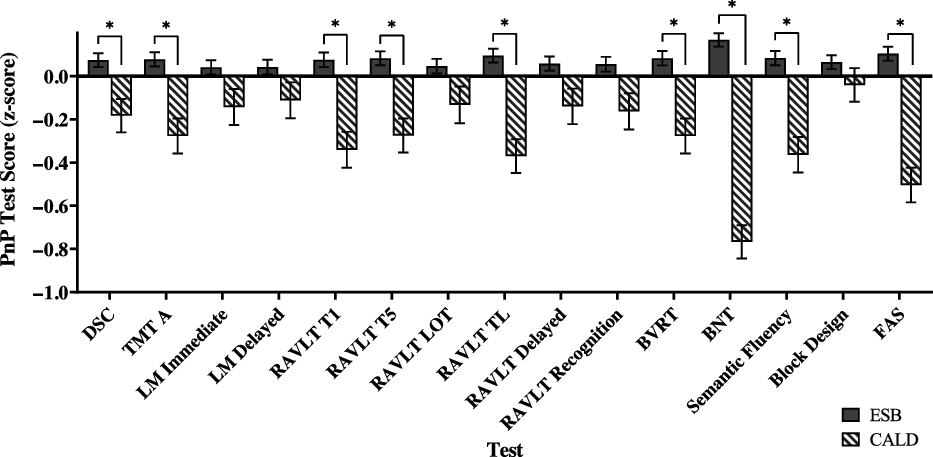
On PnPA, ESB participants performed better than CALD participants on DSC; TMT A; RAVLT Trial 1, Trial 5, and Total Learning; BVRT; BNT; Semantic Fluency; and FAS. There were no significant differences between groups on LM Immediate or Delayed Recall; RAVLT Learning over Trials, and Recognition; or Block Design. This pattern remained after Bonferroni correction for multiple comparisons. Figure 2 presents adjusted means for each test.
Estimated means of PnPA individual test z-scores from one-way ANCOVAs. Estimated means are presented for English-speaking background (ESB) and Culturally and Linguistically Diverse (CALD) participants.
Note: *p < .003. All p values are according to Bonferroni correction for multiple comparisons. Error bars represent SEM.

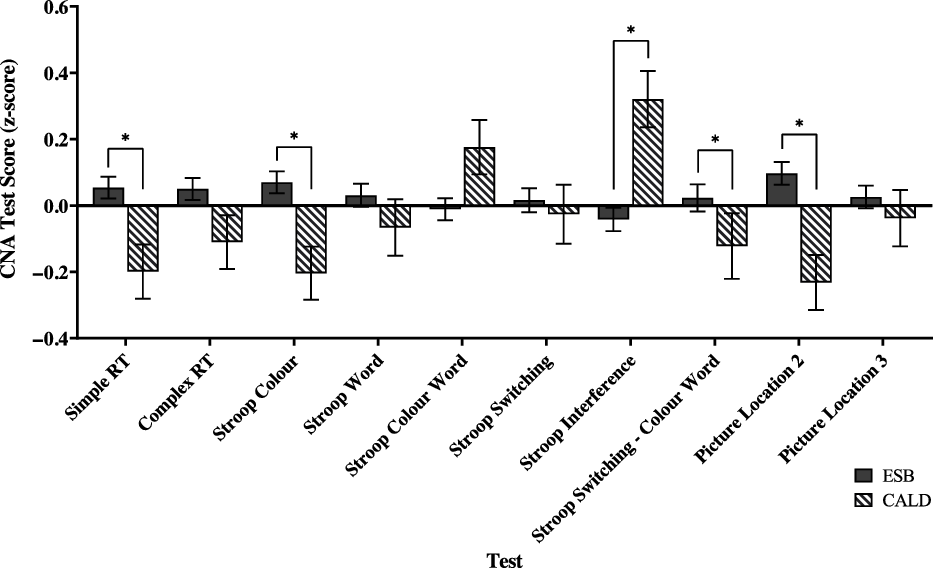
On CNA, ESB participants performed significantly better than CALD participants on Simple RT, Stroop Colour Naming, and Picture Location 2. CALD participants outperformed ESB participants on Stroop Interference. There were no significant differences between groups on Complex RT; Stroop Word naming, Colour-Word, Switching, and Switching minus Colour-Word; and Picture Location 3. This pattern remained after Bonferroni correction for multiple comparisons. Figure 3 presents adjusted means for each test.
Estimated means of CNA individual test z-scores from one-way ANCOVAs. Estimated means are presented for English-speaking background (ESB) and Culturally and Linguistically Diverse (CALD) participants.
Note:*p < .005. All p values are according to Bonferroni correction for multiple comparisons. Error bars represent SEM.

Explanatory variables for CALD performance on PnPA and CNA
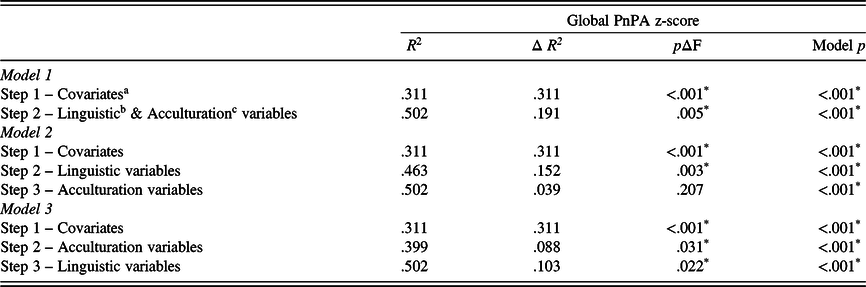
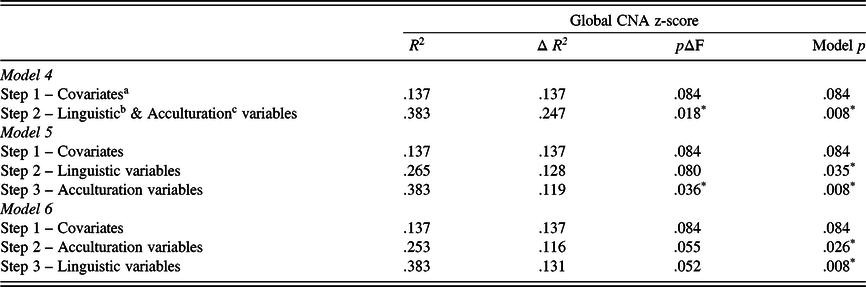
Two sets of hierarchical multiple regression analyses were performed to identify the extent to which linguistic and acculturation variables explained variance in CALD global cognition performance above that accounted for by covariates (age, sex, education, computer technology use) for PnPA (Models 1–3; Table 3) and CNA (Models 4–6; Table 4). See Supplemental Materials for complete regression results.
Hierarchical multiple regression of linguistic and acculturation variables which explain variance in CALD global cognition composite derived from PnPA performance

Note. n CALD = 72 due to reduced sample size for variables collected at Wave 4 (6-year follow-up) and missing data. Only cases with complete data were included in analyses.
a Age, sex, education, computer technology use.
b Age-of-acquisition, preferred language, percentage of day English spoken, frequency of non-English languages spoken.
c Years of residency in Australia, years of education in English, community association.
* p < .05.
Hierarchical multiple regression of linguistic and acculturation variables which explain variance in CALD global cognition composite derived from CNA performance

Note. n CALD = 60 due to reduced sample size for variables collected at Wave 4 (6-year follow-up) and missing data. Only cases with complete data were included in analyses.
a Age, sex, education, computer technology use.
b Age-of-acquisition, preferred language, percentage of day English spoken, frequency of non-English languages spoken.
c Years of residency in Australia, years of education in English, community association.
* p < .05.
For PnPA, linguistic and acculturation variables explained a significant proportion of variance in participants’ global cognition scores for all models. In Model 1, linguistic and acculturation variables together explained an additional 19.1% of global cognition PnPA z-score variance after controlling for covariates. Australian residency was a significant individual predictor (Step 2). In Model 2, linguistic variables explained 15.2% of global cognition PnPA z-score variance after controlling for covariates, but additional variance explained by acculturation variables (3.9%) was not statistically significant. Age-of-acquisition and language preference (Step 2), and years of Australian residency (Step 3) were significant individual predictors. In Model 3, acculturation variables explained 8.8% of variance in global cognition PnPA z-scores above covariates, and linguistic variables explained a further 10.3% of variance. Age-of-acquisition was an individual significant predictor (Steps 2 and 3).
For CNA, linguistic and acculturation variables also explained a significant proportion of variance in participants’ global cognition scores for all models. In Model 4, linguistic and acculturation variables together explained an additional 24.7% of global cognition CNA z-score variance after controlling for covariates. Frequency using a language other than English and years of education in English (Step 2) were significant individual predictors. In Model 5, linguistic variables explained an additional 12.8% of global cognition CNA z-score variance after controlling for covariates, and acculturation variables explained an additional 11.9% of variance. Age-of-acquisition (Step 2), and frequency of using languages other than English and years of education in English (Step 3) were significant individual predictors. In Model 6, acculturation variables explained an additional 11.6% of global cognition CNA z-score variance after controlling for covariates, and linguistic variables explained a further 13.1% of variance. Age-of-acquisition and language preference (Step 2), and age-of-acquisition and community association (Step 3) were significant individual predictors.
DISCUSSION
To our knowledge, this study is one of the first to address how cultural bias impacts both PnPA and CNA tools in older adult CALD populations. We examined differences between ESB and CALD participants from MAS across a comprehensive PnPA and a newly developed CNA (SENSUS). We further investigated the influence of several linguistic and acculturation variables on global cognition scores derived from PnPA and CNA for CALD participants.
As hypothesised, CALD participants demonstrated poorer global cognitive performance and poorer performance on select individual tests than ESB participants on both assessment types, with a greater difference emerging between groups on PnPA but no significant difference on CNA, after controlling for possible confounders. Additionally, we found that linguistic and acculturation variables explained approximately 20% and 25% of global cognitive performance on PnPA and CNA respectively, after controlling for age, sex, years of education, and computer technology use. These findings support the current body of literature demonstrating a CALD disadvantage on a range of widely used neuropsychological tests compared to ESB individuals when assessed in English (Boone et al., Reference Boone, Victor, Wen, Razani and Ponton2007; Kochan et al., Reference Kochan, Slavin, Brodaty, Crawford, Trollor, Draper and Sachdev2010; Krch et al., Reference Krch, Lequerica, Arango-Lasprilla, Rogers, DeLuca and Chiaravalloti2015; Razani, Burciaga, Madore, & Wong, Reference Razani, Burciaga, Madore and Wong2007). Whilst this finding somewhat supports the claim that CNAs may be a more culturally-appropriate alternative than PnPAs for CALD individuals, it also highlights that CNAs do not eliminate group differences – and CALD disadvantage on cognitive assessment – entirely.
In terms of individual test performance, the PnPA results show that ESB participants consistently outperformed CALD participants on BNT, Semantic Fluency, and FAS, which are all heavily mediated by language. The biggest difference between groups was apparent on the BNT, which supports prior findings (Boone et al., Reference Boone, Victor, Wen, Razani and Ponton2007; Pedraza et al., Reference Pedraza, Graff-Radford, Smith, Ivnik, Willis, Petersen and Lucas2009) that the BNT stimuli are not common to all cultures and may systematically disadvantage CALD participants. Further, CALD participants performed poorer than ESBs on word generation tests (FAS and Semantic Fluency). In addition to any differences in English vocabulary size between the ESB and CALD groups, bilinguals and multilinguals with good functional English proficiency, such as the CALD participants in our study, may experience disadvantages in lexical retrieval (Bialystok, Reference Bialystok2009). Better ESB performance was also found on RAVLT Trials 1, 5 and Total Learning, which correspond to initial learning (i.e., the acquisition phase of memory). Contrastingly, no significant group differences were found on RAVLT Learning over Trials, Delayed Recall, or Recognition. This is consistent with previous studies that report initial learning (especially Trial 1) is most influenced by acculturation/culture variables, while Delayed Recall and Recognition are largely unaffected (Boone et al., Reference Boone, Victor, Wen, Razani and Ponton2007; Kennepohl, Shore, Nabors, & Hanks, Reference Kennepohl, Shore, Nabors and Hanks2004; Poreh, Sultan, & Levin, Reference Poreh, Sultan and Levin2012). Overall, this suggests that selectively using RAVLT Learning over Trials, Delayed Recall, and Recognition may provide a more culturally-appropriate assessment approach for older CALD adults.
On CNA, contrary to our hypothesis, CALD participants had reduced Stroop Interference effect compared to their ESB counterparts. The Stroop Interference measure reflects the time difference between Stroop Colour-Word (reading words in incongruous ink) and Stroop Colour Naming (naming patches of colour). We observed poorer CALD performance on Colour Naming, consistent with slower lexical retrieval in a second language (Hanulová, Davidson, & Indefrey, Reference Hanulová, Davidson and Indefrey2011), language-specific differences in colour names (Thierry, Athanasopoulos, Wiggett, Dering, & Kuipers, Reference Thierry, Athanasopoulos, Wiggett, Dering and Kuipers2009), and the CALD disadvantage in lexical retrieval we observed in the BNT scores. Conversely, CALD participants outperformed ESB participants on Colour-Word. One explanation is that CALD participants demonstrated less automaticity in reading words compared to naming colours in the Colour-Word condition due to lower proficiency in English language reading, by contrast with highly automatic colour word reading by ESB participants, leading to reduced Stroop Interference in the CALD group (MacLeod, Reference MacLeod1991; Naylor, Stanley, & Wicha, Reference Naylor, Stanley and Wicha2012). Another explanation is that CALD participants demonstrated a bilingual advantage in executive control and inhibition, as our result was consistent with previous research on bilingualism and attentional control (Bialystok, Craik, & Luk, Reference Bialystok, Craik and Luk2008; Miyake et al., Reference Miyake, Friedman, Emerson, Witzki, Howerter and Wager2000). Data on the bilingual/monolingual status of the ESB group were not available, however, to indicate whether some participants in the ESB group also benefitted from a bilingual advantage in attentional control in the present study. Therefore, while it is clear that the derived Stroop Interference score for the CALD participants reflects the absolute value of their slower colour naming latency plus the absolute value of their faster naming of ink colours in the presence of a competing colour name, it is unclear whether this indexes slower lexical retrieval and less automatic word reading or superior attentional control in bilingual and multilingual relative to monolingual individuals. This warrants closer investigation in future studies with more comprehensive information on both CALD and ESB groups’ language status.
In line with our hypothesis and consistent with previous studies (Razani et al., Reference Razani, Burciaga, Madore and Wong2007), several tests measuring processing speed and attention were impacted by CALD status when individuals were assessed in their non-native language, English. This pattern of performance was evident in PnPA (Digit Symbol and TMT A) and CNA (Simple RT), but not on the CNA Complex RT task. The CALD disadvantage in processing speed cannot therefore be attributed to slower processing speed of non-native language instructions inducing slower processing speed during testing, as there was no CALD disadvantage on the Complex RT task. It may be that CALD performance on Complex RT benefitted from superior bilingual attentional control (Bialystok et al., Reference Bialystok, Craik and Luk2008), and that group differences on speeded tasks were otherwise influenced by culturally mediated approaches to speed-accuracy trade off. Cultural differences in time-specific attitudes and behaviours (i.e., time orientation and chronemics) may influence whether speed or accuracy is prioritised (Agranovich, Panter, Puente, & Touradji, Reference Agranovich, Panter, Puente and Touradji2011; Hayden et al., Reference Hayden, Makeeva, Newby, Plassman, Markova, Dunham and Investigators2014). Assessment of processing speed in ESB versus CALD individuals requires further investigation.
In terms of visual memory, CALD participants performed worse than ESB participants on both BVRT (PnPA) and Picture Location 2 (CNA). This suggests that CALD disadvantage is not removed by making a memory task “nonverbal” or by using visual stimuli, either abstract figures or illustrations of common everyday objects as used in this study. Further, some tests within the existing PnPA “toolkit” may not demonstrate differences between ESB and CALD performance. In the present study, in addition to the RAVLT measures noted above, Block Design also appeared robust to CALD differences, because this test relies on visual models and illustrations supporting the verbal instructions and measures perceptual reasoning.
Hierarchical regression results indicate a significant influence of linguistic and acculturation variables on global CALD PnPA and CNA performance. In support of our hypotheses, linguistic and acculturation variables together explained 19.1% of variance in global cognitive performance for the PnPA and 24.7% of global cognitive performance for the CNA, over and above all covariates.
For PnPA, linguistic variables accounted for significantly more variance in global cognition z-scores (15.2%) over acculturation variables whereas acculturation variables accounted for minimal additional variance above linguistic variables (3.9%). By contrast, for CNA, there was an approximately symmetrical amount of additional variance accounted for by acculturation variables (11.9%) above linguistic variables (12.8%), to that accounted for by linguistic variables (13.1%) above acculturation variables (11.6%). Several linguistic and acculturation variables were significant individual predictors across the six hierarchical regression models. For PnPA these were (Age-of-acquisition, language preference, and years of residency in Australia) and for CNA (Age-of-acquisition, language preference, non-English use, years of education in English and community association). In conjunction with the ANCOVA results, there is clearly a complex interplay between a range of linguistic and acculturation variables and performance on PnPA and CNA batteries. Future research will require systematic investigation of linguistic and acculturation variables to better capture the influence of CALD status on both PnPA and CNA performance. We are currently developing a self-report questionnaire to capture these variables of interest.
When interpreting our findings, it is important to consider the composition of our CALD sample and whether it is representative of the broader Australian CALD population. Detailed region and country of birth for CALD participants are presented in Appendix C. The majority of our CALD participants were born in Eastern Europe (42.1%) and Western Europe (25.0%), representing a wave of migration during and immediately post-war (1930s–1940s) (Markus, Jupp, & McDonald, Reference Markus, Jupp and McDonald2009). This differs from the South-Eastern European (11.6%) and Southern European (5.5%) CALD groups, who arrived in the 1950s and 1960s, and now represent a larger proportion of older CALD Australians (Wilson, Temple, Brijnath, Mcdonald, & Utomo, Reference Wilson, Temple, Brijnath, Mcdonald and Utomo2021). Notably, unlike their Eastern and Western European counterparts, South Eastern and Southern European migrants generally had lower levels of education and primarily worked in manual labour jobs that required minimal English proficiency (Mcdonald, Moyle, & Temple, Reference Mcdonald, Moyle and Temple2019; Wilson, Mcdonald, Temple, Brijnath, & Utomo, Reference Wilson, Mcdonald, Temple, Brijnath and Utomo2020) and were largely able to live their day-to-day lives in cultural and linguistic enclaves (Krupinski, Reference Krupinski1984). This suggests that our CALD sample, drawn from the Eastern Suburbs of Sydney, may have higher levels of English proficiency, higher socio-economic status, and ultimately less disadvantage than the wider ageing Australian CALD population. Despite this, we observed significant differences in CALD cognitive performance compared to that of the ESB group. This has critical clinical implications. Normative data and cut-off scores drawn from ESB populations should only be used with caution to interpret performance of CALD individuals on current “gold-standard” PnPAs, despite high levels of English proficiency and acculturation and regardless of whether the individual reports English as their preferred and/or dominant language. Importantly, as these widely used normative and cut-off measures were largely developed for a well-educated, English-speaking population we cannot assume the same patterns and level of performance will apply for CALD individuals. Most importantly, the greatest differences and associated bias in assessment would be seen in CALD groups with greater disparities relative to ESB level of English proficiency, education levels, and employment.
The changing trajectories of CALD populations must also be considered. A recent study by Wilson et al. (Reference Wilson, Mcdonald, Temple, Brijnath and Utomo2020) which presented migrant population growth projections for Australia found that older overseas-born groups will shift from a Europe-born to Asia-born dominance, largely driven by cohort flow. Further, there is significant variability between and within CALD groups not only in Australia, but around the world. For example, Australia has more dynamic migrant-based CALD groups defined by language (Wilson et al., Reference Wilson, Temple, Brijnath, Mcdonald and Utomo2021) compared to the US, which has more established CALD groups such as Black non-Hispanics, defined by ethnicity. This has important clinical applications. Given the range of CALD linguistic and acculturation variables that potentially affect performance on cognitive assessment, and the heterogeneity across and within CALD populations, further studies are necessary to characterise the influence of CALD status on cognitive assessment performance, especially in the emerging CALD groups of the future, in order to develop guidelines for clinical practice and develop culturally robust tools to ensure older CALD individuals receive an accurate and timely diagnosis of MCI or dementia.
Notably, this study has several important strengths. First, we investigated the influence of CALD status on PnPA and CNA performance in a large community sample of ESB and CALD participants at both a global composite and individual test-level. The test-level focus allowed us to identify specific tests and their sub-measures which may be robust to CALD differences and subsequently guide clinicians on tailoring a more culturally-appropriate assessment battery for older CALD adults. Second, we included a number of relevant linguistic and acculturation factors whilst controlling for a broad range of potential medical risk factors.
A limitation is that our CALD sample represents a very specific cohort from a European background, with good English proficiency, well-educated, and higher SES and cannot be considered generally representative of the heterogeneity in the Australian CALD population as a whole given the changes over time to migration trajectories and CALD demographic transitions discussed above. Lastly, this study utilised legacy data from the broader MAS which did not focus specifically on CALD participants. This limited the use of more comprehensive and objective language measures as well as self-report acculturation scales. We recommend that future studies include such measures that are appropriate and validated for the CALD groups of interest. Future studies should investigate additional linguistic and acculturation variables, as well as additional sociodemographic and health variables (including, but not limited to, SES, migration history, religious background, test-taking anxiety, and early life adversity) in CALD groups, especially those with greater levels of disparity and those predicted to grow in the future.
CONCLUSIONS
Our finding that CALD status had a greater influence on PnPA performance than CNA performance suggests that CNAs have promise as more culturally-appropriate tools for the cognitive assessment of older CALD populations. However, whilst the CNA in our study was more culturally-appropriate than the PnPA, further investigation of the suitability, validity, and acceptability of CNAs in older CALD samples is essential. Further, our study adds to the limited literature on older adult CALD and ESB group differences across PnPAs and CNAs by providing evidence for the significant and interwoven influence of linguistic and acculturation variables on the neuropsychological assessment of older CALD individuals, specifically this Australian cohort of proficient multilinguals.
SUPPLEMENTARY MATERIAL
For supplementary material accompanying this paper visit https://doi.org/10.1017/S1355617721001314
ACKNOWLEDGEMENT
We thank the participants and their informants for their time and generosity in contributing to this research. We also acknowledge the MAS research team: https://cheba.unsw.edu.au/research-projects/sydney-memory-and-ageing-study.
FINANCIAL SUPPORT
The Sydney Memory and Ageing Study has been funded by three National Health & Medical Research Council (NHMRC) Program Grants (ID No. ID350833, ID568969, and APP1093083). This work was additionally supported by the NHMRC Boosting Dementia Research Grant (APP1135908).
CONFLICT OF INTEREST
None.
Appendix A Linguistic & Acculturation Questions for CALD participants
Wave 1:
-
Which race do you identify with? [categorical select: Caucasian/ Asian/ Indigenous and/or Torres Strait Islander/ African/ Pacific Islander/ Mixed/ Other, free response]
-
In which country were you born? [string, free response text]
-
What year did you arrive in Australia? [continuous, free response numeric]
-
Main language spoken at home? [string, free response text]
-
What is your preferred language? [string, free response text]
-
What percentage (%) per day do you speak English? [continuous, free response numeric]
-
How old were you when you could first speak English at a basic conversational level? [categorical: ≤9 or >10]
-
Was any of your schooling conducted in English? [continuous free response for primary, high school, and university/College/TAFE)
-
What proportion of your reading material (newspapers, magazines or books) is in English? [categorical select: All/Most/Equal 50–50/Least/None/Missing]
-
How often do you read English language newspapers, magazines or books? [categorical select: Daily/At least once a week/ Occasionally/ Rarely/ Never/ Missing]
-
Whom do you associate with in the community? [categorical select: Almost always my NESB group/ Mostly my NESB group/ Equally with my NESB group and English speakers /Mostly English speakers /Almost always English speakers /Missing]
Wave 4:
-
What age did you first speak English fluently at a conversational level?[continuous, free response numeric]
-
What other languages do you speak fluently at a conversational level? [string, free response text]
-
How often do you speak this language? (for each language listed above) [categorical select: Daily/Weekly/Monthly/Less than monthly/Missing]
-
What languages can you read and write? [string, free response text]
Appendix B
Comparison of ESB and CALD participants’ individual test performance for PnPA and CNA

Note. All p values are according to Bonferroni correction for multiple comparisons.
Appendix C

Note. CALD = Culturally and Linguistically Diverse. Region and Country of Birth are presented for CALD sample. Region of Birth classified according to Australian Bureau of Statistics (2016), Standard Australian Classification of Countries (SACC).