Introduction
In America, the South American fruit fly Anastrepha fraterculus (Wiedemann) (Diptera: Tephritidae) is a major fruit pest with a wide distribution ranging from southern USA to central Argentina (Salles, Reference Salles1995; Malavasi et al., Reference Malavasi, Zucchi, Sugayama, Malavasi and Zucchi2000). It attacks more than 100 host plants (Norrbom, Reference Norrbom2004), many of which have a high commercial value. Currently, the only method available to suppress A. fraterculus populations is the application of an insecticide, which depending on the region is malathion or spinosad. Therefore, environmentally safe methods, e.g. the sterile insect technique (SIT) (Knipling, Reference Knipling1955), are being proposed for integration with other control tactics (Ortiz, Reference Ortiz1998). In Argentina, A. fraterculus is present in the north-east and north-west regions of the country, with its distribution overlapping with that of Ceratitis capitata (Wiedemann). It mainly infests guavas (Psidium guajava), mangoes (Mangifera indica), peaches (Prunus persica) and, to a lesser extent, some citrus species such as grapefruit (Citrus paradisi) (Ovruski et al., Reference Ovruski, Schliserman and Aluja2003; Segura et al., Reference Segura, Vera, Cagnotti, Vaccaro, de Coll, Ovruski and Cladera2006; Oroño et al., Reference Oroño, Albornoz-Medina, Núñez-Campero, Van Nieuwenhove, Bezdjian, Martin, Schliserman, Ovruski, Sugayama, Zucchi, Ovruski and Sivinski2008). The success of the suppression and eradication programmes against C. capitata in the region of Patagonia and the province of Mendoza, areas where A. fraterculus is not present, has encouraged the use of the SIT in those areas where the two species coexist (Guillén and Sánchez, Reference Guillén, Sánchez, Vreysen, Robinson and Hendrichs2007). This has strengthened the need to develop a SIT for use against A. fraterculus.
The SIT has been used successfully in suppression and eradication programmes against many fruit fly species belonging to the Tephritidae family (Enkerlin, Reference Enkerlin, Dyck, Hendrichs and Robinson2005). A key aspect of the success of applying the SIT is the development of cost-effective mass-rearing protocols. The rearing diet has become the single most important component (Parker, Reference Parker, Dyck, Hendrichs and Robinson2005). Knowledge about the insect's nutrient requirements as well as the local availability and affordability of diet components is of utmost importance for developing an artificial diet. Progress in such a task is based on the composition of the natural food and the mechanisms used by the insect to obtain necessary nutrients. Artificial larval diets should provide the essential nutrients that enable individuals reared in the laboratory to perform properly (Singh, Reference Singh1977). Moreover, the diets should promote the availability of the nutrients to the insect and should remain in an adequate condition until the completion of development.
Apart from the nutrients, artificial diets contain components that contribute to the texture and stability of the diet as well as to the availability of nutrients; these include emulsifiers, stabilizers, gelling agents, bulking agents, pH modifiers and preservatives such as antimicrobials and antioxidants (Cohen, Reference Cohen2004). Gelling and bulking agents provide a texture that ensures larval movement through the diet and the dissipation of metabolic heat. In this regard, much of the research on fruit fly larval diets has concentrated on bulking agents (Tanaka et al., Reference Tanaka, Steiner, Ohinata and Okamoto1969; Katiyar, Reference Katiyar1970; Tanaka et al., Reference Tanaka, Hart, Okamoto and Steiner1972; Vargas et al., Reference Vargas, Chang and Williamson1983; Artiaga-López et al., Reference Artiaga-López, Hernández, Domínguez-Gordillo, Moreno, Orozco-Dávila and Barnes2004). However, the use of inert substrates has recently been emphasized, especially those that can be recycled (Fay and Wornoayporn, Reference Fay and Wornoayporn2002; Chang et al., Reference Chang, Caceres and Jang2004, Reference Chang, Vargas, Caceres, Jang and Cho2006). The two main reasons for this, among others, are the risk of insecticidal residues on some bulking agents, e.g. wheat bran, and the large volumes of spent diet that require disposal (Chang et al., Reference Chang, Caceres and Jang2004). The availability of nutrients such as sugar (as a source of energy) and protein is likewise very important. Although protein is a valuable and scarce resource in host fruits (Moreno et al., Reference Moreno, Ortega-Zaleta and Mangan1997), in artificial diets the addition of too much protein (one of the most expensive components) is detrimental to insect development (Chang, Reference Chang2009). This is probably due to the high efficiency of fruit fly larvae to incorporate protein from poor sources. For example, in C. capitata, an excess of protein in the larval diet is not transferred to the adult and is probably deposited in the exocuticle (Nestel et al., Reference Nestel, Nemny-Lavy and Chang2004). Another important feature of a diet is the pH. The pH influences the palatability and stability of the diet, the activity of preservatives, the solubility of nutrients and probably many other not yet determined factors (Cohen, Reference Cohen2004).
Much of the research that has been conducted during the last decade to develop mass-rearing protocols has been focused on establishing laboratory colonies particularly aiming at increased egg production (Jaldo, Reference Jaldo2001; Jaldo et al., Reference Jaldo, Gramajo and Willink2001; Vera et al., Reference Vera, Abraham, Oviedo and Willink2007) and improved adult feeding (Oviedo et al., Reference Oviedo, Nestel, Papadopoulos, Ruiz, Prieto, Willink and Vera2011). Still, the larval diet most widely used to rear A. fraterculus is the one developed by Salles (Reference Salles1995). Its main components are sugar, wheat germ and brewer's yeast as nutrients in equal proportions and agar as the diet matrix. Agar is an expensive component of the diet and has the drawback that if the diet is too wet, it prevents the larvae from leaving it in search of a pupation substrate. In addition, the pH currently used is 4.5, which in some cases results in microbial growth and early deterioration of the diet. The recent finding that an excess of protein is detrimental to larval development raises the question whether the proportions of sugar, wheat germ and brewer's yeast used are optimal. All together, these constraints make it difficult to use this diet on a large scale, and thus it is necessary to explore adequate alternatives. The objective of the present study was to evaluate some larval diets for A. fraterculus, taking into account various supports or bulking agents, nutrient proportions and the pH of the diet. Evaluations were made on a small scale to obtain a diet that could then be tested on a large scale.
Materials and methods
Biological material
Eggs of A. fraterculus were obtained from a colony established at the Agriculture Zoology Laboratories of the Estación Experimental Agroindustrial Obispo Colombres, Tucumán, Argentina. This colony was initiated in 1997 with pupae obtained from infested guava fruit, collected in the vicinity of Tafi Viejo, Tucumán (north-west Argentina), and has been characterized as A. sp. 1 aff. fraterculus (Jaldo, Reference Jaldo2001). Standard rearing procedures were followed (Jaldo et al., Reference Jaldo, Gramajo and Willink2001; Vera et al., Reference Vera, Abraham, Oviedo and Willink2007). Adult holding cages contained an oviposition panel made from cloth covered with a thin silicon layer that promotes female oviposition. To prevent dehydration, moist foam rubber was applied to the outer side of the oviposition panel and held with clips onto a transparent polycarbonate panel attached to the cage. After 24 h, the foam rubber was removed and eggs were collected from the oviposition panel using a moist cloth. The volume of eggs obtained from each cage was measured, and a fixed volume was diluted at 5% in water. Eggs were air-bubbled with a pump for 48 h before being used in the experiments.
General procedures
Various diets were evaluated. In each trial, eggs (45 eggs/ml of diet) were seeded onto various diets that had been placed into plastic trays (17 × 13 × 4.5 cm) for larval development. These trays were then placed into larger trays (30.5 × 22 × 9.5 cm) containing a layer of vermiculite and were covered with a cloth and held at 25 ± 1°C and 70 ± 10% relative humidity. On the completion of development, the larvae crawled out of the diet and pupated in the vermiculite. The vermiculite was sieved 2 days before adult emergence and the pupae were weighed. For each replicate, a sample of 100 pupae was weighed and placed in a Petri dish to await adult emergence. After all the flies had died, the numbers of emerged adults (both fliers and deformed flies) and non-emerged flies (dead pupae) were recorded (FAO/IAEA/USDA, 2003). In addition, after 5 days, the mean egg hatchability was determined by deducting the number of unhatched eggs from three samples of 100 eggs placed on a moist sponge cloth.
Formulation of diets
All diets were derived from the diet proposed by Salles (Reference Salles1995): (i) sugar (Ledesma, Libertador San Martín, Jujuy, Argentina), wheat germ (Grandiet, Córdoba, Argentina) and brewer's yeast (CALSA®, Argentina) in equal proportions (6%) as nutrients; (ii) methylparaben and sodium benzoate (0.3% each); (iii) citric acid to maintain a pH of 3.5 (0.4%); (iv) agar as an inert support (0.4%); and (v) water (80.6%). To evaluate different aspects of the diet, namely the support, gelling or bulking agent, the sugar content, the nutrient proportion and the pH, four series of experiments were carried out.
Diet support
In this series of experiments, only the support (gelling or bulking agent) was changed, while the nutrient and preservative proportions were the same. The following inert supports were tested: agar (as in the original formulation), sponge cloth (as proposed by Chang et al. (Reference Chang, Caceres and Jang2004, Reference Chang, Vargas, Caceres, Jang and Cho2006)) and sugarcane bagasse (a locally available bulking agent obtained from sugarcane mills). Larval diets were prepared on the same day the experiment was initiated. The ingredients were weighed and then blended into the corresponding amount of tap water until fully dissolved and homogeneously suspended.
For the agar-based diet, half of the water was heated and the agar was completely dissolved in it at boiling temperature. This was then mixed with the water containing the ingredients and poured into plastic trays as described by Salles (Reference Salles1995). The diet was used in the experiments after cooling to 26°C.
For the sugarcane bagasse-based diet, 6.5 g of sugarcane bagasse were manually mixed in every 100 ml of diet, and then 300 ml of this diet were poured into each tray.
For the sponge cloth support diet, the procedures described by Chang et al. (Reference Chang, Caceres and Jang2004, Reference Chang, Vargas, Caceres, Jang and Cho2006) were used. Two pieces of sponge cloth (Mortimer, The Clorox Company, Aldo Bonzi, Argentina) were used for each larval tray – one piece (12 × 9 cm) at the bottom of the tray and the other (12 × 4.5 cm) on top of it (above which eggs were seeded). The sponge pieces were rinsed in water and wrung dry before being placed in the tray. First, the bigger sponge piece was placed into the tray and the liquid diet was poured onto it; then, the smaller sponge piece was placed and the eggs were seeded.
Seven different egg batches were used: four during 2006 and three during 2007. Within each batch, three trays (i.e. replicates) were seeded for each diet. General procedures were followed, and in the experimental series of 2006, development was assessed until adult emergence, while in the experimental series of 2007, only larval development was assessed and the experiment was complete once the larvae pupated.
Sugar content
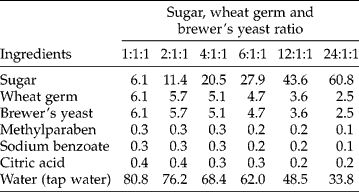
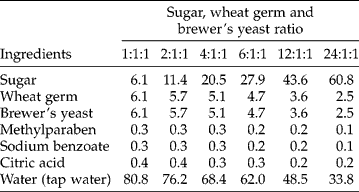
In this series of experiments, six different diets with different amounts of sugar were evaluated (Table 1). Diet preparation and seeding procedures were the same as those described above, and sponge cloth was used as the diet support. Experiments were conducted during 2008 and 2009 with three egg batches being evaluated with four, six and six replicates per diet. Development was followed until adult emergence.
Composition (%) of the larval diets used in the experiments evaluating sugar contents
Nutrient proportion
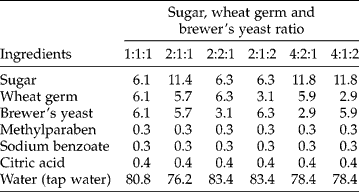
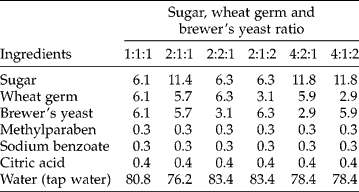
In this series of experiments, different ratios were evaluated for the three nutrients: sugar, wheat germ and brewer's yeast (Table 2). Diet preparation and seeding procedures were the same as those described above, and sponge cloth was used as the diet support. Experiments were carried out during 2009 with two egg batches being evaluated with six replicates per diet in each egg batch. Development was followed until adult emergence.
Composition (%) of the larval diets used in the experiments evaluating various nutrient proportions
Diet pH
In this series of experiments, three pH values – 4.5, 4.0 and 3.5 – and three acids – citric acid, ascorbic acid (Todo Droga S. A., Córdoba, Argentina) and lactic acid (Merck, Munich, Germany) – were evaluated, resulting in nine treatments. First, egg hatch percentage was evaluated. Then, larvae were allowed to develop. Samples of 100 eggs were placed in Petri dishes (5.8 cm diameter × 1.9 cm high) with sponge cloth as the support. Six replicates were performed in the first series and three in the second series.
Data analyses
The variables used to evaluate diet performance were larval survival (%) (estimated from the number of pupae recovered and number of viable eggs), egg-to-pupa recovery (%), pupal weight (mg), adult emergence (%) (number of emerged flying adults) and male proportion. The mean number of eggs seeded per tray was estimated from three randomly taken samples of eggs used for seeding in the larval trays, which as mentioned above ranged from 4000 to 8000 depending on the experiment. The number of viable eggs per tray was estimated from egg hatch percentage × total number of eggs seeded per tray. The total number of pupae obtained was estimated from the weight of pupae recovered and the weight of the 100-pupa sample. In the first series of experiments (diet support), given the change in the diet volume used for the sponge cloth support diet experiments between 2006 and 2007, data were analysed separately. In the second and third series of experiments (sugar content and nutrient proportion), one-way analysis of variance (ANOVA) and Tukey's honestly significant difference (HSD) multiple comparison test were used when applicable. For the pH experiments, two-way ANOVA was used with the acid and pH values as the independent variables. All analyses were performed using InfoStat (2004).
Results
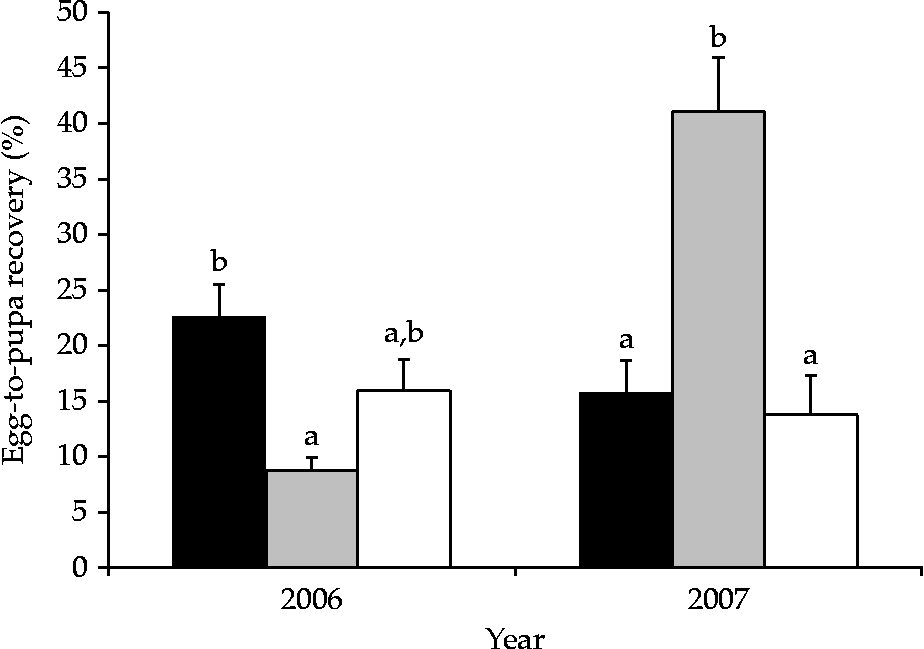
Data on egg-to-pupa recovery obtained from the experiments evaluating various diet supports are shown in Fig. 1. In the experiments conducted in both 2006 and 2007, there were significant differences in the effects of the supports used on the variables analysed (F= 6.78; df = 2, 33; P= 0.0034, and F= 14.24; df = 2, 24; P< 0.0001, in 2006 and 2007, respectively). In the first case, the sponge cloth support diet resulted in a reduced egg-to-pupa recovery when compared with the agar-based diet (P= 0.0024; Tukey's test). In the second case, the sponge cloth support diet resulted in statistically higher values when compared with the other two diets (P< 0.001; Tukey's test). With respect to the other variables analysed in the experiments conducted in 2006, the different supports did not affect pupal weight and sex ratio, while adult emergence was significantly reduced in the sugarcane bagasse-based diet (Table 3).
Egg-to-pupa recovery recorded in the experiments evaluating various larval diet supports: agar (black bars), sponge cloth (grey bars) and sugarcane bagasse (white bars). In 2007, the seeding volume was adjusted in the sponge cloth support diet to prevent first-instar larvae from drowning. Means within a year followed by the same letters are not significantly different (ANOVA followed by Tukey's test; see text).

Pupal weight, adult emergence and male proportion recorded in the experiments evaluating three supports: agar, sponge cloth and sugarcane bagasse

Values are means ± SE. Mean values within a column followed by the same letter are not significantly different by Tukey's HSD test.
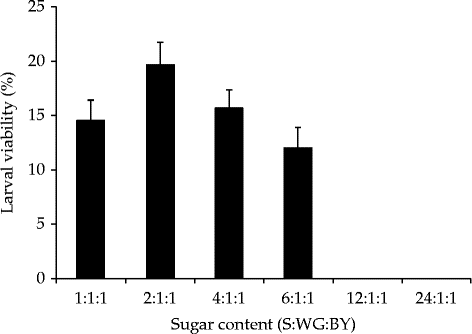
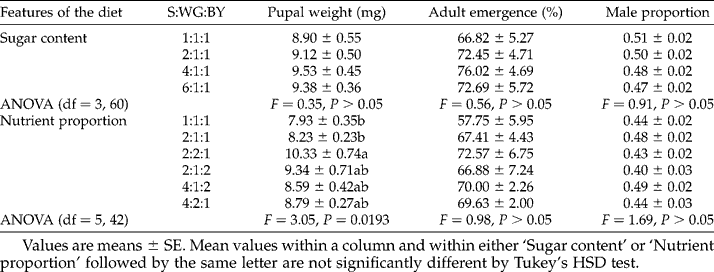
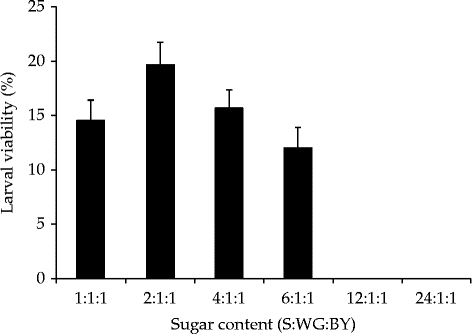
Larval viability was not affected by the amount of sugar present in the diet (F= 2.60; df = 3, 60; P= 0.0606). However, the diet that had twice the amount of sugar when compared with the other two nutrients (2:1:1) showed a tendency to result in higher values (Fig. 2). Concurrently, pupal weight, adult emergence and male proportion were not affected by the amount of sugar present in the diet (Table 4). Larval development was incomplete in diets with sugar:wheat germ:brewer's yeast ratios of 12:1:1 and 24:1:1 (more than 40% sugar).
Larval viability recorded in the experiments evaluating various sugar contents. There were no significant differences among the various treatments (ANOVA).
Pupal weight, adult emergence and male proportion recorded in the experiments evaluating various sugar contents and nutrient proportions (sponge cloth used as the diet support)
S, sugar; WG, wheat germ; BY, brewer's yeast.
Values are means ± SE. Mean values within a column and within either ‘Sugar content’ or ‘Nutrient proportion’ followed by the same letter are not significantly different by Tukey's HSD test.
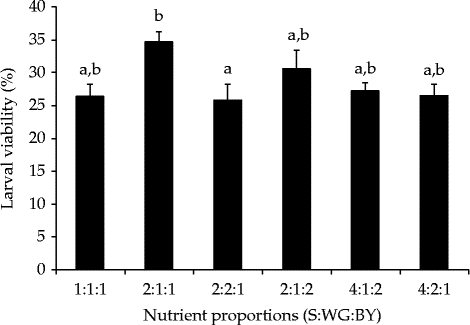
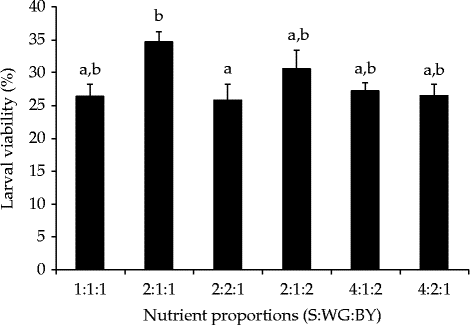
When evaluating proportions of the various nutrients, larval viability was found to be affected by the diet (F= 2.85; df = 5, 42; P= 0.0264). The diet that had two parts of sugar and one part of the other two nutrients (wheat germ and brewer's yeast) resulted in the highest value, and the diet that had two parts of sugar and wheat germ and one part of brewer's yeast (2:2:1) resulted in the lowest value (Fig. 3). Again, a tendency towards a difference, although not significant, was observed between the 1:1:1 and 2:1:1 diets. Pupal weight was also affected by the diet; the 2:2:1 diet resulted in heavier pupae when compared with the 1:1:1 and 2:1:1 diets (Table 4). Adult emergence and male proportion were not affected by the diet (Table 4).
Larval viability recorded in the experiments evaluating various proportions of the three nutrients: sugar (S), wheat germ (WG) and brewer's yeast (BY). Means followed by the same letter are not significantly different (ANOVA followed by Tukey's test; see text).
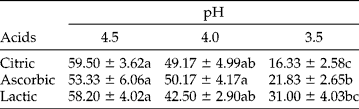
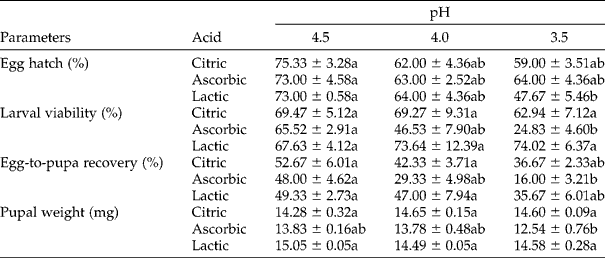
Egg hatch was affected by the pH and the acid used, but not by the interaction between these two factors (F= 37.32; df = 2, 18; P< 0.0001, for acid, F= 35.27; df = 2, 18; P< 0.0001, for pH, and F= 2.13; df = 4, 18; P>0.05, for the interaction). Lower pH values resulted in lower egg hatch, and lactic acid at a pH of 3.5 resulted in a relatively higher value when compared with the other acids (Table 5). In the experiment where larval development was complete, pH was found to affect egg hatchability (F= 14.35; df = 2, 18; P= 0.0002, for pH, F= 1.40; df = 2, 18; P>0.05, for acid and F= 1.68; df = 4, 18; P>0.05, for the interaction), with lower pH values resulting, in general, in lower egg hatch (Table 6). Larval viability was affected by the acid used (F= 13.0; df = 2, 18; P= 0.0003), but not by the pH (F= 1.68; df = 2, 18; P>0.05), and the interaction between these factors was not significant (F= 2.02; df = 2, 18; P>0.05). The diet with ascorbic acid at a pH of 3.5 resulted in a reduced larval viability (Table 6). Pupal weight was also affected by the acid used (F= 11.28; df = 2, 18; P= 0.0007), but not by the pH (F= 2.79; df = 2, 18; P= 0.0879), and the interaction between these factors was not significant (F= 2.86; df = 2, 18; P= 0.0538). Again, the diet with ascorbic acid at a pH of 3.5 resulted in the lowest value (Table 6). Egg-to-pupa recovery comprised the outcome of egg hatch and larval viability (Table 6), and hence the two factors were significant for this variable (F= 6.79; df = 2, 18; P= 0.0064, for acid and F= 13.06; df = 2, 18; P= 0.0003, for pH). The interaction between these factors was not significant (F= 1.25; df = 4, 18; P>0.05).
Egg hatch (%) recorded in the experiments evaluating larval diets with various pH values and acids (sponge cloth used as the diet support)
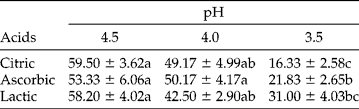
Values are means ± SE. Mean values within a row followed by the same letter are not significantly different by Tukey's HSD test.
Egg hatch, larval viability, egg-to-pupa recovery and pupal weight recorded in the experiments evaluating larval diets with various pH values and acids
Values are means ± SE. Mean values within a row followed by the same letter are not significantly different by Tukey's HSD test.
Discussion
This study evaluated various larval diets for A. fraterculus, taking into account the support or bulking agent, nutrient proportion and diet pH. The egg-to-pupa recovery was found to increase if agar was replaced with sponge cloth. In addition, the amount of sugar in the original formulation can be adjusted for a better performance of the diet. These results allow proposing a new formulation to be evaluated at a larger scale.
Selection of an appropriate support is essential for developing a larval diet. In the present study, three supports were evaluated: agar, sponge cloth and sugarcane bagasse. Our results showed that egg-to-pupa recovery was affected by the support employed, and after adjusting the conditions during larval development that minimized larval drowning, the diet with the sponge cloth was found to exhibit the best performance. Agar was evaluated as it was the gelling agent used by Salles (Reference Salles1995), and it was considered the control in the present study. Although it has been suggested that it is a good gelling agent for diets for A. fraterculus and other Anastrepha species (Rivera et al., Reference Rivera, Hernández, Toledo, Salvador and Silva2007), it has disadvantages; it is expensive and in large trays it prevents larvae from exiting in search of a pupation substrate. Sugarcane bagasse represented a good alternative, given that it is locally available and lacks insecticidal residues. In two series of experiments, the egg-to-pupa recovery in the diets with sugarcane bagasse was similar to that in the diet with agar. However, adult emergence was lower in this diet when compared with that in the other diets. This was not found by Vargas et al. (Reference Vargas, Chang and Williamson1983), who reported that C. capitata pupae reared on a diet based on sugarcane bagasse produced a higher adult emergence compared with pupae reared on a diet based on beet bagasse. Differences in the quality of the sugarcane bagasse related to its coarseness or the presence of detrimental particles might be the reason for this variation. In spite of this reduction in adult emergence, this support should not yet be ruled out as an alternative for use in mass-rearing, bearing in mind its cost, availability, absence of insecticidal residues and the texture it brings to the diet. Still, some aspects should be considered such as the fact that A. fraterculus larvae do not jump (‘pop out of the diet’), but crawl to leave the diet, which can result in many larvae pupating in the tray. Sponge cloth was also a good alternative to agar. The use of sponge cloth, in what is called a liquid diet, has been successful for other tephritids (Chang et al., Reference Chang, Caceres and Jang2004, Reference Chang, Vargas, Caceres, Jang and Cho2006, Reference Chang, Caceres and Ekesi2007). In the present study, we found, particularly in the set of experiments conducted in 2007, egg-to-pupa recovery to be better in the liquid diet than in the agar diet. This indicates that, if conditions are properly adjusted, the results can be improved (Chang et al., Reference Chang, Caceres and Jang2004). However, two important issues still have to be considered, i.e. (1) the cost of the sponge, which, at the experimental scale we used, equalled that of agar and (2) finding a way to avoid larvae pupating in the tray. The former can be overcome if the sponge is recycled, while the latter can be overcome by sieving the diet at the time when most of larvae have completed their development, as is being done for other species of the genus, e.g. Anastrepha obliqua (Macquart) (Artiaga-López et al., Reference Artiaga-López, Hernández, Domínguez-Gordillo, Moreno, Orozco-Dávila and Barnes2004). This procedure is applicable for sponge cloth but not for sugarcane bagasse. Hence, our results indicate that an evaluation of sponge cloth should be done at a larger scale.
Doubling the original amount of sugar in the diet resulted in increased larval viability. Although this was not statistically significant, the results of the two experiments that included this diet were consistent, suggesting that the original proportions can be adjusted. This was evident when we evaluated various proportions of the three nutrients, where we found an increase ranging from 26% to almost 35% in larval viability resulting from using the diets with 1:1:1 and 2:1:1 sugar:wheat germ:brewer's yeast ratio. In C. capitata, an excess of sugar (>24%) in the diet was found to delay the developmental time and moderately decrease the pupal weight (Nestel and Nemny-Lavy, Reference Nestel and Nemny-Lavy2008). In the present study, no differences were observed in pupal weight, suggesting that A. fraterculus compensated for the diet imbalances. The lack of development in the diets with more than 40% sugar (12:1:1 and 24:1:1) can be attributed to diet viscosity and high osmotic pressure in which cells of the larvae lose water to the medium (Cohen, Reference Cohen2004). Evaluation of various proportions of the other nutrients revealed that although an increase in wheat germ resulted in heavier pupae, it decreased larval viability. Wheat germ has proved to be a highly successful diet ingredient given its well-distributed profile of amino acids, lipid content, minerals and vitamins (with the exception of vitamins A and C) (Cohen, Reference Cohen2004). For A. fraterculus, the original proportion (Salles, Reference Salles1995) appears to be the best because neither a reduction (4:1:2 ratio) nor an increase (2:2:1) of wheat germ yielded a diet with a better performance.
Finally, when we evaluated various levels of pH, we found that a decrease in pH adversely affected egg hatch; a pH of 3.5 resulted in lower egg hatch. In some cases, diet was found to be contaminated when the pH was 4.5. The addition of adequate amounts (5 mg/g diet) of ascorbic acid (vitamin C) to the larval diet of Bactrocera latifrons (Hendel) was found to improve larval development, but addition of larger amounts (>15 mg/g diet) was found to decrease egg-to-pupa recovery, weight and overall growth (Chang and Kurashima, Reference Chang and Kurashima1999). In the present study, we used large amounts of ascorbic acid, particularly at pH 3.5, because it was the only acid that gave the desired pH values (13, 27 and 66 mg/g diet for pH of 4.5, 4.0 and 3.5, respectively). It would be useful to know whether adding adequate amounts of ascorbic acid to the diet with citric acid improves larval development. Overall, irrespective of the acid used, a pH of 3.5 appears to be too low, and the best compromise seems to be a pH of 4.0.
Conclusions
In all, it can be concluded that it is possible to improve the larval diet for rearing A. fraterculus. In this diet, sponge cloth can be used instead of agar, increased amounts of sugar can be added and the pH can be lowered to 4.0. However, more research is needed to determine the water content and whether a better performance would be achieved by adding adequate amounts of ascorbic acid in conjunction with citric acid. Another step would be to evaluate the diet on a larger scale and determine the feasibility of reusing the sponge cloth to reduce the costs.
Acknowledgements
The authors thank the International Atomic Energy Agency (RC-13015) for providing financial support to E. Willink and the Agencia Nacional de Promoción Científica y Tecnológica for providing financial support to M. T. Vera (PICT 2006 JI-1747) and to E. Willink (PICTO 2005 EEAOC-32932). They are grateful to Compañía Argentina de Levaduras S. A. (CALSA) for donating brewer's yeast, ARCOR S. A. for donating corn protein (used in the adult diet), and Azucarera Concepción S. A. Atanor and J. Minetti y Cia. S. A. C. I. for donating sugarcane bagasse. They also thank the reviewers and editors for giving suggestions and comments throughout the revision process, which helped improve the manuscript.