INTRODUCTION
Suctorian ciliates are common epibionts on benthic marine and interstitial invertebrates like harpacticoid copepods, nematodes, halacarid mites etc. (Jankowski, Reference Jankowski1981; Dovgal, Reference Dovgal1996; Dovgal et al., Reference Dovgal, Chatterjee and Ingole2008). A number of suctorian ciliate ectocommensals have been observed occurring on the cuticle of various members of the family Desmodoridae (Allgen, Reference Allgen1952, Reference Allgen1955; Matthes, Reference Matthes1956). In the present study, suctorian ciliates have been recovered on the cuticle of two nematode species Desmodora sphaerica and D. pontica belonging to the Desmodoridae family isolated from the deep-sea sponge Pheronema sp. from the Andaman Sea. Scrupulous microscopic observations revealed suctorian epibionts are conspecific with Thecacineta calix. Thecacineta calix is reported here for first the time from the Andaman Sea.
MATERIALS AND METHODS
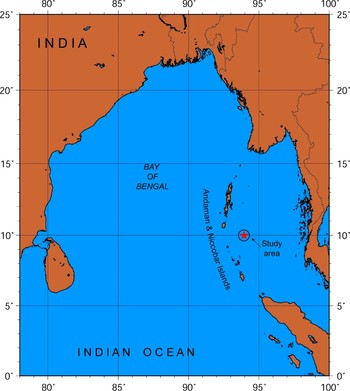
As part of a deep-sea study of benthic biodiversity, sediment sampling was performed in the Andaman Back Arc Basin (Figure 1) during the RV ‘Sonne’ cruise (NIO-RVS-II, 17 October to 1 December 2007). Seabed samples were obtained by deploying a TV camera-guided grab (area: 0.6 m3) which consists essentially of a set of steel jaws with a video camera in the centre. It collected sediment and rock samples and transmitted pictures of the ocean floor to the deck unit. Some specimens of hexactinellid sponge were collected along with the sediment and rock samples taken from the upper slope of the Northern Seamount located off Nicobar Island, 9°59′31.52″N 93°57′15.48″E, from a water depth of 1301 m. Upon collection, the sponges were carefully separated from the sediment and immediately preserved with absolute alcohol. In the laboratory, the sponge samples were washed carefully and the entire faunal community associated with sponge spicules were sorted out carefully and identified to the lowest possible taxa. All the nematodes were separated and fixed in 5% formalin. Nematodes were identified to genus/species level according to Platt & Warwick (1983) and using on-line recent literature (www.nemys.ugent.be).
Map showing sampling location (indicated with a star ★).

Measurements of ciliates were made using the computer program Scope Photo v. 2.0 for processing of digital images. For slide preparation the material was stained by Boehmer's haematoxylin and mounted in Canada balsam. Permanent slides of infested nematodes were deposited in the collections of the Department of Fauna and Systematics of Invertebrate Animals of the Schmalhausen Institute of Zoology, National Academy of Sciences, Ukraine and in the museum of Biological Oceanography, National Institute of Oceanography, Goa, India.
RESULTS AND DISCUSSION
Nematodes species Desmodora sphaerica and D. pontica, belonging to the genus Desmodora of the family Desmodoridae associated with a deep-sea hexactinellid sponge Pheronema sp., were used for the present study. A total of 71 specimens of nematodes belonging to six species were isolated from the deep-sea Pheronema sp. Of these, five (Desmodora sphaerica, D. pontica, D. schulzi, Desmodora sp.1 and Desmodora sp.2) belonged to the family Desmodoridae and one specimen could not be identified as it was damaged. Among these, D. sphaerica (17 individuals out of 71 specimens of nematodes collected) and D. pontica (12 individuals out of 71 specimens of nematodes collected) together made ~41% of the nematode population. Among 17 individuals of D. sphaerica collected, 13 (76%) were infested with suctorians and among 12 individuals of D. pontica 9 (75%) were infested with suctorians. Among the infested D. sphaerica 54% were female and 46% were male; among the infested D. pontica 67% were female and 33% were male. The suctorians were mostly noticed on the tail region but a few specimens were also found in the mid-region.
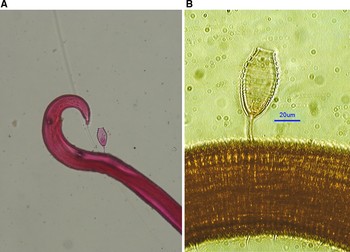
The detailed taxonomic study of the suctorian revealed that they belong to the ectocommensal Thecacineta calix (Schröder, Reference Schröder1907). Thecacineta calix, a marine loricate suctorian ciliate with a single apical fascicle of tentacles, was described from marine nematodes (Schröder, Reference Schröder1907). Subsequently, (Collin, 1909) combined all known species that had a similar morphology into the genus Thecacineta. Later, (Matthes, Reference Matthes1956) investigated T. calix as epibionts on harpacticoid copepod Laophonte cornuta from the Mediterranean Sea. This epibiont is also reported from various meiobenthic organisms such as halacarid mites, harpacticoid copepods and nematodes.
(A) Thecacineta calix attached with Desmodora pontica from the Andaman Sea; (B) magnified view of Thecacineta calix attached with Desmodora from the Andaman Sea.

DIAGNOSIS
Marine loricate, suctorian. Cell body entirely fills the lorica and attached to their bottom. Lorica totally ribbed transversely. Apical part of body protrudes beyond lorica aperture. Up to 30 clavate tentacles with length about 90 µm arise from upper body surface. Macronucleus large, oviform, located at the bottom of the cell body. With large contractile vacuole placed in basal body part usually near macronucleus.
MEASUREMENTS
Measurements (μm) of four individuals from the Andaman Sea, in parentheses measurements of individuals from copepod host (after Matthes, Reference Matthes1956): body length 14–24 (47–49 under colonization of the copepod host); width in the middle of body 12–17 (22–30 in copepod host); macronucleus diameter 6–8 (13–16 in copepod host); length of the lorica 44–60 (103–164 in copepod host), lorica width 25–26 µm, stalk length 15–21 µm, stalk thickness 1.5–3 µm.
DISTRIBUTION AND HOST SPECIFICITY
Earlier Thecacineta calix was reported as epibiontic on nematodes, crustacean copepods, halacarid mites from the Atlantic, Pacific, Antarctic and Indian Oceans (Kerguelen Island) (Schröder, Reference Schröder1907; Allgen, Reference Allgen1949, Reference Allgen1952, Reference Allgen1955; Matthes, Reference Matthes1956; Gelmboldt & Dovgal, 2005; Dovgal et al., Reference Dovgal, Chatterjee and Ingole2008). Among nematodes T. calix has been reported as epibiontic on Desmodora campbelli, D. microchaeta, D. odhneri, D. reducta, D. stateni, Acanthopharynx japonicas, Epsilonema symbioticum, E. poccilothrix and Paradesmodora sp. (Schröder, Reference Schröder1907; Steiner & Hoeppli, 1926; Schulz, Reference Schulz1931; Steiner, Reference Steiner1931; Allgen, Reference Allgen1949; Matthes, Reference Matthes1956; Susetiono, Reference Susetiono2006; Jankowski, Reference Jankowski and Alimov2007). The present report is the first to record T. calix from the Andaman Sea. Thecacineta calix also has been reported from fresh water in Thailand (Charubhun & Charubhun, Reference Charubhun and Charubhun2000), however, the latter find calls for further investigation because T. calix is a marine species.
REMARKS
In many cases the suctorians were attached close to the cloaca of the nematodes. Probably that observed location may be connected with the mode of reproduction of thecacinetid suctorians, including T. calix, by vermigemmic budding. The swarmers (migratory stages, devoid of ciliature, vermiform and unable to swim) are formed during reproduction. These swarmers crawl onto the new host over the surfaces of the copulating hosts, therefore, localization of the commensals near the zone of joining of copulating nematodes may possibly give priority to epibionts for expansion.
ACKNOWLEDGEMENTS
The authors wish to express their gratitude to the CSIR for financial support to the Net-Work project ‘Indian Ridge studies’. We also thank the Director of NIO Goa for the facilities. We wish to acknowledge the team leader Dr Kamesh Raju and the entire ‘Ridge Group’ for excellent teamwork during the deep-sea cruises. Our special thanks to Dr K.R. Tabachnick, Russian Institute of Oceanology, Moscow for identifying the deep-sea sponge. This is contribution No. 4492 of NIO (CSIR) Goa.