Disaster preparedness has become a health policy priority for the United States after the anthrax attacks and the events of 9/11. Natural disasters such as Hurricanes Katrina and Rita in 2005, as well as the recent tornadoes in the southern United States have further reinforced the importance of disaster and public health readiness. Governmental agencies such as the Agency for Healthcare Research and Quality and the Federal Emergency Management Agency have published guides to help health care organizations make important decisions when confronted with catastrophic events. Many of the previous efforts to improve public health emergency preparedness have focused on large, urban areas.Reference Van Fleet-Green, Chen and House1Reference Spranger, Villegas, Kazda, Harris, Mathew and Migala2Reference McHugh, Staiti and Felland3Reference Madsen and Greenberg4Reference Rumoro, Bayram, Malik and Purim-Shem-Tov5Reference Kochtitzky, Frumkin and Rodriguez6 Although rural communities may not initially be considered high-profile targets such as the World Trade Center, the Twin Towers, or the Pentagon, they may be easier targets because of limited supervision and security.
All 50 states have rural communities, and 65 million Americans reside in such communities.Reference Rosenthal7 Rural areas may be particularly vulnerable to human-induced emergencies such as a terrorist attack or bioterrorist attack for a number of reasons.Reference Rosenthal78Reference Putzer, Koro-Ljungberg, Duncan and Dobalian9Reference Dobalian, Tsao, Putzer and Menendez10Reference Tsao, Dobalian, Wiens, Gylys, Clawson and Brooks11Reference Clawson and Brooks12 Rural settings often possess fewer resources and less-developed public health infrastructure than larger, urban areas. Rural areas comprise the source of most food and farming distribution, so a localized bioterrorist agent targeting agriculture could threaten significant portions of the country.Reference Dobalian, Tsao, Putzer and Menendez10 Many cities obtain their drinking water from rural reservoirs that have limited security.Reference Dobalian, Tsao, Putzer and Menendez10 Moreover, many national energy sites, nuclear sites, and hazardous materials manufacturers are located in rural areas.Reference Dobalian, Tsao, Putzer and Menendez10 Thus, contaminants presumably could be dispersed to cities by crop duster aircrafts originating from rural airports.Reference Stamm13 Consequently, given that a significant number of Americans live in rural areas, with many in close proximity to potential military or economic targets, it is critical that these areas are prepared to respond in the event of a human-induced public health emergency.8
Few previous studies have examined rural disaster preparedness, principally via surveys of hospital administrators,Reference Cliff, Morlock and Curtis14Reference Reilly and Markenson15 and even fewer have examined rural physician preparedness.Reference Hsu, Mas, Jacobson, Harris, Hunt and Nkhoma16 The perceived lack of a human-induced disaster as a threat to rural communities may lead to reduced public health emergency preparedness.Reference Sterling, Clements and Rebmann17Reference McFee, Leikin and Kiernan18Reference Shadel, Rebmann, Clements, Chen and Evans19 Nonetheless, rural communities are especially challenged to organize preparedness and response efforts and to ensure that physicians and other health care providers are capable of providing health services to victims of such a disaster. Thus, a public health emergency such as a bioterrorist attack would present unique challenges for frontline physicians and health care providers in rural community settings.
Bioterrorist agents presumably may cause mass casualties, resulting in significant morbidity and mortality, societal disruption, and long-term human and economic hardship.Reference Danzig20Reference Inglesby, Dennis and Henderson21 The strain that such events would impose on the medical infrastructure—from hospital beds and pharmaceutical supplies to emergency departments, primary care medical offices, and clinics—would probably be unprecedented, especially given the fact that an attack with biological weapons would not be known in advance.Reference Karwa, Bronzert and Kvetan22Reference Inglesby, Grossman and O’Toole23Reference Borio, Frank and Mani24Reference O’Toole25 Therefore, identifying and classifying the impediments that presumably would hinder rural frontline health care professionals from being prepared for a public health emergency are particularly salient. Thus, the objective of our study was to determine the barriers impeding rural physicians from feeling or being prepared for a human-induced disaster such as a bioterrorist incident.
METHODS
In the last decade, qualitative research studies have become more prevalent in health services research and particularly the medical community.Reference Crabtree and Miller26Reference Frankel and Miller27 Denzin and Lincoln have found that qualitative researchers make sense and interpret phenomena in ways in which study participants bring meaning to phenomena.Reference Denzin, Lincoln, Denzin and Lincoln28 Furthermore, qualitative research uses various field methods and tools that enable in-depth study of lived experiences. In addition, the sampling in qualitative research often is driven not by a need to generalize across contexts or predict but rather by a need to create new interpretations.Reference Crabtree and Miller26
Our study employed a qualitative research approach using semistructured key interviews with rural physicians. Florida was considered a particularly appropriate location for this study because the state was a previous site of anthrax attacks in 2001 and because approximately half of the state's counties are considered rural. This study was approved by the University of Florida institutional review board.
Purposeful sampling was used to ascertain the representativeness or typicality of the settings and the individuals. Six comprehensive interviews were conducted with physicians from 5 federally designated rural counties in Florida as part of a larger study on preparedness in the state. Furthermore, purposeful sampling was performed to select cases that illustrate or highlight variations in experiences and to identify what is typical and common regarding rural physicians' perceptions and beliefs regarding emergency preparedness, specifically with respect to bioterrorist events. The physicians were selected from 2 common sources providing health services: county departments of health and rural health clinics. Each of the physicians was classified as a primary care physician.
The semistructured interviews were conducted between September 2004 and September 2005 among rural physicians in the north Central Florida region. To assess the impediments for disaster preparedness, rural physicians were asked the following guiding interview question—How do you describe the barriers affecting your professional and organizational disaster preparedness?
After the interviews, the data were transcribed verbatim in preparation for in-depth data analysis. More specifically, grounded theory method was used to analyze interview data.Reference Glaser29 First, transcripts were checked for accuracy and then open coded. Next, our coding process proceeded from the specific to the general by beginning with particular pieces of data (open and axial codes) and continuing toward the development of a meaningful whole (theoretical codes and the development of a conceptual model). Sentences and occasionally paragraphs formed our smallest unit of analysis. Furthermore, we followed the processes of Strauss and Corbin and Charmaz for coding: open coding, selective/axial coding, and theoretical coding.Reference Strauss and Corbin30Reference Charmaz and Smith31 Finally, all codes were constantly compared with each other to develop an inductive and databased conceptual model that illustrated the participants' experiences of barriers to professional and organizational preparedness.
RESULTS
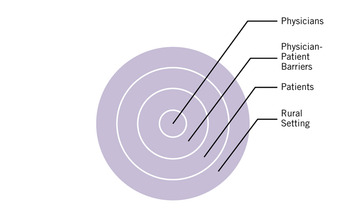
After a thorough inductive analysis of participant responses, we assembled the important components of rural physician preparedness and the barriers impeding their readiness. Figure 1 illustrates the preparedness and the barriers encountered by a rural physician in the context of a public health emergency. This figure proposes 4 contextual settings within a human-induced disaster scenario: the environment (ie, rural setting), the patients, the physician-patient barriers, and physician preparedness characteristics (ie, personal and professional factors).
Human-Induced Disaster-Bioterrorist Event.

It is important to note that one contextual factor may have a tangible impact on another contextual setting. For example, the environmental context has a prominent impact on both the personal and the professional physician preparedness context, whereas the personal and professional physician context interacts with other contextual factors such as the patient context vis-à-vis the physician-patient related barriers.
The scenario begins with an emergent event represented in our study as a bioterrorist event. Although the emergent event may represent any public health emergency such as a natural disaster or another human-induced event, in our study a bioterrorist event was chosen to represent a possible public health emergency. The first circular component represents the environmental context of a public health emergency, represented as a geographically rural health facility setting. The second circular factor represents rural patients. The innermost circular factor represents the personal and professional characteristics of physician preparedness.
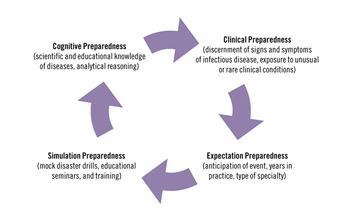
The personal contextual part of physician preparedness includes elements such as a physician's age, training, career stage, and previous experience with public health emergencies. This component also represents physician professional preparedness factors. Physician professional preparedness factors are ones that physicians perceive, anticipate, and experience as being important to assist patients in both the immediate aftermath and in the ensuing period following a public health emergency. A physician's professional preparedness is influenced by 4 interrelated elements: cognitive preparedness, clinical preparedness, expectation preparedness, and simulation preparedness (Figure 2).
Physician Professional Preparedness Contextual Factors.

Cognitive preparedness encompasses the physicians' scientific and educational knowledge, as well as their analytical reasoning acumen. Clinical preparedness involves physicians being aware, sympathetic, and sensitive to patient symptoms along with the corresponding overt and covert medical signs if such an event has occurred. Expectation preparedness involves the ability to anticipate the possibility of a catastrophic event such as a bioterrorist event and be prepared mentally for the aftermath of such an event that may be manifested by a patient's altered health condition and behavior. Expectation preparedness is affected by factors such as the type of medical specialty and the number of years the physician has engaged in medical practice. Simulation preparedness is the actual training (educational and mock exercises) pertinent to public health emergencies such as bioterrorism.
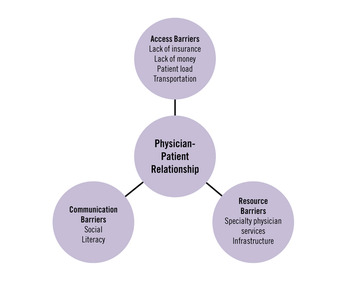
The third component of Figure 1 consists of the barriers adversely affecting the physician-patient relationship. The 3 impediments identified in our study include access barriers, communication barriers, and resource barriers. Each of these barriers also has associated subgroups with corresponding contributing factors (Figure 3).
Physician–Patient-Related Barriers.

Access Barriers
Access to health care may be thought of as a concept that describes the fit between the patient and the health care system. Barriers to accessing health care will adversely affect patients' entry into or use of the health care system and one or more of these elements. Patients encountering barriers to access care may be a result of a lack of health insurance, a lack of money, and increased patient loads imposed on their physicians due to the public health emergency and transportation difficulties.
The majority of participants mentioned financial barriers that patients may encounter in accessing medical care. One physician explained, “Finances become bigger because they're willing to do it, but they may have a harder time affording it. Taking the costs of medicine becomes a problem. That is a problem with psychiatric medicines, too, but it's a bigger problem with physical ones.” Another participant mentioned that, “there are so many blocks to access of care.”
Each participant in our study expressed that with a catastrophic event such as a bioterrorist event there would be a surge in the number of patients presenting to the health care facility or to the patient load. Clinicians explained that the number of people who “think they are infected” would dramatically increase. Not only would there be an increase in patients who exhibit physiological symptoms of stress, but there would also be an increase in patients who are worried and concerned. For example, one physician explained that there will be an overabundance of patients presenting with “all the symptoms—real or thought up.”
Patients facing transportation barriers often fail to receive timely and appropriate medical care. Transportation barriers thereby affect the accessibility of health care services and presumably the health status of the patient. Accessibility in relation to transportation may be thought of as the relationship between the location of patients and the location of physicians and health care facilities. It must account for patient transportation resources, travel time, distance between the patient and the facility, and cost. Thus, a transportation barrier may result as a consequence of the lack of a reliably performing automobile, the lack of an automobile entirely, or the prohibitively high expense associated with gasoline and other transportation costs.
Several physicians discussed transportation as a formidable access barrier. When asked what limits people accessing health care at rural clinics, many physicians answered transportation difficulties for rural patients. One participant explained, “we are seeing that more with the cost of gas. A lot of families have only one vehicle. If dad is at work, the mom may have the child, but there is no way to get here. A lot of people around here also have cars that are older and less efficient.” Another physician explained that, “my patients cannot get transportation. They have a doctor's appointment two months in advance and then their ride falls through and they cannot make it.”
Communication Barriers
Communication impediments may be defined in this study in terms of social and literacy barriers. Social barriers adversely affect the physician-patient dynamic and include geographical isolation, a lack of telecommunication, or a lack of social support. Several physicians expressed communication barriers as presenting an impediment to administering medical care. One participant noted, “people who do not have a good support system through communication and people who are more isolated would tend to have more trouble coping with something like that because they are not able to talk about that as much with others. People in rural areas would have more difficulties with those things. A lot of my patients don't even have telephones. They just see what is in the papers or maybe what they see on TV.”
Literacy difficulties also reside under the auspice of communication barriers. A literacy barrier may be defined as patients not understanding the medical rhetoric or jargon of physicians. A few participants explained that patient literacy was a noticeable barrier to the physician-patient relationship. One physician commented on barriers in communication between the physician and the patient by stating that “you can't use really big words sometimes. I have had some complaints from patients about them not getting it, but not many.”
Resource Barriers
Resource barriers include a lack of medical infrastructure such as a lack of hospitals within close proximity to rural inhabitants, inadequate numbers of adequately trained health care personnel (eg, specialty physicians), a lack of medical equipment, and a scarcity of facility examination rooms and infectious disease isolation and quarantining rooms.
Several rural physicians in our sample explained the lack of medical infrastructure as problematic and the geographical isolation as formidable barriers to providing care. Moreover, the majority of study participants explained that a significant obstacle involved rural patients receiving adequate specialty medical care. As one physician summarized it, “our biggest barrier to specialized care is being able to get people in. Any specialty care insurance is a big hurdle.”
COMMENT
Rural physicians in our study reported several barriers that would adversely affect the physician-patient relationship in response to a human-induced public health emergency such as a bioterrorist event. These physician-patient impediments included 3 major types: access barriers, communication barriers, and resource barriers. Each major barrier type also included associated subgroups of contributing impediments (Figure 3). For instance, access to care was affected by a lack of health insurance, a lack of finances for health services, and transportation difficulties. Communication barriers included obstacles such as social barriers and literacy barriers. Resource barriers adversely affected many of the components of providing health care services. Resource barriers limited the availability to use the service-producing capacity of resources.
Access to health care may include elements such as affordability, availability, accommodation, and accessibility.Reference Penchansky and Thomas32 Affordability includes the patients' existing health insurance and prescription drug coverage and the physicians' health insurance requirements. Some patients may possess limited health insurance and be able to visit a clinician and even wish to adhere to the treatment regimen prescribed by their physician, but may fail to comply because they cannot afford the cost of the medications. Thus, a patient without adequate and appropriate health insurance will encounter financial barriers that impede access to health care. Patient financial difficulties are magnified even more for individuals lacking health insurance. In such a case, a rural patient's disposable personal income becomes the prominent factor in determining affordability of health care services and, subsequently, a central determinant regarding personal access to medical care.
The advent of a disaster would adversely affect an individual's financial health in a number of ways. Catastrophic events often threaten or cause the depletion of financial and personal resources. A crisis precipitates actual and perceived stress. Stress during or after a crisis is often related to fear, uncertainty, morbidity, and/or the loss of others (ie, family members, friends, neighbors). Financial resources may mitigate such stressors and provide a safety net under such circumstances.
Another example of a physician-patient access barrier is an increased patient load. An increased patient load refers to the fact that during a disaster such as a bioterrorist event the perception and expectation among residents is that the number of patients frequenting physicians will dramatically increase. Consequently, a health care facility and its associated physicians will be inundated with an increased number of patients with actual illnesses and many patients with self-perceived illnesses.
An increased patient load adversely affects both the availability of health care services and the accommodation of patients seeking health care services. In addition, it can affect the availability of health care services by altering the relationship between the patient volume and type of existing services and resources with the increased patient volume and needs. For instance, a bioterrorist event presumably would exceed the capacity of the health organizational facilities' availability of rooms and beds, medical supplies and pharmaceuticals, and other needed equipment for diagnostics. A shortage of health care personnel and physicians in significant specialties such as primary care, pulmonology, and cardiology may also occur. These shortages often manifest under normal conditions and would only be further exacerbated with the advent of a public health emergency.
The increased patient load would adversely affect the accommodation of patients by altering the relationship by which the supply of resources is organized for patients. This supply would be disrupted because waiting times would be increased, appointments would be delayed, and hours of operation at the health care organization, as well as corresponding staffing hours, would need to increase significantly, thus further overburdening health care professionals. Moreover, in the advent of a public heath emergency, patients will be fearful and pensive and thereby increasingly will seek physicians and care that, in turn, will further increase the patient load and subsequently further diminish access to health care.
The increased patient load also may serve to exacerbate other physician-patient related impediments such as communication and subsequently impose additional stressors on the facility, resources, and the rural medical infrastructure in general. Indeed, access is a complicated concept that involves myriad elements including financial affordability, patient load, and consequent health care availability and accommodation, a means to transportation and accessibility, and resource availability. Thus, an already overburdened and understaffed workforce would be attempting to manage these challenging elements in the midst of a superimposed calamity.
In rural areas, patients, physicians, and health care facilities may not be concentrated or within close proximity to one another, which may hinder means of communication. Geographical isolation also may preclude a physician from being able to reach a patient by conventional telecommunication methods such as through the use of telephones, facsimiles, or electronic mail. Thus, geographical isolation may lead to a lack of timely information, which may adversely affect a patient's condition. Moreover, geographical isolation may slow delivery of vital health care resources or personnel from other clinical sites during a crisis. Facilities must also plan for the possibility that health care professionals and staff may not be able to staff their offices due to personal illness, family illness, or staff illness. Physicians and staff calling in sick leads to fewer professionals available to care for the masses of patients.
Studies conducted during the outbreak of severe acute respiratory syndrome (SARS) indicated that many health care workers were infected with the virus.Reference Loeb, McGeer and Henry33Reference Lu, Jiang and Liu3435 Exposure to a variety of infectious communicable diseases is a professional hazard for health professionals. Moreover, when an unknown infectious bioterrorist agent is dispersed through a community the health professionals may be equally susceptible and affected, especially if it is a rare or novel agent. This is principally because many individuals will not have any preexisting immunological natural immunity to such an infectious agent. Thus, geographical distance and isolation may not only lead to communication barriers but also may require strategic resources and assistance from outside professionals during the crisis. The geographical isolation and communication barriers affecting rural settings would only further adversely affect the ability to recruit health professionals and needed resources during such a crisis.
Social barriers may preclude patients from having a support system (ie, family or friends) to assist them to emotionally cope with stressful events. This lack of a social support system may further adversely affect a patient's health status. Consequently, social barriers engender feelings of isolation and accentuate difficulties encountered among rural residents when they attempt to communicate with other community members. Our sample participants explained that many rural patients encountered numerous social barriers that would only worsen in the advent of a bioterrorist event.
Literacy barriers are illustrated by patients not understanding the medical rhetoric or jargon of physicians.Reference Williams, Parker and Baker3637Reference Paasche-Orlow, Parker, Gazmararian, Nielsen-Bohlman and Rudd38 Physicians need to appreciate that each patient has a different level of education. Some patients may need physicians to explain medical conditions slowly, repeatedly, or in a simplified and easy to understand fashion. Thus, it is important to evaluate each patient's cognitive ability and subsequently convey information in a comprehendible manner. Yet, it is equally important for physicians to explain medical terminology and conditions in a respectful fashion to patients.
Public health emergencies such as a bioterrorist attack may well precipitate panic and chaos among all residents. Physicians and other ancillary personnel may be experiencing many of the same feelings and sentiments, which would result in diminished productivity. Consequently, hospitals and health organizations may be functioning in a suboptimal fashion in spite of increased needs. Nevertheless, clinicians should attempt to maintain a decorum of professionalism and compassion. During a crisis, the virtues of patience and empathy become even more essential. Physicians need to continue to honor a patient's autonomy and intelligence, because if patients feel that physicians are disparaging, they may feel disrespected, which may affect patient compliance with physician-recommended medical interventions.
Primary care physicians may be considered the frontline physicians in emergent disaster settings.Reference Varkey, Poland, Cockerill, Smith and Hagen39 Specialty physicians would include psychiatrists and infectious disease physicians. Presumably, psychiatrists and infectious disease specialists would assume a greater prominence in the event of a public health emergency such as a bioterrorist attack. Psychiatrists would be needed to treat both acute cases as well as refractory mental health disorders, while infectious disease specialists would be required to assist with the management of patients afflicted by bioterrorist-induced infectious agents. However, our study showed that resource accessibility to specialty care is a formidable barrier.
It may be argued that access to specialty physicians is especially difficult for rural patients. This difficulty may have a number of different explanations. One reason is a lack of specialty care physicians residing in rural settings.Reference Deprez40 Also, specialty care physicians may be quite particular regarding what type of health insurance they accept from their clients. Another interpretation is that specialty care physicians may be geographically isolated from rural residents, which may be more closely related to accessibility transportation barriers.
Limitations
This study had a few limitations. Florida is a state with a history of natural disasters and 2004 and 2005 were particularly active hurricane seasons. Thus, the reported physician attitudes about barriers hindering preparedness may not reflect attitudes in other states. We primarily chose to query the selected rural physicians regarding barriers affecting their preparedness to human-induced disasters such as a bioterrorist event. Bioterrorism preparedness was chosen to represent a type of public health disaster emergency preparedness from among the broad realm of public health emergencies. Although bioterrorism or other human-induced disasters and natural disasters share some common characteristics, each type of event has unique features. It is, therefore, unclear if the present results would have differed if we had asked rural physicians about barriers affecting public health preparedness for other events. Nevertheless it may be argued that due to the recurrent possibility of hurricanes in the state of Florida, rural physicians may be more likely to be aware of the potential consequences of public health emergencies than rural physicians in states or areas that are less susceptible to natural disasters. Further research is needed to examine the relationship between knowledge of health consequences related to recurrent events such as hurricanes in Florida and less common events such as bioterrorism.
This study conducted a one-time interview of rural physicians. Public health emergency preparedness is a complex phenomenon and presumably would benefit from multiple interviews with the same participants to discuss different aspects in detail. Moreover, future studies could include rural patient interviews to better understand the issue.
This qualitative study was based on a detailed analysis of participants' interviews, and data analysis was concluded when no new insights were discovered. The number of participants allowed the researchers to gather an ample amount of data to obtain validity, while at the same time limiting the amount of data generated so that the researcher could provide in-depth descriptions of the participants' perceptions.Reference Miller, Crabtree, Addison, Gilchrist and Kuzel41Reference Patton42Reference Merriam43 PattonReference Patton42(p185) further states “the validity, meaningfulness, and insights generated from qualitative inquiry have more to do with the information-richness of the cases selected and the analytical capabilities of the researcher than with sample size.” Notwithstanding, a possible limitation of this study may be a selection problem, which is known as “key informant bias” according to Pelto and Pelto.Reference Pelto and Pelto44(p7) This bias is principally because our study used key informant interviews of 6 physicians located in rural areas to describe the barriers they anticipate or would encounter when confronted with a public health emergency. Thus, in a fashion similar to most qualitative study results, the findings from this study are generalizable within the sample, but not across contexts.
CONCLUSION
It appears that the existing impediments discussed in this study are quite formidable and adversely affect the physician-patient dynamic. This conclusion is principally based on the comments provided by our sample of rural physicians who stressed several needs. They suggested the need to address the inadequate number of medical specialists and accompanying resources, the accessibility difficulties, and the lack of adequate communication. Many of these issues presumably would be exacerbated if a public health emergency arises, especially when rural residents begin to seek health care services in even greater demand. Unmet patient needs could increase significantly following such an event. Thus, strategically implemented policies are needed to alleviate the barriers identified in this study that have hindered rural physician preparedness and the physician-patient relationship.
Funding and Support: This study was supported from a larger study (1U01HS014355-01/7U01HS014355-02) funded by the Agency for Healthcare Research and Quality (AHRQ).