It has been argued that moral bioenhancement is desirable even if this would make it impossible for us not to do what is morally required (or perhaps precisely for this reason).Footnote 1 Others find this apparent loss of freedom of choice objectionable.Footnote 2 I share this opinion. However, it is difficult to see how a world in which there is no moral evil because people are incapable of hurting each other or doing other things that we consider morally wrong can plausibly be regarded as worse than a world in which people are not only free to do evil, but in which they actually do it. How can it ever be desirable that people be able to do things that most people would agree are very undesirable? It seems that by accepting this claim we would commit ourselves to the seemingly paradoxical view that, under certain conditions, the bad is better than the good. Probably for this reason, the mere suggestion that the freedom to do evil might actually be in itself valuable has been flatly dismissed as “too absurd to need rebuttal.”Footnote 3 Notwithstanding, in this article I will try, once again,Footnote 4 to defend the seemingly indefensible: that the freedom to do evil might be worth protecting from the grasp of moral bioenhancement.
The Prevention of Ultimate Harm
My argument will take its cue from a fictional case of moral bioenhancement that I owe to Anthony Burgess and his 1962 novel A Clockwork Orange. Footnote 5 The case in question is perhaps not quite one of moral bioenhancement, because the enhancement itself is not strictly speaking biological, but rather psychological (although biological means are used to achieve the desired morality-enhancing psychological effect). However, what makes it relevant to the discussion of moral bioenhancement as it is being advocated today, primarily by its main proponents, Ingmar Persson and Julian Savulescu, is that the objectives are very similar, namely (in general terms) to prevent people from doing what is considered wrong or bad or in some other way undesirable. Therefore, even though the chosen methods might not be the same, the objective is in both cases to deprive people of the freedom to do what we (or at any rate some people) think they should not be doing. In this article, I am not going to look at the methods by which moral enhancement is sought to be achieved. Although it is certainly an important question, I will not discuss whether we are at all likely to achieve by those methods whatever it is we hope to achieve. Instead, my main focus will be on the objectives of moral bioenhancement and the question of whether those objectives are worth pursuing.
There are of course several different possible objectives of moral bioenhancement. Which objective is pursued depends not only on what we think morality is and what it requires us to be or do,Footnote 6 but also on why we are seeking moral bioenhancement in the first place; that is, on the problem that it is intended to provide a solution to. The objectives follow from both our understanding of that problem and our understanding of the nature of morality. It is, therefore, possible to imagine a moral bioenhancement taking place whose objectives include the preservation or even the extension of (some form) of human freedom. Take for example Immanuel Kant’s understanding of morality and of morality’s purpose. In Kant’s view, we should be moral not so much for the sake of others, but primarily for the sake of ourselves: to become worthy of being happy, to honour the idea of humanity in ourselves, to give our existence an absolute rather than a merely relative value. And being moral, for Kant, means nothing else but being the rational, and, as such, self-governing, creature that we have always been meant to be. The principal problem for a Kantian, therefore, would not be that there are so many bad things (for example, violence to people, or the destruction of the environment) happening in the world because people are not moral enough, but rather the unworthiness of our existence that is a corollary of our lack of morality/autonomy. To tackle this particular problem, we may then try to achieve moral betterment by enhancing our ability to disregard our inclinations and to act only in accordance with (and out of respect for) reason and the moral law, or, in other words, our ability to act truly autonomously. However, even if we do not agree with the Kantian conception of autonomy (which is admittedly somewhat peculiar and does not square easily with our common conception of individual freedom), we may still want to insist that some kind of autonomous decisionmaking is essential to morality, so that any form of enhancement that undermines human autonomy does not really deserve to be called moral enhancement at all. However, although an autonomy-preserving or autonomy-enhancing form of moral bioenhancement is certainly conceivable and may be seen to provide a suitable solution to some problems, it is clearly not the kind of moral enhancement that its main proponents, Ingmar Persson and Julian Savulescu, have in mind when they try to convince us of the “urgent imperative to enhance the moral character of humanity.”Footnote 7 This is because such an autonomy-preserving enhancement would not solve the problem that it is intended to solve.
For Persson and Savulescu, moral bioenhancement is urgently needed to prevent “ultimate harm” (i.e., the destruction of the environment to the point that a worthwhile human life is no longer possible, or the termination of worthwhile human existence through the hands of terrorists and weapons of mass destruction [WMDs]).Footnote 8 Therefore, the “moral” enhancement that is being proposed has a clearly defined practical purpose. Whether it is really moral in the sense of being an enhancement of human morality as such is beside the point. The objective is not primarily to make us more moral, whatever we think that means. Whether becoming moral consists in being more altruistic and just, or more receptive to moral reasons, or in seeing more clearly what is good and bad, or in being more able to act in accordance with our own understanding of what is right and wrong, makes no difference. The objective, and the only objective, is always simply to erase or substantially reduceFootnote 9 people’s ability to do things that might conceivably cause ultimate harm. Whatever a more moral attitude is taken to consist of, it merely has the role of a means, not that of an end. (Therefore, to call the proposed enhancement moral enhancement is a diversion, a smoke screen. It suggests that what is being proposed is intrinsically desirable.) The end is the prevention of ultimate harm, or in other words: saving the world as we know and value it. A problem has been identified: that the world is in danger. A diagnosis is provided: that this danger is caused by a moral failure that is rooted in our human nature. A cure is suggested: that we can only save the world by becoming better persons (or, as it is human nature that is identified as the culprit, by becoming post-human). Therefore, if we want to save the world, we have to make sure that this is going to happen. Note that to achieve this goal, it is not sufficient to simply improve our inclination to do good (i.e., not to use WMDs or not to damage the environment). Merely giving our motivation a boost will most likely prove insufficient to save us from ultimate harm. We cannot afford to take chances. Because we are threatened with the imminent end of human life as we know it if we do not change, mere encouragement is not an option. It is clear that if we can change people in such a way that they will finally do without fail what is required to save us from self-destruction, then we ought to do it. If that is not really possible or not even intended as Persson and Savulescu sometimes, somewhat disingenuously, claim,Footnote 10 then the whole moral bioenhancement project has lost its raison d’etre, and we have no reason to pursue it. Therefore, it can be assumed that the objective of the proposed moral bioenhancement is to make it impossible for people to do things that might cause ultimate harm. If that ever became an option, should we endorse it? Or should we rather shy away from it because it would entail losing the ability to possibly cause ultimate harm and because that loss would be worse than the possibility of ultimate harm?
The Little Alex Problem
Readers of this article are now sufficiently prepared to consider the fictional case provided in Anthony Burgess’s novel. A Clockwork Orange tells the story of a 15-year old thug called Alex (who refers to himself as “little Alex”) in some unnamed city in an undefined future. Alex spends his nights roaming the streets with his friends looking for fun, which to them mostly means terrorizing others, including beating people up and raping, or even killing them. Eventually he is betrayed by his friends and put into prison, where, after some time, he is being offered the opportunity to undergo a novel treatment called Ludovico’s Technique, which is designed to turn sociopaths like Alex into good, well-behaved citizens. The technique is an aversion therapy, which works by injecting the subject with a substance that induces nausea and then making him watch ultraviolent films all day long (strapped to a chair with his eyelids held open by a device). Alex agrees to give it a try and after two terrible weeks he has indeed learned to associate violence so strongly with a feeling of nausea that he can no longer even think of violence (let alone engage in a violent act) without immediately getting sick. By this method of Pavlovian conditioning, he is cured of his predilection for antisocial behavior and, no longer a danger to his fellow citizens, can now be released from prison. However, incapable of defending himself against the violence and abuse that confronts him wherever he goes, he gets increasingly desperate until eventually he tries to commit suicide by throwing himself out of a window. He survives, however, and, when he awakes in his hospital bed, finds to his relief that the effects of Ludovico’s Technique have been reversed and his aversion to violence is gone.
At the heart of the novel is the question of whether, in the words of the prison chaplain who looks after Alex’s soul, “such a technique can really make a man good.” The unnamed chaplain has his doubts because, as he says, “goodness is something chosen. When a man cannot choose he ceases to be a man.”Footnote 11 If that is so, however, is not then “a man who chooses the bad perhaps in some way better than a man who has the good imposed upon him?”Footnote 12 This is what I call the “Little Alex Problem.” The question poses a problem because it invites the reader to share a certain moral intuition (namely that it is in some unspecified way bad or wrong or inhuman to force people into goodness, i.e. to make it impossible for them not to be good) and, therefore, to accept the ensuing paradox that, under certain conditions, the bad is better than the good, because it is suggested that not only is it wrong to force people to be good (which is fairly uncontroversial), but that also the resulting goodness is somehow tainted and devaluated by the way it has been produced. How is this possible? How can a world in which there is no moral evil because people are incapable of hurting each other or doing other things that we consider morally wrong be worse than a world in which people are not only free to do evil, but where they actually do it? And how can a person who chooses the bad be better than one who does the good without choosing to do so (in the sense that the decision to be good did not initiate in them)? In what way exactly are they better? The chaplain in Burgess’s novel provides some sort of answer by declaring that “goodness is something chosen.” In that case, we could hold that someone who has the good imposed upon them is not really good at all. They just appear to be good.
Immanuel Kant famously claimed something that, at first glance, seems very similar; namely, that someone who did the right thing, that is, someone who acted in accordance with the moral law, but did so out of inclination, because that person simply felt like it or because it was that person’s nature to do so, would not be praiseworthy in any way. Therefore, that person would not really be good insofar as the act would have no moral worth, and that is because it did not result from a conscious decision to do the right thing simply because it was the right thing. According to Kant, only actions that are motivated by respect for the moral law are expressions of a good will and are, therefore, morally praiseworthy, because only through such an act does one establish oneself as an autonomous being and acquire or actualize the intrinsic, absolute worth that Kant calls dignity. Therefore, a world in which everyone was good out of inclination and did the right thing naturally, but without having decided to do so (or more precisely without both knowing that this was their duty and doing it for the sole reason that it was their duty) would be, morally speaking, worthless, and it would be worthless precisely because the people who populated it would be worthless. As mere freaks of nature, they would have a price, but no dignity. They would exist as mere means, and no longer as ends, and with this their humanity would in effect have been lost.Footnote 13
However, it does not seem that, for Kant, it should make much of a difference, if any at all, whether people do the right thing because they have been deliberately manipulated to act that way or whether they do it because they happen to be the kind of people whose disposition is such that they naturally do the right thing. Either way, their actions will have no moral worth. However, for Burgess’s prison chaplain, the choice on whose moral indispensability he insists is not Kant’s autonomous choice. People who are good because they had the good imposed on them, are not really good, in contrast to people who are good of their own accord, no matter for what reason, whether they have made a conscious decision to be so or simply because it is their nature to be good.
Either way, however, it would only follow from this that people who have the good imposed on them, such as Alex, are not really better than people who are bad or who do bad things. It would not follow, however, that such a person is in any way worse. A good action (i.e., an action that is in accordance with the moral law) that is not freely chosen (either in the Kantian sense or in the wider sense that does not exclude individual preferences and inclinations from being seen as free) may not have any moral worth; however, that does not make it worse than a bad action, nor does the person performing it, who is one who is naturally inclined to the good and, therefore, not really good, seem to be worse than the bad person, who certainly is not really good either. The crucial issue here, therefore, does not seem to be whether one is really good or merely appears to be so, but that people who have the good imposed upon them have no choice in the matter, not so much because the good has been imposed upon them, but rather because, as a result, they can no longer choose to do anything that is (considered) bad. It is the result, the being-good-without-a-choice, and not the way in which this condition was achieved, that is thought to be problematic. And what makes it so, must be the fact that someone who no longer has the choice to be anything but good is in some significant way no longer human, which again is ultimately also the concern that Kant had. It is alleged that our very humanity, our humanness—in an emphatic sense of the word, in which being human is also something that is worth preserving and is important to protect—has been compromised. Another character in the novel, the author whose wife Alex raped before his imprisonment, later repeats almost verbatim what the prison chaplain said to Alex earlier and what Burgess himself seems to believe: “They have turned you into something other than a human being. You have no power of choice any longer. You are committed to socially acceptable acts, a little machine capable only of good …A man who cannot choose ceases to be a man.”Footnote 14
Better and Worse Possible Worlds
Obviously, “ceasing to be a man” is seen here as something even worse than being a bad man. The assumption is that what makes us human in the first place is the ability to choose between good and evil, and this ability, the essence of being human, is of a far greater intrinsic value than the mere fact of being good in the sense of not doing anything that we might consider bad (or perhaps not even wanting to do something that we might consider bad). By calling this value “intrinsic” I mean that it is better for there to be such a choice than for there to be goodness without choice. We can trace this idea back to early Christian attempts to explain the existence of evil in a world that was supposedly created by an all-powerful and benevolent God. How is (moral) evil possible? It is possible because we have been given a choice, and there is no choice without the possibility of evil. We have been given free will, which is always risky. But why did God give free will to human beings? The only possible reason, assuming, as we must, that God is omnipotent and good, is that a world in which people have free choice (either to fall or to ascend to God) is better than one in which there is none. And it is better, as Augustine explains, because a being that has a choice is somehow nobler, more excellent, more dignified than one who does not: “An errant horse is better than a stone that cannot err because it has neither motion nor feeling of its own. So a creature which sins by its own free will is more excellent than one which cannot sin because it has no free will.”Footnote 15
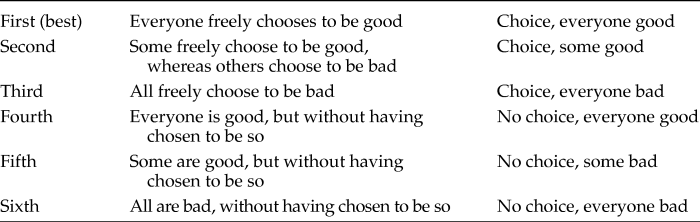
This intuition is echoed by Burgess and the prison chaplain in A Clockwork Orange who acts as the author’s mouthpiece. If we accept this intuition, we end up with the following hierarchy of values, or valuable states: the best possible world would be one in which people actually choose the good. That is, they do have a choice, and they use it for the good. Second best is a world in which there is choice, which some use for the good and others for the bad. Bad things happen in this world, but at least there is a choice, which is more important than being good. Third best is a world in which everyone chooses to be bad. This is unfortunate, but still better than for there to be no choice at all. Fourth best is a world in which all people are good, but without being able to choose anything other than the good. They do not have a choice, but are good by default, which might still be better than if there were some people who are bad without choice (the fifth best option) or if everyone were bad without choice (the worst option), but worse than if people were bad from choice. Table 1 illustrates this particular ranking of valuable states, which prioritizes choice over goodness (here to be understood as desired behavior).
Ranking of Valuable World States, Prioritizing Choice

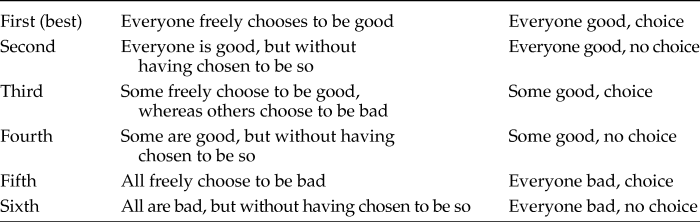
Obviously, this hierarchy of valuable world-states has no logical necessity to it. There is nothing obviously wrong with declaring a state in which everyone is good, choice or no choice, to be better than a state in which people are free to do evil. Alternative rankings are possible and vary depending on whether choice or goodness (i.e. compliant behavior) is given priority and to what extent it is given priority. Table 2 shows a ranking that prioritizes goodness over choice.
Ranking of Valuable World States, Prioritizing Goodness

Intuitions, however, can also be more mixed. We may, for example, feel that although choice is generally a good thing, if everyone is to be bad, then it would be better if they were bad not by choice, but by necessity.
One could argue that Alex in Burgess’ story actually chooses to be deprived of his freedom to choose. After all, he is not forced to undergo the treatment. Therefore, in a way he chooses the good. What he does is comparable to Homer’s Odysseus letting himself be tied to a mast in order to be able to hear the sirens sing without being in danger of following them. However, once the sirens start singing, Odysseus commands his men (in vain, as it happens) to untie him. Similarly, Alex, after successfully completing the conditioning process, is still inclined to violent behavior, but finds it impossible to follow through with his violent impulses because each time he tries he gets sick. Is that perhaps the reason why we hesitate to call the changed Alex “good”? Alex’s behavior has changed, but not his character and his inclinations. He is not suddenly motivated by altruism, nor has he developed greater empathy. He is just literally sick of violence. Would it make a difference for our evaluation of the procedure if his motives were changed instead of merely his behavior? Curiously, however, this issue is not addressed at all in the novel. It seems that for Burgess the discrepancy between Alex’s (violent) impulses and the inability to actually do anything remotely violent is at best a side issue. The main problem is that he has no choice in the matter. But should it really not matter how Alex feels? Should it not matter whether he happily does the good and, therefore, feels free, or unhappily does the good because he finds it impossible to act as he would like to? Imagine that there was a pill that we could give to someone like Alex. He swallows it and at once all his violent impulses are gone, and he wants to hug everyone and wishes everyone well. Would that make the imposition better? It is true that he would still have no real choice, but at least he would be able to act in accordance with his will. He would do good because he wanted to, not in spite of not wanting to. Does it really matter what has caused him to want to do good and that he only wants to do good because someone has made him want it? It is true that, after having taken the pill, he does no longer have a choice, but then again, do any of us ever have a choice? If we are good, have we really deliberately decided against evil (as a real possibility in our lives)? If we do not want to harm other people, do not feel the urge in us to beat people up, to rape and kill them, are we then free to feel otherwise? And would it really be better if we were entirely free and nothing prevented us from choosing evil instead of good?
Why Should We Protect the Freedom to Fall?
Our interpretation of Burgess’s A Clockwork Orange has suggested that by making it impossible for us to do (what is considered to be) wrong, or undesirable, we may lose something of great value that is somehow connected to our humanity. This has also been suggested by John Harris who has claimed, very much like the chaplain in A Clockwork Orange, that the freedom to do evil is in itself valuable and should not be sacrificed. However, the reasons he gives for this claim are different from the chaplain’s and do not quite hit the mark because their plausibility relies on a tacitly assumed theological perspective. Harris cites Milton’s God who justifies his determination to punish humankind for their disobedience and ingratitude by declaring himself blameless for human actions. God gave us all we needed and made us “just and right, sufficient to have stood, though free to fall.”Footnote 16 Harris argues that it is important that we are, and remain, “free to fall” because “without the freedom to fall, good cannot be a choice; and freedom disappears and along with it its virtue. There is no virtue in doing what we must.”Footnote 17 Another related point Harris makes is that we can no longer be held responsible for our actions if we are not free to do otherwise.Footnote 18
Unfortunately, neither of these two points is very persuasive. It is a curiously Kantian argument to make for someone who is generally more inclined to a utilitarian mode of thinking. It may be true that there is no virtue in morality without choice, but why should we be interested in providing opportunities for people to be virtuous? If we simply do the right thing because we cannot do otherwise we may not deserve praise for what we do, and our action may not have intrinsic moral worth; however, it is still the right thing, and we may find that virtue is no longer needed if evil is no longer an option. That virtue is important in itself is much more convincing in a theistic framework. Life can then be seen as a test, in which choice, the freedom to fall, plays an important role, in that it allows us to prove our worth to God. There is something to be gained through virtue and something to be lost through vice. There are possible rewards and possible punishments. But without God, there is no real point in being virtuous, in choosing to be good. There is, however, still a point in being good, in not hurting others or not destroying the world we have built for ourselves. Similarly, it is far from obvious that it would be deplorable if we could no longer be held responsible for our actions. Of course, as long as we are responsible for our actions, it is desirable that we can also be held responsible for them. But why should it be considered important that we are responsible for what we do in the first place?
Even if we attach some intrinsic value to virtue and responsibility it is doubtful whether other things may not be more important. Therefore, David Degrazia has argued that, even if the envisaged kind of moral bioenhancement compromises human freedom (which he does not think it does), it would not matter, because freedom is only one among several values that are important to us, and when we look at what we might gain in exchange for our freedom (namely deliverance from evil), then “the elimination of freedom with respect to these types of action is no great loss.”Footnote 19 The evil that might be prevented by curtailing human freedom makes for a powerful argument in favour of moral bioenhancement. The extent of such evil makes it difficult to defend the value of human freedom, even within a theistic framework. As Katarzyna Lazari-Radek and Peter Singer have pointed out, the argument that God had to give us the freedom to fall because otherwise the good we do would have no merit, is ethically
dubious because it implies that the value of free will is so great that it outweighs all the atrocities that humans have committed, including the slaughters of all the wars that have ever occurred, plus the Nazi holocaust, Stalin’s crimes, the killing fields of Cambodia, and so on and on, for tens of thousands of years. And then to that we must add up all the individual acts of cruelty committed on a daily basis, and we should not forget the vast amount of suffering that humans inflict on untold billions of animals. We find it hard to accept that having free will is so good that it can outweigh all that.Footnote 20
Engineering Goodness
To render plausible the idea that all that evil is a price worth paying for the human freedom to choose, we need that freedom to be more than just one value among others. It must be in some way foundational. In other words, it must be something we simply cannot do without. However, there seem to be least two problems that may prevent us from accepting this hypothesis. The first is that people whom we think of as good people are not usually ones who have chosen to be good despite being just as capable of being bad. A good person is not someone who decides against torturing and killing other people, but someone who is constitutionally incapable of doing so. If doing something really bad is a real option for me, then I am not a good person, even if I always, in practice, reject that option. A good person is not free to do evil. Those people’s goodness is rather an integral part of their nature, and our nature is not something that we have chosen, but something that has first been given to us and then evolved over time. It is, therefore, not plausible, as Persson and Savulescu, quite sensibly, have pointed out, to measure human freedom by the extent to which someone is capable of evil: “People who are morally good and always try to do what they regard as right are not necessarily less free than those who sometimes fail to do so.”Footnote 21
The second problem is that whatever freedom we may have, moral bioenhancement does not seem to diminish it. The plan is not to turn people into “mindless robots who do not act for reasons,” but rather to enhance them in such a way that they always act for the right reasons. If it is then indeed impossible for them to do what we think they should not be doing, it is not going to be physically impossible, but merely “psychologically or motivationally ‘impossible’.”Footnote 22
However, if moral bioenhancement is not objectionable because it deprives us of a genuinely free choice (mainly because there is no such thing as a genuinely free choice), then it must be so for other reasons, always assuming that it is objectionable in the first place. But what reasons? Robert Sparrow points in the right direction by drawing attention to the fact that freedom is “also a relation between persons: it is political not (just) metaphysical.”Footnote 23 Perhaps, therefore, it is this kind of freedom that is being threatened here, and when Persson and Savulescu try to soothe the readers’ concerns by assuring them that the impossibility in question would be not physical, but “merely” psychological and motivational, they do not realize that such an impossibility is, in a political or social context, far more worrying because it is far more comprehensive than a mere physical impossibility could ever be. If somebody else makes it physically impossible for me to do what I want to do, then that person exercises a great deal of control over my life. However, if someone manages to make it psychologically impossible for me even to want anything other than what that person wants me to want, then the person’s control over me is complete, and this is what moral bioenhancement ultimately seeks to accomplish: a state of complete control, not only over people’s bodies, but also over their minds. We can now understand what the morally relevant difference is between the naturally good and the morally enhanced: the latter have been engineered to feel, think, and behave in a certain way. Someone else has decided for them what is evil and what is not, and has programmed them accordingly, which undermines, as Jürgen Habermas has argued,Footnote 24 their ability to see themselves as moral agents, equal to those who decided how they were going to be. But the point is not so much that they have lost control over how they feel and think (perhaps we never had such control in the first place), but rather that others have gained control over them. They have changed, or have been changed, from something that has grown and come to be by nature, unpredictably, uncontrolled, and behind, as it were, a veil of ignorance, into something that has been deliberately made, even manufactured, that is, a product.Footnote 25 Thus the “boundary between persons and things” has been obliterated.Footnote 26 Habermas suggests that “the instrumentalization of human nature” might change “the ethical self-understanding of the species in such a way that we may no longer see ourselves as ethically free and morally equal beings guided by norms and reasons.”Footnote 27 Therefore, it is not so much what we are that will have changed (free or not free), but rather how we will in all likelihood view ourselves and each other (as free or not free). The change “takes place in the mind,”Footnote 28 but the control is real enough. It is not only in the mind.
The End of Morality
It may be objected that this would only make compulsory moral enhancement, but not voluntary enhancement or self-enhancement, questionable; however, that is not so. Because Habermas is mainly concerned with genetic engineering and, therefore, with the manipulation of others and the resulting asymmetry between the enhancers and the enhanced, he does not consider the possibility of self-manipulation. However, his argument can perhaps be extended to cases in which we voluntarily choose to submit to a moral enhancement procedure whose ultimate purpose is to deprive us of the very possibility of doing wrong. The asymmetry would then persist between our present (and future) self and our previous self, which to our present self is another. The event would be similar to the case in which someone voluntarily signed a contract that made that person a slave for the rest of his or her life. Although that person would have freely chosen to be a slave, once a slave, he or she would no longer have the choice not be one, and it is not an uncommon intuition that therefore it is wrong (and should not be permitted) to make such a choice. Likewise, by voluntarily and deliberately depriving ourselves of the possibility of acting in certain ways (that have been selected as morally undesirable or “bad” by someone else), we are turning ourselves into slaves of a previous decision, and whether this decision was our own or somebody else’s, does not really matter because either way we end up being slaves.Footnote 29
Although most people will readily agree that altruism, kindness, generosity, and similar traits, are good and, all things being equal, desirable, that does not mean that it is also good and desirable to make them, or us, more altruistic, kind, or generous. Likewise, although the undesirable is never desirable, the ability to do the undesirable may well be. Even if moral bioenhancement were completely voluntary,Footnote 30 we might still see a problem with the resulting lack of choice, either by itself or because of the changed self-understanding that accompanies it. However, it is not likely that we will all go down the path of moral enhancement willingly. What shall we do if certain people refuse, if they prefer to stay the way they are? Should they be forced, and simply made good, like Alex? That may seem a good idea when it comes to certified psychopaths who delight in hurting others, but what about the rest of us, the average, run-of-the-mill person who is not very bad, but not quite good enough when it comes to saving the world by giving up their time and privileges to fight poverty and environmental depletion, which is exactly the kind of moral shortcoming that, according to Persson and Savulescu, makes exploring possibilities for moral enhancement so urgent. Some people, they believe, “would need to be involuntarily connected”Footnote 31 to the God Machine, a fictional invention that intervenes each time someone wants to commit a morally undesirable act, in such a way that it simply changes the mind of the would-be perpetrators, to whom it would appear as if they had changed their minds on their own impulse. This may seem to be the ideal solution to the moral insufficiencies of humankind, because we would not even know that we have been manipulated and that our choice to be good has not really been our choice at all. Even if that were still seen as an infringement of human freedom, we should, according to Persson and Savulescu, remember that freedom is, after all, “only one value,” and that the effective prevention of serious crime surely should outweigh the comparative loss of freedom.Footnote 32 When I discussed this issue with Savulescu a few years earlier, he told me that “the disease is human choice.” This suggests that we would be better off without it, but I find it difficult to believe that. We treasure human freedom, not the metaphysical one that very likely is a mere illusion, but the social, relational one. It defines what we are, our very humanity. From that perspective even the God machine poses a threat because the problem would still be that we are being controlled by a machine that has been designed with the explicit goal of controlling us. Whether we are actually aware of the manipulation or not is not relevant, or is not the main problem. The main problem is the fact that we are being controlled by, per definition, somebody else’s will, and the fact that the purpose of our being controlled is that we conform to certain moral standards does not make it any better, but rather the contrary, because instead of being ends in ourselves, we thereby become means to the end of morality, which ultimately makes morality itself pointless because we no longer have a good reason to treat each other as ends if we are in fact nothing but means.