Introduction
Species of the lichen family Cladoniaceae Zenker have been studied intensively in many areas of the world. The European, North American, South American, east Asian and Australasian species are fairly well studied (e.g., Archer Reference Archer1992; Ahti Reference Ahti2000; Awasthi & Ahti Reference Awasthi and Ahti2007; Galloway Reference Galloway2007; Burgaz & Ahti Reference Burgaz and Ahti2009; Ahti & Sipman Reference Ahti and Sipman2013; Ahti & Stenroos Reference Ahti and Stenroos2013). On the other hand, species from Africa, Indonesia, Malaysia and other parts of South-East Asia are much less known. Furthermore, there are species groups all over the world which are poorly understood. Molecular systematics has begun to clarify some of these problems, but these data have also revealed non-monophyletic taxa in unexpected groups, suggesting that much work remains to be done to resolve the species-level taxonomy in the genus. Our recent molecular analyses (S. Stenroos et al., unpublished data) include numerous additional species of Cladoniaceae, that have not previously been included in molecular phylogenetic studies; these are from poorly known areas (e.g., Madagascar, Bolivia, Réunion) and some material has turned out to represent undescribed species. We formally describe four of these new species here, together with an assortment of other taxonomic and nomenclatural novelties that were uncovered as part of our ongoing work on the genus.
Material and Methods
This study is based primarily on material deposited in FH, H, KRAM, LPB, TNS and UGDA. Morphology and anatomy were examined using a NIKON SMZ800 and a NIKON ECLIPSE 80i (DIC) microscope. Secondary metabolites were studied using C, K and P spot tests and by thin-layer chromatography (TLC) according to standardized procedures (Orange et al. Reference Orange, James and White2001), using the solvents A, B/B' and C. Phylogenetic placements of the new species are based on a five loci phylogeny (S. Stenroos et al., unpublished data). ITS rDNA sequences from the type specimens have been submitted to GenBank.
Results and Discussion
Cladonia asperula Ahti & S. Stenroos nom. nov.
MycoBank No.: MB 816815
Cladonia aspera Ahti & Kashiw. in Inoue, Stud. Cryptog. S. Chile: 132 (1984), nom. illeg., non Cladonia aspera (Flörke) Doign., Feuille Naturalistes, N.S. 2: 102 (1947).
This synonymy was stated in Ahti & Stenroos (Reference Ahti and Stenroos2012), but no new name was given to the illegitimate C. aspera. Earlier, Stenroos & Ahti (Reference Stenroos and Ahti1991) and Stenroos et al. (Reference Stenroos, Ferraro and Ahti1992) had regarded C. aspera Ahti & Kashiw. to be a synonym of C. sarmentosa (Hook. f. & Taylor) C. W. Dodge. Hammer (Reference Hammer2002) did not accept that synonymy (see also Galloway Reference Galloway2007) but indicated that C. aspera was a distinct, austral species, which is not sorediate but schizidiate. We have decided to follow Hammer’s opinion, although the taxonomy of this group is not entirely clear. The earlier homonym C. aspera (Flörke) Doign. has been overlooked in all catalogues. It was synonymized with C. gracilis (L.) Willd. subsp. gracilis by Ahti & Stenroos (Reference Ahti and Stenroos2012).
Cladonia beaumontii (Tuck.) Vain.
Acta Soc. Fauna Fl. Fenn. 10: 455 (1894).— Cladonia santensis var. beaumontii Tuck., Syn. N. Amer. Lich. 1: 245 (1882); type: USA, “Alabama septentrionalis” (probably Moulton Co.: Tuskegee), 1853, J. F. Beaumont 25 (FH-Tuck 2488—lectotype, designated by Robbins, Rhodora 29: 134 (1927)).
Ahti (Reference Ahti1993: 68) incorrectly cited the above-mentioned type specimen to be the “holotype”, although two specimens were cited in the protologue of C. santensis var. beaumontii. Robbins (Reference Robbins1927) was evidently the first author to select a lectotype, also indicating that the other syntype belongs to a different species. The specimen cited here is the same one mentioned by Ahti (Reference Ahti1993).
Cladonia botryoides (Tuck.) Vain.
Acta Soc. Fauna Fl. Fenn. 4: 431 (1887).—Cladonia squamosa f. botryoides Tuck., Syn. N. Amer. Lich. 1: 246 (1882); type: USA, South Carolina, “mountains”, 1844 (?), H. W. Ravenel 312 (or 315?) (FH-Tuck 2483—lectotype, designated here; PC—probable isolectotype, as no. 48, n.v.).
Cladonia botryoides is an overlooked name, which Vainio (Reference Vainio (Wainio)1887: 430) mentioned in passing under an annotation on C. squamosa f. botryoides Tuck. (“ad speciem autonomam (Cl. botryoidem Wainio), in stirpem Cl. pityreae pertinentem, spectat”). Later, Vainio (Reference Vainio (Wainio)1894: 363–364) further discussed the specimen in PC and, in changing his mind, definitely stated that it rather (“potius”) represents a forma of C. pityrea (=C. ramulosa (With.) J. R. Laundon) and gave a long Latin description of the lichen.
Although Vainio (Reference Vainio (Wainio)1887) wrote “Cladonia botryoides Wainio”, we interpret that he made a new combination at the species level citing Tuckerman’s description and a specimen that apparently is a syntype of forma botryoides. When Tuckerman’s herbarium in FH was examined, it became clear that the original Ravenel material clearly represented a low-growing (0·5–2·0 cm tall) form of C. squamosa Hoffm., growing on wood. The material had a white UV reaction owing to squamatic acid, and a negative P reaction owing to the absence of fumarprotocetraric acid, the latter being characteristic of C. ramulosa. Cladonia botryoides is thus a new synonym of C. squamosa.
Cladonia camerunensis Ahti & Flakus sp. nov.
MycoBank No.: MB 816811
Similar to Cladonia didyma (Fée) Vain., but differs by being pale glaucous, melanotic at the base (necrotic parts blackening), with more coarsely granulose and microsquamulose podetia and much thicker, sparsely divided primary squamules.
Type: Cameroon, Minloua Mountain, c. 20 km W of Yaoundé, 03°53'00''N, 11°26'06''E, alt. 780 m, on plant debris over rock in open area, 19 December 2007, J. Piątek & M. Piątek s. n. (KRAM-68038—holotype; H—isotype); GenBank ITS rDNA accession No. KU923375.
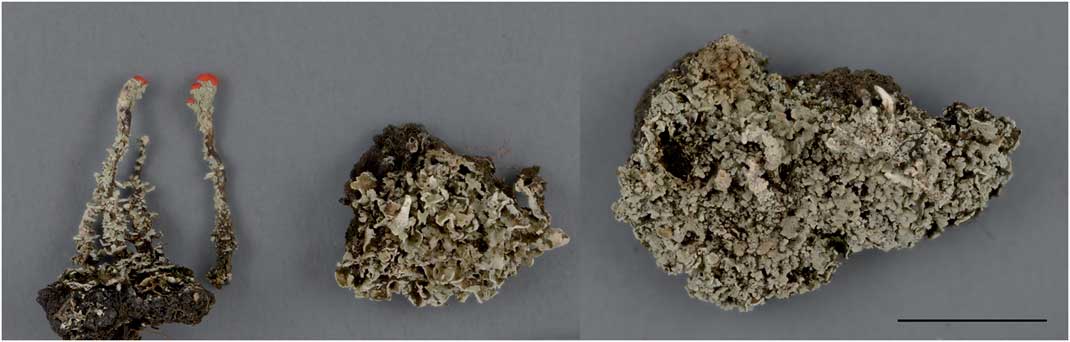
(Fig. 1)
Cladonia camerunensis (isotype, H). Scale=1 cm. In colour online.
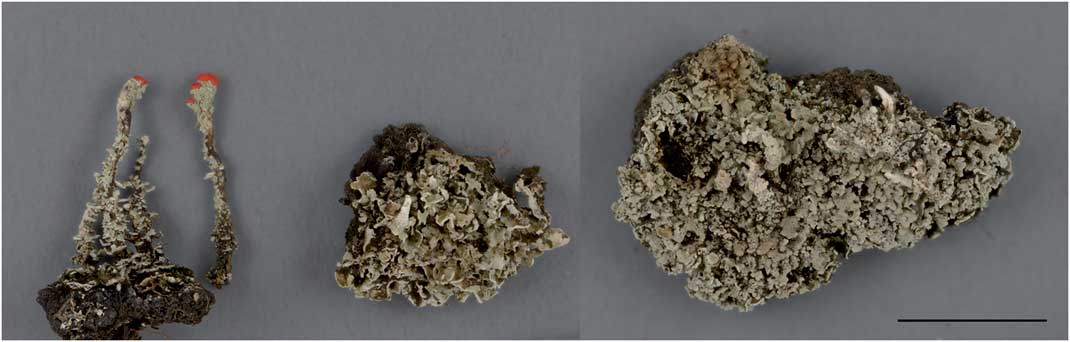
Primary thallus persistent, forming continuous crust consisting of roundish, dichotomously divided and radially arranged squamules, 0·5–3·0×0·3–0·8(–1·2) mm, thick (convex) and in part slightly convolute, often slightly elevated, esorediate, upper side glaucous grey, or yellowish white in older specimens, smooth, shiny or slightly pruinose, underside white, thinly arachnoid, slightly flocculose and veined, 150–350 μm thick, cortex 10–50 µm, medulla 100–300 µm.
Podetia frequent, laminal, 4–12 mm tall, 1–2 mm thick, pale greyish green to melanotic at base, acute to clavate, to simple, sparsely branched, cylindrical to slightly flattened, ascyphose. Surface of podetia rough, coarsely granular and microsquamulose, besides larger granules with patches of less coarse granulose soredia, in part decorticate, at base with a distinct cortical sheath. Podetial wall (100–)250–350 µm, cortex 0–30 µm, medulla 60–80 µm, stereome (80–)150–200 µm, hard cartilaginous, central canal present, striate. Hymenial disc sessile on podetial tips, red, almost flat to slightly convex, 1·0–1·5 mm diam., simple or forming small aggregations, mature ascospores not seen.
Conidiomata dark brown to black, on primary squamules, large, up to 2 mm tall, 0·5 mm thick, elongate pyriform, constricted at base, shortly stalked, containing red slime; conidia not observed.
Chemistry. K−, P−, C+ green, UV−. Barbatic (major) and didymic acid (minor). The C reaction is distinct and probably owing to a high barbatic acid content, although this substance does not always cause a green spot test reaction.
Etymology. The epithet refers to Cameroon.
Distribution and ecology. Known only from two localities on Minloua Mountain, a tropical inselberg in Cameroon, where two populations were observed at the top and at the base. It has been collected on soil over rocks.
Notes. Cladonia camerunensis belongs to the “Supergroup Cocciferae” as defined by Stenroos et al. (Reference Stenroos, Hyvönen, Myllys, Thell and Ahti2002). Morphologically, C. camerunensis resembles C. didyma or C. macilenta Hoffm., but those species have clearly different positions in phylogenetic analyses, which thus supports the specific status of C. camerunensis. Cladonia didyma has simple or sparingly branched podetia and the surface is ecorticate, microsquamulose to minutely granulose, and the stereome surface is usually exposed, while C. macilenta is farinose sorediate (Ahti Reference Ahti2000). It should be noted that C. didyma has a long list of synonyms (Ahti Reference Ahti2000), and one possibly represents C. camerunensis. Unfortunately, all types could not be re-examined. None of them, however, was described from West Africa. Therefore we decided to describe our material as a new species.
Additional specimen examined. Cameroon: Minloua Mt, c. 20 km W of Yaoundé, 03°53'13''N, 11°25'54''E, alt. 821 m, on plant debris over rock in open area, 28 ii 2007, J. Piątek & M. Piątek (KRAM-69037).
Cladonia compressa Ahti & Flakus sp. nov.
MycoBank No.: MB 816812
Differs from Cladonia pityrophylla Nyl. in having deeply divided, narrow, elongated primary squamules, with irregularly crenate and granulose to sorediate margins, and scattered, marginal, phyllopodiate podetia.
Type: Bolivia, Dept. La Paz, Prov. Nor Yungas, near Siniari colony, km 74 on road from Coroico to La Paz, 16°13'20''S, 67°50'37''W, 2186 m, Yungas secondary cloud forest, terricolous, 24 May 2011, A. Flakus 21537 & O. Plata (KRAM—holotype; H, LPB—isotypes); GenBank ITS rDNA accession No. KU923376.
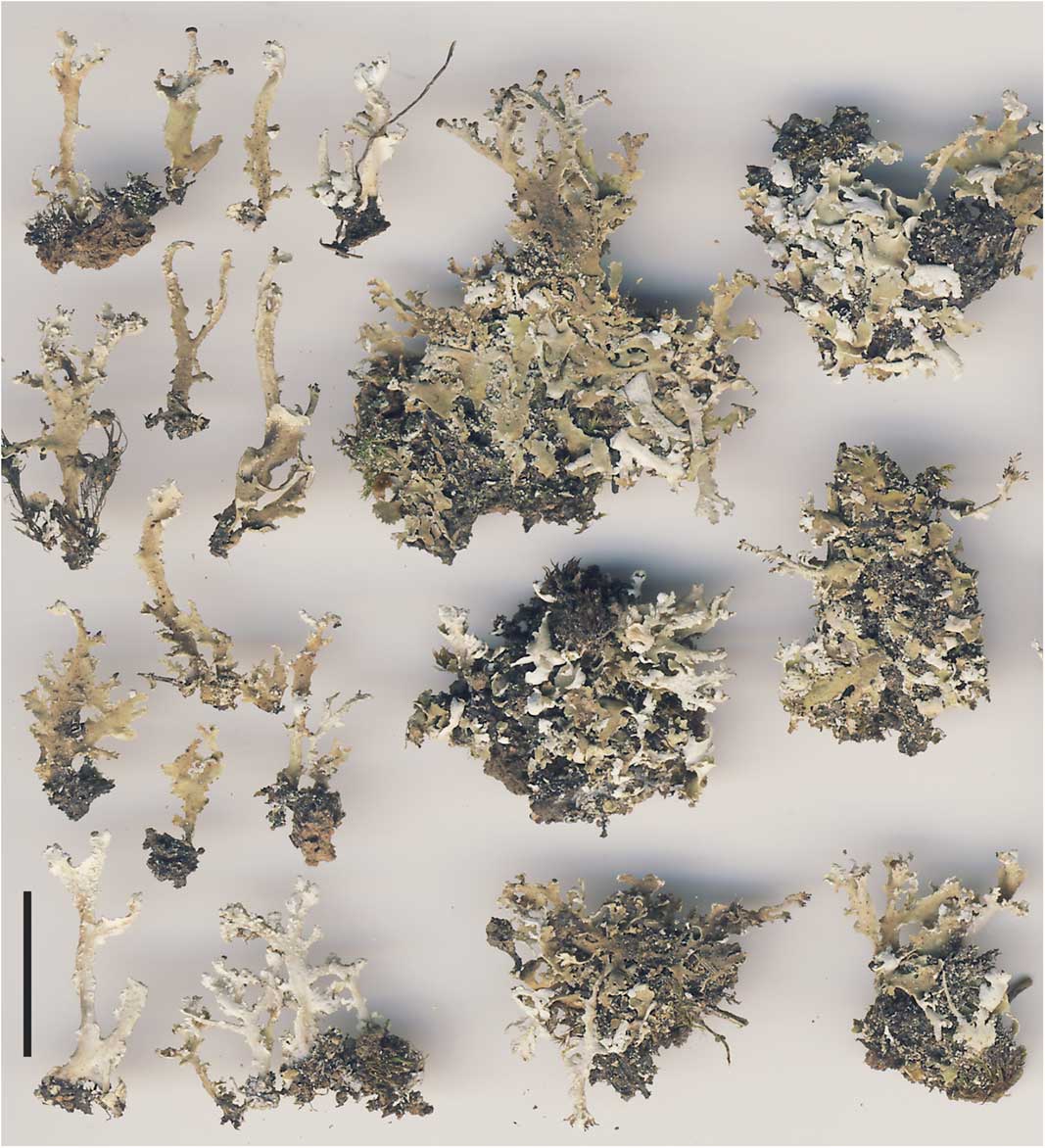
(Fig. 2)
Cladonia compressa (holotype, KRAM). Scale=1 cm. In colour online.
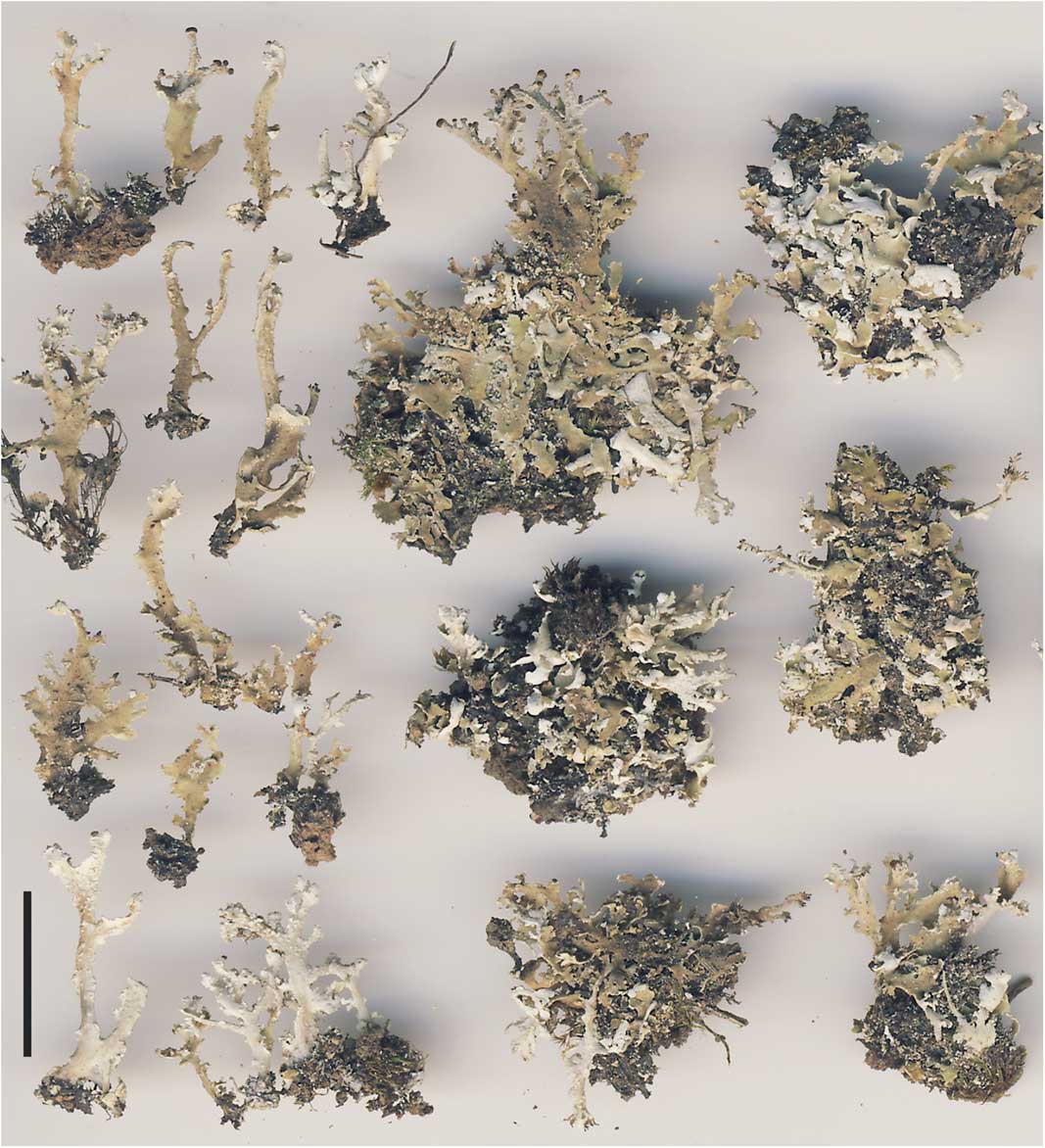
Primary thallus persistent, dominant, consisting of well-developed, rather large squamules, which are flat to imbricate and slightly recurved when dry, but strongly erect when wet, 2·0–20·0×0·5–1·5(–3·0)mm. Deeply divided into narrow, elongated lobes (or rarely broad-lobed), with irregularly crenate margins; along margins sorediate or granulose; upper side glaucescent to yellowish green and sometimes brownish in part, opaque, rough, faintly maculate; underside white, thinly arachnoid and somewhat veined, in places slightly granulose or sorediate, necrotic parts turning ochraceous; cortex 30–80 µm, medulla (100–)200–500 µm.
Podetia sparse, phyllopodiate, flattened in part, 3–10 mm tall, 0·3–1·2 mm thick, pale green, unbranched at first, but soon developing numerous, short apical branchlets tipped with branched hymenial primordia and finally hymenial discs, occasionally appearing scyphoid, with lateral perforations and slits; axils closed or sometimes perforated. Surface of podetia rough, shallowly areolate corticate to strongly verruculose, decorticate and arachnoid in part, with bullate or flat squamules and rarely granular soredia. Podetial wall 200–400 µm, cortex 20–40 µm, medulla 20–80 µm, stereome 100–250 µm, hard cartilaginous, narrow central canal present. Hymenial discs sessile, on podetial tips, subspherical, pale to dark brown, 0·3–0·8 mm diam.; ascospores 10–15×2·0–4·4 µm, oblong, with tapering ends.
Conidiomata on primary squamules, 300–600×200–400 µm, pyriform, constricted at base, shortly stalked, containing hyaline to yellowish brown slime; conidia not observed.
Chemistry. C−, K−, P+ orange to rust red, UV−. Fumarprotocetraric acid (major), protocetraric acid (minor to trace), and (?) physodalic acid (minor to trace).
Etymology. The epithet ‘compressa’ refers to the presence of flattened podetia.
Distribution and habitat. Known only from Bolivia, where it occurs on humus mixed with mineral soil in Yungas montane cloud forest.
Notes. Cladonia compressa is morphologically a very distinct species not much resembling C. pityrophylla Nyl. or other abundantly squamulose soil lichens of South America (Ahti Reference Ahti2000). Sequences from the two cited specimens of C. compressa were subjected to molecular analyses and they formed a well-supported clade. They were nested in a clade which could be called a Cladonia peziziformis-C. cartilaginea group, characterized by rather simple, ascyphose podetia. Cladonia compressa is located in a subclade with C. nana Vain., C. farinophylla Ahti and C. solida Vain.; all these species are rather ephemeral pioneers on bare soil on earth banks in Latin America (Ahti Reference Ahti2000; Ahti & Sipman Reference Ahti and Sipman2013).
Additional specimen examined. Bolivia: same location as the type, 2011, A. Flakus 21554 & O. Plata (H, KRAM, LPB).
Cladonia conspicua (Ahti) Ahti
In Santesson, Lich. Sweden Norway: 64 (1994).—Cladina conspicua Ahti, Ann. Bot. Fenn. 26: 223 (1986).
Ahti (Reference Ahti1986) segregated this species from Cladonia rangiferina (L.) F. H. Wigg. This decision was based on two large specimens from Newfoundland in Canada and two from Sweden. Ahti & Stenroos (Reference Ahti and Stenroos2013) and Ahti & McCarthy (Reference Ahti and McCarthy2013) later synonymized C. conspicua with C. rangiferina because of the lack of additional records. Cladonia conspicua is reinstated here because in 2014 one of us (TA) detected the species again in New Brunswick, Canada. The lichen formed one major patch on a somewhat shaded rock outcrop together with typical C. rangiferina. The two species were very clearly distinct in the field, C. conspicua having star-like polytomic branching and forming whitish patches with an absence of dark pigments in the tips (Ahti Reference Ahti1986).
A sequence from one specimen of C. conspicua from New Brunswick was included in recent molecular analyses based on ITS rDNA (Athukorala et al. Reference Athukorala, Pino-Bodas, Stenroos, Ahti and Piercey-Normore2016) and was outside C. rangiferina, closer to C. subtenuis.
Specimen examined. Canada: New Brunswick: Charlotte Co., 1·2 km W of Lepreau exit on Hwy 1, N side of Seven Mile Lake Road, wooded rock outcrop on roadside, under spruce in half-shaded glade, one large patch with C. rangiferina, 6 ix 2014, T. Ahti & S. R. Clayden (H, NBM, WIN). In addition, four specimens cited in Ahti (Reference Ahti1986) were examined again.
Cladonia crinita Bertol.
Rendiconto Sess. Accad. Sci. Ist. Bologna 1855–1856: 51 (1856); type: USA, Alabama, H. Gates s. n. (BOLO?, n.v.).
Although no original material has been examined, the reasonably good original description obviously refers to Cladonia evansii Abbayes. This identification is corroborated by Bertoloni’s (Reference Bertoloni1856 a) citation of C. rangiferina var. minor Michx. as a synonym. The type (PC) of var. minor from “Carolina” is definitely C. evansii (Ahti Reference Ahti2000). The description of C. crinita was republished and augmented by Bertoloni (Reference Bertoloni1856 b: 21), now even including a drawing (tab. 3, f. 2c–d) which also clearly shows C. evansii.
Thus C. crinita (1856) is a much older name than C. evansii (1938). However, C. evansii is a well-established name for an abundant, showy lichen that is also known to the public in the south-east of the United States. Therefore, it should not be reduced merely to synonymy but needs conservation, or rejection of C. crinita. At this point we suggest that C. evansii should be treated as a nom. cons. prop. (ined.). See also the discussion below under C. perfoliata.
Cladonia longisquama Ahti sp. nov.
MycoBank No.: MB 816813
Characterized by the presence of barbatic acid and unusually large primary squamules, which are 15–30 mm long, 2–8 mm wide and sorediate below, while the podetia are unknown.
Type: Seychelles, Silhoutte Island, summit of Mt. Corgat, 500 m, on moss at base of rock, 20 July 2000, J. Gerlach s. n. (H—holotype; SEY—isotype); GenBank ITS rDNA accession No. KU923377.
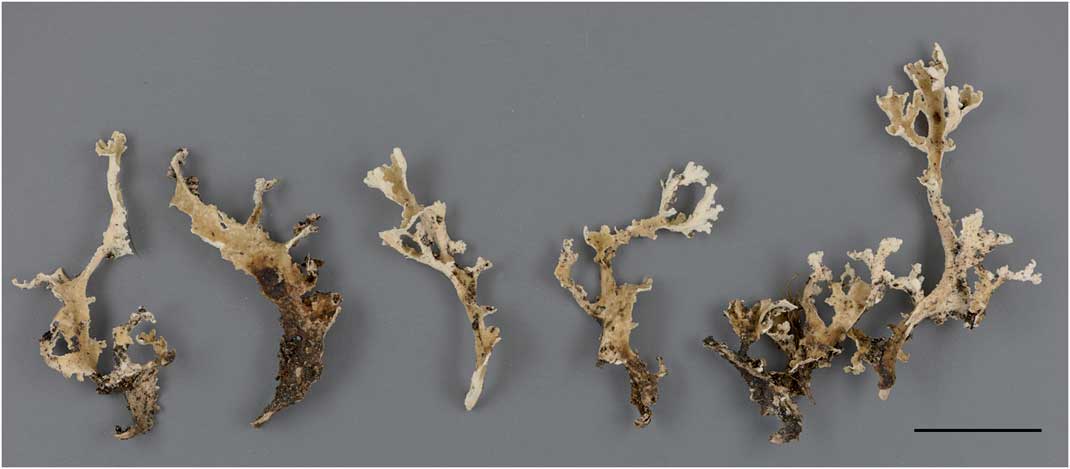
(Fig. 3)
Cladonia longisquama (holotype, H). Scale=1 cm. In colour online.
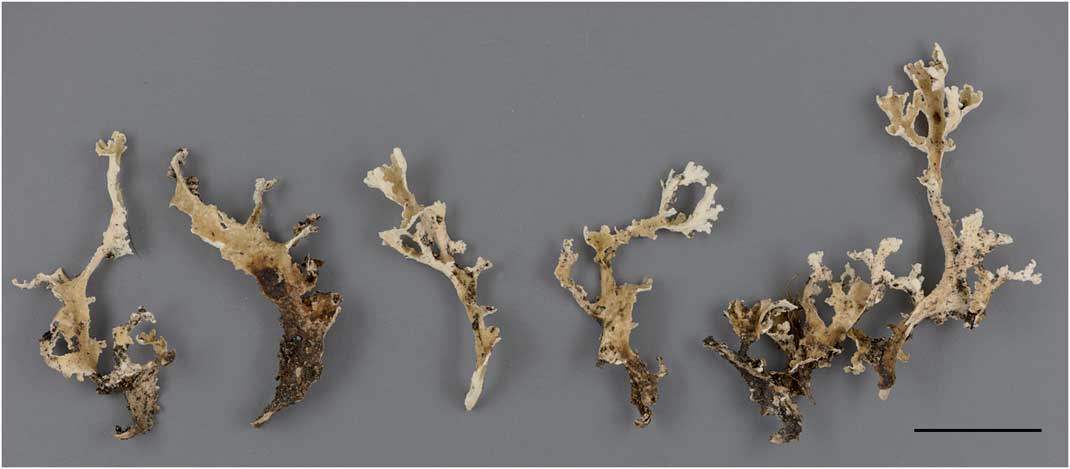
Primary thallus well developed, consisting of large, somewhat laciniate squamules, 15–30 mm long, 2–8 mm wide, above smoothly corticate, greenish grey, below whitish, ecorticate, finely sorediate, especially along the margins, veined and keeled towards the slightly yellowish base.
Podetia not seen, but apparently phyllopodiate (i.e., the podetia developing by apical extension of a primary squamule), judging from small initials of podetia at a squamule margin. Hymenial discs or conidiomata not known.
Chemistry. C−, K−, P−, UV−. Contains barbatic acid and unidentified fatty acids.
Etymology. The epithet refers to the long primary squamules.
Distribution and ecology. Known only from the Seychelles where it was found growing on mossy rocks.
Notes. This species is similar to C. meridionalis Vain. from tropical South America (Ahti Reference Ahti2000; Ahti & Sipman Reference Ahti and Sipman2013). The latter has more rounded lobes and its major secondary compound is obtusatic acid, which is produced together with accessory barbatic acid. The hymenial discs are red in C. meridionalis and C. longisquama is thus also expected to be red-fruited. In our molecular study, C. longisquama was recovered in the “Supergroup Cocciferae”, near C. weymouthii. The latter is an austral, red-fruited species with smaller squamules (Archer Reference Archer1992).
Cladonia oricola Ahti & S. Stenroos
Abhandl. Westfälischen Mus. Naturkunde 70: 401 (2008); type: Canada, Newfoundland & Labrador, Island of Newfoundland, Avalon Peninsula, Witless Bay Line, at boundary of Hawke Hills Ecological Reserve, 7 September 2007, T. Ahti 67674 & S. Stenroos (H—holotype; CANL, BM, NFM, NY—isotypes).
This species was described from the island of Newfoundland and was also reported from Nova Scotia (Ahti & Stenroos Reference Ahti and Stenroos2008; Ahti & McCarthy Reference Ahti and McCarthy2013). More recent field and herbarium work has revealed that it is more widespread south of Nova Scotia, extending to the United States where we report it from Massachusetts. In Halifax County, Nova Scotia, it appeared to be very abundant within the spray zone along the ocean, while its relative C. rangiferina was observed only further from the shoreline (T. Ahti, unpublished data).
Athukorala et al. (Reference Athukorala, Pino-Bodas, Stenroos, Ahti and Piercey-Normore2016) included a single specimen of C. oricola from Nova Scotia in their molecular study, and their analyses supported the distinctness of this species (as well as C. conspicua) from C. rangiferina. However, C. rangiferina can be extremely variable in some areas, indicating that it may still hide further taxa. A recent molecular study by Kanz et al. (Reference Kanz, Brackel, Cezanne, Eichler, Hohmann, Teuber and Printzen2015) in Central Europe shows part of this variability.
Selected specimens examined. Canada: Newfoundland & Labrador: Burin Peninsula, 5 mi SW of Fortune, maritime heath, 1956, T. Ahti 2999 (H, NY 1224996); 3 mi W of Lamaline, blanket bog, 1956, T. Ahti 3670 (H); 2 mi NW of Long Pond, c. 10 mi W of Swift Current, bog, 1956, T. Ahti 9447; Isle aux Morts, above Otter Bay, maritime heath, 2015, T. Ahti 75974 & J. McCarthy (CANL, H); Rose Blanche Lighthouse, maritime heath, 2015, T. Ahti 76002 & J. McCarthy (H). Nova Scotia: Halifax Co., East Pennant, Crystal Crescent Beach Provincial Park, NW of Mackerel Cove, heath, 2011, T. Ahti 71318 (H, NSPM); Duncan’s Cove, near Chebugto Head Lighthouse, 2011, T. Ahti 71334 (H, NSPM), D. Richardson, F. Anderson & C. Porter; Yarmouth Co., East Barclay Brook, c. 2 km W of Flintstone Rock, bog, 1999, T. Ahti 57160 (H, NSPM).—USA: Massachusetts: Barnstable Co., Cape Cod, Eastham Town, vic. of Coast Guard Beach, 1976, R. Dirig 1805 (NY); Nantucket Co., Gibb’s Pond, 1937, R. H. Torrey s.n. (NY); Plymouth Co., Middleboro, R. H. Torrey s.n. (NY).
Cladonia perfoliata Flörke
De Cladon.: 30 (1828); type: Brazil (probably Diamantina), C. Martius (M—neotype, designated by Ahti & Marcelli Reference Ahti and Marcelli1995; BM—isoneotype).
Cenomyce crinita Delise ex Pers. in Gaudichaud, Voy. Uranie: 212 (1828, ‘1826’).— Cladonia crinita (Delise ex Pers.) Ahti in Ahti & Marcelli, Biblioth. Lichenol. 58: 13 (1995), nom. illeg.; type: Brazil, Rio de Janeiro, 1823, C. Gaudichaud 39 (PC—lectotype, designated by Ahti & Marcelli Reference Ahti and Marcelli1995; PC—Thuret—isolectotype).
Cladonia crinita (Delise ex Pers.) Ahti was recognized as a widespread endemic species from south-eastern Brazil by Ahti & Marcelli (Reference Ahti and Marcelli1995) and Ahti (Reference Ahti2000). Unfortunately, the name is a later homonym of the overlooked C. crinita Bertol. (see above) from Alabama. Therefore we have resurrected its synonym C. perfoliata for use, instead of the illegitimate C. crinita.
Cladonia vescula Ahti, Kukwa & Flakus sp. nov.
MycoBank No.: MB 816814
Differs from Cladonia peziziformis (With.) J. R. Laundon in having ecorticate surfaces of the podetia, and having large corticate areoles and bullate or downward projecting microsquamules mixed with macrosquamules. Contains homosekikaic and sekikaic acids with fumarprotocetraric acid, or fumarprotocetraric acid alone.
Type: Bolivia, Dept. La Paz, Prov. Larecaja, near Consata village, 15°20'46'S, 68°29'16''W, 1240 m, Yungas inferior montane secondary forest, terricolous, 15 May 2011, A. Flakus 20510 & O. Plata (KRAM—holotype; H, LPB—isotypes); chemotype I. GenBank ITS rDNA accession No. KU923378.
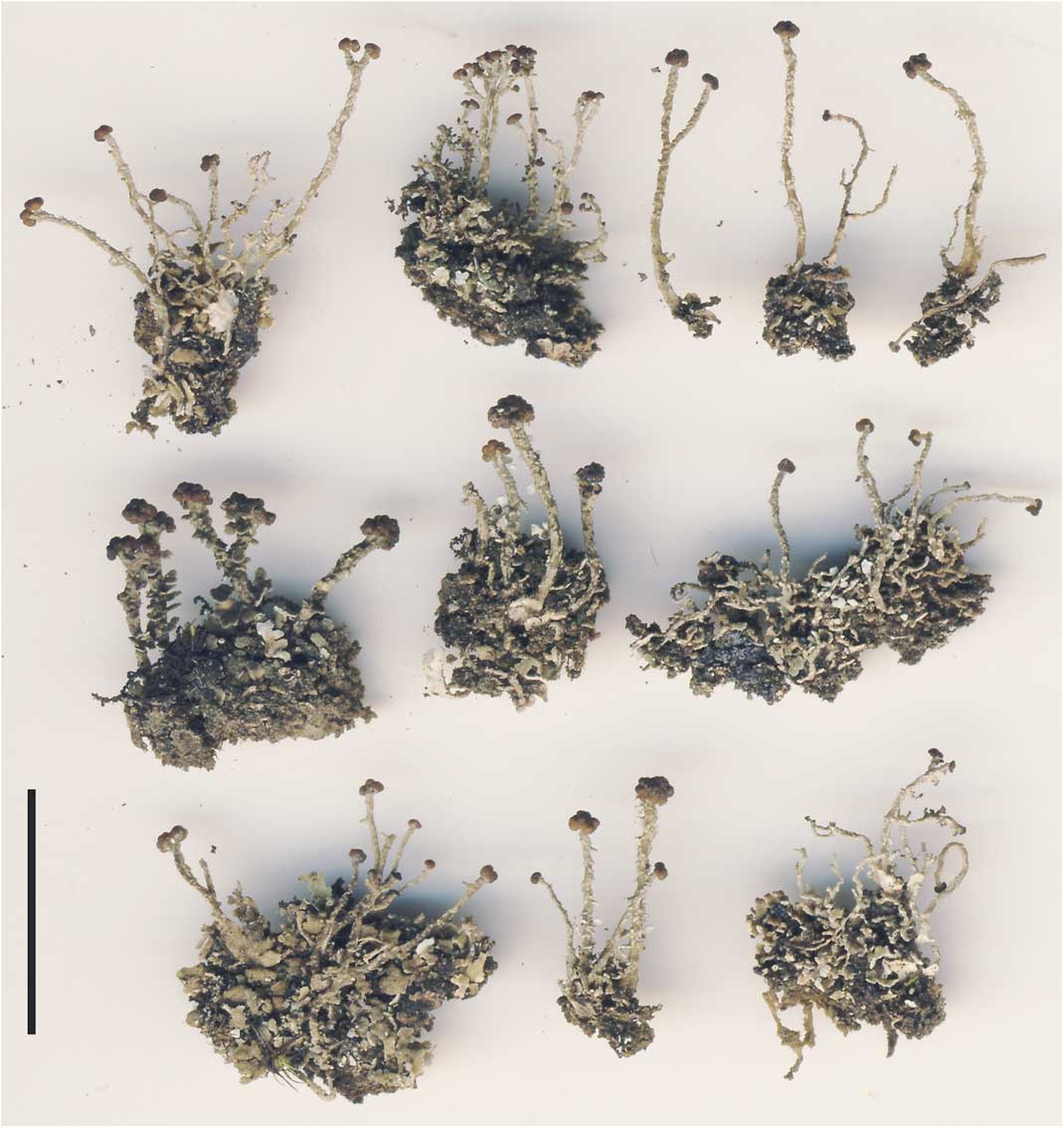
(Fig. 4)
Cladonia vescula (holotype, KRAM). Scale=1 cm. In colour online.
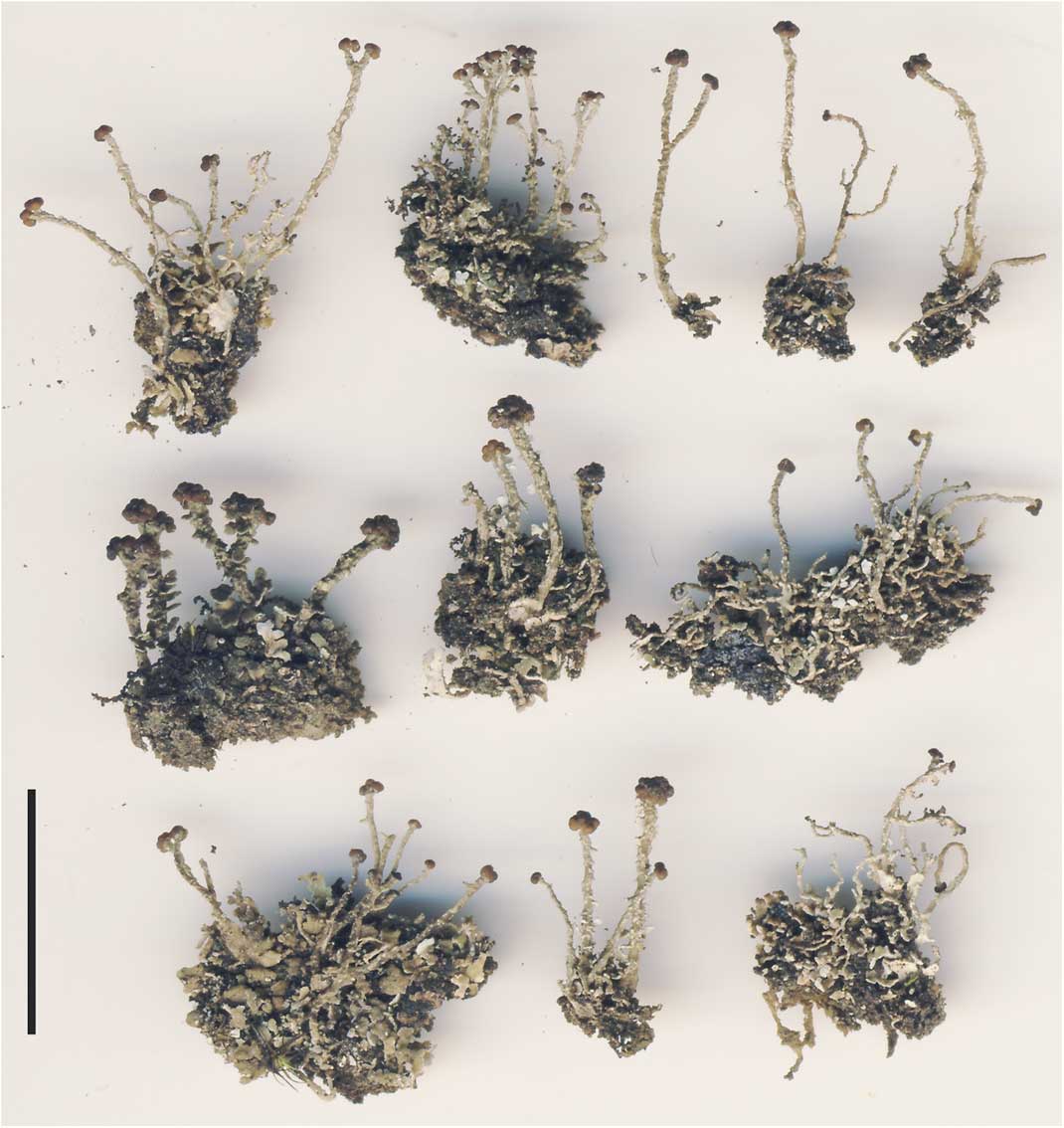
Primary thallus persistent, consisting of small, esorediate squamules, 0·4–2·5(–4·0)×0·3–1·0 mm, mostly short-laciniate, thick and convex, upper side green to glaucous, brownish green in part, smooth, shiny or pruinose, underside white, thinly arachnoid; cortex 30–100 µm, medulla 150–250 µm.
Podetia frequent and often abundant, arising from margins of primary squamules, 3–13(–17) mm tall, 0·2–0·6(–0·8) mm thick, pale greyish green to brownish green, slender, often clavate, simple to sparsely branched (often divided into 2–10 branchlets at the tips), cylindrical but in part flattened, ascyphose, axils closed. Surface of podetia almost completely ecorticate, revealing bare stereome, in part covered by large corticate areoles, and bullate or downward projecting microsquamules, sometimes with longitudinal ridges and cracks, and some macrosquamules, esorediate. Podetial wall (50–)100–300 µm, cortex 15–30 µm, medulla 30–100 µm, stereome 70–250 µm, hard cartilaginous, very narrow central canal present, striate. Hymenial dics sessile on podetial tips, dark to pale brown, almost flat to subspherical, 0·3–0·8 mm diam., simple or forming aggregations (older aggregations confluent and cerebriform, 1·0–1·8 mm diam.); ascospores 7–12×3–4 µm, oblong.
Conidiomata on primary or podetial squamules, pyriform, often flattened, constricted at base, shortly stalked, containing hyaline slime; conidia 5–12×1·0–1·5 µm, falciform.
Chemistry. Two chemotypes: 1) C−, K−, P−, UV+, containing homosekikaic acid (major), sekikaic acid (minor to trace) and fumarprotocetraric acid (minor to trace); 2) C−, K−, P+ red, UV−, containing fumarprotocetraric acid (minor to major). Chemotype I seems to be more common.
Etymology. Vesculus is the diminutive of vescus, Latin for ‘poor, thin’, referring to the tiny habit of the lichen.
Distribution and ecology. Known only from Bolivia and Peru. In Bolivia it occurs on mineral soil mixed with humus in Yungas montane cloud forest and pre-Andean Amazonian forest.
Notes. In morphology, C. vescula much resembles C. peziziformis, but is even more tiny or slender than that species and almost completely ecorticate. Another similar species is C. corymbosula Nyl., which tends to be slightly more robust and corticate. In addition, C. vescula and C. corymbosula are phylogenetically very distant (S. Stenroos et al., unpublished data). Cladonia vescula and C. signata (Eschw.) Vain. appeared together in a rather isolated clade in the Supergroup Cladonia. Cladonia signata is a peculiar, tall and dense “subcladinoid” species of tropical South America (Ahti Reference Ahti2000) and morphologically distant from C. vescula. The molecular analyses support the specific status of C. vescula. The three specimens (of Chemotype 1) analyzed formed a well-supported clade (S. Stenroos et al., unpublished data).
Additional specimens examined (Chemotype 1). Bolivia: Dept. La Paz: same location as the type, 2011, A. Flakus 20520 & O. Plata, A. Flakus 20543 & O. Plata (H, KRAM, LPB), M. Kukwa 8564 (H, LPB, UGDA L-18938).
Additional specimens examined (Chemotype 2). Bolivia: Dept. La Paz: same location as the type, 2011, A. Flakus 20543 & O. Plata, A. Flakus 20520 & O. Plata (KRAM, LPB); Prov. Bautista Saavedra, Calzada Village, 15°09'06''S, 68°30'24''W, 835 m, on soil in pre-Andean Amazonian secondary forest, 2011, M. Kukwa 8802 (H, LPB, UGDA L-18954).—Peru: Prov. Paucartambo: Challabamba, 2800 m, 1984, H. Kashiwadani 21902 (TNS).
We thank the curators of the herbaria FH, H, KRAM, LPB, NY, TNS, and UGDA for access to their material. Linda in Arcadia and Prof. P. L. Nimis helped in the clarification of Cladonia crinita. Rosa I. Meneses Q. (La Paz) and Herbario Nacional de Bolivia (Instituto de Ecología, Universidad Mayor de San Andrés) are gratefully acknowledged for their generous cooperation. Dr Jolanta Piątek and Dr Marcin Piątek (Kraków) are thanked for making the specimen from Cameroon available for the study, Dr M. Kukwa (Gdańsk) for making available the specimen of C. vescula and Oscar Plata (La Paz) and Pamela Rodriguez Flakus (Kraków) for their kind help during the fieldwork in Bolivia. AF received support from the W. Szafer Institute of Botany of the Polish Academy of Sciences through its statutory funds. Prof. D. Pfister provided help during the visits to the Farlow Herbarium by TA. In fieldwork, TA was assisted by Dr Stephen Clayden in New Brunswick, Prof. David Richardson in Nova Scotia, and Father Dr John McCarthy in Newfoundland & Labrador. Prof. Mark Seaward (Bradford) forwarded a specimen from the Seychelles for study. The molecular analyses were primarily performed by the authors RPB and SS in Helsinki. RPB and SS received funding from the European Union’s Seventh Framework Program (FP7 2007-2013) under grant no PIEF-GA-2013-625653.