Introduction
Ireland has had a steadily declining population for more than a century. Economists and sociologists are agreed that, if this ominous trend continues, in another century the Irish race will have vanished much like the Mayans, leaving only their monuments behind them.Footnote 1
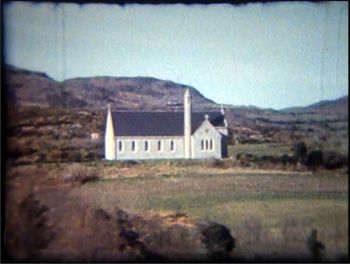
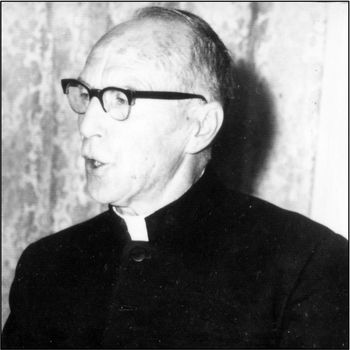
This article explores the intellectual culture of Catholic architectural production in 1950s Ireland. In doing so, it speaks to a broad range of social, economic, and political aspects of Irish rural life and religious expression in what is often portrayed as a bleak decade marked by emigration, insularity, and conservative Catholicism.Footnote 2 Its focus is an unusually well documented church-building project in rural West Cork of the early 1950s – the Church of Mary Immaculate, Dromore, Co. Cork (Figure 1) – and the life, work, and writings of the energetic parish priest who oversaw its construction, Canon Patrick Henchy (1888–1969) (Figure 2). The building of Catholic churches in postwar Ireland was unusual by international standards: few other countries combined such intensive architectural production with such pronounced rural depopulation and economic stagnation. While the Church of England made redundant many hundreds of rural churches in the 1950s and 1960s, the Irish Catholic Church, by contrast, engaged in a wave of construction and renewal that rivalled the peaks of church building in the 1820s (around the time of Catholic Emancipation) and in the 1860s (in the era of Emmet Larkin’s Irish ‘devotional revolution’).Footnote 3 This article uses the building of Dromore church to explore five key themes: first, it analyses cultural nationalism in 1950s Ireland from an ecclesiastical perspective. Second, it adds to our understanding of the phenomenon of the Irish ‘church-building priest’ in terms of their socio-economic background, fundraising abilities, and position within rural communities – building on a new wave of research into the economic history of the Irish Catholic Church.Footnote 4 Third, it focuses on the role that the Irish countryside played in conditioning clerical understandings of architectural style and taste, and in particular priests’ political reading of the rural landscape. Fourth, it analyses the aesthetics of Marianism in church design and ornamentation around the time of the international ‘Marian Year’ of 1954. And finally, it focuses on the political meanings of the rhetoric employed by Catholic clerics at church consecration ceremonies. Furthermore, the building of Dromore church is discussed here as the outcome of a conjunctural moment in Irish history, formed at the confluence of a range of local, national, and international events, both sacred and secular. This included a new bishop in the Cork and Ross diocese, Cornelius Lucey (1902–1982), and his launching of an ambitious urban church-building programme in Cork city; the challenges and opportunities presented by rural emigration; the particular cultural imagination of a parish priest, formed by certain childhood experiences, socio-economic factors, and geographies of the south-west of Ireland; and finally this priest’s rural relocation of the eve of Pius XII’s declaration of the Marian Year.Footnote 5
The Church of Mary Immaculate, Dromore, Co. Cork, Ireland. A still from a video taken from a passing train by Walter McGrath, 1961. Reproduced courtesy of Michael Patterson.

Canon Patrick Henchy (1888–1969). Reproduced courtesy of Fr Danny Pyburn, Dromore, and Mrs Cecilia Wilcox, Dromore.

Considering the dominant role of religion in modern Irish culture, it is unsurprising that there is a very substantial literature on the twentieth-century history of the Irish Catholic Church. Early political surveys such as John Henry Whyte’s Church and State in Modern Ireland (first published in 1971) have been followed in more recent years by a wealth of political, social and cultural studies, by James S. Donnelly, Lindsay Earner-Byrne and many others.Footnote 6 The revelations of clerical institutional abuse since the 1990s have given impetus to a new wave of research into previously neglected aspects of the Irish postwar experience. Scholars including James Smith, Maria Luddy, Jacinta Prunty, Sarah-Anne Buckley, and others have brought into clear focus key questions of class, gender, and power within Irish Catholicism.Footnote 7 Furthermore, sociological and anthropological studies, for example by Tom Inglis, Louise Fuller, and others have queried the relationships between the Catholic Church, politics and business in modern Ireland.Footnote 8 They have unpacked the complexity of Irish religious experience and attempted to explore the reasons for its rapid decline in recent decades.Footnote 9 These studies overlap with more general political, economic and cultural histories of postwar Ireland, with a dominant narrative throughout of emergence and enlightenment from a supposed insularity and stagnation (the ‘lost’ years of ‘De Valera’s Ireland’ in the 1940s and 1950s) through to a sunburst of economic reforms and liberalisation from the late 1950s onwards, largely credited to the civil servant T. K. Whitaker.Footnote 10
The ‘lost decade’ thesis, as Keogh terms it, is of course backed up by raw data: more than 400,000 people emigrated from Ireland during the 1950s, bringing the population down to its lowest ever number of 2.8 million in 1961. Much of this exodus was from rural areas.Footnote 11 Arguably the influential concept of a ‘lost decade’ has made the 1950s less attractive for new scholarly research – continuity presumably being less interesting than change. There are, however, many gaps within our knowledge of this key decade, not least in terms of some of the themes at the core of this article: rural culture, religion, and architectural production.Footnote 12 Síle de Cléir’s recent study of popular devotion in Limerick city between the 1920s and the 1960s, based on oral history sources, has begun to shed more light on this important field of research. For Catholic church architecture, as de Cléir notes, the moment of change and renewal was not the economic reforms of the late 1950s but the profound devotional, cultural and material changes brought about a decade later by ‘Vatican II’.Footnote 13 Irish Catholic church architecture of the 1940s and 1950s remains largely neglected, despite the pioneering work of Ellen Rowley and others.Footnote 14 Considering the sheer number of new churches built mid-century, it is remarkable how few have been studied in any detail. Scholarly analysis continues to be substituted by journalistic invective, as for example in Brian Fallon’s view from the late 1990s: Irish Catholic priests, were, he argued
for the most part, very ordinary men (very often younger sons of farmers) without original ideas or judgement, and untrained in any method of constructive criticism – something which would certainly not have been encouraged officially, in any case. … Culturally the clergy were mostly philistines, as was immediately obvious from the ugliness of many or most of the parish churches.Footnote 15
In exploring the building of a church in rural West Cork, this article uses new archival evidence to offer a more nuanced perspective on mid-century Catholic clerics and their architectural and material culture. It shows how a parish priest engaged in a serious and scholarly way with architectural style and how he weaved together rural religious tradition with a profound admiration for the mountainous landscape of the south-west of Ireland. The article follows in the wake of earlier research on the nineteenth century by Larkin, David W. Miller and Kevin Whelan, and more recent interventions by Cara Delay, Sarah Roddy and many others, in attempting to understand the materiality of the Irish Catholic Church in its socio-economic and cultural contexts.Footnote 16 The building of Dromore church is a particularly rewarding case study for four key reasons: first, it occurred at the very high-water mark of popular and official Catholic devotion in Ireland around the Marian Year of 1954, before the Church began to go into decline (in ordinations, and later in mass attendance, cultural esteem and political influence).Footnote 17 Second, it occurred within the diocese of Cork and Ross, which was led from 1952 until 1980 by Lucey, one of Ireland’s most influential and outspoken clerical sociologists.Footnote 18 Lucey regularly spoke and wrote about issues such as emigration, rural life, Marianism, and family values, yet remains largely neglected in existing scholarship.Footnote 19 He oversaw one of the most ambitious programmes of church building outside of Dublin: between 1953 and 1963, he built ten new churches in the diocese: seven in or near Cork city and three clustered together in West Cork.Footnote 20 This article adds to our – admittedly limited – understanding of the early years of Lucey’s tenure as bishop. Third, the building of Dromore church occurred in a county of Ireland – Cork – that is richly served in existing eighteenth- and nineteenth-century socio-economic histories by David Dickson and Donnelly (for whom County Cork had ‘some claim to be regarded as a microcosm of the entire country’), and in more recent work by Eipper, Peter Hart, and others.Footnote 21 Eipper, who undertook anthropological research near Dromore in the 1970s, was moved by the ‘pervasive catholicity’ of the people he studied. He found religious expression in their ‘sentiments expressed in the media, literature[,] song [and] in the very idioms of [their] language’, and suggested that ‘people keenly appreciated the fact that, compared with … other countries, religion occupied a distinctive place in their life’.Footnote 22 And finally, the building of Dromore church is unusually well documented in both visual and textual archives. Henchy wrote regularly for the diocesan magazine, The Fold, founded by Lucey in 1953, and for the local newspaper, the Southern Star. Few other church-building projects in 1950s Ireland are so well served by surviving historical sources. For example, less than eight kilometres from Dromore, another new church was built at the same time; however, far fewer sources survive and the parish priest responsible remains a much more elusive figure.Footnote 23 Methodologically, this article analyses a substantial body of written and visual sources that survive but also pieces together Henchy’s family background and career using biographical records from the Cork and Ross diocese and socio-economic data from the digitised Irish census returns.
1950s mentalities: Catholic cultural nationalism
The 1950s marked the peak of triumphant Catholic cultural nationalism in Ireland, and this mentality was deeply rooted both in the canonical texts of early twentieth-century cultural nationalism more broadly and in an understanding of the Irish rural landscape. The two were, of course, linked: Daniel Corkery’s The Hidden Ireland: A Study of Gaelic Munster in the Eighteenth Century (1924) situated Gaelic (and thereby Catholic) ‘Irish Ireland’ away from the cities and towns, ‘among the bogs and hills’, he suggested, and ‘far into the mountains’. This was where, he thought, ‘the native Irish … still lurked’, with what Corkery saw as their purer culture, language, and religion.Footnote 24 The creation of the Irish Free State in the 1920s, with its remarkably homogeneous Catholic populace, presented an opportunity for the institutional Church and, in the decades that followed, Church and state worked largely in tandem to reinforce a particular form of socially and economically conservative Catholicism. Bishops and priests also emphasised the religious devotion of many nationalist leaders, thereby in subsequent years recasting the revolution itself as a ‘Catholic’ uprising. The close relationship between Church and state was evident, for example, in the celebration of the centenary of Catholic Emancipation in 1929; the hosting of the International Eucharistic Congress in Dublin in 1932; in new legislation governing sexuality, family life and censorship; and in the drafting of the 1937 Irish Constitution.Footnote 25
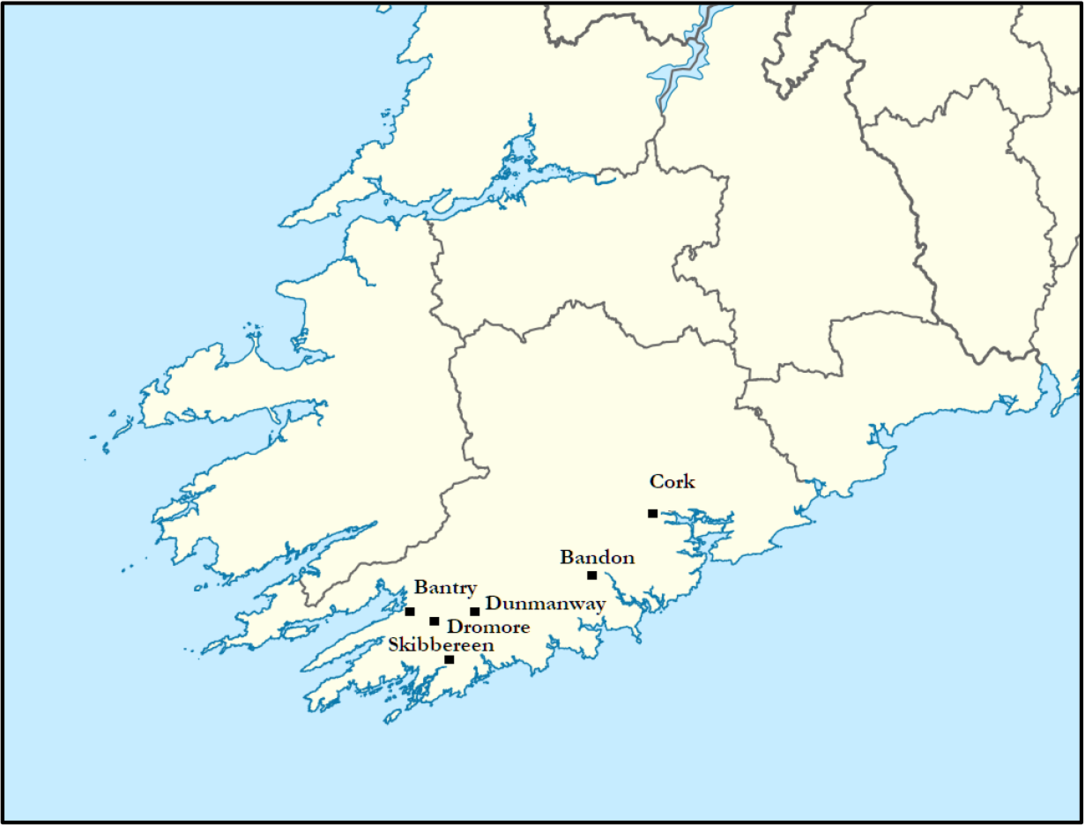
Henchy’s writings during his time as parish priest of Caheragh, and in some later reflections, show a deep understanding of these interwoven aspects of Irish cultural nationalism. Born into ‘a well-known Cork City family’ in 1888, and ordained in 1913, his early years teaching in the diocesan seminary at Farranferris in Cork city were punctuated by the War of Independence (1919–21), the burning of Cork city by British forces (1920), and the Civil War (1922–3).Footnote 26 His petit bourgeois father John, whom he referred to throughout his life as ‘the boss’, owned a large pub at St Luke’s Cross in the north inner city, close to a substantial military barracks.Footnote 27 The youngest son from a family of five boys and a girl, Henchy grew up in what the 1901 census referred to as a ‘1st class’ house, and like many sons of the comfortable Irish Catholic ‘shopocracy’, he made a distinguished career in the priesthood.Footnote 28 He was asked to serve as diocesan inspector of schools in the late 1920s. Touring the countryside with the privilege of access to a car gave him an opportunity to escape the city and appreciate the coastal and mountainous scenery of the western reaches of the diocese. As he recalled in 1963, ‘I was on the run … Four years spent travelling with the Catechism gave me an insight into the topography of the diocese of Cork. [It] was hard but pleasant going and showed me the kindness and understanding of the priests and teachers.’Footnote 29 Urban life then returned and between the 1930s and the early 1950s he served as curate (CC) of the poor inner-city parish of St Peter and St Paul’s. It was, he remembered somewhat bleakly, ‘smoke and lanes …, miles of stairs and countless cases. It took a lot of getting used to, but gradually the humour and goodness of the poor cut one down to size and working in the slums became real happiness.’Footnote 30 Then, in October 1953, shortly after the beginning of Lucey’s tenure as bishop, he had another chance to escape urban life with a promotion to parish priest (PP) at the age of sixty-four and a move to Caheragh in West Cork.Footnote 31 This parish, entirely rural, was made up of a church in Caheragh (sometimes known as Killeenleigh) and a chapel-of-ease in nearby Dromore (Figure 3). The relocation had a great effect and marked a new chapter in his life. More broadly, anti-urbanism was commonplace within Irish Catholic mentalities at the time (for example in the handbooks of the rural community development organisation Muintir na Tíre), with the countryside, as in other countries, seen as a reservoir of social virtue and moral probity.Footnote 32 For Henchy, set free from the city after eighteen years, the move had immediate practical consequences: ‘I shaved’, he said, ‘with an electric razor on Saturday morning in [Cork]; on Sunday, in Caheragh, I had to manage with a basin of cold water, a cut-throat, and with the light of a candle.’ The old parish church, from the 1820s, ‘had no pulpit’. He was endeared by what he saw as the uncomplicated life of the rural community, into whose world he now entered. In the church, ‘the people were all around. It was very different from talking from the raised, carved, commanding pulpit in SS. Peter and Paul’s.’ ‘It was’, he thought with little attempt to conceal a patrician tone, ‘like teaching in a classroom of very attentive pupils.’Footnote 33
The south-west of Ireland, showing relevant settlements in County Cork.

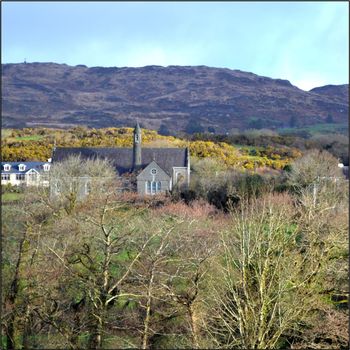
Henchy was greatly affected by what he perceived as the humble piety of the rural people and situated this within a broader narrative of triumphant Catholic cultural nationalism. Soon after his arrival in Caheragh, he wrote a short essay for the diocesan magazine The Fold about a ‘Holy Year’ cross built on top of a hill in the parish (Figure 4). In response to Pius XII’s declaration in 1950 of a Holy Year for the Church, forty-five men volunteered to build an eight-metre-high concrete cross on the rocky outcrop behind Dromore’s early nineteenth-century chapel-of-ease.Footnote 34 The cross was one of the many visual signifiers of Catholicism in the Irish countryside – including churches, shrines, and grottos. Henchy understood it as an act of ‘from below’ popular devotion but also as a territorial claim on the Irish landscape in Corkery’s ‘hidden Ireland’. Irish hills had long been appropriated for military, political and religious purposes. Following the failed French invasion of 1796, signal and Martello towers were built by the British state along the coastline; many of these, especially in the south-west, survive as ruins on promontories and hill tops.Footnote 35 In the nineteenth century, bonfires were lit on hills to endorse secret society activity and mark major nationalist political meetings.Footnote 36 Well into the twentieth century, festivals such as Beltane (in May) and Saint John’s Eve (in June) were accompanied by hill bonfires.Footnote 37 Henchy’s story centred on a devout married man ‘with an incurable malady’ who lived in the shadow of the new cross on Dromore hill. When, Henchy ‘first saw the Holy Year Cross on the hill of Dromore’, he thought it looked like ‘a flag floating over a besieged fortress’, a ‘stronghold [that] would never be taken’. ‘The flag’, he added, ‘would ever float victoriously’. He was moved by the barrenness of the landscape, commenting that ‘there is something fascinating about hills … the bare rocky heights showing their strength in naked stone’. Yet the tragedy of the man’s illness cast a dark shadow on the landscape, and in emotive language, Henchy commented that ‘it is a shocking thing to see a man crying’. The story then takes a dramatic turn as the man spots the cross on the hill, and reinvigorated by his faith, straightens ‘his withered frame’ and squares ‘his thin shoulders’. Triumphantly recalling the death of Jesus on the cross, the man turns to the priest and says, ‘he conquered death and with God’s help I and mine will too’. For Henchy, this experience was an opportunity to reflect on, as he put it, ‘the splendour of the high hills and the greatness of the souls of the men who were born and who lived amongst them’. ‘The hearts of the men of the hills’, as he described his parishioners, were inseparable from the triumph of the Church itself through the visual signifier of the Holy Year cross. Demonstrating his deep romantic appreciation for the Irish rural landscape, his essay set the tone for his extensive writings in the diocesan magazine and in the local newspaper during the building of Dromore church.Footnote 38
Dromore church with the ‘Holy Year’ cross, built in 1950, on the hill behind. Photograph by author, 2016.

The church-building priest
The process of building or reconstructing a church was both a spiritual and a practical concern.Footnote 39 For some priests, engaging in fundraising, planning and construction came rather naturally, and in Ireland and probably many other countries, we find the phenomenon of the ‘church-building priest’. These men often came from comfortable, middle-class backgrounds and had the social and cultural capital to organise a community and raise the finances to undertake building work. They might otherwise quite easily have become involved in business or engineering, but as priests they were almost continually involved in some kind of construction. In general, they were shaped by certain childhood experiences and tended to follow similar role models. In coordinating the different phases of architectural production, they fell easily into highly gendered, bourgeois categories of respectability, ‘hard work’ and ‘common sense’ – the product again of certain forms of family background and education.Footnote 40 Recent research has highlighted the economic importance of parish priests in modern Irish history, though examples from the postwar years are relatively scarce.Footnote 41 For example, in Donegal in the 1850s, the priest Edward Glacken is described by Brendán Mac Suibhne as politically active in his local Repeal campaign and as a ‘consummate organizer’ who had overseen the building of a new chapel and schools in his parish.Footnote 42 And in east County Galway in the 1930s, the priest Malachy Brennan built two churches, two parish halls, six schools, a priest’s house and a handball alley in the space of ten years. A Gaelic Leaguer, he had combined his pastoral work with the founding of a Sinn Féin branch and had given many nationalist sermons from the pulpit. His building work was, the Connacht Tribune commented, the result of his ‘organising genius’ and the ‘esteem in which [he was] held’.Footnote 43 Henchy was similarly a classic church-building priest. In almost all his appointments as PP, he undertook some building work.Footnote 44 Within a month of moving to Caheragh, he announced plans for building the new chapel-of-ease in Dromore. At the same time, Lucey was beginning work on five large new churches in Cork city, and while this placed a huge financial burden on the diocese as a whole (around £500,000), Lucey extended an offer of some support to the Caheragh parish.Footnote 45 He endorsed the rebuilding plans in a letter that Henchy read to his parishioners in December 1953. The old church, Lucey wrote, was ‘in very bad condition, so bad in fact that to put it in good order would cost practically as much as to replace it with a new one’. Reflecting the commencement of the Marian Year on the feast-day of the Immaculate Conception, he suggested the new church, which might cost £15,000, could be dedicated to Mary: ‘a special Mass will be offered in it every year … on the Feast of Our Lady’, he promised, ‘for benefactors living and dead’.Footnote 46
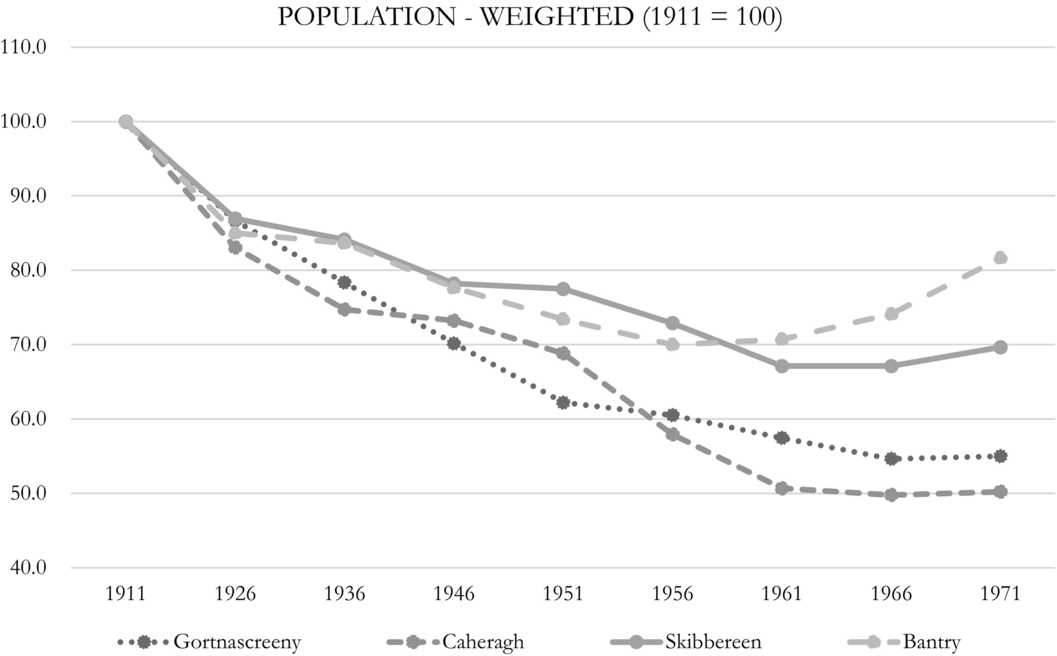
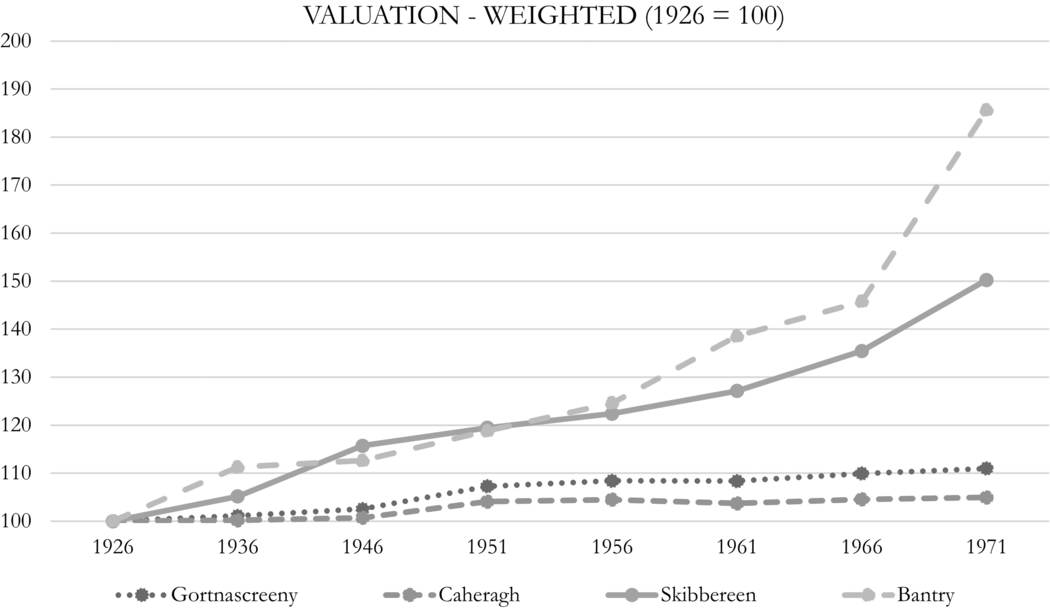
While the sum to be raised in Caheragh was small compared to Lucey’s plans for the city, it was nonetheless a formidable hurdle for a rural community that had been greatly affected by high levels of emigration – in the post-Famine years but also through the twentieth century.Footnote 47 In these years the total parish collection each year amounted to around £700 – from which the priest’s and curate’s salaries were paid.Footnote 48 The pressure that the church-building campaign placed on the community is evident in a detailed examination of census returns. Though there is, as Eoin O’Mahony has shown, significant variation between Irish parish and census boundaries, changes in the Caheragh parish can be represented with reasonable accuracy by studying the returns for the two District Electoral Divisions (DEDs) of Gortnascreeny (for the north of the parish) and Caheragh (for the south).Footnote 49 By the early 1950s, the area’s population had reduced by one third since 1911, and this increased further to almost one half of its 1911 level by 1966 (Figure 5). Though the two nearby towns of Skibbereen and Bantry also saw significant depopulation, this was less pronounced than in their rural hinterland, and they began to experience a reversal of fortunes from the early 1960s. In absolute numbers, the Catholic population of the parish fell from around 2,500 persons to just 1,750 in the years between Henchy’s tenure as schools’ inspector in the 1920s and his return as PP in the 1950s.Footnote 50 The Southern Star sounded alarm in these years with the headline, ‘Population at Lowest Point Ever: Emigration Toll’.Footnote 51 In terms of taxable valuation, the Caheragh area lagged far behind its nearby towns, especially from the 1950s onwards (Figure 6).Footnote 52 As this data is unadjusted for inflation, it is clear that the area’s valuation decreased significantly in real terms in the years after independence.Footnote 53 Overall these figures show just how daunting was Henchy’s building campaign. Yet emigration brought an unexpected bonus when a site for the new church was donated by a local man, whose brother, the Southern Star noted, served as a priest in ‘the oil-producing state of Oklahoma’.Footnote 54 As Roddy has shown, Irish Catholics abroad often played an important role in helping the Church back at home.Footnote 55
Population figures for certain DEDs in West Cork (1911–71).

Valuation figures for certain DEDs in West Cork (1926–71).

Henchy’s strategy for building Dromore’s new church was inspired by events he had experienced as a young cleric working in the diocese. Following his term as schools’ inspector, he was appointed CC in Bandon, a large and mostly urban parish around 30 km south-west of Cork city, where he served between 1931 and 1935. Later, he reflected that his superior there, Canon Martin Murphy, as a ‘great man for High Masses and processions’ and as someone who took a special interest in building work. He was ‘always doing things to the church and grave-yards’.Footnote 56 Murphy’s predecessor, Canon Jeremiah Cohalan (brother of the then-bishop of the diocese) had been a similarly enthusiastic church-builder in the parish; he oversaw the construction of a new chapel-of-ease in Gaggan in 1928–9. As CC, Henchy regularly said mass in this small church, designed by the Cork architect Bertie O’Flynn.Footnote 57 In general size and architectural arrangement, it was very similar to what he later built in Dromore – and as a chapel-of-ease it would have been an obvious precedent to draw upon twenty years later. The church in Gaggan – and the process of building it – provided a blueprint that Henchy could later follow.
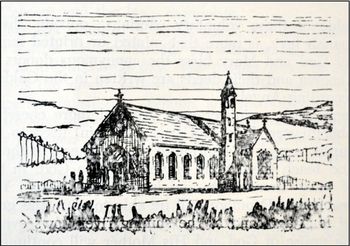
To raise the funds required to build Dromore, Henchy launched a sophisticated campaign of local charity events and took to writing in The Fold to win over the hearts and minds of his parishioners. In April 1954 he penned a short article ‘Our New Church at Dromore’, which included a sketch drawing of the building (Figure 7), closely matching what was later built. ‘The old church’ at Dromore, he argued,
is beyond repair. From its sagging roof to its stone-flagged floor there comes a breath of decay. Its crumbling, blotched walls and stoke-hold-like sacristy are certainly not fit surroundings for the King of Kings. … Just as its predecessor, the small thatched chapel – 250 yards to the north – it has had its day.
Perspective sketch of Dromore church, from The Fold, April 1954, p. 25.

It had been built in the 1820s, at the same time as the energetic local PP, Fr David Dore, rebuilt the main parish church in Caheragh.Footnote 58 Yet Henchy saw practical benefit in speculating that it had been built somewhat earlier, at the time of the United Irishmen rebellion:
It is said that the present church was begun in 1798. The people were so poor that they built the transept only. Then a Father Begley, about fifty years ago [sic later], completed the nave. The parish was in debt and a levy was put on the parishioners of one penny a month. It was a huge sum for the starving people of the time. History is repeating itself and I … am proud to say that the present parishioners are worthy successors of the men and women who starved to build a house for God.Footnote 59
Perhaps Henchy was not aware that according to local folklore, Dore had faced considerable resistance in his fundraising campaigns of the 1820s: ‘the new walls’ of his church in Caheragh ‘were being pulled down at night by those who opposed its building’, action that was only halted when Dore ‘threatened to put a curse on those who were committing the damage’.Footnote 60 A century and a quarter later, in such different political circumstances, Henchy faced no such opposition. As well as the offer of a site free-of-charge, he appointed collectors of funds for the various townlands in the parish, and the local Catholic Young Men’s Society organised a raffle and performed a comedy to an ‘almost full house’ in Bantry to raise funds.Footnote 61 The Men’s Sacred Heart Confraternity in Henchy’s former Cork city parish also made a significant donation.Footnote 62 Henchy’s success in raising money was all the more remarkable considering another new church was also being built at this time in the neighbouring parish of Drimoleague, and there the PP organised more than twenty-five separate fundraising events between 1952 and 1955.Footnote 63 In such a sparsely populated rural area, weakened by decades of emigration, the building of two new churches at the same time undoubtedly placed a heavy burden on the local community.
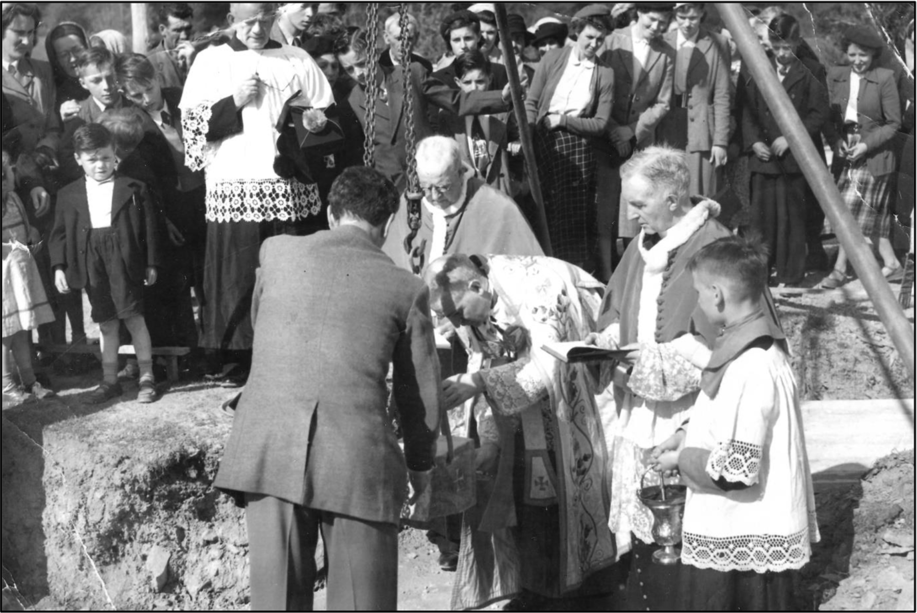
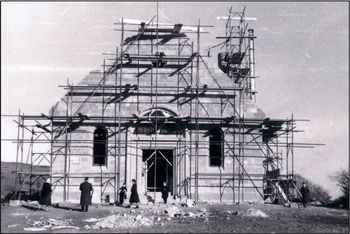
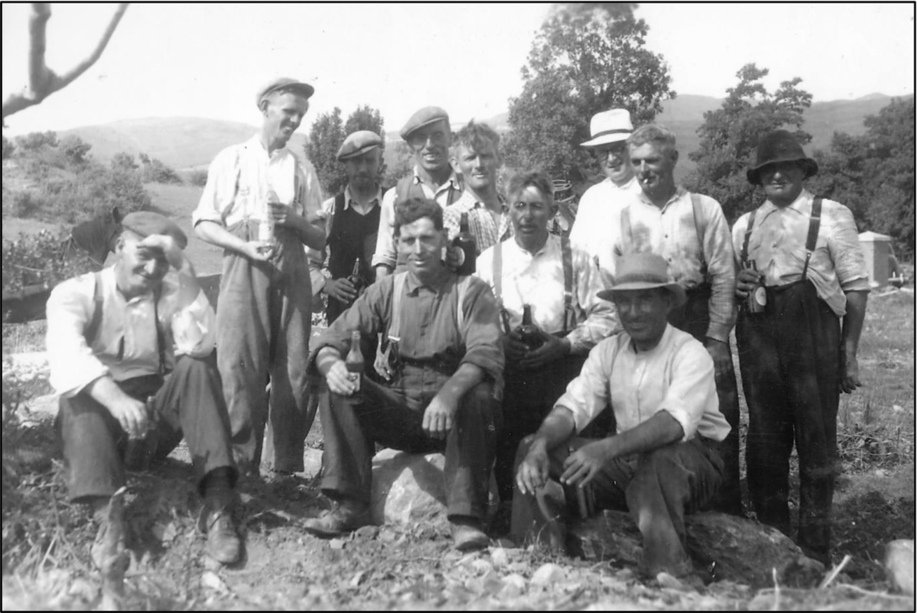
The construction of Dromore church proceeded rapidly. Bishop Lucey visited twice in May 1954 to bless the site and, a fortnight later, to lay the foundation stone (Figure 8).Footnote 64 Regular updates on the project were published in the local newspaper. Initially, Henchy hoped to have the church opened during the Marian Year of 1954 but this proved a little too optimistic.Footnote 65 By the summer of 1954 the floor had been laid, by September the walls were at roof height and it was noted the workers were receiving ‘much encouragement and assistance’ from their parish priest (Figure 9).Footnote 66 Volunteers from the parish helped with the building work, and posed for photographs with their bottles of beer on a warm summer’s day (Figure 10). By February 1955 the roof and much of the carpentry work were finished, with ‘work on the belfry tower’ ongoing, and by May the church was complete.Footnote 67
Bishop Lucey laying the foundation stone of Dromore church, May 1954. Reproduced courtesy of Fr Danny Pyburn, Dromore, and Mrs Cecilia Wilcox, Dromore.

Dromore church under construction. Photograph by Paddy O’Keeffe, c. 1954–5. Reproduced courtesy of Fr Danny Pyburn, Dromore, and Mrs Cecilia Wilcox, Dromore.

Parishioners who volunteered to help build Dromore church. Photograph by Paddy O’Keeffe, c. 1954–5. Reproduced courtesy of Fr Danny Pyburn, Dromore, and Mrs Cecilia Wilcox, Dromore.

Henchy was immensely proud of his new church, writing later that ‘from the cutting of the first sod to the blessing and first Mass’, the building work ‘took only 356 days’.Footnote 68 Yet its consecration – a major public event to be considered shortly – was also a bittersweet moment for him, as within a week he received news from the bishop that he was to be transferred to another parish. ‘It was lonesome leaving Caheragh’, he wrote, adding that ‘the happiest job I ever did was the building of the Church of Mary Immaculate in Dromore.’Footnote 69 The swap was necessitated by Lucey’s decision to split the Cork city parish of Blackrock into two separate entities and the subsequent need for an experienced, senior priest to take charge of a newly-created parish (Ballinlough) in a rapidly growing suburb of the city.Footnote 70 Cork’s continued expansion came at Henchy’s expense, and he was asked to backfill the vacant PP post in nearby Dunmanway. Unlike Caheragh, his new parish ‘had water and light’, but, he added, ‘it took getting used to – the convent, the numerous schools, the big church and the two outside churches were all strange’. For church-building priests such as Henchy, being forced to move on from their adopted parishes must have been quite painful. Yet in Dunmanway he once again found solace in tidying the ‘paths and hedges in the [parish] cemetery’.Footnote 71 Within a few years, in a different parish, he was once again engaged in building work.Footnote 72
Architecture, landscape and Marianism
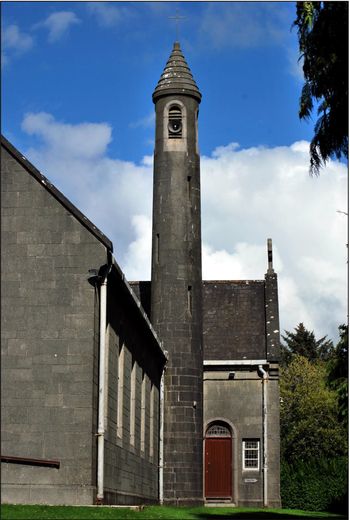
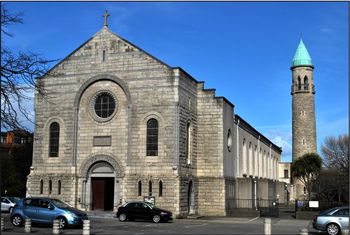
For Henchy, the architectural style of Dromore church, and especially its most prominent feature – an eighteen-metre-high concrete Round Tower emulating Irish Hiberno-Romanesque architecture (Figure 11) – had clear political and cultural meanings. Challenging Fallon’s accusation of philistinism, Henchy understood quite well the interplay between the design of the new church and its surrounding rural landscape.Footnote 73 He sought to explain its iconography and symbolism to his parishioners in contributions to The Fold and the local newspaper. In choosing to adopt a distinctly ‘Irish’ style of architecture, Henchy followed, of course, in the wake of late nineteenth-century Irish cultural nationalism. There were, for example, perhaps a dozen other Catholic churches built between 1890 and 1955 that feature revivalist Hiberno-Romanesque motifs such as Round Towers.Footnote 74 Furthermore, this stylistic decision was probably as much Henchy’s as it was Dromore’s architect, Henry (Harry) Fitzgerald-Smith, as Henchy wrote so extensively about the design, and Fitzgerald-Smith generally followed more contemporary trends in his other known works. Dromore’s traditionalism was thus an outlier within this architect’s oeuvre.Footnote 75
Dromore church. Photograph by author, 2012.

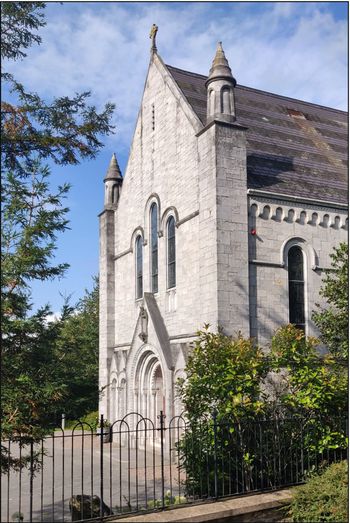
Architecturally, Dromore church was quite straightforward: a single large hall arranged on a traditional east-west axis, around thirty by twelve metres, with a small chancel to the east and a sacristy in a south wing.Footnote 76 Round-headed windows, in a pared-down Romanesque style, are used throughout (decorated with stained glass to be discussed shortly). In featuring an asymmetrically placed Round Tower and Celtic crosses on its gables, the design follows closely the Honan Chapel (Figure 12), a Celtic Revival church of international renown at University College Cork, designed by James McMullen and built in 1915–16 (during which time Henchy was working in the city).Footnote 77 McMullen in turn borrowed from a wealth of medieval architecture in the south of Ireland, not least St Crónán’s in Roscrea, Co. Tipperary, and nineteenth-century imitations such as Daniel O’Connell’s round tower mausoleum at Glasnevin, Dublin, completed in 1869.Footnote 78 In designing Dromore church, Henchy and Fitzgerald-Smith may also have been aware of the Round Tower, dated 1845, adjacent to a church at Waterloo, north of Cork city, or, closer to Henchy’s former Bandon parish, the church at Timoleague (built in 1906–12), which also featured a prominent Round Tower (only finished in 1930).Footnote 79 Other new churches with Round Towers included Our Lady, Star of the Sea, in Quilty, Co. Clare (built in 1909–10); St Patrick’s in Donegal town (consecrated in 1935); and a church on Merrion Road in south Dublin (Figure 13), designed by Simon Aloysius Leonard and built in the early 1950s.Footnote 80 By the mid-1950s, such traditionalism was hotly contested within Irish architectural circles. This was evident, for example, in the clash between modernists and more conservative voices at the ‘Church Architecture Today’ symposium held in Dublin in June 1955. For the writer Stephen Rynne, many church architects were ‘yes men’ to their clerical patrons: there were, he felt, ‘a lot of yes buildings around the country’. He criticised what he termed ‘flag-waving’ and ‘nailing ourselves to the Cross of Cong to prove our nationality’. In a similar vein, architects such as Liam McCormick and Michael Scott, firmly rooted in the modernist school, advocated for international influence and an escape from historicism. By contrast, John J. Robinson, who went on to build Galway Cathedral, saw reasons to celebrate reviving traditional styles in contemporary building.Footnote 81 The architecture of Dromore church left little doubt of the aesthetic preferences of its parish priest, whatever of his architect.
The Honan Chapel, University College Cork. Photograph by author, 2019.

Church of Our Lady Queen of Peace, Merrion Road, south Dublin. Photograph by author, 2012.

Henchy imbued his new church with a rich array of political symbolism and meaning.Footnote 82 Its design was sufficiently advanced by April 1954 for him to promote the project in The Fold. Alongside the perspective sketch mentioned earlier, he introduced the folklore of the surrounding valley and, in particular, a pass through the hills shown on Ordnance Survey maps as the ‘Murdering Glen’ (visible to the right of Figure 1 earlier). This road, formerly an important thoroughfare, was remembered in folklore as a site of theft and murder of passing travellers in centuries past, and its lawlessness was described by John Windele in 1839 as: ‘a wild and lonely pass, … the retreat of daring outlaws, whose deeds acquired for it its sanguinary title’.Footnote 83 Jagged protruding rocks and boulders gave it a foreboding appearance, which Henchy had learned of soon after his move to the parish. He commented that:
Here a murderess and her son lived. Her reddened knife and blunderbuss were the terror of the travellers. Her son was caught and taken to Cork. He was sentenced to be hanged. On the scaffold he told of treasures he had buried in Dromore hill. These were never found. All that remains now is the cave and the overhanging jutting rock. … The hill of Dromore still hides the fabled pot of gold.Footnote 84
Into this landscape of violence and the exercise of (British colonial) judicial authority stepped Henchy’s new church. ‘Another mother’s dwelling place’, he wrote, ‘will soon rise near this ill-omened spot. Her Son, too, was put to death as a criminal, but not before He gave to us His treasure.’Footnote 85 Seeking to link architecture, landscape and history, he interpreted the church’s traditional ‘Irish’ motifs of Round Tower and Celtic crosses using militaristic language that echoed his earlier writings on the ‘victorious’ Holy Year cross nearby:
Coming southwards over the hills towards Dromore you see a splendid tower. It rises in tapering roundness to a cross-topped point. It is like the lifted lance of a warrior guarding the pass of the murdering glen. The steel blue slated roof might be the armour of the sentinel but all thoughts of strife disappear when you notice the Celtic crosses on the gables. Their quiet serenity is emphasised by the stone circles linking the outstretched arms of the torture tree of Christ. He died for all and His reign is for eternity, a circle is all embracing and has no beginning or end.
He believed that his new church, despite its embrace of concrete blocks and other modern building materials, fitted with organic neatness into the surrounding rural landscape, writing that ‘the colour of the walls fits in with the rocks around so well that the church seems to have grown out of the ground’ and that ‘the rounded arches of the windows and door correspond with the curves of the hills’.Footnote 86
This marriage of architecture and landscape also had a distinct – if rather surprising – political meaning for Henchy: he used it to champion conservative social values and to demonise of any kind of socialist politics. In a rambling contribution to The Fold on the eve of the church’s consecration, ostensibly on the subject of ‘mass rocks’, he attempted to bring together the legacy of Cromwell in Ireland, his new church, the rural landscape, and the contemporary politics of postwar Europe.Footnote 87 Mass rocks, scattered in significant numbers in the vicinity of Dromore, served as altars for the saying of mass in the Irish countryside during the time of the Penal Laws from the mid-seventeenth century to the early nineteenth century.Footnote 88 The ‘message from the mass rocks’, as Henchy termed it, was one of perseverance in the face of adversity from the ‘Cromwellian generals’: these secret sites of worship had been ‘planted on the mountain side by the hunted priest’ like ‘the tiny seed of the gospel’. Now, in an independent Irish republic, the Catholic Church had reversed its fortunes: the seed was now ‘a mighty tree’, he wrote, that showed ‘its power and grandeur over all the land’. He saw in the rural landscape proof of the cultural revival and Catholic triumphalism of his youth, into which, he penned with poetic energy, would now sit his new Hiberno-Romanesque church:
It is evening, the golden red rays of the setting sun transform the rugged ranges of the hills into shining towers and gleaming battlements. To the north-west the Kerry mountains are blue-black shadows on the horizon. Standing on a summit, I think of the great priests and people who lived in this land; of their great faith which, when driven underground, gained strength. … I thank God that the new Church of ‘Mary Immaculate’ dominating the valley of Dromore mirrors again the living strength and power of the same Faith which gathered our forefathers round the Mass rocks of the high hills long ago.
However, rather than ending his essay here, he appended a final paragraph that warned of the threats posed to Ireland by Communism, presenting it as a postwar menace comparable to Cromwell’s actions three hundred years before. He issued a rallying call to the Catholic faithful, warning of the coming ‘battles’ and of a need to defeat the ‘twisted creed symbolised by the crooked cross of the hammer and the sickle and the clenched fist so like the paw of a beast’. ‘We will never retreat or panic’, he claimed, ‘before the blood-stained hordes of Communism.’Footnote 89 Such ‘red scare’ language was a dramatic shift from his typical rural antiquarianism, but it must be seen in the context of the Irish Catholic Church’s vocal condemnation of left politics at home, and across European from Irish Catholic involvement in the Spanish Civil War to the Soviet persecution of Catholics in Hungary, Yugoslavia and elsewhere after 1945.Footnote 90 In laying down a challenge to the (essentially non-existent) left politics of 1950s rural West Cork, Henchy followed the lead of Lucey, who regularly extolled the dangers of any kind of socialism in sermons while on the annual ‘Confirmation’ rounds.Footnote 91 Other bishops – most notably Michael Browne in Galway – took their anti-Communism almost to the point of obsession in these years.Footnote 92 Henchy’s comments show how hostility to left politics could be rooted in a particular reading of the rural landscape – and in the loudly proclaimed ‘Irishness’ of the architecture of a new church.
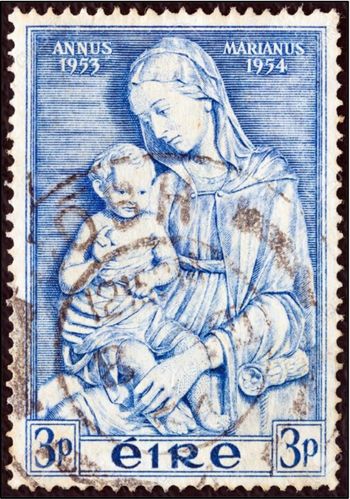
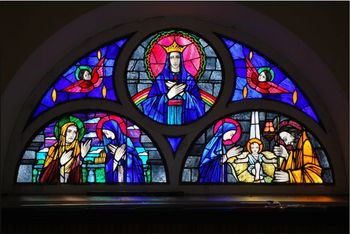
At the heart of the building of Dromore church was Henchy’s – and his parishioners – profound devotion to Mary. Every aspect of the church’s planning, fundraising, building, and ornamentation was deeply intertwined with the Catholic Marian Year celebrations from December 1953 to December 1954 – one of the most important religious and cultural events of postwar Ireland.Footnote 93 As Delay and Liger have recently commented, ‘Mary presented a model of Irish womanhood markedly different from the modern, independent English woman.’ ‘She symbolized’, they suggest, ‘sacrificial, selfless motherhood, which the emerging Irish nation promoted as women’s singularly valuable role.’Footnote 94 Marianism in Ireland intensified during – and as a response to – the ‘devotional revolution’ of the nineteenth century.Footnote 95 During 1954, countless new Marian shrines and grottos were (re)built throughout Ireland as acts of both official and popular devotion – a cultural legacy that is only now beginning to be chronicled.Footnote 96 Even the state, for example, issued a special commemorative stamp (Figure 14) to mark the year.Footnote 97 In Dromore, Henchy’s Marian devotion extended beyond the name of the church to include its programme of stained glass and statuary. In the same way as he sought to explain its architectural style to parishioners through the newspapers and The Fold, he also wrote about its ornamentation. ‘A stained-glass window’, he thought, ‘can tell a story with deep spiritual significance.’ Above the main door of the church, a semi-circular window by the Dublin firm of Earley & Co. (Figure 15) shows three scenes: Mary crowned queen of heaven in the centre, flanked by depictions of the Visitation and the Holy Family.Footnote 98 A rich blue is used throughout to emphasise the Marian dedication. The thirteen side windows are decorated with small medallions including St Joseph’s lily (‘he must be remembered in the house of Mary’, Henchy thought), ‘M. R.’ (for Maria Regina), ‘B. V. M.’ (Blessed Virgin Mary), a star (symbolising ‘Mary the Star of the Sea’), and a red rose (symbolising Mary’s love). Henchy gave a brief theological explanation for each of these in his writings, but felt little need to go into any depth as, he thought, ‘any Catholic understands [them]’.Footnote 99 On either side of the altar, small niches contain statues taken from the old church, of Mary and Joseph, and outside, to complete the ensemble, parishioners built a Marian grotto.Footnote 100
A ‘Marian Year’ stamp. Photograph by author.

Dromore church, stained glass window by Earley & Co., 1955. Photograph by author, 2016.

Performance and piety
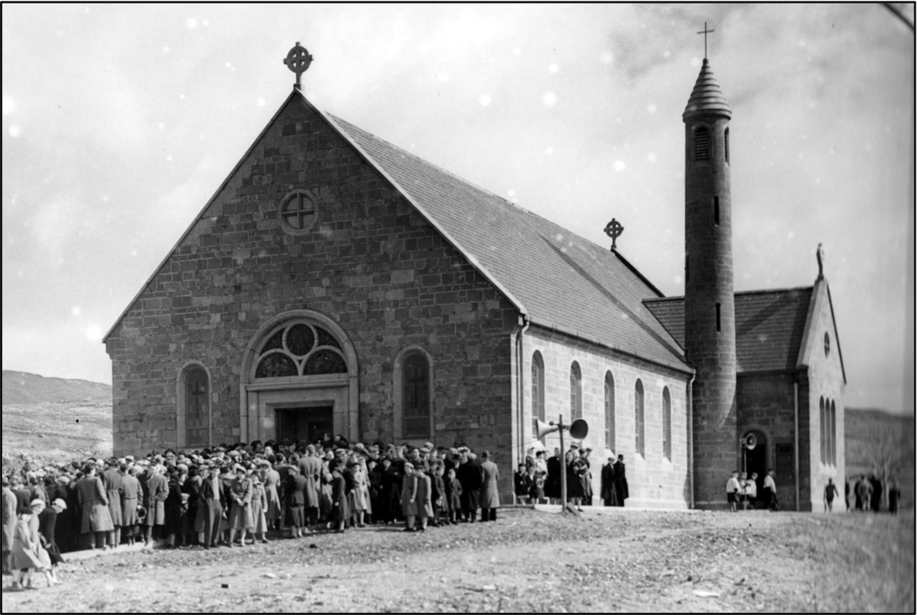
The consecration of a new church offered many opportunities for celebration, triumphalist rhetoric, as well as displays of public devotion. As Niamh NicGhabhann has recently commented relating to an earlier period in Irish Catholic church building, these events were ‘significant public and visible expressions of the Roman Catholic community’, which, she argues, ‘were explicitly used as opportunities to define and display an increasingly confident and powerful Roman Catholic identity’.Footnote 101 The building of Dromore’s new church was the outcome of many different agendas, and these were all represented at its consecration in May 1955: it was, of course, a huge personal achievement for Henchy and his campaign, against all odds, to raise the funding necessary to build the church. It marked the first new church to be consecrated in rural West Cork since 1932 – the longest gap since the 1790s.Footnote 102 Furthermore, it was the first new church to be built during Lucey’s time as bishop – and served as the prelude to his five new city churches that were all then under construction or being planned. Finally, it marked the achievement (and Marian devotion) of a rural community that had seen their numbers fall relentlessly for over a century. ‘The road leading to the church’, the Southern Star commented, ‘was spanned by buntings, while the precincts of the church were also decorated.’ Overall one thousand people crammed into and around the new church (with a seating capacity for just four hundred): the newspaper noted that ‘several hundred people … knelt in the precincts’. In what was probably the largest gathering in the parish for many years, photographs by a prominent local historian, who evidently realised the significance of the day, show that megaphones were required (Figure 16) to relay the ceremony to those unable to squeeze into the church.Footnote 103 Around seventy clergy attended, some forming a choir for the ceremony, while a special guest of honour was the Rev. Donal Keohane, home from Durant, Oklahoma, whose brother had donated the site.Footnote 104
The consecration of Dromore church. Photograph by Paddy O’Keeffe, May 1955. Reproduced courtesy of Fr Danny Pyburn, Dromore, and Mrs Cecilia Wilcox, Dromore.

In choosing who should give the sermon at the consecration, Henchy made clear his preference for the general tone of the event. Considering the colour of his antiquarian, religious, and political writings, it is not surprising that he chose Monsignor Joseph Scannell (c. 1879–1961), the dean of the diocese. Scannell had an illustrious career that matched Henchy’s militaristic writings: both men had briefly overlapped in the diocesan seminary before Scannell went abroad as chaplain to the Irish Guards during the First World War (for which he was awarded the Military Ross and the Croix de Guerre). Under the new regime, he served as the first chaplain to the Irish Free State forces in Collins Barracks in Cork during the Civil War, during which time he oversaw the dedication of the Garrison Chapel there as a place of Catholic worship. In 1927, he was invited to unveil the First World War Memorial in Cork city, and later he served as president of the diocesan seminary for almost twenty years.Footnote 105 When Scannell was invited to give the sermon at the consecration of a new church at Drinagh in 1932 – the last to be built in West Cork before Dromore – a young Henchy was in the audience to hear his remarks.Footnote 106 Anticipating the beginning of the International Eucharistic Congress in Dublin, Scannell then played to Catholic nationalist sensibilities by recalling, as Henchy would later emulate, the ‘ruined shrines’ and the ‘poor, gaping, voiceless mouths’ of Catholic persecution during the Penal Laws. The building of a new church was, Scannell suggested, in the ‘best traditions of Irish nationality’, and he proudly referred to the church as ‘our public cult’.Footnote 107 Twenty-three years later in Dromore, following some brief remarks from Lucey, Scannell adopted a similar tone, referencing Henchy’s writings about mass rocks and the parish’s ongoing struggles with poverty and emigration in a remarkable rhetorical flourish:
Your pastor has written recently, and in a very touching manner, of the Mass-rocks of the parish, poor mute witnesses to the fidelity of your ancestors despite a persecution as cruel as mean, and as despicable as any from the first to the twentieth century. You will preserve these squalid relics of a sadly glorious past. They will shed a halo around this church. The story of your parish is the story of Ireland, a story of fidelity to religious principle, despite material loss, a story of suffering and of ultimate victory, and you who present this church to God to-day, are acting in the best traditions of our Motherland.
Dromore’s parishioners were, he said, ‘no mere group worshipping in a secluded Munster shrine’. They were, instead:
active members of the greatest society the world had ever known or ever would know. Ever and always, it was morning somewhere, and ever and always, Mass was being offered somewhere on earth [. Today] a new voice [is] added to the chorus of adoration, praise and love. It [will] blend harmoniously with the voices of the countless churches which the sun would shine on in its daily round.Footnote 108
Such rhetoric sat uneasily with the socio-economic realities of the parish at the time, but the triumphalist tone was a fitting conclusion to Henchy’s own writings about a rural community that he held in great affection, and of the fundraising, volunteering, and organisation that had underpinned the building of the new church. ‘The opening of a new church’, Lucey commented, ‘was an event that did not happen very often: whole generations passed in the parish without witnessing it.’Footnote 109
Conclusion
As much as this article focuses on the socio-economic history of church-building in 1950s Ireland – through examining fundraising, the position of the parish priest within a rural community, and the effects of emigration – it more broadly attempts to write a cultural history of the process of religious architectural production. Through its central themes of architecture, rhetoric and landscape, it explores (Catholic) cultural nationalism from the perspective of a parish priest who enjoyed writing for both his diocesan magazine and his parishioner’s local newspaper. Henchy’s extensive paper trail, alongside digitised Census data and the biographical records of the Cork and Ross diocese, allow us to understand in some more detail the phenomenon of the ‘church-building priest’ in modern Ireland – an economic and cultural personality among communities that deserves much more scholarly attention. Henchy’s writings also make clear that his interest in church-building went beyond simply fundraising and bricks-and-mortar: the architectural style and furnishings of his new church had political and cultural meanings that were inseparable from Irish history, from the surrounding mountainous landscape, and from contemporary political debate in Ireland and further afield. What was absent, it would seem, was any concern for what we would now term heritage and conservation: Dromore’s old church has vanished entirely (it is now a car park).Footnote 110 For Henchy, the renewal of the local community through building a new church evidently outweighed a concern for protecting, in some way, an early nineteenth-century building he dismissed as ‘not the fit surroundings for the King of Kings’.Footnote 111 Instead, as he planned his new church, and especially in choosing how its story would be presented at its consecration, Henchy drew from a host of experiences going back to his childhood and his early career – and a range of connections that are only apparent once existing diocesan biographical records are combined to form prosopographical networks. Furthermore, the building of the church was the result of a series of historical conjunctures, from the ruinous state of the old church at Dromore upon Henchy’s relocation in late 1953 to the declaration of Pius XII of the Marian Year a few months later. This chronology meant that the church would forever be tied to the particular cultural moment of Marian devotion in Ireland around 1954: Dromore church was, in effect, a Marian shrine.
Research of this kind into what used to be termed Ireland’s ‘lost decade’ is still relatively scarce – and international comparative work is almost non-existent. The building of Dromore church is well served by surviving textual and visual sources, and most of all by an enthusiastic parish priest who documented it with fervour. Yet other church-building projects will inevitably draw from less plentiful wells, and not enough work has been done to answer the important question of how representative were the events in Dromore at this time. Furthermore, though this priest left a considerable archive, there are many missing voices – most of all the ordinary parishioners who donated what they could from their mostly insubstantial wages, who organised fundraising events, and who volunteered their time and energy to help build the church. The surviving sources are also heavily skewed towards male voices – though in practice local women were probably more significant actors in community organisation and fundraising. For many parishioners, whatever their gender, their donations and volunteering, their enthusiasm for constructing a ‘Holy Year’ cross and a Marian grotto, and their smiles as they posed for photographs in 1954–5, tell us much about popular devotion and the place of religion in daily life – as aspect of Irish cultural life often hard to fully grasp from the perspective of Catholicism in contemporary Ireland.
This article began with the apocalyptic warnings of John A. O’Brien, so typical of the 1950s, that emigration would sound the death knell of the independent Irish state. ‘Only their monuments’, he prophesied, would be left behind.Footnote 112 One of these would presumably have been Dromore’s Hiberno-Romanesque style church, which Henchy, in his writings, situated within a much longer run of conquest, persecution and revival, the material legacies of which were everywhere to be found, he suggested, in the surrounding rural landscape. Where O’Brien showed anxiety, Henchy was filled with confidence and even triumphalism – of an institutional church then at the peak of its political and cultural power. Yet the challenge for the historian today is not, of course, that the ‘Irish race’ (as O’Brien termed it) was lost. Instead, what has vanished is the Catholic and Marianist religious culture of a particular moment in Irish history that produced such a wealth of public buildings, shrines and grottos. These monuments, which have been largely left behind, and the culture that produced them, needs now to be better understood.