Introduction
To directly influence a public policy, interest groups must gain access to institutional venues making binding policy decisions, such as constitutional amendments, laws, regulatory decisions or court rulings. A group can lobby the legislature (law-making) or the executive branch (rule-making), bring a case to court (litigation) or launch a popular initiative if the political system provides for direct democracy, as in several United States’ (US) states. Some groups target only one venue as an advocacy niche, whereas other groups combine several political venues as a “policy battleground” (Holyoke Reference Hilson2003). Furthermore, a group can opt to work alone or join an ad hoc coalition (Gray and Lowery Reference Gerber, Lupia, McCubbins and Kiewiet1998; Mahoney Reference Lowery and Gray2007). In short, many advocacy tactics are available, and groups that always face institutional access rules and limited resources must make strategic choices.
This article examines whether interest groups’ involvement in multiple venues and coalitions influences the policy process and outcomes, and whether interest groups are able to realise their policy preferences. Aside from considering specific advocacy strategies, the power of the policy status quo is a strong determinant in predicting advocacy success (Baumgartner et al. Reference Baumgartner and Leech2009). Acknowledging this finding, this study addresses the following questions: under which conditions do pro-status quo groups increase their chances of realising their preferred outcomes? To identify this conditional relationship, the study focusses on two factors. First, does advocacy in multiple venues contribute to the success of status quo defenders? Second, how do coalition alliances influence these groups’ abilities to obtain their desired outcomes? In addition, this study also takes into account the group type (e.g. business versus public interest groups) as a potential factor in explaining advocacy success. Finally, it examines whether the advocacy experience of groups also influences its success in attaining its preference. The empirical investigation focusses on lobbying activities during the California policy process regulating stem cell research.
This research design is innovative for four reasons. First, most studies ask groups to self-assess their typical strategy patterns in policy decontextualised surveys, even if there is an obvious need to link groups’ strategies to a specific policymaking process (Baumgartner and Leech Reference Baumgartner1998, 174; Baumgartner Reference Baumgartner, Berry, Hojnacki, Kimball and Leech2007, 487; Beyers Reference Beyers2008, 1206–1207; Halpin and Binderkrantz Reference Grossmann2011, 207; Hojnacki et al. Reference Hojnacki, Kimball, Baumgartner, Berry and Leech2012). Unlike these survey studies, the present study captures the observed lobbying strategies of groups in all the venues activated during an entire policymaking process.
Second, previous studies that have already adopted such a dynamic and policy-contextualised approach concentrated on a limited number of venues (e.g. Holyoke Reference Hilson2003; Bouwen and McCown Reference Bouwen and McCown2007; Boehmke et al. Reference Boehmke, Gaillmard and Patty2013; Binderkrantz et al. Reference Binderkrantz, Christiansen and Perdersen2014). No empirical study has yet considered simultaneously all four venues available to groups – namely, legislature, administration, courts and direct democracy. Some studies were dedicated to explaining how groups choose between two or three advocacy strategies in the US (Hilson Reference Heaney and Lorenz2002; Miller Reference McKay2009; Grossmann Reference Gray and Lowery2012) and in Europe (Binderkrantz Reference Binderkrantz2005; Kriesi et al. Reference Ingold and Varone2007; Halpin et al. Reference Halpin, Baxter and MacLeod2012; Pedersen et al. Reference Nownes and Freeman2014). The added value of this study is to take into account the direct democracy venue as one strategic option for groups. So far, this venue has been either ignored or, contrarily, has been the only venue researched (Gerber Reference Galanter1999; Boehmke Reference Boehmke2005a).
It is also important to investigate groups’ activities in all possible venues, as most decisions taken in different venues are not independent of one another. Some venue changes are institutionally predetermined, such as the delegation of powers from the legislature to the administration or a bill ratification or veto by the governor. When a venue change is the result of a proactive strategy by policy entrepreneurs, the connection between decisions is also obvious. For instance, groups may contest the constitutionality of popular initiative (see Proposition 71 in the empirical case study presented below). In summary, interest groups use multiple venues to influence policymaking, and a new venue might represent an opportunity for redress for a group that did not achieve its preference in the previous venue. Groups might mobilise in some venues but not in others, and may achieve advocacy success in one venue before experiencing a setback elsewhere. The availability of multiple venues as a mechanism to counter undue influence is a foundational characteristic of the American political system. In addition, to understand how this feature applies to status quo defenders, it is critical to include all institutional venues.
Third, this article is innovative because it applies classical indicators of social network analysis (SNA) to capture the relational profile and network positions of groups trying to influence binding policy decisions in several institutional venues and through coalitions. Previous SNA studies looking at the position that groups occupy within political networks active in one venue demonstrate that well-connected groups tend to display higher access to policymakers (Beyers and Braun Reference Beyers and Braun2013) or even higher influence on policy outputs (Heaney and Lorenz Reference Hansford2013; Box-Steffensmeier et al. Reference Box-Steffensmeier, Christenson and Hitt2013). The added value of the present study is to apply the SNA approach across the entirety of the policy process.
In addition, existing SNA literature does not consider groups’ advocacy goals. The fourth innovation is thus to combine the groups’ network position with their strategy as defenders versus challengers of the policy status quo. Baumgartner et al. (Reference Baumgartner and Leech2009, 241) argue that one of the most consistent findings throughout lobbying studies is that pro-status quo groups usually realise their preferences and get what they want – namely, no substantial policy change. This study considers the advocates’ positions regarding the policy status quo as the main factor shaping advocacy strategy and success, in contrast to other studies exclusively focussing on a group’s interest, resources or policy positions without regard to the policy status quo.
The next section reviews the relevant literature on advocacy success as it relates to the status quo and concludes by formulating five theoretical expectations. The description of the main variables, measurements and data sources for the empirical analysis follows. Next, we present the empirical results in two steps: descriptive statistics and regression analyses. After summarising the main findings, the concluding section puts them into perspective.
Theoretical framework
The striking resilience of policy status quo has been highlighted by many studies on interest group lobbying. We capitalise on this robust finding, but specify the conditions under which status quo defenders are able to avoid major “policy punctuations”. In particular, we expect that the number of venues in which pro-status quo groups are active, the number of coalitions they build or join, their resource endowment and their advocacy experience contribute to the success of their policy influence strategies, and this throughout the many decisions that shape the policy process.
The power of status quo
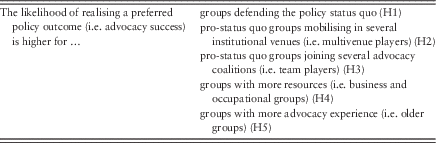
In their seminal study of lobbying to the US Congress, Baumgartner et al. (Reference Baumgartner and Leech2009, 247–250) claim that defenders of the status quo enjoy a tremendous advantage in policymaking processes. Advocates of substantial policy change frequently face the major problem of not attracting sufficient attention from political decisionmakers. To get on the political agenda, status quo challengers must expand the level of issue saliency and the scope of conflict. In contrast, the pro-status quo groups may be less active and strategically raise doubts about the feasibility and costs of the proposed policy change. Further reasons for status quo bias include the difficulty of building a large (bipartisan) majority to support a substantial policy change and convincing the gatekeepers of existing programmes that revising “their” programmes is necessary. Accordingly, our first hypothesis is that groups defending the status quo have a higher probability of advocacy success (H1). Our goal here is to specify this general expectation by looking at the conditions under which a group defending the status quo may increase its policy success. Therefore, we simultaneously consider the network positions of pro-status quo groups, and also the resources and advocacy experience of all groups defending or challenging the status quo.
Network position: multivenue and team players
Recent studies relying on a formal SNA concluded that the relational profile of interest groups and their embeddedness in networks matter considerably for their access to venues and, eventually, for policy influence. Groups that collaborate with other well-connected groups and have developed a strategic “coalition portfolio” (Heaney and Lorenz Reference Hansford2013, 253) increase their policy influence during policy formulation, implementation and litigation processes (Box-Steffensmeier et al. Reference Box-Steffensmeier, Christenson and Hitt2013). The network position of a group is as important as its internal resources (e.g. members and staff) to explain venue access (Beyers and Braun Reference Beyers and Braun2013). This empirical finding holds in very different political systems and policy domains.
These SNA findings let us assume that actors who benefit from their relational profile or their network position are able to increase their advantage by adopting a pro-status quo perspective (Baumgartner et al. Reference Baumgartner and Leech2009). Consequently, our second and third hypotheses are that the likelihood of realising a preferred policy outcome (i.e. advocacy success) is higher for pro-status quo groups mobilising in several institutional venues (i.e. multivenue players) (H2) and for pro-status quo groups joining several coalitions (i.e. team players) (H3). In addition to the supportive empirical evidence provided by previous SNA studies (Varone et al. Reference Varone, Ingold and Jourdain2016), several arguments underlie these theoretical hypotheses.
“Multivenue players” are groups that mobilise to influence several binding decisions in different venues. It has been confirmed that “repeat players” have a larger policy influence than “one-shotters” (Galanter Reference Furlong and Kerwin1974). For example, if a group wins a case within the judicial venue (Galanter Reference Furlong and Kerwin1974; Hansford Reference Hansen2004), it rapidly brings a subsequent suit in court to “lock-in” the earlier (favourable) court ruling by having it applied as precedent in later (positive) court decisions. Past success thus explains the ex post (successful) use of a litigation strategy and, eventually, the consolidation of the policy status quo. We assume here that a similar lock-in strategy is also at work across venues. In order to solidify the substantive content of the policy and to avoid a substantial policy revision, pro-status quo groups stay mobilised and act as multivenue players. Groups want to translate a legislative victory into favourable rule-making outputs in the executive venue, or the winners of a direct democracy ballot (i.e. legislative or constitutional initiative) want to prevent their opponents from “stealing” their initiative through a judicial review process (Miller Reference McKay2009) or during the rule-making and implementation process (Gerber et al. Reference Gerber2001). Such a lock-in strategy is particularly important for groups defending the status quo (Baumgartner et al. Reference Baumgartner and Leech2009, 232ff).
Finally, the membership strategy of groups might also be a strong impetus for advocating through the entire policymaking process. To secure the survival, maintenance or reinforcement of its own organisation (e.g. membership, financial resources, reputation, etc.), a group has to demonstrate to its (potential) members that it is a resilient warrior (Solberg and Waltenburg Reference Solberg and Waltenburg2006; Lowery Reference Lowery2007). Faced with competition for members, a group has an incentive to mobilise in all venues in which opposing or competing groups are also mobilised (Holyoke Reference Hilson2003). As suggested by Lowery and Gray (Reference Leifeld, Cranmer and Desmarais2004, 170), there are strong interdependencies between the choice of venues and advocacy tactics by a particular group, on the one hand, and its chance of organisational survival within the overall group’s population, on the other hand.
The label “team players” characterises groups with coalition membership(s). Joining a formal coalition has at least two advantages for a pro-status quo group. First, it allows for pooling human and financial resources, thereby achieving higher professionalisation and efficiency in advocacy activities. Second, a large coalition sends a clear signal to decisionmakers that the policy status quo promoted by the coalition benefits from large political support. According to the classical “resource exchange theory” (Hansen Reference Halpin and Binderkrantz1991; Wright Reference Wright1996), groups have to provide new, useful and high-quality information to elected politicians, judges and bureaucrats in exchange for formal access to an institutional venue and policy influence (expertise as “access good”). The information delivered by a group is relevant insofar as it facilitates the re-election calculus of politicians – for example, if the group shows that a large majority of voters supports the status quo. The information is also valuable if it reduces the policymaking uncertainty that judges and bureaucrats are facing – for instance, if the group shows that the status quo is still accepted by many policy target populations. Therefore, a group involved in coalitions is probably the most able to deliver relevant information. It should thus have easy access to policymakers and, consequently, high advocacy efficiency and success.
In summary, to realise its own policy preferences, it seems crucial for a group to be situated between other well-connected groups and play the role of “policy broker” (Ingold and Varone Reference Holyoke2012). The positive relationship between the network centrality of a group and its advocacy success has been demonstrated for different individual venues, but without considering simultaneously all venues effectively activated during the life course of a policy issue. To engage in the next research step, we argue here that multivenue and team players, who defend the status quo, occupy a key position in the overall policymaking network, as they have several links with other groups and are able to bridge across groups, coalitions and venues. This key position should eventually also translate into high advocacy success.
Resources and experience count
To account for the postulated dominance of business groups in policy advocacy (i.e. the famous “upper-class accent” in the pluralist heavenly chorus according to Schattschneider Reference Schattschneider1960, 34–35), we also conceptually and later empirically distinguish between group types. The conventional wisdom is that one should expect a higher success rate for business and occupational groups than for public interest, religious, identity, institutional or others groups. Business and occupational groups presumably have more financial and personnel resources and specific, material and short-term-oriented interests to promote. In addition, corporate institutions have more managerial latitude than membership groups to make strategic decisions about resource allocation and advocacy activities (Salisbury Reference Salisbury1984, 68). Nevertheless, Baumgartner et al. (Reference Baumgartner and Leech2009, 203, 212–213 and 225–236) found no direct, positive or strong link between a group’s resources and its policy success. The main reason for this low correlation has to do with competition between individual groups and/or policy sides with roughly similar resources. In a follow-up study, McKay (Reference Mahoney2012, 913) similarly concluded that “greater financial variables do not appear to help lobbyists’ chances of achieving their objectives or attaining their preferred policy outcome”.
However, these studies tested the “resources count” argument only in one single venue. As we consider in this study an entire decision-making process, it is plausible that financial and personnel resources become more important for groups that are active in many venues. Multivenue players probably need more financial resources to hire lobbyists, to fund political action committees and to contribute to campaigning coalitions. Political staff members with legal and technical expertise are also required for writing an amicus curiae brief or for delivering credible comments to rules proposed by a regulatory agency. Despite the rather ambivalent findings of previous research, we expect here that groups with more resources (i.e. business and occupational groups) have higher advocacy success (H4).
In a similar vein, our last hypothesis stipulates that the likelihood of realising one’s preferred policy outcome is higher for groups with more advocacy experience (H5). Over the years and after being involved in various policy processes, an organisation learns how to better advocate towards its policy goals, in which venue to mobilise and which winning coalitions to join to be associated with success (Gray and Lowery Reference Gerber, Lupia, McCubbins and Kiewiet1998, 14). Groups with advocacy experience know that an affiliation with some venues makes it easier to enter into other venues as recognised “interested parties”. In California, administrative decisions are subject to judicial review, and a group may elect to lobby an agency in anticipation of a future legal dispute. Similarly, in the same (judicial) venue, a group might file a suit to ensure standing as the case moves to the appellate level. In summary, groups with more advocacy experience are more frequently repeat and multivenue players and, according to our first hypothesis, have higher advocacy success (Table 1).
Research hypotheses
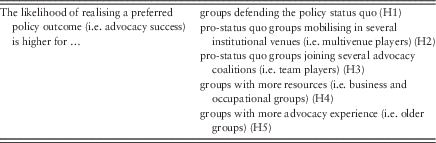
Research design, variables and sources
To test whether lobbying in multiple venues or in several coalitions increases advocacy success for pro-status quo organisations, this study compares groups’ activities during California’s policymaking on stem cell research. A documentary analysis reconstructs the life course of this policy issue and identifies all binding decisions that were made in the different venues (e.g. laws adopted by the legislature, popular initiatives accepted by the voters, court rulings and regulatory decisions by an administrative agency). Furthermore, it takes a systematic inventory of the 152 unique groups that tried to influence these binding decisions (e.g. through reported lobbying of the legislature, contribution to a ballot campaign committee, writing an amicus curiae brief to support a party or formulating comments to proposed rules). Finally, it associates the appropriate groups by identifying coalition membership for each decision in each venue. The following sections present the sources and results of such documentary analysis.
Regulating research on stem cells: venues and decisions
Research on human embryonic stem cells (hESC) intends to develop therapies to treat degenerative pathologies such as cancer, Parkinson’s or Alzheimer’s disease. The problem is that the destruction of embryos to derive hESC is a very sensitive political issue. The political debate over the regulation of hESC research has been very controversial at both the federal and the state levels. We focus on California’s policy concerning hESC research.
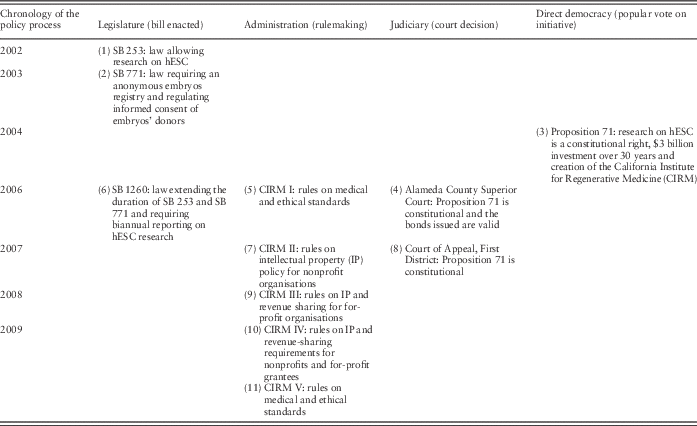
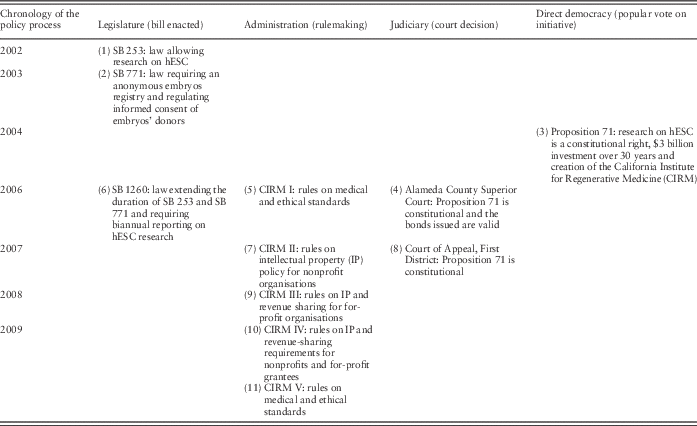
In 2002, the California Legislature passed Senate Bill (SB) 253 allowing research on hESC. One year later, SB 771 established an anonymous registry of embryos for research purposes. California thus became a haven for hESC research, but public funding was still unavailable. Robert Klein, board member of the Juvenile Diabetes Research Foundation and father of a diabetic son, took control of Proposition 71, which (1) made conducting hESC research a state constitutional right, (2) allocated $3 billion over a period of 10 years to hESC research and (3) created a public agency, the California Institute for Regenerative Medicine (CIRM), as well as an Independent Citizen’s Oversight Committee (ICOC) to oversee it. In 2004, California voters approved Proposition 71. In 2005, plaintiffs People’s Advocate and National Tax Limitation Foundation filed an action in superior court against the ICOC, arguing that the disbursement of state funds by a private entity not under the exclusive control of the state violates the California Constitution. Shortly after, plaintiff California Family Bioethics Council, LLC (the Council) filed another complaint against CIRM, contending that Proposition 71 concealed the true scope, meaning and costs of the initiative from the voters. These two actions were consolidated, and in 2006 the court ruled that the plaintiffs failed to show that Proposition 71 was unconstitutional. In 2007, the California Court of Appeals confirmed once again that Proposition 71 did not violate the Constitution and did not mislead the voters. Meanwhile, in 2006, the California Legislature passed SB 1260, which indefinitely extended the 1 January 2007 repeal date of SB 253 and 771. Finally, the CIRM, endowed by Proposition 71, launched several rule-making procedures about medical and ethical standards and intellectual property and revenue-sharing requirements for non-profit and for-profit grantees (Table 2).
Venues and binding decisions concerning research on human embryonic stem cells (hESC)
Variables and measurements
Advocacy success constitutes the dependent variable of this study and is measured through the realisation of a group’s policy preference (McKay Reference Mahoney2012). One key advantage of focussing on the “preferred outcome” variable is that it is based on behavioural data that can be observed in different venues. For instance, for each decision taken in the legislative venue, this variable can be conceived as a dichotomous measure of whether or not a bill actively supported by a group succeeded in becoming a law. If a group lobbied on more than one decision, we sum the measures of preference attainment for each decision and divide the result by the number of decisions on which the group advocated to obtain an interval variable. Within the direct democracy venue, one can assess whether the ballot proposition supported by a group is eventually accepted by the voters. In the judicial venue, the court’s decision also constitutes a binary measure of advocacy success, depending on whether the ruling is for or against the group’s position. Similar to the legislative venue, the variable at the judicial venue level is weighted by the number of mobilisations and measured as an interval. In the administrative venue, we assess whether a rule-making agency modifies the rule according to the changes proposed by a group, and we obtain an interval measure of advocacy success depending on how many modifications were requested and how many were actually modified in the final rules. We then aggregate the overall measure of advocacy success as an interval variable, summing the venue-specific measures and weighting it by the number of venues where the group mobilised. Such a qualitative-objective variable partially relates to important studies focussing on lobbyists’ policy preferences and success (Bernhagen et al. Reference Bernhagen, Dür and Marshall2014). For instance, Baumgartner et al. (Reference Baumgartner and Leech2009) measures whether a pro-status quo side got its full preferred outcome, only a part of it or nothing at all.
The independent variables focus on the pro-status quo versus pro-change positions of a group, and on their policy network positions. An organisation is coded as “pro-status quo” if it favours the policy already in place. The SNA measures, which capture the network position of a group, are based on two different two-mode networks – the first “mode” being actors and the second “mode” being decisions and coalitions, respectively. Two rectangular data matrices of actors (rows) by events (columns) are created, where each cell indicates whether an actor participated (1) or not (0) in the respective decision or coalition. Such a matrix was created for each venue (consisting of all decisions and respective coalitions in each venue) and for the overall policy process.Footnote 1
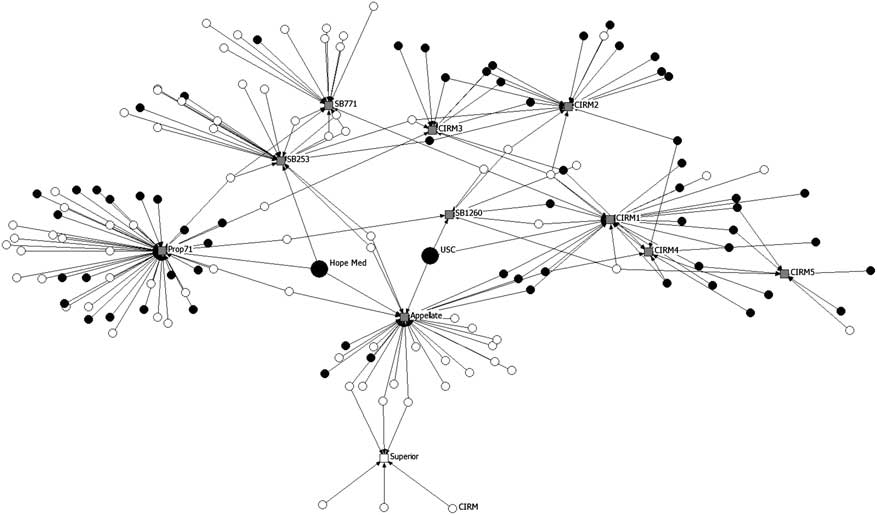
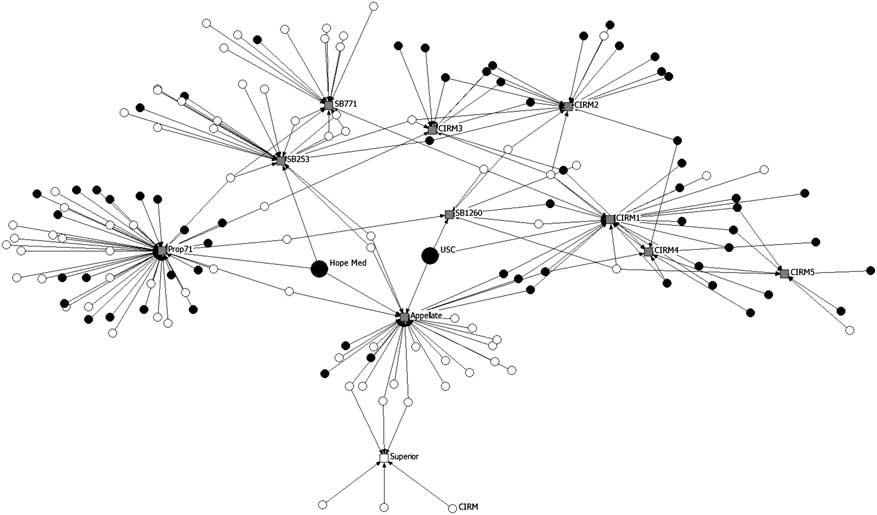
Figure 1 offers a visualisation of the two-mode network crossing groups and policy decisions. The squares correspond to the 11 binding decisions identified during the entire policy process (see Table 1), and the circles correspond to the 152 interest groups active in the stem cell policy. The circles with node names represent interest groups participating in more than one venue; they are thus multivenue players. City of Hope Medical Center (Hope Med) and the University of Southern California (USC) are the only two interest groups in this process participating in three different venues. Thus, their nodes are larger than other nodes. For example, Hope Med initially mobilised to change the status quo and allow stem cell research in California with the passing of SB 253 in 2002. It then continued to defend this new status quo by contributing to Proposition 71 through the “Coalition for Stem Cells Research and Cures”, lobbying to extend previous legislation facilitating research (SB 1260), and co-signing an amicus brief of the California Institute of Technology for the California Appellate Court, defending Proposition 71. Its advocacy efforts led to the realisation of preference attainment in all venues and decisions. USC lobbied to consolidate the status quo when it participated in CIRM’s first rule-making proceeding on medical and ethical standards, co-signing comments with other research entities to modify the initial definition of a stem cell line as a trigger for administrative review. It then lobbied to extend previous legislation allowing research, and joined Hope Med and other amici in co-signing the amicus brief in support of Proposition 71 for the Appellate Court. For USC also, all advocacy efforts led to the realisation of its preferences, with the minor exception of one comment (also in coalition) to CIRM that requested a stronger regulatory stand to avoid duplicate reviews among state and other agencies. The comment was denied.
Two-mode network with groups and decisions. Note: Black nodes=business and occupational groups; white nodes=union, religious and public interest groups; grey nodes=decisions.
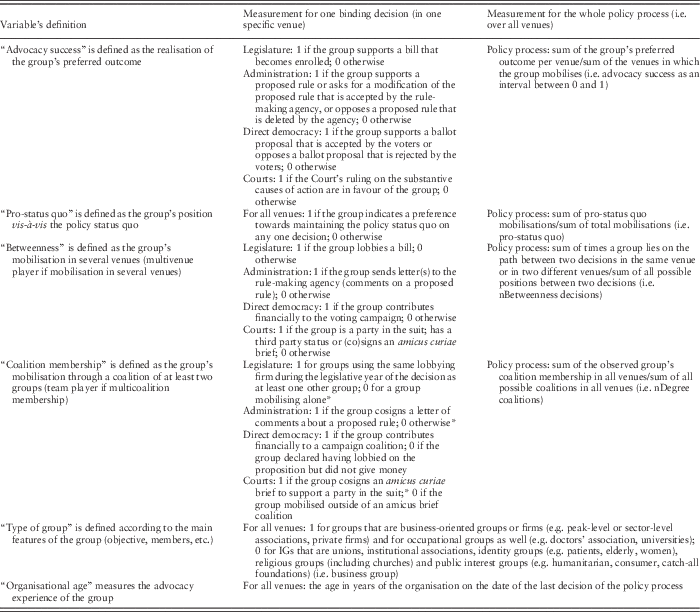
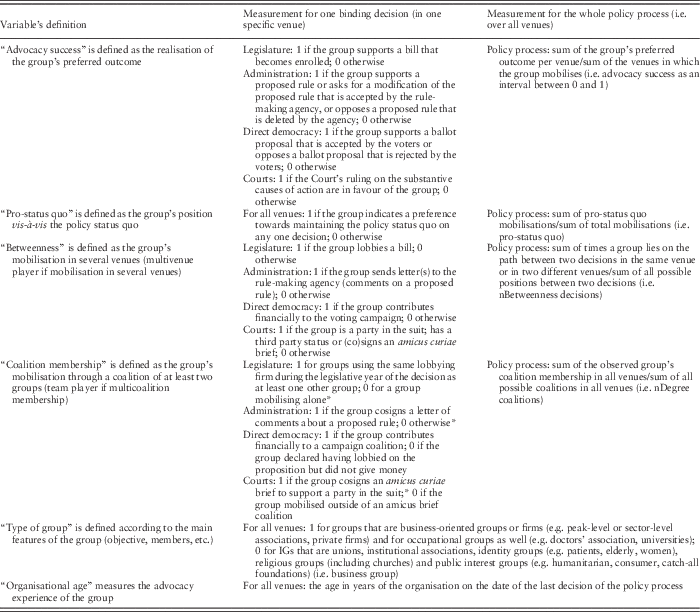
Subsequently, two main complementary dimensions capture the network centrality of a group across institutional venues. The “nBetweenness decisions” variable is an SNA indicator signalling how often a group lies on the path between two binding decisions that were made in different venues. We attach a positive weight to the “nBetweenness decisions” variable if the group lobbies to maintain the policy status quo and a negative weight if the group wishes to introduce a substantial policy change. The “nDegree coalitions” variable assesses to what extent a group is a member of one or more coalitions. The degree centrality of a node is defined as the number of edges incident upon that node (Freeman Reference Eising1979, 219). Applied to actors in the coalition network, this means that the degree of an actor is the number of coalitions he or she attended or participated in. For this step, we use normalised degree centrality, dividing actors’ degrees by the total number of nodes in the network minus one. In the case of a bipartite graph, the maximum degree of a node is given by the number of nodes in the opposing set (Wasserman and Faust Reference Wasserman and Faust1994). Thus, we normalised the degree (also for the betweenness centrality) by taking the total number of decisions or coalitions into account (Scott Reference Scott2000). Table 3 reports how the different variables were defined and operationalised at the levels of one binding decision and over the whole policy process.Footnote 2
Definitions and measurements of variables
Note:
IGs=groups.
* We capped the measures of coalition membership to 1 if the group participated in more than one coalition per decision or sent more than one letter of comments per round in rule-making proceedings.
Our process-tracing methodology presents a unique challenge when selecting and measuring the variables commonly found in the literature to grasp groups’ characteristics, including organisational budget and political staff, or visibility in the media. Consider, for example, the biotechnology organisations that benefitted from the grants distributed by CIRM after the passing of Proposition 71. Gathering data now that these policies have found a new equilibrium is not only difficult but also may cause issues of reverse causality, as a group’s budget, staff or media visibility may have been altered because of one or more decisions in the policy process. We therefore include the age of the organisation as a proxy for advocacy experience (Appollonio and La Raja Reference Appollonio and La Raja2004). We use the group type as a proxy for resource endowment.
Sources
Multiple sources were used to empirically measure these variables. For the legislative venue, we extracted data about groups’ activities from the legislative history (www.leginfo.ca.gov) and the California Secretary of State’s records of lobbying reports. To assess which groups mobilised in the administrative venue, we examined CIRM files that were subject to Office of Administrative Law approval. For the direct democracy venue, the National Institute on Money in Politics (www.followthemoney.org) provides an interface to the Secretary of State’s records on financial contributions. In the judicial venue, we identified groups that participated in a suit through California courts’ websites, which provide access to dockets and documents and, as needed, through Westlaw Next and LexisNexis. Regarding the control variables, we screened the websites of all groups. For “organisational age”, we identified the year of creation of each group, or used the California Secretary of State’s records if this information was not otherwise available. For “business and occupational groups”, two co-authors classified all groups in predefined categories (business, occupational associations, unions, public interest groups, etc.) using a double-blind process.
Empirical results
The empirical findings are presented in two steps. First, descriptive statistics depict the level of mobilisation across venues and of coalition membership of groups participating in the policy process. Second, regression analyses show that occupying a central network position is not sufficient for the pro-status groups to improve their advocacy success.
Where and with whom do groups mobilise?
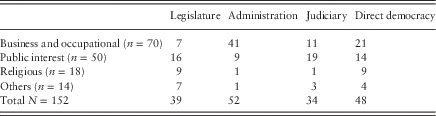
As a starting point, Table 4 lists the number of unique groups that mobilised in each venue to influence the related binding decisions. First, we observe that groups were politically active in the four different venues. This demonstrates the appropriateness of adopting a policy-contextualised approach, encompassing all venues (re)visited over the life course of a policy issue. Second, business and occupational groups (e.g. Biotechnology Industry Organization of California, Invitrogen Corporation, BIOCOM, StemCells, Inc) and public interest groups (e.g. Alzheimer’s Association, Juvenile Diabetes Research Foundation, Planned Parenthood Affiliates of California) are clearly dominant in the policy process. Third, the absolute levels of groups’ mobilisation in the different venues vary across group types. Business and occupational groups are the most involved in the administrative venue (as predicted by Culpepper Reference Pedersen, Binderkrantz and Christiansen2011) and also invest in the direct democracy venue to preserve the policy status quo. By contrast, public interest groups are relatively more present in the legislative and judicial venues. Furthermore, the status quo is overwhelmingly defended by 93% of all business and organisational groups, with support from 87% of all public interest and 78% of “other” group types. On the contrary, religious groups are more divided, with half supporting the status quo, whereas the other half lobby for policy change.
Institutional venues and groups’ mobilisation by group type
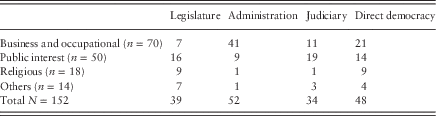
Note: Sums across the rows are more than the total number of groups per type or in all, as some groups are active in more than one venue.
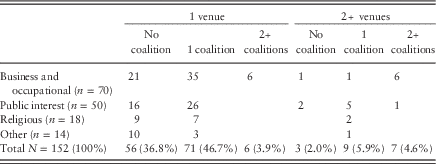
Digging deeper in the descriptive statistics, Table 5 crosses the number of venues where a group is active with the number of coalitions the group joins. The exercise is highly instructive, as it shows that very few groups are both multivenue and team players. Only 4.6% of all groups mobilise in two or more venues and, at the same time, are members of two or more coalitions. All of them are pro-status quo, six are business and occupational groups, including hospitals, research institutes and universities, and one is a public interest group (Juvenile Diabetes Research Foundation). As a corollary, over 87% of all groups invest time and resources for advocacy activities in one single venue. Moreover, although about 37% of groups elect to advocate alone, almost half of all groups (47%) join one coalition and less than 4% of groups join two coalitions in the same venue.
Multivenue mobilisation and multicoalition membership by group type
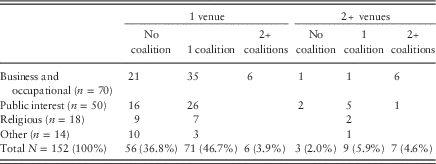
Both findings are in sharp contrast with most survey data based on self-reported groups’ behaviour. In quantitative surveys about the prevalence of different tactics, groups generally declare using very diverse advocacy tools in many venues and through several coalitions (e.g. Nownes and Freeman Reference Miller1998; Binderkrantz Reference Binderkrantz2005; Furlong and Kerwin Reference Freeman2005; Kriesi et al. Reference Ingold and Varone2007). However, our findings confirm the results of the study conducted by Pedersen et al. (Reference Nownes and Freeman2014) on the multivenue involvement of Danish groups during 225 law-making processes: only 13% of all groups participated in both the administrative consultation (bill preparation) and the parliamentary committee activities (bill treatment). In short, most groups seem to engage in one venue only, at least in California and Denmark.
As our theoretical hypotheses focus precisely on the very few multivenue and team players, we scrutinised their respective websites to identify their missions and memberships, political staff and so forth. These groups share the following traits: they are well-established organisations and display a high level of professionalisation, including for political activities. Unsurprisingly, the policy issue at stake directly affects their core business (i.e. research centres). They thus belong to the dominant category of groups mobilised during the whole policymaking process. Finally, all groups are in favour of the development of hESC research. This means that they defend the status quo in 10 out of the 11 decisions, as only the first law (SB 253) introduced a substantial policy change by allowing research on hESC for the first time. The groups opposed to the development of hESC research (i.e. religious groups) did not mobilise in many venues or join many coalitions. Moving one step further, the next section presents the empirical test of the theoretical hypotheses.
Are pro-status quo groups occupying a central network position more successful?
To investigate the extent to which pro-status quo groups that are multivenue and team players might enjoy higher advocacy success, we conduct a multiple regression analysis. This is a common approach to investigate predictors at the actor level and to explain attributes of an actor at the interval level (such as “preferred outcome”). To ensure that the dependent variable is independently identically distributed, we applied the ordinary least squares regression analysis on UCINET (Borgatti et al. Reference Borgatti, Everett and Freeman2002; v. 6.582; see also Borgatti et al. Reference Borgatti, Everett and Jefferey2013), which integrates a random permutations method for constructing sampling distributions of R 2 and slope coefficients.Footnote 3 The model’s main variables are already depicted in Table 3. However, one point should be highlighted: the variable “multivenue player” was operationalised through the nBetweenness score of a group in the decision network (i.e. the number of times a group lies on the geodesic path between two binding decisions). This theoretical choice is strongly supported by the empirical data. The match between a high nBetweenness score and a high multivenue mobilisation is almost perfect. In other words, the nBetweenness centrality is indeed a valid indicator for groups’ activities across different venues.
Our model estimates whether the likelihood of advocacy success is higher for groups that are defenders of the policy status quo, central in the decisions’ network or in the coalitions’ network. We consider these strategies individually and include an interaction term for the groups that participate in pro-status quo decisions or in pro-status quo coalitions’ networks. We also test whether groups with more advocacy experience (proxied by organisational age) and resources (type business or occupational) enjoy a higher rate of success in addition to their selected strategy. There are no problems of collinearity between these variables (see Table 8 in the online Appendix).
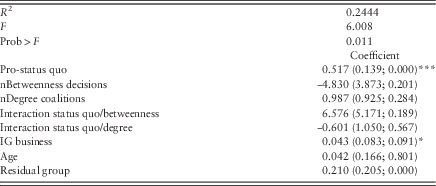
Results show that empirics fully support the general expectation of increased advocacy success for the pro-status quo groups (Baumgartner et al. Reference Baumgartner and Leech2009), as stated in our first hypothesis. The pro-status quo coefficient is positive (0.517) and significant (at p⩽0.0001)Footnote 4 even when controlling for network position, age and resources, as shown in Table 6 (see also Model 5 in Table 7, online Appendix). In contrast, the results show that neither being active in many venues nor participating in many coalitions impacts advocacy success, with the coefficient on these variables failing to return statistical significance (see also Models 2, 3 and 4 in Table 7, online Appendix). When integrating pro-status quo preferences, being a multivenue player (nBetweenness decisions) might even negatively affect one’s advocacy success. However, pro-status quo groups do not seem to be unduly affected by this effect. Instead, they seem to suffer when participating in many coalitions (see the interaction effects). However, those results have to be treated with caution, as the interaction terms taking into account the multivenue mobilisation (H2) and coalition membership (H3) of pro-status quo groups also return nonsignificant results. Our second and third hypotheses are therefore left unverified.
Regression analysis for variables influencing IGs advocacy success
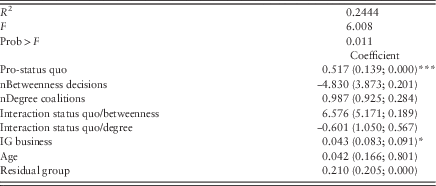
Note: IGs=groups. As the variable age could not be investigated for all 152 groups previously included in the descriptive statistics, the number of groups included for this analysis is 138.
First numbers in parentheses are “SE”, second numbers are the “proportions as extreme as the real coefficient”. Permutation standard errors (as obtained by the node-level regression provided on UCINET version 6.582 run here) are the SD of the coefficients obtained by running the regression with the Y values permuted. This does not correspond to the classical standard error test where estimated βs could have varied given sampling variation. Therefore, and in permutations as displayed here, the p-value is obtained by counting how often a coefficient from a randomly permuted regression was as large (or small, thus extreme) as the real coefficient (see second number in parentheses).
Levels of statistical significance: *p⩽0.05, ***p⩽0.001.
In addition, we also control for the causal effect between business and occupational groups, the presumed availability of financial resources and professionalisation for engaging in advocacy activities and advocacy success (H4). The coefficient for the “IG Business” variable is positive (0.043) but hardly significant (at p⩽0.1). The intensity of mobilisation, and therefore resource advantage of business groups, is observed in direct democracy (i.e. the coalition supporting Proposition 71 raised almost $25 million, 37 times more than its opponents) and administrative venues (i.e. technical expertise and staff for monitoring and commenting on rulemaking by the CIRM), but not in the legislative and judicial venues. Thus, we find some indications that business and occupational groups can translate their (postulated) resource advantage into a higher advocacy success rate compared with other group types. Finally, we examine how advocacy experience (proxied by organisational age) might enhance the advantages of groups and find a lack of support for our fifth hypothesis. Advocacy experience does not seem to generate benefits for interest groups.
All in all, the empirical results yield mixed evidence with respect to our five theoretical hypotheses. On the one hand, this study confirms once again the endurance of the policy status quo, using a process-tracing methodology that accounts for the path of the policy process across all available institutional venues. Defenders of the policy status quo display higher levels of advocacy success than challengers proposing a substantial policy change. On the other hand, pro-status quo groups mobilising in many venues do not systematically outperform status quo defenders advocating in only one venue, and pro-status quo groups that are team players do not experience additional success compared with status quo defenders working alone. In fact, we were unable to identify the effect of advocating in multiple venues or in several coalitions on lobbying success for groups supporting or changing the status quo. In addition, and in line with the ambivalent results of previous studies, it appears that groups defending business interests enjoy only a slight advantage in realising their policy preferences. Finally, advocacy experience does not appear to affect preference attainment.
Conclusions
The major aim of this study was to identify under which conditions a pro-status quo interest group can realise its preferred policy outcome. To answer this question, we developed an innovative framework and methodology by placing groups’ advocacy activities in their policy context. The collected behavioural data capture a diverse set of groups in all institutional venues activated during an entire policymaking process. The theoretical approach is therefore ambitious in comparison to previous studies focussing either on lobbying (the legislature or the administration), litigation or direct democracy campaigning. Furthermore, this study applied tools of SNA to capture groups’ embeddedness in multivenue involvement and coalition networks. This allowed for a straightforward link among the level of advocacy activities across the policy process, the group’s position in the policy network and towards the policy at stake (i.e. status quo defenders versus challengers), and finally advocacy success.
The empirical results first and foremost support previous findings regarding a pro-status quo advantage, which can now be extended through time and the path of a policy debate across several institutional venues. In contrast, this study reveals that multivenue and team players do not display higher advocacy success than groups lobbying in one venue and alone, whether or not they are defending the status quo. In SNA jargon, actors with high nBetweenness or nDegree centralities and opposing a policy change are not the most successful. This finding is not in line with previous (SNA) literature on interest groups. In contrast, being a business or occupational group with a supposedly large resource endowment increases the chances of realising one’s preferred policy outcome. The fact that business groups’ advocacy activities pay off is contrary to findings of previous studies (Baumgartner et al. Reference Baumgartner and Leech2009; McKay Reference Mahoney2012), which show that the resources and membership size of a group have no significant correlation with its ability to realise its preferred outcome. However, resource endowment is not a very strong predictor for advocacy success in our models. This does not mean that resources do not matter, but that the impact of resources is limited by the type of issue at stake, the heterogeneity of actors’ coalitions and the counter-mobilisation by opponents that are also well endowed with a financial budget, a large membership and qualified staff or by the particular characteristics of the institutional venue.
The more striking aspect in our results is the very small number of multivenue players and the missing link between multivenue involvement and advocacy success. This puzzling result shall be further investigated with a process-tracing approach. Such an approach should consider interdependencies between decisions, venues and the related path-dependent group behaviour. Simply put, a group might lobby in one venue because of past (or desired future) involvement in another. For example, as discussed earlier, a group might mobilise in rulemaking to preserve its right of appeal in the judicial venue. If confirmed, such a finding would contribute to an explanation of why multivenue involvement does not translate into higher advocacy success.
Furthermore, the present study has several limitations and opens the path to new (SNA) studies on interest groups. First, there is the realisation that the group’s “preferred outcome” was measured empirically as a very rough proximate for capturing (perceived) advocacy success (Bernhagen et al. Reference Bernhagen, Dür and Marshall2014). Nevertheless, the “preferred outcome” variable goes one step further than the dependent variables used previously by Beyers and Braun (Reference Beyers and Braun2013), who captured the “venue access” and “advocacy intensity” of groups. Of course, venue access is a precondition for any policy influence (Eising Reference Culpepper2007), and thus deserves analytical attention. However, we claim that future (SNA) studies focussing on many institutional venues and coalitions should aim to measure the policy impacts of groups’ advocacy (Box-Steffensmeier et al. Reference Box-Steffensmeier, Christenson and Hitt2013; Heaney and Lorenz Reference Hansford2013) during a whole policymaking process and test if and to what extent the “preferred outcome” variable is a robust correlate of (perceived) advocacy success and, eventually, a good predictor of policy influence.
Second, the behavioural data collected here could be complemented by survey data about groups’ self-reported mobilisation, exchanges within and across coalitions and perceived advocacy success. It would then be fascinating to compare the results of two SNA based on behavioural versus self-reported data, respectively (McKay Reference Mahoney2012; Bernhagen et al. Reference Bernhagen, Dür and Marshall2014).
Third, groups are a type of policy actor. In other words, a full SNA should include a variety of relevant policy actors such as political parties, legislators, judges and scientific experts, among others. Thus, the target groups of the groups’ advocacy activities are missing in the present study. To consider the flip side would be very instructive indeed. This additional step is required to isolate the net impact of groups on policy processes and outputs.
Fourth, the reasons behind the prevalence of advocacy success for status quo defendants warrant further investigation, particularly because the data for this analysis illustrate a bias in preference attainment, but not necessarily in policy influence. In other words, by using preference attainment, we remain a few causal steps away from showing that these groups are actually successful in impacting policy change, and it may be that the institutional design through which a new policy must emerge is so advantageous to the status quo that the groups defending it appear more successful in their advocacy strategies.
We conclude with this study’s major added values, including (1) to extend the analysis and to take four institutional venues of the policy process into account; (2) to go one step further by not only investigating access to decisionmakers but also investigating advocacy success as a dependent variable; and (3) to combine classical variables of interest group literature (such as position vis-à-vis policy status quo, organisational age and resources) with SNA measures of the network position of groups. To gain a full picture of advocacy strategies and success, however, it would be worth triangulating this approach with a survey-based and multiactor analysis. One promising future research path is the in-depth analysis of the causal links between a group’s network position, the success of its advocacy activities and, eventually, its policy influence. The integration of the last element of this chain (i.e. influence on policy process and outputs), together with the inclusion of political parties, bureaucrats, judges, etc., could probably help us resolve the puzzle of multivenue and multicoalition involvement that we uncovered here.
Acknowledgements
F. V. is grateful to the Center for the Study of Law and Society (CSLS) at UC Berkeley for hosting him as a visiting scholar in 2012–2013, when this study began. The authors acknowledge Steve Borgatti’s great support regarding the inclusion of standard errors in the current UCINET version 6.582 for node-level regression analysis. The authors also thank Philip Leifeld for his remarkable methodological and statistical support and expertise, as well as for the programme updates on “tnam” in “xergm” package on R (Leifeld et al. Reference Kriesi, Tresh and Jochum2015). Previous versions of this article were presented at the ECPR Joint Session of Workshop in Salamanca (April 2014) and at the “Interest Group Politics” conference hosted by the University of Aarhus (June 2014). The authors thank Jan Beyers, Anne Binderkrantz, Rainer Eising, Michael Heaney, Laura Morales, Helene Pedersen and Matia Vannoni, as well as the three anonymous reviewers, for their helpful comments.
Financial Support
F. V. and C. J. acknowledge the financial support of the Swiss National Science Foundation (funding of project 100017_149689).
Supplementary Material
To view supplementary material for this article, please visit http://dx.doi.org/10.1017/S0143814X16000179