As aggression researchers pay increasingly more attention to indirect, covert, and interpersonal forms of aggression, robust findings have emerged supporting the validity of relational aggression as an aggressive subtype that has far-reaching consequences for the perpetrators and victims of these acts (e.g., Archer & Coyne, Reference Archer and Coyne2005; Card, Stucky, Sawlani, & Little, Reference Card, Stucky, Sawalani and Little2008; Crick, Ostrov, & Werner, Reference Crick, Ostrov and Werner2006; Tackett & Ostrov, Reference Tackett and Ostrov2010). Although research on this topic sometimes falls under different labels (most notably, “indirect” or “social” aggression; Cairns, Cairns, Neckerman, Ferguson, & Gariépy, Reference Cairns, Cairns, Neckerman, Ferguson and Gariépy1989; Lagerspetz, Björkqvist, & Peltonen, Reference Lagerspetz, Björkqvist and Peltonen1988), we rely on the label “relational” aggression (Crick & Grotpeter, Reference Crick and Grotpeter1995), which can be defined as behaviors intended to harm others through the use of purposeful manipulation or exclusion in the context of the peer relationship. Despite the far-reaching consequences of relational aggression, the topic remains understudied relative to other forms of youth antisocial behavior. In particular, although conceptualizations of relational aggression strongly support its inclusion in the broader externalizing spectrum (e.g., Burt, Donnellan, & Tackett, Reference Burt, Donnellan and Tackett2012; Card et al., Reference Card, Stucky, Sawalani and Little2008; Tackett, Daoud, De Bolle, & Burt, Reference Tackett, Daoud, De Bolle and Burt2013), research on causes, correlates, and consequences of relational aggression continues to lag behind work on other forms of externalizing, such as physical aggression. One example of this is the current lack of understanding regarding how relational aggression is related to normative dispositional traits, such as personality. Specifically, what are the broader personological features associated with relational aggression, how do such features provide evidence for similarities and differences with other forms of youth antisocial behavior, and could a broader psychological conceptualization of relational aggression lead to a deeper scientific understanding of these behaviors, with implications for prevention and intervention? These represent the goals of the present study.
Relational Aggression and Youth Externalizing Problems
A growing literature has documented some key characteristics and consequences of relational aggression. Effective use of relational aggression often requires advanced social skills, owing to an emphasis on manipulation (Archer & Coyne, Reference Archer and Coyne2005; Underwood, Galen, & Paquette, Reference Underwood, Galen and Paquette2001). Common examples of relational aggression include spreading rumors about another child, divulging a victim's secrets to others, befriending others as a form of revenge, or encouraging others to dislike another child (Archer & Coyne, Reference Archer and Coyne2005; Cairns et al., Reference Cairns, Cairns, Neckerman, Ferguson and Gariépy1989; Crick & Grotpeter, Reference Crick and Grotpeter1995; Lagerspetz et al., Reference Lagerspetz, Björkqvist and Peltonen1988). Relational aggression was initially conceptualized as a primarily female form of aggression, and some research suggests that girls use relational aggression more than boys do (Crick & Grotpeter, Reference Crick and Grotpeter1995; Murray-Close & Ostrov, Reference Murray-Close and Ostrov2009; Ostrov, Woods, Jansen, Casas, & Crick, Reference Ostrov, Woods, Jansen, Casas and Crick2004; Spieker et al., Reference Spieker, Campbell, Vandergrift, Pierce, Cauffman and Susman2012; Vaillancourt, Miller, Fagbemi, Côté, & Tremblay, Reference Vaillancourt, Miller, Fagbemi, Côté and Tremblay2007). However, other studies have not found evidence for gender differences or have found gender differences only from certain informants (Card et al., Reference Card, Stucky, Sawalani and Little2008; Coyne, Archer, & Eslea, Reference Coyne, Archer and Eslea2006; Rys & Bear, Reference Rys and Bear1997; Tackett, Waldman, & Lahey, Reference Tackett, Waldman and Lahey2009).
Although some research has suggested that relational aggression may be adaptive in certain contexts (e.g., within the peer group in regards to perceived popularity; Banny, Heilbron, Ames, & Prinstein, Reference Banny, Heilbron, Ames and Prinstein2011; Mayeux & Cillessen, Reference Mayeux and Cillessen2008; Rose, Swenson, & Waller, Reference Rose, Swenson and Waller2004), it is generally viewed as a maladaptive behavior that is accompanied by a host of negative consequences (Crick et al., Reference Crick, Ostrov and Werner2006). For example, relationally aggressive children are at risk for later social maladjustment (Card et al., Reference Card, Stucky, Sawalani and Little2008; Crick, Reference Crick1996; Crick et al., Reference Crick, Ostrov and Werner2006). Relational aggression is also negatively associated with academic performance and positively associated with social problems (Preddy & Fite, Reference Preddy and Fite2012). In addition, relational aggression has been associated with internalizing and externalizing problems, peer rejection, and poor friendship quality (Card et al., Reference Card, Stucky, Sawalani and Little2008; Grotpeter & Crick, Reference Grotpeter and Crick1996; Murray-Close, Ostrov, & Crick, Reference Murray-Close, Ostrov and Crick2007; Prinstein, Boergers, & Vernberg, Reference Prinstein, Boergers and Vernberg2001; Tackett & Ostrov, Reference Tackett and Ostrov2010; Werner & Crick, Reference Werner and Crick1999).
Relational aggression is strongly associated with physical aggression, yet conceptually and empirically distinct from it (Card et al., Reference Card, Stucky, Sawalani and Little2008; Tackett, Daoud, et al., Reference Tackett, Daoud, De Bolle and Burt2013; Vaillancourt, Brendgen, Boivin, & Tremblay, Reference Vaillancourt, Brendgen, Boivin and Tremblay2003). Physical aggression typically decreases between middle childhood and early adolescence as children's emotion regulation improves and social skills develop (Pellegrini & Long, Reference Pellegrini and Long2002). In contrast, relational aggression often increases during this period, which has been attributed to advances in cognition, social skills, and the perception of subtle forms of aggression (Björkqvist, Lagerspetz, & Kaukiainen, Reference Björkqvist, Lagerspetz and Kaukiainen1992; Côté, Vaillancourt, Barker, Nagin, & Tremblay, Reference Côté, Vaillancourt, Barker, Nagin and Tremblay2007; Coyne et al., Reference Coyne, Archer and Eslea2006; Murray-Close et al., Reference Murray-Close, Ostrov and Crick2007; Underwood, Beron, & Rosen, Reference Underwood, Beron and Rosen2011; Vaillancourt et al., Reference Vaillancourt, Miller, Fagbemi, Côté and Tremblay2007). Associations between relational aggression and other forms of antisocial behavior are often quite high (e.g., a meta-analysis comparing direct and indirect aggression showed a correlation of .76; Card et al., Reference Card, Stucky, Sawalani and Little2008). This is consistent with the early conceptual origins of the relational aggression construct, which positioned relational aggression as a new subtype of youth aggression. Recently, empirical investigations have supported this hypothesis in studies of youth (Tackett, Daoud, et al., Reference Tackett, Daoud, De Bolle and Burt2013) and adults (Burt et al., Reference Burt, Donnellan and Tackett2012), consistent with the increasingly common inclusion of relational aggression as a component of the broader externalizing spectrum (Baker, Jacobson, Raine, Lozano, & Bezdjian, Reference Baker, Jacobson, Raine, Lozano and Bezdjian2007; Krueger, Markon, Patrick, Benning, & Kramer, Reference Krueger, Markon, Patrick, Benning and Kramer2007). Further work is needed to explore relational aggression as a distinct construct and to find the delineation of convergence and divergence between relational aggression and other types of antisocial behavior.
Dispositional Traits as a Broader Psychological Context for Understanding Youth Externalizing Problems
Temperament and personality traits are measurable and meaningful from early in life, show stability across childhood and adolescence, predict important outcomes in later life (Shiner & Masten, Reference Shiner and Masten2008, Reference Shiner and Masten2012), and demonstrate empirically robust and theoretically meaningful connections with youth psychopathology (Nigg, Reference Nigg2006; Tackett, Reference Tackett2006). Temperament/personality taxonomies are comprehensive systems indexing a large variety of individual differences in youth emotion, regulation, reactivity, cognition, and behavior (e.g., De Pauw & Mervielde, Reference De Pauw and Mervielde2010). Thus, they represent a particularly broad psychological context within which to better understand discrete behavioral expressions, such as specific forms of psychopathology. In other words, psychopathology domains can be juxtaposed against the larger backdrops of temperament/personality frameworks and thus leverage the psychological breadth and depth that such frameworks encompass. Given relational aggression's relatively new entry into developmental psychopathology research, such an approach has not yet been comprehensively applied to this domain. This represents the focus of the current study.
Historically, temperament and personality constructs were largely viewed as distinct from one another, with researchers putting forth conceptualizations that emphasized their differences (Shiner & Caspi, Reference Shiner and Caspi2003). This distinction has increasingly blurred over time, as researchers working from both perspectives have come together to acknowledge that temperament and personality traits are more alike than different. Nonetheless, differences do exist between popular measures of temperament and child personality, which is perhaps more reflective of differences in measurement development than in conceptual underpinnings (De Pauw, Mervielde, & Van Leeuwen, Reference De Pauw, Mervielde and Van Leeuwen2009; Tackett, Kushner, De Fruyt, & Mervielde, Reference Tackett, Kushner, De Fruyt and Mervielde2013). For example, temperament models typically focus on individual differences in reactivity and regulation in general (Zentner & Bates, Reference Zentner and Bates2008). In terms of specific traits, temperamental negative affect is often weighted by anger, antagonism, and frustration content to a greater degree than is the personality analog neuroticism (Rothbart, Reference Rothbart2007; Shiner & Caspi, Reference Shiner and Caspi2003; Tackett et al., Reference Tackett, Slobodskaya, Mar, Deal, Halverson and Baker2012; Zentner & Bates, Reference Zentner and Bates2008). Similarly, temperamental surgency is often weighted by activity level content to a greater degree than is the personality analog extraversion (De Pauw et al., Reference De Pauw, Mervielde and Van Leeuwen2009; Shiner & Caspi, Reference Shiner and Caspi2003; Zentner & Bates, Reference Zentner and Bates2008). Thus, it remains important to investigate temperament and child personality traits alongside one another, because each perspective may provide complementary information.
Another important dispositional trait domain to consider is the area of personality disorder, or personality pathology. Whereas temperament and child personality models typically focus on normative individual differences, personality pathology trait models emphasize measurement of abnormal, or maladaptive, personality traits (e.g., Samuel, Simms, Clark, Livesley, & Widiger, Reference Samuel, Simms, Clark, Livesley and Widiger2010; Samuel & Widiger, Reference Samuel and Widiger2008). Even as research in youth has lagged behind that in adults, researchers now recognize that personality pathology is manifest and can be reliably measured in childhood and adolescence (Cicchetti & Crick, Reference Cicchetti and Crick2009). Recent advances in empirically informed psychometric tools for assessment of youth personality pathology have opened new doors to expanding the dispositional context of early development. Furthermore, initial evidence suggests that relational aggression is both theoretically and empirically linked to personality disorder, emphasizing the need to further explicate such associations in large samples and using comprehensive measures.
The current study aims to capture the broadest and most comprehensive dispositional context yet for better understanding relational aggression: moving from analysis of temperament traits, to youth personality traits, to youth personality pathology traits. Previously, researchers hypothesized that temperament traits were the earliest emerging individual differences, which subsequently developed into more complex personality traits. Personality pathology has also been thought to emerge later in adolescence or adulthood, which suggests a certain developmental progression across these trait areas (i.e., temperament, followed by personality, followed by personality pathology). Thus, we might expect different dispositional trait models to be optimally useful at different ages. It is also possible that trait associations with relational aggression are strongest during periods of highest prevalence (e.g., Tackett, Herzhoff, Reardon, De Clercq, & Sharp, Reference Tackett, Herzhoff, Reardon, De Clercq and Sharp2013), which would potentially emerge as a quadratic function given increased prevalence of relational aggression in middle childhood/early adolescence. Thus, we tested age as both a linear and a quadratic moderator of the associations between dispositional traits and relational aggression.
Although not yet comprehensively investigated in regard to relational aggression, associations between dispositional traits and youth externalizing problems are fairly well documented and robust across studies. Among adults, the personality traits of (low) agreeableness and (low) conscientiousness tend to show robust connections to many types of externalizing problems (Jones, Miller, & Lynam, Reference Jones, Miller and Lynam2011; Kotov, Gamez, Schmidt, & Watson, Reference Kotov, Gamez, Schmidt and Watson2010; Miller & Lynam, Reference Miller and Lynam2001; Trull & Sher, Reference Trull and Sher1994). This is consistent with evidence that the temperamental trait of (low) effortful control is often a strong predictor of youth externalizing problems (De Pauw et al., Reference De Pauw, Mervielde and Van Leeuwen2009; Eisenberg et al., Reference Eisenberg, Sadovsky, Spinrad, Fabes, Losoya and Valiente2005, Reference Eisenberg, Valiente, Spinrad, Cumberland, Liew and Reiser2009), as are personality pathology traits indexing pathological disagreeableness (De Clercq, Van Leeuwen, De Fruyt, Van Hiel, & Mervielde, Reference De Clercq, Van Leeuwen, De Fruyt, Van Hiel and Mervielde2008; Tackett, Herzhoff, et al., Reference Tackett, Herzhoff, Reardon, De Clercq and Sharp2013). In addition, several studies have found associations between trait negative emotionality/neuroticism and youth externalizing (De Pauw et al., Reference De Pauw, Mervielde and Van Leeuwen2009; Eisenberg et al., Reference Eisenberg, Sadovsky, Spinrad, Fabes, Losoya and Valiente2005, Reference Eisenberg, Valiente, Spinrad, Cumberland, Liew and Reiser2009; Singh & Waldman, Reference Singh and Waldman2010). This may be especially relevant for temperamental measures of negative emotionality, which do not typically measure an analogous agreeableness trait at the higher order trait level, yet subsume aspects of disagreeableness (e.g., frustration and aggression) under trait negative emotionality (Tackett, Kushner, et al., 2013).
A small number of studies have provided some initial evidence that relational aggression shows links with normative dispositional traits that demonstrate convergence with trait-externalizing associations, as well as associations potentially unique to relational aggression (Burt et al., Reference Burt, Donnellan and Tackett2012). For example, relational aggression appears to show overall personality trait associations that are consistent with physical aggression and rule breaking: specifically, low agreeableness and conscientiousness, and high neuroticism (Gleason, Jensen-Campbell, & Richardson, Reference Gleason, Jensen-Campbell and Richardson2004; Tackett, Daoud, et al., Reference Tackett, Daoud, De Bolle and Burt2013). Another study examining temperamental constructs, however, found both higher frustration and higher affiliation to be associated with higher relational aggression but not physical aggression (Ojanen, Findley, & Fuller, Reference Ojanen, Findley and Fuller2012). Such early findings emphasize the need for further research incorporating broad and comprehensive dispositional trait frameworks and examining lower order trait, or facet, associations as well.
Infrequently studied as well are associations between relational aggression and personality pathology. Early theoretical conceptualizations suggested that relational aggression may be linked with early manifestations of borderline personality disorder (Crick, Murray-Close, & Woods, Reference Crick, Murray-Close and Woods2005; Rogosch & Cicchetti, Reference Rogosch and Cicchetti2005), and this hypothesis has received some empirical support (Ostrov & Houston, Reference Ostrov and Houston2008; Werner & Crick, Reference Werner and Crick1999). Recent evidence that borderline personality disorder shares features with both externalizing and internalizing disorders (Eaton et al., Reference Eaton, Krueger, Keyes, Skodol, Markon and Grant2011) is also consistent with findings that relational aggression often shows a comorbidity profile marked by higher co-occurrence of externalizing and internalizing problems (Crick et al., Reference Crick, Ostrov and Werner2006). Initial evidence also implicates associations between relational aggression and narcissistic traits (Bukowksi, Schwartzman, Santo, Bagwell, & Adams, Reference Bukowski, Schwartzman, Santo, Bagwell and Adams2009; Tackett, Herzhoff, et al., Reference Tackett, Herzhoff, Reardon, De Clercq and Sharp2013; Underwood et al., Reference Underwood, Beron and Rosen2011; Vaillancourt et al., Reference Vaillancourt, Miller, Fagbemi, Côté and Tremblay2007) as well as traits reflecting social dominance (Tackett, Herzhoff, et al., Reference Tackett, Herzhoff, Reardon, De Clercq and Sharp2013). Overall, relational aggression does appear to be associated with disinhibitory forms of personality pathology, although disorder specificity has not been clearly established (Schmeelk, Sylvers, & Lillienfeld, Reference Schmeelk, Sylvers and Lillienfeld2008). Thus, we chose to maintain an exploratory approach in the current study by examining potential associations between relational aggression and traits reflecting the broader domain of personality pathology.
Various theoretical models have been proposed to explain the links between personality and psychopathology, all of which could potentially apply to personality-relational aggression associations, as well (Tackett, Reference Tackett2006). For example, some personality traits may predispose individuals to manifesting relational aggression (a vulnerability model), whereas other traits may exacerbate or prolong relationally aggressive behavior (pathoplasty/exacerbation model). For example, children who are high on trait alienation may be more likely to exhibit relational aggression, particularly when provoked or under stress (vulnerability). In contrast, children who are high on socially dominant traits may repeatedly engage in relationally aggressive behaviors, because they find certain outcomes (e.g., higher social status) especially reinforcing (pathoplasty/exacerbation). Another potential explanation for such associations is a spectrum model, which positions personality traits and psychopathology as distinct manifestations of a common, underlying dimension. The spectrum model has been helpful in delineating personality–psychopathology associations in childhood and adolescence (e.g., Tackett, Lahey, et al., Reference Tackett, Lahey, Van Hulle, Waldman, Krueger and Rathouz2013). In application to relationally aggressive behaviors, core traits such as antagonism may reflect particularly likely candidates for a spectrum association with relational aggression. Although the data presented in the current paper are not able to tease apart these different theoretical models, the present study represents a necessary first step in delineating the dispositional context of relational aggression and presents a fertile ground for hypothesis development along these lines.
The Present Study
The present study aimed to provide the most comprehensive account of the dispositional context of relational aggression to date in a large (N = 1,188) combined sample of children and adolescents. Specifically, dispositional associations with relational aggression were examined across three different trait frameworks: temperament, youth personality, and youth personality pathology. Dispositional trait associations were examined at both higher and lower order trait levels. Moderation of trait-relational aggression associations was examined for gender and for linear and quadratic effects of age. Finally, the robustness of these findings was examined when controlling for physical aggression.
Method
Participants
Sample 1
Participants were the mothers of 446 children (mean age = 9.97 years, SD = 1.15; 50.4% female) in the Child Personality and Behavior Study (CPBS), a four-wave longitudinal investigation of personality development and behavioral outcomes. Specifically, this sample was composed of all participants who were involved in any wave of the study, with only one time point used per participant, to maximize a cross-sectional sample. At the outset of this study, 346 children aged 9 to 10 years (M = 9.96, SD = 0.83) and their parents were recruited using a community-based participant pool maintained by the Department of Psychology at the University of Toronto, and through advertisements and flyers posted throughout the community. Additional participants were recruited at later waves to increase the overall sample size and to account for attrition. Inclusion criteria were fluency in English for both the caregiver and child; exclusion criteria were the presence of neurodevelopmental disorders, psychotic disorders, or intellectual disability in the child. Informed consent was obtained from parents. For the current investigation, we examined the earliest available mother-reported data obtained throughout the duration of the study (i.e., 344 mothers at Wave 1, 2 mothers at Wave 2, 94 mothers at Wave 3, and 6 mothers at Wave 4) on 446 youth. Time elapsed between assessments was approximately 1 year (T1–T2: M = 1.17, SD = 0.28, range = 0.18–2.12; T2–T3: M = 0.92, SD = 0.31, range = 0.11–2.04; T3–T4: M = 0.99, SD = 0.26, range = 0.47–2.42). Additional participants were recruited into the study at Wave 3, which represented the second lab visit, accounting for the increase of new participants at that time. Average ages for youth added at each wave were 11.00 (SD = 1.41; n = 2) at Wave 2, 11.96 (SD = 0.58; n = 94) at Wave 3, and 12.83 (SD = 0.75; n = 6) at Wave 4.
Parents reported the following ethnicity breakdown for their children: 65.7% Caucasian, 9.4% Asian Canadian, 3.6% African Canadian, 0.4% Hispanic, 0.2% Pacific Islander, 18.2% other/multiracial, and 2.5% not reporting ethnicity. The majority of parents were married or living with a partner (88.2%), 7.5% were divorced or separated, 2.0% were widowed, 1.7% never married, and 0.6% did not report marital status. Most parents completed a postsecondary degree or diploma (87.6%), 7.2% partially completed some postsecondary education, 4.6% completed high school, and 0.6% partially completed high school. More than half of participating parents were employed full-time (58.7%), 22.0% were employed part-time, 13.9% were stay-at-home caregivers, 2.3% were unemployed, 2.0% were students, 0.6% were retired, and 0.6% were on medical or psychiatric disability. Parents reported the following distribution for average annual household income, reported in Canadian dollars: 10.1% <$20,000, 9.2% $20,000–$40,000, 11.0% $40,000–$60,000, 14.1% $60,000–$80,000, 14.4% $80,000–$100,000, 35.3% >$100,000, and 5.8% did not report income.
Sample 2
Participants were the parents (579 mothers, 163 fathers) of 742 children (51.6% female) in the Child Personality Across Cultures Study, a two-wave longitudinal investigation of personality development and behavioral outcomes. Specifically, this sample was composed of all participants who were involved in the intake wave. At the outset of this study, youth aged 6 to 18 years (M = 11.25 years, SD = 3.64) and their parents were either recruited using a community-based participant pool maintained by the Department of Psychology at the University of Toronto, and advertisements and flyers posted throughout the community (thus, sampled from the same population as Sample 1; n = 469), or by undergraduate psychology students for course credit (n = 273). Inclusion/exclusion criteria were identical to those for Sample 1. Informed consent was obtained from parents.
Parents reported the following ethnicity breakdown for their children: 48.2% Caucasian, 14.2% Asian Canadian, 2.2% African Canadian, 1.2% Hispanic, 11.1% other/multiracial, and 23.2% not reporting ethnicity. Additional demographic information was obtained from a subsample of 106 caregivers during a follow-up wave of the study. The majority of parents were married or living with a partner (85.8%), 13.2% were divorced or separated, and 0.9% were never married. Most parents completed a postsecondary degree or diploma (87.7%), 6.6% partially completed some postsecondary education, and 5.7% completed high school. More than half of participating parents were employed full-time (59.4%), 21.7% were employed part-time, 16.0% were stay-at-home caregivers, 1.9% were retired, and 0.9% did not report employment status. Parents reported the following distribution for average annual household income, reported in Canadian dollars: 7.5% <$20,000, 6.6% $20,000–$40,000, 8.5% $40,000–$60,000, 13.2% $60,000–$80,000, 24.6% $80,000–$100,000, 38.7% >$100,000, and 0.9% did not report income.
Measures
Children's Social Behavior Scale (CSBS)
Children's relational aggression was measured using the CSBS (Crick, Reference Crick1996), a 13-item parent-report questionnaire. Items were rated on a 5-point Likert scale (1 = never true, 5 = almost always true). The present study used summed scores from the relational aggression (CSBS RAgg; 5 items) and physical aggression (CSBS PAgg; 4 items) subscales. The coefficient α was 0.75 for CSBS RAgg and 0.82 for CSBS PAgg in the current sample.
Early Adolescent Temperament Questionnaire—Revised (EATQ-R)
Children's temperamental traits were measured using the EATQ-R (Ellis & Rothbart, Reference Ellis and Rothbart2001), a 62-item parent-report questionnaire. Items were rated on a 5-point Likert scale (1 = almost always untrue of your child, 5 = almost always true of your child). Items from the EATQ-R were averaged to generate scores for the three higher order traits: negative affect, surgency, and effortful control, and nine corresponding lower order facets: aggression (7 items), depressed mood (5 items), frustration (6 items), shyness (5 items), fear (6 items), high-intensity pleasure (9 items), inhibitory control (5 items), activation control (7 items), and attention (6 items). The facets shyness and fear were reverse coded when computing the higher order surgency trait but left unmodified for lower order facet analyses. The EATQ-R was completed only by parents in Sample 2. The coefficient αs ranged from 0.55 (inhibitory control) to 0.86 (shyness) for lower order facets and from 0.83 (surgency) to 0.89 (effortful control) for higher order traits in the current sample.
Inventory of Children's Individual Differences—Short Form (ICID-S)
Children's personality traits were measured using the ICID-S (Deal, Halverson, Martin, Victor, & Baker, Reference Deal, Halverson, Martin, Victor and Baker2007), a 50-item parent-report questionnaire. Items were rated on a 7-point Likert scale (1 = much less than the average youth, 7 = much more than the average youth). The ICID-S assesses higher order traits in children that are analogous, but not identical, to the five-factor model in adults: neuroticism, extraversion, openness, agreeableness, and conscientiousness (Costa & McCrae, Reference Costa and McCrae1992; Goldberg, Reference Goldberg2001; Tackett et al., Reference Tackett, Slobodskaya, Mar, Deal, Halverson and Baker2012). Facet allocation to higher order traits corresponded to the structure outlined by Deal et al. (Reference Deal, Halverson, Martin, Victor and Baker2007). In addition, the ICID-S assesses 15 lower order traits: negative affect (3 items), fearful/insecure (4 items), distractible (3 items), shy (4 items), positive emotions (3 items), sociable (4 items), activity level (3 items), intellect (3 items), openness (4 items), strong willed (4 items), compliant (3 items), antagonism (3 items), considerate (3 items), achievement oriented (3 items), and organized (4 items). The facets shy (extraversion), strong willed and antagonism (agreeableness), and distractible (conscientiousness) were reverse coded when computing their corresponding higher order trait but left unmodified for lower order facet analyses. The 144-item long-form version of the ICID (Halverson et al., Reference Halverson, Havill, Deal, Baker, Victor and Pavlopoulos2003) was administered in CPBS Waves 1, 2, and 3, and thus, the 50 items comprising ICID-S scale scores were drawn from this long form for these participants. In CPBS Wave 4 and Child Personality Across Cultures Study, the ICID-S was completed. Coefficient α ranged from 0.65 (sociable) to 0.88 (negative affect) for lower order facets and from 0.83 (neuroticism) to 0.92 (agreeableness) for higher order traits in the current sample.
Dimensional Personality Symptom Item Pool (DIPSI)
Children's personality pathology traits were assessed using the DIPSI (De Clercq, De Fruyt, Van Leeuwen, & Mervielde, Reference De Clercq, De Fruyt, Van Leeuwen and Mervielde2006; Tackett & De Clercq, Reference Tackett and De Clercq2009), a 172-item parent-report questionnaire. The DIPSI was originally developed with 5- to 15-year-old Belgian youth (De Clercq et al., Reference De Clercq, De Fruyt, Van Leeuwen and Mervielde2006) and was translated into English via a full back-translational procedure with validation data suggesting excellent psychometric properties (Tackett & De Clercq, Reference Tackett and De Clercq2009). Items were rated on a 5-point Likert scale (1 = not characteristic, 5 = highly characteristic). Items from the DIPSI are averaged to generate scores for 4 higher order dimensions of personality pathology: emotional instability, introversion, disagreeableness, and compulsivity, and 27 lower order facets: depressive traits (4 items), inflexibility (9 items), anxious traits (7 items), ineffective coping (8 items), submissiveness (8 items), dependency (5 items), separation anxiety (3 items), insecure attachment (4 items), lack of self-confidence (4 items), paranoid traits (5 items), shyness (8 items), withdrawn traits (6 items), lack of empathy (10 items), affective lability (6 items), resistance (5 items), hyperactive traits (7 items), dominance-egocentrism (8 items), impulsivity (4 items), distraction (7 items), disorderliness (8 items), irritable-aggressive traits (9 items), risk taking (6 items), hyperexpressive traits (8 items), narcissistic traits (8 items), extreme order (6 items), extreme achievement striving (4 items), and perfectionism (5 items). The DIPSI was completed only by parents in Sample 2. Coefficient α ranged from 0.65 (insecure attachment) to 0.90 (irritable-aggressive traits) for lower order facets and from 0.88 (compulsivity) to 0.97 (disagreeableness) for higher order traits in the current sample.
Procedure
Data for the present investigation were drawn from two larger studies. Participants in each sample were entirely nonoverlapping. All questionnaires were completed either at the participant's home (and returned to the lab by mail or during an in-person visit) or in the lab. Ethics approval for these investigations was obtained from the institutional review board at the University of Toronto. Families received various combinations of monetary compensation and gifts for the children at different waves, depending on the extent of participation at each wave and with increasing compensation provided for longitudinal participation at subsequent waves. Missing data were infrequent with the exception of the randomized missing data design employed for Sample 2, for which data were necessarily missing completely at random. Specifically, measure administration for Sample 2 was determined by coin toss, such that each participant completed a random subset of measures (more information is available from the first author on request). Thus, missing data were imputed using the expectation-maximization algorithm in Statistical Package for the Social Sciences software version 20 prior to analyses. To account for multiple tests, findings were interpreted only at p < .01.
Results
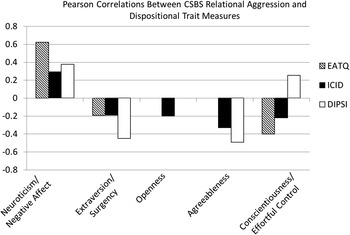
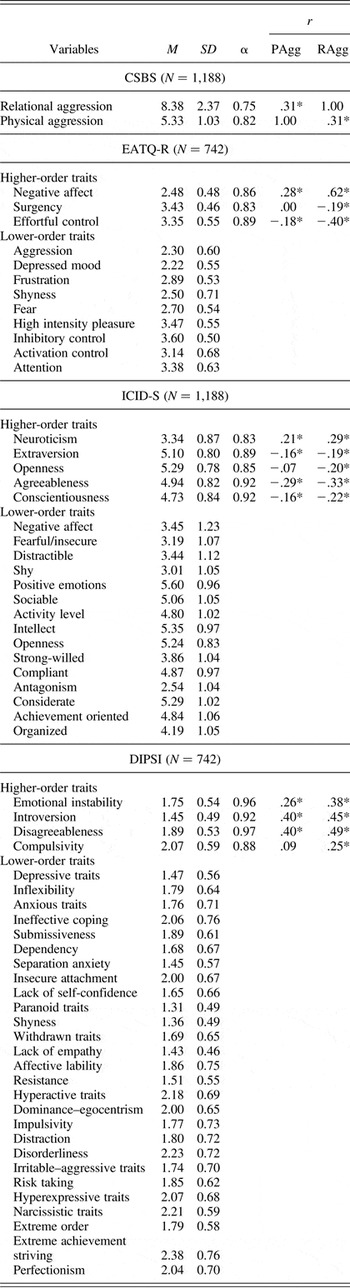
Descriptive statistics and correlations are displayed in Table 1. Independent t tests were conducted to compare boys' and girls' scores on CSBS RAgg and PAgg. On average, boys (M = 5.45, SD = 1.10) showed higher levels of CSBS PAgg than did girls (M = 5.23, SD = 0.95), t (1, 186) = 3.63, p < .001. Given the large sample size, virtually all correlations between CSBS RAgg and higher order traits were significant (see Table 1). The relative magnitude, however, differed across measures, with correlational associations stronger between RAgg and the EATQ-R/DIPSI than for the ICID-S trait domains (see Figure 1).
Bar graph displaying Pearson correlations of parent-reported CSBS relational aggression with the three dispositional trait measures. CSBS, Children's Social Behavior Scale; EATQ-R, Early Adolescent Temperament Questionnaire—Revised; ICID-S, Inventory of Children's Individual Differences—Short Version; DIPSI, Dimensional Personality Symptom Item Pool; Neuroticism/negative affect, EATQ-R negative affect, ICID-S neuroticism, and DIPSI emotional instability; extraversion/surgency, EATQ-R surgency, ICID-S extraversion, and DIPSI introversion (reversed); openness, ICID-S openness; agreeableness, ICID-S agreeableness and DIPSI disagreeableness (reversed); conscientiousness/effortful control, EATQ-R effortful control, ICID-S conscientiousness, and DIPSI compulsivity. All correlations were significant at p < .001.

Correlation coefficients and descriptive statistics for parent-reported relational and physical aggression, and dispositional traits

Note: Means and standard deviations are reported for data with missing values imputed. The coefficient alpha was computed using raw data only (i.e., only those who completed the measure). PAgg, Physical aggression; RAgg, Relational aggression; CSBS, Children's Social Behavior Scale; EATQ-R, Early Adolescent Temperament Questionnaire—Revised; ICID-S, Inventory of Children's Individual Differences—Short Form; DIPSI, Dimensional Personality Symptom Item Pool.
*p < .001.
To investigate associations between three levels of dispositions (temperament, personality, and personality pathology), and CPBS RAgg, the following analyses were conducted. Three multiple regression analyses were conducted with CSBS RAgg as the dependent variable, simultaneously predicted by covariates (age and gender) and all higher order traits from each measure to examine evidence for unique associations. Next, stepwise regression analyses were conducted with CSBS RAgg as the dependent variable, and predictors including age and gender covariates and lower order facets from each measure. Facet-level prediction was examined within higher order domain, such that independent stepwise regression analyses were conducted for each higher order trait (three for the EATQ-R, five for the ICID-S, and four for the DIPSI). Next, higher order multiple regression analyses were again conducted with the inclusion of interaction terms to examine potential moderating effects of gender, age, and age2 for each measure. Significant linear interactions were probed with simple slope analyses (in the case of age, at one standard deviation above and below the mean age) using Hayes's (Reference Hayes2013) PROCESS modeling. Finally, all analyses were again conducted while controlling for CPBS PAgg, to ensure specificity of these findings to the relational aggression construct.Footnote 1
EATQ-R analyses
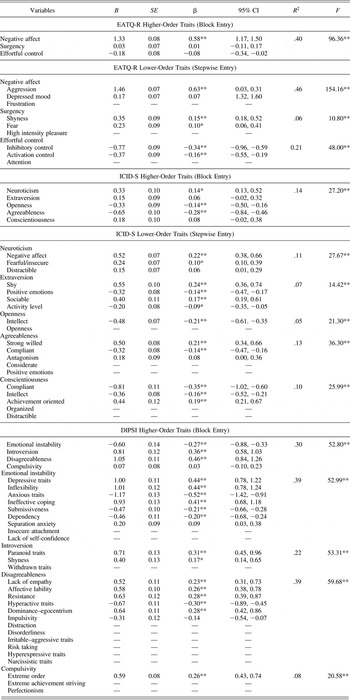
A multiple regression model was estimated to examine the capacity of EATQ-R higher order traits for predicting CSBS RAgg (see Table 2). CSBS RAgg was positively predicted by EATQ-R negative affect (β = 0.58, p < .001).Footnote 2 For the facet-level analyses, CSBS RAgg was positively predicted by the EATQ-R negative affect facet aggression (β = 0.63, p < .001) and the EATQ-R surgency facets shyness (β = 0.15, p < .001) and fear (β = 0.10, p = .009), and negatively predicted by the EATQ-R effortful control facets inhibitory control (β = –0.34, p < .001) and activation control (β = –0.16, p < .001).
Regression analyses predicting parent-reported relational aggression from dispositional traits

Note: The independent variables in the higher-order trait models were block entered, whereas the independent variables in the lower-order trait models were entered stepwise. Values for all lower-order traits denote significant predictors in the final step of each model. In all models, youth age and gender were included as covariates and entered prior to entry of dispositional trait variables. EATQ-R, Early Adolescent Temperament Questionnaire—Revised; ICID-S, Inventory of Children's Individual Differences—Short Form; DIPSI, Dimensional Personality Symptom Item Pool.
*p < .01. **p < .001.
Examination of moderation by gender yielded no significant interactions. Examination of moderation by linear effects for age yielded one significant interaction. The interaction between effortful control and age was significant (β = –0.11, p = .001), such that effortful control negatively predicted CSBS RAgg in older (B = –0.45), t (733) = –3.98, SE = 0.11, p < .001, but not younger youth (B = 0.09), t (733) = 0.79, SE = 0.12, p = .431. Examination of moderation by quadratic effects for age yielded no significant interactions.
ICID-S analyses
A multiple regression model was estimated to examine the capacity of ICID-S higher order traits for predicting CSBS RAgg (see Table 2). CSBS RAgg was positively predicted by ICID-S neuroticism (β = 0.14, p = .001) and negatively predicted by ICID-S openness (β = –0.14, p < .001) and ICID-S agreeableness (β = –0.28, p < .001). For the facet-level analyses, CSBS RAgg was positively predicted by the ICID-S neuroticism facets negative affect (β = 0.22, p < .001) and fearful/insecure (β = 0.10, p = .001), the ICID-S extraversion facets shy (β = 0.24, p < .001) and sociable (β = 0.17, p < .001), the ICID-S agreeableness facet strong-willed (β = 0.21, p < .001), and the ICID-S conscientiousness facet achievement oriented (β = 0.19, p < .001). CSBS RAgg was negatively predicted by the ICID-S extraversion facets positive emotions (β = –0.14, p < .001) and activity level (β = –0.09, p = .008), the ICID-S openness facet intellect (β = –0.21, p < .001), the ICID-S agreeableness facet compliant (β = –0.14, p < .001), and the ICID-S conscientiousness facets compliant (β = –0.35, p < .001) and intellect (β = –0.16, p < .001).
Examination of moderation by gender yielded no significant interactions. Examination of moderation by linear or quadratic effects for age yielded no significant interactions. Furthermore, we sought to compare the overall explained variance in CSBS RAgg that was differentially accounted for by the EATQ-R and the ICID-S. After partialling age and gender, EATQ-R explained 39.6% of the variance, whereas ICID-S explained only 13.9% of the variance in CSBS RAgg (see R 2 for higher order EATQ-R and ICID-S regressions in Table 2).Footnote 3 We then calculated 95% confidence intervals for both R 2 estimates using Steiger and Fouladi's (Reference Steiger and Fouladi1992) R2 program to statistically compare the difference in explained variance. The confidence interval for the EATQ-R R 2 estimate ranged from .34 to .45; the confidence interval for the ICID-S R 2 estimate ranged from .10 to .17. The lack of overlap between these confidence intervals indicates that the EATQ-R traits explained significantly more variance in CSBS RAgg than did the ICID-S.
DIPSI analyses
A multiple regression model was estimated to examine the capacity of DIPSI higher order traits for predicting CSBS RAgg (see Table 2). CSBS RAgg was negatively predicted by DIPSI emotional instability (β = –0.27, p < .001) and positively predicted by DIPSI introversion (β = 0.36, p < .001) and DIPSI disagreeableness (β = 0.46, p < .001). For the facet-level analyses, CSBS RAgg was positively predicted by the DIPSI emotional instability facets depressive traits (β = 0.44, p < .001), inflexibility (β = 0.44, p < .001), and ineffective coping (β = 0.41, p < .001), the DIPSI introversion facets paranoid traits (β = 0.31, p < .001) and shyness (β = 0.17, p = .002), the DIPSI disagreeableness facets lack of empathy (β = 0.23, p < .001), affective lability (β = 0.26, p < .001), resistance (β = 0.28, p < .001), and dominance-egocentrism (β = 0.28, p < .001), and the DIPSI compulsivity facet extreme order (β = 0.26, p < .001). CSBS RAgg was negatively predicted by the DIPSI emotional instability facets anxious traits (β = –0.52, p < .001), submissiveness (β = –0.21, p < .001), and dependency (β = –0.20, p < .001), and the DIPSI disagreeableness facet hyperactive traits (β = –0.30, p < .001).
Examination of moderation by gender yielded one significant interaction. The interaction between disagreeableness and gender was significant (β = 0.19, p < .001), such that disagreeableness more strongly predicted CSBS relational aggression in girls (B = 1.41), t (731) = 10.18, SE = 0.14, p < .001, than in boys (B = 0.56), t (731) = 3.52, SE = 0.16, p < .001. Examination of moderation by linear or quadratic effects for age yielded no significant interactions.
Discussion
The present study offers the most comprehensive account to date of the dispositional context of relational aggression in a large sample of children and adolescents. Specifically, these findings elucidate the psychological nature of relational aggression by conceptualizing this construct within the psychologically rich framework of youth dispositions. Findings revealed associations across multiple dispositional frameworks: temperament, child personality, and personality pathology; although some dispositional frameworks (i.e., temperament) appear to overlap more strongly with individual differences in relational aggression. Analyses were conducted at higher and lower order trait levels to reveal both overarching and nuanced dispositional profiles associated with relational aggression. Overall, there was little evidence of moderation of these associations by gender, age, or age2, and findings remained robust even after controlling for physical aggression.
Associations between RAgg and higher order traits
At the higher order trait level, relational aggression was uniquely predicted by temperament traits: high negative affect; personality traits: high neuroticism, low openness, and low agreeableness; and personality pathology traits: low emotional instability, high introversion, and high disagreeableness. For the most part, these associations generally map onto dispositional profiles for other youth externalizing problems (Nigg, Reference Nigg2006; Tackett, Daoud, et al., Reference Tackett, Daoud, De Bolle and Burt2013). The personality trait of agreeableness showed the strongest unique prediction of relational aggression. Agreeableness is not typically assessed by temperament measures; rather, some aspects of agreeableness may be subsumed under the broader negative affect domain in temperament models. In this study, neither conscientiousness nor effortful control significantly predicated relational aggression. The prediction of relational aggression by higher order personality pathology traits was perhaps the most surprising (particularly low emotional instability and high introversion), and is discussed in more detail in reviewing the facet-level associations below.
Associations between relational aggression and lower order traits
At the lower order trait level, relational aggression was uniquely predicted by multiple facets from all three measures: temperament, personality, and personality pathology. Such analyses were conducted within higher order domains and serve a primary purpose of elucidating the nature of higher order associations with relational aggression and providing a more complex dispositional picture of this construct. Numerous facet-level predictions emerged, and we will not reiterate them all here (see Table 2 for full results). We will, however, highlight some examples of the usefulness of examining facet-level associations alongside domain-level associations (Reynolds & Clark, Reference Reynolds and Clark2001; Samuel & Widiger, Reference Samuel and Widiger2008).
Facet-level analyses indicate that the higher order connection between negative affect and relational aggression is largely driven by the aggression facet. This clarifies the differential prediction found for roughly analogous traits across trait measures (i.e., negative affect vs. neuroticism), because the content of the aggression facet is likely tapping into antagonistic/disagreeable content that would be more closely aligned with the higher order trait of agreeableness in a personality trait model. Another example of the usefulness of facet-level associations is seen in findings for extraversion. At the higher order trait level, extraversion was not a significant unique predictor of relational aggression, yet three extraversion facets were significant predictors of relational aggression, but in divergent directions (sociability and shyness positively predicted relational aggression, but positive emotions negatively predicted relational aggression). Divergent facet-level associations often serve to mask associations at the higher order trait level, yet offer further opportunity for better prediction of outcomes when examined independently. These findings are particularly interesting in light of research showing that relational aggression is associated with indices of social adjustment, such as popularity (which may reflect positive associations with sociability; Rose et al., Reference Rose, Swenson and Waller2004), as well as indices of social maladjustment (which may reflect positive associations with shyness; Crick et al., Reference Crick, Ostrov and Werner2006). Such divergent personality profiles may reflect heterogeneity within youth who exhibit relational aggression, suggesting that trait extraversion may be a fruitful domain for further attempts to disentangle such heterogeneity. A similar divergent pattern was found for conscientiousness facets, with achievement orientation positively predicting relational aggression, but compliance and intellect demonstrating negative associations (and, similarly, these divergent facet-level associations resulted in no significant prediction of relational aggression by higher order conscientiousness). Positive associations between relational aggression and high achievement orientation also point to potential underlying processes motivating relational aggression behaviors, such as status-seeking, socially dominant, or narcissistic tendencies, which may drive relational aggression in some children (e.g., Bukowski et al., Reference Bukowski, Schwartzman, Santo, Bagwell and Adams2009; Underwood et al., Reference Underwood, Beron and Rosen2011).
Lower order facet-level analyses are also helpful in clarifying somewhat unexpected associations between relational aggression and higher order personality pathology traits (e.g., negative prediction by emotional instability and positive prediction by introversion). Several facets of emotional instability were divergently associated with relational aggression, with some facets demonstrating negative associations (e.g., anxious traits and submissiveness) and others demonstrating positive associations (e.g., depressive traits and inflexibility). The associations largely make conceptual sense, but they suggest that associations between relational aggression and emotional instability are more nuanced than with other higher order domains, so they require close examination at a lower level of analysis to fully understand them: when aggregated at the higher order trait level, they may be unclear. In contrast, the positive association between relational aggression and introversion is driven primarily by paranoid traits, which is consistent with associations found between relational aggression and social constructs such as exclusion, alienation, and loneliness (Crick, Reference Crick1996; Grotpeter & Crick, Reference Grotpeter and Crick1996; Prinstein et al., Reference Prinstein, Boergers and Vernberg2001; Soensens, Vansteenkiste, Goossens, Duriez, & Niemiec, Reference Soensens, Vansteenkiste, Goossens, Duriez and Niemiec2008). The association between relational aggression and pathological paranoia similarly points to hypotheses regarding the motivational antecedents of relational aggression, an interesting area for further study.
The current analyses revealed some surprising associations between relational aggression and personality pathology. Specifically, certain regression coefficients showed different directional effects than observed for traits in the analyses for temperament and personality reflecting similar content. For example, DIPSI anxious traits negatively predicted relational aggression, whereas EATQ-R fear and ICID-S fearful/insecure positively predicted relational aggression. These associations did not show the same divergence using Pearson correlations, which yielded positive correlations among relational aggression, EATQ-R fear, ICID-S fearful/insecure, and DIPSI anxious traits (all ps ≤ .001). One reason for this discrepancy found for regression-based associations is that the broader negative emotionality domain may be covered more extensively by the DIPSI, which comprises nine distinct facets. This may result in greater specificity of the unique variance of each facet, after controlling for the others. It will be helpful for future research to better delineate the nature of the common and specific associations presented here.
Moderation of relational aggression trait associations by age and gender
As previously noted, these associations were largely robust across age and gender, although one significant moderation effect was detected for age. Specifically, effortful control appears to be a better predictor of relational aggression among adolescents than among younger children. This evidence for an age-specific correlate of relational aggression is consistent with the supposition that mal/adaptation may be influenced by vulnerabilities and strengths that emerge across development as youth encounter new challenges and opportunities (e.g., Luthar, Cicchetti, & Becker, Reference Luthar, Cicchetti and Becker2000). This result thus serves to elucidate the dispositional vulnerability profile for relational aggression at different developmental periods.
Regarding gender, one moderating effect was also found. Specifically, high disagreeableness was associated with increased relational aggression for both boys and girls, but it appeared to be a particularly strong risk factor for girls. These results demonstrate continuity with existing research that has highlighted gender differences in precursors for broadband externalizing problems (for a review, see Keenan, Loeber, & Green, Reference Keenan, Loeber and Green1999). For example, girls generally score higher than boys on characteristics related to agreeableness, such as empathy and compliance (e.g., Briggs-Gowan, Carter, Skuban, & Horwitz, Reference Briggs-Gowan, Carter, Skuban and Horwitz2001; Keenan & Shaw, Reference Keenan and Shaw1997). It has been suggested that in excess, empathy and compliance may increase girls' vulnerability for internalizing problems (Keenan & Hipwell, Reference Keenan and Hipwell2005). Conversely, the current results suggest that excessive disagreeableness may increase girls' vulnerability for externalizing problems, including relational aggression.
Limitations and future directions
Several limitations of the current study are of note. First, the current results may be influenced by shared method variance resulting from examining dispositional and relational aggression data obtained from a single parent. Despite having extensive information of their child's dispositional traits (Rothbart & Bates, Reference Rothbart, Bates, Damon, Lerner and Eisenberg2006; Tackett, Reference Tackett2011), the results from parent reports may not generalize to other informants. Informant discrepancies are relatively common within child psychopathology research (Achenbach, Reference Achenbach2006; De Los Reyes & Kazdin, Reference De Los Reyes and Kazdin2006). This issue is particularly salient in the study of relational aggression, which has frequently employed teachers, peers, selves, and parents in providing information about an individual's level of relational aggression. The potential for informant differences when measuring relational aggression raises both substantive and methodological concerns (Card et al., Reference Card, Stucky, Sawalani and Little2008; Smith, Rose, & Schwartz-Mette, Reference Smith, Rose and Schwartz-Mette2009). It is therefore essential for future researchers to incorporate cross-informant data as well as other methodological sources (e.g., observational approaches) in research on relational aggression and dispositional associations. Second, the data analyzed here were cross-sectional, which limits our understanding of age-related differences in the temperament, personality, and personality pathology correlates of relational aggression across time. Longitudinal research is needed to examine intraindividual change in these relationships, extending the age-specific effect for effortful control identified in the present study.
Third, although the EATQ-R was initially developed and validated for use with youth aged 9 to 15 years, the present investigation used the EATQ-R for the entire age range of the sample. The EATQ-R was selected because it captured the largest age range in the current sample relative to other temperament measures developed by Rothbart and colleagues. Nevertheless, it is important to understand how such results might change if age-specific temperament measures are used (e.g., the Children's Behavior Questionnaire for the 6- to 7-year-olds: Rothbart, Ahadi, Hershey, & Fisher, Reference Rothbart, Ahadi, Hershey and Fisher2001; the Temperament in Middle Childhood Questionnaire for 7- to 10-year-olds: Simonds & Rothbart, Reference Simonds and Rothbart2004; and the Adult Temperament Questionnaire for older adolescents and adults: Evans & Rothbart, Reference Evans and Rothbart2007). Fourth, the majority of participants were Caucasian Canadians of moderate to high socioeconomic status (SES). Given evidence for associations between relational aggression and SES (e.g., young children from higher SES families show higher rates of relational aggression than do those from lower SES families; Bonica, Arnold, Fisher, Zeljo, & Yershova, Reference Bonica, Arnold, Fisher, Zeljo and Yershova2003; McNeilly-Choque, Hart, Robinson, Nelson, & Olson, Reference McNeilly-Choque, Hart, Robinson, Nelson and Olson1996), replication in different demographic groups is needed.
Conclusions
In sum, the present study offers the largest and most comprehensive examination of dispositional associations of relational aggression to date. In a sample of 1,188 youth aged 6 to 18 years, we identified a dispositional context for relational aggression behaviors across multiple models of child individual differences: temperament, personality, and personality pathology. Substantial associations emerged across all measures, with some limited evidence for age and gender moderation of these associations. These findings largely support the inclusion of relational aggression in a broader youth externalizing spectrum (Burt et al., Reference Burt, Donnellan and Tackett2012; Tackett, Daoud, et al., Reference Tackett, Daoud, De Bolle and Burt2013), such that greater relational aggression was generally associated with higher levels of negative affect, and lower intrapersonal and interpersonal self-regulation. Thus, results from studies such as this can inform future efforts regarding classification and taxonomy of relational aggression behaviors, which have been discussed but not fully resolved (Keenan, Coyne, & Lahey, Reference Keenan, Coyne and Lahey2008; Lahey et al., Reference Lahey, Applegate, Waldman, Loft, Hankin and Rick2004; Loeber et al., Reference Loeber, Pardini, Hipwell, Stouthamer-Loeber, Keenan and Sembower2009; Tackett et al., Reference Tackett and De Clercq2009) yet hold great implications for researchers, clinicians, and educators hoping to better understand these consequential behaviors.
Furthermore, we hope that the present results provide more information regarding the psychological nature of relational aggression behaviors. The present study was designed to illustrate that temperament/personality taxonomies offer a comprehensive and psychologically rich context for examining the emergence and development of childhood behavior, and can be informatively applied to many domains beyond relational aggression (Nigg, Reference Nigg2006; Tackett, Reference Tackett2006). The present analyses further illustrate the utility of examining facet-level dispositional predictors alongside higher order domains. Such findings can clarify seeming inconsistences between measures (e.g., negative affect vs. neuroticism) that may reflect differences in measure construction or content. Substantively, facet-level analyses also reveal a much more nuanced and complex dispositional profile with which to better understand behavior. For example, divergent associations within domain (e.g., both shyness and sociability independently predict relational aggression) may highlight potentially different pathways to relational aggression behavior (i.e., equifinality; Cicchetti & Rogosch, Reference Cicchetti and Rogosch1996) that offer a great resource for hypothesis development and theory refinement around relational aggression emergence in early life and point to different potential approaches to prevention/intervention. In sum, the present results expand our understanding of the personological correlates of relational aggression in childhood and adolescence, extending previous research and pointing to new directions for the study of relational aggression in youth.