In November 2015, a 29-year-old nurse, originally from the Philippines, and working in a pediatric ward at a tertiary-care hospital in Singapore, was diagnosed with pulmonary tuberculosis (TB), with positive sputum acid fast bacilli (AFB) smear (1+), after 5 months of cough. The nurse had never been screened for latent TB infection (LTBI) because this is not mandatory in Singapore; however, she had had a normal chest x-ray on a pre-employment examination 2 years prior. There were no other known cases of pulmonary TB on the ward in question between July and November 2015.
The incidence of TB in Singapore was 300 cases per 100,000 population in 1960; however, through an active TB control program, rates decreased to 44 per 100,000 by 2016. This rate is much lower than that of neighboring countries, including the Philippines at 322 cases per 100,000. 1
“Stone in the pond” is a term used for decades to refer to the concentric-circle approach to contact tracing. First, focus is on high-level exposures, then focus extends to lesser exposures (if necessary), until the prevalence of infection approximates that of the local community.Reference Veen 2 , 3 Here, we describe such a risk-stratified approach to contact tracing after a large-scale TB exposure.
METHODS
Setting
The National University Hospital (NUH) is an academic hospital in Singapore with 1,250 inpatient beds, including 114 pediatric beds. The exposure occurred in a 43-bed inpatient pediatric unit consisting of 7 large, open rooms with 4–8 beds each, as well as 3 single-bed negative-pressure rooms.
This observational study was exempted from formal review by the National Healthcare Group, Domain Specific Institutional Review Board. The STROBE guidelines for reporting of observational studies were followed.
Contact Investigation
The infectious period was deemed to be July to November 2015. Contacts were identified as either patients cared for by the index case person, other healthcare workers (HCWs), or visitors of those patients. High-risk contacts in each group were identified as follows:
-
∙ Patients: Those who were immunocompromised, those <2 years of age, or those with >40 hours contact with the index case person.
-
∙ Visitors: Those who spent time on the ward with a patient subsequently diagnosed with latent TB infection (LTBI).
-
∙ HCWs: Those who worked primarily on the affected unit, or roommates of the index case person.
High-risk contacts were stratified by hours in contact with the index case person. Screening of high-risk contacts was conducted first, with the option to expand screening to all contacts, based on results from the first round of screening.
Screening Methodology
A Mantoux tuberculin skin test (TST) and/or a interferon-gamma release assay (IGRA), such as the QuantiFERON-TB Gold In Tube (QFT; Qiagen, Hilden, Germany) or the T-SPOT (Oxford Immunotec, Marlborough, MA) testing was offered to all high-risk contacts, and testing was repeated after 8–10 weeks if exposure was recent. Pediatric infectious diseases specialists directed the testing algorithm in pediatric contacts, based on age and immunosuppression. Positive tests were defined as follows: TST induration ≥10 mm, QFT ≥0.35 IU/ML or T-SPOT ≥8 spots. Conversion of TST or IGRA was defined as a negative initial screening result followed by a subsequent positive test ≥8 weeks later. All contacts found to have LTBI were evaluated for active disease and were offered treatment.
RESULTS
Patients
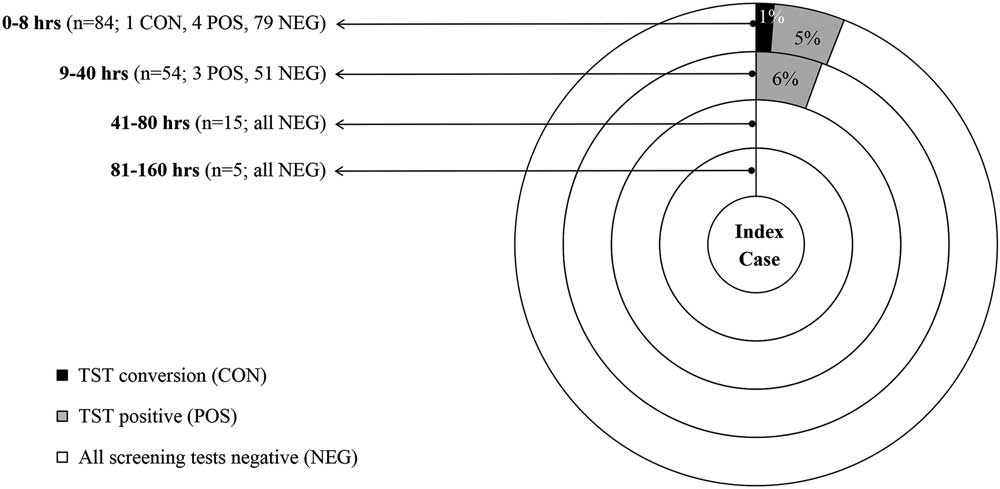
Of 481 exposed patients, 464 (96%) were ≤18 years of age. Furthermore, 173 patients (36%) were deemed high risk: 31 were immunocompromised; 116 were <2 years old; 12 had had >40 hours of contact exposure, and 14 had >1 of the preceding risk factors. Among these high-risk patients, 158 (91%) patients were screened: 110 using TST, 15 using IGRA (QFT or T-SPOT), and 33 using both TST and IGRA. Another 15 high-risk patients declined screening or were lost to follow-up: 12 were <2 years old, 2 were immunocompromised, and 1 was both immunocompromised and had >40 hours of contact exposure. In addition, 114 patients had a single screening test and 44 had a second screening test. All final screening tests were conducted ≥8 weeks from the last TB exposure. Only 8 patients (5%) had a positive TST, and only 1 was a TST conversion (Figure 1). All patients with a positive TST had induration 10–15 mm; all were <2 years of age; all had received Bacillus Calmette–Guérin (BCG) vaccination (routine in Singapore), and all had <40 hours of contact with the index case person. The single TST conversion occurred after the infant spent several weeks in a highTB-burden country (Vietnam). No patients had positive IGRAs, but 6 patients had indeterminate IGRAs; these patients were deemed negative according to the screening protocol. Of these 6 patients, 5 had negative follow-up IGRAs, and all had negative TSTs.
Pediatric patient screening results by hours in contact with the index case–concentric circle approach.

Visitors
Overall, 7 visitors were screened using QFT, and 3 patients (43%) were positive; however, all of these patients had risk factors for prior TB exposure (ie, prior known exposure, or originating from a high TB-burden country).
Healthcare Workers
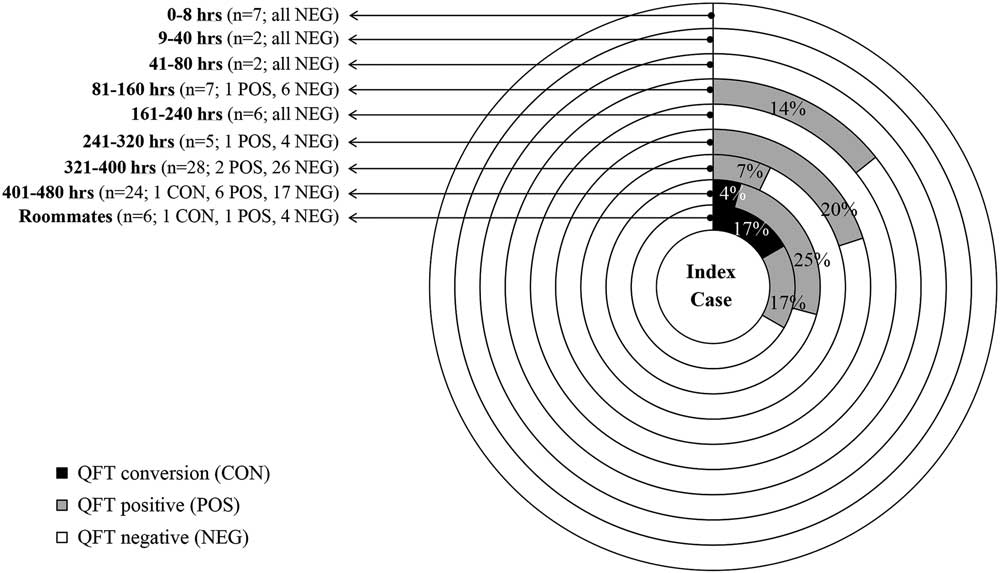
All 87 high-risk HCW contacts were screened using QFT; 11 of these HCWs (13%) had a positive QFT on the first screen, but none had been screened in the past. Furthermore, 75 HCWs underwent a second screening, 2 of whom tested positive (2.6%): 1 had >400 hours of contact exposure and 1 was a roommate of the index case person (Figure 2). All HCWs with a positive QFT had lived and worked in high TB-burden countries (ie, Philippines, India, and China), and 2 HCWs reported prior known exposures. No contacts were diagnosed with active TB disease. Of 13 HCWs with LTBI, 10 accepted treatment.
Healthcare worker screening results by hours in contact with the index case–concentric circle approach.

DISCUSSION
This TB exposure occurred over several months in a pediatric inpatient unit, yet ultimately, the conversion rate was low. The index case person sometimes wore a surgical mask at work, and the type of natural ventilation found in open-air hospital wards may be superior to the ventilation provided by modern negative-pressure rooms,Reference Escombe, Oeser and Gilman 4 although an analysis of the exposures in negative pressure versus natural ventilation rooms was beyond the scope of this work.
It was not possible to definitively attribute most of the positive screening results to this exposure, given the lack of baseline results. Positive TSTs in certain patients could have been related to BCG vaccination, and initial positive QFT results in HCWs and visitors may have been due to previous exposures. QFT conversions were more likely to have been related to this exposure, and conversions were only seen in HCWs with the most hours of contact. Using a “stone in the pond” approach, contact tracing was not expanded, which would have tripled the number of contacts requiring screening.
A risk-stratified approach is a practical and cost-effective strategy for contact tracing after large-scale nosocomial TB exposures, which may occur with some frequency in resource-limited or crowded settings. Direct costs of this exposure (ie, treatment, laboratory testing, imaging, and clinic fees) totaled more than US$100,000 and would have been significantly higher had the extent of contact tracing been expanded.
Future nosocomial TB exposures are inevitable in moderate-to-high TB-burden countries where screening for HCWs is not routine. The incidence of TB in foreign-born HCWs in the United States is 10-fold higher than it is among their US-born counterparts.Reference Lambert, Pratt, Armstrong and Haddad 5 In Singapore, ~25% of nurses originate from high TB-burden countries like the Philippines. 6
Of 87 HCWs, 11 (13%) in our cohort had an initial positive QFT, similar to published ratesReference Chee, Lim and Barkham 7 ; all of these HCWs were from high TB-burden countries. While universal screening for LTBI is recommended by the US Centers for Disease Control and Prevention,Reference Jensen, Lambert, Iademarco and Ridzon 8 it may not always be cost-effective.Reference Mullie, Schwartzman, Zwerling and N’Diaye 9 Targeted screening of HCWs from high TB-burden countries has been proposed,Reference Lambert, Pratt, Armstrong and Haddad 5 , Reference Davidson, Lalor, Anderson, Tamne, Abubakar and Thomas 10 and it could provide a starting point for HCW screening in moderate TB-burden countries.
ACKNOWLEDGMENTS
We would like to thank Professors Yee Tang Wang and Cynthia Chee at the Singapore Tuberculosis Elimination Program and Tuberculosis Control Unit for their invaluable assistance in managing this large-scale nosocomial exposure, and the National University Hospital Executive Command Group for their support of epidemiology and infection prevention.
Financial support: No financial support was provided relevant to this article.
Potential conflicts of interest: All authors report no conflicts of interest relevant to this article.