Introduction
Frontotemporal dementia (FTD) is a syndromic clinical variant of frontotemporal lobar degeneration (FTLD), which constitutes a prevalent group of the neurodegenerative diseases with cognitive impairment (Brunnström et al., Reference Brunnström, Gustafson, Passant and Englund2009). Within recent years the clinical, molecular genetic and pathological classifications of FTD have evolved (Cairns et al., Reference Cairns2007). Patients with behavioral variant of frontotemporal dementia (bv-FTD) present with a progressive deterioration of behavior and personality. Bv-FTD is the most common phenotype of FTLD, but the disease progression is characterized by the appearance of features from other forms of FTLD or a change into other FTLD syndromes in many cases (Kertesz et al., Reference Kertesz, Blair, McMonagle and Munoz2007).
We present two patients with bv-FTD phenotype and involuntary choreoathetoid movements, unusual for the diagnosis of bv-FTD, which explains why differential diagnoses, principally Huntington's disease (HD), were initially suspected.
Case reports
The two patients were seen in the Memory Disorders Clinic at Rigshospitalet, Copenhagen, Denmark, for clinical assessment of involuntary movements. Both patients gave written informed consent for publication of this study.
Patient 1
A 64-year-old woman (Caucasian Dane), a former healthy bilingual correspondent, was referred to the Memory Disorders Clinic on suspicion of HD five years after onset of involuntary movements. Her mother had a history of non-specific involuntary movements, but no other family history of neurological or psychiatric disease was known. She had never received neuroleptics nor any other drugs capable of causing tardive dyskinesia.
The first symptom noticed by the family was involuntary movements of the face and head, which had gradually progressed to generalized involuntary movements. The family had observed a gradual cognitive decline and severe behavioral changes during the 18 months prior to referral. She was apathetic, often violated social rules, and had to be encouraged and guided through activities.
At neurological examination, the patient presented with marked involuntary choreatic movements, predominantly involving the face, neck and upper extremities, delayed saccade initiation, irregular rapid alternating movements, brisk deep tendon reflexes in the arms, positive milkmaid sign, and utilization behavior. She had difficulties in understanding and cooperating at the examination, including in conversation, but gave information that spoke against severe amnesia. Her speech was with reduced output, perseveration, simple language with verbal stereotypies, but no aphasia.
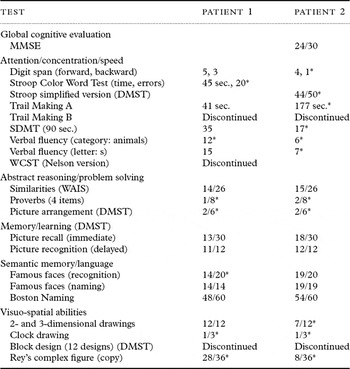
The neuropsychological investigation confirmed the clinical impression of severe executive impairment. The test results are listed in Table 1.
General neuropsychological assessment

The figures listed are raw scores.
Test results marked * indicate a score >2 SD below that expected for age- and education-matched controls.
DMST = Danish Mental Status Test; MMSE = Mini-mental State Examination; SDMT = Symbol Digit Modalities Test; WAIS = Wechsler Adult Intelligence Scale; WCST = Wisconsin Card Sorting Test.
Blood biochemistry was normal, including ceruloplasmin, ferritin and tests for syphilis. Cerebrospinal fluid (CSF) showed no pleocytosis, normal concentration of beta-amyloid, total tau, phosphorylated tau, total protein and glucose, and no oligoclonal bands. Molecular genetic investigations of the Huntington disease gene, the Huntington's disease-like (HDL) genes (DRPLA and SCA 17), the FTD genes, MAPT, PRGN and the Danish CHMP2B mutation (Lindquist et al., Reference Lindquist, Brændgaard, Svenstrup, Isaacs and Nielsen2008) as well as the Alzheimer's disease (AD) genes PSEN1, PSEN2 and APP were performed either by fragment analysis for specific repeat lengths or sequencing, and PSEN1 and APP were further analyzed for exon derangements (Lindquist et al., Reference Lindquist, Schwartz, Batbayli, Waldemar and Nielsen2009). No mutations were found.
Cerebral blood flow (CBF) SPECT showed bilateral frontotemporal hypoperfusion, more pronounced in the right hemisphere, and computerized tomography (CT) scans as well as magnetic resonance imaging (MRI) of the brain showed significant bilateral frontotemporal atrophy.
Based on clinical findings besides the involuntary movements, the neuropsychological profile and findings from neuroimaging, the patient was finally diagnosed with bv-FTD.
Patient 2
A 66-year-old woman (Caucasian Dane), a former healthy kindergarten manager, was referred to the Memory Disorders Clinic for a second opinion because of involuntary movements, atypical for the diagnosis of bv-FTD, after three years of progressive cognitive and personality changes as well as progressive involuntary movements. She had no family history of cognitive symptoms or movement disorders.
The first symptoms noted by the family were a decline in empathy, initiative and social engagement. Further, the family had noticed progressive involuntary movements of the legs and arms when the patient was at rest for a longer period without certainty of onset.
Early in the disease course she was treated for depression with escitalopram for less than 6 months. This led to a clear improvement in the affective symptoms but had no effect on cognitive symptoms, changes in personality or involuntary movements. Except for escitalopram she had never been on any medication, especially not neuroleptics or antiemetics. Later, the family observed a gradual cognitive decline and severe personality changes. She had lost most of her initiative and withdrew from social interaction. She had problems finding and pronouncing words and had lost the ability to read and write.
The patient presented at the clinic with involuntary choreatic movements primarily as orolingual movements, severe motor impersistence, primitive reflexes (palmomental and snout reflex), applause sign and severe akathisia. Her memory was disorganized but with no indication of severe amnesia. Her speech showed reduced output and word finding difficulties, and she only spoke in short sentences. A lack of insight was noticed. Neuropsychological investigation revealed progressive cognitive symptoms relative to assessment at the Department of Neurology at Glostrup Hospital two years earlier, whereas the involuntary movements seemed to be less prominent.
The neuropsychological investigation confirmed the clinical impression of severe executive impairment. The test results are listed in Table 1.
As in Patient 1, blood biochemistry and CSF tests were normal. Molecular genetic investigations as described above were performed and no mutations were found. CBF-SPECT and CT scans of the brain were normal and MRI of the brain revealed fewer than six non-specific small white matter lesions predominantly located in the frontal lobe but also in the parietal lobe.
The patient was finally diagnosed with bv-FTD.
Discussion
To our knowledge this is the first description of patients with molecular genetic exclusion of HD and HDL and involuntary movements associated with bv-FTD. Our two patients presented with involuntary choreoathetoid movements for a longer period and probably before the behavioral changes characteristic for the diagnosis of bv-FTD. The executive dysfunction and movement disorder made other neurodegenerative diseases, especially some of the hereditary diseases such as HD and HDL phenotypes, obvious differential diagnoses. Another obvious consideration was that the involuntary movements might be secondary to FTD.
Stereotypic behaviors are a common and a characteristic feature of FTLD (Shigenobu et al., Reference Shigenobu2002), but in our opinion not to be considered as a forme fruste of choreatic involuntary movements. The presence of stereotypical movements can help distinguish patients with frontotemporal dementia from those with AD although these behavioral changes are also seen in frontal variants of AD (Larner, Reference Larner2006). But these behaviors, including stereotypical movements, although without clear purpose are not involuntary. Further, stereotypical movements can be suppressed for a shorter or longer period as well as treated by replacement with more socially acceptable behaviors in contrast to the involuntary movements of our patients (Saddichha and Pandey, Reference Saddichha and Pandey2008). Patient 2 had applause sign normally described in frontostriatal neurodegenerative Parkinsonian syndromes, especially progressive supranuclear palsy and less frequent in FTD (Dubois et al., Reference Dubois, Slachevsky, Pillon, Beato, Villalponda and Litvan2005), but also seen in other Parkinsonian disorders and HD (Wu et al., Reference Wu, Sitburana, Davidson and Jankovic2008). In our case we consider applause sign as one of many frontal release signs.
Without neuropathological confirmation a definite conclusion regarding the etiology of the symptoms cannot be drawn. However, in our two patients the diagnosis of bv-FTD was made only after exclusion of other diagnoses and an observation period to ensure that the phenotype did not develop features of other forms of FTLD or changed into another FTLD syndrome.
We conclude that the HDL phenotypes may be part of the clinical spectrum of the bv-FTD phenotype.
Conflict of interest
None.
Description of authors’ roles
T. R. Nielsen collected the data, analyzed the data and wrote the paper. P. Bruhn assisted in collecting the data and assisted in writing the paper. J. E. Nielsen assisted in collecting the data, supervised the data analysis and assisted in writing the paper. L. E. Hjermind designed the study, collected the data, analyzed the data and assisted in writing the paper.