Introduction
Schizophrenia is a chronic mental disorder that is characterized by significant impairments in cognition and functioning. Marked deficits have been observed in social and non-social cognitive domains (Penn et al. Reference Penn, Corrigan, Bentall, Racenstein and Newman1997; Heinrichs & Zakzanis, Reference Heinrichs and Zakzanis1998), which cross-sectional and longitudinal studies have found to be significant and consistent predictors of functional outcome (Green et al. Reference Green, Kern, Braff and Mintz2000; Couture et al. Reference Couture, Penn and Roberts2006). Such findings have fueled arguments for the treatment of cognitive impairments in schizophrenia as a key mechanism for improving functioning in the disorder (Hogarty & Flesher, Reference Hogarty and Flesher1992; Green & Nuechterlein, Reference Green and Nuechterlein1999).
While the pharmacological treatment of cognitive impairments in schizophrenia has produced limited improvements (Keefe et al. Reference Keefe, Bilder, Davis, Harvey, Palmer, Gold, Meltzer, Green, Capuano, Stroup, McEvoy, Swartz, Rosenheck, Perkins, Davis, Hsiao and Lieberman2007; Sergi et al. Reference Sergi, Green, Widmark, Reist, Erhart, Braff, Kee, Marder and Mintz2007), a number of psychosocial cognitive rehabilitation approaches have emerged as effective methods for addressing cognitive deficits in the disorder (McGurk et al. Reference McGurk, Twamley, Sitzer, McHugo and Mueser2007). One integrated approach to the remediation of social and non-social cognitive impairments in schizophrenia that has been shown to be particularly effective at improving cognition and functioning in the disorder is cognitive enhancement therapy (CET; Hogarty & Greenwald, Reference Hogarty and Greenwald2006). In the initial CET study with chronically ill patients, we demonstrated that CET resulted in marked improvements in processing speed, neurocognition and social cognition, as well as social adjustment (Hogarty et al. Reference Hogarty, Flesher, Ulrich, Carter, Greenwald, Pogue-Geile, Kechavan, Cooley, DiBarry, Garrett, Parepally and Zoretich2004). A 1-year follow-up study also showed that these improvements could be maintained after the completion of treatment (Hogarty et al. Reference Hogarty, Greenwald and Eack2006). Recently, we tested the effects of CET as an early intervention approach with 58 early-course schizophrenia out-patients, and again found substantial improvements in neurocognition (d=0.46) and social cognition (d=1.55), but not processing speed, which was relatively preserved among early-course patients. In addition, large (d=1.53) and broad functional improvements were observed in vocational functioning, activities of daily living and other domains of social adjustment (Eack et al. Reference Eack, Greenwald, Hogarty, Cooley, DiBarry, Montrose and Keshavan2009, in press).
The effects of CET and other cognitive rehabilitation approaches on functional outcome strongly support the treatment of cognition as a critical mechanism for functional improvement in schizophrenia. Unfortunately, few studies have explicitly tested the degree to which improvements in cognition contribute to functional improvement. In the initial CET study with chronically ill patients, we found that improvements in processing speed served as a significant partial mediator of CET effects on social adjustment (Hogarty et al. Reference Hogarty, Greenwald and Eack2006). Wykes et al. (Reference Wykes, Newton, Landau, Rice, Thompson and Frangou2007) studied cognitive remediation therapy among early-onset patients and found that improvements in executive functioning, working memory and planning were related to improved social behavior; however, previous studies of that intervention with chronic patients did not demonstrate a link between changes in neurocognitive domains and functioning (Reeder et al. Reference Reeder, Newton, Frangou and Wykes2004, Reference Reeder, Smedley, Butt, Bogner and Wykes2006). To date, no studies have examined the effect of both improved neurocognition and social cognition on functional outcome during cognitive rehabilitation in schizophrenia.
Having recently found substantial functional benefits of CET in early schizophrenia during a 2-year randomized trial (Eack et al. Reference Eack, Greenwald, Hogarty, Cooley, DiBarry, Montrose and Keshavan2009), we now examine the degree to which social-cognitive and neurocognitive enhancement during this trial served as active mechanisms of functional improvement in these early-course patients. It was hypothesized that both improved neurocognition and social cognition would contribute to improvements in functioning, and mediate the differential effects of CET on functional outcome. Unlike our initial CET study (Hogarty et al. Reference Hogarty, Greenwald and Eack2006), the mediational effects of improved processing speed were not investigated, as this sample of early-course patients demonstrated relatively preserved performance in processing speed that did not change with treatment (Eack et al. Reference Eack, Greenwald, Hogarty, Cooley, DiBarry, Montrose and Keshavan2009).
Method
Participants
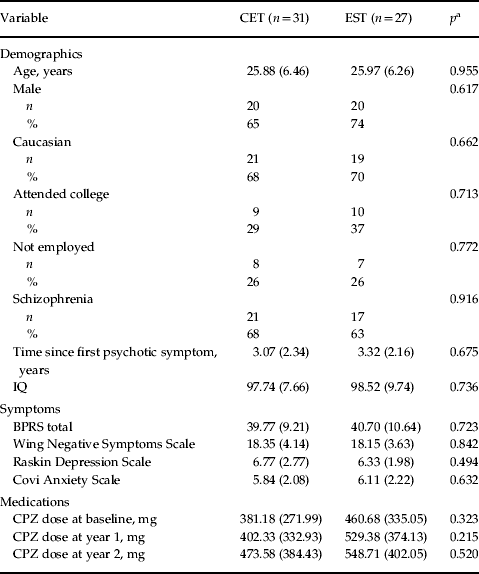
Participants consisted of 58 early-course out-patients with schizophrenia (n=38) or schizo-affective disorder (n=20), as assessed by the Structured Clinical Interview for DSM-IV (First et al. Reference First, Spitzer, Gibbon and Williams2002), treated in a 2-year trial of CET. The early course of schizophrenia was defined for this research as no greater than 8 years since the first emergence of psychotic symptomatology. Eligible participants included individuals with schizophrenia, schizo-affective, or schizophreniform disorder stabilized on antipsychotic medications who experienced their first psychotic symptom within the past 8 years, were not abusing substances for at least 2 months prior to study enrollment, had an intelligence quotient (IQ) ⩾80, and exhibited significant social and cognitive disability on the Cognitive Style and Social Cognition Eligibility Interview (Hogarty et al. Reference Hogarty, Flesher, Ulrich, Carter, Greenwald, Pogue-Geile, Kechavan, Cooley, DiBarry, Garrett, Parepally and Zoretich2004). The Cognitive Style and Social Cognition Eligibility Interview is a structured interview measure that was used to ensure that enrolled patients experienced significant cognitive and functional disability warranting treatment. Demographic and clinical characteristics of CET and enriched supportive therapy (EST) patients are presented in Table 1.
Demographic and clinical characteristics of patients treated with CET or EST

CET, Cognitive enhancement therapy; EST, enriched supportive therapy; IQ, intelligence quotient; BPRS, Brief Psychiatric Rating Scale; CPZ, chlorpromazine.
Values are given as mean (standard deviation).
a χ2 Test or independent t test, two-tailed, for significant differences between CET and EST participants.
Treatments
Participants were treated with either CET or an EST control, both of which have been described in detail elsewhere (Hogarty et al. Reference Hogarty, Flesher, Ulrich, Carter, Greenwald, Pogue-Geile, Kechavan, Cooley, DiBarry, Garrett, Parepally and Zoretich2004; Eack et al. Reference Eack, Greenwald, Hogarty, Cooley, DiBarry, Montrose and Keshavan2009). Briefly, CET is a comprehensive cognitive rehabilitation intervention designed to address the social and non-social cognitive deficits that limit functional recovery from schizophrenia. Patients treated with CET complete approximately 60 h of computer-based training in attention, memory, and problem-solving and 45 small-group social-cognitive therapy sessions designed to enhance perspective-taking, social context appraisal, foresightfulness, and getting the ‘gist’ out of social situations. EST is an illness management and education approach based on personal therapy (Hogarty, Reference Hogarty2002), which provides patients with psychoeducation about schizophrenia and teaches applied coping strategies to reduce stress. EST is tailored to the patient's level of recovery, and begins with weekly 30–60 min individual therapy sessions. As patients progress through the treatment, increasingly complex coping strategies are taught and applied, and therapy sessions are provided on a biweekly basis. All participants were maintained on antipsychotic medications approved by the US Food and Drug Administration for the treatment of schizophrenia or schizo-affective disorder.
Measures
Neurocognition
A comprehensive battery of paper-and-pencil and computerized neuropsychological tests representing the domains of verbal and working memory, executive functioning, language ability, psychomotor speed and neurological soft signs was used to assess the neurocognitive mechanisms of CET effects on functional outcome. These domains assessed reflect the prominent areas of cognitive impairment in schizophrenia, and are largely consistent with those outlined by the Measurement and Treatment Research to Improve Cognition in Schizophrenia (MATRICS) committee (Green et al. Reference Green, Nuechterlein, Gold, Barch, Cohen, Essock, Fenton, Frese, Goldberg, Heaton, Keefe, Kern, Kraemer, Stover, Weinberger, Zalcman and Marder2004). Items from tests of these domains were combined into an overall composite measure of neurocognitive function, and included immediate and delayed recall items from stories A and B of the Revised Wechsler Memory Scale (Wechsler, Reference Wechsler1987); List A total recall, short-term free recall, and long-term free recall from the California Verbal Learning Test (Delis et al. Reference Delis, Kramer, Kaplan and Ober1987); digit span, digit symbol, picture arrangement, and vocabulary items from the Revised Wechsler Adult Intelligence Scale (Wechsler, Reference Wechsler1981); Trails B time to completion (Reitan & Waltson, Reference Reitan and Waltson1985); perseverative and non-perseverative errors, categories completed, and percentage of conceptual responses from the Wisconsin Card Sorting Test (Heaton et al. Reference Heaton, Chelune, Talley, Kay and Curtiss1993); total move score and ratio of initiation to execution (planning) time from the Tower of London (W. C. Culbertson and E. A. Zillmer, Tower of London-DX Manual, unpublished results); and cognitive-perceptual and repetition-motor subscales from the Neurological Evaluation Scale (Buchanan & Heinrichs, Reference Buchanan and Heinrichs1989). Items were scaled to a common metric and then averaged to form an overall neurocognitive composite. The reliability of this composite was good (Cronbach's α=0.87).
Social cognition
Social cognition was assessed using the MATRICS-recommended Mayer–Salovey–Caruso Emotional Intelligence Test (MSCEIT; Mayer et al. Reference Mayer, Salovey, Caruso and Sitarenios2003). The MSCEIT is a performance-based measure of emotional intelligence that requires participants to solve emotionally laden problems regarding the perception, facilitation, understanding and management of emotion. In keeping with the developers' administration guidelines, patients completed the MSCEIT as a computerized, self-administered test in this research. The instrument consisting of 141 items across eight distinct tasks forms the emotion perception, facilitation, understanding, and management branches of Salovey & Mayer's (Reference Salovey and Mayer1990) proposed four-branch model of emotional intelligence. Although the MATRICS committee only recommended the use of the emotion management branch of the MSCEIT, all four branches were used in this research. We have previously shown the MSCEIT to be a reliable measure of social cognition that is unique from both neurocognitive function and symptomatology (Eack et al. Reference Eack, Greeno, Pogue-Geile, Newhill, Hogarty and Keshavan2010), and the MATRICS initiative has demonstrated the test–retest reliability of the emotion management branch of the instrument to be adequate (Nuechterlein et al. Reference Nuechterlein, Green, Kern, Baade, Barch, Cohen, Essock, Fenton, Frese, Gold, Goldberg, Heaton, Keefe, Kraemer, Mesholam-Gately, Seidman, Stover, Weinberger, Young, Zalcman and Marder2008). Behavioral ratings of social cognition previously reported on were not considered for mediator analyses, due to their completion by the same raters who assessed functional outcome and were not blind to treatment assignment.
Functional outcome
Functional outcome was assessed largely using field standards of social adjustment and functioning in schizophrenia. Measures included the Social Adjustment Scale-II (Schooler et al. Reference Schooler, Weissman, Hogarty, Hargreaves, Attkisson and Sorenson1979), Global Assessment Scale (Endicott et al. Reference Endicott, Spitzer, Fleiss and Cohen1976), Major Role Inventory (Hogarty et al. Reference Hogarty, Goldberg and Schooler1974) and Performance Potential Inventory (Department of Health and Human Services, 1986; Hogarty et al. Reference Hogarty, Flesher, Ulrich, Carter, Greenwald, Pogue-Geile, Kechavan, Cooley, DiBarry, Garrett, Parepally and Zoretich2004). These measures have been described in greater detail in previous reports (Eack et al. Reference Eack, Greenwald, Hogarty, Cooley, DiBarry, Montrose and Keshavan2009), and together they cover the broad domains of social, vocational, family, sexual, independent living, and leisure functioning. An overall composite index of functional outcome was used to avoid excessive inference testing among the large number of items gleaned from these instruments. This composite was calculated by scaling individual functional outcome items to a common metric and then averaging them to form the functional outcome composite, which displayed good internal consistency (Cronbach's α=0.87).
Procedures
Participants were recruited from out-patient services at Western Psychiatric Institute and Clinic in Pittsburgh, and nearby community clinics. Patients who met eligibility requirements were randomly assigned to CET or EST and treated for 2 years in their respective treatment condition. Cognitive and functional assessments were performed prior to treatment and then annually at 12 and 24 months using the aforementioned measures by study clinicians or trained neuropsychologists, who were not blind to treatment assignment. However, assessors administering the performance-based neurocognitive and MSCEIT tests were blind to clinical assessments of functional outcome. There were no significant differences between treatment groups with regard to demographic and symptom characteristics at baseline, attrition, or medication characteristics (Eack et al. Reference Eack, Greenwald, Hogarty, Cooley, DiBarry, Montrose and Keshavan2009). Of the 58 patients randomized and treated, 49 and 46 completed 1 and 2 years of treatment, respectively. All participants provided written informed consent prior to participation, and the study was reviewed annually by the University of Pittsburgh Institutional Review Board.
Data analysis
Mechanisms of functional improvement during CET were analysed using path analysis based on the mediator-analytic framework for clinical trials outlined by Kraemer et al. (Reference Kraemer, Wilson, Fairburn and Agras2002) . This framework is based on seminal work by Baron & Kenny (Reference Baron and Kenny1986), where a series of linear models are used to evaluate the impact of treatment assignment or choice (CET v. EST) on an outcome (improved functional outcome) through an intermediate treatment response or putative mediator (improved cognition). In a clinical trial, treatment assignment or choice has k levels corresponding to the number of treatment groups in the trial (in this case, two levels, CET or EST). In order to demonstrate that improved cognition is a mediator between treatment assignment and improved functional outcome, several conditions must be met.
First, treatment assignment must be associated with outcome response, that is, assignment to CET v. EST must have a direct impact on changes in functional outcome (criterion A). This condition is otherwise known as a main effect of treatment on outcome, and establishes that the type of treatment provided (e.g. CET v. EST) is associated with different changes in outcome (e.g. individuals in CET improve more on functional outcome than those in EST). Second, treatment assignment must be associated with response to an intermediate outcome or mediator, that is, assignment to CET v. EST must have a direct impact on changes in cognition (criterion B). This condition establishes that the type of treatment provided is also associated with a differential response on the putative mediator (e.g. individuals in CET improve more on cognition than those in EST). Third, changes in the mediator must be associated with changes in the outcome, or changes in cognition must have a direct impact on changes in functional outcome (criterion C). This condition demonstrates the interrelationship between improvement on the mediator and improved outcome. Linear models used to assess this relationship across treatment groups first adjust for treatment assignment to remove the possibility of an illusory association between the mediator and outcome, simply because of their shared relationship with treatment assignment (which is given from criteria A and B). Finally, the direct effect of treatment assignment on changes in outcome must be reduced, after accounting for the association between changes in the mediator and changes in the outcome. That is, the relationship between assignment to CET v. EST and changes in functional outcome will be reduced (i.e. partially explained by the mediator) or eliminated (i.e. entirely explained by the mediator) after adjusting for the association between changes in cognition and changes in functional outcome (criterion D). When criterion D is met, the direct effect of treatment assignment on changes in outcome is reduced because the total effect of treatment is partitioned into its direct and indirect (through the mediator) components.
Within the context of this research, these principles of mediation were applied to examine whether treatment assignment to CET (v. EST) resulted in improved functional outcome, and whether this differential functional improvement was mediated by the beneficial effect of treatment assignment to CET on neurocognition and social cognition. To accomplish this, a series of path analyses employing linear mixed-effects growth models was used to show that, consistent with previous reports from this trial (Eack et al. Reference Eack, Hogarty, Greenwald, Hogarty and Keshavan2007, Reference Eack, Greenwald, Hogarty, Cooley, DiBarry, Montrose and Keshavan2009), treatment assignment to CET resulted in greater improvement in functional outcome (criterion A) and the putative mediators, neurocognition and social cognition (criterion B), compared with EST. Next, mixed-effects models examined the association between changes in neurocognition and social cognition, and changes in functional outcome (criterion C), by predicting functional outcome from the neurocognition composite and MSCEIT branch scores over the course of the study (i.e. time-varying covariates) after adjusting for treatment assignment (Singer & Willet, Reference Singer and Willet2003). Finally, the adjusted direct effect of CET on functional outcome after controlling for cognitive change was obtained from these models, as well as the indirect effect of treatment assignment to CET on functional outcome through improved cognition (criterion D).
It is important to note that both treatment groups (CET and EST) are included in all of these models, as CET-specific effects or the true effect of CET on both cognition and functional outcome can only be estimated in contrast to a control condition. This is one of the core principles of experimental designs and randomized clinical trials (Campbell & Stanley, Reference Campbell and Stanley1963), where improvement within the CET group alone could be a function of many different factors other than the specific elements of the treatment (e.g. repeated testing effects, the provision of skilled clinicians, the use of supportive therapy). The use of a randomized control condition is designed to control for these factors, and EST in particular is designed to control for the non-specific effects of supportive treatment. As such, only improvements in CET that exceed those of patients treated with EST can be considered true, CET-specific treatment effects, and it is these CET-specific effects that are the subject of mediator analyses. In fact, because of this property of randomized controlled trials, the examination of mediators in the context of clinical trials is particularly advantageous, as the source of differential change in both the outcome and mediator is known and inferences regarding causality are considerably strengthened (Kraemer et al. Reference Kraemer, Wilson, Fairburn and Agras2002).
All mixed-effects models employed intent-to-treat analyses with all 58 patients who received any exposure to their respective treatment condition. Missing data were handled using the expectation-maximization approach (Dempster et al. Reference Dempster, Laird and Rubin1977). In addition, all models adjusted for the potential confounding effects of age, gender, illness duration and IQ at baseline, as well as current medication dose. Only confounders that demonstrated a significant effect on outcome change were retained to conserve power. Model coefficients are presented using z-scale transformations to ease interpretation and coefficient comparisons. The size and significance of mediation effects was estimated using the MacKinnon et al. (Reference MacKinnon, Lockwood, Hoffman, West and Sheets2002) asymptotic z' test of indirect effects.
Results
Mediating effects of neurocognitive and social-cognitive improvement on functional change
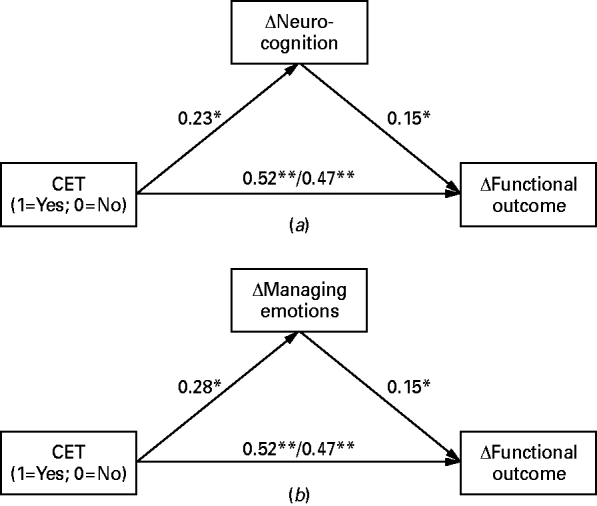
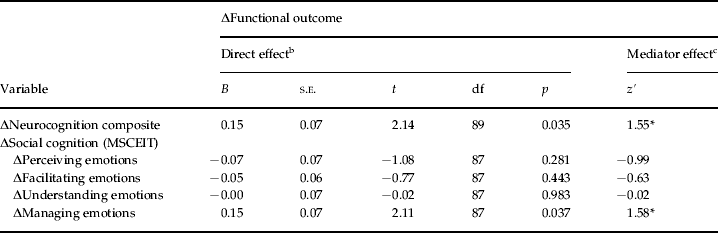
Neurocognitive and social-cognitive correlates and mediators of functional improvement among early-course patients participating in a 2-year trial of CET are presented in Table 2. Neurocognitive composite improvement was significantly related to improvements in functional outcome, with patients who experienced larger neurocognitive gains during the course of the trial also experiencing a greater functional response. With regard to social cognition, of the four branches of the MSCEIT that were examined, only the emotion management branch demonstrated a significant longitudinal relationship with functional change. Fig. 1 presents the results of path models examining the mediating effect of overall neurocognitive and emotion management improvement on functional outcome. As shown in Fig. 1 a, CET exerted a significant effect on the neurocognitive composite, which in turn was directly related to improved function. This cascade of neurocognitive change proved to significantly mediate the robust direct effects of CET on functional outcome (z'=1.55, n=58, p=0.040). A similar pattern of results was observed for the MSCEIT emotion management branch, where CET had its largest effects, which again was related to functional improvement and significantly mediated the effects of CET on functioning (z′=1.58, n=58, p=0.037, see Fig. 1 b). When examining the relative impact of neurocognitive and social-cognitive improvement on functional outcome concurrently, improved emotion management continued to demonstrate a significant direct effect on functional improvement [B=0.14, degrees of freedom (df)=86, p=0.045], whereas the effect of neurocognitive change on functioning was only marginal, but of similar magnitude (B=0.14, df=86, p=0.055). Interestingly, overall changes inneurocognition were not associated with improvements in the MSCEIT managing emotions subscale (B=0.07, df=87, p=0.459), although improved neurocognition was significantly associated with improvements in the MSCEIT understanding emotions subscale (B=0.22, df=87, p=0.009). Together, these findings indicate largely independent improvements in both neurocognition and social cognition, particularly emotion management, as mechanisms of functional change during CET in early-course schizophrenia.
Neurocognitive (a) and social-cognitive (b) mediators of the effects of cognitive enhancement therapy (CET) on functional outcome in early-course schizophrenia (n=58). Regression weights on the right of the slash (/) represent direct effects of CET on functional outcome after adjusting for the mediator (* p<0.05, ** p<0.01).

Associations between changes in neurocognition and social cognition and improved functional outcome (n=58)Footnote a

s.e., Standard error; df, degrees of freedom; MSCEIT, Mayer–Salovey–Caruso Emotional Intelligence Test.
a Results are based on mixed-effects growth models with a single cognition variable as the primary covariate, adjusting for age, gender, intelligence quotient, illness duration, medication dose, and treatment assignment.
b Direct effects represent direct relationships between changes in cognition and changes in functional outcome.
c Mediator effects represent the intervening effect of changes in cognition on cognitive enhancement therapy effects on functional outcome.
* p<0.05.
Mediating effects of improvement in individual neurocognitive tasks on functional change
Having found evidence for improvements in overall neurocognitive ability as a significant mediator of CET effects on functioning at the composite level, we proceeded to conduct a series of exploratory analyses to examine the degree to which individual neurocognitive tests contributed to this effect. Results revealed that improved delayed recall on the Wechsler Memory Scale (B=0.13, df=82, p=0.029) and long-term free recall on the California Verbal Learning Test (B=0.12, df=87, p=0.036) were significantly related to greater functional improvement, and reduced time to complete Trails B (B=−0.16, df=87, p=0.010) and perseverative (B=−0.12, df=88, p=0.017) and non-perseverative (B=−0.10, df=87, p=0.033) errors on the Wisconsin Card Sorting Test were also associated with greater functional gains. Despite several direct relationships between changes in verbal memory, executive function domains, and improved functional outcome, decreases in Trails B time to completion proved to be the only significant neurocognitive mediator of CET effects on functioning (z'=1.62, n=58, p=0.036). Such results suggest the importance of verbal memory and executive functioning improvement to functional outcome in early-course schizophrenia, and point to improved executive performance as a key neurocognitive mediator of CET effects on functioning.
Discussion
Cognition has emerged as a key target of schizophrenia treatment, and a variety of psychosocial cognitive rehabilitation programs have been developed and shown to be effective at improving both cognition and functional outcome in the disorder (McGurk et al. Reference McGurk, Twamley, Sitzer, McHugo and Mueser2007). Unfortunately, the mechanisms of functional improvement that accrue from these interventions remain largely unknown, and thus the degree to which targeting cognition results in meaningful gains in functioning is not clear. We conducted a first investigation of the neurocognitive and social-cognitive mechanisms of functional improvement during a 2-year trial of CET for patients in the early course of schizophrenia. Overall, improvements in neurocognitive composite scores were significantly associated with improved functioning, which partially mediated the effect of CET on functional outcome. Of the four branches of the MSCEIT that were examined, only the MATRICS-recommended emotion management branch proved to be a significant mediator of CET effects on functioning. Exploratory analyses of individual neurocognitive tests also revealed significant relationships between verbal memory, executive function, and functional improvement, with decreased Trails B time to completion exerting a significant mediating effect on functioning. Such findings signify both neurocognitive and social-cognitive improvement, particularly in the domains of executive performance and emotion management, as mechanisms of functional improvement during cognitive rehabilitation in early schizophrenia.
The results of this investigation support previous cross-sectional and naturalistic longitudinal studies documenting the importance of both neurocognition and social cognition to functional outcome in schizophrenia (Sergi et al. Reference Sergi, Rassovsky, Nuechterlein and Green2006; Brekke et al. Reference Brekke, Hoe, Long and Green2007, Reference Brekke, Hoe and Green2009). Consistent with previous studies (Green et al. Reference Green, Kern, Braff and Mintz2000), verbal memory improvements were the most reliable neurocognitive predictors of functional change in this research, and may represent an important neurocognitive precursor for benefiting most from treatment strategies used in CET, such as active thinking, giving feedback, responding to coaching, and abstracting the social gist. Improvements in social cognition also proved to be important contributors to functional outcome and mediated CET effects on functioning. Unfortunately, despite growing evidence on the importance of social cognition to functional outcome (Couture et al. Reference Couture, Penn and Roberts2006), the majority of cognitive rehabilitation approaches do not address social-cognitive impairments.
Although the results of this research begin to provide some evidence of a mediational relationship between changes in neurocognition, social cognition, and functional outcome within the context of a clinical trial, it is important to remember that not all mediators are causal mechanisms (Kraemer et al. Reference Kraemer, Wilson, Fairburn and Agras2002). In addition, correlational analyses of change cannot disambiguate the direction of mediational relationships, and it is possible that a bidirectional relationship exists between improved cognition and functioning. The clear identification of causality and directionality with regard to a mediator requires a priori studies designed to manipulate the presence or absence of a putative mechanism. This research lays the foundation for such studies, by identifying a need for controlled trials that examine the functional effects of treating neurocognition and social cognition either alone or jointly. Further, both social-cognitive and neurocognitive improvements were only partial mediators of functional improvement, which indicates the presence of other active mechanisms of functional change. These may include such factors as increased socialization or decreased anxiety and negative symptoms.
In addition, although a modest number of inference tests were conducted when examining associations between cognitive and functional change, corrections for multiple inference testing were not conducted and these results would not have survived type I error corrections. As such, care will need to be taken when interpreting these findings until confirmation from future studies. Finally, it is also important to note that the measurement of social cognition in this study was restricted to the MSCEIT, and that future studies will need to expand to broader measures of social cognition. It should be noted, however, that these findings do support the recommendations of the MATRICS committee to use the emotion management branch of the instrument, which we have previously observed to be the most sensitive to social-cognitive treatment effects (Eack et al. Reference Eack, Hogarty, Greenwald, Hogarty and Keshavan2007).
In summary, this first study of the effects of improved neurocognition and social cognition on functional outcome during a randomized trial of cognitive rehabilitation for early schizophrenia found that improvements in neurocognitive and social-cognitive domains both served as significant mediators of functional improvement. These results suggest that functional recovery from the illness might best be promoted through the early application of cognitive rehabilitation programs that target both social and non-social cognition.
Acknowledgements
This work was supported by grant no. KL2 RR024154 from the National Center for Research Resources (NCRR), a component of the National Institutes of Health (NIH) and NIH Roadmap for Medical Research, and its contents are solely the responsibility of the authors and do not necessarily represent the official view of NCRR or NIH. Information on NCRR is available at http://www.ncrr.nih.gov/. Information on Re-engineering the Clinical Research Enterprise can be obtained from http://nihroadmap.nih.gov/clinicalresearch/overview-translational.asp. In addition, this work was supported by NIH grants MH-79537 (S.M.E.) and MH-60902 (M.S.K.). We thank the late Gerard E. Hogarty for his leadership and direction as co-principal investigator of this study, and Susan Cooley, Anne Louise DiBarry, Konasale Prasad, Haranath Parepally, Debra Montrose, Diana Dworakowski, Mary Carter and Sara Fleet for their help in various aspects of the study.
Declaration of Interest
None.