In a December 2007 press release, New Amsterdam Records proclaimed a bold mission: “To provide a haven for the young New York composers whose music slips through the cracks between genres.”Footnote 1 An upstart record label newly launched by three youthful composers, New Amsterdam proposed to represent “music without walls, from a scene without a name.”Footnote 2 But among the journalists and critics who received this notice, careful readers might have detected a puzzling inconsistency. The release announced the creation of an accompanying website in order to “foster a sense of connection among musicians and fans in this ‘indie classical’ scene.”Footnote 3 Within a single text, the nascent record label asserted itself as part of a “scene without a name” and then, paradoxically, named this scene. Underlying this contradiction was a question whose effects would be strongly felt for the next decade within this purportedly nameless scene: what exactly is—or was—indie classical?
For close observers of recent American new music, the term “indie classical” carries a set of associations: New York–based composers such as New Amsterdam founder Judd Greenstein and Nico Muhly, music strongly influenced by minimalism and rock, ensembles including Eighth Blackbird and Roomful of Teeth, performances in club venues resembling Manhattan's (Le) Poisson Rouge, and up-and-coming record labels like New Amsterdam and Bedroom Community. As music critic and consultant Greg Sandow said in an August 2016 interview with the International New York Times, “Indie classical is a larger phenomenon—it's ways of doing classical music that are not the old ways. . . . Certainly and deliberately it has overtones with indie rock that are homemade, new and out on the edge. It is the response of the younger classical music world.”Footnote 4
But in fact, in the decade before Sandow was interviewed, members of the younger classical music world vociferously disagreed as to what the phenomenon of indie classical represented. Although New Amsterdam first brought “indie classical” into wide circulation in 2007—and subsequently became one of the most prominent new-music record labels in the United States—by 2013 the organization had distanced itself from the phrase; in the intervening years, indie classical had been strongly resisted by participants in the very community that the record label initially sought to describe. And, even as indie classical has continued to be utilized by musicians and critics to elucidate recent trends, it carries its history of resistance alongside. The term has remained unsettled, a source of debate that can be reignited each time it appears in print.
Rather than consider indie classical as a matter of fact—an established micro-genre within the world of contemporary concert music—this article treats it as a matter of concern: the subject of a heated controversy within an emergent new-music scene. I examine the heterogeneous group of composers, performers, publicists, bloggers, journalists, and critics who created the term indie classical, disseminated it online and in mainstream publications, fought vehemently (and whimsically) over its meaning, and ultimately facilitated its abandonment by the music scene it was originally meant to describe. I argue that, rather than being defined as a repertory of works informed by a particular aesthetic, or as a method of music distribution in opposition to the classical music recording industry—its two most commonplace definitions—indie classical is instead best understood as a controversy.
In analyzing indie classical as a disagreement and scrutinizing the frameworks through which it was disputed, this article reveals how a wide swath of actors constructs the aesthetic discourse and public sphere of contemporary music in the United States today.Footnote 5 Both the rise and fall of indie classical were predicated on the pathways through which the phrase traveled and the authority of those who employed it. New Amsterdam's publicity strategy, the particular nature of its scene, and its lively Internet presence at first guaranteed the success of the term but consequently led to its decline. The story of indie classical's semantic drift demonstrates the power of institutions within a contested public online. And, as such, it is a familiar one that resonates historically with Monteverdi's use of “seconda pratica,” Liszt's deployment of “Programme-Music,” and numerous other instances in which composers have invented pithy slogans to distinguish themselves in the musical marketplace.Footnote 6
I begin by outlining the background of the group of musicians who would come to define indie classical and their founding of New Amsterdam Records. I uncover the origins of the term indie classical itself, track how it was disseminated via New Amsterdam's publicity apparatus into the new-music blogging community and mainstream press, and examine pushback against the phrase among musicians. I then focus on the peak usage of the term circa 2012, and follow its rapid decline after encountering strong resistance from composers within the scene. Drawing on fifty-one interviews, unpublished press releases, the complete digital archives of New Amsterdam Records—not previously studied by any scholar—and reception materials including both traditional publications and new online sources, I recreate the rise and fall of indie classical as it transpired over the course of nearly a decade.Footnote 7 I also trace the effects of my own role in adjudicating some of these debates online, addressing tensions that may emerge when scholars participate in public dialogues about their research. The indie classical debates nuance mainstream characterizations of this generation of musicians in the United States today; a January 2016 New York Times article, for example, described the “fuzzy warmth of the current all-embracing new-music scene,” one that has “given up on labels and in which different styles coexist.”Footnote 8 In a world supposedly devoid of labels, indie classical unveils the tensions at the heart of naming a community.
Origins
The cohort of musicians that came to describe itself as indie classical first gathered together in 2002, at the inaugural Bang on a Can summer festival for contemporary music in the Berkshires.Footnote 9 Located at the Massachusetts Museum of Contemporary Art, the Bang on a Can institute houses composers and performers for several weeks each summer, where they work with David Lang, Michael Gordon, and Julia Wolfe, the founders of the collective.Footnote 10 Students at the first festival included composers Greenstein, Missy Mazzoli, Matt McBane, Tristan Perich, and Mark Dancigers, all of whom participated in subsequent New Amsterdam projects. In a 2008 blog post, Greenstein wrote:
The first year's Festival itself really laid the foundation for so many of the current elements of my musical life, both in terms of how I approached music thereafter, and in the people that I met and befriended. . . . I think I can speak for most of the people who attended, it was a ridiculously important, perhaps seminal event in our lives.Footnote 11
The festival brought together musicians who shared like-minded aesthetic concerns, and the organizers encouraged them to collaborate, form ensembles, and build their own institutions.
Following the Bang on a Can institute, Greenstein subsequently attended the master's program in composition at Yale. “Michael [Gordon] said, ‘You should go to Yale, study with Martin Bresnick: he'll help you find your voice,” Greenstein recalled in a 2015 interview. “I remember him specifically saying those words.” But Greenstein instead felt dissatisfied with what he perceived to be a conservative atmosphere; he said his Yale experiences felt like “a step backwards in time,” a “space where things were pulled into the classical tradition.”Footnote 12 At Yale, Greenstein and fellow master's student composer Patrick Burke co-founded NOW Ensemble, a chamber quintet with an instrumentation similar to Bang on a Can's All-Stars: flute, clarinet, bass, piano, and electric guitar (played by Dancigers).Footnote 13 Burke cited Steve Reich and Musicians and the Philip Glass Ensemble as models, making explicit that NOW's institutional lineage belonged less to academia than to minimalism.
In November 2005, Greenstein and composers Mazzoli and David T. Little organized Free Speech Zone, a scrappy tour that included concerts at Manhattan's Knitting Factory, Brooklyn's Galapagos, and venues in New Haven and Boston. A response to the reelection of President George W. Bush, the tour featured NOW Ensemble and Little's group, Newspeak, in performances of politically themed music by Greenstein, Little, and Mazzoli. The tour was captured in director Stephen S. Taylor's documentary The End of New Music (2007), in which the musicians explained their frustrations with the new-music world, their desire to communicate to an audience outside its purportedly limited academic purview, and their belief that the traditional concert hall was a stultifying setting: a budding indie classical ethos. Mazzoli described her dismay that she wasn't “taught practical things about what it means to really be a composer” at school, and questioned what paths were available to composers outside of teaching in academia.Footnote 14 Little discussed his longstanding love of 1980s power ballads and that, until recently, he had felt constrained by the new-music world: “I wasn't not being true to myself, but wasn't letting everything out: I was filtering me, because of what was ‘appropriate’ in certain settings.”Footnote 15
By the time that Taylor's documentary was first screened in New York—and covered by the New York Times—Greenstein had already launched New Amsterdam Records.Footnote 16 NOW Ensemble sought to record its first album, but lacked an outlet for producing, distributing, and marketing a record. Given his close relationship to Bang on a Can, Greenstein had reached out to Cantaloupe, its in-house label, but they were not interested. He realized that:
No one will release our music, therefore there is a gap in the music world. And if it applies to us, it probably applies to other people. And it turned out that it applied to many people . . . it was born of the tangible needs of the people who were involved in its creation.Footnote 17
As a subsidiary of NOW Ensemble's nonprofit structure, New Amsterdam was operational as early as 15 December 2006, when the label's website first appeared. In February 2007, New Amsterdam released its first album, cellist Jody Redhage's All Summer in a Day.Footnote 18
Greenstein had crafted a specific ethos for New Amsterdam, one deeply tied to the perspective that he and his colleagues had developed on the Free Speech Zone tour, and which he had also worked out publicly on his personal blog.Footnote 19 A “music without walls” rhetoric was present in the earliest New Amsterdam materials; in a note accompanying Redhage's album, Greenstein wrote:
It's hard to say what kind of music this is. Is it what we might call “new music,” that nebulous term that applies to music that's written down but doesn't sound like old classical music? Is it an offshoot of the so-called “freak folk” scene, where a classically trained harpist like Joanna Newsom can become a rock star? Is it something new and different and impossible to pin down?Footnote 20
Subsequent early releases included albums by composer Andrea Mazzariello, jazz composer and saxophonist Sam Sadigursky, and NOW Ensemble.Footnote 21 Although New Amsterdam had not yet employed a publicist, major voices in the press including New York Times critic Steve Smith and New Yorker critic Alex Ross were soon aware of the endeavor. In a March 2007 post on his blog The Rest is Noise, Ross noted the arrival of the label and connected it to a new scene and generation that embodied “pragmatism—music beyond ideology.”Footnote 22
Not long after Greenstein released the label's first albums, he was joined in his endeavor by composers Sarah Kirkland Snider and William Brittelle. Although Snider played piano and cello in her youth and dabbled in composition, she majored in psychology and sociology in college at Wesleyan; after graduating in 1995, she moved to New York, began pursuing composition seriously, and took classes at Juilliard, Mannes, and New York University. She subsequently attended the master's program at Yale alongside Greenstein, where they considered each other allies against an academic culture that they felt to be restrictive.Footnote 23 Brittelle approached Greenstein at a NOW Ensemble concert in 2007; after studying composition in undergraduate at Vanderbilt, Brittelle had moved to New York to attend CUNY's Graduate Center and work with composer David del Tredici. But he was more attracted to the rock world in the city and dropped out of school to play guitar and sing in bands. After several years working as a rock musician, he blew out his voice, and “decided it was time to try to reconcile all my different musical interests into one sound.”Footnote 24 The trio met for a long evening of conversation over Thai food in New York City in March 2007, where they suggested ideas for the label and decided to combine their efforts as artistic directors. It was then, Greenstein said, that “New Amsterdam as a true entity was born.”Footnote 25
“I'm realizing that hierarchy and power are two things that really stifle creativity and don't belong in the NAR [New Amsterdam Records] world,” Brittelle wrote in an April 2007 “Brainstorm” of concepts for re-launching the label as a partnership. “I really want to remain on a peer to peer level with our artists, I want to have a ‘we're all in this together’ feeling.”Footnote 26 The founders had bold plans for the structure of the label and its place in the new-music community, ones that deliberately evoked historical DIY precedents from the world of punk and new wave:
a new record label model, particular to the composer-in-the-21st century situation. let's be the most artist friendly record label in history. a label that focuses on the clear-cut goal of allowing our artists the freedom to create and develop their ideas (and eventually make a living from doing so), a label that pays our artists as much as possible, and helps fund their projects. kind of an official and formally organized version of the CBGB punk scene (or any other collectively creative scene of the past 200 years).Footnote 27
The “Brainstorm” also suggested establishing a robust website to act as the scene's “home base,” with a storefront, blog (“talking about what Alex [Ross] and Steve Smith are talking about”), podcasts, and a community calendar. For its artists, New Amsterdam would provide a web platform, funding support for CD production and distribution, support for tours, and access to in-house staff including a publicist, designer, and mastering engineer. The label would put together showcase concerts in New York and build them into tours once they established a strong national presence.
For publicity, New Amsterdam hired Steven Swartz, an established intermediary in the new-music world. Swartz had studied composition with Morton Feldman at the University of Buffalo and worked as a publicist for the New Music Distribution Service label in the 1980s, subsequently spending sixteen years as director of publicity at the publisher Boosey & Hawkes. After leaving Boosey in 2006, he opened dotdotdotmusic, a boutique firm specializing in publicity for new-music projects; New Amsterdam was his first client.Footnote 28 In a fall 2007 article for MUSO Magazine, Swartz had identified the Free Speech Zone tour composers as a promising generation that epitomized the idea that the “style wars are over.”Footnote 29 He said that, in comparison to his early career in graduate school—in which “we were all fighting proxy wars for our teachers: you were uptown, you were downtown, you were a neo-Romantic”—Greenstein's cohort appeared to lack aesthetic baggage.Footnote 30 Having cultivated connections with the classical world at Boosey, Swartz was a suitable member of the older guard to reintroduce New Amsterdam to the press.
The New Amsterdam directors crafted a new mission statement, which Swartz drew on for a December 2007 press release that announced the “official launch” of the label in January 2008. This re-launch, with the label now under the purview of its three directors, included the reissuing of NOW Ensemble's debut album and a new record from the band itsnotyouitsme; the redesigned and expanded website; and a concert at the downtown venue Joe's Pub. The label received significant early press coverage, including an interview with Greenstein and NOW clarinetist Sara Budde on John Schaefer's WNYC program Soundcheck. Swartz attributed the success of the sold-out Joe's Pub concert to the press campaign, describing Soundcheck as “the perfect target for this listenership constituency.”Footnote 31
New Amsterdam continued to obtain notable press coverage in 2008, including a central role in a feature on the NPR program “All Things Considered” and positive write-ups in New York Times articles by Smith and Allan Kozinn.Footnote 32 Perhaps the most significant result of this attention was that it attracted Naxos—the largest distributor of independent classical record labels in the world—to partner with the organization for international physical and online distribution beginning in October 2009.Footnote 33 And as the label gained prestige, New Amsterdam found itself participating in a controversy around a term that it had introduced into the world of new music.
Definition, Dissemination, and Contestation
For the January 2008 re-launch of New Amsterdam, the three directors prepared a mission statement for the label:
New Amsterdam Records was formed as a haven for the young New York composers and performers whose music slips through the cracks between genres. There's an exciting scene that's developed in our city over the past few years, as a set of strong-minded young musicians have taken their art in highly personal directions, speaking not just to the traditions that have spawned them but also to the varied musical culture in which they all live. They make music without filters, bringing the breadth of their listening experience and the love they have for many different kinds of music into their own playing and writing and producing. This is music without walls, but also without an agenda, and without an organizing principle. The records we sell will paint a certain picture of that scene without a name, without trying to give it one. We hope that New Amsterdam develops as quickly and as broadly as the scene itself, capturing the best that people in it have to offer along the way, and touching the outer edges where musics meet.Footnote 34
Though it initially intended not to provide its scene with a name, New Amsterdam offered one not long afterwards. In a December 2007 press release announcing the label's re-launch, Swartz drew on the mission statement but also noted:
To foster a sense of connection among musicians and fans in this “indie classical” scene, New Amsterdam is set to launch a new version of its website.Footnote 35
The term indie classical used to appear occasionally in Billboard magazine, dating at least as far back as 1950, to refer to small-scale classical music record labels.Footnote 36 But its more recent definition—and its centrality in the aesthetic discourse that emerged within New Amsterdam's scene of composers, performers, and institutions—can be traced to April 2007. Both Greenstein and Matt McBane have taken hesitant credit for inventing the term: each is confident that he used it first, though neither is particularly enthusiastic to claim the title of its originator.Footnote 37 (As of 2016, neither continued to use the term in his own publicity).
McBane had befriended Brittelle at the Aspen Summer Music Festival in 2000, and became close with Greenstein while attending the first Bang on a Can Summer Festival in 2002. In 2006, he moved to New York and formed a group to perform his music. In an April 2007 press release for this new-music ensemble—which he emailed directly to Alex Ross—McBane wrote:
The Abstraction is a five-piece indie classical band . . . part of a growing scene in Brooklyn and lower Manhattan of musicians finding spaces between the genre cracks and enthusiastic audiences to meet them there. As such, it recently joined the newly formed New Amsterdam Records label that is creating a home for this scene.Footnote 38
McBane said that he did not at first have an entirely developed sense of what he meant by indie classical. He wanted a quick designator for describing the kind of music he made to a non-specialist audience as well as the press:
I had been frustrated with the lack of a decent genre name for the music Build [McBane's ensemble The Abstraction, later renamed] and like-minded musicians were making. The existing options were “contemporary classical,” which lumped us in with music we had nothing in common with, and “new music,” which was impossibly vague. So I wanted to find a shorthand description of the kind of music we were making and how we were making it. In indie rock and indie film (although obviously those terms have long been coopted and beaten to death), the “indie” implies both a more artistic and hipper approach than their non-hyphenated brethren, and a social and economic model working outside of the mainstream organizations. So I came up with “indie classical” as a name for our genre for promotion and booking as we started out.Footnote 39
That same month, Greenstein wrote a blog post lamenting the closure of the music venue Tonic in downtown New York: “These are the spaces that are now the backbone for the developing indie classical community. . . . If they all go, I'm not sure what will rise to fill their void.”Footnote 40 Greenstein has written extensively over the years about his specific definition of indie classical. In a representative 2010 comment, he described it as:
an ethos, a spirit of doing-it-yourself and controlling the production chain of our artistic output, in response to the generally hierarchical and highly limited/limiting world of classical/contemporary music in which our art has historically been presented.Footnote 41
Although Greenstein did not desire indie classical to represent a specific “sound”—he believed the music of New Amsterdam was too diverse to be summarized by a term—he did not explicitly avoid the aesthetic implications of the phrase.Footnote 42 Primarily, the composer utilized indie classical to stand for a DIY institutional spirit, similarly to how “indie” had augmented “rock” in the 1980s to indicate a particular music-industry configuration.Footnote 43
The re-launch of New Amsterdam provided the structure for indie classical's dissemination. McBane's press releases and Greenstein's blog posts might have helped the term gain circulation among a small audience of readers and critics, but the weight of a new institution with a well-connected professional publicist lent it significant cachet. Swartz's December 2007 press release was part of a broader media blitz for New Amsterdam, with a local and national focus. He first planned to send information to New York media outlets including daily newspapers, weekly magazines, and radio stations; and he would then focus on national publications “including major-market dailies, music magazines (classical and crossover), NPR, blogs, etc.”Footnote 44 Among the objectives of that campaign was “Branding: launch label, define its identity in the marketplace.”Footnote 45 Swartz recalled a series of emails with the New Amsterdam founders in which they discussed appropriate terms to describe the label. He said that he advocated for indie classical specifically: “I thought that ‘alt-classical’ was very ’90s, and that ‘indie’ didn't only refer to an aesthetic sensibility but to a structural one as well—that this is independent, and that was an important part of it: people making careers outside of the academic structure, the usual ladder.”Footnote 46
Indie classical entered the media almost immediately. When Greenstein and Budde spoke with radio host John Schaefer on Soundcheck in January 2008, the broadcast began with the host questioning Greenstein about the term mentioned in the press release:
Schaefer: Let me ask you about this debut album of yours on the New Amsterdam record label, sort of being billed as “indie classical.” Judd, what does that mean?
Greenstein: Well, I like indie classical because, like everybody else, I listen to music that's mostly indie in whatever genre it's in, and I sort of think of indie classical as having nice connections both vertically and horizontally: horizontally, I mean to other indie musics out there, and then vertically also to the classical tradition. It's a nice thing that people can relate to, if they're fans of indie music or classical music.
Schaefer: The central tenets of indie music—whether we're talking indie rock, indie classical, whatever, is a kind of DIY, do it yourself approach? Would that be fair to say?
Greenstein: Sure, I think so—it means an open field. You can really do what you want to do, and then trust that there's going to be an audience for it, as long as you're doing it in the right way.Footnote 47
Indie classical became the first question raised of New Amsterdam by an influential and longstanding member of the new-music press; the term had done remarkably successful and quick work as a brand.Footnote 48 Indeed, Schaefer became a main proponent of the term, grouping several of his curated radio programs under the title indie classical. As he said,
As marketing terms go, this one annoys me a lot less than most. It says something—not about the music—but about the people making it, which I think is a fair thing for that name to do . . . it suggests a kind of working outside conventional, organized mainstream musical forms, whether that be record labels, concert halls, compositional techniques. It suggests this kind of enterprising, freewheeling, oblivious-to-boundaries approach to classical music, which, if someone had coined that term back in the ’80s you might have applied to Bang on a Can; and if someone had coined it back in the early ’70s, you might have applied it to the minimalists.Footnote 49
And indie classical continued to spread through the public sphere of new music. Between 2008 and 2010, it was taken up by several major publications, including Time Out New York, NPR, and the New York Times, as a shorthand to refer to musicians who participated in New Amsterdam projects or explicitly blurred boundaries between classical and popular music. As New Amsterdam expanded, it continued to brand albums and concerts as indie classical: a poster described its May 2009 series Undiscovered Islands as “a full month of new indie classical world premieres and record releases”; an October 2009 press release from dotdotdotmusic advertised “fall shows spotlight label artists and co-conspirators from NYC's ‘indie classical scene’”; and an August 2011 release referred to “New Amsterdam Records, the hub for the most inventive and prophetic in indie classical music.”Footnote 50
But indie classical soon became a source of contention online. Among the many animated discussions that emerged within the classical and new-music online community was a focus on naming.Footnote 51 In a 2004 New Yorker article, Ross proclaimed “I hate ‘classical music’: not the thing, but the name”; he feared that the genre designator alienated audiences, constructed a “cult of mediocre elitism,” and marginalized living composers.Footnote 52 In a January 2005 newsletter, Bang on a Can had asked for suggestions to “help us come up with a name for the kind of music that Bang on a Can plays, since we're not so fond of the ones it's been given so far,” and compiled eighty-three of the 221 recommendations on its website, from “Adventure Classical” to “Church Bingo Chance Music” to “Where-Are-The-Dancers-With-The-Garbage-Can-Lids Music.”Footnote 53 For a June 2006 post on his blog The Rest is Noise, Ross jokingly suggested he had decided to rename classical music “Awesome Music”; echoing Ross, in September 2007, New Amsterdam mounted an artist showcase that it labeled “Awesome Music Live.”Footnote 54
These jokes notwithstanding, other more serious names have been proposed for the scene in which New Amsterdam participated.Footnote 55 But none reached the widespread usage of indie classical. The closest terminological relative to indie classical was alternative, or “alt-classical,” popularized by Greg Sandow on his ArtsJournal blog.Footnote 56 He had employed the term regularly since 1997 to refer to contemporary music that appealed to audiences who might not ordinarily attend orchestral or opera performances, and first described New Amsterdam as “alternative classical” in a 2009 column in the Wall Street Journal.Footnote 57 Washington Post critic Anne Midgette similarly utilized alt-classical in an October 2009 article to identify the trend of new ensembles that played in club venues, and were also increasingly programmed by mainstream presenters.Footnote 58
Discussions over alt-classical frequently drifted into addressing indie classical.Footnote 59 In 2010, a blog post on NewMusicBox described alt-classical as contemporary music that sounded like pop.Footnote 60 Commenters weighed in on both the validity of the term and the validity of its definition. Composer Christopher Cerrone described his “desire to shoot a fiery arrow in the face of the next person who uses the obscenely overhyped phrases ‘alt-classical’ or ‘indie classical.’” Greenstein himself clarified that “‘indie classical’ is specifically not about the sound of the music that I am, or anyone else is, making”; instead, he and New Amsterdam used it to “describe the approach to disseminating that music, and framing it for potential audiences.”Footnote 61
As a result of such disagreements, in several 2011 chat forums hosted by writer and critic Olivia Giovetti, the online new-music radio station Q2 Music asked participants to reflect on appropriate terms for describing the scene. In one, David T. Little—who, since the Free Speech Zone tour, had released an album on New Amsterdam in 2010 with Newspeak—wrote: “I like ‘indie classical,’ as long as it describes how we do what we do, and not what it sounds like.”Footnote 62 For these figures, indie classical could summarize activity, but it should not summarize compositional output or musical style; Greenstein and Little desired a name that would not stick to the sound of their music in the way that minimalism had to that of composers in the 1970s, favoring a discourse that would not overtly label their individual aesthetics.
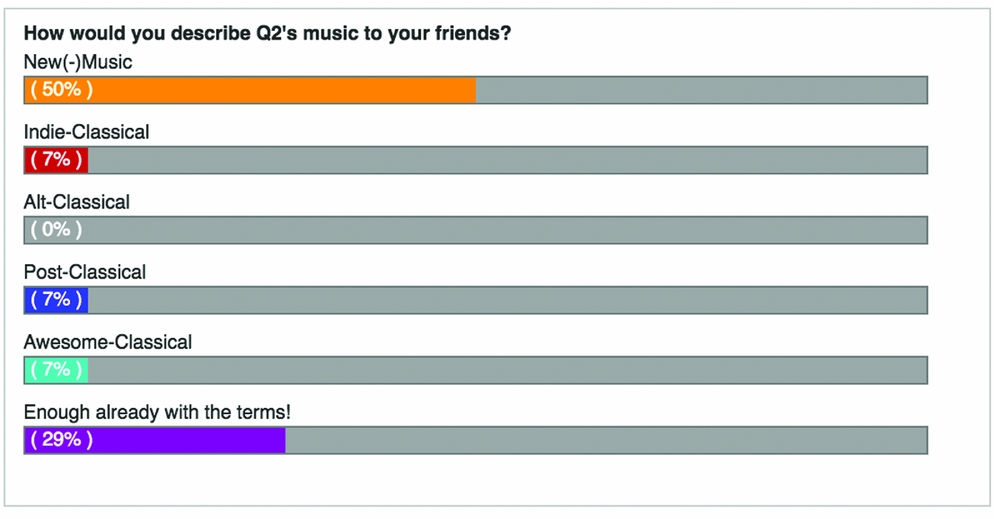
In another 2011 Q2 chat forum, listeners were polled as to their preferred term for how to “describe Q2’s music to your friends” (see Figure 1).Footnote 63 Although the poll did not reveal how many actual people voted in each category, it does register the presence of a debate: a preference for “new music” as an umbrella designator; some support for “indie classical”; a lack of support for “alt-classical”; the use of “post-classical”; “Awesome Classical,” perhaps a continuation of Ross's “Awesome Music”; and the desire for closure and an end to the process of naming (“Enough already with the terms!”).Footnote 64
Screenshot taken 6 June 2016 from chat forum, WQXR, “Hear Color, See Sound,” The New Canon, Q2 Music, 16 May 2011, http://www.wqxr.org/story/133750-hear-color-see-sound/.

As a graduate student and music critic, I had my own doubts about indie classical—until my dissertation research began in 2014, I was not aware that the term originated with Greenstein and New Amsterdam—and occasionally played the role of firebrand on Twitter, the popular social-media platform launched in July 2006. Twitter had become an online home for the new-music world by spring 2010; I started an account in June 2010, @seatedovation, first to keep up with tweets by composers including Muhly and Greenstein, and then to voice my own thoughts.Footnote 65 In December 2011, I tweeted “Just heard the words ‘indie classical’ and ‘alt classical’ come out of my speakers. Vomited a little.”Footnote 66 First to reply was Steven Swartz, who wrote “Open to your non-vomitose suggestions for another term. . .”Footnote 67 The conversation on Twitter subsequently alternated between jest and seriousness, with composers, performers, publicists, music critics, arts administrators, and even the account of New Amsterdam Records itself weighing in.Footnote 68
In the midst of graduate school coursework—and perhaps overly concerned with issues of periodization and genre—I wrote that: “I'm okay with naming things, with 2 conditions: 1) specificity of meaning, 2) no implicit/covert values.”Footnote 69 In hindsight, the naiveté of my perspective is quite clear; is there any musical name that is both specific in meaning and absent covert values? As an alternative to indie classical, Ross suggested “swingin’ on the flippity-flop”; New Amsterdam subsequently tweeted “I guess we should plant our flag. ‘New Amsterdam, the first swingin’ on the flippity-flop record label, thusly branded in 2011.’”Footnote 70 On a more serious note, Greenstein wrote that “It's not like we have any control over whether people use terms to describe music. The choice is between terms we create or terms others do” and “We can't have these conversations divorced from the real world, in which people make up all kinds of nonsense when left to their own devices.”Footnote 71 Greenstein and New Amsterdam, of course, had significant control over “whether people use terms:” indie classical is the one that the label chose and introduced to the world. Snider clarified that indie classical was a term that New Amsterdam used from its origins to suggest “small, independent, DIY—which is an important distinction from the ‘alt’ barfness.’”Footnote 72
The conversation died away less than three hours after my initial tweet. Like a typical Twitter discussion, it was at once ephemeral and permanent: unlike other social media platforms like Facebook, Twitter is a searchable, public archive, and anyone hoping to re-litigate the controversies of indie classical could find these posts. And this moment, if brief, represented a quintessential example of how the aesthetic discourse for new music was constructed in the early twenty-first century: an online platform that brought together such diverse actors as musicians, critics, publicists, record labels, and even musicologists to define and redefine indie classical in real-time debate. The “public square” aspect of Twitter––anyone who “followed” these accounts could have viewed the conversation––meant that this discussion played out among stakeholders and was also visible to others interested in the worlds of classical and contemporary classical music. Those who read the tweets would learn both who was invested in the definition of indie classical––not only the New Amsterdam composers but also their spokespersons as well as music critics who had advocated for their work––and also the terms of its debate.
Peak and Decline
In February 2012, the “scene without a name” received a particularly prominent naming, one that laid the groundwork for the most significant controversy in the history of indie classical as a term. In “Making Overtures: The Emergence of Indie Classical,” an article published in the popular online music magazine Pitchfork, critic Jayson Greene explicitly played up the connection between indie classical and indie rock:
the new generation is pouring in: eager, collaborative, as invested in indie rock as they are in the nuts-and-bolts arcana of composition. Lately, it's become hard to even tell an indie rock musician and a composer apart.Footnote 73
In his framing, Greene shifts indie classical definitively from a method of distribution informed by the institutional model of indie rock to a vaguely defined style of music informed by the aesthetics of indie rock. The indie classical scene, according to Greene, encompassed ensembles with “stamped-up genre passports” such as yMusic, rock musicians including Radiohead's Jonny Greenwood and My Brightest Diamond's Shara Nova (formerly Shara Worden), independent labels like New Amsterdam and Cantaloupe, composers such as Muhly and Mazzoli, and “a round-the-clock PR department.” Targeting Pitchfork’s rock-centric readership, Greene framed his article around this generation's cross-fertilization: “For anyone trying to sort through genres to assign team jerseys, it's a mess, and often a glorious one.”Footnote 74 Greene said that indie classical functioned as an “effective shorthand for communicating to publications” why they might want to cover new music.Footnote 75
Pitchfork strengthened the grouping of indie classical by broadening it to encompass many artists—including rock musicians such as Sufjan Stevens—granting it a history as a successor to the downtown of the minimalists and Bang on a Can, and consecrating it in a prestigious and popular outlet. Indeed, in September 2016, the top search result on Google for “indie classical” was Greene's article.Footnote 76 The article represented the belated realization of one of New Amsterdam's original goals: in April 2008, Greenstein had written an email to Pitchfork introducing New Amsterdam and explaining that “indie classical is our current choice for sub-sub-genre.”Footnote 77 Pitchfork rarely covered classical or new music, and dotdotdotmusic had been trying to convince the outlet to address the indie classical phenomenon for several years.
This strengthening, however, led to substantial social media disagreement. Although many musicians—including the New Amsterdam directors—posted online in favor of the article, a debate emerged on Twitter. Critic George Grella tweeted that “Pitchfork definitely getting in on the tail-end of this one, ‘indie classical’ is already the new Establishment.”Footnote 78 Composer Christian Carey added that “I find the danger in ‘Indie Classical,’ much as I like it, is that it keeps composers working in other styles out.”Footnote 79
And though it was invented and originally marketed by composers themselves, others attributed the term to critics or publicists; Pitchfork, which did not specialize in classical music, appeared as an outside interloper. Carey called it a “gross misrepresentation, but again seems to be a curation problem, not the artists’ idea at all”; composer Matt Marks, who had blogged about alt-classical in 2010, retorted “What are you talking about?? I woke up this morning and said to myself, ‘Today is a great day to go write some indie classical!’”Footnote 80
But the strongest backlash to indie classical was yet to come. In May 2012, the Australian Sydney Morning Herald published an article by critic Harriet Cunningham about the “indie classical movement.”Footnote 81 Mentioned in the piece was Muhly, who had become the poster child of indie classical for many writers, as an established young American composer with an international reputation who also worked with rock musicians such as Sufjan Stevens and Björk. In response to the article, he tweeted “oh man what am I going to do about this indie classical shit. If another person says it I am gonna wet myself.”Footnote 82 Still unaware of indie classical's origins, I subsequently tweeted “The thing is with indie classical: at least minimalism was coined by a critic/composer.”Footnote 83 In a subsequent blog post addressing the issue on NewMusicBox—titled “Who Cares If You Call It Indie Classical?”—composer Isaac Schankler mused as to why the label was “uniquely distressing,” writing that “A common complaint is that it describes cultural practices—a certain DIY aesthetic and entrepreneurial spirit—rather than musical qualities.”Footnote 84
Following the Twitter discussion, Muhly and publicist Maura Lafferty agreed to each blog about indie classical on their respective websites. Drawing on her professional experience—and what she perceived as the importance of artists creating a perfect “pitch” or brand—Lafferty considered the term appropriate and useful.Footnote 85 In response, Muhly strongly rejected the idea of branding:
I did a show in London that I thought was pretty great, and then online it was all indie classical this and indie classical that. . .Nothing is gained by that description, even if it makes the PR people's jobs easier. It attracts haters and lumps people together in a way that belies how actual communities of musicians function.Footnote 86
In his blog post, Muhly dismissed indie classical on two fronts: he wrote that such buzzword terminology was itself meaninglessly limiting (he advocated, instead, that “musicians should be able to describe the universe in which their music exists”); and indie as a designator was questionable given his own participation in classical music's institutional apparatus (at the time, he was preparing for the Metropolitan Opera premiere of his opera Two Boys, and had already released three albums on the label Decca). Muhly had gained significant press and institutional support from early in his career—when New Amsterdam launched in 2008, he had already received the Two Boys commission—and could afford to willfully misrepresent the role that publicists and journalists played in strengthening the position of his peers. He had experienced indie classical as a pejorative term leveled against his music; he did not need the brand, and could thus forcefully and publicly repudiate it.
Since the Pitchfork and Sydney Morning Herald articles placed the definitional weight of indie classical among critics rather than composers, Muhly could also attack the term without directly attacking his colleagues: he could chastise publicists and journalists rather than Greenstein or New Amsterdam, attributing indie classical to “PR people” rather than the musicians who first negotiated its meaning. And because Muhly may be the most widely publicized American composer of his generation—and participated in many additional interviews in advance of Two Boys at the Met—his blog represented a strong and enduring point of contention, seemingly standing as the definitive take on indie classical from the perspective of artists themselves. In subsequent discussions of Muhly's music, journalists connected him to his dislike of the term, keeping it in use but as a negative qualifier.Footnote 87 Indie classical had become a tarnished phrase, invented by critics and publicists to narrowly and incorrectly define a scene that did not need a name: it stood for controversy, not consensus. As the Guardian headlined a blog post in November 2013, “Just don't call it indie classical.”Footnote 88
Since those 2012 debates, indie classical has faded from prominent usage, although it still remains in circulation.Footnote 89 New Amsterdam ceased publicly using the label in 2013; in November 2014, Greenstein told an interviewer that “‘Indie classical’ was a term we used a lot in the early days of New Amsterdam . . . since people started describing the music in reductive ways, I've been shying away from using that term, instead using ‘post-genre music.’”Footnote 90 As Greenstein said in 2015, “People were just using it to mean the sound, and we didn't want to feed that fire.”Footnote 91
The replacement of indie classical with post-genre suggests the maturing of an organization that no longer needs to actively “define its identity in the marketplace,” as Swartz originally put it. For New Amsterdam, post-genre is a reflexive term that is not meant to suggest a “new” genre, but allow the label to continue to represent, as its website described in January 2016, “highly skilled composers and performers whose work does not adhere to traditional genre boundaries.”Footnote 92 Former intern and current label manager Michael Hammond said that “I think I prefer post-genre to indie classical, but I don't use that when I'm talking to people: I don't say ‘We're a post-genre label,’ I say ‘We represent newly composed music.’”Footnote 93 As Brittelle described post-genre, “It's not another genre, it's ‘Let's just stop having this conversation’ . . . the movement is best served by some kind of term that undermines the notion of genre itself.”Footnote 94 That said, in 2015, Brittelle expressed interest to me in writing a book that would focus on the idea of “post-genre” as an aesthetic current in contemporary culture. And though Snider preferred the term, she also raised qualms about the exclusionary implications of post-genre: “I imagine most composers would bristle at the idea that their music is classifiable by a certain genre. So, to say that some music is ‘post-genre’ implies that other music doesn't have a host of influences informing it, which isn't the intention. Like most shorthands, it's relative.”Footnote 95
The idea of post-genre echoes New Amsterdam's original “music without walls” ethos, but it presents the same conundrum as indie classical: one could imagine post-genre gaining currency as a term, stabilizing a set of sonic associations, and becoming prescriptive, controversial, and weighted with fraught definitional status. Categorizing an attempt to de-categorize is ultimately a fruitless endeavor. The benefit of post-genre for New Amsterdam in 2016 is that the label has already spent nearly a decade defining itself, and no longer needs to brand itself as actively as it did in the era of indie classical. Post-genre instead demonstrates a consistency of values within the institution itself, one in which labeling and anti-labeling have existed in a productive contradiction since its origins, and in which a record label consistently tried, and ultimately failed, to control the specific message that accompanied the music it released into the world.
In my interviews with composers, performers, and administrators affiliated with New Amsterdam, I asked them what they thought of indie classical and similar terms such as alt-classical. Some were deeply skeptical of their efficacy. As violinist, guitarist, and composer Caleb Burhans—half of the duo itsnotyouitsme that had performed at the Joe's Pub concert in 2008—said, “People need to have labels for record stores—oh, wait, record stores don't exist anymore.”Footnote 96 Others thought terms were useful, but were wary of mission creep: Mazzoli said that “I think there's a short jump to be made from those labels and these super-annoying discussions about ‘bridging the pop and the classical.’ I hate talking about music that way.”Footnote 97 Violist Nadia Sirota noted that “At the end of the day, what you want is something recognizable. I find indie classical really frustrating for a number of reasons, but if it catches on, that's great.”Footnote 98 No composer or performer that I spoke to said that he or she would purposefully continue to use the term: McBane acknowledged that he now prefers to refer to Build as an “instrumental band”; Mazzoli was comfortable identifying herself as simply a classical composer, feeling that it was the primary cultural tradition in which she participates.Footnote 99 Music critics John Schaefer and Allan Kozinn, however, were content to continue using the term; they felt that labels were important to the profession of criticism, and that indie classical was a useful and evocative summary of New Amsterdam's world.Footnote 100
The Fall?
Indie classical was created by specific agents for the purpose of branding a scene to a mainstream press and new audiences, a purpose temporarily achieved thanks to the strengths of its sponsors and particular nature of its public sphere. Because it had both the support of insiders who advocated for it, and a means to distribute the term to outsiders through a specific apparatus, from composers to institutions to publicists to critics to the world, it gained discursive strength. Despite Muhly's protestations, indie classical as a descriptor gained quite a bit for its scene; even though composers might resist the idea that the term suggested an aesthetic, its strong resonances with indie rock allowed critics such as Greene to introduce it to new audiences. Because it was originally defined by composers, indie classical could be accepted by other musicians as a valid term, but one whose definition had to be circumscribed to refer to a means of distribution, not a sound. But because it was promoted by publicists and accepted by journalists—with its origins obscured—indie classical could also be dismissed as outsider PR jargon. In the end, the cultural capital that indie classical as a brand helped its community gain—the success in reaching a Pitchfork demographic, the success of Muhly as a spokesperson for his scene, and the way in which the term's controversy overtook its original meanings—ultimately undermined that strength and led to its abandonment.
But if indie classical rose, did it in fact fall? New Amsterdam's rejection of its own term might initially appear to mark the “death of indie classical.” But such a “decline” is one reflected only among the central actors of New Amsterdam and its affiliated scene, and does not necessarily represent the reality of institutions or spokespersons tangentially or not at all related to it, who might not have followed the term's disputes or taken after New Amsterdam's abandonment.
When the University of South Carolina presented the ensemble yMusic in 2014, for example, it labeled the concert “Indy [sic] Classical Innovation.”Footnote 101 The streaming service Spotify maintains a regularly updated, curated “Indie Classical: Composed in 21st Century” playlist that features a work by Greenstein as its opening track.Footnote 102 And journalist Ginanne Brownell Mitic's August 2016 International New York Times article that interviewed Sandow about indie classical described the movement as tied to “classical music clubbing” in London and other major European cities. Mitic reported on “a larger movement called indie classical, which also can incorporate everything from contemporary classical concerts in clubs, with mash-ups including drum beats and electronica, to classical raves at festivals.”Footnote 103 In May 2016, musicians including the Swiss conductor Etienne Abelin and London composer Gabriel Prokofiev founded an “indie classical network” at the Classical: NEXT festival in Rotterdam that produced a festival in 2017, C3–IC, to “push forward the club and electronic subset of the Indie Classical scene in particular.”Footnote 104 Here we see the term drift transnationally into a network of musicians and institutions mostly distinct from the original New Amsterdam community, forming its own associations with a European club culture that may reinvigorate indie classical—absent its US-centered debate—overseas.
Indeed, if we turn from the scene that New Amsterdam sought to define, the term has not faded at all: the record label represents just one single “site” where indie classical can be observed—or in this case, no longer observed. One could similarly study indie classical as a participant in Spotify's culture of curation and data analytics; as a quick designator for hipness in the certain circles of classical music journalism; or as a brand that, after being strongly established by New Amsterdam, became valuable for other new-music institutions outside the United States. These disparate practices testify to the multiplicity of the term, and how a label can continue to flourish even after it is abandoned by those responsible for its original dissemination: the “death” of a genre may in fact mean that its usage has instead simply shifted from an initial group of actors into other contexts and settings.
And, perhaps unsurprisingly, since first publishing my examination of the history of indie classical in my dissertation in July 2016––which I made publicly available, and distributed to my Twitter followers and the musicians I interviewed––the term has seen a minor uptick in usage and, of course, online debate.Footnote 105 In July 2016, composer and singer–songwriter Gabriel Kahane—who had frequently been grouped under the label in the past because of his work in multiple genres––wrote a series of tweets that I will compile here into a single paragraph:Footnote 106
Brief twitter flurry on the occasion of @seatedovation's dissertation. In the 90’s, indie rock was both an alternate economy, but also often evinced an aesthetic less immediately accessible than mainstream pop. indie classical, by contrast, with its strong ties to post-minimalism, seems to be MORE immediately accessible than its establishment foil. My point is simply that from an aesthetic standpoint, “indie” seems to denote conflicting ideals in these two uses. And those aesthetic differences have economic implications vis a vis consumption . . . (lights fuse, leaves room).Footnote 107
Kahane's tweets align with some of the previous debates that had already taken place around the term, but also raise different questions; indeed, it was clear that he had not necessarily engaged with (or read) my dissertation specifically but was instead voicing a personal critique of the music of his peers. Conversations around indie classical often serve as a litmus test for whatever musicians may want to criticize in their scene, whether it be aesthetics or branding. A handful of responses to his tweets resembled the stakes of past arguments over the term; Greenstein tweeted that “plus, contra Gabe, not all ‘indie classical’ sounds the same and some, like Newspeak FE, is similarly confrontational.”Footnote 108
Subsequently, the online classical music magazine VAN interviewed me about my research, and as of November 2017, the resulting article, “What Is Indie Classical?” had become the second-highest search result for the term on Google.Footnote 109 I had anticipated the potential for this kind of online activity while working on my dissertation and, since my 2014 tweets criticizing the term, I had come to realize that my objective as a musicologist was to serve as a historian––rather than adjudicator––of indie classical's meaning. But the response to my dissertation confirmed the fact that, even as the term itself seemed to have faded, the community of musicians surrounding it were still engaged in the stakes of what it meant.
The story of indie classical's rise and fall provides an overview of a singular moment in the aesthetic discourse and public sphere of American new music. Since the peak of the “indie classical debates” circa 2012, the blogging community for new music has significantly shrunken; of the twenty-one blogs that I list in my bibliography, only four are still updated with regularity. The intense textuality of the blogosphere that shaped the emergence of indie classical a decade ago—one that allowed composers to fiercely debate what they should call themselves—has mostly disappeared. Although this evidence is anecdotal, it is part of a larger decline within blogging practices since around 2011, one primarily shaped by the rising presence and prestige of Facebook and Twitter.Footnote 110
And, as the blogosphere has eroded, so too has the world of professional music criticism. In April 2015, Time Out New York—an early utilizer of the phrase indie classical—drastically cut its extensive classical music listings into a handful of events in a small column. Two of the strongest proponents of indie classical in the press, Steve Smith and Allan Kozinn, have left the New York Times: in April 2014, Smith began a position as assistant arts editor at the Boston Globe; Kozinn took a buyout in December 2014 and has moved to Maine. In 2006, the New York Times had three full-time classical music critics; now it has one.Footnote 111 Two years after Smith started his position, the Boston Globe cut nearly all of its freelance music criticism, and in August 2016 Smith left the Globe to direct an arts-focused journal run by the Brooklyn performance space National Sawdust.Footnote 112 Smith wrote to me that “it's interesting to contemplate my small role in having helped to foster a musical movement, at a time when the conventional media are increasingly abandoning cultural coverage. It was a bright, shining moment—and happily the baby has its own legs to stand on.”Footnote 113 Alex Ross said that he “sometimes feels as though I belong to a dying profession while covering a dying art.”Footnote 114 These major shifts suggest that whatever the next debate over a term may be, it will take place in a very different public sphere, one no longer shaped by a strong dialogue between traditional media and long form online writing.
Debates over indie classical also reveal much about the priorities of a new generation of American composers and performers. These discussions around terminology might seem insular and petty, but they participated in a longer tradition of composers attempting to resist categorization—classic cases include Debussy's rejection of the term Impressionism, and Philip Glass refusing to be labeled a minimalist—that reassert Eric Drott's claim that “the continuing instability of genre categories within this repertory is their furious denial within the aesthetic discourse of new music, which takes it as an article of faith that the only relevant context for comprehending a composition is furnished by the composition itself.”Footnote 115 But indie classical is also distinctive in that it was invented by composers to explicitly brand themselves in a musical marketplace, attesting to what might represent a new configuration of the relationship between concert music and capital in the twenty-first century. That New Amsterdam chose post-genre to replace indie classical testifies to its directors’ desire to defy classification, but also possibly their desire to benefit from a post-genre current in the aesthetics of recent popular music.Footnote 116 In a landscape increasingly shaped by the curatorial practices of platforms such as Spotify and Pandora, “music without walls” might be an ideal selling point.
And the ideology of “music without walls” raises questions of race and cultural mobility that I have thus far left unaddressed. In their attempt to stake a claim for a music without boundaries, these rhetorical gestures resonate with what Lloyd Whitesell criticizes as a symbolic emptiness within the avant-garde, one that reinforces whiteness.Footnote 117 This language is problematic given the racial homogeneity of New Amsterdam's roster: only two black composers have recorded albums for the label.Footnote 118 As George Lewis and Michael Dessen have carefully documented, stylistic hybridity is often celebrated when performed by white artists while black musicians engaged in similar practices are ignored, overlooked, or critiqued; the mobility that is heralded among white musicians who extend their work out from the classical tradition is one that has been historically denied to African American artists.Footnote 119 Furthermore, the privileged capacity of indie classical's creators to successfully invent and disseminate a term––and subsequently withdraw it, in part, from circulation––is one not necessarily afforded to black composers, who may have to contend with their music's identity being determined externally and shaped by race. As Lewis put it in a 2017 interview, “With regard to the post-genre strategy, you can say that for yourself, but quite a bit of the time, genre is imposed upon you from the outside.”Footnote 120
The limits of the idea of “music without walls” become clearer when the “indie”-ness of indie classical is situated within the specific circumstances in which its practitioners rose to prominence.Footnote 121 Many of the origin stories of these musicians center on institutional settings that they found to be cloistered or confining, from which they subsequently extrapolated ideas about “the academy.” As Mazzoli says in The End of New Music,
As a composer, you go to school for composition. It's rare to go to a place where you're taught practical things about what it means to really be a composer. And for me, I couldn't see myself thriving in an academic world. So what does composer do if they're not teaching other people how to be composers? What does it mean to be active, writing composer in the world today?Footnote 122
For Mazzoli, “school for composition” insulates musicians from “the world today.” Academia is imagined as an Ivory Tower, implicitly identified with the legacy of Milton Babbitt's essay “Who Cares If You Listen?” and the idea of the university as supporter of elite art music that lacks a social function.Footnote 123
But it is another of Babbitt's academic legacies, the Princeton PhD program that he founded in 1962, that Greenstein, Little, and other indie classical composers found to be hospitable to their work.Footnote 124 Indeed, after early success as the creator of his own ensemble and music festival—an entrepreneurial career fitting for a composer who helped create the term indie classical—McBane entered Princeton's PhD program in 2015. “As a freelance composer, you have to work based on commissions which may not always be the projects you most want to do, or take other work that distracts from your artistic goals,” he said. “The institutional support of the PhD gives the gift of time both to focus on the projects I most want to create, and for musical study and artistic growth.”Footnote 125 Since 2013, Mazzoli has taught as a lecturer at The New School's Mannes College. New Amsterdam has sought university partnerships for its artists, and has released albums by tenured professors including Princeton composer Steve Mackey and Lawrence University Conservatory of Music pianist (and NOW Ensemble founding member) Michael Mizrahi. Indie classical musicians have received significant financial support from their alma maters: cellist and composer Jody Redhage funded her 2007 record on New Amsterdam—the first album that the label released—with a $15,000 Hertz Fellowship from the University of California at Berkeley; in 2009, Caleb Burhans received the Leonore Annenberg Fellowship from the Eastman School of Music, a two-year grant totaling $153,000.
That these musicians have deep ties to an academy that they have critiqued is not surprising: it is indicative of the combination of rhetorical distance and institutional nearness that has defined indie classical's relationship to both new music and classical music. But what does need critical nuance—and what can be dangerous in the discourse of these musicians—is that, despite the variety of musics that the university has historically supported, it is often constructed as a singular “type.” Academia is rendered a static object, unable to escape the influence of Babbitt's model (which was never as widespread or singular as he or his critics might have claimed). The university becomes an Ivory Tower “Other” against which the careers of these composers can be productively contrasted, even as their actual careers rely on academic patronage. Such discourses participate in what Andrea Moore has described as an increasing demand for self-driven music projects that have naturalized rhetorics of entrepreneurship in arts curricula.Footnote 126 When careers of such “self-starters” as Greenstein and Mazzoli are used as models for such programs—without necessarily telling the “full story” of their musical backgrounds—it can misleadingly valorize entrepreneurship, perpetuate false narratives of replicable success, and echo the logics of neoliberalism.Footnote 127
Finally, tracing the controversies that surrounded indie classical offers an example of how musicologists might approach other aesthetic labels that carry similar historical baggage. In considering clarifying or theorizing such terms—as has been done with scholarship on categories such as minimalism and spectralism, and also critiqued in studies of experimentalism—scholars might also highlight the controversies that have arisen around them.Footnote 128 Those controversies may unveil that it is not only composers who have strong stakes in the meanings of these terms, but also performers, critics, publicists, and administrators—not to mention musicologists. Rather than adjudicate their definitional status, we might serve as witnesses to their emergence, while still aware that our own acts of documentation affect the communities that we document. Treating indie classical as a matter of fact elides difference, perhaps disingenuously summarizing a set of distinct musical practices; treating indie classical as a matter of concern instead reveals, to refer back to Nico Muhly, how actual communities of musicians function.