Introduction
The research on ancient chemosynthesis-based communities has progressed much in the last few years (e.g. Majima et al. Reference Majima, Nobuhara and Kitazaki2005, Campbell Reference Campbell2006, Kiel & Little Reference Kiel and Little2006) and of special interest are the discoveries of Cretaceous seep carbonates from Japan (Hikida et al. Reference Hikida, Suzuki, Togo and Ijiri2003, Jenkins et al. Reference Jenkins, Kaim and Hikida2007a, Reference Jenkins, Kaim, Hikida and Tanabe2007b, Kaim et al. Reference Kaim, Jenkins and Warén2008a, Kiel et al. Reference Kiel, Amano and Jenkins2008a) and US Pacific Coast (Kiel et al. Reference Kiel, Campbell, Elder and Little2008c) yielding associations resembling in several aspects the modern hydrocarbon seep communities. It is also noteworthy that the associations described from Cretaceous reptile bones (Kaim et al. Reference Kaim, Kobayashi, Echizenya, Jenkins and Tanabe2008b) and sunken driftwood (Kiel et al. Reference Kiel, Amano, Hikida and Jenkins2008b) from Japan are of similar composition. It suggests that already in the Cretaceous modern-type chemosynthesis-based communities were well established and surprisingly uniform in faunal composition. Consequently, hydrocarbon seep faunas from older strata, especially from the Jurassic, are of great importance for deciphering the evolution of chemosynthetic communities. However, such associations are known from a few isolated and distant localities only. The earliest discovered Tithonian localities in California (Charlie Valley, Paskenta, and NW Berryessa) yielded a number of molluscs (Stanton Reference Stanton1895, Easton & Imlay Reference Easton and Imlay1955), but their chemosynthetic significance was not realised until much later (Campbell & Bottjer Reference Campbell and Bottjer1991, Reference Campbell and Bottjer1993, Sandy & Campbell Reference Taylor, Glover, Harper, Taylor and Crame1994). The gastropods from Californian seep carbonates have been recently reviewed in much detail by Kiel et al. (Reference Kiel, Campbell, Elder and Little2008c). Gaillard et al. (Reference Gaillard, Rio, Rolin and Roux1992) described an Oxfordian seep carbonate from southern France, illustrating some lucinid bivalves but they did not mention any gastropods. The Tithonian seep carbonate from Atoll Nunataks Formation of Alexander Island, Antarctica (Kelly Reference Kelly1991, Kelly et al. Reference Kelly, Ditchfield, Doubleday and Marshall1995) is another example of Jurassic seep carbonate. This occurrence is of particular interest given its remoteness to any other known Mesozoic chemosynthesis-based associations. Although lithological and taphonomical description supported by critical confirmatory geochemical data was published by Kelly et al. (Reference Kelly, Ditchfield, Doubleday and Marshall1995) the formal description of the fossils awaited careful palaeontological preparation. Herein we describe the gastropods from the Atoll Nunataks Formation.
Geological setting
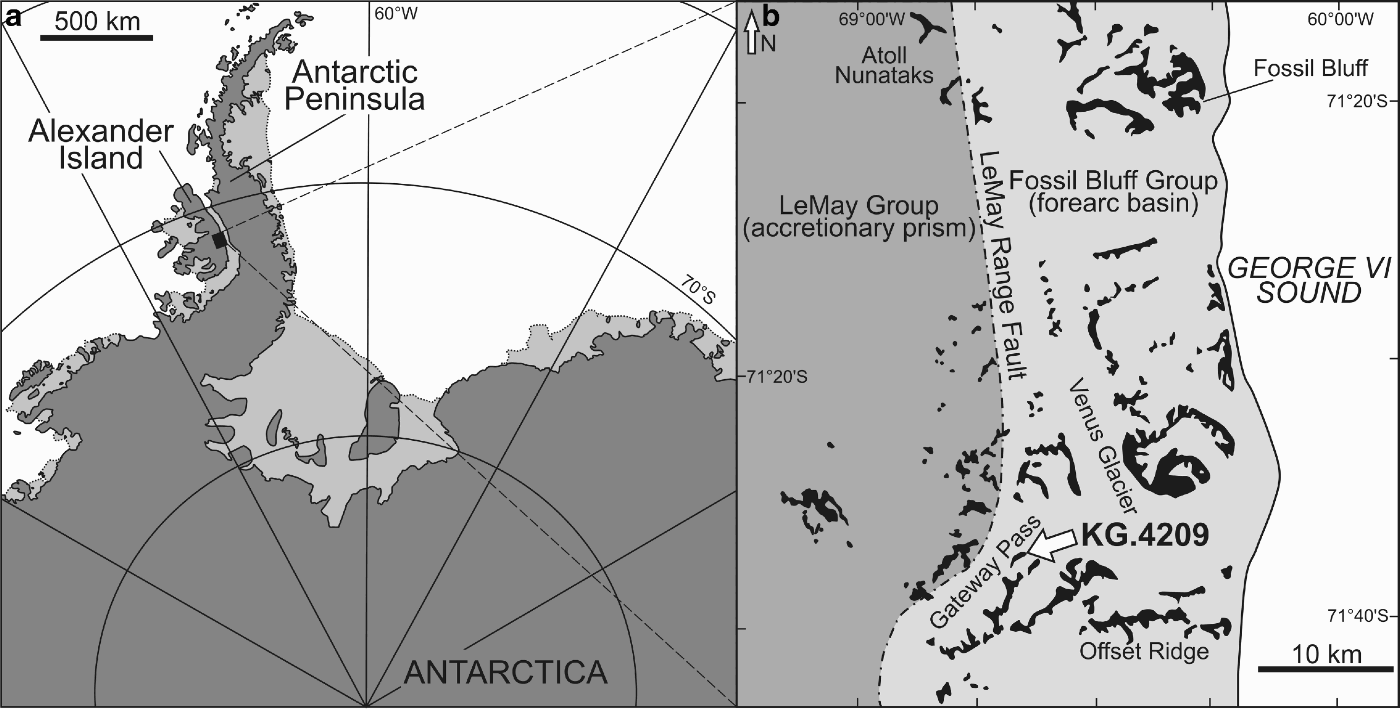
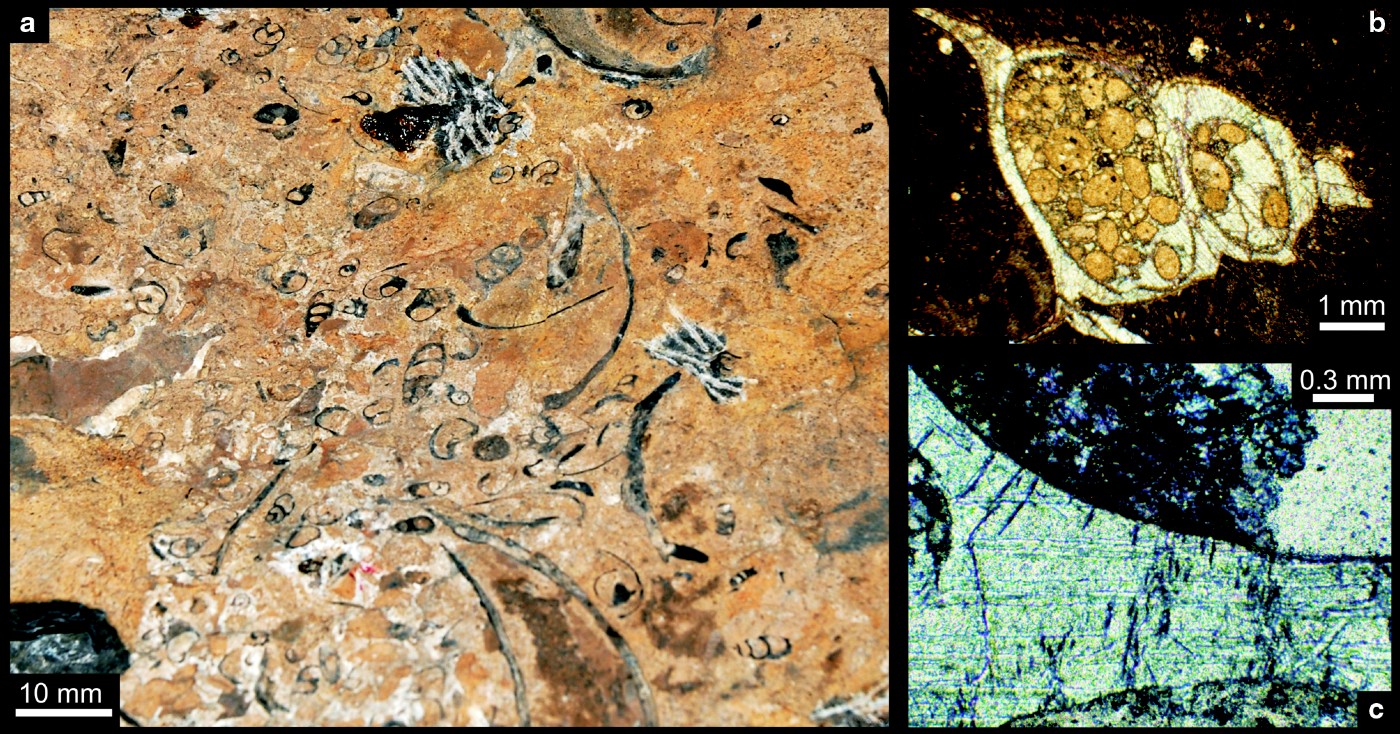
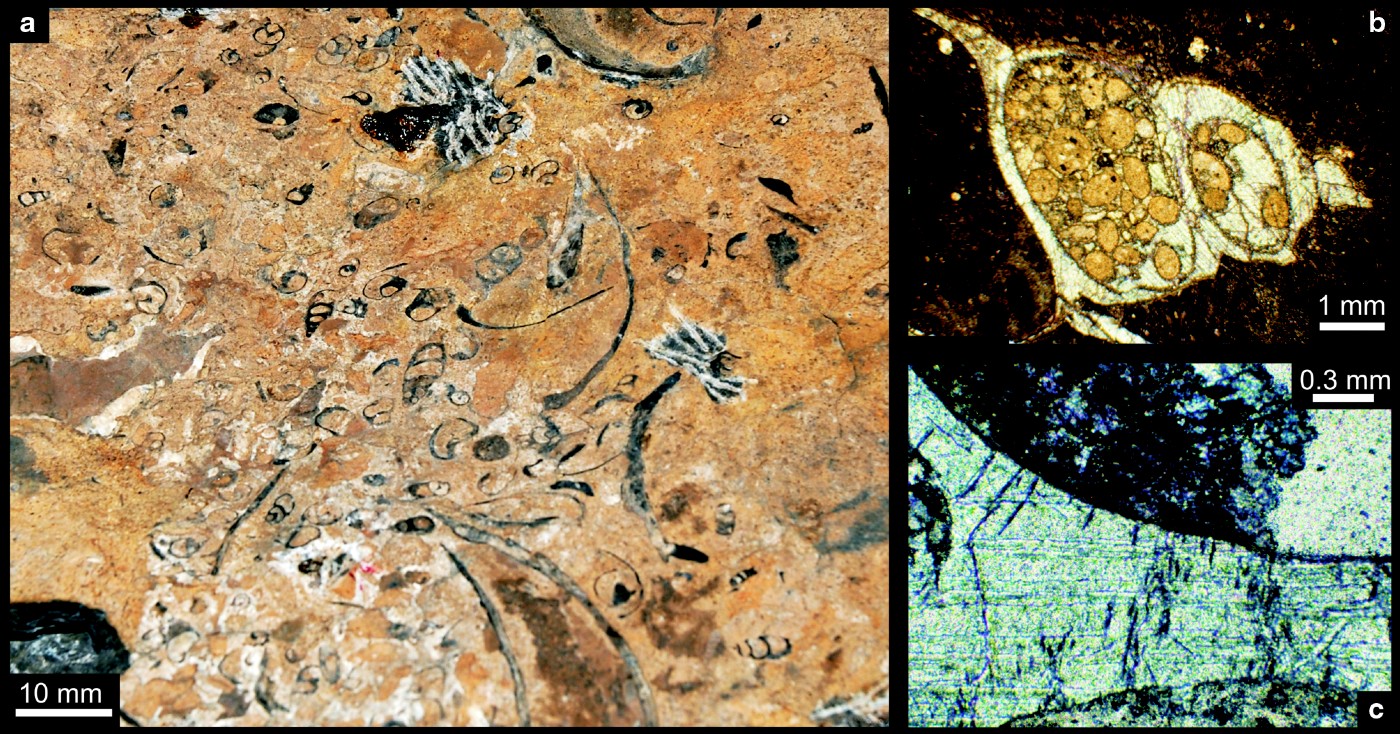
The gastropod-bearing seep carbonate unit, formally designated by Kelly et al. (Reference Kelly, Ditchfield, Doubleday and Marshall1995) as the Gateway Pass Limestone Bed, is located in the upper part of the Atoll Nunataks Formation (Doubleday et al. Reference Doubleday, Macdonald and Nell1993) of the Fossil Bluff Group that is a clastic-filled forearc basin succession. The specimens were collected from Station KG.4209 (68°39′W, 71°38′S) on Offset Ridge, Alexander Island, Antarctica (Fig. 1). The Gateway Pass Limestone Bed is exposed discontinuously between scree-filled gullies near the northern foot of the crags of Station KG.4209 for about 200 m (Kelly et al. Reference Kelly, Ditchfield, Doubleday and Marshall1995). The seep carbonate is composed of calcite-cemented mudstone and sandstone covered by irregular crusts up to 2 m wide and 20 cm thick. The δ13C isotope values measured from the seep carbonate are very negative and vary from -33.5% to -44.6% PDB (Kelly et al. Reference Kelly, Ditchfield, Doubleday and Marshall1995). The mass aggregations of fauna occurred in the mudstones associated with the crusts (Kelly et al. Reference Kelly, Ditchfield, Doubleday and Marshall1995). Dominant numerically are gastropods (Fig. 2a) with some contribution from large lucinacean and small protobranch bivalves. Kelly et al. (Reference Kelly, Ditchfield, Doubleday and Marshall1995) provisionally identified cerithiform and neritiform gastropod shells in the Gateway Limestone Bed. The former are described herein as hokkaidoconchids while the latter could not be confirmed in the material examined. The original aragonitic shells of gastropods have been replaced by nonferroan low-magnesium calcite spar (Kelly et al. Reference Kelly, Ditchfield, Doubleday and Marshall1995). The palaeolatitude of Alexander Island in the Late Jurassic is estimated as about 60°S by Golonka (Reference Golonka2000); however, the terrane model of Vaughan & Storey (Reference Suzuki, Kojima, Sasaki, Suzuki, Utsumi, Watanabe, Urakawa, Tsuchida, Nunoura, Hirayama, Takai, Nealson and Horikoshi2000) places some doubt on any simple palaeolatitude assignment for Alexander Island prior to the mid-Cretaceous. According to Vaughan et al. (Reference Vaughan and Storey2002) the final phase of terrane accretion occurred in late Early Cretaceous.
a. Locality map of Antarctic Peninsula. b. Location of Station KG.4209, Gateway Pass, Alexander Island, Antarctica.
Material and methods
The Gateway Pass locality was discovered in 1990 and given locality number KG.4209. The same site was revisited in 1992 for which locality number KG.4603 was used. The specimens were collected by S.R.A.K. and deposited in the collection of the British Antarctic Survey (BAS), Cambridge, UK. A part of a slab numbered KG.4603.44 was loaned to A.K. for preparation. The piece of weathered carbonate coquina of about 10 cm in length was split slowly using a hydraulic jawbreaker and the resulting exposed fossils were obtained from the cracked rock. The specimens and matrix are indurated and do not always part cleanly. The successfully extracted specimens were mounted on stubs, platinum-coated and observed under the Philips XL20 scanning electron microscope (SEM) at the Institute of Paleobiology, Polish Academy of Science, Warsaw, Poland.
Systematic palaeontology
Remarks
Hokkaicoconchids have multispiral protoconch which is not decollated, while in provannids the protoconch is always decollated when multispiral. Moreover, the teleoconch of provannids is never as tall as in hokkaidoconchids (Kaim et al. Reference Kaim, Jenkins and Warén2008a)
Genus Hokkaidoconcha Kaim, Jenkins and Warén 2008
Hokkaidoconcha hignalli sp. nov.
Etymology
The species is named after Martin Hignall (formerly BAS), who was the geological field assistant to S.R.A.K. in the field when the Gateway Pass limestone was discovered in 1990.
Holotype
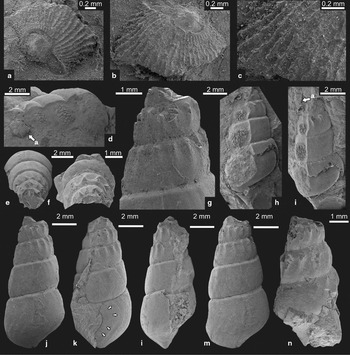
BAS KG.4603.44C, incomplete adolescent shell with neither protoconch nor aperture (Fig. 3e, g, j–m).
Paratypes
Numerous cross sections on the weathered rock surfaces in the collection at BAS, and on thin sections. Eight specimens were extracted from the rock matrix. Holotype (BAS KG.4603.44C) and two paratypes are illustrated (BAS KG.4603.44B and BAS KG.4603.44D; Fig. 3d, h, i and Fig. 3f & n respectively).
Locality
Station KG.4209 (68°39′W, 71°38′S) on Offset Ridge, Alexander Island, Antarctica.
Age
Tithonian (Upper Jurassic) Gateway Pass Limestone Bed, Atoll Nunataks Formation, Fossil Bluff Group (Kelly et al. Reference Kelly, Ditchfield, Doubleday and Marshall1995).
Diagnosis
Shell is of tall, cylindrical cerithioid shape. Apical whorls are ornamented with strong axial ribs, stronger in the adapical part and fading away in the abapical direction. Later in ontogeny axial ornamentation disappears. Spiral ornamentation is absent. Growth lines are orthocline except the last whorl where they are opisthocyrt. Adapical part of the whorl bears a narrow ramp. There is no clear demarcation of the basal surface.
Description
The shell protoconch is unknown. Initial teleoconch whorls are ornamented with 10–12 sturdy and blunt orthocline axial ribs. The ribs fade away on the third-fourth preserved whorl. The height of holotype with five whorls is 10.1 mm and its width is 5.1 mm. The aperture is not preserved.
Remarks
We classify the species under consideration as a hokkaidonchid based principally on the gross morphology and mass occurrence in seep carbonates rather than on well-established phylogeny. Such dense occurrence is typical for hokkaidoconchids (and also provannids) in the Cretaceous methane seep deposits of Hokkaido, Japan (Kaim et al. Reference Kaim, Jenkins and Warén2008a). However, in case of H. hignalli we cannot confirm its generic attribution because we do not have specimens with protoconch preserved at our disposal. Nevertheless, the specimens described herein are most similar to the specimens of Hokkaidoconcha tehamaensis described by Kiel et al. (Reference Kiel, Campbell, Elder and Little2008c) from the Tithonian locality at Paskenta in California. However, the latter species is ornamented by opisthocline rather than orthocline axial ribs and usually (but not always) also possesses fine spiral threads. The axial ribs of H. tehamaensis, similar to those on H. hignalli, are strongest on upper part of whorl and may disappear completely on lower half. Growth lines of H. tehamaensis are strongly prosocyrt unlike the ones of H. hignalli, which are orthocline first and then bent into opisthocline in the upper part of the flank. Similar features are observed in some specimens identified by Kiel et al. (Reference Kiel, Campbell, Elder and Little2008c: fig. 5K) as Abyssochrysos? giganteum Kiel, Campbell, Elder and Little, 2008. The latter species may also belong to Hokkaidoconchidae but again it cannot be confirmed without knowledge of the protoconch morphology.
Gastropoda indet.
Fig. 3a–c
Material
The single limpet shell (BAS KG.4603.44A; Fig. 3a–c) is partially exposed in the rock matrix.
Locality
Station KG.4209 (68°39′W, 71°38′S) on Offset Ridge, Alexander Island, Antarctica.
Age
Tithonian (Upper Jurassic) Gateway Limestone Bed, Atoll Nunataks Formation, Fossil Bluff Group (Kelly et al. Reference Kelly, Ditchfield, Doubleday and Marshall1995).
Description
An irregular limpet shell, with apex eroded, is partially covered by rock matrix. The shell is 1.1 mm high and 1.8 mm long. The apex is located about one-third of the shell length in its anterior/posterior extent. The surface is ornamented by numerous ribs, which are triangular in cross-section. There are 26 radial ribs on the visible half of the shell. All ribs are primaries, and there are no secondaries visible on the exposed part. The ribs widen toward the aperture. Interior shell features are unknown.
Remarks
This shell may belong to one of several groups of gastropods having convergent external morphology of the limpet shells. Without knowledge of the protoconch and internal surface we prefer to leave this shell in open nomenclature. Similar irregular shells are known from Patellogastropoda, Neomphalina, Cocculinidae, and Hipponicidae. Less probable are vetigastropods, capulids, siphonariids, and amathinids. Among taxa known from chemosynthesis-based communities similar irregular shell is possessed by the neomphalid Symmetrocapulus McLean, Reference McLean1990. However, this similarity might be purely superficial.
Discussion
The laminated crusts of Gateway Pass Limestone Bed were originally identified as stromatolites (Kelly Reference Kelly1991) and consequently reinterpreted as methane-seep carbonates based on peculiar growth pattern, and even more importantly, on their geochemical signature (Kelly et al. Reference Kelly, Ditchfield, Doubleday and Marshall1995). The crusts would appear to have been deep water bacterial mats which lined the seep openings. The bacterial crusts probably provided the food source for the grazing hokkaidoconchid and other gastropods. Associated with the mudstones and the sediment filled shells are abundant faecal pellets (Kelly et al. Reference Kelly, Ditchfield, Doubleday and Marshall1995: text-fig. 6D). These are about 1 mm diameter and subspherical in shape (Fig. 2b & Fig. 3d, h, i, l). They are typical of those made by gastropods. Despite the few protobranch bivalves present (Kelly et al. Reference Kelly, Ditchfield, Doubleday and Marshall1995, fig. 6C), which are known to be active deposit feeders, the sediment appears not to have been significantly reworked by sediment and detritus-feeding fauna, thus the gastropod faecal pellets have survived. The few large lucinid bivalves were living deeply within the sediment, and were collecting nutrient largely from the symbiotic bacteria on modified gills (Taylor & Glover Reference Sandy and Campbell2000).
Gastropod coquina from Upper Jurassic methane seep carbonate from Station KG.4209, Gateway Pass, Alexander Island, Antarctica. a. A rock slab displaying mass occurrence of hokkaidoconchid gastropods BAS KG.4209.324. b. Longitudinal cross section of Hokkaidoconcha hignalli sp. nov. in mudstone, with inner part of shell having sparry infill. Abundant subspherical/suboval faecal pellets of gastropods clearly shown in contrast to sparry infill, but are also present as completely dark cross-sections within the mudstone. KG.4209.233.I. c. Detail from thin section of hokkaidoconchid gastropod showing microborings of probable fungal hyphae penetrating the shell from the interior surface. Their position suggests that infestation was probably post-mortal. KG.4209.233.I
a–c. Unidentified limpet gastropod BAS KG.4603.44A. d–n. Abyssochrysoid gastropod Hokkaidoconcha hignalli sp. nov. d, h, i. Specimen BAS KG.4603.44B; the arrows on d and i show location of the limpet from Fig. 3a–c. e, g, j–m, the arrows on k show the opisthocyrtic growth lines. Holotype BAS KG.4603.44C. f, n. Specimen BAS KG.4603.44D. Note faecal pellets visible on 3d, h, i & l.

Provannids, the Recent counterparts of hokkaidoconchids, are known from both vents and seeps, as well as from various organic substrates in the deep sea (Kaim et al. Reference Kaim, Jenkins and Warén2008a). Large provannid genera Ifremeria and Alviniconcha are vent-specialized and they derive their nourishment largely from endosymbiotic bacteria (Suzuki et al. 2006). Species of two other genera (Desbruyeresia and Provanna) are much smaller and they apparently obtain their nourishment from grazing (Warén & Bouchet Reference Warén and Bouchet1993). It seems to be sound arguing that hokkaidoconchids had a life style similar to the smaller species of Provannidae.
We could not find any specimens of brachiopod Peregrinella which are extremely common in many Late Jurassic–Early Cretaceous seep sites (see e.g. Kiel & Peckmann Reference Kiel and Peckmann2008). As suggested by Kiel & Peckmann (Reference Kiel and Peckmann2008) Peregrinella and lucinds were mutually exclusive at the methane seeps. Peregrinella most commonly accompanied by modiomorphid Caspiconcha and/or abyssochrysoid Paskentana as documented is from several North American and European seep sites (Kiel & Peckmann Reference Kiel and Peckmann2008). The fauna from Gateway Pass Limestone Bed represents another type of association dominated by lucinid bivalves and hokkaidoconchid gastropods. Similar associations are known from US Pacific Coast (Kiel et al. Reference Kiel, Campbell, Elder and Little2008c) and Japan (Kaim et al. Reference Kaim, Jenkins and Warén2008a).
Conclusions
The Tithonian (Upper Jurassic) Gateway Pass Limestone Bed preserves the only known Mesozoic methane seep association from the Southern Hemisphere. The most abundant are high-spired gastropods identified by Kelly et al. (1995) as cerithiforms described here as probable hokkaidoconchids. Their mass occurrence together with a limpet gastropod and lucinid bivalves strongly resembles those of the Cretaceous hydrocarbon seep assemblage at Kanajirisawa in Hokkaido, Japan (Kaim et al. Reference Kaim, Jenkins and Warén2008a). Such gastropod assemblages are also relatively common in the Cretaceous plesiosaur bone (Kaim et al. Reference Kaim, Kobayashi, Echizenya, Jenkins and Tanabe2008b), sunken wood (Kiel et al. Reference Kiel, Amano, Hikida and Jenkins2008b), and other hydrocarbon seep associations from Japan and from the Pacific Coast of the USA (Kiel et al. Reference Kiel, Campbell, Elder and Little2008c). This suggests strongly that already in the Late Jurassic this type of community was well developed and widespread throughout the world oceans (Kaim et al. Reference Kaim, Jenkins and Warén2008a: table 1) reaching high austral latitudes by Tithonian. The large distance between Antarctic and North Pacific localities strongly suggests that the association of provannid/hokkaidoconchid gastropods with chemoautotrophy-based communities have originated well before latest Jurassic. Hokkaidochid-lucinid associations stand probably in opposition to Peregrinella-dominated associations as recently suggested by Kiel & Peckmann (Reference Kiel and Peckmann2008).
Acknowledgements
The material was collected during the Natural Environment Research Council (NERC) supported Mesozoic Forearc Basin Dynamics project conducted by the British Antarctic Survey (BAS) under the leadership of David Macdonald (formerly BAS, now Aberdeen University). Martin Hignall and Nick Lewis (formerly BAS) assisted S.R.A.K. in collecting the samples in 1990 and 1992 respectively. J. Alistair Crame, Mike Tabecki and Alex Tate are thanked for access to the BAS Collections. Anders Warén (Naturhistoriska Riksmuseet, Stockholm, Sweden) is acknowledged for comment on the gastropods described herein. Robert G. Jenkins (University of Yokohama, Japan) is acknowledged for assistance in Cambridge and critical reading the early draft of this paper. J. Alistair Crame and Steffen Kiel are acknowledged for their thoughtful reviews.