Introduction
Constitutional reform and the creation of a ‘regional’ legislature for Wales in 1999 (alongside those for Scotland and Northern Ireland) mark the latest phase in state restructuring in the UK and the international rise of multi-level governance. The latter is ‘an analytical concept, giving rise to questions about what forms of power and authority . . . typify a particular approach to governing’ (Newman, Reference Newman2001: 11). In part, the trend towards multi-level governance reflects ‘a lack of capacity on the part of governments, acting alone, to effect desired changes. Instead, public power manifests itself through increasingly blurred boundaries between different tiers of government, the public and private, and between the state and civil society’ (Meehan, Reference Meehan2003: 4). The following discussion explores how, over the past decade, the National Assembly for Wales has used the powers devolved to it from the UK Parliament, whilst also operating within the context of European legislation and Westminster statutes.
Prior to devolution, Wales had a lamentable record on equalities. Indices marked the country out as a worse performer than elsewhere in Britain – and beyond (Rees, Reference Rees1999). However, following lobbying by feminist activists and Welsh language campaigners, the Government of Wales Act (1998) effectively ‘constitutionalised’ the promotion of equality in the powers and procedures of the newly created legislature. From a social welfare perspective, this is significant, for the Assembly's principal responsibilities relate to social policy (Chaney and Drakeford, Reference Chaney and Drakeford2004). Thus, with qualified primary lawmaking powers and an annual budget of £16 billion, it has powers over areas such as health, education, culture and economic development. Accordingly, the present findings add to the growing literature on social policy divergence in unitary states (Alcock et al., Reference Alcock, Daly and Griggs2008; Hills et al., Reference Hills, Sefton and Stewart2009) and equalities and multi-level governance (Charles and Aull Davies, Reference Charles and Aull Davies2010; Rees, Reference Rees1998, Reference Rees2005; Dobrowolsky and Hart, Reference Dobrowolsky and Hart2004).
The article begins by focusing on neo-institutionalist aspects of devolved governance and the promotion of equalities. Discussion then turns to political representation in the wake of devolution. Against the background of successive devolved administrations’ subscription to mainstreaming equality, legislative and policy developments are then analysed. The article concludes by offering a general evaluation of the impact of constitutional reform on the promotion of equality and human rights at the sub-state level.
A variety of research methods underpin our arguments, including an extensive series of interviews with policy actors, some participant observation and discourse analysis of Assembly proceedings. We also draw upon a documentary analysis of public policy, including legal instruments and ‘grey literature’ (such as annual reports, newsletters etc.) of civil society organisations.
Neo-institutionalist perspectives on equalities and ‘regional’ governance
Neo (or new) institutionalist theory is central to the promotion of equality, for, as March and Olsen (Reference March and Olsen1984: 738) observe, ‘political democracy depends not only on economic and social conditions but also on the design of political institutions . . . [they] are arenas for contending social forces, but they are also collections of standard operating procedures and structures that define and defend interests’. As such, they determine the extent to which equalities groups can challenge their historical marginalisation and exclusion from the conduct of public business.
Studies of public administration under the Welsh Office, the territorial Ministry that served Wales prior to 1999, serve as a ‘benchmark’ to the current evaluation (e.g. Bradbury, Reference Bradbury1998). They show it to have been exclusive in the way that it operated and to have marginalised key social groupings in the policy process. During this period, equality of opportunity was not generally seen as its responsibility. Rather, it adopted statist solutions and made little effort to engage with socially diverse groups. Moreover, as Betts (Reference Betts1976: 121) concludes, ‘its attempts to reflect the bilingual reality of Welsh society were a sham’.
In response to these failings, feminist activists and Welsh language campaigners seized the political opportunity structures associated with devolution to lobby successfully for institutional mechanisms to promote equality to be included in the blueprint of the Assembly. As noted, foremost of these is a general equality duty that states: ‘Welsh Ministers must make appropriate arrangements with a view to securing that their functions are exercised with due regard to the principle that there should be equality of opportunity for all people.’Footnote 1 No such duty existed in the Welsh Office. Other equality clauses in statute include duties to promote equality for the Welsh language and uphold the general principle of equality in the conduct of Assembly business. Together these ‘fourth generation’ duties (Fredman, Reference Fredman2000) require proactivity on the part of government.
The general equality duty has had an impact on a number of associated institutional developments, such as the creation of a cross-party Equality Committee in the legislature. The latter has been charged with policy development and scrutiny of the executive's agenda. Analysis of the Committee's functioning in relation to gender equality shows that over the past decade, it has been an important nexus between elected representatives, civil and civic society. For example, discourse analysis of its deliberations during the second Assembly (2003–7) (Chaney, Reference Chaney2008) reveals how it acted as a forum for the advancement of gender equality claims by those outside government. Notably, the data reveal that women (both Assembly Members and advisors to the Committee) were probabilistically more likely than male colleagues to refer to selected gender equality terms in Committee deliberation.Footnote 2
The devolution statute also requires the creation of a range of statutory partnerships between government and local authorities, public sector bodies, the voluntary sector and business organisations. The significance of these is the way in which they may institutionalise the participation of equalities constituencies in the work of government. For example, in relation to the third sector, ministers are required to publish a Voluntary Sector Scheme setting out how they propose, in the exercise of their functions, to promote the interests of third sector organisations.Footnote 3 It states that ‘the goal is the creation of a civil society which: has a duty to promote equality of opportunity to all its members regardless of race, colour, sex, sexual orientation, age, marital status, disability, language preference, religion or family/domestic responsibilities’ (NAfW, 2000: 5). The associated Third Sector Partnership Council (TSPC) is a collection of 25 policy networks organised around policy areas or social groups, including those focussed on equalities interests such as gender, older people and ethnic minorities. Under the Scheme's provisions, members have the right to biannual meetings with ministers to discuss policy matters. Recent analysis (Chaney, Reference Chaney2007) reveals that during the Assembly's second term (2003–7), just over a half of all such meetings (58 per cent) featured discussion of equalities issues.
The Assembly's Public Petitions Committee is a relatively recent development (post May 2007). Analysis reveals that it has also emerged as a conduit for individuals, civil society organisations and others to advance equalities claims on government. Seven out of the Committee's first 13 meetings considered petitions with an equalities dimension. Inter alia, these called on government to lay specific responsibility upon local authorities to support young carers and to review NHS Wales’ screening systems for sex-specific cancers. Overall, of the first 150 petitions, 10 per cent were concerned with equalities issues.
A further consequence of devolution has been the significant development of the ‘equalities infrastructure’ over the past decade (i.e. state bodies that are wholly – or in part – concerned to monitor and uphold the promotion of equalities as part of a public performance review remit). This represents a major increase in the potential capacity of the state to monitor equalities. Such institutions include the Welsh Commissioners for Children and Older People, the Special Educational Needs Tribunal for Wales, Wales Audit Office and the Welsh Care Standards Inspectorate. However, to date, there has been limited strategic direction and co-ordination of their monitoring of equalities. Thus, their full potential has not yet been realised. This has been a missed opportunity.
Notwithstanding this, the institutional developments are significant on a number of levels. They mark an increase in the state's capacity to monitor and regulate. Moreover, the statutory partnerships require government to work with and uphold the interests of representatives of equalities organisations outside government. Thus, they provide structures for views and issues to be raised with Ministers, and add transparency to such contacts through published minutes and transcripts. Their statutory footing means that non-compliance by government can be challenged via judicial means.
Descriptive and substantive representation
Whilst devolution has generally seen disappointing progress in the election of disabled people and ethnic ‘minorities’, striking advancement has been made in terms of women's representation. In the first elections to the National Assembly, women totalled 41.7 per cent of those elected. This was a result of positive action by the three left-of-centre parties. Subsequently, in 2003, the total rose to 50 per cent but then dropped slightly, to 47 per cent, in the 2007 election. Whilst on the face of it these developments are encouraging, future progress is not assured. The reason for the latter point is that, as equalities theory underlines, positive action does not fully address the underlying structural and cultural causes of inequality and discrimination (Rees, Reference Rees1998). This point is evidenced by the backlash and ongoing bitter opposition to positive action in some quarters of the political parties (see Chaney et al., Reference Chaney, Mackay and McAllister2007).
Despite such concerns, the new levels of women's representation have allowed empirical study that engages with the key political science debate about the connection between women's descriptive and substantive representation (the former term refers to women's presence as elected parliamentarians, the latter refers to the promotion of women's interests in the conduct of politics and policy making). For example, drawing upon participant observation and research based upon interviews of Assembly Members (AMs) and senior civil servants, Jones et al. (Reference Jones, Charles and Davies2009) found that the Assembly is characterised by a consensual culture, a sharp contrast to the ‘adversarial’ political style of Westminster. This study also found that considerable attention has been paid to developing policies around domestic abuse. Moreover, analysis of the incidence of key gender equality terms in the Assembly's Record of Proceedings (1999–2003) revealed a statistically significant difference between male and female AMs (Chaney, Reference Chaney2006). The latter were found to have a greater propensity to engage in debate on ‘women's issues’ and made approximately two-thirds to three-quarters of all interventions using the key gender equality terms analysed. Evidence from the Assembly's first term also revealed that female AMs had a significantly greater propensity to introduce debate on gender equality topics compared to their male counterparts. A further notable feature of post-devolution politics has been female AMs holding key positions of power in the executive and legislative branches of government, for example as committee chairs and members of the Assembly Government's cabinet (where, during the Assembly's first term, women comprised a 5:4 majority). Analysis of published minutes reveals female Ministers intervening in cabinet discussions to advance gender equality in areas such as economic aid and policies on both health and carers.
Issues of equality and representation also extend to the devolved public sector and have been the subject of policies in relation to public appointments. Prior to 1999, just 28 per cent of public appointments under the Welsh Office were filled by women, a mere 0.6 per cent were held by people from an ethnic minority background (Welsh Office, 1999) and none of the 452 appointees of the Secretary of State for Wales was ‘non-white’ (Hanson, Reference Hanson1995: 4). Building on the Nolan Committee inquiry into standards in public life, the Welsh government has used its equality duty to go ‘beyond what is laid down under the Nolan principles in terms of making transparent and open the procedures of making public appointments’ (Chaney and Fevre, Reference Chaney and Fevre2002: 34)Footnote 4. A new Code of Practice for Ministerial Appointments to Public Bodies was introduced that led to a raft of measures, including information dissemination strategies to reach under-represented groups, targeted advertising of posts, training for those in under-represented groups in order that they be suitably skilled for positions in public life and training in best practice in candidate selection for those involved in interviewing for public appointments. The Code of Practice also set out how management procedures would be changed to promote gender equality. It stated that the ‘Public Appointment Unit [of the Welsh Government] will have discretion to look for the next man or woman on the list [of available assessors] in order to ensure gender balance on a[n appointments] panel’ (NAfW, 2004a: 62). A further move, designed to increase the representation of women, was the requirement that ‘for all posts there should be provision for reimbursement of receipted childcare or carer costs’ (NAfW, 2004a, 45).
Perhaps the most radical step in this area was the decision, taken at the end of 2000, to dismiss all the existing independent assessors involved in ensuring public appointments followed the Nolan principles (Chaney et al., Reference Chaney, Mackay and McAllister2007). This was because they had not been recruited transparently against a ‘job’ and person specification. Some but not all were among the 55 assessors then appointed following advertising and interviewing against criteria, thereby signalling a clear break with past practices and putting in place assessors with proven equality competencies. Importantly, 56 per cent of the new assessors were women (NAfW, 2003: 3). More recently, a ‘communications toolkit’ has been developed to ensure effective communication with minority ethnic communities in public appointment campaigns. Figures for 2006–7 show that 180 appointments and re-appointments were made, and, whilst the diversity of those appointed is gradually improving, major challenges remain. The percentage of women appointed was 48 per cent, the percentage of people from the minority ethnic communities appointed was 4 per cent and the percentage of disabled people was 7 per cent (WAG, 2007: 12).
The Commissioner for the Office for Civil and Public Appointments was also concerned about the ‘tap on shoulder’ way in which independent assessors in the UK had been appointed, and introduced an on-line test for all assessors to ensure they had appropriate knowledge and understanding of public appointment processes. The independent assessors used by the Welsh Assembly Government were required to take and pass this test, although they alone in the UK had been recruited following a transparent, competency-based process.
Legislating for equality and human rights
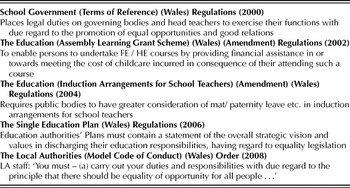
A striking feature of the first decade of devolution has been the increasing use of legal instruments passed by the National Assembly to promote equalities. This is particularly significant following the qualified primary law-making powers conveyed in the second devolution statute of 2006. It marks the move towards the increasing use of hard policy enforcement mechanisms as evidenced by the devolved government's imposition of legal duties on public and other bodies in relation to the promotion of equalities. Such action may reduce the risk of an implementation gap and provide mechanisms for legal redress in cases of non-compliance. The result of these changes is the creation of a distinctive legal framework on equalities in Wales (see Table 1 for selected examples).
Examples of Welsh Equalities Law

The impact of the new lawmaking arrangements on the promotion of equalities can be seen by reference to the Welsh government's legislative programme for 2008–9. Each of the first five proposed Assembly Measures (the term for primary enactments passed by the Assembly, equivalent to UK or Scottish Acts) deals explicitly with an equality-related topic. A key example is the proposed Welsh Language (Wales) Measure (2010) designed to further language rights, create the office of language commissioner and impose duties on parts of the public, private and voluntary sectors.
The observance of human rights is enshrined in the devolution statutes;Footnote 5 specifically, government is bound by the terms of the European Convention on Human Rights. The past decade provides some evidence of policy divergence between Wales and England. The foremost example is policy in relation to children. In 2000, the devolved administration announced its intention to make all future policy consistent with Article 12 of the UN Convention on the Rights of the Child (UNCRC) (see WAG, 2004a). The UN Committee on the Rights of the Child has welcomed this. An example of ensuing policy divergence relates to the legislative framework for the Children's Commissioner for Wales. Whereas Westminster refused to include a duty requiring the Commissioner to have due regard to the UNCRC in primary legislation, the National Assembly instead used its secondary legislative powers to achieve this end. The Children's Commissioner in England (set up some years after the one in Wales) is not covered by such an obligation. Further developments include the Strategy for Older People in Wales (WAG, 2003: 9), which states that one of its core aims is: ‘reflecting the United Nations principles for Older People to tackle discrimination against older people wherever it occurs’. Similarly, the Assembly Government's Youth Offending Strategy (WAG, 2004b: 3) asserts that it is ‘is underpinned by the UNCRC and requires consideration of the rights of the young person’. In addition, a proposed Measure is currently passing through the Assembly that will impose a duty upon Welsh Ministers to have due regard to the rights and obligations in the UNCRC when making decisions on devolved policy matters.Footnote 6 Overall, the emerging evidence suggests that human rights are gradually becoming more embedded in devolved policy and law in ways that may contrast with developments elsewhere in the UK.
Mainstreaming equality? Public policy
An early indication of the political reprioritisation of promoting equality associated with devolution emerged at the first meeting of the Assembly's cross-party Equality Committee in 1999 when a government minister set out the aim of mainstreaming equalities in public policy. This was later defined as an approach whereby ‘equality issues should be included from the outset as an integral part of the policy-making and service delivery process and the achievement of equality should inform all aspects of the work of every individual within an organisation. The success of mainstreaming should be measured by evaluating whether inequalities have been reduced’ (NAfW, 2004b: 6).
From the outset, the government acknowledged that there was a need to ensure that a ‘proper framework [wa]s in place to support the delivery of the Assembly's duty on equal opportunities’ (NAfW, 1999a: 2). Analysis reveals that it is this aspect, the creation of the institutional mechanisms for mainstreaming, rather than equality policy outcomes that are most evident after a decade of devolved governance. Prominent examples include the government's statutory equality duty and its Equality, Diversity and Inclusion Division. Notwithstanding this, four successive official reviews of the Welsh government's approach to equalities (2002–9) have highlighted a number of significant shortcomings and areas for improvement (Chaney and Fevre, Reference Chaney and Fevre2002; NAfW, 2004b, 2007; Chaney, Reference Chaney2009). In one, the cross-party Equality Committee asserted that progress was being arrested because of leadership failings: ‘there is a lot of positive activity going on but with little strategic direction . . . there [is] a high level of variation across the organisation’ (NAfW, 2004b: 57). In another, shortcomings in the availability of equalities data at an all-Wales level – and the limited uptake of equalities training by officials was highlighted (Chaney, Reference Chaney2009) (in 2009, 281 officials from a staff of 6,422 took ‘diversity related core training programmes’, WAG, 2009: 32). Questions must also be raised in relation to the adequacy of scrutiny from opposition and backbench AMs – and external bodies – for many of the problems have persisted throughout the first decade of devolution.
In response to such criticism, the government has introduced a revised Mainstreaming Strategy (WAG, 2006: 4) and ‘Inclusive Policymaking Toolkit’ (WAG, 2008a). The latter sets out a fixed equality impact assessment procedure for officials to follow (although equality for the Welsh language is a worrying and glaring omission). This has been accompanied by the government's Single Equality Action Plan to: ‘provide clarity over [government] departments’ equality priorities [and. . .] enable those developing policy to focus on the equality outcomes that are of the greatest significance to the respective department’ (WAG, 2006: 7). There is also further evidence of a more sophisticated approach to the promotion of equalities in government policy making through the use of equalities targets. During the current Assembly, these developments have gone some way to addressing the earlier malaise.
Overall, devolution has seen the introduction of an extensive raft of policies on equalities across the breadth of devolved functions; this is a major discontinuity with the previous era of public administration when it was not seen as an issue falling under the Welsh Office's remit. Notable examples include policies to promote the participation of children and young people in public decision-making and sustained government funding for equality policy networks. As a result, a number of equalities policies evidence generally good levels of consultation with the groups targeted by them.Footnote 6 However, there remains much scope for broadening the circles of those outside government engaged in such policy work. Notwithstanding new patterns of engagement and government funding, it remains the case that a minority of equalities-related organisations have thus far lobbied or taken part in policy work.
A further feature of the past decade has been the significant broadening of the focus on equalities. The initial Standing Orders of the Assembly (NAfW, 1999b) emphasised a principal focus on ‘race’, disability and gender. This has extended to include a greater range of interests, including: the Welsh language, asylum seekers, Gypsy travellers, lesbian, gay, bisexual and transgender people, age, faith and carers. When compared to the first Assembly, today there is also more evident competition between equalities interests and a greater spectrum of equalities demands on government. This is a development that has led a number of groups to speak of a ‘dilution of influence’ – and it is apparent that some equalities ‘strands’ have not received as much attention by policy makers as others (notably faith and transgender people).
Discussion
Devolution in Wales has seen progress in the promotion of equalities and human rights through new institutional mechanisms, government endorsement of mainstreaming, greater system openness, new forms of discursive and representational politics, the growing use of legal instruments and the development of devolved regulatory bodies with an equalities remit.
However, shortcomings can also be identified. These include the need to increase engagement with equalities constituencies in policy work, failure to develop mainstreaming tools adequately across government (including a poor record on equalities training), failings in the scrutiny of successive governments’ equalities programmes, an over-reliance on positive action that promotes gender parity in political representation, and a lamentable tendency to focus on equalities-related procedures rather than policy outcomes. Indeed, the National Equality Panel (Hills et al., Reference Hills, Brewer, Jenkins, Lister, Lupton, Machin, Mills, Modood, Rees and Riddell2010) shows that there is as yet little significant difference between Wales and England in terms of economic inequality, despite the commitment of the Welsh Assembly Government to greater equality and social justice. Factors that can make a significant difference in promoting economic equality, such as the imposition of minimum wage, remain solely within the capacity of the UK parliament.
A number of context-specific issues have also arrested progress over the decade, including major restructuring of the legislature on parliamentary lines (although essential, this diverted the energies of politicians and officials alike), budget limitations (the much contested Barnett formula restricts capacity beyond funding statutory obligations), the National Assembly's chronic under-capacity (just 45 AMs – if members of the Cabinet are excluded) and an arcane and cumbersome law making process.
Notwithstanding these issues, weighed against a low starting point and the fact that the pre-existing Welsh Office did not have responsibility for equality matters, the present evidence suggests that ‘regional’ legislatures operating in the context of multilevel governance have greater potential to advance the promotion of equalities based on local needs compared to centralised administration in unitary states. However, the present findings also show that a range of factors can arrest progress. As noted, some are context specific. Others resonate with the international literature on attempts to mainstream equalities in the work of government (Rees, Reference Rees2005; Mackay and Bilton, Reference Mackay and Bilton2000; IANWGE, 2005) and centre on matters such as variations between government departments’ approach to equalities, adequacy of equalities data, levels of expertise, sufficiency of training and the need for effective monitoring of policy. As such, the present can be characterised as a transitional phase. Whilst significant groundwork for promoting equalities has been put in place, continued political will, thoroughgoing mainstreaming and robust policy scrutiny will be essential if its potential is to be realised in the second decade of devolution in the Welsh polity.