Introduction
What are the driving forces of increased gender equality? Some would say none at all. One strand of feminist research argues that a masculine/feminine divide, coinciding with an order of dominance and subordination, is an inevitable feature of any human society (cf. Kimmel, Reference Kimmel2004). The point of departure for this study, however, is that genuine change is possible. Most contemporary societies are constituted in ways that put women at a disadvantage in terms of income and participation in public affairs, and violence against women and sexual harassment contribute to circumscribing women's room for manoeuvre, but our research concerns the variations in these systemic impediments that exist across time and across various settings. It is fairly well established that some countries are more gender equal than others; the Nordic countries are regularly singled out as among the most women-friendly in the world.Footnote 1
In her influential book The Politics of Presence, Anne Phillips (Reference Phillips1995: 66), states: ‘Equal rights to a vote have not proved strong enough to deal with this problem (gender inequality); there must also be equality among those elected to office’.Footnote 2 Gender equality advocates have long prioritized equal representation of women and men in elected assemblies. Phillips herself (Reference Phillips1995: 83) used the expression ‘a shot in the dark’ with reference to expectations that female politicians would affect politics in specific ways. Her doubt stemmed from her knowledge of rigidity in political institutions: parliaments do not change easily. However, over the last decade, the number of empirical studies in the field has grown and most of them report that female representatives do help strengthen the position of women in society (see Wängnerud, Reference Wängnerud2009, for an overview). One problem here, though, is that most such studies measure either input into the system, such as the attitudes of female representatives, or policy output, such as parental leave legislation.Footnote 3 Investigations of how the proportion of women in elected assemblies relates to outcomes in the everyday lives of citizens are scarce, though this is what the theory of the ‘politics of presence’ specifically concerns; as Phillips (Reference Phillips1995: 47) states: ‘It is … representation with a purpose; it aims to subvert or add or transform’.
In this study, we attempt to explain variations in gender equality at the sub-national level in Sweden. Specifically, we test whether municipalities where a large proportion of local council seats have long been held by women achieve greater gender equality than municipalities where the proportion of seats held by women has been low. Notably, both the proportion of women elected and levels of gender equality among ordinary citizens vary considerably at the sub-national level in Sweden.
Though this study emphasizes theory testing, it makes several contributions. First, we recognize that gender equality is a multidimensional concept, which leads us to consider a wide range of outcomes in the everyday lives of citizens. Second, we recognize that democratic processes work slowly. Our aim is to explain contemporary variation at the sub-national level in Sweden, but to do so we must extend the analysis of the political level back in time, essentially to the 1970s. Furthermore, we highlight some basic assumptions in the field of gender equality that merit discussion: should equality be a goal in itself, or should general well-being or the well-being of the worst off be seen as more important (Rawls, Reference Rawls1971)? The answer to that question has consequences; some of our findings could, for example, be interpreted as indicating that gender equality is worst in the most prosperous municipalities in Sweden.
The overall finding of our study is that having a high number of women elected does affect conditions for women citizens, making them more equal to men in terms of factors such as income levels, full-time vs. part-time employment, and the distribution of parental leave between mothers and fathers, even when controlling for party ideology and modernization. No effect was found, however, on factors such as unemployment, poor health, and poverty among women. The politics of presence does exert an effect, but the effect needs to be specified. For some dimensions of gender equality, the driving forces of change have more to do with general transformations in society than the equal distribution of women and men in elected assemblies.
In the following sections, we first discuss major explanatory themes in research into gender equality processes. We then develop our argument for studying variation at the sub-national level in Sweden. The section on methodology is comprehensive, since we see a need to thoroughly discuss measurement challenges, and pays special attention to the debate on indexes vs. individual indicators. In the concluding discussion, we examine the causal mechanisms underlying the statistical effects: by what mechanism do women elected to local assemblies help strengthen the position of women citizens?
Explaining variation in gender equality
As mentioned above, many studies support the notion that having a high number of women in elected office helps strengthen the position of women. At the macro level, evidence indicates that societies that elect a large number of women also tend to be more gender equal in other respects than societies that elect fewer women (Inglehart and Norris, Reference Inglehart and Norris2003). At the micro level, evidence indicates that women in office display political attitudes and prioritize issues of particular importance to women citizens, for example, social policy, family policy, and gender equality (Thomas, Reference Thomas1994; Ross, Reference Ross2002; Lovenduski and Norris, Reference Lovenduski and Norris2003; Diaz, Reference Diaz2005; Lovenduski, Reference Lovenduski2005; Thomas and Wilcox, Reference Thomas and Wilcox2005; Dodson, Reference Dodson2006). Studies in the Nordic countries, where the number of women in elected office has long been high, have found a shift of emphasis as the number of women in office increases, with women's interests being accorded greater scope and situated more centrally on the political agenda (Skjeie, Reference Skjeie1992; Bergqvist et al., Reference Bergqvist, Borchorst, Christensen, Ramstedt-Silén, Raaum and Styrkársdóttir2000; Wängnerud, Reference Wängnerud2000).
A closer look reveals that some of the most cited studies rely on questionnaires asking elected representatives about their attitudes and priorities, focusing on the input side of the political system. Vega and Firestone (Reference Vega and Firestone1995), however, examined legislative voting behaviour from 1981 to 1992 in the US Congress, and their results confirm the findings of questionnaire-based research. They conclude that ‘congressional women display distinctive legislative behaviour that portends a greater representation of women and women's issues’ (Vega and Firestone, Reference Vega and Firestone1995: 213). This finding is in line with Celis's analysis of speeches from the budget debates of the Belgian lower house between 1900 and 1979; female members of the Belgian parliament were found to be women's most ‘fervent’ representatives (Celis, Reference Celis2006: 85).
Grey (Reference Grey2002) has studied changes in New Zealand's parental leave policies. Changes were made in 1975 and 1999, and the number of women in the New Zealand parliament grew from under 5% to almost 30% over this period. Grey's analysis of the parliamentary debates preceding the changes reaches a somewhat different conclusion from, for example, that of Celis's study of Belgian lower house debates. The most obvious division found in Grey's study was along party lines and not along gender lines. Grey does, however, identify some important changes that occurred in New Zealand in parallel to the increase in the number of women elected; for example, leave provisions for both parents, rather than mothers alone, were accepted.
Although some studies have examined policy promotion, the closer one gets to actual outcomes in citizens’ everyday lives, the fewer empirical findings there are to report. In a statistical analysis of childcare coverage in Norwegian municipalities in 1975, 1979, 1983, 1987, and 1991, Bratton and Ray (Reference Bratton and Ray2002) show that the number of women elected influenced public policy outputs (increased childcare coverage), but that the effect of female representatives was not constant, being most obvious in periods of policy innovation. Bratton and Ray also point out that an important precondition for the translation of the election of a large number of women into certain policy outcomes is the existence of gender differences in the public and the presence of women in the executive. Svaleryd's (Reference Svaleryd2009) study of variation in local public expenditure patterns in Sweden is also worth mentioning, as it supports the finding that an increased number of elected women increases spending on childcare.Footnote 4
The tendency to focus on areas such as childcare provision or parental leave legislation merits discussion. Though these areas are important for women's opportunities to participate in public affairs, this focus could give a one-sided impression of the driving forces of gender equality processes. A study by Schwindt-Bayer and Mishler (Reference Schwindt-Bayer and Mishler2005), using data from 31 democracies, exemplifies a multidimensional study. The indicators they use are weeks of maternity leave, indexes capturing women's political and social equality, and marital equality in law. They conclude that an increase in the number of women elected increases the responsiveness of legislatures to women's policy concerns and enhances perceptions of legitimacy among the electorate, but the authors perceive the effects of having a large number of women elected to be smaller than anticipated in theory.
In sum, when studies of various ways of measuring the importance of gender in the parliamentary process are aggregated, the picture that emerges shows that female representatives indeed help strengthen the position of women in society. However, the closer one gets to outcomes in citizens’ everyday lives, the fewer empirical findings there are to report. Even more puzzling is the fact that studies trying to capture outcomes are generally more dubious about the impact of having a high number of elected women than are studies relying on elected representatives’ responses to questionnaires. The theory of the politics of presence obviously needs further testing.
Another major strand of research concerns the impact of modernization. In an extensive study, Inglehart and Norris (Reference Inglehart and Norris2003) promote a cultural approach. They construct a gender equality scale from measurements of citizens’ attitudes towards women as political leaders, women's professional and educational rights, and women's traditional role as mothers. Through cross-country comparative research, covering almost all parts of the world, they show that egalitarian values are systematically related to the conditions of women's and men's lives. They conclude that modernization underpins cultural change, that is, attitudinal change from traditional to gender-equal values, and that these cultural changes have a major impact on gender equality processes (see also Liebig, Reference Liebig2000; Bergh, Reference Bergh2007).
Inglehart and Norris were not the first to emphasize culture/modernization, and one early argument against this strand of research is that such explanations cannot capture short-term changes (Sainsbury, Reference Sainsbury1993). The cultural perspective has also been criticized for being almost tautological (Rosenbluth et al., Reference Rosenbluth, Salmond and Thies2006). We would like to turn this discussion in a new direction. Gender equality is a contested concept. Most people agree that it concerns more than just childcare or the inclusion of women in positions of power. A solution used by many international organizations, such as the United Nations, is to formulate indexes incorporating many variables and present them as a proxy for the network of circumstances that determines the relationship between women and men. At first glance, this solution seems reasonable, but aggregating several factors undermines the possibility of building fine-tuned understandings of operative mechanisms. A core idea of this study is that different driving forces might underlie increased gender equality: some changes might result from slow processes related to culture/modernization, whereas others might result from more direct political intervention.
Defining gender equality
It goes without saying that the concept of gender equality is difficult to define. The politics of presence theory suggests that women politicians are best equipped to represent the interests of women citizens. Phillips's argument is built on differences between women and men in their everyday lives and on the fact that women in elected office share, at least to some extent, the experiences of other women:
Women have distinct interests in relation to child-bearing (for any foreseeable future, an exclusively female affair); and as society is currently constituted they also have particular interests arising from their exposure to sexual harassment and violence, their unequal position in the division of paid and unpaid labor and their exclusion from most arenas of economic or political power. (Phillips, Reference Phillips1995: 67–68).
When Phillips concretizes what women can gain from increased political inclusion, she stresses context; women's interests are connected to how societies are currently constituted. The contextual approach implies that concepts such as women's interests and gender equality are anchored in time and space; this means that more exact definitions must be worked out in relation to the particular setting studied. One problem here, though, is that even the most carefully contextually anchored definition will necessarily end up somewhat simplified. Contemporary debate in the field concerns how gender relates to categories such as ethnicity, age, and class. The debate also touches on features of elitism in gender research, that is, a tendency to ascribe interests to women in a top–down fashion, and features of essentialism, that is, a tendency to view women and men as fixed, rather than changeable, categories (Dietz, Reference Dietz2003).
Partly because gender equality is such a contested concept, relevant cross-country comparative research is often carried out by international organizations. The World Economic Forum produces a Gender Gap Index that focuses primarily on equality between the sexes in the economic sector and in education. Social Watch produces a Gender Equity Index that, besides gender gaps in the economic and educational sectors, also includes aspects of health and well-being. The International Save the Children Alliance produces a Mothers’ Index that does not focus on gender equality per se, but on conditions for mothers.Footnote 5 The Mothers’ Index emphasizes women's opportunities to enact motherhood safely and voluntarily. The Index includes information on the lifetime risks of maternal mortality, the percentage of women using modern contraception, and the amounts of births attended by trained personnel. The United Nations also produces indexes capturing gender equality – the gender-related development index (GDI) and the gender empowerment measure (GEM) – both of which focus largely on the political inclusion of women.
Although they differ in various ways, the studies cited above share a focus on women's opportunities for self-determination – their room for manoeuvre – in society (cf. Phillips, Reference Phillips2007: 101). At an overarching level, our research is in line with the reasoning underlying the indexes of the United Nations and other international organizations, as we also perceive gender equality to be about opportunities for self-determination. International organizations, however, are less interested in seeking explanations for variations in these opportunities. Their first priority is to put pressure on leaders in countries with poorer results and to enhance certain policies. Indexes are doubtless useful from that perspective, but if the aim is to explain variation across time or across various settings, problems arise.
Instead of using one index to capture women's positions as relative to men's, we will present results for six indicators related to work, income, health, and the distribution of parental leave between mothers and fathers. Our choice was guided by criteria such as reliability and simplicity. Although we recognize that gender equality is a multidimensional concept, we cannot include too many factors; what is most important is that we capture a broad spectrum of everyday life situations.
Studying variation at the sub-national level in Sweden
The Nordic countries are, as noted previously, regularly singled out as among the most women-friendly in the world. Perhaps even more noteworthy is that this region has long been at the top of lists ranking countries according to gender equality. As early as the 1980s, the expression ‘Norden – the passion for equality’ had already been coined (Graubard, Reference Graubard1986), alluding to values deeply embedded in Nordic society.
Modernization theories often emphasize socio-economic and cultural developments. The Nordic countries are characterized not only by egalitarian values but also by a comparatively encompassing welfare state. The number of women elected to national parliaments in the region also stands out, with women currently accounting for 41.6% of the members of Nordic national parliaments, the average proportion for European parliaments being 21.9% (figures from the Inter-parliamentary Union, www.ipu.org, referring to conditions as of 30 September 2010). From a bird's eye view, it seems reasonable to suspect there to be significant interactions between egalitarian values, welfare state regimes, and pressure from politically active women (Hernes, Reference Hernes1987; Rosenbluth et al., Reference Rosenbluth, Salmond and Thies2006). Our aim, however, is to investigate the driving forces of gender equality more closely.
There are several advantages to studying variation at the sub-national level in Sweden. One advantage is that we can keep cultural factors more or less constant. We trace developments from the 1970s to the present, and although some values have shifted in Sweden over this period, we do not believe that egalitarianism has been affected in ways that can explain the patterns we find. Another advantage is that Swedish municipalities all work within the same legal and institutional framework. Even so, local governments enjoy considerable autonomy from the central government: municipalities set their own budgets and exercise powers of taxation. Previous studies have indicated that there is room for manoeuvre in the field of gender equality for ‘ambitious’ local governments; instruments that have been used in this regard include integrating a gender perspective into municipal budgeting processes (Pincus, Reference Pincus2002) and political decisions to offer full-time employment status to all part-time municipal employees (Lindgren and Vernby, Reference Lindgren and Vernby2007).
It is difficult to describe, with any exactness, the distinction between central and local government in Sweden. On the one hand, the Swedish central government is usually responsible for policies and laws/regulations with a bearing on gender equality processes. On the other hand, local government is usually responsible for implementing policies in the welfare sector. By international comparison, Sweden has very high public expenditure. An indication of municipal strength is that public consumption and investments currently total approximately 29% of GDP in Sweden; of that, approximately 71% is consumed and invested at the local level (Karlsson and Johansson, Reference Karlsson and Johansson2006). Furthermore, most municipal spending concerns care for the elderly, education, and childcare – that is, sectors with an immediate bearing on conditions for women both as employees (women constitute 79% of municipal employees in Sweden) and as the adults most often responsible for the provision of care in the family.Footnote 6
Our interest in this research was sparked by the fact that figures from Statistics Sweden indicate sub-national variation in women's positions as relative to men's.Footnote 7 This, together with the other features mentioned above, provides a useful basis for testing our idea that some progress might result from slow processes related to culture/modernization, whereas others might result from more direct political intervention. Our design lets us separate explanatory factors in new ways, and our study is arguably less plagued by many of the problems associated with cross-country comparative research.
The dependent variables
The debate on how best to measure gender equality started in earnest when the economists Anand and Sen (Reference Anand and Sen1995) published a paper detailing two new indexes to be included in the upcoming United Nations Human Development Report of 1995, the previously mentioned GDI and the GEM. The motivation for formulating the better-known index, the GDI, was to improve the human development index, which measured human development without considering the distribution of development between women and men. Anand and Sen's aim was not to create a measure of gender inequality; instead, they tried to create another measure of human development, one that penalized countries with greater gender inequality. As Schüler (Reference Schüler2006) has shown, however, the GDI has frequently been misinterpreted as a direct measure of gender inequality, both by academics and the popular press.
Since then, numerous other indexes that measure gender equality have been proposed. Permanyer (Reference Permanyer2010) reviews several and exposes the theoretical and technical problems with most of them. Permanyer also suggests some alternatives; while having fewer technical problems, these alternatives tend to involve complex calculations and are therefore not easily interpreted. Hence, a consensus on how to best measure gender equality has yet to emerge.
Measurement challenges
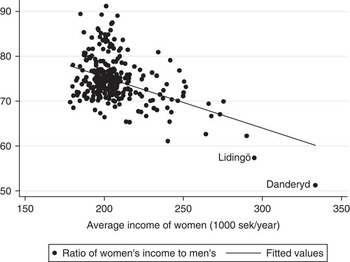
A good measure of gender equality should deal adequately with several issues. The first is whether to take welfare levels, or just inequality, into account. As highlighted by Anand and Sen (Reference Anand and Sen1995), the question is whether or not one accepts the Rawlsian concept of justice, in which overall welfare corresponds to the welfare status of the worst-off group. Most indexes created in response to the GDI focus on inequality in itself; however, the issue is problematic in cases in which inequality is largely a function of level. Earlier research using individual-level data has shown that the gender gap in wages in Sweden is largest at the top end of wage distribution (Albrecht et al., Reference Albrecht, Björklund and Vroman2003), and a simple analysis of our macro-level data confirms this conclusion. In Figure 1, the ratio of the mean income of women/men in Swedish municipalities is plotted as a function of women's income level.
The ratio of women's to men's income, 2007, as a function of women's income level, 2007. Notes: R 2 = 0.19. The scatterplot shows the 290 Swedish municipalities plotted according to the ratio of women's to men's income, and the average income of women in SEK 1000 s per year, for 2007. The values for Lidingö and Danderyd are higlighted in the text. Source: Statistics Sweden.

The figure clearly shows that the two municipalities in which women earn the most are also the most unequal. The outliers represent the wealthy Stockholm suburbs of Lidingö and Danderyd; in Danderyd, men earn almost twice as much as women.
Our response to this problem is to conduct two analyses. The women/men ratio is used as the dependent variable in both analyses, but in the second analysis, we control for the average income level. Theoretically, this implies that we ‘accept’ that municipalities with higher earnings are more unequal, which would be problematic if this exercise aimed to produce an index that could be used to rank municipalities according to level of gender inequality. Our aim, however, is to explain variation in inequality and, more specifically, to test the explanatory potential of the political representation of women. In our case, it is reasonable to accept that the relationship between level and inequality exists, and instead focus on deviations from that relationship: municipalities in which women's earnings are greater relative to men's than would be expected from the income level are considered more equal in the second analysis.
Since we have analysed a single country that is a prosperous democracy, several of the indicators used by international organizations – such as life expectancy and literacy rate – are less relevant. Still, our indicators reflect social and material resources, that is, what we label ‘outcomes’ or ‘actual conditions’ in the everyday lives of citizens. Our indicators are average income, unemployment, proportion of municipal population classified as low-income earners, sick days per year, distribution of parental leave between mothers and fathers (proportion used by fathers), and percentage employed full-time by local government.Footnote 8
The issue of full-time municipal employment can be seen as a critical test of the politics of presence theory. Approximately 20% of all Swedish employees work for local government, and therefore this indicator cannot be said to measure overall gender equality in employment. However, since women are heavily overrepresented among those working for local government, this is an area suitable for scrutinizing gender equality processes. Previous research has established a link between the decision to offer full-time employment to all part-time municipal employees and the presence of women in top executive positions in Swedish municipalities (Lindgren and Vernby, Reference Lindgren and Vernby2007). We deviate from this research because we measure actual full-time percentages instead of political decisions; however, on the basis of previous research, this area should be considered an easy test. If the politics of presence theory has no bearing here, there would be little reason to expect effects in any other area. In a similar vein, the proportion of parental leave used by fathers should perhaps be regarded as an easy test of the theory. Although legislation in this area is primarily the task of national government, local governments are fully capable of implementing various gender equality-positive instruments. For the other indicators, we have no clear expectations based on previous research into what constitutes an ‘easy’ or ‘difficult’ test of the theory.
The weighting of indicators is another issue discussed in the literature. Since most variables are measured according to different scales, it has been suggested that variables should be standardized. Standardizing, however, implies that the value of each unit of analysis depends on the values of all other units of analysis. The standardized value of one unit may thus change from one year to another, even though the underlying value remains the same. When trying to assess how equal a country or another unit is, this is a problem, but for the researcher wishing to explain cross-sectional variation, standardizing poses no such problem. Hence, standardization will be used in this study. All data were obtained from Statistics Sweden and Försäkringskassan, the Swedish national social insurance office.
Individual indicators vs. index
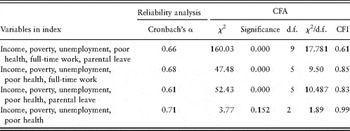
As already discussed, using an index as a dependent variable assumes an underlying construct that affects all the components of the index, such as gender equality. If the index components are uncorrelated, they are unlikely to share an explanation. The six indicators used here were therefore subjected to a reliability analysis using Cronbach's α and confirmatory factor analysis (CFA); Cronbach's α and model fit indexes from the CFA are presented in Table 1.
Reliability analysis and confirmatory factor analysis (CFA) of index components

CFI = comparative fit index.
All variables are standardized: CFA carried out using Amos 18 software.
The reliability of an index consisting of all six standardized components is 0.62, which fails to reach the conventional threshold of 0.7. The CFA confirms the result of the reliability analysis: χ 2 is significant, and both the alternative measures, that is, χ 2/d.f. and the comparative fit index, indicate that the model is unsatisfactory. Factor loadings (not displayed) are weakest for the distribution of parental leave and full-time municipal employment percentages. Excluding the parental leave variable improves the model, but excluding the full-time municipal employment percentage variable improves the model still more; however, Cronbach's α remains too low in both cases, that is, 0.68 and 0.66, respectively. When both parental leave and full-time municipal employment percentage are excluded, Cronbach's α is acceptable, as are the model fit indexes. In sum, all six variables are relevant indicators of gender equality, but do not seem to share an explanation. Despite the index being unreliable, we will present an introductory analysis that serves as an overview of both dependent variables and time, though the focus will be on the individual indicators.
The independent variables
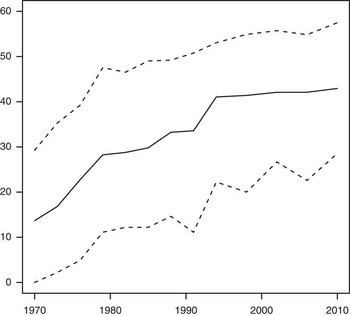
The main independent variable, female representation, is operationalized as the percentage of Swedish local councillors who are women in each mandate period from 1970 to 2010 (the mandate period for local and national governments in Sweden was 3 years until the 1994 election and 4 years thereafter). Since 1970, the proportion of women councillors has grown substantially, from an average of 13.7% in the 1970–73 period to 42.1% in the 2006–10 period. The largest increase occurred between the elections of 1991 and 1994: on average, the councils elected in 1994 had 7.5 percentage points more women than councils elected in 1991, as can be seen in Figure 2. However, the increase all but stopped in 1994, as the proportion of women increased by only one percentage point in the three subsequent mandate periods.
Percentage of women on municipal councils, 1970–2010. Notes: The diagram shows the average, standard deviation, and minimum and maximum percentage of female counsellors in Swedish municipal councils between 1970 and 2010. Source: Statistics Sweden.

Some long-term factors are likely to facilitate both the election of women to municipal council and to improve conditions for women in terms of the outcome variables. Previous research has shown that modernization is an important determinant of gender equality (Inglehart and Norris, Reference Inglehart and Norris2003; Bergh, Reference Bergh2007); it is also likely to be a determinant of how many women will be elected to office. The socio-economic controls in this study include average municipal population (log), geographical area in square kilometres (log), and average percentage of women and men with tertiary education (log). Together, the geographical variables indirectly become a measure of population density and hence urbanization. On the basis of previous research into regional differences in Sweden, we assume that urban environments are generally more modern (Forsberg, Reference Forsberg1997). Highly educated citizens in Sweden are also likely to have attitudes that are more ‘modern’, which may increase gender equality (Jakobsson and Kotsadam, Reference Jakobsson and Kotsadam2010).
Another possible long-term factor is historically rooted emancipation. We include local results for the turnout of women and men in the 1921 national parliamentary election – the first national election in Sweden in which men and women had equal voting rights – as a proxy for the early political emancipation of women. We do not believe that there is a causal effect of the turnout in 1921 on equality today. However, the variable may pick up factors that could be associated with higher gender equality today, as well as the tendency for women to participate in politics. By controlling for this variable, this possible source of spuriousness is eliminated. Since several of our dependent variables are related to the local labour market, it is reasonable to include a variable indicating public sector size in the municipality, here measured as the number of municipal employees per 1000 capita.
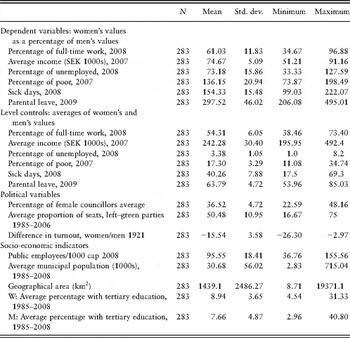
Another possible confounding factor is party politics. Previous research has shown that left-wing parties are more open to demands from women than right-wing parties (Lovenduski and Norris, Reference Lovenduski and Norris1993; Kittilson, Reference Kittilson2006). We therefore include a variable indicating the combined proportion of seats held by the three parties that constitute the left–green coalition, that is, the left, green, and social democratic parties. The main dividing line in Swedish politics is between these parties and the centre–right coalition consisting of the Moderate, Liberal, Centre, and Christian Democratic parties. However, regressions will also be rerun using variables that indicate the strength of each party separately. Summary statistics for all variables in the analysis are presented in Table 2.
Summary statistics

Notes: The number of municipalities in 2008 was 290, but since the number has varied over time, only the 283 municipalities for which there were consistent data over time were included in the analysis.
Source: for most variables is Statistics Sweden. Exceptions: sick days and parental leave (Försäkringskassan), difference in turnout women/men 1921 (Berglund, Reference Berglund1988), percentage of unemployed (The Swedish Public Employment Service).
Results
Using OLS regression, we first estimated the effects of female representation over 40 years on the index of standardized variables. While the index above is shown to have some problems, this first analysis serves as a condensed preliminary test of the effect of political representation of women on gender equality. However, due to the problems of aggregating different indicators of gender equality, the main analysis uses separate indicators as dependent variables.
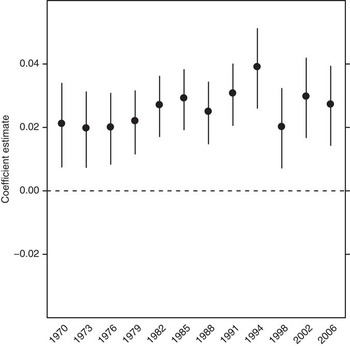
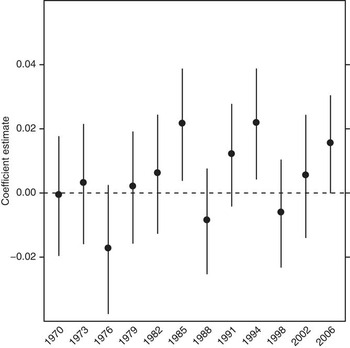
Figures 3 and 4 present two sets of coefficients and associated 95% confidence intervals for each dependent variable. When the confidence intervals overlap zero, we cannot with 95% certainty say that there is an effect that differs from zero. Coefficients with confidence intervals that differ from zero are thus significant. In Figure 3, the coefficients show the bivariate effect of a one percentage point increase in the number of women elected during the mandate period. In Figure 4, the coefficients show the effect of a one percentage point increase during the mandate period, controlling for the percentage of women in the municipal council in all other periods. Figure 3 hence displays the results of 12 regressions, while Figure 4 displays the results of one.
Bivariate effect of the percentage of female counsellors during 1970–2010 on standardized index. Notes: The graph displays the coefficients and associated 95% CIs for 12 separate regressions, estimating the effect of the percentage of female counsellors in the municipal councils at different time periods on an index of gender equality, measured during 2007–09.

Multivariate effect of the percentage of female counsellors during 1970–2010 on standardized index. Notes: Adjusted R 2 = 0.16. The graph displays the coefficients and associated 95% of CIs for one regression analysis, estimating the effect of the percentage of female counsellors in the municipal councils at different time periods on an index of gender equality, measured during 2007–09. Percentages for all periods are hence included in the same regression, as opposed to Figure 3.

Figure 3 shows that the percentage of women in the municipal council has a positive and significant effect in all mandate periods starting from 1970. The strongest correlation is found between the gender equality index and the number of women in the municipal council in the 1994–98 period. The graph seems to indicate that female councillors may have had a lasting impact on conditions for women citizens. However, the percentage of women in the municipal council in one mandate period is obviously correlated with the percentage of women in the municipal council in the preceding and following periods.
We therefore turn to Figure 4, in which the percentages of women councillors in each mandate period are included as independent variables in a multivariate regression. In Figure 4, three periods display significant effects, that is, 1985–88, 1994–98, and 2006–10. Judging from these findings, women in municipal councils seem to have exerted some influence on gender equality outcomes in the last three decades; no mandate period in the 1970s displays signs of a similar significant effect. However, other variables most likely affect both the number of women municipal councillors and actual outcomes among citizens. We now turn to the multivariate analysis of the separate indicators. Each dependent variable is analysed in two models, with and without a control variable for the average level of the dependent variable; the results are presented in Table 3.
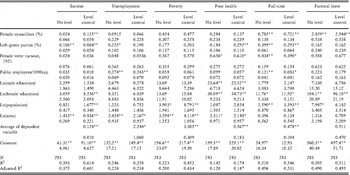
The effect of female councillors 1985–2010, on women's income, unemployment, poor health, and parental leave, in relation to men's OLS regression, unstandardized β-coefficients, SE in parentheses

Notes: The dependent variables are ratios (%) of the value for women on the variable compared to value for men. If the average income for women is SEK 200,000/year, and the average income for men is SEK 250,000/year, the dependent variable is 80%. Models designated with ‘Level control’ include a control variable that is the average of the variable for women and men. If income of women and men is as described above, the variable would have a value of 225,000.
*P < 0.05, **P < 0.01.
The percentage of women councillors has significant and positive effects on the distribution of parental leave, full-time employment, and income when controlling for level. In municipalities where the number of women elected was comparatively high throughout the 1985–2010 period, parental leave is more equally distributed among mothers and fathers, as more women are employed full-time and earn more in relation to men. The hypothesis that increasing the proportion of women in elected assemblies will lead to better conditions for women thus passes the critical test of having an effect on the ‘easiest’ variables, that is, the employment situation for women and parental leave.Footnote 9
Party politics has an effect on four of six variables, that is all except the distribution of parental leave and poverty. Women in municipalities where the left–green coalition is stronger than the centre–right coalition are, in relation to men, likely to earn more, and are less likely to be unemployed; they are also more likely to be employed on a full-time basis by the municipality. However, they are also likely to be sicker than their counterparts in municipalities where the centre–right coalition is stronger.Footnote 10
The control variable for early political emancipation, female voter turnout in 1921, has significant effects on poor health and full-time employment. In municipalities where female voter turnout was high in relation to that of men in the national election of 1921, women were, in relation to men, less sick and enjoyed more full-time employment in local government. This suggests that some of the factors that influence conditions for women have very deep roots.
Public sector size has significant effects on two variables: unemployment and full-time employment in the public sector. Our analysis shows that public sector size not only serves to reduce unemployment among women, but also reduces the proportion of women working full-time. Municipalities with larger public sectors thus seem to employ more women part-time than ones with smaller public sectors.
Education levels have significant effects on several of the variables. The more educated the women in a municipality are, the better off they will be when it comes to income, health, full-time employment, and the distribution of parental leave between mothers and fathers. The effect of female education on male parental leave confirms the results of individual-level research (Nyman and Pettersson, Reference Nyman and Pettersson2002). Male education has a strong effect on only one of the variables, women's health vs. men's health. The health gap between women and men is predicted to be greater, to the detriment of women, in municipalities where men are more educated. This is not because highly educated men make women sick, but because higher education among men reduces sick leave among men. The general absence of male education effects indicates that the primary mechanism by which education increases gender equality is by strengthening the position of women relative to men, rather than by causing men to have more ‘modern’ attitudes.
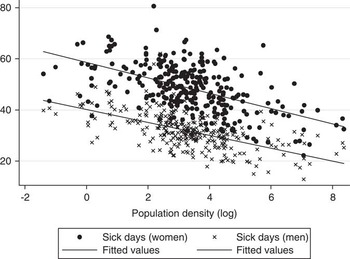
Municipal population and area have strong effects on all dependent variables, all of which point in the same direction: the situation for women vs. men is worse in more densely populated municipalities. This is a somewhat surprising result, as the modernity hypothesis states that more urban, and therefore more modern, societies should be more equal. However, this finding may to some degree result from how we measure the dependent variables: as women's values proportional to men's values. For example, population density is negatively correlated with poor health for both women and men, that is, denser municipalities are less unhealthy. However, the decrease in poor health as population density increases is of the same magnitude among both women and men. This means that, while the difference in poor health between women and men is the same in less dense municipalities as in dense ones in absolute terms, the relative difference is smaller. This can be seen in Figure 5, as the regression lines for women and men are parallel.
The effect of population density on poor health among women and men. Notes: The scatterplot shows the 290 Swedish municipalities plotted according to the number of sick days for men (marked with x) and women (marked with circles) and the log population density (measured as the number of inhabitants per square kilometre), as well as the fitted regression lines.

The findings bring us back to the appropriate definition of gender equality, and whether gender equality is the same as gender justice. What is more important, the conditions of the worst off or that conditions for both genders be equal?
To summarize, the results support the proposition that female representatives will improve conditions for women citizens, though only in the areas of income, parental leave, and the employment situation for local government employees. Politics in the form of party politics matters as well, with leftist parties having favourable effects for women for all dependent variables except poor health, which is lower under centre–right governments. Municipalities with higher female as compared to male turnout in the first national election with equal voting rights are more equal in terms of poor health and employment situation.
Discussion
Our study has shown that female representation significantly affects some areas of actual gender equality in Swedish municipalities. What, however, are the micro-foundations of our findings?
The most obvious causal mechanism is that political decisions directly affect behaviour. One example, already cited, is the possibility of local governments offering full-time employment status to municipal employees. The forerunner here was the municipality of Bollnäs, which made such a decision in 2001, after which other municipalities followed suit (Lindgren and Vernby, Reference Lindgren and Vernby2007). Another prominent example in Swedish politics is that of ‘daddy months’, which refers to the fact that a substantial part of parental leave can be used only by fathers. A first ‘daddy month’ was introduced in 1995 and another in 2002; after both reforms, the proportion of parental leave used by fathers increased, though the increase after the second reform was smaller (Eriksson, Reference Eriksson2005). While municipal councils do not have the same regulatory tools as the national parliament in this area, they can initiate projects aimed at levelling out gender differences.
Other processes are connected to more indirect political intervention. In many Swedish municipalities, local government is the biggest employer. Several local-level studies in Sweden support the existence of different priorities among women and men politicians, identifying women as the most ‘fervent’ supporters of gender equality (Hedlund, Reference Hedlund1996; Gustafsson, Reference Gustafsson2008; Svaleryd, Reference Svaleryd2009). Therefore, it is not far-fetched to believe that women politicians may promote equal hiring practices, equal salaries, etc., in the public sector. In an in-depth study of three Swedish municipalities, Ingrid Pincus (Reference Pincus2002) shows how special local government committees have been established to initiate gender equality activities in the local authority itself and in the municipality as a whole. Perhaps most interesting in Pincus's study are the examples of how influential male top administrators and/or politicians can slow various gender equality efforts (most often carried out by women). Examples of strategies to hinder such municipal development are preventing gender equality operations from acquiring resources and undermining existing operations by withdrawing resources and questioning their legitimacy.
Furthermore, apart from the mechanisms discussed above, various public sector measures may contribute to private sector changes. Private business wishing to attract skilled women must compete with employment conditions in the public sector, and therefore ambitious local governments might have knock-on effects in this sense. International comparisons have, however, indicated that the high level of employment of Swedish women in the public sector may serve as an impediment to equal women's wages, as public sector wages in Sweden tend to be lower than private sector wages (Gornick and Jacobs, Reference Gornick and Jacobs1998). The findings of our analysis seem to indicate that the public sector has ambiguous consequences for women; larger public sectors reduce unemployment among women, but the employment is often part-time.
Most importantly, our findings highlight the need for theoretical clarity in defining gender equality. Whether a factor increases or decreases gender equality in outcomes is contingent on the definition and measurement of gender equality. Scholars and policymakers should be absolutely clear as to whether they consider equality a goal in itself, or whether general well-being or the well-being of the worst off is more important; for example, municipalities with lower wages are likely to be more equal, but is it desirable to emulate them?
A final theme to consider is whether what we have conducted here is, in total, a stringent test of the politics of presence theory. For example, the distances between the independent and dependent variables are wide in several cases. We believe that research in this field must move towards measuring outcomes, and that a multidimensional approach is desirable. Research into women in parliament frequently distinguishes between descriptive and substantive representation (Pitkin, Reference Pitkin1967). This distinction roughly corresponds to whether the focus is on the number of women elected or on the effects of women's presence in parliament. The politics of presence theory provides reasons for expecting a link between the number of women elected and outcomes. From our point of view, the theory is weak if it applies only to changes on the input side of politics, that is, to the political agenda at the elite level of society. For sure, democracy works slowly and political institutions are rigid, but at some point we must recognize changes in citizens’ everyday lives if we are to conclude that the equal representation of women and men in elected assemblies transforms democracy in fundamental ways. There is an urgent need to continue the discussion on how to best explain variation in gender equality across time and across different settings.
Acknowledgements
We would like to thank Peter Esaiasson, Mikael Gilljam, David Karlsson, and Jessika Wide for their helpful comments on earlier versions of this paper.
Appendix: Variable descriptions
Percentage of female councillors
The percentage of seats on the municipal council held by women. Source: Statistics Sweden.
Percentage of left–green parties
The percentage of seats on the municipal council held by the Left Party, the Social Democrats, or the Green Party. Source: Statistics Sweden.
Percentage of full-time work
The percentage of local government employees who are employed full-time. Source: Statistics Sweden.
Average income
Average income in SEK 1000 s, before taxes. Source: Statistics Sweden.
Percentage of unemployed
The percentage of municipal inhabitants aged 20–64 years who are registered as unemployed by the Swedish Public Employment Service. Source: The Swedish Public Employment Service.
Percentage of poor
The percentage of municipal inhabitants aged 20–64 classified as belonging to the 20% with the lowest income in Sweden. In 2007, the threshold under which a person was classified as a low-income earner was SEK 117,138 of annual income, compared to the median of SEK 222,032. Source: Statistics Sweden.
Sick days
The average number of days for which Försäkringskassan (the social insurance office) has provided sickness benefits. Source: Försäkringskassan.
Parental leave
The average number of days with parental benefits used by the parents. Parental allowance covers 480 days with high economic compensation (about 75–85% of wage) and 90 days at a minimum rate. Source: Försäkringskassan.
Difference in turnout, women–men, 1921
Turnout among men minus turnout among women in the Riksdag elections 1921. Source: Berglund (Reference Berglund1988).
Public employees/1000 capita
The number of people employed by the local government per 1000 municipal inhabitants. Source: Statistics Sweden.
Education
The share of women and men with tertiary education (longer than 3 years). Source: Statistics Sweden.
Population
Municipal population.
Area
Area of the municipality, expressed in square kilometres.