Introduction
Executive functions (EF) have been suggested to be cognitive endophenotypes for ADHD, which are closely linked to underlying pathogenesis of ADHD (Bidwell et al. Reference Bidwell, Willcutt, Defries and Pennington2007; Gau & Shang, Reference Gau and Shang2010a ). With the advances of brain-imaging technique, functional and structural changes in the brain have been recognized as a primary cause underlying the behavioural problems of attention deficit hyperactivity disorder (ADHD; Liston et al. Reference Liston, Malter Cohen, Teslovich, Levenson and Casey2011). Functional imaging studies have shown that youths with ADHD had less frontostriatal (FS) activation during performance of executive tasks (Konrad et al. Reference Konrad, Neufang, Hanisch, Fink and Herpertz-Dahlmann2006), and that adults with ADHD engaged different brain areas during the performance of cognitive tasks (Dibbets et al. Reference Dibbets, Evers, Hurks, Bakker and Jolles2010). In previous structural (Tamm et al. Reference Tamm, Barnea-Goraly and Reiss2012; Shang et al. Reference Shang, Wu, Gau and Tseng2013) and functional (Hart et al. Reference Hart, Radua, Nakao, Mataix-Cols and Rubia2013) neuroimaging studies of ADHD, the importance of FS circuitry on executive control has been most consistently reported. In fact, a meta-analysis study suggested that alterations in white-matter integrity were widespread in patients with ADHD (van Ewijk et al. Reference van Ewijk, Heslenfeld, Zwiers, Buitelaar and Oosterlaan2012), and recent studies also highlighted the alteration of other fibre tracts in youths with ADHD, such as superior longitudinal fasciculus (SLF; Pavuluri et al. Reference Pavuluri, Yang, Kamineni, Passarotti, Srinivasan, Harral, Sweeney and Zhou2009; Lawrence et al. Reference Lawrence, Levitt, Loo, Ly, Yee, O'Neill, Alger and Narr2013) and cingulum bundle (CB; Pavuluri et al. Reference Pavuluri, Yang, Kamineni, Passarotti, Srinivasan, Harral, Sweeney and Zhou2009), but their relationship with EF are still undetermined.
Until now, there has been only one study investigating the association between white-matter tract and EF in ADHD (Shang et al. Reference Shang, Wu, Gau and Tseng2013), demonstrating different association patterns between EF and the microstructural property of FS tracts in youths with ADHD. Since SLF (Ge et al. Reference Ge, Yin, Xu, Tang, Han, Xu, Pang, Meng and Liu2013), arcuate fasciculus (AF; Kucukboyaci et al. Reference Kucukboyaci, Girard, Hagler, Kuperman, Tecoma, Iragui, Halgren and McDonald2012; Lebel et al. Reference Lebel, Warner, Colby, Soderberg, Roussotte, Behnke, Davis Eyler and Sowell2013) and CB (Kantarci et al. Reference Kantarci, Senjem, Avula, Zhang, Samikoglu, Weigand, Przybelski, Edmonson, Vemuri, Knopman, Boeve, Ivnik, Smith, Petersen and Jack2011; Lebel et al. Reference Lebel, Warner, Colby, Soderberg, Roussotte, Behnke, Davis Eyler and Sowell2013; Ikuta et al. Reference Ikuta, Shafritz, Bregman, Peters, Gruner, Malhotra and Szeszko2014) have been recognized to be associated with EF in healthy participants (Kucukboyaci et al. Reference Kucukboyaci, Girard, Hagler, Kuperman, Tecoma, Iragui, Halgren and McDonald2012; Ge et al. Reference Ge, Yin, Xu, Tang, Han, Xu, Pang, Meng and Liu2013), older adults (Kantarci et al. Reference Kantarci, Senjem, Avula, Zhang, Samikoglu, Weigand, Przybelski, Edmonson, Vemuri, Knopman, Boeve, Ivnik, Smith, Petersen and Jack2011) and individuals with other neuropsychiatric conditions (Lebel et al. Reference Lebel, Warner, Colby, Soderberg, Roussotte, Behnke, Davis Eyler and Sowell2013; Ikuta et al. Reference Ikuta, Shafritz, Bregman, Peters, Gruner, Malhotra and Szeszko2014), we intend to include these fibre tracts, as well as FS tracts, into analysis in the current study.
Using a matched case-control study design at the individual level, we compared the white-matter microstructural property and analysed its relationship with EF. Additionally, we analysed white-matter tracts with diffusion spectrum imaging (DSI), one of the high angular resolution diffusion imaging techniques, to address the limitation of diffusion tensor imaging (DTI) to resolve the crossing fibres (Wedeen et al. Reference Wedeen, Wang, Schmahmann, Benner, Tseng, Dai, Pandya, Hagmann, D'Arceuil and de Crespigny2008). Unlike the principal direction of the DTI that points to a direction somewhere between the crossing fibres, DSI provides an advantageous method whereby the directions of the maxima of the average propagator correspond to the underlying crossing fibre directions (Lin et al. Reference Lin, Wedeen, Chen, Yao and Tseng2003). We hypothesized that the microstructural property of these white-matter tracts might differ in youths with ADHD from typically developing (TD) youths. Furthermore, we also investigated whether the diffusion anisotropy of these target tracts correlated with EF, and whether there were altered association patterns in youths with ADHD compared to TD youths.
Method
Participants and procedures
The Research Ethics Committee of National Taiwan University Hospital approved this study prior to its implementation (approved number 200903062R, ClinicalTrials.gov number NCT00916851). Both participants and their parents provided written informed consent. All participants received clinical evaluation and their parents received psychiatric interviews with the Chinese version of the Schedule for Affective Disorders and Schizophrenia for School-Age Children – Epidemiologic Version (K-SADS-E; Gau et al. Reference Gau, Chong, Chen and Cheng2005) about the diagnosis of the participants. All the participants were tested with the Wechsler Intelligence Scale for Children – 3rd edition (WISC-III) and the Cambridge Neuropsychological Test Automated Battery (CANTAB).
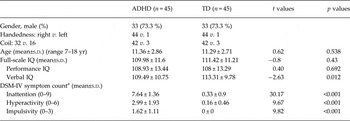
Youths with ADHD were recruited consecutively at the Department of Psychiatry, National Taiwan University Hospital. They were clinically diagnosed with ADHD according to the DSM-IV-TR diagnostic criteria, and confirmed by the psychiatric interviews with the Chinese version of the K-SADS-E. The TD youths, referred by the school principals and teachers, were recruited from the same school districts as the ADHD group. They and their parents also received the Chinese K-SADS-E interview to confirm that they did not have lifetime or current ADHD diagnosis and other psychiatric disorders. Exclusion criteria for all the participants include psychosis, mood disorders, learning disability, substance use disorder, autism spectrum disorder, neurological disorders, current diagnosis of anxiety disorders, or a full-scale IQ score <80. Of the eligible 53 pairs of youths with ADHD and individually sex-, age-, handedness-, IQ-, and coil-matched TD youths, eight ADHD patient-control pairs were excluded due to the suboptimal quality of the imaging data. A total of 45 ADHD patients and 45 controls remained in the final analysis (Table 1, detailed information about DSI quality assurance is provided in the Supplementary Material). Among the 45 youths with ADHD, 22 (49%) were of the combined type, 22 (49%) were of the predominantly inattentive type, and one (2%) was of the predominantly hyperactivity/impulsivity type. Ten of them had been treated with methylphenidate before or currently, and treatment of methylphenidate was discontinued at least 1 week before neuropsychological and magnetic resonance imaging (MRI) assessment.
Demographics, IQ, ADHD subtype, ADHD symptoms of children with ADHD and typically developing children

s.d., Standard deviation; IQ, intelligence quotient; ADHD, attention deficit hyperactivity disorder; TD, typically developing children.
a Based on psychiatric interview using the Kiddie-SADS-E interviews of the current symptoms.
A subset of the sample (10 of 45 ADHD youths, 20 of 45 TD youths) was included in a previously published work using a different DSI analysis method (Shang et al. Reference Shang, Wu, Gau and Tseng2013). However, the study hypotheses of this study are different from those in Shang et al. (Reference Shang, Wu, Gau and Tseng2013). Shang et al. (Reference Shang, Wu, Gau and Tseng2013) only focused on the FS tracts, while the current study focused on the association between EF and the microstructural property of other major fibre tracts (i.e. SLF, AF, CB) based on different DSI method (Large Deformation Diffeomorphic Metric Mapping, LDDMM), under the consideration of the effect of FS tracts on other target fibre tracts.
Clinical measures
Chinese version of the K-SADS-E
The K-SADS-E is a semi-structured interview scale for the systematic assessment of both lifetime and current diagnosis of mental disorders in children and adolescents. The preparation of the Chinese K-SADS-E includes a two-stage translation and modification of several items with psycholinguistic equivalents relevant to the Taiwanese culture and further modification to meet DSM-IV diagnostic criteria (Gau et al. Reference Gau, Chong, Chen and Cheng2005). The Chinese K-SADS-E is a reliable and valid instrument to assess DSM-IV child and adolescent psychiatric disorders, and has been widely used in a variety of studies regarding childhood mental disorders [e.g. clinic-based research (Gau & Shang, Reference Gau and Shang2010a ; Gau et al. Reference Gau, Lin, Cheng, Chiu, Tsai and Soong2010, Reference Gau, Tseng, Tseng and Wu 2014 ; Shang et al. Reference Shang, Gau, Liu and Hwu2011; Tseng & Gau, Reference Tseng and Gau2013; Gau & Huang, Reference Gau and Huang2014), and clinical trials (Gau & Shang, Reference Gau and Shang2010b ; Ni et al. Reference Ni, Lin, Gau, Huang and Yang2013)] to make the psychiatric diagnoses in child and adolescent populations in Taiwan.
Chinese version of the Swanson, Nolan, and Pelham, version IV scale (SNAP-IV) – Parent Form
The Chinese SNAP-IV is a 26-item rating scale with nine items for inattention symptoms, nine items for hyperactivity/impulsivity symptoms and eight items for oppositional symptoms according to DSM-IV symptom criteria of ADHD and oppositional defiant disorder (ODD). Items are rated as a 4-point Likert scale (0, not at all; 1, just a little; 2, quite a lot; 3, very much). The norm and psychometric properties of the Chinese SNAP-IV – Parent Form have been established (Gau et al. Reference Gau, Shang, Liu, Lin, Swanson, Liu and Tu2008). The Chinese SNAP-IV has been widely used in assessing ADHD and ODD symptoms in clinical and research settings in Taiwan (e.g. Shang et al. Reference Shang, Wu, Gau and Tseng2013; Yang et al. Reference Yang, Tai, Yang and Gau2013; Chien et al. Reference Chien, Gau, Chiu, Tsai, Shang and Wu2014). We used the symptom-count criterion from the full diagnostic criteria of DSM-IV to demonstrate the severity of ADHD symptoms in this study.
EF measures
The CANTAB is a computerized test battery which has been validated and widely used worldwide (Gau et al. Reference Gau, Chiu, Shang, Cheng and Soong2009; Chamberlain et al. Reference Chamberlain, Robbins, Winder-Rhodes, Muller, Sahakian, Blackwell and Barnett2011). It is designed to be administered by trained psychologists with standardized procedures. Five tasks of the CANTAB involving EF were administered to all the participants in this study (Gau & Shang, Reference Gau and Shang2010a ; Shang et al. Reference Shang, Wu, Gau and Tseng2013).
Intra-extra dimensional set shift (IED)
The IED, a computerized analogue of the Wisconsin Card Sorting test, is used to assess an individual's ability to selectively maintain attention on the specific attribute of compound stimuli across different examples, or intra-dimensional shift (e.g. colour-filled shapes remain the only relevant dimension), and then to shift their attention to a previously irrelevant attribute of stimuli, or extra-dimensional shift (white lines become the only relevant dimension) (Downes et al. Reference Downes, Roberts, Sahakian, Evenden, Morris and Robbins1989). After six correct consecutive responses, the computer changes the sorting rules. Two major indices were included in the present study: (1) adjusted total errors: calculated by adding 25 for each stage not attempted due to failure; and (2) adjusted total trials: adding 50 for each stage not attempted due to failure at an earlier stage.
Rapid visual information processing (RVP)
The RVP, a 4-min visual continuous performance test, is designed to assess sustained attention. Digits, from 2 to 9 in a random order, appear one at a time at a rate of 100 digits per minute in the centre of the screen. The participant has to detect three target sequences (2–4–6, 3–5–7, 4–6–8) and respond when the last number is seen (6, 7, 8, respectively). The participant was instructed to detect as many target sequences (27 in total) as possible. Three indices were presented in the present study: (1) probability of false alarms (the participant responding inappropriately): total false alarms divided by the sum of total false alarms and total correct rejections; (2) B″: a signal detection measure of the strength of trace required to elicit a response and lower score indicates higher response tendency; and (3) mean latency: mean time taken to respond in correct responses.
Spatial span
This task measures spatial short-term memory and is the visuospatial analogue of the digit span test. Nine white boxes were presented in fixed locations on the screen. The colour of the boxes changed one after the other in a predetermined sequence. Participants were required to remember the order of the boxes in which the colour was changed, and to point to the boxes on the screen in the order as previously presented by the computer. The task begins at the 2-box level then gradually maximally increases to the 9-box level. There are three sequences at each level. If the participant fails in all three sequences at a particular level the test will terminate. Two indices were used in the present study: (1) span length: the longest sequence successfully recalled; and (2) total usage errors: the number of times a box was selected that was not in the sequence being recalled.
Spatial working memory (SWM)
This task assesses non-verbal working memory based on a self-ordered search test (Luciana & Nelson, Reference Luciana and Nelson1998). Participants were asked to search through a number of coloured boxes presented on the screen to find a blue token hidden inside. The participants had to memorize the boxes which had been opened in each trial and the boxes in which the tokens had been found in the previous trial. Two indices were used in this study: (1) total errors: total times the participant visits a box that is sure not to have a blue token, i.e. either a token inside in previous trial or empty in this trial; and (2) strategy utilization: the number of search sequences starting with a novel box to assess the ability of participants to adopt a sequential search pattern, so that a higher score indicated poorer use of strategy.
Stocking of Cambridge (SOC)
The SOC task assesses spatial planning based on the Tower of London test (Luciana & Nelson, Reference Luciana and Nelson1998), and requires the participants to move balls according to a goal position with given orders and locations. Three suspended vertical stockings and three coloured balls were presented on the monitor screen, and participants were required to move the coloured balls to accomplish a goal position within a specified number of moves. Three major indices are presented in this article: (1) problems solved in the specified minimum number of moves: the number of occasions which were successfully completed in the minimum possible number of moves; (2) total moves: the total number of moves taken in excess of the specified minimum moves but within the maximum allowed; and (3) initial thinking time: the difference in reaction time taken to select the first ball for the same problem under the two conditions.
MRI data acquisition
MRI data were acquired on a 3-T MRI machine (Trio, Siemens, Germany) with a 32-channel phased-array head coil except three dyads with a 16-channel phased-array head coil (Table 1). A sagittal localizer was used to define a line between the anterior commissure and posterior commissure, which was then used to define imaging planes orthogonal to it. T1-weighted images covering the whole head were acquired using a 3D magnetization-prepared rapid gradient echo (MPRAGE) sequence, repetition time (TR) = 2530 ms; echo time (TE) = 3.4 ms; slice thickness = 1.0 mm; matrix size = 256 × 192 × 208; and field of view (FOV) = 256 × 192 × 208 mm3. Transaxial DSI data were acquired using a pulsed-gradient spin-echo EPI sequence with a twice-refocused balanced echo (Reese et al. Reference Reese, Heid, Weisskoff and Wedeen2003). An acquisition scheme which comprised 102 diffusion-weighted image (DWI) volumes (101 diffusion gradient vectors + 1 null image) corresponding to the grid points within a half sphere of the q-space (DSI 102) were applied with the maximum diffusion sensitivity value (b max) set to 4000 s/mm2 (Kuo et al. Reference Kuo, Chen, Wedeen and Tseng2008). Other acquisition parameters were TR = 9600 ms; TE = 130 ms; matrix size = 80 × 80; FOV = 200 × 200 mm2; slice number = 56 and slice thickness = 2.5 mm without gap. The scan time for DSI acquisition was approximately 16.5 min.
DSI reconstruction
The acquired DSI data allowed us to reconstruct the diffusion probability density function (PDF) based on the Fourier relationship between the PDF and q-space signal. Within each voxel, there were 102 samples at the grid points within a half sphere of the q-space. These 102 samples were projected around the origin to fill the other half sphere based on the fact that the q-space data were symmetric around the origin. The eight corners outside the sphere were filled with zeros, resulting in a 7 × 7 × 7 data grid in the q-space. A Hanning filter of 17 units in width was applied to the q-space data, followed by a 3D Fourier transform of the q-space signal to obtain the PDF. The orientation distribution function [ODF, ψ(u)] was computed by obtaining the second moment of the PDF along each of the 362 radial directions (6-fold tessellated icosahedron). At each voxel, generalized fractional anisotropy (GFA) was quantified in terms of s.d.(ψ)/RMS(ψ), where s.d. is the standard deviation and RMS is the root mean square. The GFA indicates the directionality of the ODF and ranges from zero (when diffusion is completely random in three dimensions) to one (when diffusion is extremely restricted to one dimension only) (Tuch, Reference Tuch2004). To determine the local tract directions in each voxel, an iterative approach was used to decompose the ODF into several constituent Gaussian ODFs (Yeh et al. Reference Yeh, Wedeen and Tseng2011). The resulting local tract direction field was obtained for tractography.
Tract-specific analysis
To avoid subjective variation arising from manual tractography, a template-based approach was employed. The procedures are illustrated in Supplementary Fig. S1. A study-specific DSI template was constructed from all the recruited participants using a nonlinear registration method under the framework of LDDMM (Hsu et al. Reference Hsu, Hsu and Tseng2012). A streamline-based algorithm adapted for DSI data (Yeh et al. Reference Yeh, Verstynen, Wang, Fernandez-Miranda and Tseng2013) was performed on the study-specific DSI template, and 12 target tract bundles were reconstructed using expert-monitored multiple regions of interest (ROIs) approach (Lo et al. Reference Lo, Soong, Gau, Wu, Lai, Yeh, Chiang, Kuo, Jaw and Tseng2011) based on Automatic Anatomical Labeling (AAL) system (Tzourio-Mazoyer et al. Reference Tzourio-Mazoyer, Landeau, Papathanassiou, Crivello, Etard, Delcroix, Mazoyer and Joliot2002). Having segmented each target tract bundle on the study-specific DSI template, the coordinates of streamlines were aligned along the proceeding direction of each tract bundle and were saved as the sampling coordinates. The sampling coordinates of target tracts were then transformed from the study-specific DSI template to individual DSI dataset according to the established transformation between the study-specific DSI template and the individual DSI dataset in native space. Consequently, the GFA values of each target tract were sampled on the corresponding sampling coordinates in native space.
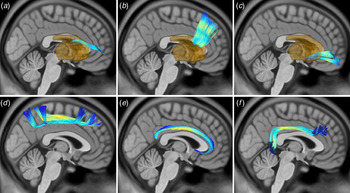
The target tracts included bilateral FS tracts, i.e. striatum-ventral lateral prefrontal cortex (VLPFC), striatum-dorsal lateral prefrontal cortex (DLPFC), and striatum-orbital frontal cortex (OFC), SLF (the combination of SLF I, SLF II, and SLF III), CB, and AF (Fig. 1). For the FS tracts, ROIs were placed at the striatum (putamen + caudate) and the prefrontal cortical regions. The VLPFC was defined as the combination of the inferior frontal gyrus and middle frontal gyrus. The DLPFC was defined as the combination of the medial frontal gyrus and superior frontal gyrus. The OFC was defined as the combination of the middle orbitofrontal gyrus, superior orbitofrontal gyrus, medial orbitofrontal gyrus, and inferior orbitofrontal gyrus. For the SLF, the ROIs were placed at the superior frontal gyrus and precuneus (SLF I), at the triangular part of the inferior frontal gyrus and middle occipital gyrus (SLF II), and at the opercular part of the inferior frontal gyrus and angular gyrus (SLF III). For the CB, the ROIs were placed at the anterior, middle, and posterior parts of the cingulate gyrus. For the AF, the ROIs were placed at the opercular part of the inferior frontal gyrus and superior temporal gyrus. The coordinates of these ROIs in AAL were transformed to the study-specific DSI template via the transformation between the study-specific DSI template and the ICBM 152 template using a ‘Dartel’ toolbox in SPM 12 (Ashburner & Friston, Reference Ashburner and Friston2011). Streamlines that passed through the selected ROIs simultaneously were segmented as a tract bundle. DSI tractography was performed using DSI Studio (http://dsi-studio.labsolver.org). Tract bundles were verified to ensure the consistency with the established anatomical landmarks (Wakana et al. Reference Wakana, Nagae-Poetscher, Jiang, van Zijl, Golay and Mori2005).
Reconstruction of the targeted tracts in the right hemisphere. (a) Striatum-ventrolateral prefrontal tract; (b) striatum-dorsolateral prefrontal tract; (c) striatum-orbitofrontal tract; (d) superior longitudinal fasciculus I, II and III; (e) cingulum bundle; (f) arcuate fasciculus. The regions of interest at the striatum (brown) are shown in (a)–(c).

Statistical analyses
Data analysis was conducted using SAS version 9.2 (SAS Institute Inc., USA). The alpha value was preselected at the level of p < 0.05. The descriptive results are displayed as the mean and s.d. for the continuous variables. Because of the matched case-control study design, we used paired t test to compare the mean scores of IQ, ADHD symptom counts, the CANTAB performance, and the GFA values of the white-matter tracts between the ADHD and TD groups. Cohen's d was computed to indicate small (d=0.2–0.5), medium (d=0.5–0.8), and large (d>0.8) effect sizes.
To control for the inflation of Type I error in computing multiple bivariate correlations, multiple linear regression models with the backward elimination procedure were conducted to determine the relationship between the indexes of EF and the GFA values of the 12 fibre tracts: bilateral FS tracts, including striatum-VLPFC, striatum-DLPFC, and striatum-OFC, SLF, AF and CB, as independent variables. The GFA values of the 12 targeted tracts were entered as independent variables, and each of the index on the CANTAB tasks, as the dependent variables. We used backward elimination procedure to identify the fitted model containing the variables from these 12 tracts which maintained significant effects on each of the measures. The R 2 values were calculated to present the proportion of the variance of each measure that can be explained by the microstructural property, presented by the GFA values, of some of the fibre tracts in the final fitted model. Because we wanted to investigate disease-specific patterns between white-matter tracts and EF in youths with ADHD, which was hypothesized to be different from the patterns in TD youths, we conducted the above-mentioned multivariate regression analyses stratifying by the ADHD and TD groups. We also tested the interactions between group and mean GFA value of tracts on the indexes of EF to decide whether the magnitude of the associations between tract GFA values and EF varied between the two groups.
Results
Demographics
As expected, we found no significant group differences in the distribution of gender, handedness, age, full-scale IQ, performance IQ, and the type of coil used during MRI assessment between youths with ADHD and TD youths. Youths with ADHD had lower verbal IQ than TD youths (Table 1).
Microstructural property
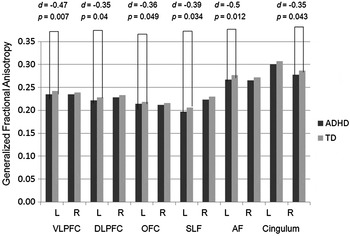
Compared to TD youths, youths with ADHD had significantly lower mean GFA values in all three left FS tracts (i.e. striatum-VLPFC, striatum-DLPFC, striatum-OFC), left SLF, left AF and right CB (Fig. 2 and Supplementary Table S1) with small effect sizes (Cohen's d=0.35–0.5).
Comparisons of the mean generalized fractional anisotropy for bilateral striatum-dorsolateral (DLPFC), striatum-ventrolateral (VLPFC), striatum-orbitofrontal (OFC), superior longitudinal fasciculus (SLF); arcuate fasciculus (AF) between youths with attention deficit hyperactivity disorder (ADHD) and typically developing (TD) youths. L, Left; R, right; d, Cohen's d.

EF
Youths with ADHD tended to perform worse than TD youths in some indexes of the CANTAB tasks involving EF with medium to large effect sizes (Cohen's d=0.47–0.81) (Supplementary Table S2). Compared to TD youths, youths with ADHD had significantly more total errors and total trials to complete the tasks in IED, had lower response tendency as indexed by RVP B″ value, and fewer problems solved in minimum moves, more total moves needed and shorter mean initial thinking time in SOC.
Correlations of fibre tract property with ADHD symptoms
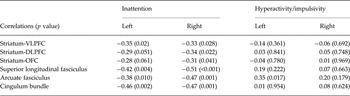
Using the ADHD symptoms assessed by SNAP-IV, the GFA values of bilateral striatum-VLPFC tracts, right striatum-DLPFC tract, right striatum-OFC tract, bilateral SLF, AF and CB were negatively correlated with inattention symptoms in youths with ADHD (p < 0.05, Table 2). Instead, the GFA values of these targeted tracts did not correlate with hyperactivity/impulsivity symptoms, except for positive association with the left AF.
Correlations between fibre tract microstructural property and ADHD symptoms in youths with ADHD

ADHD, Attention deficit hyperactivity disorder; TD, typically developing children; VLPFC, ventrolateral prefrontal cortex; DLPFC, dorsolateral prefrontal cortex; OFC, orbitofrontal cortex.
Correlations of fibre tract property with performance of EF
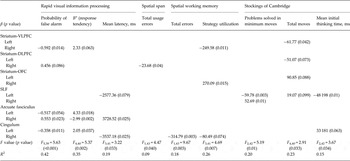
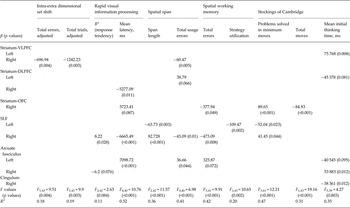
Association patterns of the microstructural property of fibre tracts, indicated by the GFA values, with indexes of EF in the final fitted model were presented separately in TD youths (Table 3) and in youths with ADHD (Table 4). In addition to FS tracts, CB was associated with most of the EF (i.e. sustained attention, working memory and planning) in TD youths, while SLF and AF were associated with most of the EF (i.e. sustained attention, short-term memory, working memory and planning) in youths with ADHD. Additionally, the left striatum-OFC tract and left CB were not correlated with any EF in youths with ADHD.
Final models of the link between white-matter tracts and executive functions in typically developing children

β, Estimate of regression coefficient; RT, reaction time; s.e., standard errors; ISI, inter-stimulus intervals; VLPFC, ventrolateral prefrontal cortex; DLPFC, dorsolateral prefrontal cortex; OFC, orbitofrontal cortex; SLF, superior longitudinal fasciculus.
Final models of the link between white-matter tracts and executive functions in children with ADHD

ADHD, Attention deficit hyperactivity disorder; β, estimate of regression coefficient; RT, reaction time; s.e., standard errors; ISI, inter-stimulus intervals; VLPFC, ventrolateral prefrontal cortex; DLPFC, dorsolateral prefrontal cortex; OFC, orbitofrontal cortex; SLF, superior longitudinal fasciculus.
Specifically, the striatum-VLPFC tract property was significantly associated with performance of spatial sustained attention (RVP), working memory (SWM) and planning (SOC) in TD youths, while with set-shifting (IED), short-term memory (spatial span) and planning (SOC) in youths with ADHD. The striatum-DLPFC tract property was significantly associated with the performance of sustained attention, short-term memory and planning in TD youths as well as in youths with ADHD. The striatum-OFC tract property was significantly associated with the performance of working memory and planning in TD youths, while with sustained attention, working memory and planning in youths with ADHD. The SLF tract property was significantly associated with the performance of sustained attention and planning in TD youths, while with sustained attention, short-term memory, working memory and planning in youths with ADHD. The AF tract property was significantly associated with the performance of sustained attention in TD youths, while with sustained attention, short-term memory, working memory and planning in youths with ADHD. The CB tract property was significantly associated with the performance of sustained attention, short-term memory, working memory and planning in the TD youths, while only with planning in youths with ADHD.
Interactions between the diagnostic group (ADHD v. TD) and fibre tract microstructural properties on the indexes of EF
We further test the interactions between group and mean GFA value of tracts on the indexes of EF. Statistical significance of interaction terms are noted in several tracts in terms of different indexes, including the left striatum-VLPFC tract with sustained attention (p = 0.009) and short-term memory (p = 0.047); the right striatum-VLPFC tract with set shitting (p = 0.028 in total errors; p = 0.021 in total trials); the right striatum-DLPFC tract with and sustained attention (p = 0.042) and planning (p = 0.033 in problems solved in minimum moves; p = 0.022 in total moves); the left striatum-OFC tract with sustained attention (p = 0.008) and planning (p = 0.028 in problems solved in minimum moves; p = 0.019 in total moves); the right striatum-OFC tract with working memory (p = 0.017) and planning (p < 0.001 in problems solved in minimum moves; p = 0.002 in total moves); the right SLF with sustained attention (p = 0.02), short-term memory (p = 0.005 in span length; p = 0.044 in total usage errors) and working memory (p = 0.003); the left SLF with working memory (p = 0.038) and planning (p = 0.037); and the right CB with working memory (p = 0.011) and planning (p = 0.045) (Supplementary Table S3).
Discussion
We conducted a strictly individually matched case-control diffusion imaging study with the strengths of comprehensive investigation of several major fibre tracts hypothesized to be involved with EF, use of the state-of-the-art DSI tractography analysis, and assessment of multiple dimensions of EF in a relatively larger sample than previous investigation. This study demonstrated that youths with ADHD had lower GFA in the left FS tracts, left SLF, left AF and right CB, and presented probably different association patterns of fibre tract microstructural property and EF between youths with ADHD and TD youths.
FS tracts and EF
Early studies investigating white-matter property in ADHD mainly focused on FS tracts, but most of them did not report the difference in the left and right sides (Pavuluri et al. Reference Pavuluri, Yang, Kamineni, Passarotti, Srinivasan, Harral, Sweeney and Zhou2009; de Zeeuw et al. Reference de Zeeuw, Mandl, Hulshoff Pol, van Engeland and Durston2012). Our finding of significantly decreased GFA in only the left FS tracts in ADHD youths is supported by the collateral evidence that youths with ADHD had reduced white-matter volume specific to the left hemisphere (Mostofsky et al. Reference Mostofsky, Cooper, Kates, Denckla and Kaufmann2002).
Our findings that FS tracts property is associated with EF in both ADHD and TD youths are consistent with some of previous studies (Shang et al. Reference Shang, Wu, Gau and Tseng2013). Our findings of the association of EF with FS tracts connecting the bilateral striatum-VLPFC, -DLPFC and -OFC tracts in both groups except no association of the left striatum-OFC tract with EF in youths with ADHD suggest that altered striatum-OFC tract by demonstrating the loss of the association between its microstructural property and EF in youths with ADHD might contribute to observed impaired EF among youths with ADHD.
SLF and EF
Our finding of decreased GFA of the left SLF in youths with ADHD is consistent with previous studies (Hamilton et al. Reference Hamilton, Levitt, O'Neill, Alger, Luders, Phillips, Caplan, Toga, McCracken and Narr2008; Pavuluri et al. Reference Pavuluri, Yang, Kamineni, Passarotti, Srinivasan, Harral, Sweeney and Zhou2009; Lawrence et al. Reference Lawrence, Levitt, Loo, Ly, Yee, O'Neill, Alger and Narr2013; King et al. Reference King, Yurgelun-Todd, Stoeckel, DiMuzio and Lopez-Larson2015), but inconsistent with Lawrence et al. reporting only difference in mean diffusivity, rather than fractional anisotropy (Lawrence et al. Reference Lawrence, Levitt, Loo, Ly, Yee, O'Neill, Alger and Narr2013). Besides, our study design is unique because we investigated the association between EF and other white-matter tracts under consideration of the effect of the FS tracts. We found that the SLF tract property is associated with sustained attention, short-term memory, working memory and planning in the ADHD group, but only with sustained attention and planning in the TD group. Our results are consistent with others reporting the association between working memory and the structural connectivity of the left (Vestergaard et al. Reference Vestergaard, Madsen, Baare, Skimminge, Ejersbo, Ramsoy, Gerlach, Akeson, Paulson and Jernigan2011) and bilateral (Peters et al. Reference Peters, Szeszko, Radua, Ikuta, Gruner, DeRosse, Zhang, Giorgio, Qiu, Tapert, Brauer, Asato, Khong, James, Gallego and Malhotra2012) SLF in TD youths.
AF and EF
To the best of our knowledge, this is the first study to report decreased diffusion anisotropy of AF in ADHD. Previous studies have reported associations of AF with the performance of set-shifting test (Kucukboyaci et al. Reference Kucukboyaci, Girard, Hagler, Kuperman, Tecoma, Iragui, Halgren and McDonald2012) and visual attention (Lebel et al. Reference Lebel, Warner, Colby, Soderberg, Roussotte, Behnke, Davis Eyler and Sowell2013) in healthy controls. Since problems in attention and set-shifting are frequently reported in ADHD (Shang et al. Reference Shang, Wu, Gau and Tseng2013; Wu et al. Reference Wu, Gau, Lo and Tseng2014), it is not surprising that AF was one of the altered white-matter tracts of ADHD in the current study.
Although the AF is well known to be responsible for language function, recent studies demonstrated that the AF is a long segment of the SLF connecting the temporal lobe with the lateral frontal cortex, a broader region than the Broca's area (Martino et al. Reference Martino, De Witt Hamer, Berger, Lawton, Arnold, de Lucas and Duffau2013). Therefore, the current study provides evidence to support that the AF may involve in the networks of cognitive functions other than language in TD youths and youths with ADHD as well. We also demonstrate that the microstructure property of AF was associated with most of the EF (except the performance of set-shifting) in ADHD youths, but only with the performance of the sustained attention in TD youths. Because youths with ADHD had lower verbal IQ than TD youths in the current study, we also examined the correlation between the GFA values of the AF and verbal IQ, and found no correlation in both groups.
CB and EF
Our finding of decreased diffusion anisotropy in the right CB is consistent with some studies of adults with childhood ADHD (Makris et al. Reference Makris, Buka, Biederman, Papadimitriou, Hodge, Valera, Brown, Bush, Monuteaux, Caviness, Kennedy and Seidman2008) and youths with ADHD (Silk et al. Reference Silk, Vance, Rinehart, Bradshaw and Cunnington2009; Peterson et al. Reference Peterson, Ryan, Rimrodt, Cutting, Denckla, Kaufmann and Mahone2011), but is not supported by other studies in youths with ADHD (Hamilton et al. Reference Hamilton, Levitt, O'Neill, Alger, Luders, Phillips, Caplan, Toga, McCracken and Narr2008; Lin et al. Reference Lin, Gau, Huang-Gu, Shang, Wu and Tseng2014). With a larger sample size, our findings may provide more convincing evidence. The CB has been reported to be associated with sustained attention (Takahashi et al. Reference Takahashi, Iwamoto, Fukatsu, Naganawa, Iidaka and Ozaki2010) and EF (Peters et al. Reference Peters, Ikuta, Derosse, John, Burdick, Gruner, Prendergast, Szeszko and Malhotra2014) in healthy subjects, and with intra-individual variability in reaction time in youths with ADHD (Lin et al. Reference Lin, Gau, Huang-Gu, Shang, Wu and Tseng2014). Unlike the microstructure property of the SLF and AF, which are associated with more domains of EF in ADHD youths, the CB seems to better explain the performance of EF in TD youths in the current study. The different association patterns lend evidence to support the hypothesis that ADHD may engage adaptive processing strategies to compensate for impairments in EF (Coghill et al. Reference Coghill, Hayward, Rhodes, Grimmer and Matthews2014) and also in other brain regions (Fassbender & Schweitzer, Reference Fassbender and Schweitzer2006). That is, some EF depending on the CB in TD youths might get compensation from the SLF and AF in youths with ADHD.
Methodological consideration
Our study has some limitations. First, whether the different diffusion anisotropy of white-matter tracts in youths with ADHD reflects the underlying neuropathology of ADHD or the consequences of a compensatory neurodevelopment process cannot be determined in this cross-sectional study. Second, long-term effects of medication on microstructural property may exist in ten youths with ADHD who ever treated with methylphenidate in this study, although no significant differences in fractional anisotropy between medicated and drug-naive children with ADHD has been reported in a recent DTI study (de Luis-Garcia et al. Reference de Luis-Garcia, Cabus-Pinol, Imaz-Roncero, Argibay-Quinones, Barrio-Arranz, Aja-Fernandez and Alberola-Lopez2015). We also try to minimize the influence of medication that all of our medicated youths had discontinued methylphenidate at least 1 week before neuropsychological and MRI assessment. Third, due to the low percentage of hyperactive-impulsive type in the ADHD group, our results may be more applicable to youths with ADHD, combined type and those with inattentive type. Fourth, due to restricting the sample to a more homogenous group by inclusion and exclusion criteria, generalization of the findings to other populations is questionable. Lastly, due to the scarce literature on this topic, we presented original statistical results to allow readers to evaluate the importance and significance of the results without adjusting for multiple comparisons (Veazie, Reference Veazie2006).
Conclusion
This study provides strong evidence that the SLF, AF and CB also involve in the core neuropathological underpinnings of ADHD. Additionally, differential association patterns between youths with ADHD and TD youths imply the possible compensatory mechanism. Studies to examine other fibre tracts theoretically associated with ADHD neuropathology, to collect longitudinal data to shed light on the developmental trajectories of different diffusion anisotropy of white-matter tracts in ADHD are warranted.
Supplementary material
For supplementary material accompanying this paper visit http://dx.doi.org/10.1017/S0033291715002767
Acknowledgements
This work was supported by grants from the National Science Council (NSC99-2627-B-002-015, NSC100-2627-B-002-014, NSC101-2627-B-002-002, NSC101-2321-B-002-079), National Taiwan University Hospital (NTUH101-S1910), and Ministry of Economic Affairs (101-EC-17-A-19-S1-175), Taiwan. The manuscript preparation was supported by National Health Research Institute (NHRI-EX102-10008PI), Taiwan. (ClinicalTrials.gov number: NCT01677793, NCT00916851.)
Declaration of Interest
None.