1 Phonological markedness and linguistic behaviour
A central concern of generative phonological theory is to characterise the relative well-formedness of phonological structures. In this paper we will use the term markedness to refer to distinctions in well-formedness (where well-formed structures are unmarked and ill-formed structures are marked). We adopt a broad definition of markedness, encompassing binary as well as gradient well-formedness distinctions both within a language and across languages. The characterisation of markedness distinctions has played a central role in accounting for ‘internal’ evidence (Zwicky Reference Zwicky1980) regarding the distribution of phonological structures within and across human languages. However, many theorists have claimed that markedness plays a central role in all aspects of phonological cognition – i.e. the production, perception and acquisition of phonological structures and patterns (e.g. Jakobson Reference Jakobson1941, Smolensky et al. Reference Smolensky, Legendre, Tesar, Smolensky and Legendre2006).
One particular aspect of linguistic behaviour that has been claimed to be influenced by markedness is speech errors – unintentional deviations from some target linguistic form of an utterance. For example, when producing utterances quickly, speakers often switch two sounds occurring in similar environments (e.g. she sells may be misproduced as see shells). A long tradition of research claims that error probabilities are influenced by markedness. For example, Jakobson (Reference Jakobson1941) claims that universal markedness principles influence errors arising subsequent to neurological impairments (see Blumstein Reference Blumstein1973 for the first of many studies exploring these claims more systematically). As we review in more detail in §2, a substantial body of work suggests that although errors arising within phonological processes in production result in both marked and unmarked outcomes, such errors are biased to produce unmarked structures. For example, in coda position voiced obstruents (e.g. /d/) are often assumed to be marked relative to voiceless obstruents (e.g. /t/ – this accounts for processes such as final devoicing; Lombardi Reference Lombardi1999). Errors not only change relatively marked structures into unmarked structures (e.g. /d/→[t]); at a lower frequency errors also change unmarked outputs into marked outputs (e.g. /t/→[d]).
Although a great deal of empirical work has examined broad correlations between various indices of markedness (e.g. typological and within-language frequency) and speech-error probabilities (see §2 for a review), little work has addressed the question of how to link specific grammatical theories to speech-error distributions. In §§3 and 4 of the paper, we address this question in the context of Optimality Theory (OT; Prince & Smolensky Reference Prince and Smolensky1993) and the related formalism of Harmonic Grammar (HG; Legendre et al. Reference Legendre, Miyata and Smolensky1990, Smolensky & Legendre Reference Smolensky, Legendre, Smolensky and Legendre2006a). In §3, we discuss how many existing grammatical accounts of probabilistic behaviour are not appropriate models for speech errors; they cannot account for the occurrence of errors in which unmarked structures are replaced by structures that are more marked along all dimensions of representation (i.e. harmonically bound outputs). In §4 we propose a novel mechanism for linking grammars to speech-error data. We show that stochastic disruption to the computational mechanisms realising an HG can account for the broad empirical patterns of speech errors. We document specific methods for linking particular HGs to speech-error distributions and illustrate their application to a set of speech-error data from English.
2 The markedness asymmetry in speech errors
Speech errors are unintentional deviations from the target form one intends to produce. Of interest here are errors targeting phonological structures; for example, in spoonerisms the initial portion of two words exchange (e.g. dear old queen→queer old dean). These errors can arise spontaneously, in experimental tasks (e.g. tongue twisters), as well as subsequent to acquired neurological impairments (e.g. aphasia). Errors have played a central role in the development of psycholinguistic theories of speech production (see Meyer Reference Meyer1992 for a critical review of evidence from spontaneous and experimentally induced errors, and Rapp & Goldrick Reference Rapp and Goldrick2006 for a review of evidence from aphasia).
A number of studies have shown that the probability of an error resulting in a relatively unmarked structure tends to be greater than the probability of an error resulting in a more marked structure. For example, in English, the consonant [h] is subject to a phonotactic constraint that prevents it from occurring in coda position. Consistent with the markedness of /h/ in this prosodic position in English, English speech errors resulting in [h] are much more likely to appear in onset position than coda position (e.g. errors like /mæd/→[hæd] are much more likely than errors like /dæm/→[dæh]). We refer to this asymmetry in error probabilities as the markedness asymmetry. The sections below review data from spontaneous speech-error corpora, experimentally induced speech errors and neurological impairment that document this asymmetry.
2.1 Categorical markedness distinctions
The English example above illustrates a case where an error outcome is illegal – i.e. categorically marked within a language. Analyses of a number of spontaneous speech-error corpora in a number of languages have shown that illegal error outcomes have much lower probability than legal outcomes (Arabic: Abd-El-Jawad & Abu-Salim Reference Abd-El-Jawad and Abu-Salim1987; English: Vousden et al. Reference Vousden, Brown and Harley2000; German: MacKay Reference MacKay1972; Mandarin: Wan & Jaeger Reference Wan and Jaeger1998). Similar results have been reported in cases of acquired speech-production impairments. For example, the speech of individuals with ‘jargon aphasia’ (fluent but semantically empty speech composed of both words and non-words) is typically reported to respect the phonotactic constraints of the individual's native language (see Marshall Reference Marshall2006 for a review).
However, it is important to note (contra many early analyses of speech errors) that although legal errors are more likely than illegal errors, both types of errors occur. Illegal errors are occasionally observed in spontaneous speech-error corpora (Stemberger Reference Stemberger1983). Experimental studies have reported large numbers of errors that violate phonotactic constraints on segment sequences (e.g. English: Butterworth & Whittaker Reference Butterworth, Whittaker, Stelmach and Requin1980). Similarly, in experimental studies where participants acquire novel categorical phonotactic constraints (e.g. English speakers acquire a constraint banning /f/ in coda), participants' speech errors will occasionally violate the novel phonotactic constraint (Dell et al. Reference Dell, Reed, Adams and Meyer2000, Goldrick Reference Goldrick2004, Taylor & Houghton Reference Taylor and Houghton2005, Warker & Dell Reference Warker and Dell2006, Goldrick & Larson Reference Goldrick and Larson2008, Warker et al. Reference Warker, Dell, Whalen and Gereg2008). Markedness constraints on individual segments are also violated in speech errors. Instrumental studies have shown that in experimental tasks participants' productions can be composed of illegal combinations of gestures (e.g. simultaneous tongue-tip and tongue-dorsum raising during the production of an English stop; Goldstein et al. Reference Goldstein, Pouplier, Chen, Saltzmann and Byrd2007, Pouplier Reference Pouplier2007, Reference Pouplier2008); similarly, acoustic studies have shown that errors can result in segments outside the speaker's native language inventory (Laver Reference Laver, Dechert and Raupach1980).Footnote 1 At multiple levels of phonological structure, then, speech errors can result in both legal and illegal structures; however, the former are more likely to occur.
2.2 Gradient markedness distinctions
Within any particular language, a large set of structures is legal. Within this set, many theories distinguish varying degrees of markedness. One criterion for distinguishing less from more marked legal structures within a language is their cross-linguistic markedness – as assessed by typological frequency in inventories, susceptibility to phonological processes, etc. For example, although English admits both [s] and [z] word-finally, [z] is cross-linguistically marked relative to [s] in this position (Lombardi Reference Lombardi1999). Another criterion often invoked is frequency (both type and token); within a language, certain sounds or sound sequences are relatively more common (both across the lexicon and across utterances). For example, because [z] is less frequent than [s] in English, some theories assume it to be more marked. As suggested by this example, these two criteria are difficult to distinguish; in general, cross-linguistically marked structures are infrequent (Zipf Reference Zipf1935, Greenberg Reference Greenberg1966, Berg Reference Berg1998, Frisch Reference Frisch, Broe and Pierrehumbert2000). For the purposes of this discussion, we will not distinguish among these various criteria. Instead, we focus more broadly on the influence of gradient markedness distinctions within a language (as determined by some criterion) on the probability of speech errors.
Studies of experimentally induced speech errors (all in English) have shown that errors on non-word targets are more likely to occur on low-frequency vs. high-frequency structures (Kupin Reference Kupin1982); furthermore, when an error occurs under these conditions, it is more likely to result in a high-frequency vs. low-frequency structure (Motley & Baars Reference Motley and Baars1975, Levitt & Healey 1985, Goldrick Reference Goldrick2002).Footnote 2 Goldrick & Larson (Reference Goldrick and Larson2008) show that the probability of participants' error outcomes are influenced by probabilistic phonotactic constraints acquired over the course of an experiment (e.g. the probability of producing an error that results in /s/ in coda increases as the relative frequency of /s/ in coda increases). Note, however, that in all of these cases gradient markedness (as indexed by frequency) merely biases the likelihood of outcomes. For example, although an /s/→[z] error is less likely to occur than a /z/→[s] error, both types occur.
Similar results have been reported in cases of aphasia. Several case studies have examined individuals with deficits affecting ‘postlexical’ phonological/phonetic processes in speech production (i.e. processes that follow retrieval of phonological information from the lexicon, but precede motoric implementation processes; see below for further discussion). These individuals tend to produce more errors on more marked structures; the resulting error outcomes tend to be relatively unmarked (English: Buchwald et al. Reference Buchwald, Rapp and Stone2007, Goldrick & Rapp Reference Goldrick and Rapp2007; French: Béland & Paradis Reference Béland and Paradis1997; Italian: Romani & Calabrese Reference Romani and Calabrese1998, Romani et al. Reference Romani, Olson, Semenza and Granà2002, Romani & Galuzzi Reference Romani and Galluzzi2005). For example, Romani & Calabrese (Reference Romani and Calabrese1998) document the case of an Italian individual whose errors are influenced by sonority-sequencing constraints. He produces more errors on onset segments of higher sonority (e.g. error rate on nasals: 0·1%; obstruents: 0·02%) and his errors tend to result in segments of lower sonority (across segment types, 68% of errors result in segments of lower sonority, 22% increase sonority and 10% maintain the same sonority level). Similar results have been reported in studies that analyse the aggregate performance of a number of aphasic individuals (e.g. English: Blumstein Reference Blumstein1973; Dutch: den Ouden Reference Ouden2002; French: Béland et al. Reference Béland, Paradis and Bois1993).
3 General issues in connecting speech-error patterns to grammatical mechanisms
3.1 The relevance of speech-error patterns for grammatical theories
It is well known that behavioural data of any kind reflect the interaction of a number of distinct cognitive processes. As noted by Chomsky (Reference Chomsky1980: 188) ‘the system of language [e.g. components of grammar] is only one of a number of cognitive systems that interact in the most intimate way in the actual use of language’. For example, consider the speech error /kæt/→[hæt]. This could reflect misselection of an unintended word (hat), correct selection of the intended word, but specification of an unintended phonological representation (e.g. [h] instead of [k]) or correct selection of the word, specification of its phonological structure, but misarticulation of the phonological targets (e.g. failure to make a sufficient velar closure).
In order to use speech-error data to draw inferences regarding cognitive structure, it is therefore critical to establish the processing locus of errors. We do so by evaluating the speech-error data above within the context of current psycholinguistic theories of speech production. As reviewed by Goldrick & Rapp (Reference Goldrick and Rapp2007), most of these theories assume that at least four broad stages of cognitive processes are involved in single-word speech production.Footnote 3 First is the process of lexical selection. A particular lexical entry is selected based on the speaker's intended meaning. For example, the concept ‘furry four-legged feline’ is used to retrieve the lexical entry <cat>. Second, a phonological retrieval process retrieves the phonological information associated with the selected lexical entry from long-term memory (e.g. /kæt/ is retrieved for <cat>). This representation is analogous to the underlying representation assumed by generative phonological theories. Psycholinguistic theories often assume this representation to be relatively abstract (e.g. failing to specify many predictable aspects of phonological structure).Footnote 4 A subsequent phonetic encoding process therefore elaborates this representation, resulting in a more fully specified representation of sound structure that serves to drive the final, motoric stage of spoken production processing. This phonetic encoding process therefore computes a function analogous to that of the phonological component of generative grammars; it maps from an abstract underlying representation to a fully specified surface representation. This process is assumed to be sensitive to markedness distinctions.
The most direct evidence that the markedness asymmetry documented above arises specifically within phonetic encoding processes comes from cases of acquired neurological impairment. The case studies reviewed above report individuals who appear to have relatively selective deficits targeting phonetic encoding processes (English: Buchwald et al. Reference Buchwald, Rapp and Stone2007, Goldrick & Rapp Reference Goldrick and Rapp2007; French: Béland & Paradis Reference Béland and Paradis1997; Italian: Romani & Calabrese Reference Romani and Calabrese1998). For example, Goldrick & Rapp (Reference Goldrick and Rapp2007) report an individual (BON) who exhibited no comprehension or articulatory impairments, suggesting her deficit was localised to post-semantic, pre-articulatory processes. The absence of semantically related errors from her productions suggests lexical selection processes were intact. Furthermore, her performance was unaffected by a number of lexical properties of target items (e.g. word frequency, lexical neighbourhood density), suggesting that phonological retrieval processes were intact as well. Finally, consistent with a phonetic encoding deficit, her phonological errors were significantly influenced by various measures of markedness (e.g. phoneme frequency, cross-linguistic markedness of syllable structure).
As noted above, the speech errors of these individuals exhibit the markedness asymmetry; their errors are more likely to result in less vs. more marked forms, but both types of errors occur. This suggests that errors resulting in marked structures do not reflect ‘contamination’ of phonological speech errors by processes that are insensitive to markedness distinctions; such errors arise specifically within phonetic encoding processes. Furthermore, most of the speech errors produced by these individuals occurred in single-word production tasks (e.g. picture naming, single-word repetition). This suggests that the source of the errors is endogenous to phonetic encoding processes. For example, it is not the case that errors resulting in marked structures solely reflect contextual intrusions from other words in the sentence or discourse.
In sum, there is evidence that speech errors can arise within a component of the spoken production system that corresponds closely to that of the phonological component of the grammar. Errors arising within this processing component result in forms that are less as well as more marked than the target. However, there is a markedness asymmetry; errors tend to result in less marked forms. Having established a plausible link between (certain) speech errors and the phonological component of the grammar, we may now ask how to connect an OT or HG grammatical theory – which makes specific claims about markedness – to speech-error patterns.
3.2 Issues in using purely grammatical mechanisms to capture speech-error patterns
3.2.1 Speech errors and harmonic ascent
A natural place to begin is to consider adapting existing grammatical mechanisms to account for speech-error data. Note that speech errors are inherently probabilistic; an error is a probabilistically occurring ‘variant’ of the target form (e.g. an error such as /kæt/→[kæd] exists in variation with correct productions /kæt/→[kæt]). OT proposals for incorporating variation into the grammar might therefore offer a promising avenue for purely grammatical mechanisms to capture speech errors.
The issue is that many of these mechanisms are too restrictive in the types of variation they allow. As repeatedly noted above, error outcomes can result in more marked structures than their targets. In OT terms, this means that an unmarked input is mapped onto a more marked, unfaithful output. The critical cases concern forms where the unfaithful output is universally more marked than the input. For example, /kæt/→[kæd] violates not only faithfulness constraints (e.g. Ident[voice]): ‘Corresponding segments in the input and output must have identical voicing specifications’), but also markedness constraints (e.g. *Lar: ‘Laryngeal features should not appear in the output’ – violated by voiced obstruents such as [d]). Critically, in this particular error, there is no markedness constraint that disprefers the target form relative to the error form (i.e. there is no constraint that disprefers final voiceless stops relative to voiced stops). The violations of the error form are therefore a superset of the violations of the fully faithful candidate. If this condition holds, there is no OT grammar that can specify this mapping; this candidate is harmonically bound by the fully faithful candidate (see Moreton Reference Moreton and McCarthy2004 for formal analyses of this restriction). Prince (Reference Prince and de Lacy2007) refers to this principle as ‘harmonic ascent’; in OT, input–output mappings must ‘ascend’ in harmony.
To illustrate this point more concretely, consider the tableau in (1).
(1)


Given these two constraints, there is no ranking under which [kæd] will be the output of the grammar for input /kæt/. With respect to all constraints in the grammar, /kæt/→[kæd] is dispreferred relative to /kæt/→[kæt]; it violates harmonic ascent. Of course, this situation may be quite uncommon; for most pairs of candidates there is at least one constraint that prefers one member of the pair relative to the other. For example, consider two possible outputs for lackey: [læki] vs. [lægi]. With respect to a constraint like *Lar, the candidate with [k] is preferred; however, with respect to a constraint against intervocalic voiceless stops (e.g. *VTV), the candidate with [g] is preferred. The possibility of the existence of such constraints makes identifying mappings that violate harmonic ascent difficult; however, it is clear that in principle they can exist.
Several studies have reported significant numbers of errors which arguably violate harmonic ascent. For example, in tongue-twister tasks, a number of studies have reported significant numbers errors where initial stops are replaced by fricatives (e.g. although /s/→[t] is more frequent than /t/→[s], both error types are observed; Levitt & Healey Reference Levitt and Healy1985, Goldrick Reference Goldrick2002). Fricatives are not only typologically dispreferred relative to stops (Maddieson Reference Maddieson1984); in initial position they are more cross-linguistically marked with respect to sonority-sequencing constraints (Clements Reference Clements, Kingston and Beckman1990). It is therefore unlikely that in absolute initial, prevocalic position of a word there is a markedness constraint preferring fricatives to stops. Errors violating harmonic ascent have also been documented in single-word production tasks in individuals with deficits affecting phonetic encoding (e.g. clusters substituting for singleton consonants (Goldrick & Rapp Reference Goldrick and Rapp2007); more sonorous segments replacing less sonorous segments in onset position (Romani & Calabrese Reference Romani and Calabrese1998)).
Speech-error patterns therefore stand in marked contrast to grammatical patterns. Categorical phonological patterns observed in human languages do not violate harmonic ascent (Moreton Reference Moreton and McCarthy2004). It is likely that this generalisation holds for grammatical variation as well. Variationist research has repeatedly emphasised the parallels between variable and non-variable phonological patterns (e.g. Guy & Boberg Reference Guy and Boberg1997). Building on this assumption, many cases of empirically documented variation have been successfully analysed within variationist frameworks that respect harmonic ascent. In the next section, we illustrate how several current OT and HG approaches to variation adopt this approach – modelling variation while respecting harmonic ascent. (We return to models which do not respect harmonic ascent below.)
3.2.2 Harmonic ascent in variationist OT models
In many variationist OT models, the assumption that variation respects harmonic ascent is most strongly embedded within frameworks that assume variation reflects the use of multiple strict rankings by an individual speaker. If these different rankings produce different outputs, variation will result. The most general version of this approach is adopted by Jarosz (Reference Jarosz2006), who assumes that the learner simply assigns a probability to each possible total ordering of the constraint set. Other proposals have adopted more restrictive mechanisms. One approach allows some constraints to take on multiple rankings relative to other constraints (e.g. by stating a partial order over the constraint set (Anttila Reference Anttila, Hinskens, van Hout and Leo Wetzels1997) or by allowing certain constraints to ‘float’ in their placement in a constraint hierarchy (Reynolds Reference Reynolds1994)). An alternative mechanism associates constraints with a probability distribution along an (arbitrary) continuous scale; rank order on this scale determines total ordering (Boersma Reference Boersma1997; see also Boersma & Hayes Reference Boersma and Hayes2001).
Critically, in all of these accounts variation reflects the presence of a set of OT grammars (i.e. strict rankings). By virtue of being an OT grammar, each member of this set necessarily respects harmonic ascent. Thus, these approaches predict that variation will necessarily respect harmonic ascent. Consider the constraints in (1). Following Anttila (Reference Anttila, Hinskens, van Hout and Leo Wetzels1997), we could produce variation by specifying a partial order; the constraints *Lar and Ident[voice] could be unranked with respect to one another. For an underlying form like /kæd/ this will result in variation. Half of the time the mapping /kæd/→[kæd] will be optimal (Ident[voice]≫*Lar); the rest of the time /kæd/→[kæt] will be optimal (*Lar≫Ident[voice]). But certain types of variation will never be produced. For an underlying form like /kæt/, no matter how the constraints are ranked in (1) the optimal output is [kæt]. These grammatical mechanisms can only produce outputs that are optimal under some constraint ranking. Since forms violating harmonic ascent are optimal under no ranking, these mechanisms cannot account for the full range of speech errors.
3.2.3 Harmonic ascent in Harmonic Grammars
Harmonic Grammar (Legendre et al. Reference Legendre, Miyata and Smolensky1990, Smolensky & Legendre Reference Smolensky, Legendre, Smolensky and Legendre2006a, Boersma & Pater Reference Boersma and Pater2008, Potts et al. Reference Potts, Pater, Bhatt and Becker2008, Pater, to appear) is the connectionist antecedent of OT. Like OT, it specifies phonological grammars through a set of ranked, violable constraints. Unlike OT, these constraints are not strictly ranked; they are numerically weighted.
One method for specifying the output of an HG assumes that each constraint ranking (or weighting) specifies a deterministic mapping from underlying to surface forms. For each candidate, the sum of the weighted violations of each constraint determine its harmony. The output is the candidate with the highest harmony. Note that like standard OT, under certain conditions this system is bound to respect harmonic ascent. Consider the HG tableau in (2). Assuming x and y are restricted to positive values, there is no weighting of the two constraints that will assign higher harmony to candidate (b). (ℌ denotes the harmony of the candidate; each constraint column gives the constraint's total contribution to harmony.)
(2) HG tableau illustrating harmonic ascent
To generate variation within this framework, Boersma & Pater (Reference Boersma and Pater2008) follow the method of Boersma (Reference Boersma1997). For any particular instance of generating a surface form based on an underlying representation, the weights of the constraints are perturbed by some random amount. If two constraints have similar weight values, this noise will cause their relative strengths to switch, altering the relative harmony levels of relevant candidates. These shifts in the harmony of competing candidates can result in variation. However, assuming constraint weights are restricted to positive values, this approach makes similar predictions to that of Boersma (Reference Boersma1997) – variation is restricted to the range of input–output mappings that can be specified by a grammar. Since all HGs with positive constraint weights respect harmonic ascent, this means that this HG model will be unable to account for the full range of speech-error patterns.
3.2.4 Summary: purely grammatical approaches to speech errors
Many of the existing OT mechanisms that can accommodate probabilistic phenomena tend to place strong restrictions on the range of variable patterns they can produce. Specifically, many variationist OT and HG grammars categorically ban underlying–surface mappings that violate the principle of harmonic ascent. This is a positive feature of such grammars, as both categorical and variable grammatical patterns within natural languages appear to respect this principle. In contrast, speech errors frequently violate this principle; these purely grammatical mechanisms are therefore inappropriate models of this form of linguistic behaviour.
It should be noted that some OT and HG mechanisms do allow for violations of harmonic ascent. Boersma & Pater (Reference Boersma and Pater2008) examine HGs in which constraint weightings are not restricted to positive values. These can produce violations of harmonic ascent. For example, if y<−x in (2), candidate (b) will be optimal. Other methods allow for violations of harmonic ascent by assuming the grammar specifies a probability distribution over candidates. Coetzee (Reference Coetzee2006) proposes that the rank order (from most to least harmonic) of the candidate set specifies the relative probability of different outputs. This mechanism could, in principle, allow for violations of harmonic ascent. Consider the tableau in (1) above. The harmonic order of the candidates is [kæt]≻[kæd]. Therefore, according to this model, [kæd] could be produced, although with a relatively small probability. Similarly, many authors have situated HGs within the more general context of Maximum Entropy statistical models, which have been widely utilised in a number of computational applications (for specific applications to OT-type grammatical models, see Johnson Reference Johnson, Merlo and Stevenson2002, Goldwater & Johnson Reference Goldwater, Johnson, Spenador, Eriksson and Dahl2003, Wilson Reference Wilson2006, Jäger Reference Jäger, Zaenen, Simpson, King, Grimshaw, Maling and Manning2007, Hayes & Wilson Reference Hayes and Wilson2008). These models allow an HG to specify a probability distribution over candidates (where probability is a function of relative harmony). As in Coetzee's (Reference Coetzee2006) proposal, this allows for violations of harmonic ascent (Jäger & Rosenbach Reference Jäger and Rosenbach2006).
4 Proposal: disruption to grammatical processing mechanisms
Rather than rely on grammatical mechanisms to model speech errors, we have chosen to pursue an alternative strategy that builds on psycholinguistic models (e.g. Dell Reference Dell1986). These view speech errors as reflecting stochastic, temporary disruptions to speech-production mechanisms. We propose that speech errors arising during phonetic encoding processes reflect probabilistic disruptions to grammatical processing mechanisms. These disruptions alter the relative harmony of various output forms; this sometimes results in a competitor form being more harmonic than the correct target, resulting in an error. For example, when determining the optimal output for /kæd/, a probabilistic disruption might increase the harmony of [kæt], resulting in a /d/→[t] error. After outlining our specific assumptions regarding grammar processing and disruptions to processing, we show how this accounts for the markedness asymmetry in speech errors. We then discuss several methods for directly relating specific grammatical theories to predicted speech-error probability distributions.
4.1 Connectionist mechanisms supporting the processing of HGs
Processing of OT and HG grammars can be realised by a number of different computational architectures. We have chosen to focus on a connectionist processing architecture in the interest of connecting this model of speech errors to other psycholinguistic approaches (which are overwhelmingly connectionist) and, more broadly, with theories that aim for an integrated approach to computation in the mind/brain (e.g. Smolensky Reference Smolensky, Smolensky and Legendre2006b).
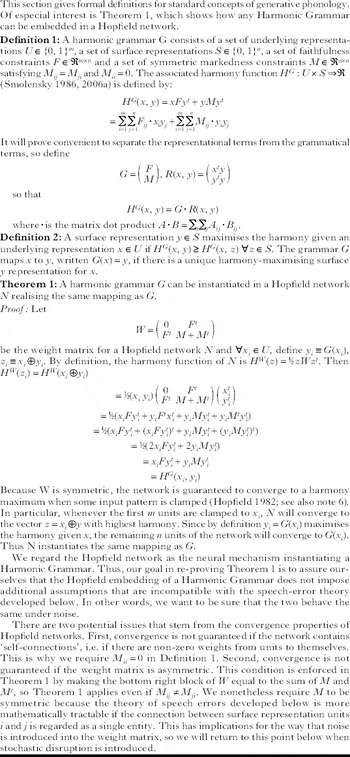
We focus on one specific type of connectionist network – a Hopfield network (Hopfield Reference Hopfield1982) – which is part of a broader class of networks that compute functions similar to those specified by HG (Smolensky Reference Smolensky, Smolensky and Legendre2006a). In such a network, a linguistic representation can be realised by a numerical pattern of activity over a set of representational units (in a Hopfield network, these are limited to binary patterns – strictly 0's and 1's – although similar properties hold for networks that allow for continuous activation values; Hopfield Reference Hopfield1984). A set of weights or connections links each of these units. These connections can be thought of constraints on the pairwise activity of units. For example, a negative weight signifies that the two units should not have the same activation value; a positive weight signifies that they should agree in activation value. (The strength of the weight represents the strength of this constraint.) During processing, units update their activation values so as to maximise the degree to which the activation pattern satisfies the constraints of the network. For example, if units A and B have a positive weight, and unit A is activated, over the course of processing unit B will become active – satisfying the constraint that both units have the same activation level.
As shown by Smolensky & Legendre (Reference Smolensky, Legendre, Smolensky and Legendre2006a), HGs can be implemented within this type of connectionist network (for implementations of specific HGs, see Legendre et al. Reference Legendre, Sorace, Smolensky, Smolensky and Legendre2006, Soderstrom et al. Reference Soderstrom, Mathis, Smolensky, Smolensky and Legendre2006).Footnote 5 The constraints of HG, as well as their relative strengths, are encoded in the weights of these networks. Our analyses assume that HG constraints reflect the structure of ‘classical’ OT (Prince & Smolensky Reference Prince and Smolensky1993) which consists of faithfulness constraints (which refer solely to the relationship between the underlying and surface form) and markedness constraints (which refer solely to properties of the surface form). We therefore assume that the HG is instantiated by connections between units representing the underlying and surface form (encoding faithfulness) as well as between units representing the surface form (encoding markedness).Footnote 6
To concretely illustrate the translation of HGs to connectionist networks, consider the HG fragment illustrated in tableau (3). This makes use of the constraints defined above, but focuses on a single feature of the underlying and surface representations (voicing).
(3) HG tableau illustrating a grammar fragment
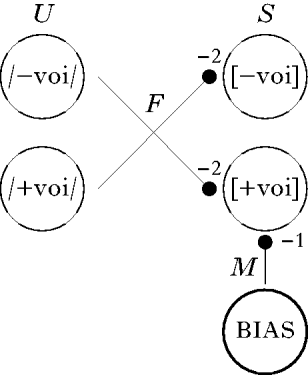
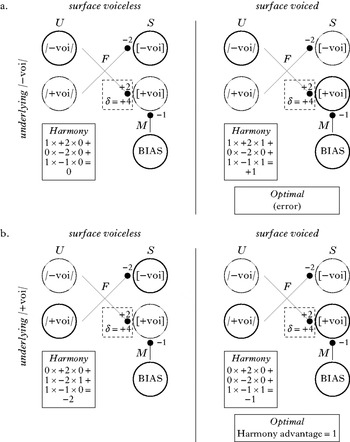
We can instantiate this grammar fragment within the Hopfield network shown in Fig. 1 below. Nodes on the left denote elements of the underlying representation (U) while those on the right denote the surface representation (S). These representations are ‘distributed’ in the sense that a single feature [±voice] corresponds to two distinct units [+voice] and [−voice]. The surface representation also contains a bias unit which is always active (note that active units are shown with thick lines; inactive units are depicted with thin lines). Two negative weights (with strength −2) connect each underlying unit to the surface unit with the opposite feature specification. These weights (denoted by F) instantiate the faithfulness constraint Ident[voice]; as discussed above, a negative weight signifies that the two connected units should not take on similar values (e.g. when /−voice/ is active, [+voice] should be inactive). The negative weight from the bias unit to the surface feature [+voice] (denoted by M) instantiates the markedness constraint *Lar. Since the bias unit is always active, this weight signifies that regardless of the input, the [+voice] representational unit should not be active. Note that although we assume the representations are fully interconnected, weights with strength 0 (e.g. connecting /+voice/ to [+voice] or the bias unit to [−voice]) are not depicted.
Hopfield network instantiating the grammar fragment illustrated in tableau (3).

The Hopfield network computes the underlying→surface mapping specified by the HG through updating the activation of representational units. The activations of units corresponding to the underlying form are fixed (or ‘clamped’) and the activations of units representing the surface form are updated in such a way as to maximally satisfy the constraints encoded by the network.Footnote 7 Specifically, as shown by Smolensky (Reference Smolensky, Rumelhart and MacClelland1986, Reference Smolensky, Smolensky and Legendre2006a), a numerical measure (harmony) can be defined which characterises the degree to which different activation patterns satisfy the constraints of these networks. The algorithms that update activation values serve to maximise this numerical measure. The end result is that the activation of the output units corresponds to the most harmonic surface form for the given input. As the output of the HG is the surface form that maximally satisfies the constraints of the grammar, the input–output pairs computed by the Hopfield network are therefore identical to the input–output pairs specified by the HG.
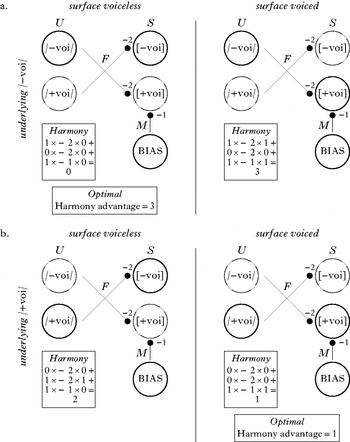
Figure 2 illustrates harmony values for the network depicted in Fig. 1. The upper panel shows harmony values for a voiceless input (i.e. where /−voice/ is active, as shown by the thickened lines for this units, and [+voice] is inactive), while the lower panel shows the corresponding values for a voiced input. The left column depicts the harmony value of a voiceless output while the right depicts a voiced output. The harmony calculation is shown within a text box in each column.Footnote 8 Harmony is simply the sum, over all weights, of the product of the activation values of the two units and the weight (Smolensky Reference Smolensky, Rumelhart and MacClelland1986, Reference Smolensky, Smolensky and Legendre2006a). For example, in the right column of the upper panel, /−voice/ and [+voice] both have activation of 1. They are connected by a weight of −2. This weights contribution to harmony is therefore 1×−2×1=−2.
Harmony in the Hopfield network instantiating the HG fragment.

Comparison of the harmony values across columns shows that this yields the same underlying–surface mapping as the HG illustrated above. For a voiceless input, a voiceless output has higher harmony (0 vs. −3); for a voiced input, a voiced output has higher harmony (−1 vs. −2). Note the asymmetry across inputs in the harmony difference between the correct output and its competitor (the harmony advantage);Footnote 9 this difference becomes critical in the next section.
4.2 Disruptions to connectionist processing cause a markedness asymmetry in errors
4.2.1 Disruptions to connectionist processing yield the full range of error types
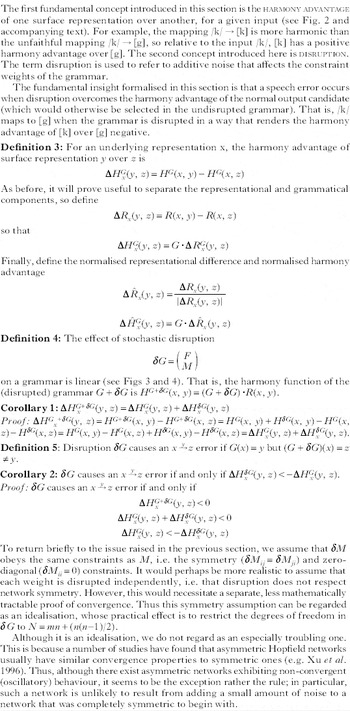
To disrupt processing within the Hopfield network, we assume that random noise is added to the connections that instantiate constraints.Footnote 10 This noise varies randomly from trial to trial within an individual. This is a common means of disrupting connectionist processing to simulate speech errors (e.g. Dell et al. Reference Dell, Schwartz, Saffran and Gagnon1997). Within a Hopfield network, the consequence of such random noise will be to distort the preferences of the constraints encoded by the undisrupted network. The relative harmony of surface forms is therefore altered. In some cases, these disruptions will be sufficient to cause the target form to be less harmonic than some competitor. Because network processing always maximises harmony, this results in an error. In general, if disruption serves to make the target less harmonic than a competitor, the competitor will be the output.
Being blind to the nature of constraints, the disruptions caused by random noise will not be constrained to produce only those mappings that can specified by the grammar. This is critical, because it will allow for the possibility of violations of harmonic ascent. This is because random disruptions will not only distort the relative strength of various constraints; they can also result in disruptions to the constraints themselves.
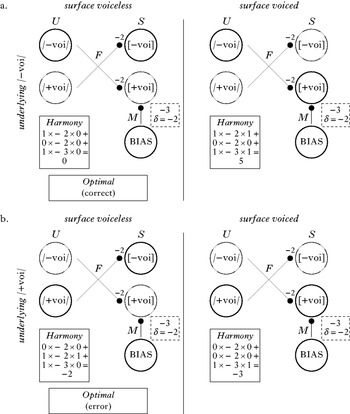
To illustrate the wide range of possible mappings that disruption can produce, we will consider two instances of disruption to single weights in the Hopfield network above. Figure 3 illustrates a case where disruption has changed the strength of the weight connecting the bias unit to [+voice] from −1 to −3 (a weight change of −2). This has a transparent interpretation in HG terms; the weighting of *Lar has increased to 3 from 1. Since *Lar now dominates Ident[voice], we would expect devoicing to occur. As shown in the figure, this is what occurs; the voiceless input is correct, but the voiced output yields a devoicing error.
Disruption to the Hopfield network yielding a devoicing error. Disrupted weight is shown by dotted lines.

However, since random noise is blind to the structure and content of constraints, it can also yield underlying–surface mappings that would not be produced by a typical HG. This is illustrated in Fig. 4. Here, noise has again disrupted a single weight in the network – in this instance, the weight linking underlying /−voice/ to surface [+voice]. Our assumption is that noise is randomly and evenly distributed. This allows for weight values to decrease (as shown above) as well as increase. The latter case is depicted here; instead of making the weight more negative, noise has flipped its sign (a weight change δ of +4). This has the effect of converting a faithfulness constraint into an anti-faithfulness constraint. This weight now signifies that when /−voice/ is active, [+voice] should also be active – in other words, underlying voiceless should be mapped to surface voiced. As shown in Fig. 4a, this yields a mapping violating harmonic ascent. This stands in contrast to other mechanisms of producing variation in HGs. Typically, HG theories restrict constraint weightings to a particular range (e.g. Potts et al. Reference Potts, Pater, Bhatt and Becker2008 restrict constraints to positive weightings; see Boersma & Pater Reference Boersma and Pater2008 for discussion). Even if such restrictions hold for undisrupted networks, the ‘blind’ nature of disruption at the level of individual weights can cause violations of such restrictions.
Disruption to the Hopfield network yielding a voicing error. Disrupted weight is shown by dotted lines.

Furthermore, since disruption occurs at the level of individual weights, it need not uniformly target a constraint. For example, since in this network the feature [voice] is realised in a distributed fashion (over two representational units), the constraint Ident[voice] is instantiated by two separate weights. Disruption may not affect all of these weights equally. In this case, the weight instantiating Ident[voice] for voiced inputs is unaffected; therefore, there is no error on a voiced target (as shown in Fig. 5b). In essence, disruption has ‘split’ Ident [voice] into two constraints – an anti-faithfulness constraint specific to voiceless inputs and a standard faithfulness constraint specific to voiced inputs.Footnote 11 This stands in contrast to other mechanisms for producing variation in HG. These typically allow random variation only in the relative weighting of different constraints (Boersma & Pater Reference Boersma and Pater2008).
Smaller Hopfield network, instantiating HG with a positive faithfulness constraint and a privative voicing feature.

4.2.2 Disruptions probabilistically respect markedness asymmetries
The blind nature of random noise allows it to produce errors that radically depart from the markedness preferences of the intact network/HG. However, just because the noise itself is blind does not entail that it favours all outcomes equally. Errors that respect the markedness preferences of the intact network – i.e. errors respecting harmonic ascent – will arise more easily than errors that do not. This is because the amount of disruption required to produce an error is a function of its harmony relative to the correct target form. If the error is unmarked along many dimensions (e.g. it satisfies markedness constraints violated by the target), then its harmony will be relatively close to the target; the harmony advantage of the target will be relatively small. A relatively small amount of random disruption to the harmony function will be sufficient for the harmony of this error to surpass that of the target. In contrast, an error that is marked along most (or all) dimensions will have a harmony far less than that of the target; a large amount of disruption will be required to produce it as an error.
A specific instance of this asymmetry can be seen in the instances of disruption discussed above. In Fig. 1, we see that the harmony advantage of a /−voice/ input is larger (3) than a /+voice/ input (1). Comparing Figs 3 and 4, we can see that the amount of disruption yielding a devoicing error is smaller (two units on a single weight) than the amount of disruption yielding a voicing error (four units on a single weight).
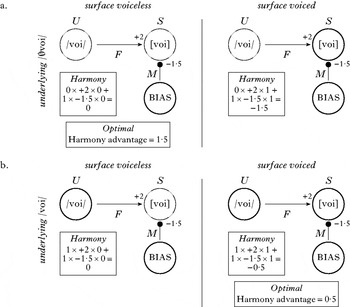
This asymmetry is not specific to these two instances of disruption, but holds more generally. This is difficult to illustrate with the network discussed above; given that there are more than two weights in the network, it is difficult to visualise the effects of disruption. Instead consider the Hopfield network shown in Fig. 5. This is distinguished from the previous example in two ways. It makes use of a privative specification of voicing (i.e. [voice] active represents voiced, [voice] inactive represents voiceless). Second, violating the convention typically adopted in both OT and HG, we make use of a faithfulness constraint that rewards satisfaction rather than penalising deviation. A positive weight connects the underlying /voice/ feature to the surface [voice] feature, signifying that both units should take on similar activation values. The weighting adopted here produces the same underlying–surface mappings as in the network above (i.e. underlying voicing is faithfully preserved in the intact network) and exhibits a qualitatively similar asymmetry in harmony advantages (i.e. the voiceless target has a harmony advantage greater than that of the voiced target).
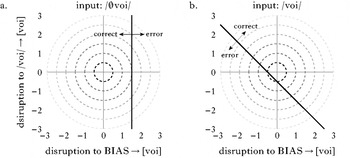
Figure 6 depicts the consequences of disruption to the weights in the network above. The x-axis represents disruption to the weight instantiating the markedness constraint; the y-axis represents disruption to the weight instantiating the faithfulness constraint. The thick line in each panel shows the boundary between correct and incorrect outputs for varying degrees of disruption to both weights. As shown in (a), for a voiceless input errors occur when the weight connecting the bias unit to the surface [voice] feature becomes positive. This corresponds to a flip in the sign of the constraint – changing it from a markedness constraint that disprefers voiced outcomes to an anti-markedness constraint which prefers such structures.Footnote 12 As shown in (b), errors for voiced inputs are influenced by two factors. First, if the faithfulness constraint is weakened (i.e. negative changes in the weight), the influence of the markedness constraint will yield voiceless outcomes. Similarly, if the markedness constraint becomes more powerful (i.e. negative changes in the weight), it will tend to overpower the influence of faithfulness.
Consequences of disruption to weights of the smaller Hopfield network (see Fig. 5).

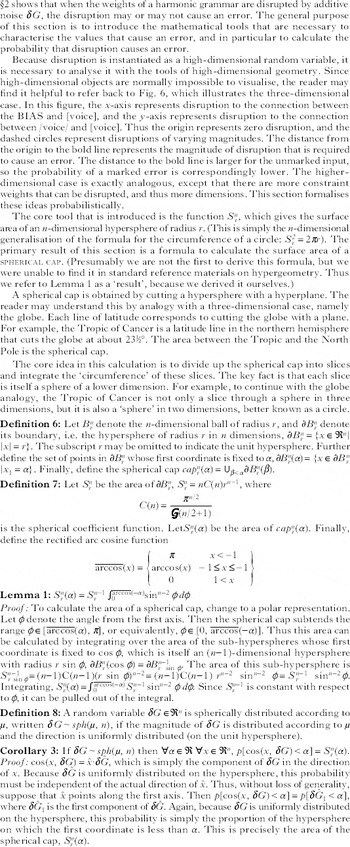
As noted above, we assume that disruption is randomly and evenly distributed along each weight. This is depicted by the concentric circles in each figure (where the centre depicts the intact network). The centremost circle contains the smallest disruptions, which have the highest probability. The ever-lighter circles surrounding it indicate decreasing probability as the level of disruption increases. Inspection of the figures reveals that it is easier for disruption to yield a devoicing error than a voicing error. Consider the region denoted by the two innermost circles. This entire area falls within the correct region for a voiceless input; in contrast, a significant portion of this area of disruption falls outside the correct region for a voiced input. As this asymmetry holds for all levels of disruption, errors for voiced inputs are more likely than errors for voiceless inputs. In general, then, if disruption is equally and randomly distributed, it will be more likely to produce an error respecting vs. violating harmonic ascent – matching the broad empirical patterns reviewed above.
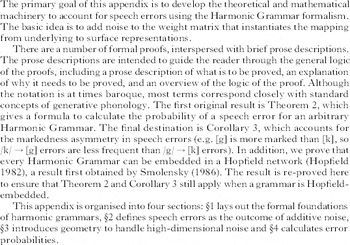
The Appendix contains a proof showing that this asymmetry holds more generally for disruption to Hopfield networks realising HGs. We specifically compare the probability of two errors that are equal distortions of the target (e.g. /+voice/→[−voice] and /−voice/→[+voice] both involve the change of one feature value). One of these error outcomes better respects the markedness preferences of the intact network/HG; this error outcome is harmonically closer to the target than the other error outcome (e.g. /+voice/→[−voice]). We then show that if an HG is instantiated within a Hopfield network, and noise is randomly and evenly distributed across all connections within the network (as in the concentric circles shown in Fig. 6 above), the probability of an error is a function of the harmony advantage of the target. This yields the desired result; errors that better respect the markedness preferences of the intact HG (e.g. /+voice/→[−voice]) are more likely than those that do not (e.g. /−voice/→[+voice]).
Unlike many purely grammatical accounts of variation, our proposed mechanism for modelling speech errors allows for the production of errors that violate harmonic ascent. However, this does not mean that errors completely disrespect harmonic differences; they are biased to result in less vs. more marked outcomes. This allows our proposal to match the broad empirical patterns identified above. Note that this holds even though disruption is completely blind to the structure and content of grammatical constraints. A process that operates solely at the level of ‘implementation’ of the grammar can nonetheless exhibit sensitivity to grammatical distinctions.
4.3 Linking grammatical theories and speech-error distributions
Although our proposal provably accounts for the general markedness-asymmetry pattern, a more concrete link between particular grammatical theories and predicted speech-error distributions would be desirable. Unfortunately, the method utilised in the Appendix for precisely characterising the speech-error distribution is computationally and analytically quite difficult. In supplementary online materials we outline more efficient methods and provide simulation implementations for use in modelling speech-error distributions.Footnote 13
4.3.1 An illustration: initial consonant errors in English
To illustrate how grammatical theories and speech-error distributions can be linked, we consider initial singleton consonants in English. Goldrick (Reference Goldrick2002) used a tongue-twister task to induce speech errors involving six pairs of such consonants. These consonant pairs differed by a single distinctive feature, and were selected such that one member of the pair was less marked than the other (with respect to both the appropriate statistics of English as well as cross-linguistic markedness distinctions). For example, [d] and [z] differ with respect to the feature [continuant]; [d] is both more frequent and less marked than [z].
The average distribution of errors across all pairs (see (6) below) fit the empirical generalisation above (e.g. errors were more likely to result in less marked forms, although both types of errors occurred). However, it should be noted that several individual pairs deviated from this overall pattern. The tongue-twister task – analysed through broad transcription – is not an ideal source of data for tapping exclusively into phonetic encoding processes. It causes disruptions at multiple levels of sound-structure processing (e.g. motor/articulatory processes; see note 1 for discussion). Errors arising at these other levels may distort the distribution of errors arising at phonetic encoding. However, since many of the errors in this task arise during phonetic encoding, we believed these data were sufficient to illustrate the approach outlined above.
To model these data we constructed a simple HG fragment. With respect to representations, we utilised three distinctive features to distinguish among the consonants in this study: [voice], [continuant] and [place] (which was associated with one of three privative specifications). The features used for the eight consonants in this study are shown in (4) (notice that there are not twelve consonants in total, as some consonants were repeated across pairs). The underlying and surface representations were triples of these features (e.g. /z/: [+voice], [+continuant], [coronal]).
(4) Features of the simple Harmonic Grammar
There were seven markedness constraints of the HG which referred to the seven values of the three features (two each for [voice] and [continuant], plus three for place; see (5) below). Three faithfulness constraints compelled identity between the feature values of each of the three features (e.g. Ident[voice]).
As all of these consonants surface faithfully as initial singleton onsets, the faithfulness constraints dominate all of the markedness constraints (we assumed they all had an equal weighting at the top of the hierarchy). To determine the relative ranking of the markedness constraints, we assumed that well-formedness is proportional to log frequency. We calculated the log frequency of each feature value by summing the type frequencies for each singleton English onset, using the frequency counts and feature matrices of Hayes & Wilson (Reference Hayes and Wilson2008).Footnote 14 As the relative ranking of markedness constraints specifies ill-formedness, we assumed that their ranking would be proportional to the inverse of log frequency. The specific weightings were assigned by arbitrarily setting the faithfulness constraints to ten, and each markedness constraint to ten times the inverse of the log frequency of the relevant feature. The resulting weightings for the markedness constraints are shown in (5).
(5) HG markedness constraints and weightings for English initial singleton onset grammar
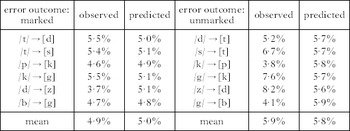
The harmony differences between target and error for each of the six experimental pairs was then calculated. We assumed that disruption to the connections within the network implementing this HG were independently and identically distributed according to a normal distribution. Using the procedure described in the online supplemental materials, we estimated the standard deviation of this normal distribution for each individual error.Footnote 15 We then averaged these estimated standard deviations to obtain an overall estimate of the standard deviation of the disruption distribution (specifically, 1·66). This average standard deviation was then used to generate the predicted rate of error for each consonant pair (using the Monte Carlo procedure described in the online supplementary materials, with 100,000 iterations per pair).
As shown in Table I, the HG was able to capture the average pattern quite closely. In the actual data, on average errors that resulted in more marked structures (e.g. /d/→[z]) occurred at a rate of 4·9%; errors resulting in less marked structures occurred at a higher rate, 5·9%. This illustrates the markedness asymmetry discussed above. On average, the simulated error distribution matched this quite closely (deviating 0·1% in each case). Although the average fits across all pairs were quite good, the model's predictions were quite far off on individual pairs; we return to this below.
Modelling of initial consonant errors in English. ‘Observed’ refers to average rate of errors by participants in Experiment 2 in Goldrick (2002).

Of course, since the parameter for generating errors (the standard deviation of the disruption function) was selected by averaging the parameter estimates for each error pair, it is not surprising that the mean predictions of the model track the mean error rates quite closely. What is more surprising is the ability of this HG to match the average error rates within each error category. This is not guaranteed to occur when using the procedure outlined above. To illustrate this, we constructed a second HG where the weights of the markedness constraints were proportional to the inverse of raw type frequency (not log frequency).Footnote 16 Utilising the same procedure outlined above, on average the model predicted a rate of 3·8% for errors resulting in more marked structures vs. 7·5% for errors resulting in less marked structures. Note the average of these two rates (5·7%) is quite close to the average of the observed error rates (5·4%). This is simply a by-product of the parameter-selection procedure. What the procedure cannot do is guarantee that the model will make the correct predictions for particular classes of errors; such matches occur only if the grammar has the appropriate architecture. In this case, the poor performance of this latter model suggests that, as in many other domains, log frequency, not raw frequency, better reflects distinctions in cognitive processing. Specifically, raw frequency overestimates the well-formedness of frequent structures.
Although we believe the Harmonic Grammar outlined above captures some aspects of English speakers' knowledge of sound structure, it is worth underscoring that the model is clearly inadequate as a comprehensive theory of English phonological knowledge. It is restricted to single consonants that can be distinguished by three distinctive features. This is woefully impoverished with respect to the consonantal inventory of English (much less the full complexities of English phonology). The space of constraints is also far too limited. As noted by a reviewer, it is well known that place and voice interact in determining markedness (Gamkrelidze Reference Gamkrelidze, Greenberg, Ferguson and Moravcsik1978). Constraints must refer to feature conjunctions to encode such interactions. The poor fit of the model to error rates on individual consonants may reflect some of these simplifications. (Alternatively, as noted above, deviations may reflect the contamination of the data from errors arising in processes other than phonetic encoding.) However, the fact that such a simple model is capable of a capturing general trends in these data suggests that this approach holds promise.
4.3.2 Extensions to the model of disruption
It should be noted that all of the methods analysed above have assumed that errors are generated by evenly distributed disruption to the weights encoding the HG. It is likely that this assumption will not provide a fully general account of all types of speech errors. In particular, we believe a full model must allow for the possibility that disruption targets particular dimensions of phonological representations. For example, Goldrick & Rapp (Reference Goldrick and Rapp2007) and Buchwald et al. (Reference Buchwald, Rapp and Stone2007) report two cases of acquired impairment to phonetic encoding processes. The former individual has a somewhat higher overall segment accuracy (roughly 95% of segments produced correctly, compared to 83% correct for the individual reported in Buchwald et al.). This slight difference in overall accuracy was enormously magnified for clusters. The former individual produced 91% of clusters correctly, whereas the latter was only 28% correct. This particular difficulty with this type of phonological structure may reflect disruption that preferentially affects those network mechanisms involved in the representation of clusters. In future work, we hope to compare and contrast the predictions of evenly vs. non-evenly disrupted models of disruption.
We have also assumed that errors arising in phonetic encoding are induced solely by disruptions to phonetic encoding mechanisms. While we believe this to be an appropriate model of errors arising in single-word tasks, it is not clear if it generalises to tasks where errors are believed to be induced by the priming of competitors. For example, as pointed out by a reviewer, tongue twisters induce errors via the production of similar sounds (in similar environments) in close temporal proximity to target sounds. Future work should examine how our approach can be extended to model such effects.
5 Conclusions
Characterising markedness distinctions among phonological structures is a central concern of phonological grammars. Although grammatical theories have been primarily motivated by internal evidence, a wealth of studies suggest that markedness influences online behaviour. Specifically, speech errors are biased to result in less vs. more marked structures. To account for this markedness asymmetry in errors, we propose that speech errors are generated by random disruptions to the connectionist mechanisms that encode the constraints of the grammar. This method provably accounts for the markedness asymmetry in speech-error distributions. Furthermore, by making certain assumptions about the distribution of random disruptions to connectionist mechanisms, we can link specific grammatical theories with speech-error data (as illustrated by the application to initial consonant errors in English).
There are numerous benefits to establishing tighter connections between phonological grammars and online speech behaviour. Theories of language processing can greatly benefit from the formal insights of grammatical theories. For example, many processing theories adopt overly simplistic notions of markedness (e.g. position-specific mono- and bi-phone frequency; Vitevitch & Luce Reference Vitevitch and Luce1999). Other accounts rely on trained connectionist networks; the internal structure of such networks is notoriously opaque (see e.g. Goldrick Reference Goldrick, Schütze and Ferreira2007 for discussion in the context of speech-error research). Grammatical theories often an attractive third path; they are complex, but analytically transparent. They may therefore provide a productive framework for illuminating the complex internal structure of phonological processing mechanisms. With respect to grammar, establishing links to speech-error data allows for a richer empirical base for theory development and testing. More generally, work of this sort is a critical part of a larger programme of research that aims to make grammars a central component of theories of language acquisition and processing (e.g. Smolensky et al. Reference Smolensky, Legendre, Tesar, Smolensky and Legendre2006).
Does this approach offer insight to phonological behaviour beyond speech errors? As noted above, a number of grammatical mechanisms have been proposed within OT and HG to account for synchronic variation. In accounting for speech errors (a type of probabilistic behaviour), we have pursued a novel approach (stochastic disruption to connectionist mechanisms that encode the grammar). Having established that our approach can account for speech errors, we can ask if it is a fully general mechanism for accounting for other types of variation. Specifically, can stochastic disruption account not just for speech errors but also synchronic variation? We suspect this is not generally true. As noted above, available data suggest that synchronic variation respects harmonic ascent. Since stochastic disruption will regularly violate this principle, it is likely that this mechanism is too unrestrictive for a general theory of grammatical variation. However, we consider it plausible that stochastic disruption may provide a better account of performance in online speech production tasks than purely grammatical mechanisms – a possibility that should be explored in future work.
If our theories adopt multiple mechanisms for producing variation (e.g. floating constraints as well as stochastic disruption), a natural question that arises is how to determine which mechanism is responsible for any particular case of variation we observe empirically. One criterion may be stability across social groups. Variationist phonological research has repeatedly emphasised that such variation is specific to particular social groups and must be acquired by its members (e.g. Roberts Reference Roberts1997). Since processing mechanisms are presumably roughly equally distributed across such groups, the existence of contrasting patterns of variation across these populations suggests that these patterns do not reflect properties of processing mechanisms (e.g. stochastic disruption). Alternatively, if some pattern of variation is influenced by increasing memory load or attentional demands while holding social factors constant, we may conclude that this pattern is at least partially influenced by the properties of processing mechanisms. Of course, as with any behavioural data, it is likely that variation reflects multiple, interacting mechanisms. For example, changes in constraint rankings (and consequent variation in outputs) might reflect both floating constraints as well as stochastic noise on connection weights. The challenge for future work is to examine how these multiple mechanisms interact to produce complex patterns of variation.
Appendix
1 Foundations
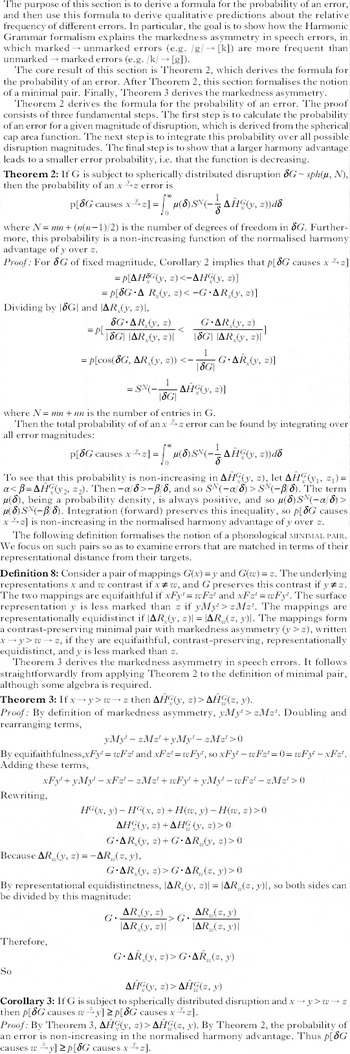
2 Speech errors
3 Stochastic hypergeometry
4 Markedness asymmetry in speech errors