Introduction
Thyroid nodules are an increasingly common clinical problem. They may be discovered by palpation during physical examination or incidentally during radiological evaluation for unrelated reasons. They are four times more common in women, and their incidence increases with age and low iodine intake.Reference Mazzaferri1 Whilst palpable nodules are found in around 5 per cent of the population, up to 70 per cent of the population are revealed to have thyroid nodules on high-resolution ultrasound.Reference Mazzaferri1–Reference Ezzat, Sarti, Cain and Braunstein3
Thyroid nodules are clinically important because of their risk of malignancy. Thyroid cancer is the most common endocrine malignancy, representing 1 per cent of all malignancies.4 Differentiated thyroid cancer, which includes papillary and follicular cancer, comprises the vast majority (90 per cent) of all thyroid cancers. The reported prevalence of malignancy in nodules evaluated by biopsy varies from 4 to 6.5 per cent, which is largely independent of nodule size.Reference Lin, Chao, Huang, Chen, Chang and Hsueh5,Reference Werk, Vernon, Gonzalez, Ungaro and McCoy6 Thyroid nodules may also cause thyroid dysfunction, and, rarely, compressive symptoms.
Epidemiological studies suggest a small but real increase in the incidence of thyroid cancer, likely attributed to both exposure to environmental risk factors and more widespread use of diagnostic imaging and medical surveillance.Reference Cabanillas, McFadden and Durante7 The latter has facilitated the identification of small subclinical thyroid nodules and small papillary thyroid cancers. This has raised concerns over the cost and potential morbidity associated with the short- and long-term management of these patients. There is a clear need for a more refined, tailored and careful approach to the management of these increasingly prevalent lesions. Similar considerations are required for nodules proven to be malignant but with a low-risk phenotype. These can be safely managed through more conservative surgery or active surveillance programmes.Reference Ito, Uruno, Nakano, Takamura, Miya and Kobayashi8
Recommendations in clinical management guidelines, such as those from the British Thyroid Association and American Thyroid Association, are largely based on expert panels and observational studies.Reference Perros, Boelaert, Colley, Evans, Evans and Gerrard Ba9,Reference Haugen, Alexander, Bible, Doherty, Mandel and Nikiforov10 Although most guidelines are periodically updated to reflect additional data, all guidelines will be inevitably outdated at the time of publication. The latest guidance from the British Thyroid Association and American Thyroid Association was published in 2014 and 2016 respectively. A number of risk stratification systems have also been developed over recent years to enable the tailoring of treatment and a subsequent follow-up strategy with more accurate prognostic prediction. Despite substantial similarities across guidelines, there are important differences for several common clinical scenarios encountered by physicians in clinical practice.
This review aimed to provide an overview, for the non-specialist, of currently recommended practices for the initial investigation and subsequent management of patients with thyroid nodules, and to highlight areas of variance between the systems in common clinical use.
Methods
The Dynamed, Medline, Embase, Cumulated Index to Nursing and Allied Health Literature (‘CINAHL’), Cochrane Library and Trip databases were searched to identify clinical trials, systematic reviews, meta-analyses and clinical practice guidelines, published from 2009, on the evaluation and management of thyroid nodules. The year 2009 was selected in order to provide a comprehensive update on the clinical review ‘Investigating the thyroid nodule’, published by Mehanna et al., in 2009.Reference Mehanna, Jain, Morton, Watkinson and Shaha11 The reference lists of selected articles were also reviewed. Case reports, conference abstracts, letters and commentaries were excluded.
Evaluation
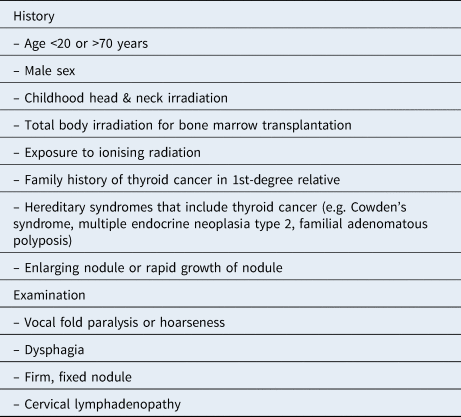
Patient history and examination should focus on detecting features suggestive of malignancy. Thyroid cancer most typically presents as a painless asymptomatic nodule. A smooth generalised goitre is more suggestive of a hormonal or inflammatory aetiology. Whilst the recent rapid growth of a thyroid nodule may indicate aggressive cancer, subacute nodular thyroiditis (associated with systemic features) and haemorrhage into a nodule should be excluded.Reference Burman and Wartofsky12 Table 1 summarises clinical features concerning for thyroid cancer. Symptoms and signs of hyperthyroidism and hypothyroidism should also be evaluated.
Clinical features suggestive of increased risk of malignancy in patients with a thyroid nodule

Initial investigations
Laboratory tests
Thyroid-stimulating hormone (TSH) should be measured in all patients with a thyroid nodule. The British Thyroid Association advises that all patients with abnormal thyroid function test results should be referred to an endocrinologist. The American Thyroid Association also recommends that patients with low TSH levels should undergo a radionuclide thyroid scan to assess the functional status of the nodule. Nodules associated with hyperthyroidism do not require a biopsy because they are benign.Reference Popoveniuc and Jonklaas13 Thyroid-stimulating hormone has been found to be an independent predictor of thyroid malignancy, with the risk of malignancy in a thyroid nodule increasing with serum TSH concentration, even within normal TSH ranges.Reference Boelaert, Horacek, Holder, Watkinson, Sheppard and Franklyn14,Reference Haymart, Repplinger, Leverson, Elson, Sippel and Jaume15
Measurement of TSH receptor antibody or thyroid peroxidase antibody is not indicated unless autoimmune thyroid disease is suspected. Routine serum calcitonin measurement is not recommended in the UK, except for patients with a family history of multiple endocrine neoplasia syndrome type 2 or suspicious investigations not consistent with papillary thyroid carcinoma.Reference Gharib, Papini, Garber, Duick, Harrell and Hegedus16 Serum thyroglobulin measurement is neither specific nor sensitive for the diagnosis of thyroid cancer. It may be elevated in many benign thyroid diseases (e.g. multinodular goitre, thyroiditis) and its measurement should be reserved for post-treatment surveillance.
Ultrasound
High-resolution ultrasound is the most sensitive test in the evaluation of thyroid nodules, as well as in the assessment of associated cervical lymphadenopathy. Several ultrasound features have been described to identify nodules that may be malignant and to determine whether fine needle aspiration cytology (FNAC) should be performed. Hypo-echogenicity, microcalcifications, irregular margins, taller-than-wide shape and intranodular vascularity were found to be independent risk factors for malignancy.Reference Kim, Park, Chung, Oh, Kim and Lee17,Reference Remonti, Kramer, Leitão, Pinto and Gross18 No single ultrasound feature is diagnostic; however, the more suspicious characteristics of a nodule, the greater the likelihood of malignancy.Reference Brito, Gionfriddo, Al Nofal, Boehmer, Leppin and Reading19 The American Thyroid Association recommends that all patients with known or suspected thyroid nodules undergo ultrasound of the thyroid gland and neck, whereas the British Thyroid Association advocates its use predominantly to increase the diagnostic accuracy of FNAC.
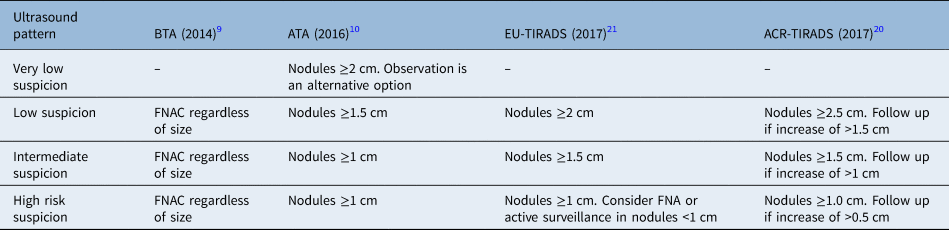
Several international clinical guidelines have developed ultrasound-based risk stratification systems based on the above (Table 2).Reference Perros, Boelaert, Colley, Evans, Evans and Gerrard Ba9,Reference Haugen, Alexander, Bible, Doherty, Mandel and Nikiforov10,Reference Tessler, Middleton, Grant, Hoang, Berland and Teefey20,Reference Russ, Bonnema, Erdogan, Durante, Ngu and Leenhardt21 The British Thyroid Association classifies ultrasound features into five categories of increasing risk of malignancy, from ‘U1’ (normal thyroid gland) to ‘U5’ (very suspicious lesion). Fine needle aspiration cytology is recommended for nodules graded ‘U3’, and most centres use a size criterion of a minimum of 10 mm, based on subsequent work.Reference Perros, Boelaert, Colley, Evans, Evans and Gerrard Ba9 The American College of Radiology proposed a Thyroid Imaging Reporting and Data System (‘TIRADS’) in 2017 using five ultrasound categories.Reference Tessler, Middleton, Grant, Hoang, Berland and Teefey20 Within each ultrasound category, size cut-offs are used to determine which lesions require fine needle aspiration (FNA), a follow-up ultrasound or no further action. The system was designed to reduce the number of unnecessary biopsies performed on benign nodules. A recent meta-analysis of the five most commonly used ultrasound risk stratification systems found a higher performance of the American College of Radiology Thyroid Imaging Reporting and Data System in selecting malignant nodules for FNA.Reference Castellana, Castellana, Treglia, Giorgino, Giovanella and Russ22
FNA: recommended indications for biopsy based on guidelines

FNA = fine needle aspiration; BTA = British Thyroid Association; ATA = American Thyroid Association; EU = European; TIRADS = Thyroid Imaging Reporting and Data System; ACR = American College of Radiology; FNAC = fine needle aspiration cytology
Artificial intelligence is a rapidly developing novel approach for evaluating thyroid nodules, which can reduce inter-observer variability. Some findings have suggested that machine learning algorithms may be more accurate than radiologists in diagnosing malignant thyroid nodules.Reference Zhang, Tian, Pei, Chen, He and Dong23
Several risk stratification systems are in active use worldwide, and many departments in a single unit may use more than one system, which may lead to inconsistent management recommendations and confusion for patients. The International Thyroid Nodule Ultrasound Working Group has attempted to devise a universal international guideline to address this.Reference Tessler, Middleton, Grant, Hoang, Berland and Teefey20,Reference Buda, Wildman-Tobriner, Hoang, Thayer, Tessler and Middleton24 This Working Group has yet to finalise its report.
Role of other diagnostic modalities
Additional imaging techniques, such as magnetic resonance imaging and computed tomography (CT) scans, are not routinely indicated for routine thyroid nodule evaluation, but they may be helpful for the assessment of: extent of spread and involvement of cervical lymph nodes, tracheal invasion, retrosternal extension, airway compression, and surgical planning.Reference Perros, Boelaert, Colley, Evans, Evans and Gerrard Ba9,Reference Haugen, Alexander, Bible, Doherty, Mandel and Nikiforov10
Fine needle aspiration cytology
All guidelines support FNAC as the most sensitive and cost-effective procedure of choice for evaluating solid thyroid nodules. Ultrasound-guided FNAC is recommended to improve diagnostic yield given the lower rates of false negative and non-diagnostic cytology rates. This is of particular importance for nodules that are difficult to palpate, posteriorly located nodules and those with a predominantly cystic component.Reference Haugen, Alexander, Bible, Doherty, Mandel and Nikiforov10 Core needle biopsy should be considered in patients with inadequate FNAC findings, to prevent repeat FNAC or unnecessary surgery.Reference Na, Kim, Sung, Baek, Jung and Lee25 Open biopsies of the thyroid are rarely required,Reference Perros, Boelaert, Colley, Evans, Evans and Gerrard Ba9 and are generally reserved for cases requiring differentiation between lymphoma and anaplastic thyroid cancer.
Indications for FNAC are based on a risk stratification approach, including patient history, ultrasound characteristics and nodule size, although this varies between guidelines (Table 2). The British Thyroid Association guidelines differ from the other guidelines in that size is not used as a criterion for FNAC. Studies have demonstrated that size itself is not an accurate predictor of malignancy, as a nodule smaller than 1 cm can still show early lymph node metastases or extrathyroidal invasion.Reference Brito, Gionfriddo, Al Nofal, Boehmer, Leppin and Reading19,Reference Noguchi, Yamashita, Murakami, Nakayama, Toda and Kawamoto26
Any patient that has a cervical lymph node with suspicious appearances (e.g. microcalcification, cystic component, peripheral vascularity, hypo-echogenicity, round shape) should also undergo FNAC.Reference Leenhardt, Erdogan, Hegedus, Mandel, Paschke and Rago27
Management of incidental thyroid nodules
The increasingly widespread use of imaging has led to the increased detection of incidental thyroid nodules, the majority of which are benign. Incidentally detected nodules on CT may require further clinical evaluation. The American Thyroid Association advise that all such incidental nodules undergo ultrasound evaluation, whereas the British Thyroid Association advise ultrasound assessment only if there are any suspicious features on CT, for example extracapsular extension, tracheal invasion or associated cervical lymphadenopathy. In general, only nodules more than 1 cm in size require further evaluation, as they have a greater malignant potential.Reference Haugen, Alexander, Bible, Doherty, Mandel and Nikiforov10 Nodules with a benign appearance on ultrasound do not require any further action. Incidental nodules identified on positron emission tomography, however, should always be investigated with ultrasound, with biopsy of nodules sized more than 1 cm that are not obviously benign because of a higher incidence of malignancy of up to 46 per cent, unless the prognosis from a separate malignancy precludes further investigation.Reference Flukes, Lenzo, Moschilla and Sader28,Reference Yoon, Cho, Lee, Kim, Moon and Kwak29
Is interval growth a predictor of malignancy?
The natural history of benign thyroid nodules is variable; however, the majority of nodules remain relatively stable in size.Reference Alexander, Hurwitz, Heering, Benson, Frates and Doubilet30–Reference Angell, Vyas, Medici, Wang, Barletta and Benson32 A prospective cohort study of 126 malignant nodules and 1363 benign nodules found that malignant nodules, particularly those with higher-risk phenotypes, grow faster than benign nodules. Thyroid nodules that do not change in size or become smaller are more likely to be benign, whereas a growth rate of more than 2 mm per year is associated with malignancy.Reference Angell, Vyas, Medici, Wang, Barletta and Benson32 It may therefore be reasonable for clinicians to have a lower threshold to undergo reassessment of cytology if significant growth is observed.
Management
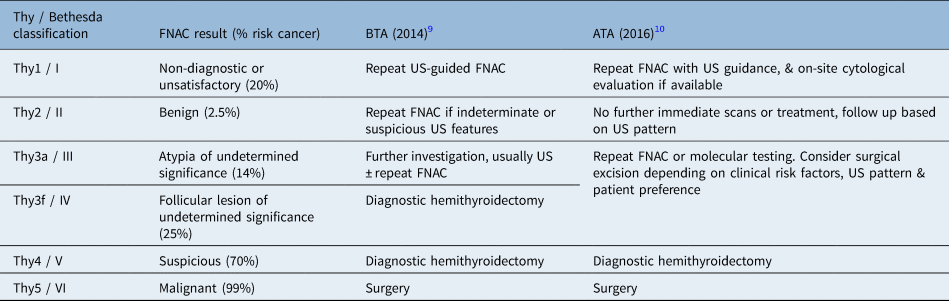
Subsequent management following fine needle aspiration depends on the cytopathological diagnosis (Table 3). Up to 20 per cent of ultrasound-guided FNA results are non-diagnostic, requiring repeat FNAC.Reference Alexander, Heering, Benson, Frates, Doubilet and Cibas33,Reference Kim, Lee, Kim, Kim, Lee and Kim34 If FNAC is to be repeated, then an interval of at least three months is recommended to avoid sampling an area of regenerative changes that can lead to atypical changes being picked up on subsequent sampling. Malignant lesions, or those suspicious for cancer, warrant surgical excision in the form of either a hemithyroidectomy or total thyroidectomy.
Comparison of thyroid nodule management following FNAC between BTA and ATA guidelines based on Bethesda classification

FNAC = fine needle aspiration cytology; BTA = British Thyroid Association; ATA = American Thyroid Association; US = ultrasound
Molecular markers
Up to 25 per cent of thyroid nodules have indeterminate or suspicious results on FNAC, with a variable risk of malignancy.Reference Cibas and Ali35 As FNAC is unable to provide a definitive diagnosis for these nodules, many patients will undergo diagnostic thyroidectomy. However, only a minority of patients may be found to have thyroid malignancy on final pathology. Molecular testing has therefore been advocated as a diagnostic modality to help identify nodules that are likely to be benign and do not require further intervention; such tests can be performed on even tiny amounts of cellular material harvested during FNA (e.g. 2.5–25 ng nucleic acid material).Reference Patel, Carty and Lee36 Current molecular testing uses a combination of genomic sequencing, messenger RNA analysis and/or microRNA expression of cancer-associated genes.Reference Patel, Carty and Lee36 The three molecular testing platforms commercially available are: Afirma™ Genomic Sequencing Classifier, ThyroSeq® v3 Genomic Classifier, and ThyGeNEXT® with ThyraMIR® (multiplatform approach).Reference Steward, Carty, Sippel, Yang, Sosa and Sipos37
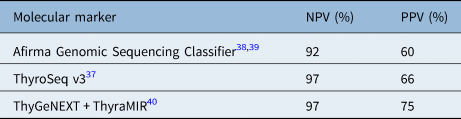
Afirma Genomic Sequencing Classifier, previously Gene Expression Classifier, measures the expression of 167 genes, identifying thyroid nodules at low risk for malignancy so that unnecessary surgery may be avoided; it is therefore considered a ‘rule-out’ test. A recent pooled analysis of 11 studies comprising 1303 participants demonstrated a high negative predictive value of 92 per cent.Reference Al-Qurayshi, Deniwar, Thethi, Mallik, Srivastav and Murad38 The test had a lower positive predictive value of 60 per cent and therefore cannot be used alone to positively identify malignant lesions.Reference Endo, Nabhan, Porter, Roll, Shirley and Azaryan39 ThyroSeq v3 incorporates next-generational sequencing to detect a variety of genetic alterations or amplifications and abnormal gene expression in 112 genes associated with thyroid cancer. If a mutation in one of these genes is found, then thyroid cancer is almost always present; therefore, this test is considered a ‘rule-in’ test. A recent multi-institutional clinical validation study demonstrated a 97 per cent negative predictive value and 66 per cent positive predictive value.Reference Steward, Carty, Sippel, Yang, Sosa and Sipos37 Finally, ThyGeNEXT with ThyraMIR combines next-generation sequencing with the microRNA risk classifier test, with initial validation studies demonstrating a 97 per cent negative predictive value and 75 per cent positive predictive value (Table 4).Reference Lupo, Walts, Sistrunk, Giordano, Sadow and Massoll40
Comparison of molecular marker negative and positive predictive values

NPV = negative predictive value; PPV = positive predictive value
Whilst the introduction of molecular testing is likely to result in a reduction in unnecessary surgery and patient anxiety, molecular testing is expensive, ranging between $4000 and $6000 (approximately £3150–£4720 GBP) depending on the specific test used.Reference Nicholson, Roberts, McCoy, Carty and Yip41 However, the majority of these analyses are based on simulation modelling rather than real-world patient data, and the results are dependent on a variety of factors including test performance parameters, cancer prevalence, costs of surgery and complications of surgery, and length of surveillance. The routine use of such tests is therefore likely to be prohibitive within the current framework of the National Health Service.
Implication of new histopathological diagnosis
The non-invasive follicular thyroid neoplasm with papillary-like nuclear features (‘NIFTP’) category was created to distinguish an indolent subset of encapsulated follicular variant of papillary thyroid cancer – with a very low risk of adverse outcomes – from conventional forms of papillary thyroid cancer.Reference Nikiforov, Seethala, Tallini, Baloch, Basolo and Thompson42 It has a reported prevalence of approximately 61 per cent amongst follicular variants of papillary thyroid cancer.Reference Sahli, Umbricht, Schneider and Zeiger43 All existing molecular panels were originally developed and validated on the assumption that the non-invasive follicular thyroid neoplasm with papillary-like nuclear features was considered malignant; therefore, the diagnostic validity of these tests is significantly reduced when the non-invasive follicular thyroid neoplasm with papillary-like nuclear features designation is considered.Reference Sahli, Umbricht, Schneider and Zeiger43–Reference Valderrabano, Khazai, Leon, Thompson, Ma and Chung45 These findings raise concerns regarding over-reliance on suspicious findings generated from molecular tests, potentially resulting in patients being subjected to unnecessary surgery.
Follow up of benign lesions
There is uncertainty regarding the optimal frequency and duration of follow up for benign thyroid lesions, and whether repeat fine needle aspiration is indicated. The British Thyroid Association does not recommend routine ultrasound follow up or repeat FNA unless there is a strong clinical suspicion of malignancy, or indeterminate or suspicious features on ultrasound. In contrast, the American Thyroid Association advises repeat ultrasound at 12–24 months for nodules with a low to intermediate suspicion on ultrasound, with repeat FNA if growth is detected (20 per cent increase in at least two nodule dimensions, with a minimal increase of 2 mm, or more than a 50 per cent change in volume). A study of over 2000 cytologically benign thyroid nodules, with a median follow up of 8.5 years, suggested that repeat assessment in asymptomatic, low-risk patients at 2–4 years’ time may be appropriate.Reference Nou, Kwong, Alexander, Cibas, Marqusee and Alexander46
Management of thyroid nodules in pregnancy
Management of patients with thyroid nodules identified in pregnancy requires careful evaluation of the risks to both the mother and fetus. All nodules should be investigated with ultrasound and FNA, to determine the risk of malignancy. Thyroid-stimulating hormone should be measured at regular intervals to optimise maternal thyroid function during pregnancy.Reference Alexander, Pearce, Brent, Brown, Chen and Dosiou47 Patients with potential or confirmed low-risk thyroid cancer do not require surgery whilst pregnant, except if nodules grow substantially by 24 weeks (50 per cent in volume and 20 per cent in diameter in two dimensions) or in the presence of metastatic cervical lymph nodes, as there is no adequate evidence to indicate that pregnancy worsens cancer prognosis.Reference Alexander, Pearce, Brent, Brown, Chen and Dosiou47–Reference Herzon, Morris, Segal, Rauch and Parnell49 Pregnant patients who have surgery postponed until after delivery should have their TSH maintained at low to normal levels.Reference Perros, Boelaert, Colley, Evans, Evans and Gerrard Ba9,Reference Angell and Alexander50 Most experts recommend that, if a thyroidectomy is to be performed, it is conducted during the second trimester, when the risks of miscarriage and preterm labour are lowest.Reference Perros, Boelaert, Colley, Evans, Evans and Gerrard Ba9,Reference Sullivan51 Patients undergoing thyroidectomy should take levothyroxine therapy to achieve suppressed serum TSH concentrations. Subsequent radioiodine treatment, if indicated, should be delayed until after pregnancy and cessation of lactation.Reference Angell and Alexander50
Management of thyroid nodules in children
Thyroid nodules in children are uncommon, but often have an increased risk of malignancy compared with adults; therefore, the threshold for surgical intervention is lower.Reference Gupta, Ly, Castroneves, Frates, Benson and Feldman52 Ionising radiation exposure, iodine deficiency, previous thyroid disease and genetic predisposition are the most commonly identified risk factors associated with the development of thyroid nodules. Children with papillary thyroid cancer are also more likely to have extensive disease at clinical presentation, with lymph node involvement, extrathyroidal extension and pulmonary metastasis on clinical presentation.Reference Francis, Waguespack, Bauer, Angelos, Benvenga and Cerutti53 However, disease-specific survival rates, even in young children, are very high.Reference Hay, Gonzalez-Losada, Reinalda, Honetschlager, Richards and Thompson54 The evaluation and management of thyroid nodules in children should be the same as in adults, except that ultrasound characteristics and clinical context are used to identify nodules requiring FNAC, rather than size alone, and all FNACs in children should be performed under ultrasound guidance.Reference Francis, Waguespack, Bauer, Angelos, Benvenga and Cerutti53
Conclusion
There is currently significant variation in the management of thyroid nodules depending on which national guidelines are followed. Whilst ultrasound is now established as the primary investigation after clinical assessment for any thyroid mass, there are a variety of scoring systems in common clinical use and with differing protocols for deciding when to perform a biopsy. This can lead to variation in practice between different clinicians or hospitals within the same multidisciplinary team area. With increasing identification of thyroid nodules, the decision to biopsy, observe or discharge is becoming more difficult. In general, nodules less than 1 cm in size can be left alone, as can those that do not grow more than 2 mm in a 12-month period, and this has been taken into account in some of the scoring systems, such as the American College of Radiology Thyroid Imaging Reporting and Data System based on ultrasound scan findings.
Thyroid nodules diagnosed during pregnancy need careful consideration regarding the risks to both the mother and fetus when deciding management priorities.
Molecular assessment of thyroid nodules is an exciting and developing area of research; however, given its cost and the lack of real-world data, it is currently not in routine clinical use.
Competing interests
None declared.