INTRODUCTION
Infectious diseases are a serious threat to host populations, and knowing the key determinants of pathogen infection is fundamental to understand infectious disease dynamics and implement effective control strategies (Smith et al. Reference Smith, Acevedo-Whitehouse and Pedersen2009a). In the context of host–parasite interactions, many factors regulate parasite transmission, including environmental factors and a range of host and parasite features (Tinsley and Jackson, Reference Tinsley and Jackson2002). Among these factors, characteristics of the host population itself are believed to be important determinants of the proportion of infected hosts and mean abundance of parasites in a host population (Bagge et al. Reference Bagge, Poulin and Valtonen2004; Johnson et al. Reference Johnson, Lafferty, van Oosterhout and Cable2011; Stringer and Linklater, Reference Stringer and Linklater2015). Several empirical studies have provided support for this hypothesis: positive relationships between transmission and host density have been observed for iridescent virus (Marina et al. Reference Marina, Fernandez-Salas, Ibarra, Arredondo-Jimenez, Valle and Williams2005) and for directly transmitted bacterial and viral pathogens of the moth Plodia interpunctella (Cross et al. Reference Cross, Creech, Ebinger, Heisey, Irvine and Creel2012). For directly transmitted parasites, transmission is also expected to increase with host density (McCallum et al. Reference McCallum, Barlow and Hone2001). Directly transmitted gastrointestinal strongylid nematodes are more abundant at high host population density (Arneberg et al. Reference Arneberg, Skorping, Grenfell and Read1998; Stringer and Linklater, Reference Stringer and Linklater2015). Parasite population size of the monogenean Gyrodactylus turnbulli on guppies (Poecilia reticulata) increases with host density in laboratory experiments (Johnson et al. Reference Johnson, Lafferty, van Oosterhout and Cable2011). However, in a field study, fish population size, rather than density, is the key factor determining mean abundance of monogeneans (Dactylogyrus spp.) on gills of the crucian carp (Carassius carassius), and the overall availability of host individuals in the host population appears to be the main constraint limiting parasite population growth (Bagge et al. Reference Bagge, Poulin and Valtonen2004). In the context of host–parasite interactions, host population size plays a crucial role in determining the extent of infection, risk of spread, and any impacts from intervention (Scott and Smith, Reference Scott and Smith1994). In terms of spread, a higher number of susceptible hosts in a population can enhance the contact rate between the susceptible host and infected host (McCallum et al. Reference McCallum, Barlow and Hone2001). If so, there may exist a threshold of the host population size, limiting the invasion or persistence of infectious diseases (Lloyd-Smith et al. Reference Lloyd-Smith, Cross, Briggs, Daugherty, Getz, Latto, Sanchez, Smith and Swei2005) and it may be possible to effectively control wildlife diseases by reducing the number of susceptible hosts.
Besides the features of the host population, host body condition can also affect the transmission of parasites (Tadiri et al. Reference Tadiri, Dargent and Scott2013; Warburton et al. Reference Warburton, Pearl and Vonhof2016). Host body condition is generally used as an important determinant of an individual's health and well-being (Peig and Green, Reference Peig and Green2010), and also greatly contributes to an individual's ability to defend itself against disease (Møller et al. Reference Møller, Christe, Erritzoe and Mavarez1998).
Goldfish (Carassius auratus), the most common ornamental fish around the world, tend to shoal, which facilitates parasite transmission (Barber et al. Reference Barber, Hoare and Krause2000; Bakke et al. Reference Bakke, Cable and Harris2007). The most common gyrodactylid in goldfish (Li et al. Reference Li, Li, Wu and Wang2014), Gyrodactylus kobayashii, mainly transmits from one host to another during host contacts (Olstad et al. Reference Olstad, Cable, Robertsen and Bakke2006). Usually, viviparous gyrodactylids lack a specific infective stage and have the capability of continuous transmission during their entire lifespan, which allows them to rapidly colonize new hosts (Boeger et al. Reference Boeger, Kritsky, Pie and Engers2005). Their viviparous reproduction in situ on the host and short-generation time can lead to exponential population growth (Scott and Anderson, Reference Scott and Anderson1984; Cable and van Oosterhout, Reference Cable and van Oosterhout2007). The majority of gyrodactylids attaches to the epidermis and fins of host via specialized hooks and feed on epithelial cells and mucus (Bakke et al. Reference Bakke, Cable and Harris2007). The external attachment on the fish makes it feasible to monitor the presence of gyrodactylids in a non-lethal manner, permitting the determination of gyrodactylid transmission in guppy (P. reticulata)–gyrodactylid host–parasite systems (Scott and Anderson, Reference Scott and Anderson1984; Harris, Reference Harris2011; Johnson et al. Reference Johnson, Lafferty, van Oosterhout and Cable2011).
In the present study, using a new host–parasite laboratory model, the goldfish – G. kobayashii system, and by holding density constant, we evaluate the influence of host population size and body condition on the population dynamics of the parasite.
MATERIALS AND METHODS
Goldfish – G. kobayashii model setup
Immature goldfish with a mean body weight of 5·18 ± 0·63 g lacking sexually diagnostic features were purchased from a local fish farm in Wuhan City, China and kept in several 100-L aquariums equipped with aerators (water temperature 19·0–21·0 °C, pH 6·9–7·2). To remove all ectoparasites, fish were treated with three consecutive baths in 1:10 000 formalin solution for 12 h at 48-h intervals. Treated fish were kept in aquaria for 30 days following the cleaning procedure, after which 10 goldfish were randomly selected, anaesthetized with 0·02% MS-222 (tricaine methanesulfonate) and examined to confirm their gyrodactylid-free status using a stereomicroscope. The treated goldfish showed no resistance to gyrodactylids in preliminary tests. The goldfish – G. kobayashii model was established in a similar way to the guppy – G. turnbulli host–parasite system (Harris, Reference Harris2011). In short, the uninfected fish were anaesthetized with 0·02% MS-222 and put in contact with the caudal fin of a heavily infected fish reared in our laboratory, allowing an individual parasite to transfer between hosts. The newly infected fish was placed in a container with 1 L of water and examined daily using a stereomicroscope to determine the success of the infection. To ensure that the ectoparasites were G. kobayashii, two parasites were collected from the newly infected fish for morphological and molecular identification 10 days after the successful infection (Li et al. Reference Li, Li, Wu and Wang2014). Some gyrodactylid-free goldfish were introduced periodically into an 80 L aquarium with the infected goldfish to obtain more infected fish for the experiment.
Experimental infections
Gyrodactylid-free goldfish were anaesthetized with 0·02% MS-222, and standard length (mm) and weight (0·01 g) were measured. Then fish were randomly assigned to five groups, containing a varying number of individuals: 3, 6, 12, 24 and 48 (Table 1). To achieve the same host population density (one fish per 2·2 L of water), three different aquarium sizes were used: 35 × 28 × 22 cm3 for groups with three and six fish, 65 × 28 × 22 cm3 for 12 fish, and a round 60 (Φ) × 60 cm tank for 24 and 48 fish, i.e., water volume was proportional to fish number. Fish were maintained in static dechlorinated tap water at 20 ± 1 °C and 12 h light–dark cycle and fed twice daily with commercial pellet feed at 2% of the estimated total fish biomass. To keep the water in good condition, feces and uneaten feed were removed regularly, and one-third of the water was changed every 3 days.
Epidemic parameters of Gyrodactylus kobayashii at five population sizes of the host goldfish (Carassius auratus) over the 70-day experiment

N, number of replicates; mp, maximum prevalence; mm, maximum mean abundance; mpp, total mean population size of parasite; s.d., standard deviation.
After 7 days of acclimation, a single fish from each tank was anaesthetized with 0·02% MS-222 and infected with five G. kobayashii individuals via contact with a piece of caudal fin of a heavily infected fish. At day 0, this primary infected goldfish (source fish), possessing a unique colour pattern to permit identification, was inoculated, and the primary infected fish was re-examined the next day to ensure that at least one parasite was still present. When no parasites could be observed on the source fish on day 1, the infection procedure would be repeated and the time reset to day 0. Parasite abundance of each fish was assessed using a stereomicroscope (after anaesthetization with 0·02% MS-222) every 1 or 2 days for 70 days. In preliminary experiments, we have determined that G. kobayashii parasite abundance tends to be the highest on the caudal fins, so in order to shorten the duration of anaesthesia and reduce the associated stress for fish, parasitological examination was undertaken only on caudal fins, which would underestimate the number of gyrodactylids. However, by focusing on the consistently most infected location on the fish, population growth rates can be compared among treatments. During the experiment, if a fish died, it was left in the tank for 1 day so that parasites had the opportunity to transfer to other live hosts, and then replaced with an uninfected goldfish to maintain a constant host population size and density.
Statistical analysis
Prevalence (the percentage of the population infected with G. kobayashii excluding the source fish), mean abundance (the average number of G. kobayashii per fish) and population size of the parasite (the total number of G. kobayashii recorded in a tank) were calculated for each sampling day (Bush et al. Reference Bush, Lafferty, Lotz and Shostak1997). Total mean prevalence, total mean abundance and total mean population size of the parasite were also calculated for each treatment throughout the experiment (average value of all the sampling days). Since the majority of gyrodactylid transmission occurs directly through host contacts (Bakke et al. Reference Bakke, Harris, Jansen and Hansen1992), effective contacts between infected and uninfected hosts were inferred from the new infections. Transmission rate (the number of new infections per day) and effective contact rate [the number of infectious contacts (successful transmission) per infected host per day] were estimated as (I t+1 − I t)/(T t+1 − T t) and (I t+1 − I t)/I t/(T t+1 − T t), respectively, where I is the number of infected hosts and T is the time (day) of examination (McCallum et al. Reference McCallum, Barlow and Hone2001). Parasite exchange via contacts among infected hosts, which may be unnecessary to evaluate epidemic dynamics, was not included in the equation determining the effective contact rate. The times of maximum prevalence and mean abundance of parasites were also determined.
Relative body condition index (Kn), used to measure the overall health of a fish, was computed as the observed mass of a specific individual divided by the mass predicted from equations for the population under study (Peig and Green, Reference Peig and Green2010). The formula was: Kn = W/(aSLb), where W and SL are weight (W) and standard length (SL) of each fish, whereas the slope (b) and the intercept [log(a)] for the best fitting curve were obtained by the least squares regression of Log(SL) and Log(W) of all of the goldfish (Lecren, Reference Lecren1951). The initial Kn of the source fish and uninfected fish in each tank were measured according to the weight and the standard length of each fish at the beginning of experiment.
Linear mixed-effects models (LMM) were used to analyse the influences of the host population size and host relative body condition on total mean prevalence and total mean abundance of parasites using the R package lme4 (R Development Core Team, 2014). In all models, tank size was used as a random factor, and host population size and host relative body condition were the explanatory variables. The P values for the variables in all models were computed by the ‘Anova’ function in the car package. The models were compared by the Akaike's Information Criterion (AIC) using the ‘anova’ function in lme4 and the model with the lowest AIC was deemed the best fit model for the data. The significance of differences in total mean population size of the parasite throughout the experiment (all the sampling days) among different treatments was tested using analysis of variance (ANOVA). The differences in transmission rate and effective contact rate among different treatments on each sampling day during the first 20-day period were assessed using the non-parametric test (Kruskal–Wallis test). In all cases, the level of significance was set at P < 0·05.
RESULTS
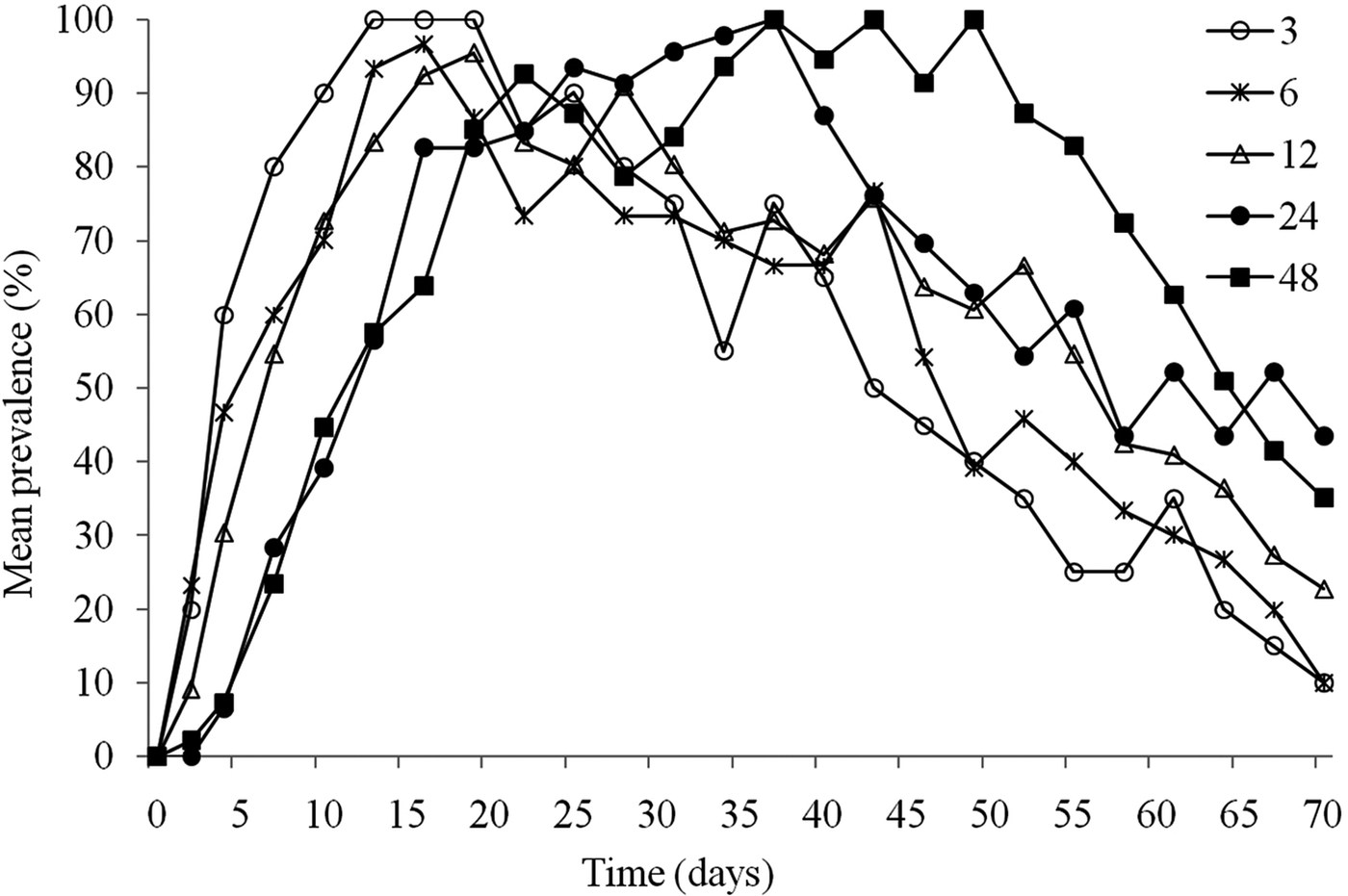
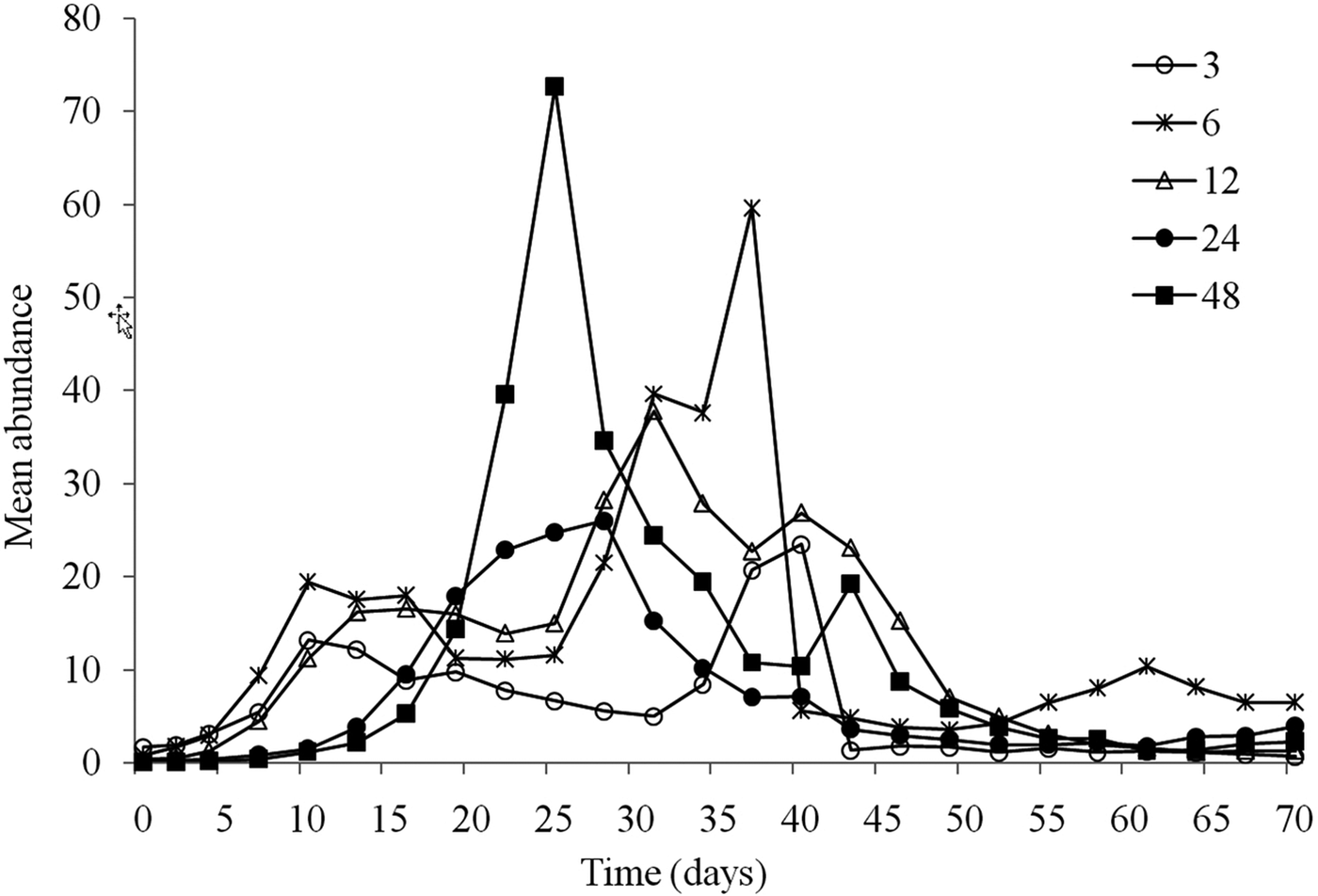
In all host population sizes, prevalence increased rapidly until approximately day 20 and then either entered a stationary phase or started to decrease slowly, presumably as fish acquired immunity. During this period, prevalence was higher in host populations with smaller sizes (Fig. 1). Prevalence in 20 of the 26 tanks reached 100% during the experiment. Mean time to maximum prevalence was 7, 9·5, 10·5, 19 and 20·5 days after the first inoculation in groups 3, 6, 12, 24 and 48, respectively (Table 1). Mean abundance also increased more quickly in smaller host populations during the first 20 days, but peak values were somewhat higher and occurred somewhat later in larger host populations (Fig. 2). Mean time to the maximum mean abundance was 21·1, 24·0, 34·0, 23·0 and 24·0 days in 3-, 6-, 12-, 24- and 48-fish groups, respectively (Table 1).
Changes in mean prevalence (excluding the source fish) of Gyrodactylus kobayashii over time in different population sizes of the host Carassius auratus.

Changes in mean abundance of Gyrodactylus kobayashii over time in different population sizes of the host Carassius auratus.

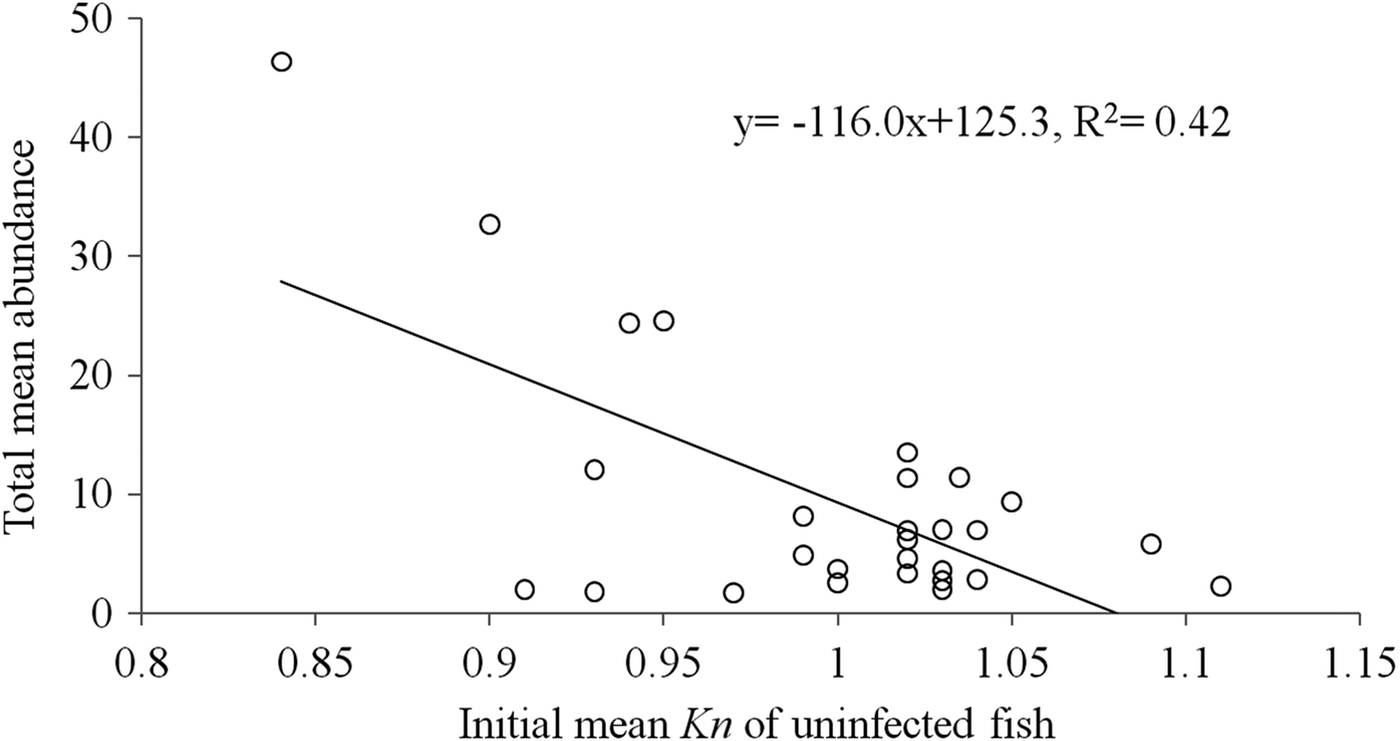
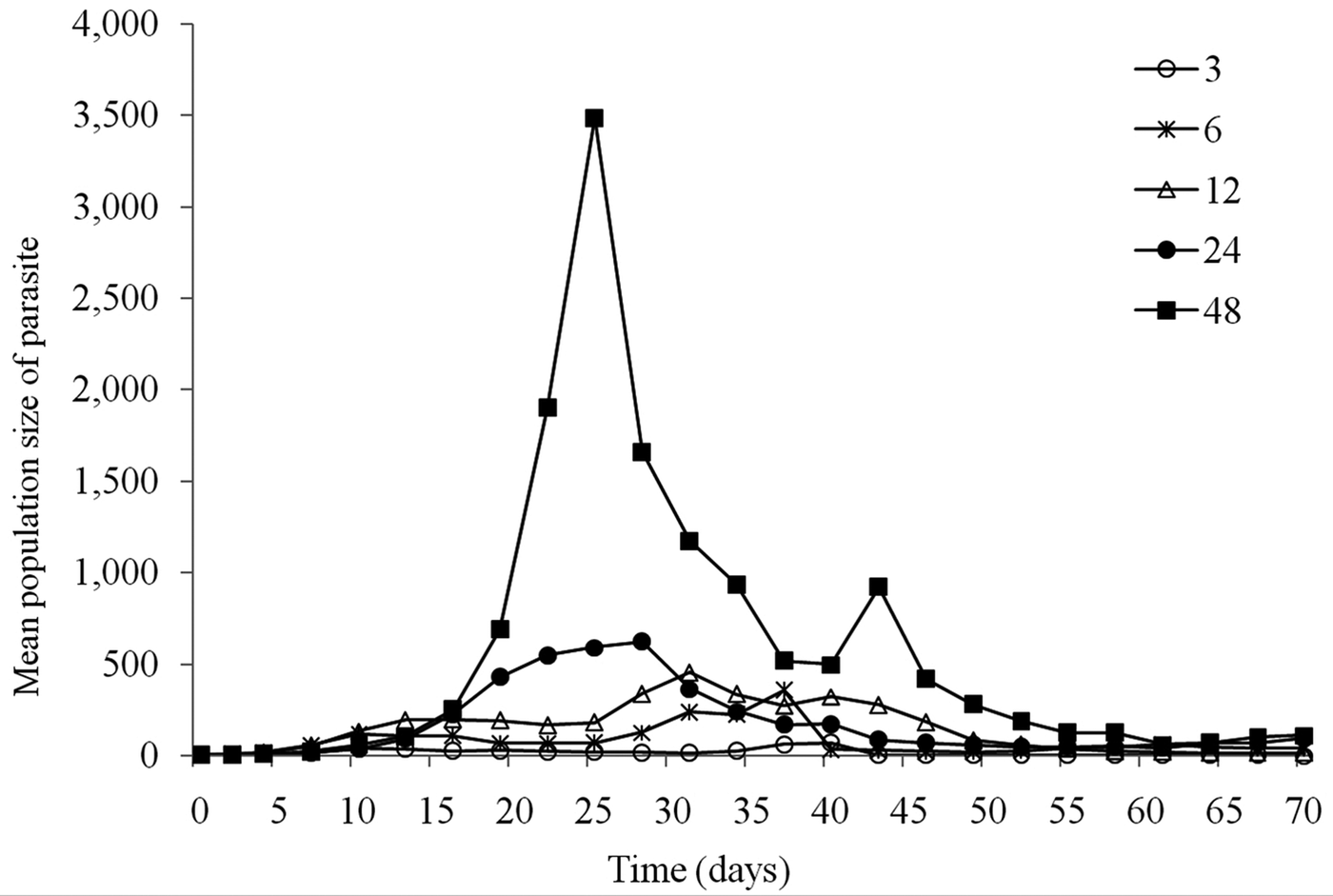
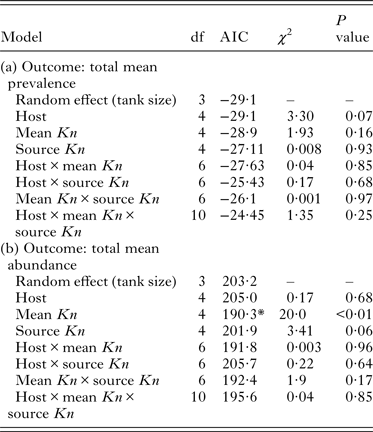
Of the eight LMM, mean Kn of uninfected goldfish was found to be the best explanatory variable for total mean abundance of parasites, while no model successfully explained total mean prevalence. The statistical analyses indicated that total mean prevalence and total mean abundance were not significantly affected by host population size, while a significant negative influence of mean Kn of uninfected goldfish on total mean abundance of parasites was detected (Table 2, Fig. 3). Larger parasite population size was observed in larger host populations on most of sampling days (Fig. 4), and the differences in total mean parasite population size throughout the experiment were statistically significant among the five groups (ANOVA, F = 7·67, P < 0·01).
Relationship between initial mean relative body condition (Kn) of uninfected goldfish (Carassius auratus) and total mean abundance of Gyrodactylus kobayashii throughout the experiment.

Changes in mean population size of Gyrodactylus kobayashii over time in different population sizes of the host Carassius auratus.

Summary of linear mixed-effects model outputs for the measures of epidemics of Gyrodactylus kobayashii on goldfish (Carassius auratus) over the 70-day experiment

df, degree of freedom of the model; AIC, Akaike's Information Criterion; χ 2, the Chi-square value; mean Kn, mean relative body condition (Kn) of uninfected goldfish; source Kn, Kn of source goldfish; –, no values.
*Indicates the best fit model based on AIC selection process.
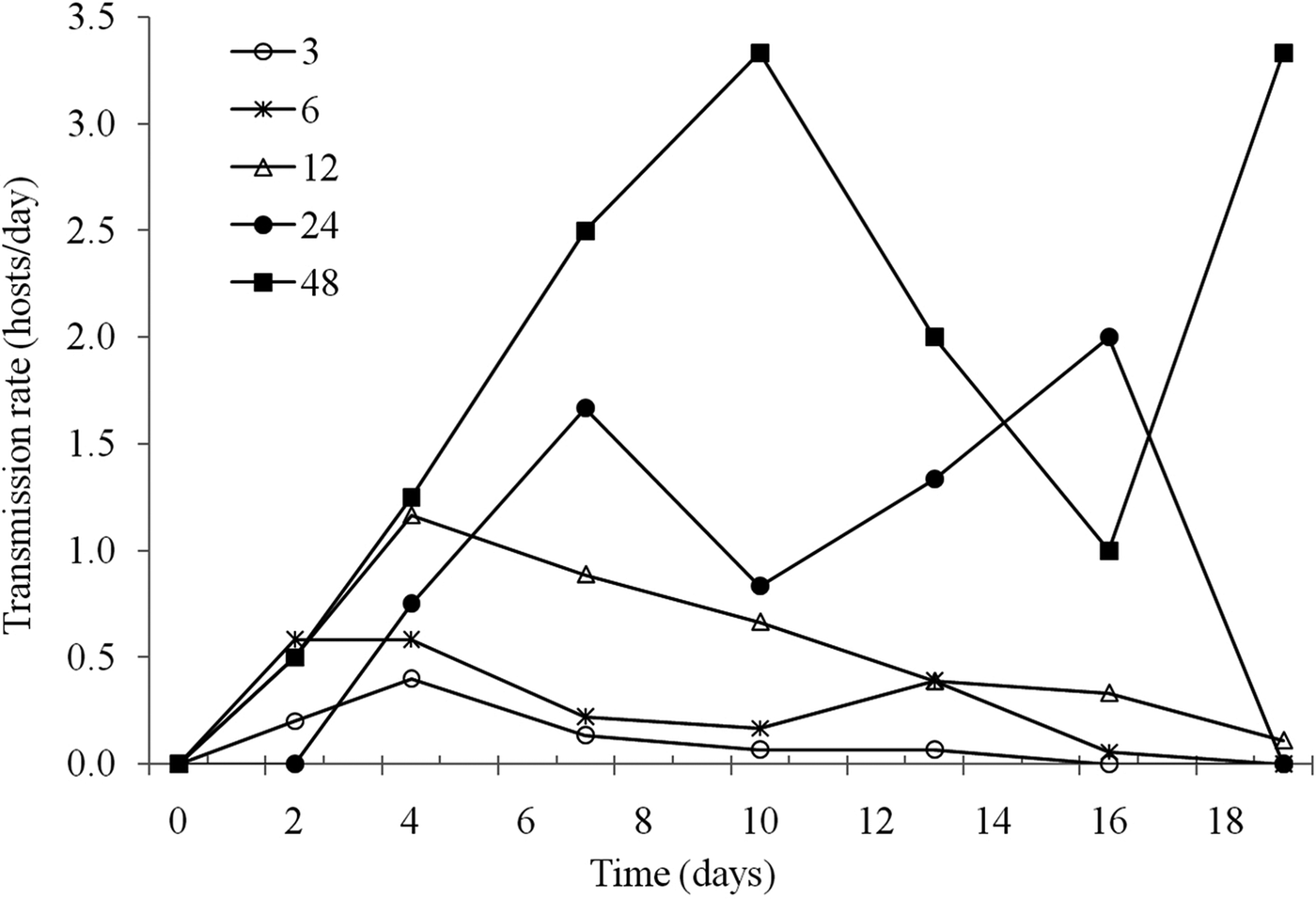
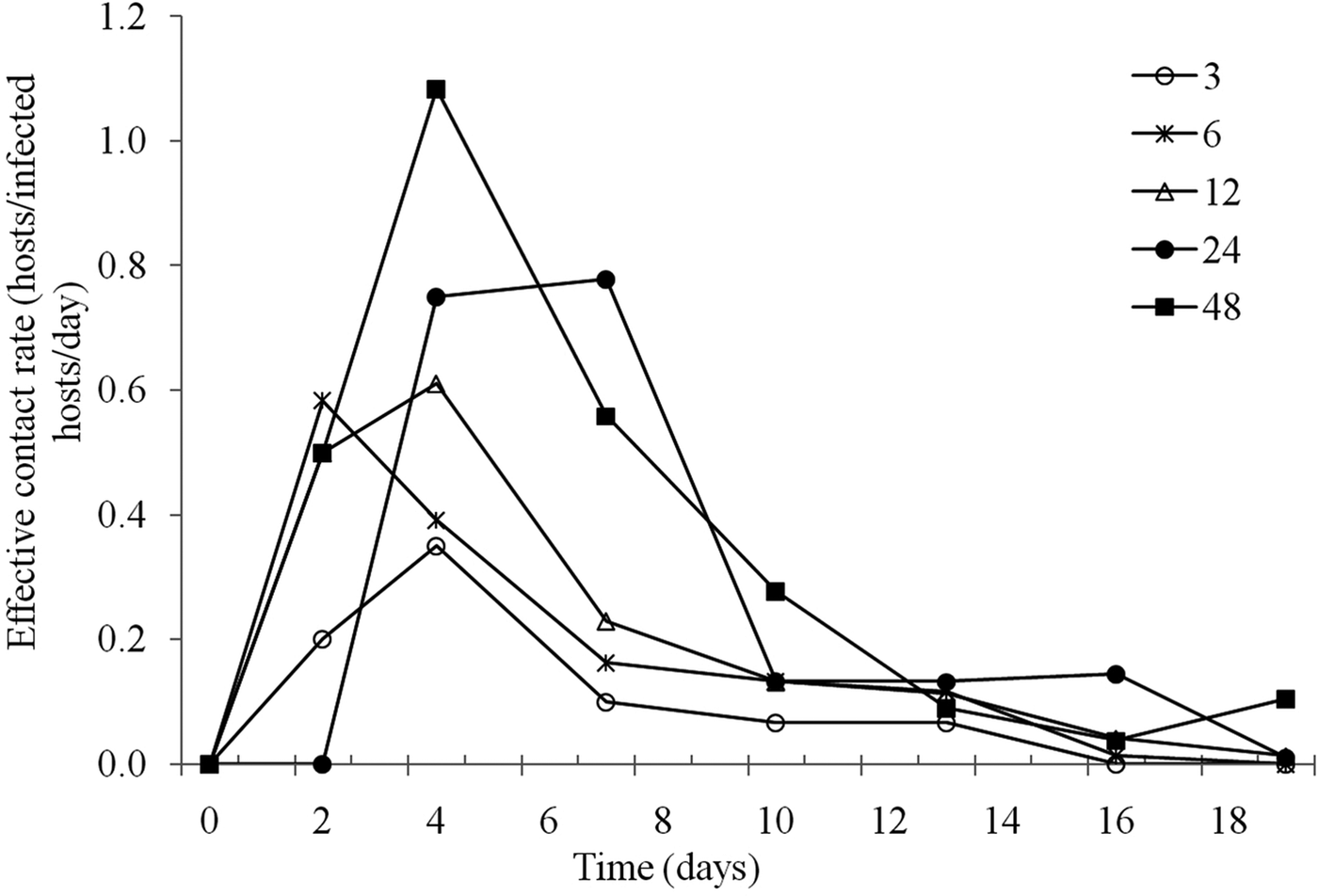
Since prevalence began to decline in three of the five groups after day 20, transmission rate and effective contact rate were estimated only for the first 20-day period. Convex curves of transmission rate were observed in all groups. Higher transmission rate was detected in larger host populations (Fig. 5), and significant differences were found on day 7, 10, and 16 (Table 3). Effective contact rate increased rapidly until day 4 except for day 7 in 24-fish group, and then rapidly declined and remained low after day 10 in all groups. With the exception of day 7, differences in effective contact rates among the five host population sizes were relatively small on all sampling days (Fig. 6), but there was no significant difference on each sampling day (Table 3). Standard deviations of all the mean value were indicated in a Supplementary Table (Table S).
Changes in mean transmission rate (the number of new infections per day) of Gyrodactylus kobayashii over time in different population sizes of the host Carassius auratus during the first 20 days of the experiment.

Changes in mean effective contact rate (the number of successful transmission contacts per infected host per day) between infected and uninfected hosts (Carassius auratus) over time in different host population sizes during the first 20 days of the experiment.

Significant differences in transmission rate of Gyrodactylus kobayashii and effective contact rate between infected and uninfected goldfish (Carassius auratus) among five host population sizes on each sampling day during the first 20 days of the experiment

*Indicates significant difference among various host population size treatment.
DISCUSSION
Faster spreading epidemics were not detected in larger host populations at constant density using the goldfish – G. kobayashii system. On the contrary, before day 20 of the experiment, epidemics occurred faster in smaller host populations. For the entire experiment, however, total mean prevalence and total mean abundance were not significantly affected by host population size, implying that on a longer time-scale, parasite transmission is independent of the host population size.
Contact rate (interactions) among individuals is critical for the transmission dynamics of a disease. Interaction rate is usually recorded directly by radiotelemetry locations (Ramsey et al. Reference Ramsey, Spencer, Caley, Efford, Hansen, Lam and Cooper2002) or proximity loggers (Cross et al. Reference Cross, Creech, Ebinger, Heisey, Irvine and Creel2012). Although in natural environments contact rate can be affected by population size, seasons and feeding behaviour (Cross et al. Reference Cross, Creech, Ebinger, Manlove, Irvine, Henningsen, Rogerson, Scurlock and Creel2013), for a specific host population under controlled conditions, contact rate among the individuals should be constant, especially among immature individuals not subject to reproductive effects. In the goldfish – G. kobayashii system, we measured the rate of successful transmission (effective transmission rate) between infected and susceptible goldfish, not the simple contact rate. However, it is likely that some of the contacts did not lead to a successful transmission (transmission efficiency), and the actual contact rate among goldfish was probably much higher than our estimate. Thus, effective contact rate was not constant and should change with the number of susceptible hosts. Accordingly, effective contacts should have been highest on the first day of the experiment, when the largest number of susceptible fish was present in the population. However, effective contacts increased quickly and peaked on day 4, which may have been a consequence of only one infected goldfish present in the population on day 1, as well as the limited reproductive rate of gyrodactylids (<0·6 parasites day−1) (Scott and Nokes, Reference Scott and Nokes1984; Jansen and Bakke, Reference Jansen and Bakke2009). Basically, the parasites required a short period of time before reproducing and spreading to new hosts. After day 4, the effective contact rate decreased with the reduction in the number of susceptible hosts, and remained low after the prevalence reached maximum value on day 10 at most host population sizes. This result indicates that the number of susceptible hosts (uninfected hosts) within a limited area around infected hosts was the determinant of effective contacts, rather than the total number of individuals in the population (McCallum et al. Reference McCallum, Barlow and Hone2001).
Mathematical models generally assume that either contact rate between hosts is linearly related to host density (density-dependant) or that contact rate is independent of density (frequency-dependant) (McCallum et al. Reference McCallum, Barlow and Hone2001; Johnson et al. Reference Johnson, Lafferty, van Oosterhout and Cable2011). Using time series data, cowpox transmission in field voles (Microtus agrestis) is best fit by a function between density and frequency dependence, where contact rate increases with density at low densities, but tends to saturate as density increases further (Smith et al. Reference Smith, Telfer, Kallio, Burthe, Cook, Lambin and Begon2009b). An almost identical observation has been reported for brucellosis seroprevalence and elk (Cervus canadensis) density, where the function is increasingly non-linear with increasing elk density (Cross et al. Reference Cross, Cole, Dobson, Edwards, Hamlin, Luikart, Middleton, Scurlock and White2010). A follow-up study on elk, based on proximity loggers, finds that in large elk groups contact rate does increase with group size, but at a decreasing rate (Cross et al. Reference Cross, Creech, Ebinger, Manlove, Irvine, Henningsen, Rogerson, Scurlock and Creel2013). In fish, the density of guppies (equivalent to 0·16/2·2 L to 1·32/2·2 L) does not significantly affect the epidemicity of G. turnbulli, and high host densities (3–24 fish in 40 L) do not increase contact rates (Johnson et al. Reference Johnson, Lafferty, van Oosterhout and Cable2011). These results suggest that contact rate reaches saturation and remains constant at a sufficiently high host density or sufficiently large population size (Ryder et al. Reference Ryder, Miller, White, Knell and Boots2007; Cross et al. Reference Cross, Creech, Ebinger, Manlove, Irvine, Henningsen, Rogerson, Scurlock and Creel2013). In our study, no significant differences in the effective contacts were found among the five different host populations, implying that effective contact rate is independent of the goldfish population size at constant density. Host density in this study (1 goldfish per 2·2 L) was much higher than all but the highest host density in the guppy – G. turnbulli study (Johnson et al. Reference Johnson, Lafferty, van Oosterhout and Cable2011). Thus, we hypothesize that effective contact rate among the goldfish is saturated at a threshold host density and hence exhibits negligible differences among different population sizes. If effective contact rate is constant despite density above a threshold value, transmission rate will depend on the number of susceptible hosts in a population, that is, it will be frequency-dependant (Johnson et al. Reference Johnson, Lafferty, van Oosterhout and Cable2011).
Furthermore, like guppies, goldfish tend to shoal which enhances disease spread independent of host density (Johnson et al. Reference Johnson, Lafferty, van Oosterhout and Cable2011). It is known from the studies of schooling behaviour of goldfish that the mean distance among individuals, also known as host density in local space, does not decrease with the increasing density (Leem et al. Reference Leem, Jeon, Yun and Lee2012), which suggests that contact rate may be constant for fish exhibiting schooling behaviour. Then contact rate among hosts with shoaling behaviour is independent of both host density and host population size (above the threshold value).
Higher transmission (infection) rate in larger host populations would result from the availability of more uninfected hosts and a constant contact rate at constant host density. According to the simple transmission function dI/dt = βSI/(S + I), where β is the transmission coefficient, S is the number of susceptible hosts, and I is the number of infected hosts (McCallum et al. Reference McCallum, Barlow and Hone2001; Smith et al. Reference Smith, Telfer, Kallio, Burthe, Cook, Lambin and Begon2009b), transmission rates should be higher in a larger population with more susceptible hosts, and peak when the number of infected hosts equals the number of susceptible hosts. Our results are in agreement with this function of frequency-dependant transmission.
Other epidemiological parameters, such as total mean prevalence and total mean abundance associated with the effective contact rate, were not affected by the host population size. At the beginning of the experiment, epidemics occurred more rapidly in smaller host populations, which may be explained by the identical contact rate and fewer susceptible hosts in smaller populations. The constant number of contacts at constant densities ensured that each goldfish around the infected host had the same chance to be infected. Due to the limited number of infected hosts and the limited number of parasites, some goldfish in larger host populations did not have an opportunity to be infected at the beginning of the experiment. Thus, higher prevalence and mean abundance were observed in larger populations after day 20 as the infection continued to spread. As the number of infected goldfish increased in the larger populations, transmission rate also increased.
These results are inconsistent with a previous field study on monogeneans, which suggests that host population size is the key factor explaining dactylogyrid abundance in fish (Bagge et al. Reference Bagge, Poulin and Valtonen2004). High fish density (almost 0·003 fish L−1) should be responsible for the frequency-dependant transmission of dactylogyrids, and the total number of fish available may become the real determinant of parasite population growth (Bagge et al. Reference Bagge, Poulin and Valtonen2004). According to our results that total mean abundance is independent of host population size at a sufficiently high host density, increased fish number should not increase the mean abundance of dactylogyrids. Perhaps this conflict is a result of differences in reproductive patterns and transmission strategies, which can impact the parasite transmission (Jackson and Tinsley, Reference Jackson and Tinsley2001; Tinsley and Jackson, Reference Tinsley and Jackson2002). The viviparous gyrodactylids directly spread from one host to another during host contacts and have the capability of continuous transmission during their entire lifetime (Boeger et al. Reference Boeger, Kritsky, Pie and Engers2005; Olstad et al. Reference Olstad, Cable, Robertsen and Bakke2006). In contrast, the transmission of dactylogyrids mainly depends on the ability of the oncomiracidium, which is the infective larval stage, to find a new host within several hours (Llewellyn, Reference Llewellyn1968). Active transmission of oncomiracidia via contact with hosts (not host to host) might be dependant on the density of susceptible hosts or host population size.
Generally, transmission dynamics are determined by the transmission coefficient β, along with the number of infected and susceptible hosts. The coefficient β is generally determined by the infectivity of parasites and susceptibility of hosts. Relative condition index (Kn), an indicator of host's ability to ward off pathogens, is a vital factor affecting the susceptibility to parasite infection (Møller et al. Reference Møller, Christe, Erritzoe and Mavarez1998; Tadiri et al. Reference Tadiri, Dargent and Scott2013); host populations with higher Kn exhibit a better ability to prevent parasite establishment and inhibit the growth of parasite population (Beldomenico et al. Reference Beldomenico, Telfer, Gebert, Lukomski, Bennett and Begon2008). In agreement with this, in this study, total mean abundance was significantly negatively correlated to the initial Kn of uninfected fish, suggesting that host susceptibility also plays a role in parasite epidemiology.
In summary, effective contact rates may be saturated at a sufficiently high host density. The epidemic of gyrodactylids is independent of the host population size due to the constant effective contact rates (frequency-dependant transmission). Significant negative influence of the initial body condition of uninfected goldfish on total mean abundance of parasites suggests that susceptibility of hosts is also a determinant of parasite transmission. Therefore, at a sufficiently high host density, there is no minimum threshold host population size, limiting the transmission of parasites. The enhancement of the fish immune response through improved host condition may be an alternative means to decrease frequency-dependant transmission of parasites.
SUPPLEMENTARY MATERIAL
The supplementary material for this article can be found at https://doi.org/10.1017/S0031182017000543.
ACKNOWLEDGEMENTS
The authors would like to thank Dr I. Jakovlić for his help in English language editing.
FINANCIAL SUPPORT
This work was supported by the National Natural Science Foundation of China (31272695, 31572658), the Earmarked Fund for China Agriculture Research System (CARS-46-08) and the major scientific and technological innovation project of Hubei Province (2015ABA045).
COMPLIANCE WITH ETHICAL STANDARDS
All applicable international, national, and/or institutional guidelines for the care and use of animals were followed.
CONFLICT OF INTEREST
The authors declare that they have no conflict of interest.