Introduction
In the general context of economic analyses of population growth and resources, birth control is beneficial for the health of a population. The use of modern contraception reduces the fertility rate (Conde-Agudelo et al., Reference Conde-Agudelo, Rosas-Bermúdez and Goeta2007; Rutstein, Reference Rutstein2008; Feldman et al., Reference Feldman, Zaslavsky, Ezzati, Peterson and Mitchell2009) and allows developing countries to achieve Millennium Development Goals (MDGs) (Stover & Ross, Reference Stover and Ross2010; Byrne et al., Reference Byrne, Morgan, Soto and Dettrick2012). Contraception use slows population growth, improves birth spacing and maternal health, and reduces the risk of infant and maternal mortality (Conde-Agudelo & Belizán, Reference Conde-Agudelo and Belizán2000; Khan et al., Reference Khan, Mishra, Arnol and Abderrahim2007; WHO, 2009; Saifuddin et al., Reference Saifuddin, Qingfeng, Liu and Tsui2012; Khan & Shaikh, Reference Khan and Shaikh2013). Contraceptives prevent unintended pregnancies, reduce the number of abortions and lower the incidence of death and disability related to complications of pregnancy and childbirth. The expected percentage of maternal deaths averted by contraceptive use ranges from 18.2% and 15.2% in Malawi and the DRC respectively, to 76.8% in the United Kingdom and 73.8% in the United States of America (Saifuddin et al., Reference Saifuddin, Qingfeng, Liu and Tsui2012).
In developing countries, an estimated 35% of births are unintended and some 200 million couples reportedly express a desire to delay pregnancy or cease fertility. However, they often do not use contraception (United Nations, 2011a, b). It is therefore not surprising that sub-Saharan Africa is the region most affected by a lack of access to, and use of, modern contraceptives. Countries such as Rwanda and Uganda have an estimated 38% level of unmet need for family planning, with Ghana and Kenya at 35% and 26%, respectively (United Nations, 2011a, b). A low modern contraception use prevalence of 1.0% has been recorded for Guinea, and prevalences of 1.2% and 1.7% have been recorded in Somalia and Chad, respectively (United Nations, 2011b). This situation has stalled the targeted fertility decline in Africa (Westoff & Cross, Reference Westoff and Cross2006) and this is also partly attributable to a lack of suitable population policies.
If all women with unmet need in developing countries were able to space or limit their births as desired, the estimated total fertility rate decline would be in the range of 10–25%, with the value in these ranges depending on the country, and would move 30–50% of the way towards replacement fertility (Westoff & Cross, Reference Westoff and Cross2006).
The DRC does not have a population policy (Sala-Diakanda, Reference Sala-Diakanda1994; Ngondo & Pishandenge, Reference Ngondo and Pishandenge1994). As such, family planning activity has not evolved into a global development plan. It was originally centred on women without taking into account either their reproductive health wishes (Sala-Diakanda, Reference Sala-Diakanda, Virnard and Zanou2000) or the constraints of the physical environment (Gauthier, Reference Gauthier2002). With a population growth rate of 2.8%, the country's population has increased five-fold over the past five decades (estimated at 70 million), depriving the population of the socioeconomic benefits of controlled fertility.
In 1994, in response to the Cairo conference, family planning methods were extended to couples in the DRC but nearly 17 years later national investigations, including MICS I (1996), MICS II (2001) and DHS-2007, still found poor reproductive health indicators, such as high child and maternal mortality, a high proportion of short birth intervals, and a low contraceptive prevalence of 6.7%. This was partly due to compromised births, which were either early, late or too close together, a situation that has led to a high rate of maternal and child death (549 women per 100,000 live births and 97 children per 1000 live births). Nearly 26% of the births occur at intervals of less than 24 months. This is partly attributable to a lack of access to, and use of, modern contraceptives.
The Congolese family planning market meets only 46% of the demand and 45% of potential applicants are reportedly waiting for access (Mathe et al., Reference Mathe, Kasonia and Maliro2011). For youth, studies have shown that condoms are not used effectively in the DRC (Kalambayi, Reference Kalambayi2007). Those aged 15–19 have a fertility rate of 135 per thousand, and with the current family planning policy these young people will continue to procreate at similar levels. At this rate, the country will not be able to achieve most of its development targets or to achieve its goal of initiating demographic transition.
This higher fertility is undoubtedly variable within the country, especially if regional inequalities, disparity in living standards, education of women and/or area of residence are taken into account. For example, the Total Fertility Rate (TFR) varies from 3.7 children per woman in Kinshasa to 7.7 in Kasaï Occidental.
In the DRC, as in many sub-Sahara African countries, factors related to regional variations in contraceptive use that typically remain unaccounted for by individual and household factors are related to the issue of availability, accessibility, affordability and remoteness. These causes of regional variations also include distal factors such as regional-level heterogeneous area cultural beliefs, the presence and quality of reproductive health services, the physical characteristics of the area, macroeconomic factors, the presence of transport routes, and whether or not the region is under armed conflict (Amin et al., Reference Amin, Malwade and Stephenson2002; Stephenson & Tsui, Reference Stephenson and Tsui2002; Stephenson et al., Reference Stephenson, Baschieri, Clements, Hennink and Madise2007; Nwakeze & Kandala, Reference Nwakeze and Kandala2011; Ettarh, Reference Ettarh2011).
Complex statistical analysis of reproductive health issues is often hard to convey in terms of a clear policy message to policymakers (Stephenson & Tsui, Reference Stephenson and Tsui2002; Stephenson et al., Reference Stephenson, Baschieri, Clements, Hennink and Madise2007; Nwakeze & Kandala, Reference Nwakeze and Kandala2011). On the other hand, regional or geographic information, which also establishes the link between health, behaviour and population in a given area, is often overlooked by traditional statistical analysis approaches (Ettarh, Reference Ettarh2011; Amin et al., Reference Amin, Malwade and Stephenson2002). Many developing countries have substantial geographic variations in contraceptive use, although the factors shaping these variations are to date little understood (Amin et al., Reference Amin, Malwade and Stephenson2002). Kenya, Bangladesh and Italy have all reported a geographic pattern of modern contraceptive use (Amin et al., Reference Amin, Malwade and Stephenson2002; Kravdal, Reference Kravdal2002; Borgoni & Billari, Reference Borgoni and Billari2003; Ettarh, Reference Ettarh2011; Emina et al., Reference Emina, Chirwa and Kandala2014). A fundamental factor in the study of contraceptive decision-making is the environment in which people operate, which is a core requirement for the proper availability and accessibility of contraception (Borgoni & Billari, Reference Borgoni and Billari2003). Several studies on contraceptive use have concentrated on individual or household demographic and socioeconomic factors, such as determinants of the utilization of contraception (Stephenson et al., Reference Stephenson, Baschieri, Clements, Hennink and Madise2007). However, the use of modern contraception also has to integrate the geographic dimension, which is not often reported but can help capture certain local or shared factors such as cultural norms, as well as contraceptive availability and accessibility.
The fifth target of the MDGs seeks to improve maternal health by reducing the maternal mortality rate by 75% by 2015. There is an expectation that through the use of modern contraceptive methods there will be an improvement in maternal health in all the provinces of the DRC. This study uses geographic information that includes the precise locations of the women to highlight variations associated with the use of contraception by province to enable an optimized use of resources. Further, this study provides maps of modern contraceptive use in the DRC, which may be used for interventions necessary to achieve the MDGs in specific regions (Amin et al., Reference Amin, Malwade and Stephenson2002; Stephenson & Tsui, Reference Stephenson and Tsui2002; Stephenson et al., Reference Stephenson, Baschieri, Clements, Hennink and Madise2007; Nwakeze & Kandala, Reference Nwakeze and Kandala2011; Ettarh, Reference Ettarh2011).
This study therefore aims to examine the geographic distribution of the prevalence of modern contraceptive use across the provinces of the DRC using data from DHS 2007. Furthermore, it investigates the association between modern contraceptive use, birth intervals and associated risk factors among Congolese women in general and young women in particular.
Methods
Study population
The Demographic Health Surveys are periodic cross-sectional health surveys funded by the US Agency for International Development's (USAID) Bureau for Global Health. The DHS includes a number of modules on demographics and household economic status, including fertility, reproductive health and maternal and child health, as well as nutrition and knowledge of the practices related to HIV/AIDS (1990–2004 DHS). Data from the DHS undertaken in the DRC in 2007 were used. The objectives, organization, sample design and questionnaires used in the DHS are described elsewhere (Ministry of Planning & Macro International, 2008). A random sample of 9995 women of reproductive age (between 15 and 45 years) was selected. There were a few participants with missing data for contraception choice, preceding birth intervals and other covariates; thus, the current analysis is based on 7172 women with a complete set of data (Ministry of Planning & Macro International, 2008).
Outcome measurement
The percentages of women reporting the current use of any modern contraception method, along with the percentages reporting a preceding birth interval of ≤24 months of the indexed child, were tabulated by the eleven provinces of the DRC. Modern methods include female sterilization, male sterilization, the pill, the intra-uterine device (IUD), injectable contraceptive drugs, implants (such as Norplant), depotmedroxyprogesterone acetate (DMPA), female and male condoms, the lactational amenorrhea method (LAM), emergency contraception, diaphragms and foam/jelly (United Nations, 2011a). The outcome variable ‘use of modern contraception (yes/no)’ was used to examine the associations between short birth intervals and demographic, environmental and behavioural variables among individual women. To capture the impact of a woman's physical environment on the use of modern contraception, the province of residence during the interview period was modelled as a geographic effect.
Covariates
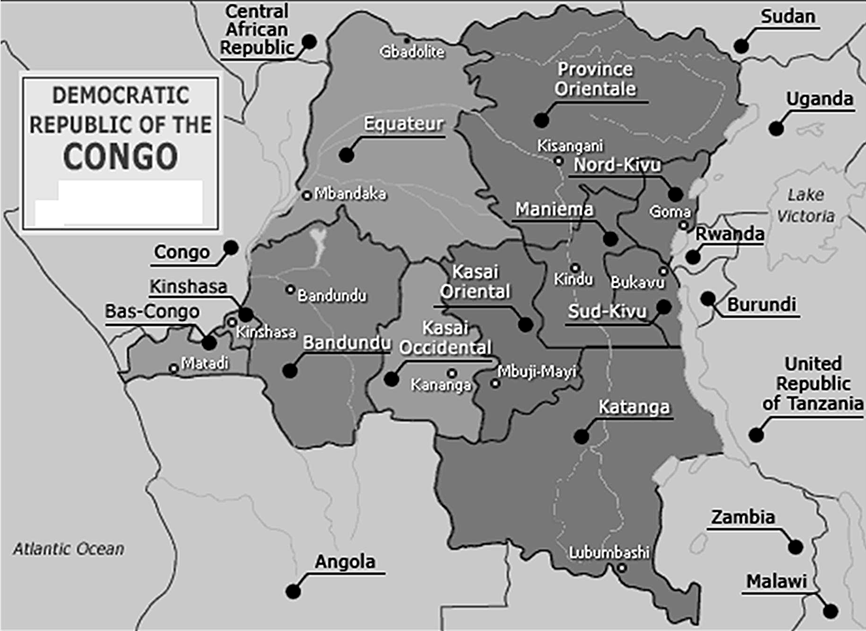
Self-reported fertility, contraception choice, reproductive health, maternal and child health, information on contraceptive choice and breast-feeding, as well as the mother's age, residence in an urban or rural area, education, household economic status and preceding birth interval for women with fewer than five children were recorded, as were other socio-demographic data, including the province of residence. The main exposure variable investigated was the respondent's geographic location, i.e. the administrative province of residence (Fig. 1). The respondent's age at the time of the survey was also included as an indicator of the birth cohort of the participant. Other socio-demographic covariates were the education level of the respondent (no education vs primary, secondary and higher education), household socioeconomic status (low and middle income vs high income households), breast-feeding (never and exclusive vs mixed feeding). Finally, the environmental factors included the place (locality) and province.
Map of the Democratic Republic of Congo showing the eleven provinces. The provinces highlighted in dark shading are conflict-affected areas.

Statistical analysis
In analyses of household survey data the commonly adopted method utilizes standard logistic regression models, which use linear index functions. However, such models do not allow adjustment for the geographic effects or correlation between clusters. For example, the DHS uses cluster sampling to draw upon women respondents via multi-stage sampling of the enumerated areas (villages/communities), the households within the selected communities or all female respondents (aged 15–49 years) in the sample households. Although cluster sampling is a cost-saving measure, without the requirement of listing all the households, methodologically it creates analytical problems in that the observational units are not independent. Thus, statistical analyses that rely upon the assumption of the independence of the households drawn would not be valid. Therefore, there are advantages to using this study's approach over existing ones, say, logistic models with constant-fixed effects of covariates and fixed (or random) provinces effects or standard two-level multilevel modelling with unstructured spatial effects. With such models, it is assumed that the random components at the contextual level (province) are mutually independent, even though, in practice, this assumption is not actually implied by these approaches, so correlated random residuals could also be specified. The independence assumption has an inherent problem of inconsistency: if the location of the event matters, it makes sense to assume that areas close to each other are more similar than areas that are far apart.
To account for the geographic autocorrelation in the proportion of women reporting current use of any modern reversible contraception at the province level, a unified approach was applied to assess the non-linear effects of continuous risk factors. Thus, in addition to the standard logistic regression method, this was achieved using a geo-additive semi-parametric mixed model. The model employed a fully Bayesian approach using a Markov Chain Monte Carlo (MCMC) technique for both inference and model checking (Brezger et al., Reference Brezger, Kneib, Lang and Bayes2005). The response variable was defined as yi=1 if a women i uses modern contraception, otherwise yi=0. The standard measure of effect was the odds ratio (OR) compared to the posterior odds ratio (POR) and 95% credible interval (CI).
The Bayesian analysis was carried out using version 2.0.1 of the BayesX software package, which permits Bayesian inference based on MCMC simulation techniques (Brezger et al., Reference Brezger, Kneib, Lang and Bayes2005). The statistical significance of apparent associations between potential risk factors and the proportion of women reporting the use of contraception was assessed with chi-squared (χ2) for categorical and binary variables and the non-parametric Mann–Whitney U-tests for continuous variables. The adjusted (marginal) OR for modern contraceptive use across provinces was obtained from standard logistic regression models, with Kinshasa used as the reference category because it exhibited the highest observed proportion of women using modern contraception (see Table 1). Multivariate Bayesian geo-additive regression models were used to evaluate the significance of the POR determined for the fixed, non-linear effects and geographic effects.
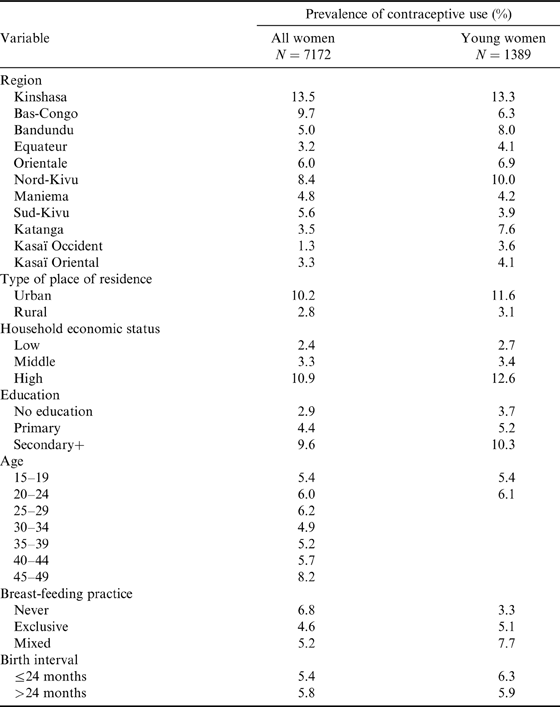
The prevalence of use of modern contraception among all women and young sample, 2007 DHS, Demographic Republic of Congo
Results
The analysis was divided into two groups: the first analysis used all women of reproductive age (15–45 years old) and the second analysis focused on young women, defined as young women of reproductive age between 15 and 24 years of age (N=1389). The overall prevalence of modern contraceptive use among the entire sample of women (15–49 years old) was 5.7% and that of young women (15–24 years old) was 6.0%.
Table 1 shows the unadjusted prevalence of modern contraceptive use by study characteristics for all women and the young sample. For the all-women sample, those living in Kinshasa were shown to have a higher percentage of modern contraception use (13.5%) than women of the other regions. Kinshasa's use of modern contraception is nearly three times more than that of Bandundu, one of the neighbouring regions of the capital (13.5% vs 5%). For young women, the use of modern contraception in Kinshasa is twice that of Bas-Congo, another neighbouring region of the capital (13.5% vs 6.3%). The use of modern contraceptives for all women (2.8%) and young women (3.1%) in rural areas was nearly 4 times less than that for their counterparts in urban areas (10.2% and 11.6% respectively).
It appears that the use of modern contraception tends to be a higher-income-household practice. Women (10.9%) and young women (12.6%) living in households of higher income use modern contraception more than those of low-income households (2.4% and 2.7%, respectively). The use of modern contraception also increases with women's level of education, with a higher usage among those who are highly educated. The usage by women with secondary and higher education (9.6%) is respectively two and three times higher than those with only primary (4.4%) and no education (2.9%). A similar pattern is found among young women with higher education, primary and no education (10.3%, 5.2% and 3.7% respectively). The same pattern is present in women who never practised breast-feeding, who had a higher use of modern contraceptives (6.8%) than those who practised mixed (5.2%) or exclusive breast-feeding (4.6%). In contrast, young women with a mixed feeding pattern used modern contraceptives more (7.7%) than those practising exclusive breast-feeding (5.1%) or those who never practised breast-feeding (3.3%).
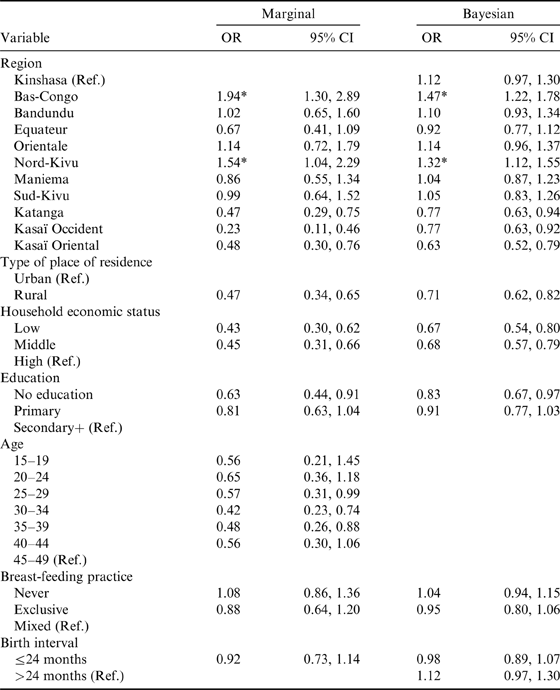
Factors that were found to be significantly associated with modern contraception use in the bivariate analysis were considered further in the adjusted analysis. Table 2 shows the five provinces with significant differences in the use of modern contraceptives relative to Kinshasa: Bas-Congo, Nord-Kivu, Katanga, Kasaï Occidental and Kasaï Oriental. For example, in the adjusted analysis, the women of Bas-Congo were two times more likely to use modern contraception (OR 1.94; 95% CI 1.30, 2.89) than the women of Kinshasa, while those of Kasaï Occidental were significantly less likely (OR 0.23; 95% CI 0.11, 0.46).
Fully adjusted marginal and Bayesian OR (95% CI) of modern contraception use among all-women sample, 2007 DHS, Demographic Republic of Congo
* Indicates a statistically significant higher likelihood of using modern contraception.
Ref.: reference category.
See Fig. 2 for non-linear estimates of the effects of age on contraceptive use.
Women in rural areas have a 53% (OR 0.47; 95% CI 0.34, 0.65) reduced likelihood of using modern contraception compared with women living in urban areas. For household economic status, women of middle income (OR 0.43; 95% CI 0.30, 0.62) and low income (OR 0.45; 95% CI 0.31, 0.66) have, respectively, a 55% and 57% lower chance of using modern contraception than those of higher income. Usage of modern contraception depends also on level of education. Uneducated women have a 37% (OR 0.63, 95% CI 0.44, 0.91) lower chance of using modern contraception than those with higher or secondary education.
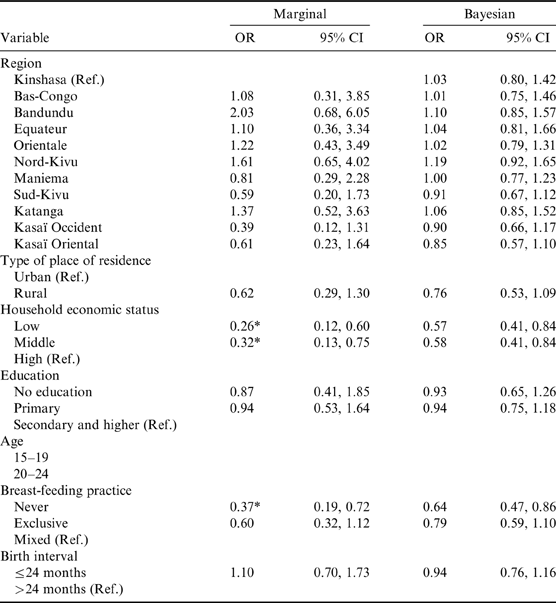
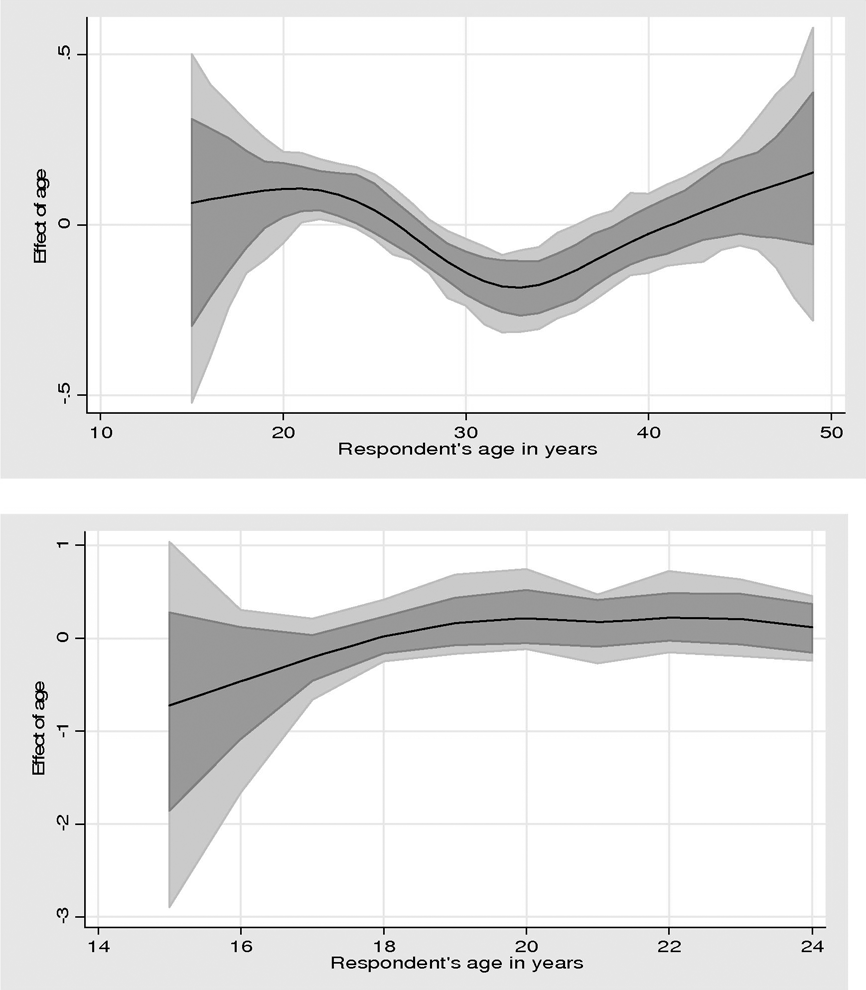
Modern contraception use seems to be restricted to young women and women >40 years of age. In fact, women between the ages of 25 and 40 years have on average a 49% (OR 0.57; 0.42; 0.48 and 95% CI 0.31, 0.99; 0.23, 0.74; 0.26, 0.88) lower chance of using modern contraception than women aged 45–49 years. In contrast to women of all ages, the adjusted model for young women's use of modern contraception shows that region of residence, location of residence, education and birth intervals are not significant factors. However, each variable can separately help explain the pattern of use of modern contraception (Table 3). The results show that household economic status and breast-feeding were associated with the use of modern contraception by young women. Household economic status odd ratio for middle income relative to high income is 0.32, with a 95% CI of 0.13 to 0.75 in adjusted analysis. Those who have never breast-fed were 63% less likely to use modern contraception (OR 0.37; 95% CI 0.19, 0.72) compared with those with a mixed breast-feeding practice.
Fully adjusted marginal and Bayesian OR (95% CI) of modern contraception use among young women, 2007 DHS, Demographic Republic of Congo
* Indicates a statistically significant higher likelihood of using modern contraception.
Ref.: reference category.
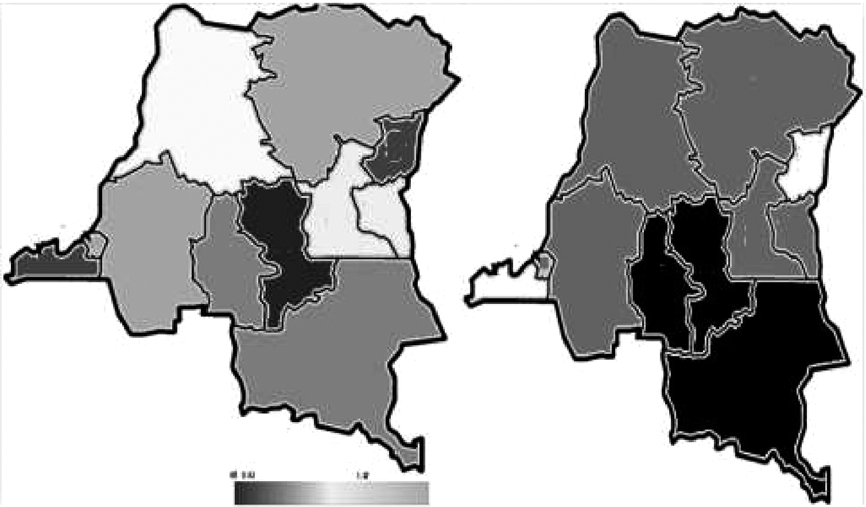
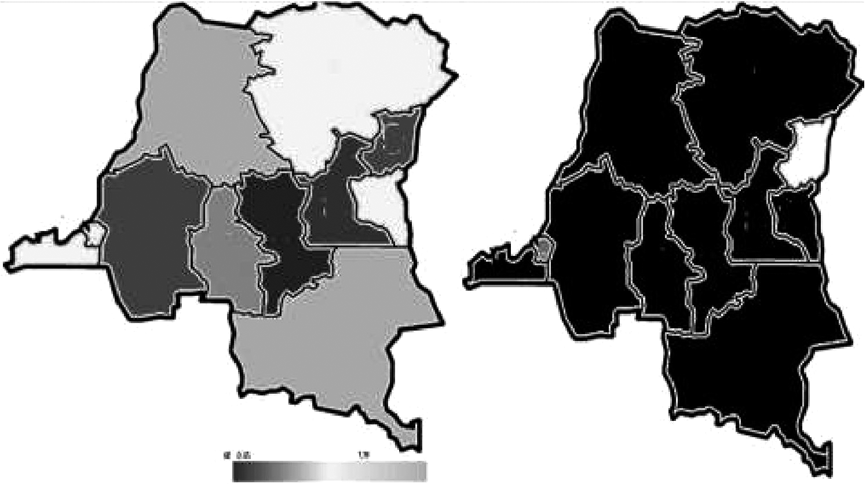
Tables 2 and 3 also show the marginal and posterior odds ratios for the use of contraception across the selected covariates. The results from both the standard logistic regression and multivariate Bayesian geo-additive analyses (the right-hand columns) support the role of women's socioeconomic status as a risk factor for the use of modern contraception, for both all women and the younger women sample. Specifically, women in a low-income household (OR 0.67; 95% CI 0.54, 0.80), a middle-income household (0.68; 0.57, 0.79) and women with no education (0.83; 0.67, 0.97) are to be considered at risk in all of the women sampled. For younger women, those in low-income households (0.57; 0.41, 0.84), middle-income households (0.58; 0.41, 0.84) and women who have never breast-fed (0.64; 0.47, 0.86), were all consistently associated with lower odds of using modern contraception. Furthermore, there was a clear non-linear association between a respondent's age and her use of modern contraception (Fig. 2). As expected, for younger women the likelihood of using modern contraception increased as their age increased. For all women, the likelihood of using modern contraception decreased as their age increased up to 35 years, and increased again after the age of 35, as shown in Fig. 2 using a flexible non-linear curve. There was striking variation in the use of modern contraception among all women across provinces, the highest rates being in Bas-Congo (1.47; 1.22, 1.78) and North Kivu (1.32; 1.12, 1.55), with the lowest in Kasaï Oriental (0.63; 0.52, 0.79), Kasaï Occident (0.77; 0.63, 0.92) and Katanga (0.77; 0.63, 0.94). For the young women sample, except for Nord-Kivu with the highest use of modern contraception, all of the other provinces exhibited a pattern of lower use.
Left: the estimated non-parametric effect of respondent's age on modern contraception use. The posterior mean within the 80% credible intervals is shown. Right: the estimated non-parametric effect of the youth's age on modern contraception use. The posterior mean within the 80% credible intervals is shown.
Figures 3 and 4 show the results for the covariate-adjusted provincial modern contraceptive use differentials captured by the global provincial effects (left). There was a clear (east–south–west) east–west gradient; specifically, the two Kasaï provinces were associated with a lower prevalence of modern contraception, while the North Kivu and Oriental provinces were associated with a higher modern contraception use. These patterns conform with the findings shown in Table 1. In Figs 3 and 4, the left-hand maps show the estimated posterior total residual provincial odds of modern contraceptive use (i.e. the adjusted odds after multiple adjustments for geographical location, taking into account the auto-correlation structure in the data, the uncertainty in the province levels and the all-subject-level traditional risk factors) for modern contraception use in each province, with the light shading indicating the maximum posterior odds recorded, while the grey shading denotes a lower odds. The right-hand maps show the 95% posterior probability maps of modern contraception use, which indicate the statistical significance associated with the total excess risk. The white portion indicates a negative geographical effect (associated with reduced risk of modern contraception use), black a positive effect (an increased risk) and grey a non-significant effect. In all, there was a consistently higher prevalence in the Nord-Kivu provinces and a lower prevalence in the two Kasaï provinces. The interaction terms were assessed, and they proved non-significant.
Left: the total residual spatial effects at the province level in the DRC of the use of modern contraception. Black/dark shading: low use of contraception (OR 0.63); light shading: high use of contraception (OR 1.47). Right: the corresponding posterior probabilities at 80% nominal level. Black: negative spatial association (low use); white: positive spatial association (high use); grey: no statistical association.
Left: total residual spatial effects at the province level in the DRC of the use of modern contraception among youth. Black/dark shading: low use of contraception (OR 0.85); light shading: high use of contraception (OR 1.19). Right: the corresponding posterior probabilities at 80% of the nominal level. Black: negative spatial association (low use); white: positive spatial association (high use); grey: no statistical association.
Discussion
The overall aim of this study was to examine the geographic distribution of the prevalence of modern contraceptive use across provinces of the DRC using data from the 2007 DHS, and to investigate the association between modern contraceptive use and birth intervals among Congolese women in general and young women in particular. The results show that the use of modern contraceptives is dependent on the respondent's province of residence, location of residence, household economic status, level of education and age. These findings by themselves are not new. What is novel in the context of the DRC is the evidence for distinct geographic patterns in the use of modern contraceptives in young women and the whole sample of women, suggesting a potential role for socioeconomic factors such as accessibility, affordability and availability as well as environmental factors at the province level, beyond any individual-level risk factors.
As reported in some countries of sub-Saharan Africa, this study shows that the use of modern contraception is low in the DRC. These women exhibit a pattern of contraception late in their reproductive period, i.e. when they already have more than two children. The use of contraception increases with age. It is used more frequently between the ages of 20 and 29 and use peaks again between 45 and 49, when it is motivated by the need to stop further child birth.
Women practising exclusive breast-feeding are reportedly less likely to use contraceptives. However, the study did not show any significant differences between breast-feeding practices and a lengthening of the period between births. No association was found between the use of modern contraceptive methods and the interval between births. Compared with the present study, which used data from a single DHS (2007), other studies on the use of modern contraceptive methods, made from successive DHS data collections in Malawi (1992 and 2000), Tanzania (1992, 1996 and 1999) and Zambia (1992, 1992 and 2001), have reported similar results. The substantial increase in contraception in these countries was not accompanied by a reduction in the percentage of short interval births (Kandala & Stones, Reference Kandala and Stones2005).
As in most reported analyses at the individual level, regardless of the husband's influence on the decision of a woman (Rwenge, Reference Rwenge1994; Kamau et al., Reference Kamau, Karanja, Sekadde-Kigondu, Ruminjo, Nichols and Liku1996), the use of contraception is related to wealth status and the level of female education (Stephenson et al., Reference Stephenson, Beke and Tshibangu2008). Compared with South Africa, where contraception is free and easy to access (Wood & Jewkes, Reference Wood and Jewkes2006), in the DRC access to contraception is not only difficult but comes with a fee. Most of the population can easily pay for condoms; other contraceptives are not affordable. With prices ranging from about US$1 for a condom to more than US$800 for an IUD, some of these women, and maybe a lot of them, would switch methods if they could afford to (Secura et al., Reference Secura, Allsworth, Madden, Mullersman and Peipert2010), especially in a context where 75% of the population lives on less than one dollar per day (Institut National de la Statistique, 2005). Moreover, pronatalist cultures often exhibit an ignorance of proper contraceptive use, and the propensity for the spreading of damaging rumours (Kamau et al., Reference Kamau, Karanja, Sekadde-Kigondu, Ruminjo, Nichols and Liku1996; Wood & Jewkes, Reference Wood and Jewkes2006; Mathe et al., Reference Mathe, Kasonia and Maliro2011), especially among uneducated women, can have an effect on contraception utilization.
The 2007 DHS indicates that modern contraceptive use is approximately 6.7% for all women in the DRC and, when geographically stratified, is higher in urban than rural areas. The urban environment apparently alters life aspirations and procreative behaviour (Tambashe, Reference Tambashe1984; Rwenge, Reference Rwenge1994). People are more likely to work and have knowledge through the media and family planning counselling services, along with access to a variety of contraceptive methods. Women in rural areas are both less educated and disadvantaged by the scarcity of the necessary products, the remoteness of health facilities and even the quality of family planning products and services (Zah, Reference Zah2010; Mathe et al., Reference Mathe, Kasonia and Maliro2011). Indeed, the politics of contraceptive marketing are largely governed by economic rather than social or health needs. Contraceptive products are imported and are not exempt from taxes. They are therefore expensive and hence inaccessible to poor women. This distribution system was developed to meet urban demand. Although 80% of the population live in rural areas, efforts to sell and improve access to contraception in rural areas are not working. The evidence shows that subsidizing the cost of contraceptives would increase access to contraceptive products, while education of less educated women in rural areas would help with their utilization.
The lack of infrastructure and geographic inaccessibility also contribute to the unequal access to contraceptives in the provinces (Zah, Reference Zah2010; Mathe et al., Reference Mathe, Kasonia and Maliro2011). In addition, in the west, which consists of the capital Kinshasa, Bas-Congo and Bandundu, there is a matrilineal culture (Pradelles de Latour, Reference Pradelles de Latour2001), and women have more opportunities of access and thus an increased frequency of contraceptive use. The eastern provinces, which have been engulfed in a long conflict, must rely on massive interventions by NGOs to improve women's access to contraception. This is not the case in Equateur and the two Kasaï regions, where there is a persistence of a pronatalist culture associated with a low level of female education, gender inequality and a situation in which 86% of all women do not have access to modern health facilities when they need them (UNDP, 2009).
In the context of the DRC, use of modern contraception is certainly a matter of individual choice, but this fact alone is insufficient to provide insight into the steps needed for a demographic transition and to meet multiple national and international challenges. Certainly, the integration of the geographic dimension is of great importance to understand the changes required to solve the problems effectively. However, such disaggregated data in each province are not always available. The country thus cannot carry out the requisite profound changes needed to allow it to gain from more widespread availability of contraception (Smith, Reference Smith1985; Singh & Darroch, Reference Singh and Darroch2012). It is necessary to immediately reduce all barriers to access, improve the distribution system and especially to integrate family planning activities into a national development plan.
This study has certain limitations. First, with the cross-sectional nature of the data, temporality cannot be established and thus the causality of the observed associations. Given the self-reporting method for modern contraception use, it cannot be ruled out that contraception use may be influenced by recall bias. Second, the analysis was based on data collected in 2007, which is likely to underestimate the current prevalence of modern contraception use. Although the 2007 DHS was carried out after the 2006 elections (2nd February to 30th April 2007 for Kinshasa, and from 10th May to 31st August 2007 for the remaining provinces), certain villages and municipalities in the eastern provinces of Nord-Kivu, Sud-Kivu and Oriental regions were engaged in armed conflict at the time. Thus this analysis should be repeated with more recent nationally representative reliable data from the DRC with information on modern contraception use. In addition, there was only limited or lacking information for certain variables such as the number of reproductive health centres in each province and also the provincial reproductive health policy in the provision of family planning services. Nevertheless, the findings corroborate the claim that a relative lack of modern contraception use is an increasing public health issue in the DRC, with evidence of considerable geographic variation across different provinces of the DRC.
Conclusion
The importance of province of residence on contraceptive use in the DRC is reflected in the significance of several variables. The regional variations of contraceptive use may reflect various underlying provincial processes, such as prevailing cultural norms surrounding the expected roles of women in a community. However, together these distal influences reflect the importance of prevailing cultural norms, economic development, women's access to education and, very likely, service provision.
In summary, there are many factors that account for the spatial variations of contraceptive use within provinces of the DRC. One is that the country relies upon a variable physical and human health infrastructure that has suffered from lack of investment and fallen prey to decades of protracted conflict, poor governance and economic mismanagement. The second factor is that access to health care, the health service infrastructure and level of development are unevenly distributed; although urban areas and provinces such as Bas-Congo, Katanga and the capital city Kinshasa perform fairly well, other rural areas and provinces such as Bandundu, the two Kasaï, Maniema, Equateur and the two Kivu lack adequate and developed health infrastructure to address reproductive health issues. The third factor is that the recent conflict in the eastern part of the country has exacerbated this situation even further. In essence, known predictors of contraceptive use are associated with availability and accessibility, especially in conflict areas such as the Oriental province, Maniema, Katanga, Nord-Kivu, Sud-Kivu, and many areas remain inaccessible and alien to government and international community interventions.
Acknowledgments
This research was supported by the British Council under the DelPHE (Development Partnership in Higher Education) scheme and the University of Witwatersrand, South Africa. The authors thank Macro International for providing free access to the 2007 DHS datasets for the DRC. Ngianga-Bakwin Kandala is also supported by the National Institute for Health Research (NIHR) Collaboration for Leadership in Applied Health Research and Care West Midlands at University Hospitals Birmingham NHS Foundation Trust. The views expressed are those of the author(s) and not necessarily those of the NHS, the NIHR or the Department of Health, UK.