I. INTRODUCTION
The dominant notion in Europe is that private antitrust plaintiffs face considerable obstacles when pursuing their claims before the courts. In order to overcome the (perceived) deficient private enforcement mechanisms and to encourage victims to seek compensation for the loss they suffered from anticompetitive restraints, various proposals have been made to alleviate the burden that is usually on plaintiffs in civil litigation. The European Commission has shaped this private antitrust enforcement policy issuing two policy papers and drafting a Directive.Footnote 2 The declared goal of this initiative is to foster private damages claims for the breach of EU competition law. In February 2011 a consultation on collective redress was launched to bring forward a European framework for private group actions.Footnote 3
The measures proposed in the White Paper and the draft Directive are intended to increase the volume of antitrust proceedings but apply mainly to damages claims; cases in which plaintiffs argue that a violation of competition law has caused a loss they believe that they are entitled to recover.Footnote 4 Until the consultation on collective redress, which also includes injunctive relief, the Commission's initiative excluded all other private remedies such as injunctions, interim relief, voidness and restitution claims. Although injunctive relief is now explicitly mentioned in the consultation document, the European private antitrust policy still seems to be primarily concerned with damages actions. Better compensation and enforcement mechanisms are to apply to all types of illegal behaviour under article 101 and article 102 TFEU.
This paper analyses the European approach critically with respect to the general effects of more private actions. Acknowledging the fact that private antitrust enforcement is an indispensable part of the enforcement scheme, the paper shows that the actual European private antitrust policy may not be appropriate as it, inter alia, promotes a ‘one-improved-damages-remedy-fits-all-infringements’ policy. Instead of applying claim-facilitating rules to all types of infringements, the paper makes the case for a revised and limited reform. Especially facilitated damages actions should be restricted to hardcore infringements like, for instance, cartels. The criticism of this ‘one-fits-all’ approach is based on two main arguments. The private antitrust reform may have unintended effects that could offset the expected gains from more competition law enforcement. The law and economics literature provides ample evidence for the ambiguous effects of rules which create or strengthen incentives for litigation. The potential distortions that are caused by incentive-enhancing rules may lead to additional cost for society. The second argument against the ‘one-fits-all’ policy is based on an assessment of litigation data from Europe and the United States. The data indicate that a refined approach would address an actual need as relatively few private antitrust actions deal with cartels. Although the analysis is, to a certain extent, based on the White Paper, the reasoning also applies to other proposals that aim at an alleviation of private litigation. In the next section II, I will outline the European private antitrust policy. Section III revises this policy using insights of the law and economics literature and empirical evidence. Section IV concludes.
II. EUROPEAN PRIVATE ANTITRUST ENFORCEMENT POLICY
Private antitrust enforcement in Europe takes place in a unique system characterized by the parallel application of both European and national competition law before the national courts of the Member States. Articles 101 and 102 are applied alongside the national equivalents in the Member States if the trade between the Member States is affected. European courts do not have jurisdiction to hear private damages claims for the infringement of EU or national competition law although the courts of the Member States can make a preliminary reference to the European Court of Justice (ECJ).Footnote 5 The procedural framework for individual antitrust claims is—apart from the substantive law of the Treaty—provided by the Member States. The standing rules, the types of remedies available to antitrust plaintiffs, and the rules governing the standard and burden of proof are determined by national law. Consequently, the conditions for legal actions can differ between the Member States.Footnote 6
Confirming the procedural autonomy of the Member States, the European Court of Justice held that any victim who suffered loss from anticompetitive conduct should be able to seek redress before the national courts.Footnote 7 In both its Courage and Manfredi rulings the Court dealt with the question whether or not damages actions were available to private plaintiffs. In Courage the antitrust claim was brought by the initial defendant who participated in a vertical anticompetitive beer tie agreement.Footnote 8 In the course of the legal proceedings the question arose whether he was entitled to damages, brought as a counterclaim, despite a conflicting principle of illegality under English law. The ECJ held that, according to the principle of effectiveness, damages for the violation of EU antitrust law are generally available even if the plaintiff participated in an anticompetitive agreement. The subtleties of Italian civil procedure, especially questions of jurisdiction, prompted the reference in Manfredi and the Court's general statement that there is a right for victims of anticompetitive conduct to seek compensation.Footnote 9 The ECJ established that
[i]n the absence of Community rules governing the matter, it is for the domestic legal system of each Member State to designate the courts and tribunals having jurisdiction and to lay down the detailed procedural rules governing actions for safeguarding rights which individuals derive directly from Community law, provided that such rules are not less favourable than those governing similar domestic actions (principle of equivalence) and that they do not render practically impossible or excessively difficult the exercise of rights conferred by Community law (principle of effectiveness) […].Footnote 10
According to Manfredi, the national systems must be open to damages actions for the infringement of the European competition rules. However, the ECJ did not impose a duty on the European Commission or other policy makers to facilitate access to damages claims for potential victims or provide extra incentives to seek compensation. One could think that the Commission's policy initiative is transforming the effectiveness principle because of the frequent use of the term ‘effective’. However, the damages action reform does not create the right to damages nor does it create a remedy.Footnote 11 The European private antitrust policy is an attempt to incentivize private antitrust actions for harmed business and consumers and, especially, damages claims.
Referring to the ECJ's Courage ruling, and later to Manfredi, the European Commission published two discussion papers and drafted a Directive in order to foster the private enforcement of European competition law. The Green Paper on damages actions for breach of the EC antitrust rules of 2005 considered different options to overcome the perceived obstacles to more effective private actions. The White Paper of 2008 focused on a selective mix of procedural and substantive issues to surmount the ‘[…] legal and procedural […]’Footnote 12 hurdles in the Member States in order to remedy ineffective compensation. The Commission's policy aims at the strengthening of the already existing right of victims to obtain redress and the damages actions remedy. Even without final legal measures in place, the Commission's efforts have encouraged changes of the legal frameworks in some Member States.Footnote 13
The White Paper arranged for several measures to lower the barriers for antitrust plaintiffs to bring their law suits in order to achieve effective compensation. Indirect purchasers, who had no direct dealings with the infringer but suffered a loss nevertheless, should have standing for damages actions. They may also rely on a rebuttable presumption that the illegal overcharge was entirely passed on to them. At the same time, defendants who are sued by their direct purchasers could claim (but then must prove) that an overcharge has been passed on to customers of the plaintiff, the so-called passing-on defence.Footnote 14 Addressing the problem of scattered individual losses, the White Paper suggests that the Member States introduce collective redress mechanisms by way of either representative actions through designated bodies or opt-in collective actions.Footnote 15 To assist antitrust damages plaintiffs gathering information about a breach of competition law, they are supposed to gain access to crucial evidence in possession of the defendant. Final decisions of national competition authorities or the Commission will become binding in subsequently initiated antitrust litigation (follow-on actions). Limitation periods are suggested to be changed in favour of antitrust claimants, especially when the violation is of continuous or repeated nature and concealed. With regards to court fees and cost the Commission invites the Member States to review their cost rules to achieve an early dispute resolution and reallocate costs and court fees in favour of plaintiffs. The possible interference of more damages actions with leniency programmes will be prevented by a strict non-disclosure of statements submitted to the Commission. The recent consultation on collective redress has significantly broadened the scope of the envisaged reform of private enforcement in Europe including injunction claims against unlawful business practices. It remains to be seen what measure the Commission will propose on the basis of the stakeholders' submissions.
The current antitrust policy in Europe is still characterized by its focus on effective compensation through damages actions for breaches of articles 101 and 102. Various measures are being discussed to alleviate reparation claims and achieve effective compensation. The proposals apply to all types of anticompetitive behaviour but are restricted to certain remedies, mainly damages claims and injunctions.
III. REVISITING THE EUROPEAN PRIVATE ANTITRUST POLICY
In this section, I look at the potential effects of a reform of private antitrust damages actions. The European private antitrust policy potentially includes inefficiencies and may increase the risks that are associated with private antitrust litigation. Although the European Commission claimed that the European approach strikes a balance ‘[…] in order to have effective measures which do not result in a situation where unmeritorious litigation are encouraged or facilitated […]’,Footnote 16 society's law enforcement expenses, the risk of nuisance suits and the price for errors have played a minor part in the White Paper's assessment of effective compensation.Footnote 17 Despite the criticism that is levied against the European private antitrust policy in the following subsections, private antitrust enforcement has to be understood as an integral part of the overall enforcement scheme complementing public enforcement. But it is the amount and types of actions brought that determines whether or not it turns out to be a blessing or a curse.Footnote 18 The potential risks of claim-enhancing rules are briefly discussed in the following section A. Giving more weight to the potential costs and risks of improved antitrust damages litigation, I reject the current policy approach (section B). Measures aimed at facilitated damages claims should be limited to damages actions against hard-core infringements such as price fixing (section C). In section D, I will show that victims of cartels are in particular need of facilitated access to damages actions and may benefit from improved access to damages actions. The following sections deal mostly with the damages remedy because no concrete proposals with respect to injunctive relief have been brought forward. My analysis is based on the assumption that changes are necessary, although the empirical evidence for this assumption is sparse.
A. The Cost of Private Antitrust Enforcement
When an antitrust statute is infringed, society typically deals with two types of costs. There are losses caused by the actual breach of law (conduct cost) and expenses for pursuing the violation (enforcement cost).Footnote 19 Conduct costs consist of the loss of those who kept purchasing a product despite the overcharge levied on it and the deadweight loss describing the loss to society caused by foregone purchases of the affected product.Footnote 20 The expenditure on enforcement comprises of spending on detection and apprehension (cost for courts and management time)Footnote 21 as well as error costs if a wrong decision concerning the existence of an infringement is made.Footnote 22 While conduct costs occur when the law is violated, enforcement costs are only generated if resources are spent on reducing the existing individual loss (compensation) or preventing future harm (deterrence). But how much should be spent to enforce a certain type of legislation and deter potential offenders? The question is whether or not an equilibrium exists in which the returns from private litigation justify the expenditure. Underpinning all approaches to optimal enforcement is the fact that litigation is costly. Public and private enforcement cost rise with an increase in the number of actions. The price of enforcement prevents society from compensating all victims or deterring every potential offender as this would turn out to be prohibitively expensive if not impossible because resources that can be devoted to apprehension and detection are limited.Footnote 23 The growth of the enforcement costs with the number of actions requires more of the society's scarce resources being devoted to antitrust enforcement activities.Footnote 24 Not only is an increase of the level of antitrust enforcement costly, it also provides diminishing returns up to the point where fewer results are produced for the extra units devoted to enforcement.Footnote 25 The fact that a total enforcement of norms is impossible and the enforcement cost can exceed the enforcement benefits derived thereof, one could think of a theoretical equilibrium in which the cost of applying and enforcing the norm still not outweigh the benefits of the enforcement activity. Although this optimal level of enforcement can be determined in theory it is hard to tell when this equilibrium is reached in practice, for instance, because of the difficulties of measuring the degree and benefits of deterrence.Footnote 26
According to Becker's seminal analysis of punishment, one would save detection or process cost if the penalty was increased and the detection rate lowered provided that the offender is risk neutral or risk averse.Footnote 27 The increased penalty balances the decreased probability of being convicted and maintains the deterrence effect.Footnote 28 If this model is applied to private antitrust actions, the volume of litigation would ideally decrease and, thus, would litigation expenses. However, Landes and Posner argue that this optimum cannot be achieved in civil damages litigation.Footnote 29 A higher penalty, which equals to a multiplied damages award, induces higher rather than lower litigation costs.Footnote 30 Setting a higher penalty creates greater incentives for the victims to file a law suit.Footnote 31 Consequently, a higher penalty leads to more instead of fewer actions. A higher award also makes plaintiffs more willing to increase their spending on detection and litigation in order to receive the damages award.Footnote 32 Although more damages actions have a greater deterrence or compensation effect, more will be spent on enforcement. As a consequence, more damages actions would reduce the number of offenses but at the price of a suboptimal use of resources.Footnote 33 Schwartz called this phenomenon the ‘lock-step’ effect. The damages award constitutes the penalty from the defendant's point of view but, at the same time, also provides for the plaintiff's incentive to sue.Footnote 34
As for damages actions, it is the monetary relief for the plaintiff that provides the stimulus for bringing the action.Footnote 35 The motive for initiating a claim may differ though, especially when plaintiffs request non-damages remedies. However, in private litigation it is usually the pecuniary award, and not the notion of social desirability or the defendant's obedience with the law, that motivates the victim to seek redress in court.Footnote 36 A claim is brought if the potential individual gain outweighs the individual costs. At the same time, the social costs of recovery may exceed the plaintiff's personal gain and cause an increasing detriment to society with an increasing number of civil actions. Shavell has phrased this conflict between society's and individual interest as the divergence of the private and the public motive to bring a legal suit.Footnote 37
Procedural rules favouring plaintiffs and improving the chance of receiving a payment may also provide for incentives to strategically use antitrust litigation extorting settlements from or imposing costs on the defendants:
Private firms will generally pursue antitrust actions when it is in the private firm's interest, an interest that could easily diverge from the social interest. Firms may have incentive to use the antitrust laws strategically, which may hinder rather than promote competition.Footnote 38
Breit and Elzinga refer to one type of theses inefficiencies as the misinformation effect or nuisance suits: A party claims that an antitrust violation has occurred although, in fact, the infringement did not exist.Footnote 39 Extending this definition, nuisance suits may be described as claims with a low probability of winning which are filed with the prospect of inducing the defendant to settle because the latter wants to avoid the costs of a legal disputes or the risk of an adverse court ruling.Footnote 40 Uncertainty about the legal rules and standards amplifies the effectFootnote 41 or causes firms to modify behaviour that is in ‘grey areas’.Footnote 42 Antitrust rules, like most norms, necessarily consist of vague terms. Thus, it can be difficult to assess, on the face of it, whether or not business strategies fall into the realm of illegality. Facing legal uncertainty, the risk of an unknown trial outcome or future legal cost the defendant may be inclined to settle. Enlarging the potential reward or facilitating access to damages actions may increase the risk that nuisance suits occur:
As has been shown, nuisance suits are more likely to occur when a defendant cannot easily show that the claimant's charges are groundless and when the defendant predicts that he has a good chance of being found guilty. If a defendant is risk averse, and his expected payment to allegedly injured claimants is relatively large, the greater will be his desire to settle without litigation. We would predict that any attempt to deter monopolistic activity through increasing payments to plaintiffs or easing the way to their bringing and winning suits would increase the amount of misinformation that the system generates regarding the extent of monopolistic activity.Footnote 43
The US experience also suggests that special procedural rules for private antitrust cases cause distortions because they create incentives to turn business, contract and other disputes into antitrust litigation.Footnote 44 In a procedural system where the rules for contract and antitrust litigation do not provide for significantly different conditions, the assertion of anticompetitive conduct does not change the balance between the parties. If an antitrust claimant benefits from special rules such as discovery, multiple damages or favourable fee shifting, there is a greater incentive to allege the breach of competition law. This may cause a shift of balance between the parties in contract litigation, increase the misinformation effect and change contract relationships altogether. Parties to law suits tend to use all possible arguments including the breach of antitrust rules to strengthen their case and increase the chance of winning.Footnote 45 This occurs even in the absence of plaintiff-favouring rules and may be aggravated if stronger incentives for plaintiffs are provided. Where special antitrust provisions apply, the breach of competition law is frequently claimed in dealer termination suits, franchise disputes but also in takeover battles.Footnote 46 Private antitrust actions are also used to alter the conditions of long-term agreement, respond to litigation, extort settlements from profitable rivals and impede healthy competition.Footnote 47 Therefore, the problem of potentially inefficient litigation, where the claim is legally well-founded but too costly, is aggravated by wasteful litigation and socially trivial complaints that cause additional cost and potentially deter procompetitive conduct.Footnote 48 Furthermore, nuisance suits or perceived litigation excesses can prompt the judiciary to impede access to antitrust litigation.Footnote 49 Rules providing overincentives may lead to two suboptimal consequences: First, we might observe more and more ambiguous litigation. Second, courts may limit the access to private actions, swinging the pendulum into the other direction.Footnote 50
Many of the above-mentioned insights from the law and economics literature are based on a private antitrust model with a damages multiplier aiming at optimal deterrence.Footnote 51 Multiple damages awards in this particular shape do not form part of the European private antitrust policy. Deterrence is regarded as being a secondary rather than the primary goal in Europe. The purpose of optimal deterrence is to make inefficient illegal conduct unprofitable but to permit efficient illegal conduct.Footnote 52 By contrast, compensation is aimed at providing redress for those who have suffered a loss from a violation of the antitrust laws.Footnote 53 Although both the deterrence and the compensation goal differ, the underpinning incentive mechanisms and cost problems of private antitrust damages litigation remain the same regardless of the primary objective.Footnote 54 Shavell argues that the divergence problem actually grows when private enforcement is directed at compensation.Footnote 55 Especially under a compensation objective, where damages are calculated on the basis of individual loss, resources are also wasted estimating damages.Footnote 56 There will be hardly any difference between systems in which deterrence is to be achieved and those where the payment of civil damages is supposed to compensate victims with respect to nuisance suits and contract litigation. It is the monetary payment itself—not the function of it—that motivates private actions.
The considerably high costs of private litigation as a means of wealth transfer raise the question whether the dedication of resources is socially justified by the results that are produced.Footnote 57 The overall level of enforcement activity can easily exceed the point where the benefits of compensation or deterrence justify the costs for the society. In addition, the prospect of personal profits obtained through private claims may lead to nuisance suits and the strategic use of antitrust litigation. The risk that too many resources are spent on litigation or that too many strategic lawsuits are being brought exists in both compensatory and deterrence-based frameworks. It appears that private antitrust enforcement is not able to reach an optimal level of private proceedings.Footnote 58 Private antitrust enforcement cannot deliver and should not aim at complete deterrence or the compensation of all victims, as the cost would be prohibitive, but attempt to reach a more efficient level.Footnote 59
B. The Potential Negative Effects of the European Private Antitrust Policy
In this subsection I will examine some of the potential effects the current policy may have with regard to damages actions. It is undisputed that harmed consumers may need more incentives to bring their claims to court. However, the European private antitrust policy is not restricted to consumers as it will also affect litigation between firms. It has been shown that inter-firm litigation constitutes the better part of litigation in some jurisdictions.Footnote 60 If a policy is implemented that aims at helping consumers but does not take into account potential effects on litigation between firms, it may reduce welfare due to inefficiencies and costs.
The documents underpinning the damages actions reform asserted that the costs of violation will be sustained by the infringer and not by society.
Achieving [the] objective of more effective compensation will ensure that the costs of infringements of competition law are borne by the infringers, and not by the victims, by compliant business and, indirectly, by society as a whole.Footnote 61
Although this statement implies that the Commission found a way to reconcile the conflict between more damages actions and increasing enforcement cost, the policy documents lack the evidence thereof. It appears that the European Commission and other stakeholders underestimate the costs of more damages litigation. It has been repeatedly claimed that effective compensation can be achieved at no extra cost. The authors of the Welfare Impact Report, which underpins the White Paper, dealt with the potential costs of litigation and considered the minimization of litigation cost. Under any scenario laid out in the Report, the benefits of more private actions are weighed against the potential expenditure and the optimal level of private enforcement.Footnote 62 The authors assert that the overall costs of litigation would not offset the damages recoveryFootnote 63 because ‘[t]here are good reasons to assume that lawyer's fees, firms’ opportunity costs and the costs of the legal system never outweigh the wealth transfer effect of private damages actions.'Footnote 64 This is inconsistent with the theoretical insights from the law and economics literature as it was shown above: Greater incentives to bring actions can create more than the optimal volume of litigation.Footnote 65 Consequently, the price for compensation may be higher than the benefits derived from it.
That the Commission's policy is less concerned with the cost of private actions is also shown by the focus on effective compensation. While the Welfare Impact Report discussed efficient deterrence and compensation the White Paper promoted effective compensation. Effective compensation implies that the only criterion a system must meet is the ability to produce compensation, rather than to produce compensation at the lowest possible price. From an effectiveness viewpoint, costs are negligible as long as the aim of compensation is achieved. From an efficiency perspective,Footnote 66 however, the individual as well as society's costs of private litigation matter. The documents underpinning the reform, apart from the Welfare Impact Report, offer hardly any evidence for efficiency considerations. When the Commission referred to the Impact Report it ‘[…] also [gave] consideration to the possible economic and social impacts of an enhanced level of actions for damages’.Footnote 67 It is the lack of contemplating cost or building in safeguards that contradicts the mission statement of the antitrust damages reform that ‘[…] the policy choices proposed in this White Paper […] consist of balanced measures that are rooted in European legal culture and traditions.’Footnote 68 As the resources that can be devoted to litigation are scarce, it is important to focus on a more optimal level of antitrust enforcement. It is the efficient rather than the effective use of resources the enforcement policy must aim at. The magnitude of private damages actions for the violation of competition law is unlikely to reach an efficient level, so the question is not how to achieve optimal enforcement but how much inefficiency should be tolerated in the interest of providing compensation.Footnote 69 The European private antitrust model does not account for the inefficiencies of damages actions nor does it consider whether the ratio of overall costs and output attains a sensible level.Footnote 70
The effects of enhanced private enforcement on social costs are aggravated, as the current approach does not differentiate between infringements with no (or only theoretically) beneficial effects on competition and those that contain some efficiencies, such as certain types of vertical restrains or unilateral conduct. Although the Welfare Impact Report pointed out the potential risk of a ‘one-improved-damages-measure-fits-all-infringements’ approach the issue has not been pursued any further.Footnote 71 Ignoring the difference between detrimental conduct where the harm is unambiguous and ambiguous anticompetitive behaviour, the European private antitrust policy risks that both clearly harmful conduct and potentially efficient behaviour will be subject to more and strengthened damages litigation. If more claims were brought to mute efficient or competitive rivals, it would pervert the objectives of the antitrust rules. European competition law seeks to ensure that consumers benefit from the efficient use of resources and vigorous rivalry between firms. In omitting safeguards against too much or abusive litigation, the current strategy could have the contrary effect as it would hamper competitive businesses. The European policy should therefore increase the threat of litigation only for unambiguously and actually anti-social behaviour. Facilitated antitrust damages actions applied to all types of infringements are likely to also deter overall beneficial actions.Footnote 72 Uncertainty about the legality of activities under articles 101 and 102 may aggravate the potential adverse effects and discourage aggressive business strategies. This dampening effect occurs even when the plaintiffs do not specifically aim at deterring pro-competitive behaviour. It is sufficient that the eased access to damages claims attracts more litigation against all types of potentially anticompetitive conduct. It is claimed that the White Paper already excluded measures that are likely to cause ineffectiveness or excessive costs, like broad discovery rules and damages multipliers. However, it has been overlooked that the generally eased access to damages can have similar effects.Footnote 73
As for the risk of strategic lawsuits, the European damages action reform increases the risk that such actions occur despite the assertion that litigation which does not have merits is to be avoided:
The Commission made clear in its 2005 Staff Working Paper that it does not intend to incentivise victims to bring an action when their actions are not meritorious. It considers it fundamental, though, that those victims who have meritorious claims for damages are able to bring such actions successfully, and are not deterred from bringing an action to court due to the numerous obstacles they face.Footnote 74
The damages actions reform does not provide for a framework which would reduce the risk of non-meritorious litigation. Most of the proposals aim at creating more incentives for antitrust plaintiffs promoting special rules for damages claims under articles 101 and 102. The suggestions apply mostly to antitrust actions but not to any other type of civil law litigation. This will have two unintended effects. First, plaintiffs are tempted to exploit the legal uncertainty that, for instance, prevails with regard to the abuse of dominance under article 102. There are no safeguards in place to reduce the incentives to extort settlements or payments from the defendants. Second, the favourable treatment of antitrust claims increases the incentives of parties to contract disputes to allege the violation of a competition law statute.Footnote 75 Using all relevant statutory provision is a rather common approach in litigation but does not, by and large, result in a great change of procedure or shift the balance between the parties. However, if special procedural rules like discovery or various legal presumptions are made available to plaintiffs if, and only if, they allege violations of antitrust law, it becomes obvious that it would be advantageous for a plaintiff to claim even the most unlikely breach of EU competition law hoping for a settlement. Plaintiffs may not resist the temptation to search for an antitrust hook in their claim in order to gain a procedural advantage and increase their chances of winning the case.
Three conclusions can be drawn from this analysis of the European approach to private antitrust enforcement. First, the focus on effectiveness is most likely to increase the costs beyond what would be socially beneficial. Second, the risks associated with more private enforcement actions may outweigh the benefits of improved compensation.Footnote 76 If litigation became excessive, judges may restrict the access to private actions. As we know from the United States, augmenting the pleading standards or requirements for evidence could be one way of correcting an over-inclusive legal framework. In this case, the compensation objective is unlikely to be achieved. Third, creating a special procedure for antitrust actions can deter detrimental violations but also reduce the potential benefits from efficiency-enhancing vertical agreements or unilateral conduct. The changes caused by European private antitrust policy would affect other types of civil litigation as well.Footnote 77
C. Limiting the Scope of the European Private Antitrust Policy
In this section, I will argue that a limited approach to facilitating antitrust damages claims may address the problems outlined above and become one of the safeguards against strategic litigation the European Commission mentioned in its consultation on collective redress. The European private antitrust policy aims at fostering compensation and providing a stronger damages tool for those who suffered harm from anticompetitive conduct. At the same time, the potential risks of facilitated damages law suits call for a more cautious approach. In order to reconcile the benefits of stronger private enforcement with a need for curbing risks and cost control, the scope of the European private antitrust policy should be constrained to hard-core cartel violations. Victims of other anticompetitive conduct would still be able to claim compensation but without the suggested facilitated measures. The distinction between generally accessible compensatory actions in the Member States and access to the improved damages remedy is crucial. My proposal does not exclude victims of unilateral conduct or vertical restraints from compensation because the damages action reform does not create the right to damages. The adjustments I advance are required only if changes, especially for damages actions, are deemed necessary and strategic litigation remains a concern under the current policy.
According to Hovenkamp, antitrust remedies should be more flexible and reflect the differing degrees of harm.Footnote 78 I broadly adopt his concept of a ‘sliding scale’ for antitrust remedies in order to refine the scope of the European private antitrust policy: Harsher remedies or improved damages actions are only to be provided for more severe violations of competition law. Others have suggested similar approaches, for instance, providing treble damages for per se violations (in the US) and simple damages for all other breaches of antitrust rules.Footnote 79 The European Commission contemplated varying treatments for the different types of antitrust violations in policy option 1 of the White Paper suggesting double damages for private actions against cartels and single damages for all other infringements.Footnote 80 Following this general idea of adjusting the remedy to the type of infringement, the measures to increase the detection rate and alleviate access to damages claims should be exclusively provided for the most severe breaches of the antitrust rules. Cartels that fix prices or share markets would fall into the realm of such hard-core violations. They are often difficult to detect and it requires a considerable amount of resources to successfully conclude a trial against a cartel member. The clear and unambiguous harm to society, the relatively clear legal concept and, thus, the lower probability of legal errors justify an improved access to damages actions.
It is difficult to draw a distinct line between violations that have clearly negative effects and those that are more ambiguous although the criminalization of specific anticompetitive practices provides for a reference point.Footnote 81 The criteria to determine the cartel offence laid out in part 6 of the UK Enterprise Act 2002 comprise of price fixing for products or services, limitations of supply and restrictions of output, market sharing and bid rigging. All those cartel practices have in common that competitors agree to reduce or eliminate competition amongst them. One could argue that this distinction is arbitrary and that there are no reasons to treat horizontal price fixing differently from resale price maintenance or unilateral conduct. However, the negative effects from cartels are, more often than not, clear and there are not many cases in which collusive output restrictions or price agreements improve competition.
Cartels are distinct from other types of anticompetitive constraints and share certain features that would justify a special treatment under the damages actions reform. They harm consumers and have adverse effects on prices and output, normally raising the former and decreasing the latter. The harm caused by international and national cartels is substantial.Footnote 82 The Welfare Impact Report summarized different studies about the adverse effects of cartels estimating the lower band for overall cartel harm around €16.9 billion per year while the upper band would amount to €261.22 billion per year.Footnote 83 Although it is impossible to determine the exact amount of cartel-induced loss hardcore horizontal restraints have an overall adverse impact on competition and welfare. The same cannot be said about vertical restraints or unilateral conduct. Those practices may improve the willingness to invest or foster cost efficiencies.Footnote 84 For instance, vertical exclusive restraints imposed by manufacturers help to secure the incentives for retailers to invest in the provision of services for a certain good and avoid free-riding problems.Footnote 85 Price discrimination which may fall under article 102 could have positive effects on welfare and investment.Footnote 86
Another argument in favour of a harsher treatment of cartels stems from the fact that they usually do not occur by mistake. It is difficult to imagine a situation where firms inadvertently enter into a price-fixing or market-sharing agreement given the nature of those infringements. With the current level of public enforcement of the cartel prohibition there is little reason to believe that managers accidently stumble into cartels. In contrast, certain vertical restraints or discriminatory activities may have a plausible commercial background.Footnote 87 This shall not hide the fact that some dominant firms intentionally abuse their powers to force competitors to exit the market or to prevent market entry in the first place. Nevertheless, unilateral conduct also includes behaviour which is regarded common business activity and not necessarily harmful.
Facilitated access to damages actions—including disclosure rules—would also be justified in cartel-related litigation because of the detection and information-gathering problems. Knowing the consequences of their engagement in price-fixing or market-sharing activities, offenders act with great care and in secrecy to avoid detection and punishment.Footnote 88 Cartel meetings are normally disguised,Footnote 89 transmitted information is encrypted sometimesFootnote 90 and evidence of illegal agreements may be destroyed.Footnote 91 It is the secrecy of cartels that poses one of the major problems for private enforcers. If the victim does not notice that competition law was breached, there is no opportunity to react. In case an affected firm initiates proceedings, the claimant will find it difficult to retrieve information about communication between cartel members which are necessary evidence in legal proceedings.Footnote 92 On the other hand, victims of vertical restraints or unilateral conduct are often, though not always, in a close contractual relationship with the violator or even part of the anticompetitive arrangement. It is said that the detection rate of antitrust violations within contracts is 100 per cent.Footnote 93 If price conditions in an agreement contravene the antitrust rules, the negatively affected business partner is likely to observe those illicit terms, as occurred in the Courage litigation.Footnote 94 In contrast, the secret nature of cartels increases the probability that victims miss the opportunity for legal action altogether. Cartel members are likely to impose extra enforcement cost on potential plaintiffs, as the latter usually needs to invest more in order to gather the evidence about disguised price fixing.Footnote 95
The clearly negative economic effects of horizontal hardcore agreements facilitate the legal treatment. Most hardcore cartel infringements fall under a tight scrutiny hardly qualifying for a justification or a consideration of their procompetitive effects.Footnote 96 In the US, the Supreme Court deemed price-fixing,Footnote 97 output restraints,Footnote 98 and market divisionFootnote 99 per se illegal. Those agreements are held to be unlikely to yield pro-competitive effects and, therefore, do not require a case-by-case analysis of their pro-and anticompetitive effects. Price-fixing and market-sharing agreements in the EU have already the object of distorting competition under article 101 and no anticompetitive effects need to be proven.Footnote 100 This is not a per se approach but hard-core cartel violations are unlikely to qualify for a justification under article 101(3). The legal treatment of cartels is relatively clear narrowing the leeway for a legal (mis)interpretation and uncertainty. The same cannot be said about unilateral conduct under article 102 which is controversial and complex.Footnote 101 Terms like ‘normal’ or ‘fair’ have an almost philosophical notion and are difficult to handle in the court room. Although both article 101 and article 102 provide for examples of prohibited practices, the enumeration in article 102 leaves much room for speculation. Difficulties in determining the exact meaning of the article 102 prohibition increase the likelihood of judicial error and may deter welfare-enhancing and pro-competitive behaviour if the prohibitions are interpreted too broadly, or if type II errors occur. The exclusionary abuse under article 102 remains ambiguous despite the effort of the European Commission to clarify it.Footnote 102
There are not only economic and legal arguments that support a revised European private antitrust policy. The documents underpinning the reform suggest that the primary motivation behind the project is to improve damages actions against cartelists. For example, only cartel victims will benefit from access to leniency statements which the Commission tries to regulate in its White Paper. Similarly, a potential discovery procedure is particularly advantageous for cartel victims as they probably know the least about the violations compared with victims of other breaches of competition law. Vertical restraints and unilateral conduct occur quite often in contracts for which the detection rate is considerably higher. The planned extension of limitation periods for cases in which the victim has not yet discovered the loss is also more likely to be of use in disguised price-fixing cases. The preparatory documents deal more often with cartels and the problems related to them than with all other infringements. The Welfare Impact Report devoted 24 pages to the assessment of the harm from cartels while losses from all other infringements of the competition rules were summarized on eight pages.Footnote 103 Finally, the emphasis on damages claims despite the existence of other forms of relief may also be interpreted as an implicit focus on cartels. Damages do not aim at restoring a relationship for the future unlike, for instance, injunctions. Compensatory payments only solve a conflict between parties for the past and repair the harm done. Thus, damages may be preferred by cartel victims as a remedy of last resort. Requesting payments for past harm makes a lot of sense in cases where the cartel was broken up but is less useful in constellations where the illegal conduct continues. If, for instance, the access to an essential facility is unduly restricted, damages actions compensate the harm in the past but will not grant (unrestricted) access to the facility for the future. Furthermore, in contract cases, such as vertical restraints, it may also satisfy the plaintiff if he can just alter the terms of a contract.
There are good reasons to limit the damages actions reform in order to reduce the potential side-effects. Instead of making all possible violations of articles 101 and 102 subject to the facilitated damages remedy, considerations of costs and risks and the documents underlying the reform argue for a restrictive approach limiting improved damages actions to cartels. As I will show in the next section, there are not only good theoretical arguments against a too broad a damages actions reform but also a particular need to strengthen damages claims against cartels.
D. Addressing a Real Need—Damages Actions against Cartels
The theoretical arguments against an unrestricted scope of the damages actions reform can, to some extent, be taken further. Studies undertaken in Europe and the United States suggest that victims of cartels are the least likely to seek remediation in the courts. Therefore, a refined European policy that eases access to damages claims for cartel victims would probably address a real need. The data underpinning my proposal are taken from the EU Impact Report,Footnote 104 this author's work on German cases,Footnote 105 Rodger's study in the UK,Footnote 106 and two projects from the US.Footnote 107 The authors of the Georgetown Study collected information about private antitrust litigation filed between 1973 and 1983 in five federal districts in the US.Footnote 108 It was estimated that the study covered about one sixth of all filed antitrust litigation during that period. Kauper and Snyder used the data from the Georgetown Project to compare follow-on and stand-alone cases.Footnote 109 Perloff and Rubinfeld analysed settlements in private antitrust actions also working with a sample from the Georgetown Study.Footnote 110 The Georgetown Project is a snapshot of litigation between 1973 and 1983—but still the best to date—rather than an actual reflection of private cases. The number of private antitrust proceedings has declined and the legal landscape has changed since the early 1980s. In a more recent analysis of US litigation, Lande and Davis selected 40 large-scale and successful private actions that produced more than US$50 million in cash benefits and were concluded before 1990.Footnote 111 They focused on claims that had already reached the final litigation stage. The authors of the Welfare Impact Report tried to identify private enforcement litigation for the breach of articles 81 and 82 (now articles 101 and 102) in the Member States although empirical research was not the central theme of their report for the European Commission. In their study the authors counted 96 antitrust damages actions for the EU27 between May 2004 and the third quarter of 2007.Footnote 112 Barry Rodger's study in the UK reported all identifiable private enforcement cases up to 2008 in which parties asserted the violation of either EU or UK law.Footnote 113 For the German dataset I collected data on 368 private antitrust cases concluded between 2005 and 2007. The dataset contains claims alleging breach of either national or EU competition law.Footnote 114 The latter two studies attempt to provide a complete sample of private antitrust cases in the respective observation period. Although the observation periods, objectives and legal backgrounds of all empirical studies differ they provide an overview about antitrust litigation against cartels.
1. Horizontal price-fixing cases
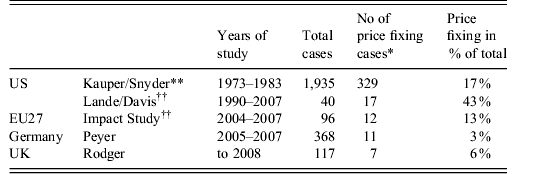
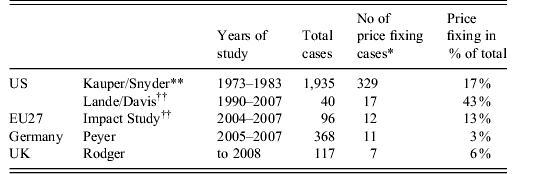
A survey of the available data reveals that there is comparatively little litigation against hard-core cartel constraints despite the clear legal concept of price fixing and market sharing. The German Federal Cartel Office indicated once that hard-core cartels are by no means the majority of privately pursued antitrust violations.Footnote 115 This is a clear contrast to the perception of cartel damages actions which seemingly dominate the discussion. As for litigation against cartels, Table 1 shows the ratio of cartel cases to other antitrust proceedings for various time periods and jurisdictions.
Private actions against price fixing
* Primary allegation.
** Salop and White using the same data from the Georgetown Study defined a sample with 1,959 cases in which almost 16 per cent of primary allegations dealt with price fixing.Footnote 116
† Selection of 40 successful damages claims minimum worth $50 million cash benefits. Most of these cases were settled.
†† The focus was on damages actions for violation of EU antitrust law.
Kauper and Snyder found that 17 per cent of all allegations in the US were related to price fixing which corresponds to 329 cases of a total of 1,935 non-multi-district cases.Footnote 117 In Lande's and Davis' study almost 43 per cent of all cases in their sample were price-fixing allegations. Compared with other data the proportion appears to be extraordinarily high. It is likely to be artificially augmented because of the non-random and selective sample. Cartels typically create large losses, so we can expect a higher number of cartel proceedings in a sample that is based on large-scale cases. Studies from Europe showed lower proportions of price-fixing cases compared to the US. Of the 96 proceedings discovered by the Welfare Impact Report, 61 were concerned with vertical restraints and only 12 actions tackled hard-core constraints. The authors of the Report could not identify a successful damages claim taking into account pending appeals but ignoring private enforcement of national competition laws. Rodger's research in the UK revealed seven cases in which hardcore violations were alleged.Footnote 118 While Rodger discovered only two cases until 2004, he found five actions related to price fixing between 2005 and 2008. Rodger's study excluded proceedings that ended with a settlement but there might be more actions against cartels that settle pre-trial and do not show in the data. The German data also support the hypothesis that only a few court cases are launched against firms engaging in price-fixing. From a total of 368 finished civil proceedings between 2005 and 2007, only 11 dealt with hardcore cartels. In two of these 11 cases, plaintiffs challenged the validity of cartel-affected contracts and did not request damages. Only one compensation claim for alleged price fixing was successful.Footnote 119
The proportion of damages claims in the US were relatively high while in the UK and Germany damages claims were filed less often. Vertical restraints and unilateral conduct seem to attract more litigation in Europe than hardcore violations although one cannot exclude the possibility that more cartel cases are settled before trial because of the clear legal concept and harm.Footnote 120 Whether or not the number of actions brought against cartels will change with more cartels being discovered due to the relatively new leniency programmes remains to be seen. The results from the Welfare Impact Report indicated a higher ratio of price fixing cases than Rodger's and my study. However, the Welfare Impact Report focused on damages actions excluding other remedies, a fact that may have contributed to the higher proportion of cartels in the sample. In general, only very few price-fixing cases were brought before the courts in Europe. Allegations of other types of anticompetitive conduct account for the majority of private antitrust actions.Footnote 121 The evidence offered is far from being exhaustive but it provides a sense of what private plaintiffs file their actions for. Taking into account the enormous harm price-fixing cartels create, the particularly low ratio of claims against cartelists in Europe may indicate a need to improve the conditions for damages claims against cartels. If the European private antitrust policy is concerned with private actions against cartels, then the assumption of a litigation deficit is probably right. Increasing the incentives for cartel victims to seek redress is likely to address a real need.
2. Cartels and follow-on litigation
Price fixing is difficult to detect and private litigants often lack the resources and compulsory process (by means of public powers) to discover cartel violations.Footnote 122 Without preceding government cases plaintiffs are more likely to focus on conduct that is more visible like, for example, vertical restraints.Footnote 123 Investigating cartels and publicizing information about cartel investigations in the first place, public enforcers signal a potential infringement, reveal necessary evidence and motivate the potential victims to seek compensation in the courts. If a claim is triggered by a public investigation and all or a part of the findings are used by the claimant, the claim is commonly referred to as follow-on case. Stand-alone actions are independently initiated and not based on a public decision specifying the violation. Some jurisdictions provide for a binding effect of public decisions in subsequent private suits. For instance, section 47A of the UK Competition Act 1998 declares the finding of the infringement binding in follow-on trials before the Competition Appeal Tribunal. In Germany claimants can rely on final infringement decisions of the European Commission and other EU competition authorities. Decisions of the US courts are used as prima facie evidence in subsequent trials according to section 5(a) of the Clayton Act. Relying on the facts from public investigations, follow-on cases supposedly need fewer resources, lead to higher awards and are more likely to be litigated and settled.Footnote 124 At the same time, follow-on actions ‘free ride’ on public expense and only marginally increase the deterrence effect through detection while providing compensation. In contrast, stand-alone litigation is said to contribute to the scarce resources of the public investigator. Plaintiffs who independently pick up cases in addition to those under public scrutiny provide extra information about anticompetitive restraints. Stand-alone claims might, thus, increase the detection rate but also come at a higher investigation cost.
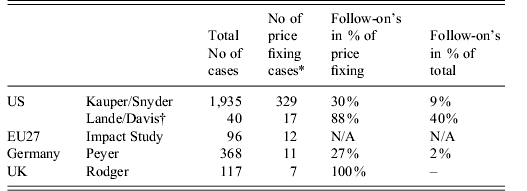
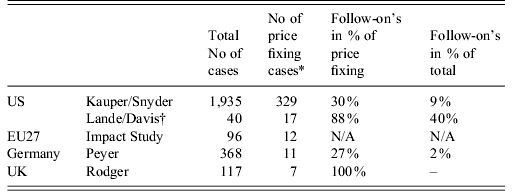
The data compiled in Table 2 show the proportion of follow-on actions in price fixing proceedings and the percentage of follow-on actions in all proceedings in the respective sample. For all studies the ratio of follow-on actions based on price-fixing allegations exceeds the average proportion of follow-on litigation. According to Kauper's and Snyder's data, 30 per cent of private US price-fixing actions followed a public investigation while only nine per cent of all claims were preceded by government activity. In the sample of Lande and Davis the vast majority of claims alleging price-fixing were triggered by investigations by the competition authorities. The small number of observations in Rodger's and my study do not allow final conclusions. Nevertheless, there is a link between private price-fixing cases and prior government activity in Germany. Roughly 27 per cent of price-fixing actions followed a public investigation, but only two per cent of all cases were follow-on proceedings.
Follow-on cases alleging price fixing
* Primary allegation.
† Selection of 40 successful damages claims minimum worth $50 million cash benefits. Most of these cases were settled.
The most important proposition with regard to hard-core infringements is that ‘[…] follow-ons are far more likely than independently initiated cases to focus on horizontal price-fixing, the most egregious and economically significant antitrust violation.’Footnote 125 Independently-initiated cases are less likely to deal with hardcore cartel constraints.Footnote 126 Strengthening damages claims against cartels means that more compensatory payments have to be made, which in turn add to deterrence. It seems that the Commission has this type of compensation and deterrence effect in mind because it suggests, for example, a binding effect of infringement decisions for follow-on proceedings or regulates the access to documents received during public investigations. This hints towards the role of private actions as follow-on proceedings. However, follow-on litigation is unlikely to raise the detection rate or to preserve public funds by complementing official investigations. A damages actions reform that focuses on compensation and strengthens tools for follow-on proceedings may help to achieve the compensation objective and add to deterrence if it applies to cartel cases but it also risks the duplication of enforcement efforts.
3. Price-fixing allegations and remedies
Very few data were available about the remedies victims of cartel violations requested. The Georgetown Project data did not reveal how often damages were claimed on the basis of price-fixing violations or if plaintiffs sought other remedies against price fixers. Lande and Davis' study of US litigation as well as the Welfare Impact Report in Europe examined only damages actions and did not include alternative relief. The German data offer some information about the relation between the remedies and the alleged anticompetitive conduct. A very cautious interpretation suggests that law suits against cartels were often actions for damages while other breaches of the competition law rules did not necessarily triggered requests for compensation. In roughly 55 per cent of the cases in which price fixing was primarily alleged the claimants sought compensation.Footnote 127 In contrast, only 11 per cent of all primarily requested remedies in the full sample of 368 cases were aimed at damages. Rodger's first study until 2004 revealed a similar pattern in the UK with all price fixing cases being claims for compensation while the overall ratio of damages claims was just around 18 per cent. Although both Rodger's and my study are based on very small samples they show a tendency: Compensation is the first-choice remedy against cartels because there is no other, more useful remedy against price fixers. In most instances the cartel has been broken up by a competition authority. It no longer harms the plaintiff but he has probably suffered losses that are worth recovering. In cases of vertical restraints or unilateral conduct an injunction or nullity of a contract may suffice to remediate the problem with effect to the future.
Threatening price-fixing firms with an increased likelihood of private damages payments may also strengthen deterrence and make good for the suboptimal fining of cartels. It was repeatedly shown that cartel fines imposed by the European Commission are too low and, in all likelihood, do not even recover the ill-gotten profit of cartel members.Footnote 128 Although private enforcement activities are only a second-best solution to a harsher pecuniary punishment of the infringing firms, optimal fines are unlikely to be achieved because they lack public or political acceptance.Footnote 129 Litigation against members of cartels can improve the deterrence effect if the antitrust policy creates the incentives for those who are less likely to initiate legal actions in the current framework. It may help to address the problem of deterrence and compensation if access to damages claims is eased in hardcore cases, where harm undisputedly occurred and difficulties for recovery exist.
4. Follow-on price fixing litigation and settlements
The number of private antitrust proceedings brought against cartels and other types of anticompetitive conduct may conceal the true magnitude of private litigation. Particularly in disputes where facts and legal assessment are relatively clear, parties may be willing to settle the matter before a trial is commence. However, for most jurisdictions no or very little information about settlements is available. Numerous contributions deal with theoretical issues of settlements and the conditions under which parties are likely to resolve issues without a judge's decision.Footnote 130 Two of the factors that determine the willingness of parties to settle are the estimated likelihood of success and a consensus between the parties about the probability of the court's actions.Footnote 131 This narrow focus ignores other aspects that can potentially influence the decision of the parties to settle the case.Footnote 132 While a decision of the competition authority strengthens the plaintiff's claim and raises the plaintiff's expectation to receive a higher payment, it may reduce the probability of successfully defending the case for the defendant, thus making a settlement more likely.Footnote 133 If parties have different expectations about the outcome of the case despite there being a previous public decision, a follow-on action does not guarantee a successful settlement. Nevertheless, the higher probability of winning for the plaintiff implies that one can realistically expect a higher number of follow-on settlements which were not taken into account in the European litigation data presented above.Footnote 134
The German dataset, for instance, is based on cases that were concluded with a court decision on the merits offering no information about other outcomes. However, we do know that of the cases litigated, roughly two thirds were won by the defendant. Since there were a number of cartel cases both at the EU level and in Germany during that period,Footnote 135 and given that these cases on the whole are more easy to litigate because culpability has been established, we would expect a high level of settlements in cases where the defendant's position was weak, leaving the cases where the litigant misjudged the strength of the defendant's case to go to court. With respect to settlements in European jurisdictions, Posner argues that the continental cost allocation rule, under which the loser normally pays the legal fee of the winning party, will lead to more settlements as it punishes a wrong estimation of success.Footnote 136 However, Rodger's study on UK cases, although indicating an increasing number of settlements, did not find settled cases concerning price fixing.Footnote 137 Perloff and Rubinfeld's US settlement analysis based on Georgetown Study data revealed that price fixing cases were the least likely to be settled.Footnote 138
Although it is not clear how many cases are settled, we can assume that settlements take place and cases may be more likely to be settled after government intervention. Facilitating access to damages claims may strengthen the case for the plaintiff and induces more settlements. Limiting the European private antitrust policy will not negatively affect other follow-on disputes. If the infringement has been clearly established by a public authority previous to the legal argument, the threat of litigation does not lead to a strategic use off uncertain legal.
5. Preliminary conclusion
The data showed that very few actions are initiated on the basis of price-fixing allegations. The relatively small number of follow-on proceedings may point towards a lack of incentives to bring actions against cartels even if they have been persecuted by a competition authority. Although private cases which follow public investigations are more often than other antitrust lawsuits directed against cartelists, there is still comparatively little cartel litigation. This may indicate difficulties for cartel victims to obtain compensation even in follow-on actions. The data show that damages claims appear to be the most valuable and most frequently used remedy against cartels. Improving damages claims against cartels would not only help to compensate victims of cartels but also add to the sub-optimal deterrence of cartels due to insufficient public fines. Furthermore, a reform that is focused on damages implicitly addresses cartel victims who, if they file a law suit, normally request compensatory payments.
IV. CONCLUSION
The European private antitrust enforcement policy has certainly raised the awareness of damages claims against breaches of the antitrust rules. It is an attempt to base compensation claims on a common framework, albeit a rather incomplete one. The antitrust damages reform in its current shape suffers from an over-inclusiveness and an underestimation of the risks and cost of private enforcement. The emphasis on effective compensation combined with a ‘one-improved-damages-measure-fits-all-infringements’ approach fosters not only ‘good’ claims but also provides incentives to bring ‘bad’ actions or turn contract disputes into antitrust cases. This is particularly likely for inter-firm litigation. The special treatment of antitrust damages claims vis-à-vis other antitrust and non-competition law remedies incentivizes the strategic use of competition law rules and may distort civil litigation. Subverting litigation-encouraging rules for non-intended purposes is not just a theoretical concern or limited to the US with its treble damages and one-way fee shifting. Litigation that takes place between firms is often based on failed negotiation or contracts and offers ample opportunities to strategically exploit the threat created by facilitated damages actions. In order to reduce the potential cost and risk of the damages action reform, it should be limited to those cases in which hardcore cartel violations like price-fixing or market sharing occur.
A potential European private antitrust policy that distinguishes between hardcore cartel infringements and other types of anticompetitive conduct will not totally eliminate potential distortions, but it may reduce the likelihood that private antitrust procedure is exploited for other, possibly anticompetitive, purposes. The available litigation data suggest that a narrower scope of the reform would address an actual need. Cartel victims are particularly dependent on damages claims and preceding public investigations. Facilitating access to actions against cartels may create better incentives to follow a public investigation and, thus, achieve a higher level of compensation and deterrence. If the reform proposals are applied to other types of violations, they will risk greater inefficiencies. In its recent consultation on collective redress the European Commission asked for safeguards against ‘abusive litigation’.Footnote 139 One of the safeguards is to reduce the incentive for potential plaintiffs and limit litigation-enhancing rules to cases in which it is less likely that the antitrust laws are used strategically. Eased access only to damages claims against cartels will primarily lead to more follow-on litigation. This can cause a duplication of enforcement efforts which, however, seems to be the European Commission's intention. From a welfare perspective, it begs the question of whether this allocation of resources to private litigation is truly ideal. Although this paper argues in favour of a more differentiated European private antitrust policy, it should be noted that private litigation is an integral part of successful antitrust enforcement scheme. It is not a question of whether or not to have private antitrust litigation in Europe but whether or not private enforcement needs strengthening and, if so, what measures ought to be implemented.