1. Introduction
Accurate groundwater dating is crucial for effective water resource management, particularly in the water-stressed semi-arid regions of western India, where aquifers serve as the primary source of freshwater for agriculture, domestic use and industry. These resources are increasingly threatened by over-extraction, contamination, and the impacts of climate variability (Bandyopadhyay et al. Reference Bandyopadhyay, Bhuiyan and Saha2020, Reference Bandyopadhyay and Chatterjee2023; Chaudhari et al. Reference Chaudhari, George and Sanyal2024; Swain et al. Reference Swain, Taloor, Dhal, Sahoo and Al-Ansari2022; Taylor et al. Reference Taylor, Scanlon, Döll, Rodell, Van Beek, Wada, Longuevergne, Leblanc, Famiglietti and Edmunds2013). Understanding aquifer age structures and recharge dynamics is therefore vital for ensuring long-term sustainability. Radiocarbon (14C) dating of dissolved inorganic carbon (DIC) in groundwater provides valuable insights into age of the groundwater, residence times in aquifers, recharge rates and water origins, allowing the distinction between modern, renewable groundwater and older, non-renewable reserves (Agarwal et al. Reference Agarwal, Gupta, Deshpande and Yadava2006, Reference Agrawal, Mohanty, Rathi, Mehta, Yadava, Kumar and Laskar2024; Borole et al. Reference Borole, Gupta, Krishnaswami, Dutta and Desai1979; Han et al. Reference Han, Plummer and Aggarwal2012; Laskar et al. Reference Laskar, Sarkar, Mohanty, Agrawal, Kumar and Shivam2025a; Pearson and Hanshaw Reference Pearson and Hanshaw1970; Plummer and Glynn Reference Plummer and Glynn2013; Vogel and Ehhalt Reference Vogel and Ehhalt1963; Yin et al. Reference Yin, Wang and Chen2023). In regions with highly seasonal rainfall and limited surface water availability, robust groundwater age estimates are critical for guiding policy decisions, protecting recharge zones, and adapting to increasing anthropogenic and climatic pressures.
14C dating has long been established as a reliable tool for estimating groundwater residence times (Agrawal et al. Reference Agrawal, Mohanty, Rathi, Mehta, Yadava, Kumar and Laskar2024; Cartwright et al. Reference Cartwright, Currell, Cendón and Meredith2020; Clark and Fritz Reference Clark and Fritz1997; Geyh Reference Geyh2000; Kalin Reference Kalin, Cook and Herczeg2000; Laskar et al. Reference Laskar, Agrawal, Singh, Mohanty, Rahman and Kumar2026a; Plummer and Glynn Reference Plummer and Glynn2013). Groundwater 14C ages provide information of recharge dynamics, flow pathways, and aquifer sustainability, and also help assess the contributions of various sources to the DIC pool. In particular, the stable carbon isotope ratio (δ13C) in DIC, along with radiocarbon content, provides important clues about interactions between soil carbon, carbonate minerals, and groundwater during recharge. Groundwater dating using 14C in DIC commonly assumes that DIC is primarily derived from modern soil CO2 produced by root respiration and microbial decomposition (e.g., Clark and Fritz Reference Clark and Fritz1997; Geyh Reference Geyh2000; Mohanty et al. Reference Mohanty, Agrawal, Shivam and Laskar2025; Plummer and Glynn Reference Plummer and Glynn2013) although experimental and modelling studies also considered contribution from other sources including soil carbonates (Bacon and Keller Reference Bacon and Keller1998; Han and Plummer Reference Han and Plummer2016; Wallick Reference Wallick1976). The simple assumption that soil CO2 is the sole origin of DIC in groundwater may hold reasonably well in many humid temperate environments; however, it may not be valid in semi-arid and arid settings. Even when contributions from multiple carbon sources are considered, both the relative proportions and the extent of mixing can vary substantially depending on the local geology, hydrology and climatic conditions. A major complexity arises from the fact that the 14C content of these contributing components can itself be highly variable. These uncertainties highlight the need to better constrain the contributions and radiocarbon signatures of multiple carbon sources under different environmental settings.
In semi-arid to arid regions, soil carbonate and calcretes are common due to prolonged evaporation and limited leaching (Breecker et al. Reference Breecker, Sharp and McFadden2009). The age of these carbonates is influenced by regional climate conditions: in arid environments, they tend to be considerably older than the surrounding soils, reflecting slower dissolution and precipitation rates. In contrast, increased rainfall promotes more frequent dissolution and re-precipitation cycles, resulting in relatively younger soil carbonates (Achyuthan et al. Reference Achyuthan, Flora, Braida, Shankar and Stenni2010; Khadkikar et al. Reference Khadkikar, Chamyal and Ramesh2000; Pendall et al. Reference Pendall, Harden, Trumbore and Chadwick1994). During recharge events, these carbonates may dissolve and contribute carbon to the DIC pool in the unsaturated zone with a different age than the soil CO2, potentially biasing 14C based age estimates of groundwater. Despite its critical influence on 14C age estimates in groundwater, the age of DIC in unsaturated zone soil water (UZSW) remains largely unquantified, particularly in semi-arid regions. Many previous studies, including model-based analyses, have considered the contribution of carbonates to DIC; however, most assume that these carbonates are 14C dead (Bacon and Keller Reference Bacon and Keller1998; Han and Plummer Reference Han and Plummer2016; Plummer and Glynn Reference Plummer and Glynn2013; Wallick Reference Wallick1976), an assumption that may not always be valid. Consequently, groundwater ages estimated from 14C in DIC under this assumption may be significantly biased. Therefore, rather than assuming carbonate-derived carbon to be 14C-free, it is important to determine the 14C content of the contributing carbonates and apply appropriate corrections to groundwater age estimates.
Despite its importance, almost no studies have systematically measured DIC ages in UZSW for such corrections, leaving a major gap in understanding the influence of soil carbonate dissolution on groundwater dating and on the apparent age of recharge water before it enters the aquifer. If soil carbonates contribute significantly to DIC and are not entirely 14C free, the initial 14C content of recharge water would be higher than that estimated under the conventional assumption of 14C dead carbonate contribution. Assuming the carbonate contribution to be completely devoid of 14C would therefore overestimate the dilution of 14C activity in DIC, ultimately leading to an underestimation of groundwater ages. Therefore, understanding the sources and age of DIC in UZSW is essential for refining groundwater dating, especially for younger groundwater systems (<10,000 years). For older waters, the correction may lose relevance as other factors may cause even larger uncertainty (Agrawal et al. Reference Agrawal, Mohanty, Rathi, Mehta, Yadava, Kumar and Laskar2024). In the Indian context, this is particularly relevant, given that the country is among the most groundwater-dependent regions in the world. Accurate age estimations are crucial for identifying recharge zones, assessing groundwater vulnerability and informing policy decisions regarding sustainable extraction in its vast groundwater irrigated regions.
In this study, we conducted detailed measurements of 14C and δ13C in DIC from UZSW, soil CO2, soil organic carbon (SOC), and soil carbonates across agricultural lands in semi-arid Gujarat. Our objectives were to (i) quantify the relative contributions of soil CO2 and soil carbonate to the DIC pool in the unsaturated zone, (ii) estimate the age of DIC in UZSW, and (iii) assess how carbonate-derived DIC influences groundwater age interpretations. We also discussed the methodological challenges of isolating DIC in the presence of organic carbon during sample processing. The findings provide new insights into groundwater dating in semi-arid environments and underscore the need for careful consideration of carbonate inputs when using 14C for groundwater dating.
2. Materials and methods
2.1. Selection of agricultural sites
A major portion of the alluvial plains in Gujarat is under agriculture, where intensive farming practices lead to substantial water recycling. In these regions, in addition to the monsoon rainwater (limited to the July–September period), groundwater is extensively extracted for irrigation, and a portion of this water re-infiltrates into the aquifers called irrigation return flow. Therefore, maximum groundwater recharge is expected to occur in these agricultural areas, as irrigation is carried out throughout the year. The irrigation return flow has been found to influence the recharge dynamics substantially in the region (Laskar et al. Reference Laskar, Agrawal, Singh, Mohanty, Rahman and Kumar2026a). Given the importance of this component in recharging the aquifers, we selected agricultural sites to estimate the age of water in the recharge zones of farmlands. This helps assess the age of the major recharge component and suggest correction in the age of the aquifer water measured using 14C in DIC.
2.2. Climate and groundwater hydrology of Gujarat
Gujarat’s climate is primarily influenced by the southwest monsoon, which occurs from late June to September and accounts for about 80% of the region’s annual precipitation (Pai et al. Reference Pai, Sridhar, Rajeevan, Sreejith, Satbhai and Mukhopadhyay2014). The climate ranges from sub-humid to arid, with notable variations in monsoonal rainfall. Southern coastal areas receive between 1500 and 2000 mm annually, while northern regions get less than 500 mm, with an overall average of approximately 650 mm (Dave and James Reference Dave and James2017). Temperatures fluctuate between 25–45°C during summer and 10–35°C in winter.
The hydrogeological characteristics of Gujarat have been well-documented (Agarwal et al. Reference Agarwal, Gupta, Deshpande and Yadava2006; Laskar et al. Reference Laskar, Agrawal, Singh, Mohanty, Rahman and Kumar2026a; Pandey et al. Reference Pandey, Padhya, Ganguly, Chakra and Deshpande2023), revealing a diverse array of geological formations, including unconsolidated, semi-consolidated, and fissured aquifers. The unconsolidated aquifers, extending from north to south are highly productive, exhibiting high hydraulic conductivity (5–20m/d) and yields of 10–40 liters per second (lps) (CGWB Report 2015–2016). In contrast, semi-consolidated aquifers in northern part have lower yields (<15 lps) and moderate hydraulic conductivity (2–10m/d). Fissured formations in eastern Gujarat store groundwater in shallow weathered zones and deep fractures, generally yielding between 2–15 lps. Notably, the presence of thermal springs along certain faults and fissures indicates active hydrothermal circulation (Deshpande and Gupta Reference Deshpande and Gupta2007; Das et al. Reference Das, Maya, Padmalal, Laskar, Sudheer, Kumar, Roy and Rawat2026).
Groundwater levels in Gujarat have declined markedly in recent decades (Bandyopadhyay Reference Bandyopadhyay and Chatterjee2023; CGWB 2021; Debsarma et al. Reference Debsarma, Sahu and Kalubarme2023; Shanthakumar et al. Reference Shanthakumar, Banerjee and Batas2021), particularly in North Gujarat, where over 60% of the land is dedicated to agriculture, heavily reliant on deep, static groundwater reserves (Saha and Ray Reference Saha and Ray2019). In Central Gujarat, the extensive alluvial plains host multi-layered aquifer systems, both confined and unconfined, underscoring the need for extensive groundwater monitoring and sustainable management.
2.3. Soil, soil water samples and extraction of CO2 from SOC and DIC
Soil samples were collected from different depths from the agricultural lands (Figure 1) in December 2023–January 2024. Detailed information on the soil types and soil sampling procedures is provided elsewhere (Laskar et al. Reference Laskar, Mohanty, Agrawal, Dabhi and Kumar2026b; Mohanty et al. Reference Mohanty, Agrawal, Shivam and Laskar2025). Briefly, the soils of the alluvial plains of Gujarat predominantly fall under five soil orders: Entisols, Inceptisols, Vertisols, Alfisols, and Aridisols. Soil samples were collected using a stainless steel auger. About 500 g soil was collected from each depth, packed them in a polypropylene zip-lock bag and transferred to the laboratory and stored at ∼4 °C until analysis. For measurements of DIC contributed by soil carbonate and its isotopic analysis, about 100 g of gravel free soil was poured in a 250 mL glass bottle. The bottle was crimped to make it vacuum tight and the air inside the bottle as well as the CO2 in the soil pore space were pumped connecting to a vacuum system. About 100 mL ultra-pure (MilliQ) water was poured into the evacuated bottle using a syringe, shaken it rigorously and left for a couple of days. The soils settle at the bottom leaving clean water above. About ∼50 mL water was sucked gently from the relatively clean water above the soil layer, using a syringe without disturbing the system and was used for further analysis. The extraction of CO2 from DIC in groundwater follows the method detailed in Agrawal et al. (Reference Agrawal, Mohanty, Rathi, Mehta, Yadava, Kumar and Laskar2024) and also shown in Figure 2A. Briefly, 1–2 mL of commercial orthophosphoric acid (85%) was reacted with the ∼50 mL extracted water in a pre-evacuated flask. The liberated CO2 was separated from moisture and purified from other impurities using a cryogenic technique. This is done by passing the CO2 through two U-tubes (U) and a spiral tube (SP), with the first U-tube immersed in an alcohol-liquid nitrogen slush maintained at -80 °C and the spiral and next U-tube immersed in liquid nitrogen (LN2) at –196 °C. The U-tube maintained at –80 °C trapped most of the moisture, while CO2 passed through and was cryogenically trapped in the LN2-cooled U and spiral tubes. The spiral tube enhances CO2 trapping efficiency. The extracted CO2 was further purified by repeated freeze-thaw cycles during transfer between traps to remove residual moisture and other impurities. The purified CO2 was finally collected in a pre-evacuated high-vacuum glass ampoule. The CO2 amount was quantified by expanding it into a calibrated volume (CV) connected to a pressure gauge (PG). The pure CO2 was then separated into two aliquots, one for stable carbon isotope ratio (δ13C) analysis and other for graphite preparation followed by radiocarbon measurements (Laskar et al. Reference Laskar, Pratheeksha, Singh, Agrawal, Mohanty, Shah and Yadava2025b). δ13C was measured using a dual-inlet stable isotope ratio mass spectrometer (MAT 253) at the Physical Research Laboratory. This method achieved a DIC extraction yield of 98 ± 5%, with excellent measurement accuracy (Agrawal et al. Reference Agrawal, Mohanty, Rathi, Mehta, Yadava, Kumar and Laskar2024).
Map of the study area showing sampling locations along with the measured 14C ages (in kBP) of topsoil carbonates at selected sites. The colour gradient represents the spatial distribution of annual precipitation across the region.

Figure 1. Long description
A map of western India showing soil core sampling locations and mean annual precipitation. The map includes the Gulf of Kutch and the Gulf of Cambay, with the Arabian Sea to the west. Key labeled locations include soil core sampling sites marked with triangles and labeled L 1, L 2, L 4, L 14, L 16, L 18, L 19, and L 21, each with associated radiocarbon ages in thousand years before present (kBP). The Physical Research Laboratory (PRL) coordinate is marked with a red star. The color gradient represents mean annual precipitation, ranging from 350 mm to 1,750 mm. The map also includes an inset showing the broader geographic context within India.
(A) Glass vacuum line used for extraction of carbon dioxide from dissolved inorganic carbon. Water samples are injected into the sample flask, reacted with orthophosphoric acid under vacuum, passed through tubes immersed in slush (–80 °C) and liquid nitrogen (–196 °C) and finally collected in the sample bottle; (B) Vacuum system for preparation of CO2 from soil using combustion method and extraction utilizing cryogenic separation.

For CO2 extraction from SOC, soil samples were carefully inspected to remove visible plant remains and decarbonated using 1–2% dilute HCl. The samples were thoroughly rinsed with deionized water to achieve neutral pH and subsequently oven-dried at 50–60 °C. Carbon concentrations in the treated samples were measured using a C/N Analyzer (Thermo Fisher, Bremen, Germany). For CO2 extraction from SOC, the dried samples were combusted in a custom-built vacuum system (Figure 2B). The released CO2 was purified from moisture and other impurities in the vacuum system with a series of three U tubes, first one immersed in alcohol-liquid nitrogen slush (–80 °C) and the subsequent two in LN2 at –196 °C and collected using a cryogenic trapping technique as discussed above for CO2 liberated from DIC.
2.4 Soil air and soil carbonate sampling and CO2 extraction from them
For soil CO2, soil air was collected from different depths using a customized vacuum system with pumping arrangement (Figure 3A,B) (more details in Agrawal et al. Reference Agrawal, Mohanty, Rathi, Mehta, Yadava, Kumar and Laskar2024, Reference Agrawal, Kumar and Laskar2026; Laskar et al. Reference Laskar, Sarkar, Mohanty, Agrawal, Kumar and Shivam2025a, Reference Laskar, Mohanty, Agrawal, Dabhi and Kumar2026b; Mohanty et al. Reference Mohanty, Agrawal, Shivam and Laskar2025). A stainless steel pipe was inserted into the soil to the target depth for soil air collection. The soil material within the pipe was carefully removed, and a second hollow pipe equipped with a vacuum-tight assembly was placed into the cavity. The annular space around the pipe was sealed with surrounding soil material to prevent contamination from atmospheric air. The glass flask and connected tubing were then evacuated using a rotary vacuum pump for ∼5 minutes to completely remove residual atmospheric air from the system. Subsequently, the flask was filled with soil air collected from the desired depth up to atmospheric pressure (1 atmosphere), which was monitored using a pressure gauge (Figure 3B). Further details of the sampling procedure are provided in our previous studies (e.g., Agrawal et al. Reference Agrawal, Mohanty, Rathi, Mehta, Yadava, Kumar and Laskar2024; Laskar et al. Reference Laskar, Sarkar, Mohanty, Agrawal, Kumar and Shivam2025a; Mohanty et al. Reference Mohanty, Agrawal, Shivam and Laskar2025).
(A) Schematic of soil CO2 sampling from different depths. The samples are collected in the high vacuum pre-evacuated glass flask. (B) Actual soil air sampling from field; 1: stainless steel pipe inserted to the desired depth for soil air sampling, 2: vacuum pump, 3: power supply from a portable generator, 4: vacuum valves, 5: ¼ inch vacuum system with Swagelok ferules and cajons for connecting different parts, 6: glass stopcock, 7: pressure/vacuum gauge, 8: high vacuum sample collection flask. (C) Extraction of CO2 from soil air using high vacuum cryogenic technique.

CO2 from soil air was extracted and purified through a vacuum system using cryogenic process (Figure 3C), also elaborated in previous publications (Laskar et al. Reference Laskar, Sarkar, Mohanty, Agrawal, Kumar and Shivam2025a; Mohanty et al. Reference Mohanty, Agrawal, Shivam and Laskar2025; Agrawal et al. Reference Agrawal, Kumar and Laskar2026). Briefly, the flask containing the soil air sample was connected to the extraction line, and CO2 was quantitatively separated from the soil air. The soil air was passed in a controlled manner through a series of three U-tubes as described above. The purified CO2 was finally collected in a pre-evacuated high-vacuum glass ampoule for isotopic analysis using the MAT 253 at Physical Research Laboratory. No measurable isotopic fractionation was observed during the extraction procedure, as verified through air CO2 extraction experiments (Laskar and Liang Reference Laskar and Liang2016; Laskar et al. Reference Laskar, Mahata and Liang2016b) and replicate analyses of multiple soil-air aliquots collected from the same depth (Agrawal et al. Reference Agrawal, Mohanty, Rathi, Mehta, Yadava, Kumar and Laskar2024).
To extract CO2 from soil carbonates, approximately 5–10 g of pebble-free soil was taken in McCrea reaction vessel (McCrea Reference McCrea1950) and reacted with ∼85% orthophosphoric acid at ∼50 °C. The resulting CO2 was cryogenically purified and collected using the same technique as described above. The volumetrically measured CO2 was then used to estimate the carbonate content in the samples.
2.5. Graphite preparation and radiocarbon measurements
The purified CO2 samples were converted into graphite using an in-house graphite preparation line (Agrawal et al. Reference Agrawal, Mohanty, Rathi, Mehta, Yadava, Kumar and Laskar2024; Laskar et al. Reference Laskar, Pratheeksha, Singh, Agrawal, Mohanty, Shah and Yadava2025b). Briefly, about 50 micromole CO2 was transferred to a vacuum system in which pre-conditioned iron (∼5 mg) and zinc (∼25 mg) powders were loaded in the two arms of an L-shaped interconnected vacuum sealed quartz tubes (Jull et al. Reference Jull, Donahue, Hatheway, Linick and Toolin1986; Laskar et al. Reference Laskar, Pratheeksha, Singh, Agrawal, Mohanty, Shah and Yadava2025b). Iron and zinc powders were heated to appropriate temperatures for CO2 reduction to elemental carbon (graphite) which deposited on the surface of iron powder. The graphite-coated iron was pressed in an aluminium holder and its 14C content was measured in a 1 MV accelerator mass spectrometer (AMS) at Physical Research Laboratory Ahmedabad, India (Agrawal et al. Reference Agrawal, Mohanty, Rathi, Mehta, Yadava, Kumar and Laskar2024; Laskar et al. Reference Laskar, Pratheeksha, Singh, Agrawal, Mohanty, Shah and Yadava2025b). Using 14C/12C or 14C/13C for samples, ages were estimated. Along with the samples, measurements of international standards such as Oxalic Acid I, Oxalic Acid II and background materials (anthracite) were made to estimate the background corrected activity of samples and measure their radiocarbon ages. The ages were corrected for the isotopic fractionation during sample preparation and within the AMS (Donahue et al. Reference Donahue, Linick and Jull1990; Laskar et al Reference Laskar, Pratheeksha, Singh, Agrawal, Mohanty, Shah and Yadava2025b).
2.6. Radiocarbon ages of SOC, soil CO2, soil carbonate and dissolved inorganic carbon
The radiocarbon age of a sample, based on the Libby half-life of 5568 years, is determined using the standard equation described by Stuiver and Polach (Reference Stuiver and Polach1977)
 $\rm t = {\rm{ }} - 8033\;ln\left( {{A_{SN}}/{A_{ON}}} \right)\;$
Where ASN and AON are the isotope fractionation corrected activity measured in sample and the initial activity, respectively.
Radiocarbon content can also be expressed as factor modern (F14C) or percent modern carbon (pMC) as defined below:
 $\rm {F^{14}}C = {A_{SN}}/\left( {0.7459 \times {A_{OXII}}} \right)$
 $\rm pMC = \left[ {{A_{SN}}} \right]/\left[ {{A_{ON}} \times {e^\lambda }^{(y - 1950)}} \right] \times 100$
Where AOXII is the activity of the Oxalic Acid II radiocarbon standard, λ is the 14C decay constant based on modern half-life (1/8267 yr−1) and y is the year of sampling. By convention, 74.59% of the activity of Oxalic Acid II is taken as equal to the activity of 1950 atmospheric 14C.
A sample with negative 14C age or positive F14C or pMC greater than 100 indicate presence of bomb carbon i.e., carbon that was fixed from the atmosphere after 1950 due to nuclear weapons testing. A sample with finite 14C age can also have bomb carbon but not enough to make its age negative.
2.7. Precision and reproducibility of measurements
Precision and reproducibility of measurements for δ13C of soil organic carbon, soils CO2, soil carbonate is 0.1‰ (Agrawal et al. Reference Agrawal, Mohanty, Rathi, Mehta, Yadava, Kumar and Laskar2024; Laskar et al. Reference Laskar, Sarkar, Mohanty, Agrawal, Kumar and Shivam2025a, Reference Laskar, Pratheeksha, Singh, Agrawal, Mohanty, Shah and Yadava2025b). The reproducibility for radiocarbon measurement is 30–50 yr for samples in the age range of 0–15000 yr. For older samples (15000 to 35000 yr), the analytical uncertainty in radiocarbon ages is in the range of 50–100 yr. The precision for radiocarbon measurements varies between 0–100 yr (Laskar et al. Reference Laskar, Pratheeksha, Singh, Agrawal, Mohanty, Shah and Yadava2025b). Unless otherwise stated, all the uncertainties are reported at the 1σ level.
2.8. Partitioning contribution of carbon from different sources
In semi-arid to arid regions, soil carbonates are abundant with ages ranging from modern to several thousand years. These carbonates can contribute significantly to the DIC pool in the unsaturated zone, especially during the rainy season when dissolution processes are enhanced. The contribution of DIC in the UZSW has been estimated using the following two component mixing assuming that the DIC has two sources viz. soil CO2 and soil carbonates in semi-arid regions of Gujarat.
 $\rm {F^{14}}{C_{DICUZSW}} = {f_{SCO2}} \times {F^{14}}{C_{SCO2}} + {f_{SC}}{F^{14}}{C_{SC}}$
Where F14CDICUZSW, F14CSCO2 and F14CSC are the F14C values in DIC in UZSW, DIC originated from soil CO2 and soil carbonate. fSCO2 and fSC are the respective fractions from soil CO2 and soil carbonate.
3. Results
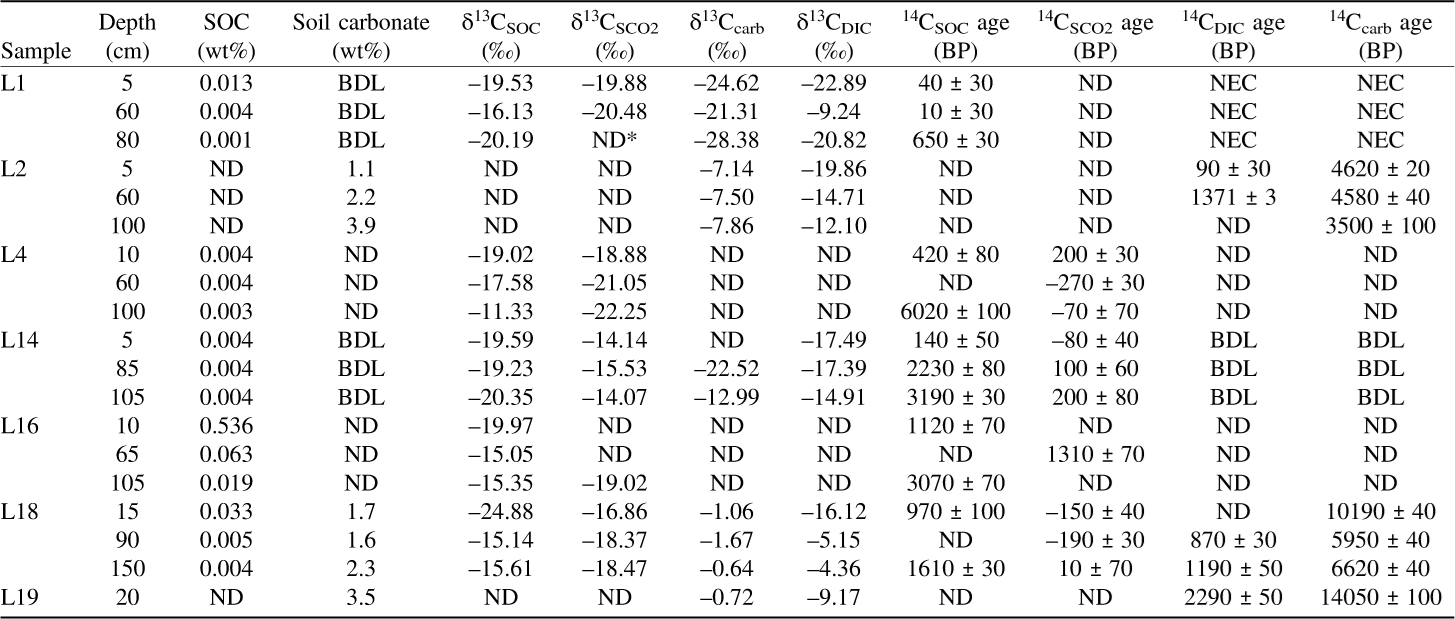
Soils are highly depleted in SOC in the agricultural lands of Gujarat (<1%) and rich in carbonates, especially in the northern semi-arid regions (Table 1). In such regions, a significant fraction of DIC in the UZSW can have carbonate origin. δ13C values in SOC in the top layers varies between –17.0 to –24.8‰ (Table 1). In most profiles, δ13C values increase with depth, consistent with microbial preferential decomposition of 12C-enriched compounds. However, occasional decrease in δ13C with depth likely reflect historical shifts in vegetation, possibly driven by past climate changes (Laskar et al. Reference Laskar, Sharma, Ramesh, Jani and Yadava2010, Reference Laskar, Yadava, Ramesh and Sharma2013; Sridhar et al. Reference Sridhar, Laskar, Prasad, Sharma, Tripathi, Balaji, Maurya and Chamyal2015).
Sampling locations with depths, δ13C in SOC, soil CO2, soil carbonates and DIC in UZSW. 14C ages (with Libby half-life of 5568 year) of SOC, soil CO2, DIC in UZSW, and soil carbonates are also presented. In the southern sub-humid region, soil carbonates were largely absent at most sites. However, acid digestion occasionally produced trace amounts of CO2, primarily derived from the decomposition of SOC or DOC, as indicated by the δ13C signatures. The CO2 amounts were insufficient for 14C measurements, and only δ13C values were obtained for those samples without carbonates. Negative 14C ages in soil CO2 indicate presence of bomb carbon.

Table 1. Long description
The table presents data on soil properties and carbon isotope measurements across various samples and depths. It includes columns for depth in centimeters, soil organic carbon (SOC) weight percent, soil carbonate weight percent, delta 13C values for SOC, soil CO2, soil carbonates, and dissolved inorganic carbon (DIC), as well as radiocarbon ages for these components. The table has 19 rows and 13 columns. Each row represents a different sample and depth, with specific values for each measured parameter. Notable trends include variations in delta 13C values with depth and the presence of bomb carbon indicated by negative 14C ages in soil CO2. The table also highlights the absence of soil carbonates in the southern sub-humid region and the occasional presence of trace amounts of CO2 derived from the decomposition of SOC or DOC.
ND: No data; BDL: below detection limit; NEC: not enough carbon for measurement.
δ13C values of CO2 in soil pore space are sometimes comparable to those of SOC but show significant deviations at other sites, likely due to changing crop types across seasons. For instance, at sites L14 and L18, the disparity in δ13C values between SOC and soil CO2 suggests recent vegetation shifts. While SOC reflects long-term accumulation, soil CO2 predominantly originates from modern root respiration and decomposition of fresh organic matter (Mohanty et al. Reference Mohanty, Agrawal, Shivam and Laskar2025).
In sub-humid sites (L1, L4, and L14), δ13C values of DIC in UZSW and soil carbonates exhibit mixed signatures of SOC and carbonate sources. In some cases, the signatures are even of pure SOC or dissolved organic carbon (DOC) as indicated by the δ13C values of –20 to –23‰ in DIC in UZSW and –21 to –28‰ in soil carbonate. This is an experimental artefact where SOC and DOC were reacted with orthophosphoric acid to liberate CO2. The soil carbonates in these sites are negligible (Table 1). Normally, under mild acid treatment SOC or DOC are not released. However, treating with 85% phosphoric acid for longer duration may release a significant amount of CO2 from SOC or DOC particularly for soil/sediments poor in soil carbonates. Therefore, this aspect needs to be carefully considered during CO2 extraction from soil carbonates by acid digestion for isotopic analyses. The results clearly indicate that the CO2 released from soil carbonates at the southern Gujarat sites carries a mixed inorganic and organic carbon signature. Consequently, the 14C ages of the soil carbonates or DIC in UZSW from these sites have limited practical significance. In contrast, the semi-arid sites of northern Gujarat exhibit δ13C values characteristic of predominantly carbonate-derived DIC and soil carbonates, making them more suitable for 14C dating to evaluate the contribution of soil carbonates to the DIC of UZSW. The δ13C values of soil carbonates for these samples range from –1.6 to 0.2‰ indicating absence or insignificant organic matter contributing the liberated CO2 (Achyuthan et al. Reference Achyuthan, Quade, Roe and Placzek2007). An enrichment of ∼ 14‰ takes place in carbonate when precipitated from soil CO2 under isotopic equilibrium (Cerling Reference Cerling1984; Cerling and Quade Reference Cerling and Quade1993). Therefore, carbonates precipitated under C3 vegetation should have δ13C values in the range of –6 to –18‰, and +5 to –3‰ under C4 vegetation. The range of δ13C values of the soil carbonates indicate mixed signatures of C3 and C4 vegetation (Table 1). Negligible proportion SOC and presence of high proportion of carbonates in these sites result in the low abundance of decomposable organic matter. Furthermore, organic matters in the semi-arid agricultural soils of northern Gujarat are highly depleted and exhibit mean residence times of ∼1000 years in the surface layers, increasing substantially in deeper soils (Mohanty et al. Reference Mohanty, Agrawal, Shivam and Laskar2025). This indicates the relatively refractory nature of the organic matter, suggesting that acid digestion likely caused only minimal loss of organic carbon from these soils. Therefore, the 14C data in carbonates in the northern semi-arid parts of Gujarat are very likely representatives of the age of the carbonates. However, a more systematic analysis of both soil carbonates and SOC is required for confirmation. The carbonate content in the soils of Gujarat vary in the range of 0–4.4% with no presence of carbonate in the southern sub-humid part and highest in the northern semi-arid region (Table 1).
14C ages of DIC in UZSW reveals ages between 90 and 2290 BP with an average age of 1240 BP (Table 1), indicating that the DIC in unsaturated soil zone is not modern but significantly older and highly variable. This apparent 14C age in the semi-arid agricultural soils of Gujarat suggests that carbonate dissolution as the source of this older age. The other component i.e., soil CO2 contributing the DIC in are mostly modern (see 14C ages of soil CO2 in Table 1). In some cases, soil CO2 gives negative ages (Table 1) indicating presence of bomb carbon, i.e., the atmospheric CO2 incorporated recently after the nuclear weapon testing in 1950s and 1960s. Details of 14C ages of soil CO2 and SOC has been discussed in Mohanty et al. (Reference Mohanty, Agrawal, Shivam and Laskar2025). Radiocarbon ages of soil carbonates range from 3500 to 14,050 BP, indicating substantial spatial variability across the study region. Soil carbonates from the semi-arid northern sites are generally older than those from the relatively sub-humid southern sites, likely reflecting enhanced dissolution and re-equilibration during monsoonal infiltration in the southern region. These apparent 14C ages represent integrated or average ages of soil carbonates formed and modified over extended periods through repeated cycles of dissolution during wet phases and reprecipitation during dry seasons. In the northern semi-arid region, where annual rainfall is relatively low (∼300 mm yr−1), carbonate dissolution is expected to be limited. Consequently, the apparent 14C ages may more closely reflect the long-term accumulation history of soil carbonates. Since detailed dating and formation history of soil carbonates are beyond the scope of the present study, we did not investigate these processes further and instead focused on evaluating their contribution to DIC in UZSW. Using the 14C contents of DIC in UZSW and soil carbonates together with the mixing equation (Eq. 4), the contribution of soil carbonates to DIC in the region was estimated to be 1–23% with an average of 13%.
4. Discussion
In semi-arid to arid climates, soil carbonates typically form as part of the pedogenic process (Cerling Reference Cerling1984; Cerling and Quade Reference Cerling and Quade1993). During pedogenesis, carbonates precipitate from soil water through evaporation, incorporating dissolved carbonate sourced from the weathering of calcareous dust, limestone within alluvial sediments and calcium-bearing silicate minerals. Some bedrock carbonates can also be retained in the soil carbonates (Kowalska et al. Reference Kowalska, Zaleski, Józefowska and Mazurek2019). With successive wetting and drying cycles, partial dissolution and re-precipitation of these carbonates occur, governed largely by local rainfall patterns (Retallack Reference Retallack2005). These processes significantly influence the 14C and δ13C values of soil carbonates and, consequently, the DIC pool in the UZSW. As soil carbonates dissolve, their carbon can mix with DIC formed from soil-respired CO2, the latter is typically modern in age at-least in the study region (Mohanty et al. Reference Mohanty, Agrawal, Shivam and Laskar2025; Laskar et al. Reference Laskar, Sarkar, Mohanty, Agrawal, Kumar and Shivam2025a), resulting in mixed 14C signatures. While re-precipitation in wetter conditions can introduce younger carbon via organic matter interactions, the resetting of 14C and δ13C values remains incomplete, and the extent of isotopic alteration increases with precipitation. Our findings show that the 14C ages of soil carbonates increase with increasing aridity (Table 1), consistent with reduced dissolution/precipitation in drier regions.
Given these complexities, radiocarbon dating of soil carbonates often provides unreliable absolute ages of carbonate formation (Callen et al. Reference Callen, Wasson and Gillespie1983; Khokhlova et al. Reference Khokhlova, Bulysheva and Kuznetsova2023; Pustovoytov et al. Reference Pustovoytov, Schmidt and Parzinger2007). However, in this study, the primary goal of 14C measurements in soil carbonates was not to date carbonate formation or estimation of soil ages, but to quantify their contribution to the DIC in the UZSW, a factor typically neglected in groundwater age or residence time estimations (Agrawal et al. Reference Agrawal, Mohanty, Rathi, Mehta, Yadava, Kumar and Laskar2024; Fontes and Garnier Reference Fontes and Garnier1979; Gillon et al. Reference Gillon, Barbecot, Gibert, Corcho, Marlin and Massault2009; Seltzer et al. Reference Seltzer, Bekaert and Barry2021). In the carbonate-rich agricultural soils of northern Gujarat, our results indicate that the apparent 14C ages of DIC in the UZSW are in the range of 90-2290 BP with an average of ∼1240 BP. This signal primarily reflects the incorporation of old carbon from partially dissolved soil carbonates. Using mass balance (Equation 4), we estimate that approximately 13% of the DIC in these soils originates from carbonate dissolution.
The important implication of our study is summarized in Figure 4. It is well documented that carbonate dissolution occurs during groundwater evolution and was incorporated in previous studies and established models but most of them assumed that the carbonates are 14C dead (Bacon and Keller Reference Bacon and Keller1998; Han and Plummer Reference Han and Plummer2016; Plummer and Glynn Reference Plummer and Glynn2013; Wallick Reference Wallick1976). Our measurements demonstrate that soil-zone carbonate can possess significant radiocarbon activity (3500–14050 BP, or 17.9 to 65.5 in pMC), which differs substantially from the commonly assumed 0 pMC endmember used in many groundwater correction approaches.
Schematic illustration showing the radiocarbon ages of different components contributing to DIC in unsaturated zone soil water (UZSW) in semi-arid regions of Gujarat, western India. Quantitative estimates of the potential underestimation of groundwater 14C ages derived from DIC when accurate 14C signature of the dissolution of soil carbonates is not accounted for are also provided. Overall, the diagram summarizes the major processes controlling the radiocarbon composition of DIC in groundwater, highlights the limitations of directly using DIC 14C for groundwater age determination, and demonstrates where and how appropriate corrections for carbonate dissolution should be applied.

The measured 14C activities of DIC in the UZSW provide important constraints on the applicability of conventional groundwater 14C correction models in semi-arid western India. Classical correction approaches (e.g., Fontes and Garnier Reference Fontes and Garnier1979; Han and Plummer Reference Han and Plummer2016) generally assume that carbonate minerals contributing carbon to groundwater are radiocarbon dead (0 pMC). Under this assumption, dissolution of carbonate minerals dilutes the modern soil CO2 derived carbon, thereby lowering the initial 14C activity of DIC prior to groundwater transport and radioactive decay. However, our results show that the pedogenic carbonates in the study region are not 14C dead. The measured 14C ages of soil carbonates range from 3500 to 14,200 BP giving 14C activities of 17.9–65.5 pMC. In addition, the 14C age of DIC in the UZSW is ∼1240 BP, indicating that about 1–23% of the DIC is derived from carbonate dissolution. Thus, the carbonate endmember contributing to DIC contains finite 14C activity and cannot be treated as a dead-carbon source.
To evaluate the implications of the conventional assumption, a simplified recharge scenario is considered in which DIC is derived from 85% soil CO2 (pMC=100) and 15% from carbonate dissolution. If the carbonate endmember is assumed to be 14C dead, as in conventional approaches, the resulting initial DIC activity becomes 86.1 pMC, corresponding to an apparent radiocarbon age of ∼1340 BP, even before any subsurface residence time is considered. In contrast, using the measured carbonate activities from this study (pMC: 17.9–65.5), the initial DIC activity would correspond to an apparent age of only 440–1080 BP. Therefore, assuming a 14C free carbonate endmember would introduce an excess correction equivalent to 260–900 years for this case. These results demonstrate that the assumption of 14C free carbonate can significantly bias groundwater age corrections in regions containing abundant pedogenic carbonates. Unlike lithogenic marine limestones, pedogenic carbonates form from soil-derived carbon have finite 14C activity. Consequently, the evolution of DIC in such environments is more appropriately described as mixing between modern soil CO2 and pedogenic carbonate carbon of finite 14C content.
Although based on a limited dataset, our results indicate that groundwater ages corrected using conventional radiocarbon correction models may be systematically overestimated, particularly in relatively young to intermediate-age groundwater systems (<10000 yrs) where pedogenic carbonate dissolution contributes to the DIC pool. However, a more robust assessment requires additional measurements across a wider range of climatic, geographic, and hydrogeological settings to better constrain the 14C signature of DIC in UZSW. For older waters, however, the errors introduced by carbonate contributions may become comparable to uncertainties arising from hydrological dispersion and advection processes, thereby diminishing the relative impact of carbonate correction (Agrawal et al. Reference Agrawal, Mohanty, Rathi, Mehta, Yadava, Kumar and Laskar2024; Cartwright et al. Reference Cartwright, Currell, Cendón and Meredith2020). Nonetheless, for accurate age determination in younger groundwater systems, particularly in semi-arid and arid regions, the role of soil carbonates in influencing DIC composition should be carefully considered.
The estimated contribution of soil carbonate to DIC in the agricultural lands of the study area may, in part, reflect enhanced carbonate dissolution associated with irrigation practices. In semi-arid regions that rely heavily on groundwater for irrigation, irrigation return flow can promote additional dissolution of soil carbonates during infiltration through the unsaturated zone, thereby increasing the carbonate contribution to DIC in UZSW. In the alluvial aquifers of Gujarat, irrigation return flow has been estimated to account for approximately 30–50% of the extracted groundwater, with the majority occurring during the dry season (Jiménez-Martínez et al. Reference Jiménez-Martínez, Skaggs, van Genuchten and Candela2009; Séraphin et al. Reference Séraphin, Vallet-Coulomb and Gonçalvès2016; Tulip et al. Reference Tulip, Saddik, Islam, Rahman, Haghighi and Mustafa2022). Although this return flow contributes little to net groundwater storage, its 14C signature may be altered through atmospheric exchange and interaction with soil carbonates during percolation. Consequently, mixing of irrigation return flow with groundwater can influence the apparent 14C age of groundwater, depending on the 14C signature the percolating water acquired during infiltration. However, the magnitude of this effect remains poorly constrained because of limited information on the extent of irrigation return flow, carbonate dissolution, and associated isotopic modifications. Further investigations are therefore required to quantify the role of irrigation return flow in groundwater 14C age determinations in such agricultural settings.
The δ13C values of pedogenic carbonates from the northern semi-arid region of Gujarat, where post-depositional dissolution and reprecipitation are expected to be limited, range from –1.6‰ to 0.2‰. These values suggest a substantial contribution of C4 vegetation during the late Pleistocene to mid-Holocene (∼6000–14,000 BP; L18 and L19 in Table 1), despite the predominance of C3 vegetation in the region today. This interpretation is consistent with previous paleovegetation reconstructions that document a transition from C4 dominated vegetation during the late Pleistocene to predominantly C3 vegetation during the late Holocene and present day (Laskar et al. Reference Laskar, Sharma, Ramesh, Jani and Yadava2010, Reference Laskar, Yadava, Ramesh and Sharma2013; Mehta et al. Reference Mehta, Dinakaran, Patel, Laskar, Yadava and Ramesh2012). However, the use of pedogenic carbonate δ13C values as paleovegetation proxies requires caution, particularly in the relatively wetter central and southern parts of Gujarat, where dissolution and reprecipitation processes may alter the primary isotopic signatures.
5. Limitations of the study
In this study, we attempted to measure δ13C and 14C in the potentially interconnected carbon pools, including SOC, soil CO2, soil carbonates and DIC, across a large number of samples to obtain a comprehensive understanding of the sources of DIC in UZSW. However, in several cases, particularly for soil DIC, the amount of recovered CO2 was insufficient for isotopic measurements or partly from DOC or SOC rather than solely from DIC or soil carbonates. Since quantification of these organic carbon contributions was not the primary scope of the present study, corresponding 14C measurements for such samples were not measured. Comprehensive isotopic characterization of all targeted carbon pools was not possible for every sample because of insufficient carbon in some pools and consequently some datasets remain incomplete. In total, 14CDIC was measured in 5 samples, 14Ccarb in 7 samples, δ13CDIC in 13 samples and δ13Ccarb in 12 samples. Despite these limitations, the available dataset provides important insights into the contribution of soil carbonates to DIC in UZSW and offers a useful framework for improving groundwater age corrections based on 14C measurements of DIC.
Another practical challenge is the release of CO2 from only DIC or only carbonates with orthophosphoric acid. We observed that treatment with 85% orthophosphoric acid can also release CO2 from organic matter. Even after treatment with 2–3% H2O2 to remove organic matter, contribution from organic matter releasing CO2 was observed for soil with relatively high SOC requiring careful consideration. Additionally, some dissolution of soil carbonates during DIC extraction from UZSW cannot be completely ruled out. Although near-neutral Milli-Q water (pH: 7.0–7.5) was used and equilibrated with the soil for two days, minor carbonate dissolution may have contributed to the extracted DIC and influenced its isotopic composition.
6. Conclusions
In semi-arid regions, soil carbonates substantially influence the DIC pool in the unsaturated (recharge) zone, affecting groundwater age estimates. Our study in semi-arid northern Gujarat reveals that the radiocarbon age of DIC in the unsaturated zone ranges from 90 to 2290 BP, with ∼13% of the DIC attributed to soil carbonate dissolution while in the southern parts of Gujarat with sub-humid to humid climate, no significant pedogenic carbonates were found in the soil. The contribution of soil carbonate in DIC leads to certain ages of the DIC which are different from that assumed by models (e.g., 0 pMC in soil carbonates), which must be considered when estimating groundwater residence time, particularly for younger samples (<10,000 yr). For older groundwater, the required corrections become insignificant. The radiocarbon dating of DIC through acid digestion is complex due to the potential co-dissolution of SOC and DOC, which can introduce errors in age determinations. Accurate interpretation of 14C ages in both unsaturated zone water and groundwater thus demands stringent analytical protocols. Furthermore, 14C ages of soil carbonates in the semi-arid regions of Gujarat vary widely, from 3500 to 14,000 BP, with older ages observed in more arid areas. This pattern likely reflects reduced carbonate dissolution and re-precipitation rates under drier conditions. These findings underscore the need to consider the 14C signature of soil carbonates when interpreting DIC based radiocarbon ages of groundwater.
Acknowledgments
This work was funded by the Science and Engineering Research Board, Department of Science and Technology, India, under grant number SRG/2021/001338 to AHL. We acknowledge the support provided by the Physical Research Laboratory, which is funded by the Department of Space, Government of India. Special thanks to Mr. Bankimchandra Pandya for his assistance with sampling.
Author contributions
Nanditha Narendran: Sample processing, measurements, analysis, writing and review.
Aishwarya Singh: Sample processing, measurements, analysis, writing and review.
Rahul Kumar Agrawal: Sample collection, processing, writing and review.
Sanjeev Kumar: Analysis, investigation, writing and review.
Amzad Hussain Laskar: Project planning, conceptualization, sampling, analysis, fund acquisition, investigation, validation, original draft writing and review.
Declaration of competing interest
All authors agree to submit this manuscript as a research article in the journal, and no conflicts of interest exit in the submission of manuscript. The work is original research that has not been published previously and is not under consideration for publication elsewhere, in whole or in part.
Declaration of generative AI in the manuscript preparation process
During the preparation of this work the authors used ChatGPT for improving language and presentation. After using this tool, the authors reviewed and edited the content as needed and take full responsibility for the content of the published article.