Introduction
Code-switching is a unique characteristic of bilingual speech. Many bilinguals code-switch fluidly from one language to another within a sentence or conversation while preserving grammaticality (Poplack, Reference Poplack1980) and committing few speech errors (Poulisse & Bongaerts, Reference Poulisse and Bongaerts1994). Studies suggest that bilinguals activate two or more languages even when they exclusively use only one language during reading (Dijkstra, Reference Dijkstra, Kroll and Groot2005; van Heuven, Dijkstra & Grainger, Reference van Heuven, Dijkstra and Grainger1998); listening (Blumenfeld & Marian, Reference Blumenfeld and Marian2013; Marian & Spivey, Reference Marian and Spivey2003); and speaking (Costa & Santesteban, Reference Costa and Santesteban2004; Hermans, Bongaerts, De Bot & Schreuder, Reference Hermans, Bongaerts, De Bot and Schreuder1998). Given this, bilinguals’ code-switching, which reflects the successful management and manipulation of two languages despite substantial linguistic interference, should demand a complex and high level of control abilities, which in turn should adaptively benefit their cognitive control.
Although code-switching has been increasingly studied in relation to various aspects of cognitive control, two major issues stand out in the literature. First, previous findings have been largely inconsistent. For instance, some studies found positive relations between code-switching frequency and inhibitory control, such that frequent code-switching is associated with an enhanced ability to suppress irrelevant information (Prior & Gollan, Reference Prior and Gollan2011; Verreyt, Woumans, Vandelanotte, Szmalec & Duyck, Reference Verreyt, Woumans, Vandelanotte, Szmalec and Duyck2016). Other studies, however, found negative relations between frequent code-switching and inhibitory control (Kuzyk, Friend, Severdija, Zesiger & Poulin-Dubois, Reference Kuzyk, Friend, Severdija, Zesiger and Poulin-Dubois2019; Paap & Greenberg, Reference Paap and Greenberg2013) while a few studies have failed to demonstrate any relation between code-switching and cognitive control outcomes such as inhibitory control, conflict monitoring, and task-switching (de Bruin, Bak & Della Sala, Reference de Bruin, Bak and Della Sala2015; Paap & Greenberg, Reference Paap and Greenberg2013).
The second issue is that few studies have systematically examined bilinguals’ diverse code-switching patterns, which are likely to have different effects on cognitive control. Specifically, prior studies have focused mostly on bilinguals’ overall quantity of code-switching (indexed in terms of frequency) without considering how code-switching may occur in qualitatively dissimilar forms. For example, some bilinguals actively code-switch between two languages to communicate with interlocutors of different language backgrounds, while others readily borrow words from their second language (L2) when they speak in their first language (L1) or vice versa (Muysken, Reference Muysken2000). Given that each pattern of code-switching demands a different degree of cognitive control, it is possible that some mixed findings in the literature can be explained by the use of qualitatively different code-switching patterns. Therefore, it is vital that their effects are taken into consideration when seeking to understand the association between bilingualism and cognitive control outcomes.
In this regard, the adaptive control hypothesis (Green & Abutalebi, Reference Green and Abutalebi2013) offers a useful theoretical framework for investigating the relation between patterns of code-switching and a range of cognitive control outcomes, because the theory postulates that bilinguals’ interactional contexts of conversational exchanges – which necessarily implicate different code-switching patterns to different degrees – impose varying demands on control processes; i.e., goal maintenance, interference control (comprising conflict monitoring and interference suppression), salient cue detection, selective response inhibition, task engagement, task disengagement, and opportunistic planning. Given that most of these control processes have not been thoroughly tested in relation to code-switching, we set out to investigate these potentially critical relations.
By drawing on the adaptive control hypothesis, our primary goal was to examine the impact of bilinguals’ diverse code-switching patterns on three control processes: (a) interference control – which, although widely studied, has yielded mixed findings – and (b) two additional control processes (salient cue detection and opportunistic planning) that were proposed by the adaptive control hypothesis but have not been studied, despite their empirical importance. In line with the adaptive control hypothesis, we expected that bilinguals’ relative distribution of code-switching patterns and interactional context exchanges would lead to different cognitive control outcomes. Below, we described the code-switching patterns of interest in this study and the adaptive control hypothesis along with its theoretical predictions.
Code-switching
According to Muysken (Reference Muysken2000), bilinguals’ code-switching practices can be broadly grouped into three patterns. Alternation occurs when a bilingual speaker switches cleanly between two languages (e.g., “Do you have time? 等一下可以帮我打包午餐吗 [Could you help me pack lunch later]?”). Insertion occurs when a bilingual speaker borrows words or phrases from one language while speaking another language (e.g., “Could you help me 打包 [pack] lunch later?”). Congruent lexicalization occurs when a bilingual speaker merges words or phrases from two languages, such that the main source of language is indistinguishable within a sentence (e.g., “Later 帮我打包 [help me pack] lunch can?”). On first glance, this may appear to be a form of insertion, whereby a Mandarin Chinese phrase is inserted into a predominantly English sentence. However, the positions of the auxiliary verb “can” and adverb “later” are actually reflective of Mandarin Chinese syntax. Therefore, the overall syntactic frame is shared by both languages – a characteristic of congruent lexicalization that can make it difficult to identify a clearly predominant language.
Each pattern can be located along a continuum of control process involvement, according to the degree to which grammatical and lexical elements are integrated across both languages (Treffers-Daller, Reference Treffers-Daller2009). Specifically, alternation involves the most cognitive control, since grammatical and lexical elements from each language are kept separate, while congruent lexicalization involves the least cognitive control since grammatical and lexical elements from both languages are combined, and there is little need to select these elements based on language membership.
The tendency for bilinguals to engage in different patterns of code-switching is influenced by factors such as language proficiency, language equivalence, and the broader sociolinguistic environment. Regarding language proficiency, code-switching in the form of insertion may occur due to bilinguals’ limited proficiency in one or both languages, while code-switching in the form of alternation may occur due to bilinguals’ having attained high levels of proficiency that allow for the use of both languages to fulfil their specific discourse needs (Bentahila & Davies, Reference Bentahila, Davies and Harris1992). Language equivalence also acts as a constraint on the type of code-switching a bilingual may adopt. Languages with similar grammatical structures offer more opportunities for code-switching within a sentence (e.g., insertion or congruent lexicalization), while languages with different grammatical structures may naturally limit code-switching only across sentences (e.g., alternation; Poplack, Reference Poplack1980). Lastly, sociolinguistic environments that have a history of close language contact likely promote more dense code-switching than those whose languages are traditionally separated (Muysken, Reference Muysken2000). For instance, Singapore, a diverse city state, has a history of prolonged language contact and has been described as a linguistic tropical rain forest since it is home to multiple ethnic groups, and its bilingualism policy encourages Singaporeans to be proficient in both English and their own ethnic mother tongues. Bilinguals in such a sociolinguistic landscape would be more likely to engage in congruent lexicalization – i.e., dense code-switching – within a single sentence. In contrast, in France, where emphasis is placed on the stable and predominant use of French by the majority of its population, bilinguals would likely engage in alternation – i.e., code-switching in response to changes in the context of speech (e.g., interlocutors of different languages).
Code-switching in Singapore
Singapore adopts a bilingual education policy that requires all students to be taught English, which is the official medium for instruction in schools (Pakir, Reference Pakir1993), in addition to a mother tongue, which is ascribed based on their ethnicity and taught as a secondary language in schools. As a result, multi-language literacy (i.e., literacy in two or more languages) among Singaporean residents aged 15 and over is approximately 73.2%, according to the most recent national survey (Singapore Department of Statistics, 2016). An analysis of 716 students between 10 and 11 years showed that 71% predominantly spoke both English and their mother tongue at home, 7% spoke only English at home, and 19% spoke only their mother tongue at home (Aman, Vaish, Bohkorst-Heng, Jamaludeen, Durgadevi, Feng, Khoo, Mardiana, Appleyard & Tan, Reference Aman, Vaish, Bohkorst-Heng, Jamaludeen, Durgadevi, Feng, Khoo, Mardiana, Appleyard and Tan2009). Not surprisingly, an analysis of 80 preschool children sampled from the Singapore Children Spoken Mandarin Corpus (SCSMC; which originally comprised 600 Singaporean Chinese preschool children) showed that they engaged in all three code-switching patterns (i.e., insertion, alternation, and congruent lexicalization; Goh, Reference Goh2017). Taken together, code-switching is seen to be ubiquitous in Singapore and can be attributed to the presence of multiple ethnic groups as well as the longstanding emphasis on bilingualism as a cornerstone of Singapore's language policy.
Consequently, the use of Singlish, a colloquial form of Singapore English arising from close language contact between Malaya, the Nanyang, and the vernacular of early Singapore (Tay & Goh, Reference Tay and Goh2003), is pervasive among Singaporeans. Scholars are divided on whether Singlish should be defined as a creole. However, it is generally agreed that Singlish is inherently characterized by routine code-switching or code-mixing (Hartanto & Yang, Reference Hartanto and Yang2019b; Wong, Reference Wong2004, Reference Wong2014a, 2014b), because it features borrowed vocabulary and grammar constructions from Singapore's official state languages – Malay, Mandarin and Tamil – as well as a number of regional languages and dialects such as Bengali, Hokkien, Cantonese and Teochew (Leimgruber, Reference Leimgruber2011). According to Wong (Reference Wong2014b, p. 310), “Singlish, like a linguistic ‘pirate’, can easily absorb or borrow words and phrases from other locally spoken languages and make them its own. Initially, this process may be regarded as code-switching but paradoxically, code-switching is itself a defining feature of Singlish.”
Because the study of bilingual interactional contexts in Singapore has been scarce thus far, we follow previous empirical studies that similarly considered participants’ daily dense code-switching practices to be comparable to the use of Singlish (Hartanto & Yang, Reference Hartanto and Yang2016, Reference Hartanto and Yang2019b). Thus, given that Singlish is a dominant feature of local speech (Pakir, Reference Pakir1993; Vaish, Reference Vaish2007) that occurs even among preschoolers (Shouhui, Yongbing & Huaqing, Reference Shouhui, Yongbing and Huaqing2007), we expect that bilinguals in Singapore would likely engage in all three patterns of code-switching, with individual differences in their relative distributions depending on their daily interactional contexts and discourse needs.
The adaptive control hypothesis
The adaptive control hypothesis (Green & Abutalebi, Reference Green and Abutalebi2013) proposes that bilinguals’ recurrent patterns of conversation determine cognitive control outcomes. This theoretical framework identifies three interactional contexts of conversational exchanges: (a) single-language, (b) dual-language, and (c) dense code-switching. In a single-language context, only one language is used at any one time (e.g., using English in school and Mandarin Chinese at home). As a result, the speaker hardly engages in any code-switching. In a dual-language context, both languages are used in one setting but typically in response to two different speakers (e.g., using English with a teacher and Mandarin Chinese with classmates in a classroom). Code-switching may therefore occur within a conversation or across sentences, but not within a sentence. In a dense code-switching context, elements from both languages converge and are interwoven within a single sentence. Although the theory provides some suggestions for the various types of code-switching that may occur within each context (Green & Abutalebi, Reference Green and Abutalebi2013, p. 518), it does not refer explicitly to the patterns of code-switching we have defined above (i.e., alternation, insertion, and congruent lexicalization). However, based on Green and Abutalebi's (Reference Green and Abutalebi2013) suggestions, it is presumable that bilinguals in a single-language context would predominantly engage in little to no code-switching, whereas bilinguals in a dual-language context would predominantly engage in alternation, and bilinguals in a dense code-switching context would predominantly engage in insertion and congruent lexicalization.
Further, the adaptive control hypothesis identifies several cognitive control processes that are influenced by bilinguals’ language control: goal maintenance, interference control (comprising conflict monitoring and interference suppression), salient cue detection, selective response inhibition, task disengagement, task engagement, and opportunistic planning. Of these, we focused on three control processes: interference control, salient cue detection, and opportunistic planning; these will be discussed in greater detail in the next section. We chose these control processes for two reasons. First, the literature on the relation between code-switching and interference control has reported largely mixed findings, which we believe may be ascribed to a failure to consider qualitatively different patterns of code-switching. Second, although the adaptive control hypothesis predicts that a dense code-switching context, which primarily implicates insertion and congruent lexicalization, would enhance opportunistic planning, this prediction has not been empirically tested thus far. This is especially significant given that the adaptive control hypothesis predicts that only a dense code-switching context – and not other interactional contexts – would enhance opportunistic planning (Green & Abutalebi, Reference Green and Abutalebi2013). Third, there is also a dearth of research on salient cue detection, which is crucial for successful conversation because bilinguals are often expected to note the arrival of a new interlocutor. Therefore, it is critical that we evaluate the theoretical prediction regarding the relation between a dual-language context, which implicates alternation and salient cue detection.
Theoretical predictions
The adaptive control hypothesis proposes that bilinguals’ language control processes adapt to the recurring demands placed on them by their interactional contexts. In particular, the adaptive control hypothesis predicts that, relative to monolingual speakers in a monolingual context, a dual-language context places more demands on the control processes of goal maintenance and interference control while a dense code-switching context places more demands on the control process of opportunistic planning (Green & Abutalebi, Reference Green and Abutalebi2013).
Interference control involves two processes that work in tandem: conflict monitoring (the ability to monitor for conflicting information) and interference suppression (the ability to suppress conflicting information). During alternation, both languages compete for selection, and thus require monitoring and interference suppression. In contrast, during insertion and congruent lexicalization, the languages do not compete but rather cooperate to allow efficient integration of elements from the different languages whenever convenient. Given this, bilinguals who frequently engage in alternation (i.e., dual-context bilinguals) should display a greater advantage in interference control relative to bilinguals who frequently engage in insertion and congruent lexicalization (i.e., dense code-switching bilinguals).
Similarly, different patterns of code-switching should lead to different demands on salient cue detection. The ability to detect relevant linguistic cues in an environment is integral to successful communication for dual-language context bilinguals, because it enables them to switch languages in response to different cues – such as the arrival of a new speaker or hearing a different language being spoken nearby – when necessary. Conversely, dense code-switching context bilinguals may not need to enhance their sensitivity to such cues. Thus, we expect that bilinguals who predominantly engage in alternation (i.e., dual-context bilinguals) would display a greater advantage in salient cue detection relative to bilinguals who predominantly engage in insertion or congruent lexicalization (i.e., dense code-switching bilinguals).
Finally, opportunistic planning entails “making use of whatever comes most readily to hand to achieve a goal” (Green & Abutalebi, Reference Green and Abutalebi2013, p. 519). Given that opportunistic planning appears to be a relatively new topic in the bilingualism literature, we refer to Hayes-Roth and Hayes-Roth's (Reference Hayes-Roth and Hayes-Roth1979) model of opportunistic planning which describes a control process that occurs in small bursts during a cognitive activity and flexibly follows up on opportunities as they emerge in the situation. Under some conditions, this may lead to more optimal and cognitively less demanding execution than would sticking to a formulated plan (Hayes-Roth & Hayes-Roth, Reference Hayes-Roth and Hayes-Roth1979). In applying this within the context of bilingual speech, a bilingual speaker may borrow a proverb from Mandarin Chinese to convey an idea more efficiently, instead of attempting to deconstruct it in English for which there may be no equivalent. Given this, bilinguals who predominantly engage in alternation (i.e., dual-context bilinguals) are unlikely to tap into the control process of opportunistic planning, since alternation requires strong cognitive control over interference from the competing language. Even if opportunities for code-switching were to arise within a conversation, acting on them would be costly for bilinguals because they need to overcome the default coordination that suppresses items from the other language (Green & Abutalebi, Reference Green and Abutalebi2013). On the other hand, bilinguals who predominantly engage in insertion and congruent lexicalization (i.e., dense code-switching bilinguals) should demonstrate a relative advantage in opportunistic planning, since they seize opportunities to incorporate expressions from different languages.
Therefore, in line with the theoretical predictions of the adaptive control hypothesis, we formulated the following hypotheses. Bilinguals who predominantly engage in alternation (i.e., dual-context bilinguals) should display a greater advantage in interference control and salient cue detection, relative to bilinguals who predominantly engage in insertion and congruent lexicalization (i.e., dense code-switching bilinguals). On the other hand, bilinguals who predominantly engage in insertion and congruent lexicalization (i.e., dense code-switching context bilinguals) should display a greater advantage in opportunistic planning, relative to bilinguals who predominantly engage in alternation (i.e., dual-context bilinguals).
The present study
To test our hypotheses, we studied bilinguals in Singapore, which is well suited due to its multilingual population and rich sociolinguistic landscape. Study 1 was conducted with the purpose of devising and testing a task that could adequately assess opportunistic planning within the context of bilingual speech comprehension and production. Study 2 examined the relations between the three code-switching patterns (i.e., alteration, insertion, and congruent lexicalization) and the three cognitive control processes (i.e., interference control, salient cue detection, and opportunistic planning), while controlling for a wide range of covariates, all of which have been shown to influence executive functioning. These include sex; age (Hartanto & Yang, Reference Hartanto and Yang2019a; Huizinga, Dolan & van der Molen, Reference Huizinga, Dolan and van der Molen2006); parental education level or socioeconomic status (Hackman, Gallop, Evans & Farah, Reference Hackman, Gallop, Evans and Farah2015; Last, Lawson, Breiner, Steinberg & Farah, Reference Last, Lawson, Breiner, Steinberg and Farah2018); immigration status (Backus, Extra & Verhoeven, Reference Backus, Extra and Verhoeven1998); and language proficiency (Yow & Patrycia, Reference Yow and Patrycia2015; Yow, Tan & Flynn, Reference Yow, Tan and Flynn2018).
Study 1
Participants
Forty English–Chinese bilingual students (27 females; mean age = 21.75 years, SD = 0.47) were recruited from a local university in exchange for extra credit or a monetary reward ($5). Students were required to be proficient in English and Mandarin Chinese in order to take part in the study. All study procedures were approved by the university's Institutional Review Board.
Materials
Verbal opportunistic planning task
As a cognitive control process, opportunistic planning involves using whatever comes most readily to hand in order to achieve a goal. According to Green and Abutalebi (Reference Green and Abutalebi2013), this can be observed when speakers adapt the words of one language into the syntactic frame of another language. Because dense code-switching bilinguals do not limit their access to items and constructions belonging solely to one language during speech production, any cross-language intrusions arising from joint language activation can be used opportunistically to create novel, mixed-language utterances (Green & Abutalebi, Reference Green and Abutalebi2013).
To the best of our knowledge, no verbal, language-based opportunistic planning tasks have been developed. With this in mind, we sought to devise a task that assessed opportunistic planning within the context of bilingual speech comprehension and production. Our task procedure was adapted from the Hayling Sentence Completion Test (Burgess & Shallice, Reference Burgess and Shallice1997), such that participants were presented with sentences that each contained a missing word(s). Participants were asked to complete the sentences with words that best fit the context, and to do so as quickly and accurately as possible. All sentences were constructed such that the predominant matrix language could be clearly identified as English. Participants were informed that they could provide their answers in any language (i.e., English, Mandarin Chinese, Hokkien, Malay, etc.) as long as they attained the goal of completing each sentence with the most suitable and appropriate answer.
Unbeknownst to participants, however, the sentences were in fact constructed to ensure that the most appropriate answer (relative to most alternatives) would only be accessible if participants seized the opportunity to code-switch. For example, one of the sentences read as follows: “It's already week 10 and my group still hasn't started on our project yet! I think we'll have to stay in school to ________.” While English-based answers such as “finish the project”, “complete it”, and “rush the work” are acceptable, code-switched answers such as “chiong” and “pia” (derived from Chinese-based dialects for which there is no direct English equivalent) convey the same meaning and intention with fewer words. Such answers were considered to reflect opportunistic planning, since participants were able to follow up on opportunities to code-switch by incorporating expressions from different languages that best suit their discourse needs.
Procedure
Participants were asked to give their consent at the beginning of the study. The study was conducted in a laboratory setting, with participants seated individually in an open cubicle. The verbal opportunistic planning task was administered on computers. Instructions were first given on the screen, followed by an attention check to ensure that participants understood the instructions correctly. The task consisted of 30 sentences and was preceded by two practice sentences, where participants received feedback in which the answers they submitted and examples of preferred answers were shown. Afterward, participants completed a demographic and language-background survey and were debriefed. All responses were provided in writing, and all spoken and written instructions were given in English.
Results
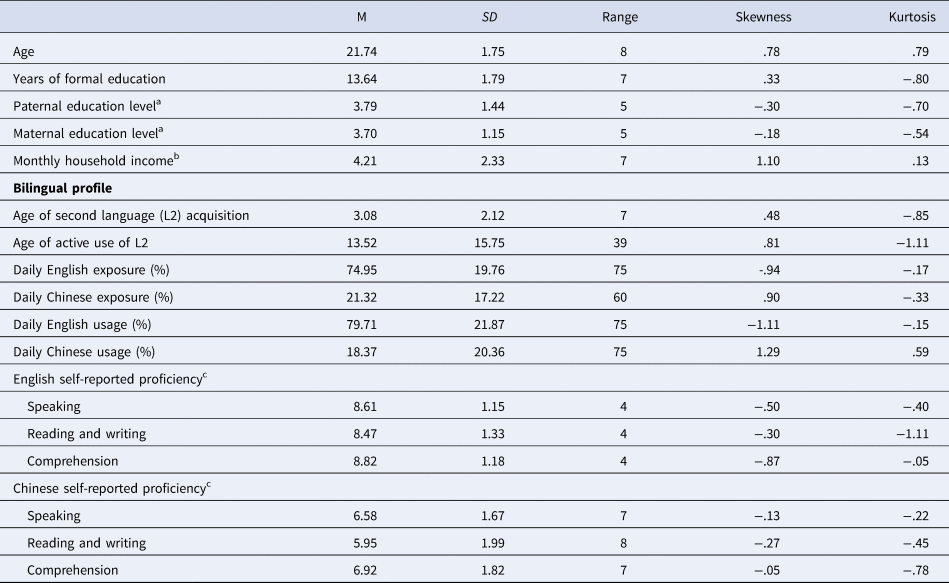
As mentioned, the goal of the task was to complete each sentence with the most relevant and appropriate answer. To adequately capture the cognitive control process of opportunistic planning, these answers should only be accessible if participants chose to code-switch and leverage on words with no real English equivalents. We sought to test a total of 30 sentences, with the aim of ensuring that the sentences met these constraints (see Table 1 for detailed bilingual characteristics).
Participants’ Demographic and Language Characteristics in Study 1

Notes. a Parental education level was rated on a scale of 1 (none) to 6 (master's or PhD).
bHousehold income was rated on a scale of 1 (less than S$2,500) to 9 (more than S$20,000), with intervals of S$2,500.
cProficiency was rated on a scale of 1 (very poor) to 10 (excellent).
Three raters scored the accuracy (i.e., relevance, appropriateness and suitability) of each answer provided on a 3-point scale (0 = inaccurate, 1 = partially accurate, 2 = accurate) by taking into consideration the sentence's overall meaning and context. Accurate answers were those that best fit the sentence as a whole; partially accurate answers were those that did not fully capture the sentence's intended meaning/were not entirely relevant; and inaccurate answers were entirely irrelevant and inappropriate within the context of the sentence. We obtained inter-rater reliability scores of accuracy ranging from .74 to .99 across 15 items; however, one item was reworded to better enhance its clarity before being included in the main study. The other 15 items failed to demonstrate sufficient inter-rater reliability and were subsequently used as distractors to prevent participants from habitually code-switching, given that opportunistic planning is intended to reflect cognitive control. The 15 items retained were then checked to ensure that the most accurate answers (scoring ‘3’ on the 3-point scale) were accessible only after having code-switched and that inaccurate and partially accurate answers (scoring ‘0’ or ‘1’ on the 3-point scale) largely comprised non code-switched answers. The two practice trials were not scored and were therefore excluded from the analysis.
Study 2
Participants
One hundred and fifty undergraduates were recruited in exchange for either course credit or a monetary compensation of $10. A majority of participants were Singaporean (n = 134), while a small proportion of participants were immigrants from China (n = 5); Malaysia (n = 7); Indonesia (n = 1); Myanmar (n = 1); Thailand (n = 1); and Vietnam (n = 1). To control for any potential confounds arising from differences in participants’ bilingual language-pairs, all participants were required to be proficient in English and Mandarin Chinese in order to take part in the study.
For their L1 by order of acquisition, 77% of participants listed English (n = 116) and 20% listed Mandarin Chinese (n = 30). The remaining 3% listed Cantonese (a Chinese dialect; n = 2); Burmese (n = 1); and Vietnamese (n = 1). For their L2 by order of acquisition, 78% of participants listed Mandarin Chinese (n = 117) and 21% (n = 32) listed English. Only one participant listed Bahasa Indonesia. A proportion of participants were multilingual and listed Chinese dialects such as Hokkien (n = 13), Cantonese (n = 12), Teochew (n = 4) and Shanghainese (n = 2) as their third and fourth acquired languages – which was not surprising given Singapore's diverse linguistic landscape – alongside other languages such as French (n = 5), Malay (n = 15), Bahasa Indonesia (n = 4), Korean (n = 7) and Japanese (n = 9).
Materials
Language background questionnaire
To assess participants’ language background, we administered a questionnaire adapted from the Language Experience and Proficiency Questionnaire (Marian, Blumenfeld & Kaushanskaya, Reference Marian, Blumenfeld and Kaushanskaya2007) and the Language History Questionnaire (Li, Zhang, Tsai & Puls, Reference Li, Zhang, Tsai and Puls2014) which have been used in other bilingualism studies (Kałamała, Szewczyk, Chuderski, Senderecka & Wodniecka, Reference Kałamała, Szewczyk, Chuderski, Senderecka and Wodniecka2020; Lai & O'Brien, Reference Lai and O'Brien2020). The measure consisted of detailed questions regarding bilingual participants’ age of acquisition, order of acquisition, and order of dominance for each language. Participants also reported their level of proficiency in speaking, reading, writing and understanding across these languages. Research has shown that self-reported language proficiency is predictive of one's actual language ability (Marian et al., Reference Marian, Blumenfeld and Kaushanskaya2007) and is less problematic when administered to bilinguals with relatively homogenous language combinations (Tomoschuk, Ferreira & Gollan, Reference Tomoschuk, Ferreira and Gollan2019).
Bilingual Interactional Contexts Questionnaire
To assess participants’ relative distribution of code-switching patterns and interactional context exchanges, we adapted the Bilingual Interactional Context Questionnaire (Hartanto & Yang, Reference Hartanto and Yang2019b; see Appendix A). The questionnaire measured the extent to which participants engaged in each code-switching pattern – alternation, insertion from L1 into L2, insertion from L2 into L1, and congruent lexicalization – across four contexts (home, work, school and other environments), taking into account the percentage of time spent in each of these contexts. This was calculated using the following formula:
 $${\rm Alternation\;index} = \sum\nolimits_{i = 4}^4 {\displaystyle{{\,p{\rm i}\;{\rm X\;ai}} \over {100}}} $$
 $${\rm Insertion\ index\ } = \sum\nolimits_{i = 4}^4 {\displaystyle{{\,pi\;{\rm X\;}ini} \over {100}}} $$
 $${\rm Congruent\; lexicalization\;index} = \sum\nolimits_{i = 4}^4 {\displaystyle{{\,pi\;{\rm X\;}cli} \over {100}}} $$
where pi denotes the percentage of time spent in each context (home, work, school and others), and ai, ini, and cli denote the percentage of alternation, insertion, and congruent lexicalization within a given context, respectively. Frequency of alternation was assessed by asking participants how often they switched languages between sentences or within a conversation (“I tend to switch languages between sentences. That is, I speak one sentence in my first language (e.g., English) and another sentence in my second language (e.g., Chinese). For example,‘谢谢老师 [thank you teacher]. I really appreciate your help.’”). Frequency of insertion was assessed by asking participants how often they borrowed words or phrases from another language (for insertion of L2 into L1, “I primarily speak my first language (e.g., English) but occasionally slot in words or phrases from my second language (e.g., Chinese). For example, ‘Could you help me 打包 [pack] food?’”). Frequency of congruent lexicalization was assessed by asking participants how often they blended two languages (“I tend to blend my first and second languages creatively. For example, ‘Eh, this class very sian [boring, tiring, to be caught in a bothersome situation] hor [right]?’”). Research has shown that self-reported code-switching tendencies are reflective of bilinguals’ code-switching tendencies in daily conversations (Prior & Gollan, Reference Prior and Gollan2011; Soveri, Rodriguez-Fornells & Laine, Reference Soveri, Rodriguez-Fornells and Laine2011). Further, a recent study by Cox, LaBoda, and Mendes (Reference Cox, LaBoda and Mendes2020) compared self-reported code-switching practices with actual code-switching practices produced in autobiographical narratives and found that the two were positively correlated, and that this was accentuated when reporting on various types of code-switching.
Verbal opportunistic planning task
The verbal opportunistic planning task was administered as a measure of opportunistic planning. Instructions were first shown on the screen, followed by an attention check to ensure that participants understood the instructions. The task consisted of 30 sentences preceded by two practice sentences. Of the 30 sentences, 15 were retained from Study 1 and served to assess participants’ opportunistic planning within the context of bilingual speech comprehension and production. The other 15 sentences served as distractors to ensure that participants intentionally, rather than habitually, code-switched as a reflection of the opportunistic planning cognitive control process.
Akin to Study 1, three raters scored participants’ answers according to the accuracy (i.e., relevance, appropriateness and suitability) of each answer provided on a 3-point scale (0 = inaccurate, 1 = partially accurate, 2 = accurate) by taking into consideration the sentence's overall meaning and context. Distractors were excluded and not scored. Opportunistic planning allows bilinguals to make use of the words and phrases that come most readily to hand in order to achieve their discourse goal more quickly or efficiently, even if these words and phrases are in another language. Therefore, we also considered participants’ reaction time (RT) which was measured by the interval duration between the presentation of each sentence and the participant's response.
Attention Network Test for Interaction and Vigilance (ANTI-V)
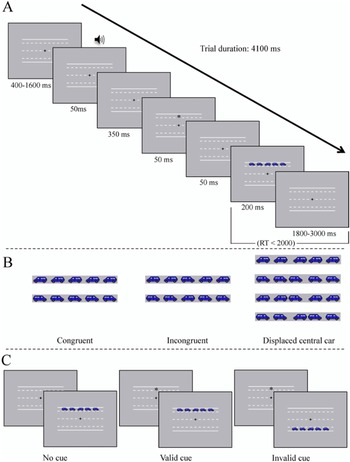
The ANTI-V (Roca, Castro, López-Ramón & Lupiáñez, Reference Roca, Castro, López-Ramón and Lupiáñez2011) was administered as a measure of interference control and salient cue detection. In each trial, participants were first shown a black fixation cross and a white zenith view of a two-lane road with two parking lanes against a grey background. A row of five cars would then be presented above or below the fixation point, superimposed onto one of the two parking lanes in the background (see Figure B1 in Appendix B). Participants were required to respond to the direction of the target central car as quickly and accurately as possible by pressing the corresponding key (“c” for left or “m” for right). The target car was flanked by cars pointing in the opposite direction in half of the trials (incongruent condition), and in the same direction in the other half of the trials (congruent condition). This was preceded by either a visual cue (a black asterisk) in the same lane as the forthcoming row of cars (valid cue condition), a visual cue in the opposite lane (invalid cue condition), or no visual cue at all (no cue condition). A warning auditory signal was also presented before the appearance of the target car on some trials (warning tone condition) but not others (no warning tone condition). Additionally, a secondary task was embedded within the ANTI-V in which the presentation of an infrequent stimulus required a change in participants’ responses. On standard trials, participants had to respond to the direction of the central target car. On vigilance trials, in contrast, the location of the target car was significantly displaced to either the left or right from the center. Upon detecting the displacement, participants had to ignore the direction of the target car and press the spacebar instead.
The task comprised a total of seven blocks of 64 trials (48 standard trials and 16 vigilance trials with a displaced target car). Standard trials took on a factorial design: 2 (Warning signal: Tone/no tone) x 3 (Visual Cue: Invalid cue/no cue/valid cue) x 2 (Congruency: Congruent/incongruent). Vigilance was not crossed orthogonally with the other three conditions, and a random selection of the 12 possible combinations of warning signal, visual cue and congruency were used only in the standard trials. The first block, which provided feedback after each trial, served as a practice block to help participants become familiar with task requirements and was thus excluded from data analysis. No feedback was given on the remaining six test blocks.
Participants’ accuracy and RT on standard trials of the ANTI-V yielded three attentional network scores: (a) alerting, which is the readiness to receive and respond to information (mean difference in accuracy and RT between tone and no tone conditions, only in no cue conditions); (b) orienting, which is the ability to direct attention to a target stimulus (mean difference in accuracy and RT between invalid cue and valid cue conditions); and (c) executive control, which is the ability to resolve conflict (mean difference in accuracy and RT between incongruent and congruent conditions; Fan, McCandliss, Sommer, Raz & Posner, Reference Fan, McCandliss, Sommer, Raz and Posner2002). Given the aims of our study, we focused only on the executive control scores on standard trials, which reflect interference control since they involve both conflict monitoring and interference suppression.
On the other hand, the number of hits (proportion of correct spacebar responses when the target car was displaced) and false alarms (proportion of incorrect spacebar responses when the target car was not displaced) on vigilance trials were used to compute sensitivity (d'; the ability to detect an infrequent target) based on Stanislaw and Todorov's (Reference Stanislaw and Todorov1999) formula:
 $$d^{\prime} = {\rm \unicode{x003C6}}^{ \hbox{-1}}( {{\rm Hit\ rate}} ) \hbox{-}{\rm \ }{ \unicode{x003C6} }^{ \hbox{-1} }( {{\rm False\ alarm}} ) $$
Demographics questionnaire
Participants were asked to indicate demographic characteristics (such as age, sex, race, country of origin, household income). Subjective socioeconomic status was assessed using the MacArthur Scale of Subjective Social Status (Adler & Stewart, Reference Adler and Stewart2007). In the latter, participants were shown an image of a “social ladder” that represents one's social standing within the community and asked to rate where they felt they stood on a 10-point scale (1 = lowest standing, 10 = highest standing).
Procedure
The experimental session lasted 1 hour and was conducted in a laboratory setting, with participants seated individually in an open cubicle. Similar to Study 1, participants were asked to provide their consent at the beginning of the study. Participants completed the verbal opportunistic planning task and the ANTI-V task, which were administered on computers, in a fixed order. They then completed the demographic and language background questionnaires and the Bilingual Interactional Contexts Questionnaire before being debriefed. Participants provided their responses in writing, and all spoken and written instructions were given in English.
Results
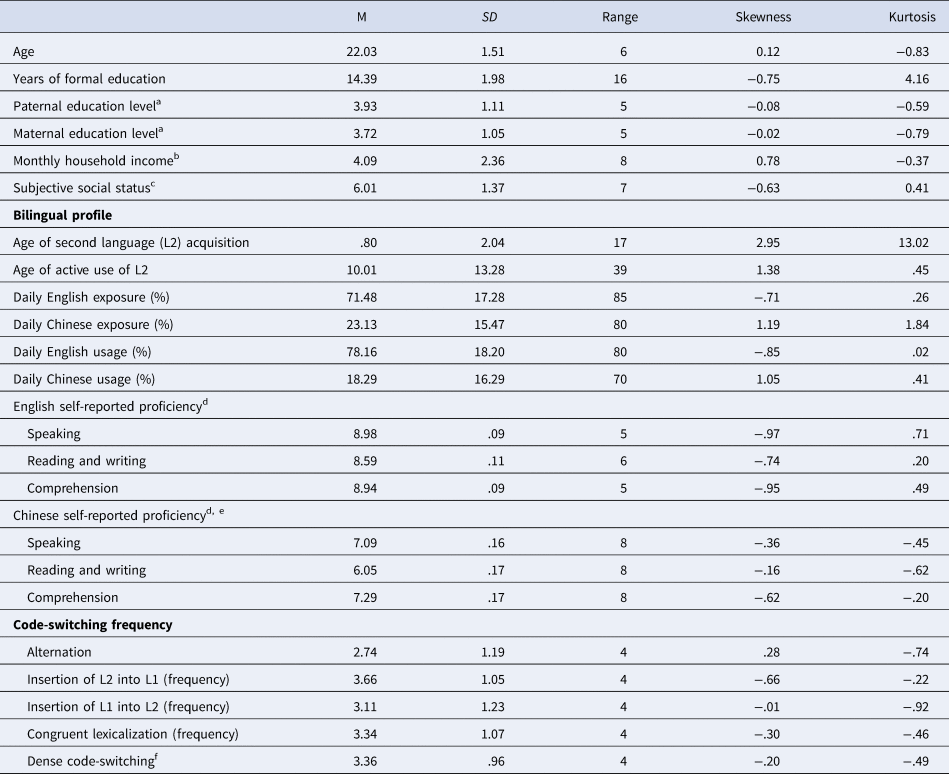
Participants’ demographic and language characteristics can be seen in Table 2. Participants reported that they engaged in different patterns of code-switching to varying degrees: insertion of L2 into L1 was the most frequent, with 79% reporting its use, followed by congruent lexicalization (70%), insertion of L1 into L2 (59%), and alternation (43%).
Participants’ Demographic and Language Characteristics in Study 2

Notes. a Parental education level was rated on a scale of 1 (none) to 6 (master's or PhD).
bHousehold income was rated on a scale of 1 (less than S$2,500) to 9 (more than S$20,000), with intervals of S$2,500.
cSubjective social status was rated on a scale of 1 (lowest standing on a social ladder) to 10 (highest standing).
dProficiency was rated on a scale of 1 (very poor) to 10 (excellent).
eData for one participant was missing.
fThe dense code-switching score was calculated by averaging participants’ insertion and congruent lexicalization frequency scores.
Given that the adaptive control hypothesis suggests that bilinguals in a dense code-switching context would predominantly engage in both insertion and congruent lexicalization, we combined participants’ L1 and L2 insertion and congruent lexicalization scores to obtain an overall index we termed dense code-switching.
To examine the effects of dense code-switching and alternation on (a) interference control (indexed by executive control scores – i.e., accuracy and RT on standard trials of the ANTI-V); (b) salient cue detection (indexed by sensitivity scores on vigilance trials of the ANTI-V); and (c) opportunistic planning (indexed by accuracy and RT on the verbal opportunistic planning task), we conducted a series of ordinary least squares (OLS) regression analyses with respect to each of these control processes.
The Attention Network Test for Interaction and Vigilance (ANTI-V)
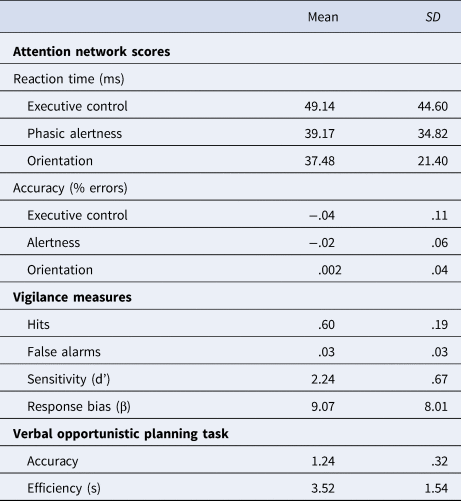
The ANTI-V was used to assess interference control and salient cue detection. The ANTI-V scores are summarized in Table 3. Incorrect trials and extreme RTs that were either 2.5 SD above or below an individual's mean RT were removed. Multiple OLS regression analyses were conducted to examine the relations between bilinguals’ use of alternation and dense code-switching and the indices of interference control and salient cue detection.
Accuracy, Reaction Time, and Sensitivity (d') Scores from the ANTI-V Task and Verbal Opportunistic Planning Tasks

Interference control
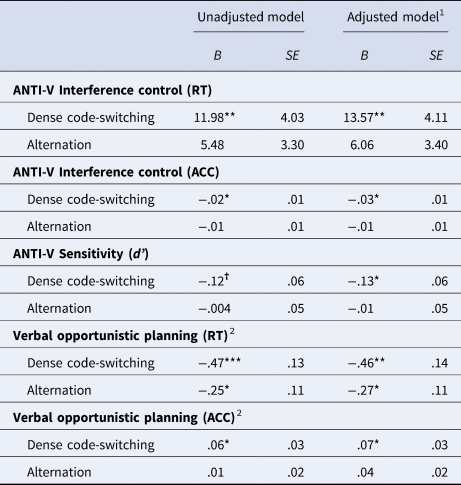
To examine the relation between bilinguals’ use of each code-switching pattern and interference control, we conducted multiple OLS analyses to predict accuracy and RT as criterion variables. Further, given that the correlational coefficients between code-switching patterns were moderately high (ranging from .49 to .63; see Table C1 in Appendix C), we ran separate OLS analyses with each code-switching pattern serving as a single predictor in each model. This was done because excluding covariance between alternation and dense code-switching would likely eliminate core characteristics of each type of code-switching. We found that dense code-switching significantly predicted worse interference control, as indexed by executive control scores calculated in accuracy (B = −.02, SE = .01, p = .03) and RT (B = 11.98, SE = 4.03, p = .003; see unadjusted models in Table 4). Notably, the relation between dense code-switching and interference control in terms of accuracy and RT remained significant even after controlling for a wide range of demographic (age, socioeconomic status, immigration status, parents’ education level) and linguistic (language proficiency) covariates (see adjusted models in Table 4). These findings suggest that dense code-switching context bilinguals who predominantly engage in insertion and congruent lexicalization are likely to display poorer performance on interference control. In contrast, alternation did not significantly predict interference control in accuracy (B = −.01, SE = .01, p = .33) or RT (B = 5.48, SE = 3.30, p = 0.10), contrary to our expectations and the predictions of the adaptive control hypothesis which posit that dual-language context bilinguals who predominantly engage in alternation should reap advantages in interference control. Given that the results held true even when covariates were added to the model, this suggests that dual-language context bilinguals may not exhibit any significant changes in interference control.
Regression Coefficients from Separate Analyses of Dense Code-switching and Alternation Predicting the ANTI-V and Verbal Opportunistic Planning Tasks

Notes. RT = reaction time; ACC = accuracy. †p < .06; *. p < .05; **. p < .01, ***. p < .001.
1Adjusted model includes age, immigration status, paternal and maternal education levels, monthly household income, subjective social status, English proficiency, and Chinese proficiency as covariates. None of the covariates significantly predicted control processes.
2Data from 11 participants were missing due to technical issues.
Salient cue detection
We also examined the relation between bilinguals’ use of each code-switching pattern and salient cue detection. Separate OLS analyses were performed with respect to each code-switching pattern, with sensitivity (d') scores as a criterion variable. We found that dense code-switching significantly predicted d' scores (B = −.12, SE = .06, p = .05; see Table 4). These results held true even when a host of covariates were controlled for (B = −.13 SE = .06, p = .04), which suggests that dense code-switching context bilinguals who predominantly engage in insertion and congruent lexicalization are likely to display poorer salient cue detection. In contrast, alternation did not significantly predict sensitivity (B = −.004, SE = .05, p = .93; see Table 4). Again, this was contrary to our expectations and the predictions of the adaptive control hypothesis, which posits that dual-language context bilinguals who predominantly engage in alternation should reap advantages in salient cue detection. These findings did not change when covariates were accounted for and suggest that dual-language context bilinguals may not exhibit any significant changes in salient cue detection.
Verbal opportunistic planning task
The verbal opportunistic planning task was used to assess opportunistic planning, which was indexed by both accuracy and RT scores. These scores are summarized in Table 3. Multiple OLS regression analyses were conducted to examine the relations between bilinguals’ use of alternation and dense code-switching and the indices of opportunistic planning.
To examine the relation between bilinguals’ use of each code-switching pattern and opportunistic planning, we similarly conducted multiple OLS analyses with each code-switching pattern as a single predictor in each regression model, to predict accuracy and RT as criterion variables (see Table 4). We found that dense code-switching significantly predicted both accuracy (B = .06, SE = .03, p = .04) and RT (B = −.47, SE = .13, p < .001), which suggests that dense code-switching context bilinguals who predominantly engage in insertion and congruent lexicalization are likely to display better performance on opportunistic planning (i.e., greater accuracy and more efficient attainment of one's discourse goals). Notably, this relation between dense code-switching and accuracy and RT remained significant even after controlling for covariates, which further confirms our expectations and the predictions of the adaptive control hypothesis. On the other hand, alternation did not significantly predict accuracy (B = .01, SE = .02, p = .31), regardless of whether covariates were controlled for. However, alternation significantly predicted RT (B = −.25, SE = .11, p = .02) and this relation remained even when covariates were controlled for. Our expectation that alternation would not significantly affect opportunistic planning was partially supported in terms of accuracy, but not RT.
Discussion
Findings from our study demonstrate that bilinguals’ qualitatively dissimilar code-switching patterns have different implications for various cognitive control processes. Bilinguals who predominantly engaged in alternation (i.e., dual-language context bilinguals) did not demonstrate advantages in interference control, salient cue detection, or opportunistic planning in terms of accuracy, but demonstrated advantages in opportunistic planning in terms of RT. In contrast, bilinguals who predominantly engaged in insertion and congruent lexicalization (i.e., dense code-switching context bilinguals) demonstrated disadvantages in interference control and salient cue detection, but advantages in opportunistic planning both in terms of RT and accuracy. Overall, our findings lend partial support to the theoretical predictions of the adaptive control hypothesis.
Our finding that alternation did not predict advantages in interference control or salient cue detection was contrary to the theoretical predictions of the adaptive control hypothesis, which suggests that alternation between languages in response to different interlocutors within a dual-language context would benefit interference control and salient cue detection (Green & Abutalebi, Reference Green and Abutalebi2013). However, it is notable that extant findings in the literature have been mixed. For instance, in favor of the adaptive control hypothesis, Hofweber, Marinis, and Treffers-Daller (Reference Hofweber, Marinis and Treffers-Daller2020b) found that dual-language context bilinguals displayed interference control advantages over monolinguals. Conversely, Hartanto and Yang (Reference Hartanto and Yang2019b) found that dual-language context bilinguals failed to demonstrate better interference control than single-language context bilinguals. In fact, they found no significant relation between a dual-language context and interference control, similar to the finding in our study. In a similar vein, Lai and O'Brien (Reference Lai and O'Brien2020) found no significant correlation between a dual-language context and several cognitive control processes, including interference control. The adaptive control hypothesis has therefore received limited empirical support, and more research is warranted to affirm its theoretical predictions regarding the effects of bilinguals’ predominant use of alternation within a dual-language context on interference control and salient cue detection.
Unexpectedly, dense code-switching (i.e., insertion and congruent lexicalization) predicted disadvantages in interference control and salient cue detection. These results imply that such bilinguals experience significantly fewer demands on interference control, leading to relative disadvantages. In contrast, the adaptive control hypothesis originally postulated that the dense code-switching context would be neutral in its effects on these two cognitive control processes, i.e., bilinguals within the dense code-switching context may not experience any demands on interference control or salient cue detection. A possible explanation could be derived from Green and Wei's Control Process Model (Reference Green and Wei2014), which theorizes that dense code-switching operates in an open control mode in which different language schemas are coordinated in a cooperative relationship (Green, Reference Green1998; Green & Abutalebi, Reference Green and Abutalebi2013). These, in turn, facilitate the flexible borrowing of lexical items from other languages when they become salient. Due to the cooperative operation of two language-task schemas, a dense code-switching context demands less interference control, in contrast to a dual-language context in which language-task schemas are in a competitive relationship and thus demands substantial interference control. Regarding salient cue detection, one possibility is that dense code-switching likely occurs in a community in which multiple languages are valued and commonly used, such that sensitivity to changing linguistic and contextual cues (e.g., the arrival of a new interlocutor) is deemed unimportant.
Our finding that dense code-switching (i.e., insertion and congruent lexicalization) predicted advantages in opportunistic planning was in line with the theoretical predictions of the adaptive control hypothesis, which state that a dense code-switching context should place greater demand on opportunistic planning, since bilinguals seize opportunities to flexibly adapt alternative expressions from one language while speaking another language as long as they satisfy syntactic constraints (Green & Abutalebi, Reference Green and Abutalebi2013). Indeed, opportunistic planning is more likely to occur within a dense code-switching context that allows for the cooperative operation of two language-task schemas, according to Green and Wei's (Reference Green and Wei2014) theoretical view. Further, consistent with our expectations, alternation did not significantly predict opportunistic planning in terms of accuracy. As theorized by the adaptive control hypothesis, bilinguals in a dual-language context (i.e., who engage in alternation) have language schemas that are naturally in a competitive relationship (Green & Abutalebi, Reference Green and Abutalebi2013). This restricts the speaker's lexical access to only one language at a time and renders it more difficult to seize opportunities to adapt expressions from another language. However, alternation significantly predicted opportunistic planning in terms of RT. While this finding appears to contradict the adaptive control hypothesis, it implies that dual-language context bilinguals are quick to respond in a conversation but may be less effective (accurate) in conveying their intended meaning than dense code-switching bilinguals. Therefore, we conclude that dual-language context bilinguals who predominantly engage in alteration may not exhibit significant changes in opportunistic planning. Taken together, given that certain patterns of code-switching – which are associated with different interactional contexts – impose greater cognitive demands on some aspects of cognitive control, future studies should examine whether bilinguals’ habitual use and relative distribution of each code-switching pattern modulate their advantages in cognitive control.
Our findings lend partial support to the theoretical predictions of the adaptive control hypothesis. One reason that could account for our mixed findings is the possibility that when interactional contexts are quite fluid, other key constructs not specified by the adaptive control hypothesis may play a more influential role in shaping bilinguals’ cognitive control. Further research is, therefore, needed to ascertain what these constructs may be.
Another reason is that the construct of bilingual interactional contexts may be too broad – at least within a multilingual environment like Singapore where bilinguals engage in all three patterns of code-switching to some extent, due to the use of four official languages and high multilingual literacy. Green and Abutalebi (Reference Green and Abutalebi2013, p. 525) have previously highlighted the possibility that bilingual speakers may experience all three contexts (and thus all three code-switching patterns) to some extent. That is, one speaker may have a preponderance of single-language context exchanges, some dual-language context exchanges (i.e., some alternation), and no dense code-switching exchanges (i.e., no insertion and congruent lexicalization). Conversely, another speaker may have a preponderance of dense code-switching exchanges (i.e., mostly insertion and congruent lexicalization), some single-language context exchanges, and no dual-language context exchanges (i.e., no alternation). Hence, more fine-scaled measures may be required to detect an effect on cognitive control processes (Lai & O'Brien, Reference Lai and O'Brien2020). For example, a minimum threshold of engagement in each context may be necessary for cognitive effects to be observed (Lai & O'Brien, Reference Lai and O'Brien2020). This is plausible given that studies previously conducted among Singaporean bilinguals have found no significant association between engagement in a dual-language context and some cognitive control processes (Hartanto & Yang, Reference Hartanto and Yang2019b; Lai & O'Brien, Reference Lai and O'Brien2020).
Lastly, different measures that have been administered in previous studies to test the predictions of the adaptive control hypothesis could explain mixed findings. In this study, we used various indices (i.e., accuracy and RT on standard trials, sensitivity on vigilance trials) from the Attention Network Test for Interaction and Vigilance), which primarily relies on flanker effects, as measures of interference control and salient cue detection. Prior studies have instead administered the flanker task (Hartanto & Yang, Reference Hartanto and Yang2019b; Hofweber, Marinis & Treffers-Daller, Reference Hofweber, Marinis and Treffers-Daller2016; Hofweber et al., Reference Hofweber, Marinis and Treffers-Daller2020b), Stroop task (Lai & O'Brien, Reference Lai and O'Brien2020), and other inhibition tasks (e.g., antisaccade, go/nogo, stop-signal; Kałamała et al., Reference Kałamała, Szewczyk, Chuderski, Senderecka and Wodniecka2020) to assess interference control and have yielded mixed findings. Since different tasks rely on different inhibition-related processes, it is possible that the lack of significant correlation between alternation and interference control may depend on the type of inhibition task administered; for instance, antisaccade, stop-signal and Stroop tasks tap into an individual's ability to deliberately suppress automatic responses, while variants of flanker tasks tap into an individual's ability to resist interference from distracting or irrelevant information (Friedman & Miyake, Reference Friedman and Miyake2004). At the same time, each cognitive task necessarily captures not only the cognitive control process in question, but other peripheral processes (e.g., perceptual processing, motor abilities, etc.) in what is known as the task impurity problem (Burgess, Reference Burgess1997; Miyake, Friedman, Emerson, Witzki, Howerter & Wager, Reference Miyake, Friedman, Emerson, Witzki, Howerter and Wager2000). Therefore, a latent variable approach may be preferred in order to maximize the variance of interference control processing and to rule out the issue of findings being task-dependent.
Given moderately high correlations (.48 to .69) between the three code-switching patterns (see Table C1 in Appendix C), one may question whether they should be treated separately. First, we found no indication of multicollinearity among the three code-switching patterns, suggesting that they are not identical and explain only limited proportions of variance in each other. Second, our finding of the relatively higher correlation between insertion and congruent lexicalization (.65 for insertion of L1 into L2; .69 for insertion of L2 into L1) are actually in line with (a) Green and Abutalebi's (Reference Green and Abutalebi2013) theoretical conceptualization of a dense code-switching context that comprises both patterns of code-switching and (b) Muysken's (Reference Muysken2000) typology of code-switching which proposes that insertion and congruent lexicalization involve greater integration of grammatical and lexical elements from both linguistic systems. Further, previous studies have treated three code-switching patterns as separate variables despite demonstrating similar correlations (.41 to .68; Lai & O'Brien, Reference Lai and O'Brien2020). Results from frequency judgment tasks that assessed alternation, insertion, and congruent lexicalization also generally show that bilingual participants engage in all three patterns (Hofweber et al., Reference Hofweber, Marinis and Treffers-Daller2016; Hofweber, Marinis & Treffers-Daller, Reference Hofweber, Marinis and Treffers-Daller2020a; Treffers-Daller, Ongun, Hofweber & Korenar, Reference Treffers-Daller, Ongun, Hofweber and Korenar2020). Therefore, we believe that the decision to treat these code-switching patterns as separate variables is reasonable.
Despite the novel contributions of our study to the debate on bilingual advantages, we acknowledge several limitations. Although our sample size of 150 participants had sufficient power, we observed a relative imbalance between our participants’ use of each code-switching pattern – that is, the majority of our bilinguals predominantly engaged in dense code-switching (i.e., insertion and congruent lexicalization), outweighing those who predominantly engaged in alternation. This is to be expected and corroborates Muysken's (Reference Muysken2000) theory, which predicts that bilinguals in communities with close language contact and multiple ethnic groups are likely to code-switch more densely. This is also in line with theories proposed by Poplack (Reference Poplack1980) and Sankoff and Mainville (Reference Sankoff and Mainville1986), which emphasize that equivalent language typologies facilitate code-switching by providing more switching opportunities within a sentence (i.e., insertion or congruent lexicalization). Given that the major official languages spoken in Singapore share the same grammatical structure (SVO), it is thus natural that our bilingual participants would more frequently engage in denser forms of code-switching. Future studies should therefore mitigate this problem by oversampling bilinguals who predominantly engage in alternation.
Second, as mentioned, every cognitive task necessarily captures not only the cognitive control process in question, but other peripheral processes (Hartanto & Yang, Reference Hartanto and Yang2019b; Miyake et al., Reference Miyake, Friedman, Emerson, Witzki, Howerter and Wager2000). According to Burgess (Reference Burgess1997) and Miyake et al. (Reference Miyake, Friedman, Emerson, Witzki, Howerter and Wager2000), task impurity is a common issue across most, if not all, studies on cognitive control. For instance, Ikeda, Okuzumi and Kokubun (Reference Ikeda, Okuzumi and Kokubun2014) argue that working memory demands are added to the processing requirements of the Stroop Task, which is widely used to assess prepotent response inhibition. The use of a latent variable approach based on multiple tasks assessing interference control, salient cue detection and opportunistic planning may therefore be beneficial to further clarify the association between the three code-switching patterns and the three cognitive control outcomes investigated in this study.
Third, our findings should be interpreted with caution because of their correlational nature. Although we found that code-switching patterns are associated with different cognitive control outcomes, it is plausible that individual differences in cognitive control abilities could bias bilinguals toward the predominant use of specific code-switching patterns. Future research should, therefore, examine these relations in a longitudinal manner to shed light on the causal relation between qualitatively dissimilar code-switching patterns and cognitive control processes.
Fourth, since we focused on English–Chinese bilinguals to eliminate any potential confounds arising from differences in bilinguals’ language pairs, it is difficult to generalize our findings to bilinguals with other language pairs. Different language pairs may facilitate more predominant use of certain code-switching patterns, which may then lead to different cognitive outcomes. Indeed, prior studies have reported that different language combinations may give rise to different cognitive control outcomes (e.g., Yang, Yang & Hartanto, 2019). Future studies may hence wish to replicate this study among bilinguals with other language combinations and different linguistic profiles.
Our fifth limitation is that we relied on self-reported measures of language proficiency and code-switching. Although Tomoschuk et al. (Reference Tomoschuk, Ferreira and Gollan2019) argued that self-ratings may be misleading in some cases, this was highlighted as being most problematic when comparisons are made across bilinguals with different language combinations (e.g., English–Chinese vs. English–Spanish; Tomoschuk et al., Reference Tomoschuk, Ferreira and Gollan2019). In contrast, the linguistic profiles of our participants were relatively homogeneous (i.e., all our participants were required to be proficient in English and Chinese). Further, self-reported language proficiency in our study was assessed in order to control for its influence on bilingual participants’ own code-switching patterns; thus, the use of self-reported proficiency may be less problematic for our results. Regarding self-reported code-switching frequency, while ecologically valid methods of assessing code-switching practices do exist, most have been developed for frequency judgment tasks within experimental settings (e.g., discourse completion tasks, in which participants compose a bilingual email). These methods, however, may not necessarily capture the extent to which code-switching differs depending on a bilingual's interactional contexts and time spent across contexts (Backus, Reference Backus2015; Hofweber et al., Reference Hofweber, Marinis and Treffers-Daller2016; Hofweber, Marinis & Treffers-Daller, Reference Hofweber, Marinis and Treffers-Daller2019). Moreover, a recent study by Cox et al. (Reference Cox, LaBoda and Mendes2020) compared self-reported code-switching practices with actual code-switching practices produced in autobiographical narratives and found that the two were positively correlated, and that this was accentuated when reporting on various types of code-switching. Additionally, a number of studies that examine code-switching and executive functions have administered self-reported measures of code-switching in which participants are tasked to indicate the frequency with which they engage in code-switching (Hartanto & Yang, Reference Hartanto and Yang2016, Reference Hartanto and Yang2019b; Hofweber et al., Reference Hofweber, Marinis and Treffers-Daller2020b; Kałamała et al., Reference Kałamała, Szewczyk, Chuderski, Senderecka and Wodniecka2020; Soveri et al., Reference Soveri, Rodriguez-Fornells and Laine2011; Verreyt et al., Reference Verreyt, Woumans, Vandelanotte, Szmalec and Duyck2016). Taken together, we believe that the use of self-reported measure of proficiency and code-switching patterns is still valid and best suited for the purpose of our study. Nevertheless, future studies may seek to develop and administer an ecologically valid method of assessing qualitatively different code-switching patterns, in conjunction with the Bilingual Interactional Contexts Questionnaire, to assess their convergent validity and relation to various cognitive control outcomes.
Lastly, for dense code-switching-context bilinguals, our results indicate an advantage in opportunistic planning but a disadvantage in interference control and salient cue detection. This is not to say that dense forms of code-switching are any better or worse than alternation. Indeed, important socio-pragmatic factors must be taken into consideration. In Singapore, congruent lexicalization tends to be frowned upon, as it is regarded by some as implying a lower socioeconomic status, while the pure use of each language (particularly English) is regarded as “powerful and prestigious…in terms of educational and career opportunities” (Pakir, Reference Pakir1991, p. 167). These results, therefore, should be interpreted with caution within the bilingual's specific sociolinguistic background and community.
In closing, our findings shed light on the relation between bilinguals’ code-switching patterns and different control processes. Our study is notable, because it is the first attempt to conceptualize and empirically test opportunistic planning and salient cue detection in relation to bilinguals’ code-switching. Further, contradicting the previous notion that dense forms of code-switching are associated with negative cognitive outcomes, our study yields a novel finding that dense code-switching can in fact be advantageous to some aspects of cognitive control (i.e., opportunistic planning). Altogether, our study illustrates the importance of disparate bilinguals’ code-switching practices in shaping cognitive control outcomes. This further implies that the presence of a bilingual advantage may be nuanced and depends on diverse linguistic factors.
Acknowledgements
This study was supported by a grant awarded to Hwajin Yang by Singapore Management University through a research grant (16-C242-SMU-005) from the Ministry of Education Academy Research Fund Tier 1. We thank Stacy Tan for her assistance in data collection and coding. Both authors contributed equally.
Appendix A
Revised Interactional Contexts Questionnaire
Q1. How much time do you spend in each of the following situations, in general? Note that your answers should add up to 100%.

Q2. How often do you engage in the following styles of language switching/mixing in each situation? Note that your answers should add up to 100%.
I primarily speak my first language (e.g. English), but occasionally slot in words or phrases from my second language (e.g. Chinese).
e.g. Could you help me 打包 [dǎ bāo; pack] food?

I primarily speak my second language (e.g. Chinese), but occasionally slot in words or phrases from my first language (e.g. English).
e.g. 这是一个 [zhè shì yí gè; this is a] fantastic 的主意 [dè zhŭ yì; idea]?

I tend to switch languages between sentences. That is, I speak one sentence in my first language (e.g. English), and another sentence in my second language (e.g. Chinese).
e.g. 谢谢老师 [xiè xiè lǎo shī; thank you teacher]. I really appreciate your help.

I tend to blend my first and second languages creatively.
e.g. Eh, this class very sian [boring, tiring, to be caught in a bothersome situation] hor [right]?

Appendix B
The Attention Network Test for Interaction and Vigilance (ANTI-V)
Note. The top (A), middle (B), and bottom panels (C) show the schematic representation of the procedure, the target stimuli used in the present experiment, and the visual cue conditions, respectively.

Appendix C
Zero-order Correlations between Disparate Code-switching Patterns