


1 The preference for obstruent–sonorant onset clusters
The majority of work on tautosyllabic consonant clusters explains a cross-linguistic preference for obstruent–sonorant (OR) onset clusters over other cluster types in terms of the sonority hierarchy (Sievers Reference Sievers1881, Steriade Reference Steriade1982, Clements Reference Clements, Kingston and Beckman1990, Blevins Reference Blevins and Goldsmith1995, Berent Reference Berent2013).
-
(1)


Whether the sonority hierarchy adopted is the seemingly universal one shown in (1), or a more language-specific scale like those argued for in Steriade (Reference Steriade1982) or Parker (Reference Parker2002), phonologists are largely in agreement on two points. First, in all spoken languages where sonority plays a role in sound patterns, sonorants (vowels, glides, liquids, nasals) are more sonorous than obstruents (fricatives, affricates, oral stops). Second, in all spoken languages where sonority plays a role in the organisation of tautosyllabic consonant clusters, the Sonority Sequencing Generalisation in (2) is active.
-
(2)

OR onset clusters have a rising sonority profile, and this profile is claimed to be favoured over sonority plateaus or sonority falls, due to the universal role of the sonority hierarchy in determining syllable structure, as expressed by the Sonority Sequencing Generalisation. In accordance with the SSG, the most common language types should be those with no consonant clusters and maximal CV or CVC syllables, and those with consonant clusters where the majority are OR onsets or RO codas. Maori exemplifies a maximal CV syllable, Gilbertese maximal CVC and Kokota maximal ORV, while Spanish syllables are maximally ORVRO, with only a few exceptions involving OO codas.Footnote 1
Phonetic principles have also been invoked to arrive at deeper explanations for the widespread preference for OR onsets over other complex onsets. Release cues for obstruents that provide information on place of articulation and laryngeal features may be strongest when a vowel follows. Since sonorant consonants, especially glides and liquids, are most vowel-like in terms of their acoustic properties, they are the next-best carriers of these kinds of cues, providing some rationale for a general preference of OR vs. OO sequences (Steriade Reference Steriade, Fujimura, Joseph and Palek1999, Blevins Reference Blevins, Féry and van de Vijver2003, Reference Blevins2004: 89–97).
Similar phonetic explanations account for cross-linguistic patterns in cluster resolution: when languages without consonant clusters borrow words with initial TR onsets (T = oral stop), an epenthetic vowel is typically inserted between the two consonants, while in word-initial #ST clusters (S = sibilant), a prothetic vowel precedes the sibilant (Broselow Reference Broselow, Gass and Selinker1983, Reference Broselow, Gass and Selinker1992, Reference Broselow, Hsiao and Wee2015, Fleischhacker Reference Fleischhacker2001, Reference Fleischhacker2005, Kenstowicz Reference Kenstowicz2007, Uffmann Reference Uffmann2007, Reference Uffmann, Honeybone and Salmons2015, Kang Reference Kang, van Oostendorp, Ewen, Hume and Rice2011, Berent Reference Berent2013). The general pattern is illustrated in (3) by languages from four different families: (a) Pitjantjatjara/Yankunytjatjara, a Pama-Nyungan language of the Australian Western Desert (Goddard Reference Goddard1992), (b) Rotuman, an Austronesian language of the Oceanic subgroup spoken on an isolated rocky outcrop in the Pacific (Churchward Reference Churchward1940), (c) Tzotzil, a Mayan language of present-day Chiapas, Mexico (Campbell Reference Campbell1998)Footnote 2 and (d) Popoluca de Texistepec, a Mixe-Zoquean language of Southern Veracruz, Mexico (Wichmann Reference Wichmann2002). In all cases, the source language (English or Spanish) allows TR onsets, while the recipient language does not, and the word is borrowed with an epenthetic vowel (underlined) splitting the cluster.Footnote 3 Meanings of loanwords are roughly equivalent to those of the source lexeme.
-
(3)
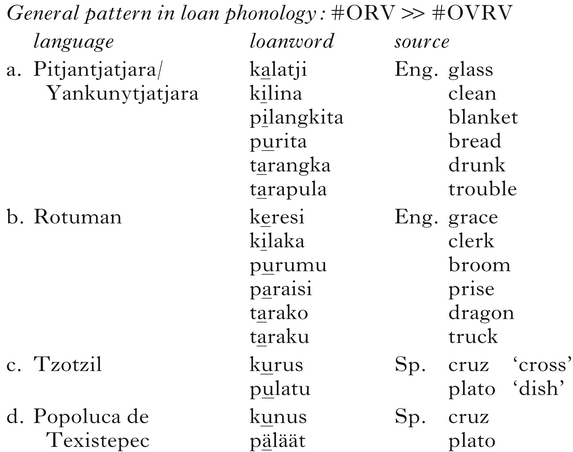
The languages in (3) have been chosen to rule out spelling pronunciation, or borrowing from other languages. Since literacy rates in all of these areas were low at the time of contact, spelling pronunciation is highly unlikely. Further, since Western Desert languages and Rotuman are relatively isolated, intermediate languages are an unlikely source for these loans. Finally, the regularity of the pattern within each language suggests that it is original, as do certain distinct features (e.g. Spanish /ɾ/ realised as /n/ in Popoluca de Texistepec). The sample, then, appears to represent a recurrent pattern of spoken input forms, with initial TR clusters being accommodated to native phonotactics through epenthesis of a cluster-splitting vowel. For more examples, see the references cited in the previous paragraph.
Fleischhacker (Reference Fleischhacker2001, Reference Fleischhacker2005) argues that the general pattern illustrated in (3) is determined by perceptual similarity: initial TR clusters are perceptually more similar to TVR than VTR, while initial ST clusters which, as she demonstrates, typically take a prothetic vowel, are more similar to VST than to SVT sequences. Experimental work supporting this hypothesis includes Kang (Reference Kang2003: 221) and numerous studies summarised in Berent (Reference Berent2013).Footnote 4 Broselow (Reference Broselow, Hsiao and Wee2015) further suggests that the preference for anaptyctic copy vowels in OR clusters, as opposed to prothetic default vowels in ST clusters, may also result from listeners’ misinterpretation of the acoustic signal: when they hear initial clusters in the donor language, gestural overlap between the resonant and the following vowel results in misperception of a copy vowel preceding the resonant.
Nevertheless, some languages are reported to regularly resolve word-initial OR clusters in loans by deleting the first obstruent. A feature shared by all of these languages is that words and syllables cannot begin with consonant clusters. The best-known example is probably Finnic, due to its importance in terms of dating and reconstruction of Indo-European subgroups and their migrations; however, the pattern holds of other Uralic languages, and of several Mayan languages as well.
-
(4)

In Finnic, early Germanic loans, possibly as old as Proto-Germanic, reflect initial OR clusters as single sonorants, as illustrated in (4a), and the same is true in loans from Old Russian and Swedish (Luthy Reference Luthy1973, Campbell Reference Campbell1998: 62). Note that cluster simplification in Finnish reduces all OR clusters to single sonorants (ranta ≪ Gmc strand), in conformity with the phonotactic constraint that allows only simple C onsets in the language. A similar phenomenon is evident in Ch'ol (Campbell Reference Campbell1998: 61), as illustrated in (4b).
The Finnish and Ch'ol loanword adaptation patterns are unexpected, for numerous reasons. Acoustic cues for the initial obstruents are expected to be stronger than those for the sonorants; maintenance of the obstruent results in a larger sonority rise (OV vs. RV), in line with Clements’ (Reference Clements, Kingston and Beckman1990) sonority cycle; loss of the initial obstruent results in massive neutralisation, while retention preserves more lexical contrasts; and, finally, there is no obvious reason why these languages would not employ strategies of vowel epenthesis, as some related languages do. Compare, for example Ch'ol rus in (4b) with Tzotzil kurus in (3c), both from Spanish cruz.
A final well-documented case of apparent initial-obstruent loss in OR clusters is found in Basque, and is the focus of this study. As illustrated in (5), early Basque loans assumed to be from Latin show the same kind of cluster resolution exhibited by Finnish and Ch'ol in (4): an initial OR cluster is simplified, with loss of the initial obstruent, the main difference being that this process only affects OL (L = lateral) in Basque. The examples in (5) are taken from Michelena (Reference Michelena1976, Reference Michelena and Hualde1995) and Michelena & Sarasola (Reference Michelena and Sarasola1987–2005).Footnote 6
-
(5)

The remainder of this squib focuses on the Basque data in (5) and an explanation for it. Throughout, Basque words are given in the standard Unified Basque orthography, with IPA transcriptions where appropriate, e.g. lore [loɾe] ‘flower’.
Before we consider the data, a brief note is in order regarding the history of the Basque language and its contact with other languages. From the earliest historical periods, Basque and earlier forms of Euskarian have had extensive contact with a range of Indo-European languages.Footnote 7 Speakers of Celtic languages are thought to have passed through the Basque country between 600 bce and 100 ce, with evidence of their occupation in the form of Bronze Age artefacts and place-names (Nervión, Deba, Ulzama).Footnote 8 Pre-Roman Basque was surrounded by diverse languages, most of them Celtic: the Indo-European (presumably Celtic) language of the Cantabrians in the west, the Celtic Celtiberian in the south, the unclassified Iberian in the east and Celtic (Gaulish) languages in the north, beyond the Garonne river (De Hoz Reference De Hoz, Tovar, Elissalt, Allières, Haritschelhar and Alvarez Enparantza Txillardegi1981, Echenique Elizondo Reference Echenique Elizondo1987: 47, Gorrochategui Reference Gorrochategui and Hualde1995: 57). Approximately 400 years later, the Roman invasion began, and from 195 bce to the beginning of the Common Era, contact with Latin steadily increased (Gorrochategui Reference Gorrochategui and Hualde1995: 35). This Latin influence is visible in the earliest attested Euskarian language: Aquitanian (Gorrochategui Reference Gorrochategui1984). Aquitanian inscriptions are written in Latin, but include Euskarian names of people and divinities, often with Latin endings and function words. The influence of Latin upon Aquitanian must have been intense at least from the campaign of P. Crassus in 56 bce, and even before that in the case of peninsular Basque (Michelena Reference Michelena and Hualde1995: 160). Germanic tribes, including the Visigoths, are also known to have travelled through the Basque Country, arriving in 407 ce, with Leovigildo, the Visigoth king, founding Victoriacum (formed by a Latin name victōria and a Celtic inflection -acum) on or near the Basque village of Gasteiz in 581. During this period, Basque was in contact with Gothic, the earliest attested Germanic language. The Basque whaling tradition, dating from the early Middle Ages, brought Basque into contact with other Germanic languages. From the early Middle Ages to the present day, influence from other Romance languages to the North and South has been continuous, with intense contact with Navarro-Aragonese and Gascon, and, later, Spanish and French. As a consequence, Romance loans in Basque like those in (5) may be from Latin, or postdate the evolution of descendant Romance languages.
2 Borrowed OR onset clusters in Basque
Given the general preference for OR clusters cross-linguistically, and the typical resolution of these clusters by insertion of an epenthetic vowel between the two consonants, the apparent loss of initial obstruents in the Basque borrowings in (5) is striking. While Proto-Basque is generally reconstructed as lacking initial clusters (Michelena Reference Michelena1976, Egurtzegi Reference Egurtzegi and Martinez-Areta2013), the expected repair in loanwords, on the basis of typological, phonetic and experimental work cited above, is copy-vowel epenthesis, as in (3), rather than the obstruent loss in (5). That is, for a word like Latin gloria, the expected loan is Basque **gororia < **goloria, instead of attested loria, where intervocalic *l > /r/ in **gororia is a consequence of a regular sound change occurring in the Middle Ages (Michelena Reference Michelena1976). Indeed, there is evidence for just such a vowel-copy process in Basque in other loans with OR clusters, as illustrated in (6).Footnote 9 Note that these Romance clusters have /l/ as well as /r/ as the second member, unlike (5). In addition, the vowel-copy process is not limited to absolute word-initial position, applying in word-medial clusters as well (lukuru, liburu).
-
(6)
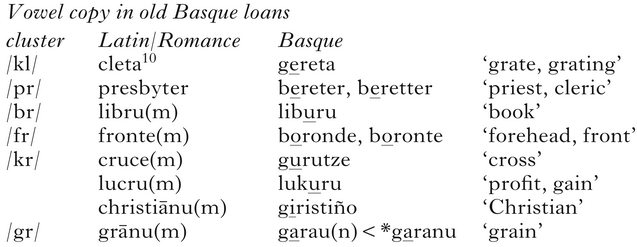
We suggest that the vowel-copy strategy seen in (6) is the consequence of direct borrowing from local Late Latin varieties (Väänänen Reference Väänänen1963) into Common Basque. Since Basque did not allow initial consonant clusters, perceptually driven epenthesis applied, leading Basque speakers to hear and produce OR clusters as OVR sequences. As a consequence, Romance loans beginning with #ORVi were borrowed with initial #OViRVi sequences, and non-initial clusters were also resolved by epenthesis, as in liburu < libru(m).
After centuries of close contact and bilingualism, the situation was different.Footnote 11 Basque speakers were familiar with the source Romance languages, and both /Or/ and /Ol/ clusters began to be borrowed intact, with no evidence of obstruent loss or vowel copy. Basque words of this kind from different sources are shown in (7).
-
(7)

Nevertheless, for unfamiliar words the strategy of vowel copy continued for /Ol/ clusters into modern times. Since the loans in (8) postdate intervocalic *l > /r/, they show /l/ from the loan source.
-
(8)

Artiagoitia (Reference Artiagoitia, Hualde and de Urbina1993) suggests that the borrowings in (6)–(8) belong to different strata. First, Late Latin loanwords are adapted with epenthesis of a copy vowel in the case of /Or/ clusters, and with stop deletion in the case of initial /Ol/ clusters (though see our alternative analysis below). Later, Romance /Ol/ clusters are adapted with vowel insertion instead of obstruent deletion, as in the examples in (8), thus using the expected repair method in all OR clusters. Lastly, Basque has more recently not only borrowed these clusters unaltered, as shown by (7), but has also created new clusters by means of metathesis, as in the adaptation of loanwords such as Sp. turco ‘Turkish’, terco ‘stubborn’, taberna ‘tavern’ (> Basque truku, treku, tramena) (Egurtzegi Reference Egurtzegi2014).
Artiagoitia (Reference Artiagoitia, Hualde and de Urbina1993: 285) proposes that the phonotactic constraint against syllable-initial clusters ends after the Middle Ages. He observes that the first attested Basque texts from the 16th century show variation in words such as regla [erregla] and regela [erregela], found in Leizarraga (cf. Michelena Reference Michelena1976). Nevertheless, borrowings from the second half of the Middle Ages such as Ingalaterra ‘England’, and even the 19th-century borrowing bizikeleta ‘bicycle’, show adaptation by insertion of a copy vowel in an /Ol/ cluster. We conclude that loan strategies reflect both Basque phonotactic constraints and the degree of familiarity with loanword phonology, often paired with multilingualism.
3 Borrowed /ʎ/-initial words in Basque
With this as background, we can now review the strange behaviour of the initial OR clusters in (5), where the second member of the cluster is /l/ in the Romance loan source. We suggest that the apparent loss of the initial obstruent is just that, apparent. These Basque words were not borrowed directly from Latin, but from Romance languages on the Iberian peninsula that had undergone a well-documented sound change involving palatalisation of inherited /Ol/ clusters. Under our reanalysis, the Basque word-initial laterals in (5) are nativised versions of palatal laterals in the source words.
The Romance palatalisation of laterals in initial #/Ol/ clusters has been widely discussed (cf. Lausberg Reference Lausberg1956–62, Menéndez Pidal Reference Menéndez Pidal1968: 126, Otero Reference Otero1971: 309, Hartman Reference Hartman1974: 161, Reference Hartman, King and Maley1985, Tuten Reference Tuten2003, Penny Reference Penny2002, Schmeiser Reference Schmeiser2009). We view this regular sound change as having two distinct phases. First, the lateral in Latin/Romance #Cl clusters was produced with heavy palatalisation, as [ʎ] (9a).
-
(9)

This stage may be in evidence in Aragonese, where we find, for example, pllou [pʎow] ‘it rains’ (cf. Lat. pluvia), cllau [kʎaw] ‘key’ (Lat. clāvem), and, in some varieties bllanco [bʎanko] ‘white’, bllat [bʎat] ‘wheat’, glloria [gʎoria] ‘glory’.Footnote 13 Subsequent to this palatalisation, in some languages, for example Galician, delateralisation and coarticulation within the cluster resulted in neutralisation of all these initial clusters to a palatal consonant.Footnote 14 In Castilian the output was /ʎ/ (9b.i), while in Galician-Portuguese it was an alveopalatal affricate (9b.ii). We propose that the sound change in (9a) took place after voiceless and voiced obstruents, though many scholars argue that in Hispano- and Luso-Romance only /kl pl fl/ were affected (Repetti & Tuttle Reference Repetti and Tuttle1987). A further question is whether the sound change was regular or not (Malkiel Reference Malkiel1963–64). We discuss the status of Early Romance /bl/ and /gl/ below. For the purposes of this analysis, all that is important for Romance /kl pl fl/ is that there is some plausible source of borrowing showing palatalisation or cluster reduction in the specific lexeme in question.
-
(10)

(10) shows cases with both lateral palatalisation (9a) and cluster simplification (9b). Note that no Latin /bl/ clusters are exemplified in (10). This is because Romance forms like Aragonese bllanco [bʎanko] and bllat [bʎat] are generally assumed to be loans from Gallo-Romance, with these /bl/ clusters ultimately a consequence of contact with Frankish or other early Germanic languages. Indeed, if olata (vs. oblāta) ‘offering of bread’ is eliminated from the class of old loans (see note 6), there are no Basque loans with initial /l/ from simplification of /bl/.
In contrast, only a weak case can be made for Early Romance #/gl/ > #/gʎ/. Though rare, Late Latin/Early Romance spellings with <gll> are attested. Outside of Aragonese, where this palatalisation is well described (see above), we find: a pre-1304 spelling <glloria> in a medieval Venetian text, reading <AUtissimo Re pare de glloria…>; a 1351 gold quarter-noble coin of Edward II with the Latin inscription exaltabitvr in glloria, where <ll> is described as a typographical error; and a 15th-century Venetian manuscript with the phrase <Exurge glloria Venetorum>. Given the high frequency of Latin gloria (and forms derived from the same root) in religious texts, it is possible that this word may have taken on a standardised spelling, with palatalisation rarely transcribed for Late Latin and Early Romance. Independent of palatalisation, the position that Latin initial /gl/ clusters did undergo /g/-loss in at least some Ibero-Romance languages is widely held, and follows Menéndez Pidal (Reference Menéndez Pidal1968: 127), who provides the following examples: glandula > landre; *glirōne > lirón; glattire > latir; globellu > (el) *lovillo > el ovillo. If /g/ was lost without lateral palatalisation, this must be seen as a sound change independent of (9a) and (9b.i), and Basque loria ‘glory’ could be a direct loan from Romance after this sound change. In either case, a form occurs in Early Romance that can give rise to Basque loan forms without positing #OR > R cluster reduction in Basque loanword phonology.
If we now return to (5), we see that the simplest explanation of the apparent obstruent loss is direct borrowing from a Romance language like Castilian that underwent the regular shift of Latin #/Ol/ > #/Oʎ/ > #/ʎ/. The pathways we suggest are shown in (11).
-
(11)

The palatal lateral is borrowed in these early loans as Basque /l/, not /ʎ/ or /j/, for two reasons. First, at the time of borrowing, neither /ʎ/ nor /j/ existed as contrastive phonemes in the language, but /l/ did.Footnote 15 Common Basque, which Michelena (Reference Michelena1981) dates to the 5th–6th century, did not have contrastive /ʎ/. From the time of Common Basque onward, palatalised or palatal laterals arose from three distinct sources: (i) internal to Basque, palatalisation occurred after /i/; (ii) it also occurred as a morphological marker of diminutive sound-symbolic forms (Oñederra Reference Oñederra1990); and (iii) a final source was (later) contact with neighbouring Romance languages that had this sound. If our hypothesis above is correct, the evolution of palatalised laterals in Basque must have occurred after these loans came into the language, otherwise we would expect initial palatal laterals at this stage of Basque as well.Footnote 16 A second reason that Romance /ʎ/ was borrowed as /l/ is that this was, arguably, the perceptually closest matching phoneme in Basque at the time. Common Basque and its early descendants had only a single lateral /l/, and no palatal consonants. The borrowing of Romance /ʎ/ as Basque /l/ at this time can be compared to similar loan patterns in the Americas. For example, in Kaqchikel (Adell Reference Adell2014), colonial Spanish words, which, according to Canfield (Reference Canfield1981), were still pronounced with /ʎ/ are borrowed as /l/, despite the fact that the consonant inventory of Kaqchikel does have the palatals /j/ and /∫/: kaxlan < castellano ‘Spanish’, kuchila < cuchillo ‘knife’, lawe, law < llave ‘key’, xila < silla ‘chair’.
One implication of this analysis is that Romance forms like *ʎore ‘flower’ and either *loria or *ʎoria ‘glory’ existed on the Iberian Peninsula close to Basque-speaking regions. The absence of palatalised forms in modern Castilian and Galician may reflect borrowing directly from Latin after the palatalising sound change took place.
4 Summary
In this paper we have argued that initial obstruent loss in (5) is only apparent. These lateral-initial words were borrowed directly from Romance languages that themselves had undergone palatalisation and simplification of Latin #/Ol/ clusters. Evidence for this includes the distinct behaviour of direct loans from Latin, the absence of #/Or/ clusters in this category, the typological rarity of a loanword process of this type and the lack of phonetic explanation for the sound pattern. Distinct patterns of loanword nativisation are related to the degree of contact between Basque and the source language. Epenthetic vowels break up clusters when speakers are less familiar with the source language, while clusters are adopted intact when the language or particular lexical item is familiar. We should not be surprised that for some words, e.g. gurutze ‘cross’ (< Latin crucem), we find a wide range of variants, including krutze, grutze and kurtze, with metathesis. The form with vowel epenthesis would be arguably the earliest borrowing, at a time when Basque speakers had not been exposed to much LatinFootnote 17 or to Christianity, while the cluster-initial forms may reflect a later period, when these sound patterns had become more familiar through intensive contact with Latin and other Romance languages. Indeed, a re-evaluation of many Basque words thought to be Latin loans may reveal that they reflect loans from descendant Romance languages.
The analysis proposed above is highly language-specific, and cannot be extended to the Finnish or Ch'ol loanword data discussed earlier, which are representative of more widespread patterns within Uralic and Mayan respectively. However, with the Basque examples of ‘obstruent loss’ essentially eliminated, future study of Uralic and Mayan should bring us closer to understanding the specific conditions under which the role of sonority in cluster resolution is inactive, and to a general theory of the kinds of transformations that can occur when words of one language are adopted naively by speakers of another.


