INTRODUCTION
Sea chubs (Kyphosidae) are diurnal herbivore fish (Choat et al., Reference Choat, Robbins and Clements2004), occurring worldwide in tropical and temperate seas (Nelson, Reference Nelson1994). Their morphology, suited for consumption of algae (Clements & Choat, Reference Clements and Choat1997), is rather uniform with only subtle variations among species (Humann, Reference Humann1994). After several taxonomic revisions (e.g. Sakai & Nakabo, Reference Sakai and Nakabo1995, Reference Sakai and Nakabo2004), 12 valid species are ascribed to the genus Kyphosus (Eschmeyer, Reference Eschmeyer2013), plus a new species (K. gladius) recently described from Western Australia (Knudsen & Clements, Reference Knudsen and Clements2013).
In the Mediterranean Sea, two species of Kyphosus have been recorded so far, namely K. incisor (Cuvier, 1831) and K. sectatrix (Linnaeus, 1758), both native of the Atlantic Ocean (Santos et al., Reference Santos, Porteiro and Barreiros1997). Mediterranean occurrences of K. sectatrix, often reported under the not valid names of K. saltatrix or K. sectator, have been reported since the 19th Century (Döderlein, Reference Döderlein1884) from the western and central sectors of the basin (e.g. Tortonese, Reference Tortonese1975, Reference Tortonese, Whitehead, Bauchot, Hureau, Nielsen and Tortonese1986; Sgano, Reference Sgano, Fisher, Bianchi and Scott1981; Quignard & Tomasini, Reference Quignard and Tomasini2000; Ligas et al., Reference Ligas, Sartor, Sbrana and De Ranieri2011; Kiparissis et al., Reference Kiparissis, Loukovitis and Batargias2012; Lelong, Reference Lelong2012). By contrast, K. incisor has been recorded only once in the Mediterranean, in concomitance with the capture of two individuals at Camogli (Ligurian Sea) in July 2009 (Orsi Relini et al., Reference Orsi Relini, Costa and Relini2011). The species is originally distributed in the western Atlantic from New England, including Bermuda, throughout the Caribbean, and extending southward to Brazil and in the eastern Atlantic, mostly from off northern Africa (Tortonese, Reference Tortonese, Whitehead, Bauchot, Hureau, Nielsen and Tortonese1986; Carpenter, Reference Carpenter and Carpenter2002). Its biology and ecology are poorly known (Randall, Reference Randall1967; Silvano & Güth, Reference Silvano and Güth2006).
MATERIALS AND METHODS
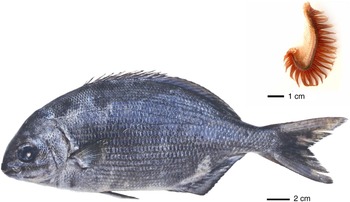
In June 1998, one specimen of Kyphosus incisor (Figure 1) was captured off Almuñécar (Granada, Spain: 36°43′26″N 3°41′25″W) by trammel net. The individual was photographed and then kept frozen within a labelled plastic bag. In November 2012, it was defrosted, weighted and identified on the basis of both meristic and morphometric characters, which were taken following standard procedures, used in other descriptions of sea chubs (Sakai & Nakabo, Reference Sakai and Nakabo1995; Carpenter, Reference Carpenter and Carpenter2002; Orsi Relini et al., Reference Orsi Relini, Costa and Relini2011). Thereafter, the specimen was fixed in formalin and deposited in the Marine Fauna collection (CFM) of the Instituto Español de Oceanografía (IEO) of Málaga with the access number CFM_IEOMA: 2641. Sex and maturity could not be established because of poor condition of internal organs after the prolonged period of freezing. Interviews with local fishermen were conducted in 2012 to assess if other sea chub specimens were captured in the same area.
Kyphosus incisor captured in June 1998 off Almuñécar (Granada, western Mediterranean Sea): on the right the first gill arch.

RESULTS AND DISCUSSION
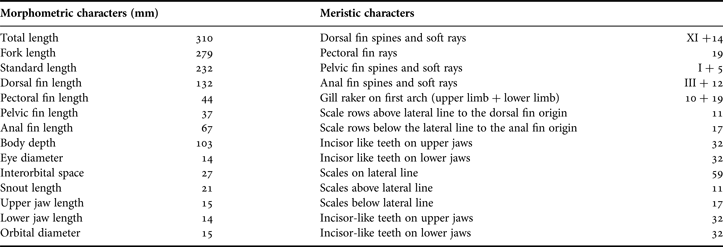
The specimen was of 452 g total weight. It is described as follows: oval shaped body, head short, mouth small and horizontal. Head profile in front of eye gently convex. Each jaw was provided with a regular row of close-set incisor-like teeth. Scales are ctenoid, moderately small. Colour was dorsally grey to silvery on the belly. Meristic and morphometric characters are presented in Table 1. All features fitted well with the description of Kyphosus incisor available in the literature (Tortonese, Reference Tortonese1975, Reference Tortonese, Whitehead, Bauchot, Hureau, Nielsen and Tortonese1986; Sgano, Reference Sgano, Fisher, Bianchi and Scott1981; Carpenter, Reference Carpenter and Carpenter2002) and with the description provided for its first Mediterranean record (Orsi Relini et al., Reference Orsi Relini, Costa and Relini2011). Kyphosus incisor differs from the congeneric K. sectatrix by a number of key characters such as the anal fin with 12 or 13 soft rays; 19 to 22 gill rakers on the lower limb of first gill arch, and the gently convex head profile in front of eye (Carpenter, Reference Carpenter and Carpenter2002). Indeed K. sectatrix has anal fin usually with 11 (rarely with 10 or 12) soft rays; 16 to 19 (rarely 19) gill rakers on the lower lobe of first gill arch and a head profile typically with a distinct bump (Carpenter, Reference Carpenter and Carpenter2002). Interviews with fishermen revealed that sea chubs were occasionally fished in the area. Unfortunately, given the similarity between K. incisor and K. sectatrix, we could not get further information at the level of species.
Morphometric and meristic characters of Kyphosus incisor (total weight 452 g) captured in June 1998 off Almuñécar (Granada, western Mediterranean Sea).

Noteworthy, the Almuñécar specimen was stored in the freezer for 15 years before being identified by the present study. Therefore, this old record precedes the observation of Orsi Relini et al. (Reference Orsi Relini, Costa and Relini2011), setting the date of the first Mediterranean record of K. incisor back to 1998.
Kyphosus incisor and K. sectatrix are inshore species, but they can also occur offshore under floating objects or following ships, the reason why they are often called rudderfish (Nelson, Reference Nelson1994). This behaviour could help sea chubs to move/disperse over large distances and eventually to enter the Mediterranean Sea through the Strait of Gibraltar. So far, most of the Mediterranean records of sea chubs were related to isolated specimens but some evidence would suggest that K. sectatrix has established a permanent population along the Algerian coasts (Hemida et al., Reference Hemida, Kanoun, Golani, Ben Souissi, Guelorget and Capapé2004). Recently, Kyphosus sectatrix has also been recorded in Portugal, off the Galician coast and in the Bay of Biscay, northward of its previous distribution limit in the Atlantic European waters (Canas et al., Reference Canas, Vasconcelos, Lino and Santos2005; Quéro et al., Reference Quéro, Spitz, Vayne, Auby, De Casamajor, Leaute, Marie, Monhurel and Quinquis2009; Bañón et al., Reference Bañon, Villegas-Ríos, Serrano, Mucientes and Arronte2010). As argued by Orsi Relini et al. (Reference Orsi Relini, Costa and Relini2011), fish of the genus Kyphosus are relatively large and easy to identify, so we can assume they are properly monitored in the Mediterranean, but a detailed examination of some morphological characters is needed to distinguish K. incisor from K. sectatrix. As for other tropical and subtropical fish that have recently expanded their latitudinal ranges, the occurrence of sea chubs should be actively surveyed because of their importance to indicate large-scale changes in the marine environment (Azzurro et al., Reference Azzurro, Moschella and Maynou2011). Considering the paucity of Mediterranean herbivorous fish in the central and western sectors of the Mediterranean (Azzurro et al., Reference Azzurro, Fanelli, Mostarda, Catra and Andaloro2007), low levels of competition with resident fish are envisaged.
To the best of our knowledge no further observations of K. incisor have been reported since 2009 (Orsi Relini et al., Reference Orsi Relini, Costa and Relini2011) and this species should be considered as ‘not established’ in the Mediterranean Sea. Nevertheless, the ability of sea chubs to travel over large distances and their thermophilic character could in the future facilitate the naturalization of K. incisor in the Mediterranean, contributing to those changes in species distribution and assemblage composition (Albouy et al., Reference Albouy, Guilhaumon, Araújo, Mouillot and Leprieur2012) which are now facing this sea under a warming climate.
ACKNOWLEDGEMENT
Thanks are expressed to the Instituto Español de Oceanografía of Málaga, for their help with morphological analysis.
FINANCIAL SUPPORT
This research received no specific grant from any funding agency, commercial or not-for-profit sectors.